Introduction
Individual decision making is important in health seeking because it allows a choice between several alternatives. If the choice is to seek care, then several options could be made on where and when to seek care. Utilization of health services is one measure of decision making and health-seeking behaviour (Andersen, Reference Andersen1995). For example, in Uganda there is poor access to, and utilization of, HIV prevention interventions despite a high burden of HIV/AIDS infection, currently estimated at 6.5% (Uganda Bureau of Statistics, 2006). Recently it has been reported that only 28% of pregnant women in Uganda receive HIV counselling during antenatal care (ANC) and 6% are tested for HIV (Ministry of Health & Macro International, 2006).
Poor access to, and utilization of, PMTCT services prevails in Uganda, yet PMTCT is an important HIV prevention strategy. This is because HIV infection in women has direct implications for the burden of disease among children. It is estimated that 21% of HIV transmission in Uganda is due to mother-to-child transmission (McConnell et al., Reference McConnell, Bakaki, Eure, Mubiru, Bagenda and Downing2007). Availability of HIV/AIDS prevention services is limited; and only 29% of the facilities in Uganda are able to offer HIV testing services. Further to this, only 28% of facilities provide any of the components of PMTCT services; while even fewer (15%) provide a full package as described in the PMTCT policy guidelines (Ministry of Health & Macro International, 2008). Thus alternative delivery modes of PMTCT are urgently required. The components of PMTCT in Uganda include: (1) primary prevention of HIV (HIV counselling and testing); (2) family planning (contraceptives and dual protection methods); (3) reduction of PMTCT with anti-retroviral (ART) drugs (HIV counselling and testing, infant feeding options, appropriate maternal nutrition, anaemia prophylaxis, malaria prevention); (4) care and support of women and their families to provide ARVs and cotrimoxazole (Ministry of Health, 2006).
Previous analyses on HIV/AIDS infection in Uganda have shown regional, age and gender distribution. HIV prevalence in Uganda is highest among women aged 30–34 years, married couples and people in the highest wealth quintile (Ministry of Health & Macro International, 2006; Uganda Bureau of Statistics, 2006). However, analyses that relate decision making and access to PMTCT across socioeconomic, regional, gender, age and education sub-groups are lacking. Yet these analyses are useful in targeting HIV/AIDS treatment and prevention interventions and could help overcome inequitable access to, and utilization of, services.
It has been shown that health-seeking behaviour is influenced by beliefs about cause and transmission of disease; and these vary in different societies, cultures, education levels, and access to, and attitude of, health workers (Ruebesh et al., Reference Ruebush, Kern, Campbell and Oloo1995; McCombie, Reference McCombie1996; Ahorlu et al., Reference Ahorlu1997; Heggenhougen et al., Reference Heggenhougen, Hackenthal and Vivek2003; Mbonye et al., Reference Mbonye, Neema and Magnussen2006; Chamberlain et al., Reference Chamberlain, Watt, Mohide, Muggah, Trim and Bantebya-Kyomuhenda2007). In this study, barriers to seeking PMTCT have been conceptualized based on a model designed by Andersen (Reference Andersen1968), and modified by the International Collaborative Study on Health Care (Kohn & White, Reference Kohn and White1976). The model classifies factors that influence care seeking into three categories. The first category is composed of predisposing demographic characteristics: household/family composition and education levels. The second category consists of enabling factors, which include accessibility to health care, health insurance and income security. The third category consists of health system factors (like availability of health services) linked to a country's social and macro-economic system (Andersen, Reference Andersen1968, Reference Andersen1995).
In order to address poor access to, and utilization of, PMTCT services in Uganda, a study has been designed with the main objective of examining the feasibility of involving the private sector in providing HIV testing and anti-retroviral drugs to pregnant women in Wakiso district. The intervention was structured into three phases. The first phase was a formative study; the second phase an intervention that aimed at training private midwives to offer HIV counselling and testing, family planning services and malaria prevention in pregnancy; while the third phase was an evaluation process that involved cost-effective analyses of the intervention. This article presents results from the first phase, which assessed care-seeking practices and barriers to seeking PMTCT. These data will help inform policy on how to increase access to PMTCT in Uganda.
Methods
Study area and population
The formative study was implemented in Wakiso district, central Uganda. The district has an area covering 2807 km2, bordered by Lake Victoria in the south, Mpigi and Mubende districts in the west, Luwero district in the north, and Mukono district in the east. Although the district is in the outskirts of Kampala, the capital city, most people (92%) live in rural areas (Uganda Bureau of Statistics, 2008). The total population of the district is 1,158,200 with an annual population growth rate of 4.1%. Wakiso district is inhabited by the Baganda, an indigenous ethnic group whose main occupation is subsistence agriculture.
The district has poor access to health services with 34% of women delivering in health facilities and 43% of pregnant women receiving two doses of intermittent preventive treatment for malaria (Uganda Bureau of Statistics, 2008). The district was selected to implement the study because it has one of the highest HIV prevalence rates of 8% (Ministry of Health & Macro International, 2006).
Design of the formative research
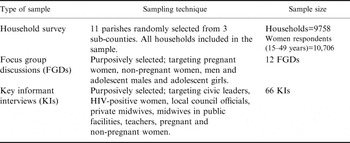
The formative study was conducted between January and April 2009 in parishes/clusters excluding those selected for the intervention study. A household survey was conducted targeting all households in eleven randomly selected parishes/clusters to collect data on household characteristics, socio-demographic characteristics and health-seeking practices for family planning, HIV/AIDS and other essential health services. Another questionnaire was designed to capture individual women's health-seeking practices. These tools were pre-tested and revised. During field work, questionnaires were checked for completeness and corrections made. The selected research assistants had completed an advanced level of education. They were trained for one week, part of which involved classroom lectures on interviewing techniques and role-plays and the rest was field work to familiarize them with the tools. The woman questionnaire was administered by female research assistants to avoid situations where, due to cultural considerations, women might feel uncomfortable discussing sexual issues with males. The data were supplemented by focus group discussions (FGDs) and key informant interviews (KIs), which explored patterns of care-seeking practices to PMTCT, and the constraints experienced in the study area. Key informant interviews targeted civic leaders, HIV-positive women, local council officials, private midwives, midwives in public facilities, teachers, and pregnant and non-pregnant women. The focus group discussions targeted pregnant women aged 20–49 years, non-pregnant women aged 20–49 years, men aged 20–55 years and adolescents aged 15–20 years. The participants were selected with the help of local council officials. This approach enabled data collection from a range of different people in order to get a broad picture for designing the intervention study (see Table 1 for a summary of data collection methods).
Description of surveys, sampling techniques and sample sizes

Data analyses
Data were entered into EpiInfo version 6.0 (CDC, Atlanta, GA, USA), cleaned and transferred to Stata version 8.2 (Stata Corp., College Station, Texas, USA). Univariate analyses were used to calculate proportions on variables of interest. Bivariate analysis was performed to study relations between variables that explain health-seeking practices. Comparisons between the decision maker (who makes the decision), wealth quintiles and background characteristics were done using Pearson's χ 2 test.
The sample size calculations for the survey were based on the ability of the study to detect a difference as small as 1% in the proportion of pregnant women accessing HIV testing services, estimated at 6% (Ministry of Health & Macro International, 2006), a power of 80% and a 5% level of significance. The minimum sample size targeted was 6472 women in the reproductive age group.
Qualitative data were analysed following guidelines described in Dawson et al. (Reference Dawson, Sanderson and Tallo1993). Tapes were transcribed in Luganda and later into English. Grid analysis was performed, responses were coded and themes identified. This was done for each FGD and the data compiled into a log book. Key informant data were analysed along the same thematic areas as FGD data to identify similarities and differences, and partly as a validation process. In this paper, FGD, KI and household survey data are thematically presented together in order to have enriched data to explain access to PMTCT and constraints experienced.
Computation of the wealth index
A proxy index for socioeconomic status of the household was computed using a number of household variables, namely: type of material used for the construction of the house roof, wall and floor; type of fuel used for lighting; type of material used for cooking; type of toilet facility; type of bathroom; type of kitchen; ownership of transportation assets; ownership of communication assets; and main source of information by the household. For each of these variables, a dummy variable that places the household in either the high or low socioeconomic class was generated. Subsequently, eleven dummy variables were pooled to generate a single proxy index for socioeconomic status of the household by taking an average score on the eleven variables. The index assumed values between 0 and 1. Finally, the pooled score was broken down into quintiles (lowest, second, middle, fourth and highest) to reflect the wealth ranking of each household relative to other households in the study population (Rutstein & Kierstein, Reference Rutstein and Kierstein2004).
Ethical approval
The study was approved by the Uganda National Council of Science and Technology (Reference: HS485). Verbal consent was obtained from all respondents who participated in the study.
Results
Background characteristics of respondents
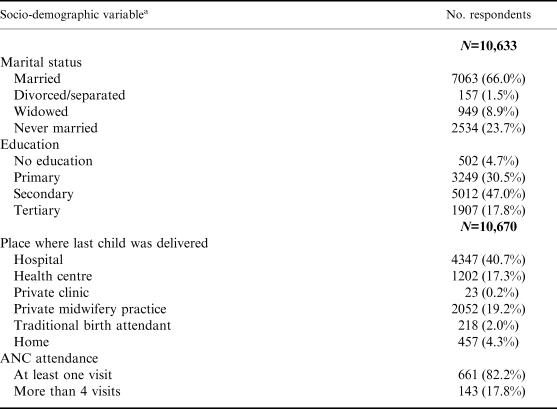
A total of 10,706 women were interviewed (100% response rate). Their mean age was 25.8 years (range 14–49 years) and the majority (7339; 69.0%) were aged between 20 and 34 years. Similarly, the majority of respondents (8619; 78.5%) attained primary education and 5012 (47.0%) attained secondary education. The majority of women (7063; 66.0%) were married (Table 2). Most respondents (4786; 57%) were in the lowest wealth quintile. Similarly most participants were involved in agriculture, a few in retail business, and the majority were housewives with no income-generating activities.
Distribution of respondents by socio-demographic variables
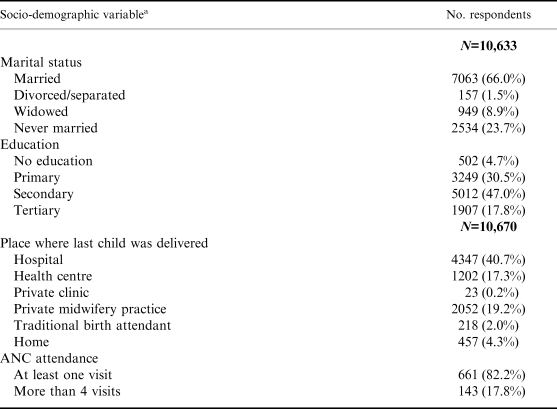
a Socio-demographic characteristics of respondents in the household survey.
Mean age of respondents, 25.8 years (range 14–49 years).
A total of twelve FGDs (one with adolescent girls, one with adolescent boys, two with men, two with pregnant women and six with non-pregnant women) were conducted involving a total of 123 participants composed as follows: 18 pregnant women, 67 non-pregnant women, 20 adolescents and 18 men. Thirty-three (27%) participants had attained some primary education, while 90 (73.2%) had attained secondary education and above. Most participants (72; 59%) were married while 50 (41%) were single and one participant was separated. Adolescents were aged 15–20 years, while women were aged 20–46 years and men 25–52 years.
Access to, and utilization of, family planning services
Analyses identified the following thematic areas concerning access to, and utilization of, family planning and PMTCT services by private midwives: access, costs, trust, confidentiality, equity and barriers to seeking care. Over three-quarters of respondents agreed that private midwives would increase access to services if they were more trained on PMTCT and provided with supplies. The basis for this was that some pregnant women already visited private midwives and other women could benefit from these services if they were subsidized. One respondent at an FGD at Gayaza remarked that this intervention would help women who have difficulty in accessing family planning: ‘With this intervention, the women can access family planning better and be able to plan the number of children they produce.’
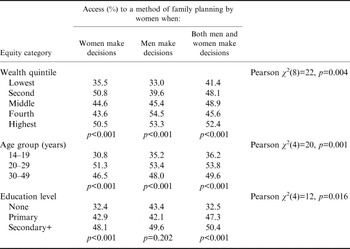
A total of 5410 women and men (household survey) were asked about decision making on access to essential services. Overall, 2319 (42.9%) of women made decisions on their own to access various services. Six hundred and forty-two (11.9%) men made decisions for their spouses to access PMTC, while 2449 (45.3%) of women and their spouses made decisions together (data not shown). Decision making and access to family planning were mostly influenced by wealth quintile, age group and level of education a woman had attained. Women in the lowest wealth quintile, young women and those with less education were least likely to use family planning, even when they made their own decisions (Table 3). Overall, use of family planning was higher when both men and women make decisions together. This was the case among wealth quintiles (p=0.004), age groups (p=0.001) and women's education level (p=0.016) (Table 3). The lowest use of family planning was when men made decisions for their spouses.
Decision making and access to family planning services

Access to, and utilization of, HIV testing services
Of all the women (pregnant and non-pregnant) surveyed, the majority (7810; 73.0%) had ever tested for HIV through different outlets; while of the 1232 women who were pregnant, 999 (81.1%) had tested for HIV. Most women (4404; 57.0%) received HIV testing from hospitals, 1347 (17.4%) from health centres, 744 (9.6%) from private clinics and 608 (7.8%) were tested by private midwives. Most clients in the study area received other services from public hospitals and health centres. Nevertheless, the private health sector (private clinics, private midwives and drug shops) provide a substantial proportion of services. Currently, private midwives provide 7.8% of HIV testing, 8.6% of family planning and 7.6% of ARVs (data not shown).
HIV prevalence in the study sample was calculated based on the rate of 8% reported in the central region where Wakiso is located (Ministry of Health & Macro International, 2006). Out of a total sample of 10,706 women surveyed, 857 were expected to be HIV positive. With only 237 on ARVs (27.7%), access to HIV/AIDS treatment in the study area was poor.
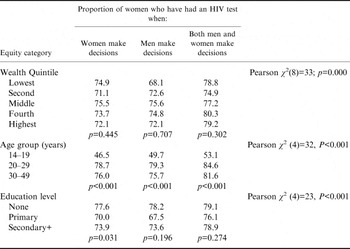
Table 4 shows that there were no statistical significant differences in decision making across the wealth quintiles for women who had an HIV test. This is because the majority of women in the study area had ever been tested for HIV through routine antenatal care. However, young women and the less educated were less likely to have had an HIV test. Overall, the likelihood of having had an HIV test was higher when both men and women make decisions together. This was the case among wealth quintiles (p<0.001), age group (p<0.001) and education level a woman had attained (p<0.001) (Table 4). As earlier noted for family planning, the lowest use of HIV testing was when men made decisions for their spouses.
Decision making and access to HIV testing services

Participants in all the FGDs reported that most women take the initiative to have an HIV test, unlike men who fear to know their HIV status. Women reported that men engage in unsafe sex and are not sure of their HIV status. However, in all the women FGDs it was noted that HIV testing has been made compulsory for pregnant women who go for antenatal care at any health facility. One respondent at Nansana trading centre noted as follows: ‘it is forced, you don't decide for yourself’. Another respondent at Gayaza noted as follows: ‘These days there is no deciding for yourself. During pregnancy, HIV testing is compulsory, so you don't decide yourself but it is a must. So the health workers decide for us. This happens at Mulago hospital and in all health centres’. Compulsory HIV testing was seen as a constraint for some women to use services at health facilities.
In FGDs with adolescents, it was reported that parents decide for them, as indicated in these quotes. ‘My parents made the decision for me to go and test because I was falling sick all the time.’
In five FGDs with women and two with men it was reported that sometimes both men and women decide to go for an HIV test, as indicated in this quote: ‘Sometimes it is between the man and woman for purposes of knowing their HIV status; but it is usually women who decide because men fear to test.’ Another respondent in Entebbe trading centre said that ‘…these days some churches demand an HIV test before you get married’. In this case the decision to go for an HIV test is influenced by an institution. The findings on decision making and HIV testing were confirmed by data collected through KIs.
Access to delivery care
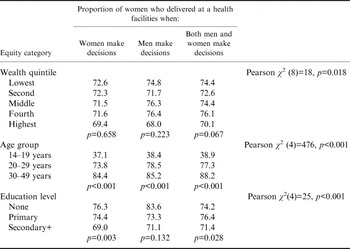
Women respondents were asked the place where they delivered their last child. Most women (4347; 40.7%) delivered in hospitals, 1202 (11.3%) at health centres, 23 (0.2%) at private clinics and 2052 (19.2%) at private midwifery practices (Table 2). Decision making and how it affected where a pregnant woman delivered was assessed. Age group and education levels were the two factors that influenced decision making and where a woman delivered. Young women were less likely to deliver at health facilities when they made decisions alone compared with older women (p<0.001); while women with no education were more likely to deliver at health units if they were empowered to make their own decisions (p=0.003). Women in the lowest wealth quintiles were more likely to deliver at health facilities if they were empowered to make decisions on their own, although this was not statistically significant (Table 5). Overall, decision making influenced delivering at a health facility. This was the case among wealth quintiles (p=0.018), age group (p<0.001) and the education level a woman had attained (p<0.001), (Table 5). We note that men's decisions influence place of delivery, especially for those in the lowest wealth quintiles, young women, and those with lower education (Table 5).
Decision making and access to delivery care at health facilities

Discussion
The results from the present study show that decision making is important in accessing family planning, HIV testing and delivery at health units. Decision making is influenced by socioeconomic status (wealth quintiles, education levels), age, individual and institutional practices influence access to PMTCT services. In most cases, when both women and men make decisions, access to care is higher than when women make decisions alone. Similarly, when men make decisions for their spouses to seek care, access to HIV and family planning is low, except for deliveries at health units. Other factors that influence access to, and utilization of, PMTCT include fear of women and male spouses to have an HIV test and the perception that HIV testing is compulsory in ANC clinics. Using Andersen's model (Andersen, Reference Andersen1968), the following were facilitating factors to accessing PMTCT: women and men making decisions together for health seeking, women empowered to make their own decisions, wealthy households, older women and those with high education levels; while barriers were: men making decisions for their spouses to seek care, poor households, young women, low education levels, negative perceptions of HIV testing and fear that HIV testing is compulsory in ANC clinics.
Lack of support and poor decision making by male spouses for prevention of malaria in pregnancy has been documented previously in central Uganda (Mbonye et al., Reference Mbonye, Neema and Magnussen2006). Similarly, access to HIV testing among males has been found to be poor in south-western Uganda due to stigma and lack of confidentiality (Bwambale et al., Reference Bwambale, Ssali, Byaruhanga, Kalyango and Karamagi2008). However, in a recent study, male spouse negotiations and decisions on use of microbicides for HIV prevention were useful, and provided opportunity for intimate communications, and building trust (Montgomery et al., Reference Montgomery, Lees, Stadler, Morar, Ssali and Mwanza2008). Based on the results, recommendations have been made to provide information to people and facilitate decision making and appropriate responses for care seeking (Golooba-Mutebi & Tollman, Reference Golooba-Mutebi and Tollman2007).
Previous analyses on equity in health interventions have shown disparities among socioeconomic groups, with people in the lowest wealth quintile having a higher burden of disease (Ruebesh et al., Reference Ruebush, Kern, Campbell and Oloo1995; McCombie, Reference McCombie1996; Ahorlu et al., Reference Ahorlu1997; Heggenhougen et al., Reference Heggenhougen, Hackenthal and Vivek2003). But these studies have noted methodological challenges to measuring the socioeconomic groups on which to compare health outcomes. The most direct measures of socioeconomic status are income, expenditure and consumption levels, but data on these variables are exceedingly rare. Therefore proxy measures using household assets are commonly used. In this present article, a composite indicator based on household ownership of assets was used as a socioeconomic indicator. The results are comparable to analyses in the recent Uganda Demographic and Health Survey (Uganda Bureau of Statistics, 2006). The survey showed that use of family planning, ANC and institutions for delivery were lowest among women in the lowest wealth quintile (Uganda Bureau of Statistics, 2006).
The definition of equity contains some elements of fairness and distribution of resources (Mooney, Reference Mooney1983). For the present study, equity to PMTCT was defined as utilization of existing PMTC services. In order to utilize a particular service, a client must access it. Anderson (Reference Andersen1995) categorizes access into two: potential access defined as the presence of enabling resources, and realized access as actual use of services (Andersen, Reference Andersen1995). The present study shows that equity to PMTCT was influenced by wealth of the household, age and education attained by the clients. In order to increase equity to PMTCT services, policies that address poverty reduction and access to education are important. These data should provide a platform for policy discussions with sector ministries like those of finance, education and gender to draw up actions on how best to reach the poor with PMTCT and other services. This would provide a strong basis to allocate more funds to improve the quality of education, especially universal primary and secondary education.
One of the policy options is to empower women to make decisions and to have several delivery outlets to enable free choice and access to family planning and HIV testing services. Similarly, service providers should be equipped with skills to offer quality services (appropriate counselling, managing side-effects and offering explanations to clients) so that women can make free choices. For the intervention study, private midwives will be trained to focus on the above areas.
Since men's decisions are important in seeking care for their spouses, novel interventions to encourage men to discuss and support their spouses to seek care are recommended in future studies. One of the ways proposed for the intervention study (second phase of the study) following these formative results is to train community health workers to initiate dialogue between women and their spouses using well designed education materials.
The immediate policy actions to address barriers to PMTCT like fear of HIV testing and the perception that HIV testing is compulsory in ANC clinics is to widely disseminate the policy on HIV testing, which emphasizes voluntary counselling and testing of HIV (VCT) in Uganda. All health workers should be aware of this and give appropriate information to clients. Further implications of the results to the intervention are: to train private midwives in appropriate counselling so that pregnant women receive the correct information on HIV testing and its benefits. Private midwives will also be trained to encourage couple counselling so that they provide an extended package of PMTCT.
Acknowledgments
The authors would like to thank the District Director of Health Services Wakiso District, Dr Mukisa, and Mr Steven Kalake for their support during field work, and all people who participated in this study. They also thank Ms Charity Wamala and Jolly Namuddu for their help in qualitative data collection and analyses. The study was funded by a grant from The Bill & Melinda Gates Foundation through the Grand Challenges Exploration Initiative.