The coronavirus disease (COVID-19) pandemic has strained public health infrastructure across America and has disproportionately impacted disadvantaged and racial minority populations. Reference Bambra, Riordan, Ford and Matthews1–Reference Brakefield, Olusanya, White and Shaban-Nejad4 The Memphis metropolitan area has historically faced wide health outcome disparities that were susceptible to further worsening during the pandemic. 5–7 The lack of an integrated population health data platform has hampered a timely collection of COVID-19 testing data to guide population-level resource management to help those in greatest need of support.
This report describes the Memphis Pandemic Health Informatics System (MEMPHI-SYS), a novel multidisciplinary initiative which broadly leverages academic talent to coordinate assembly and analysis of COVID-19 testing data across safety-net providers in the Memphis metro region. MEMPHI-SYS delivers Web-based data access and analytic resources, shares leadership with the City of Memphis-funded COVID-19 testing program, and has been enlisted to inform publicly funded COVID-19 community intervention projects.
To provide context, in March 2020 the University of Tennessee Health Science Center (UTHSC) College of Medicine rapidly activated a large drive-through testing site and in-house diagnostic laboratory resources to make COVID-19 testing available and free of charge to the public. The City of Memphis directly funded this effort under contract with UTHSC and its clinical practice plan. This whole-campus effort, which included the full student body, is described below.
By May 2020, UTHSC had professionally staffed all of its testing sites and had partnered with other community-based health care providers to create a coordinated city-wide testing service sponsored by the City of Memphis. At that time, the authors of this manuscript jointly decided to create the MEMPHI-SYS COVID-19 testing data registry.
Methods and Results
Part 1. Establishing Community-Based COVID-19 Testing
In March 2020, following guidance from the American Association of Medical Colleges, junior and senior year students at the UTHSC College of Medicine were removed from the clinic due to COVID-19. Leaders at the College identified an opportunity to create a large-scale, community drive-through, COVID-19 testing site and solicited student participation. Student leaders were immediately tasked with organizing the site with clinical administrators, representatives from the Memphis Fire and Police Departments, and faculty members. Additional medical student volunteers underwent training in proper personal protective techniques, specimen collection/handling, and electronic health record (EHR)-based patient registration the following day, allowing the testing site to open within 72 hours of initial planning. Competencies and performance of all volunteers were monitored by faculty from the Department of Infectious Disease, and all facilities and operations were inspected and signed off by the Director of the UTHSC Research Safety Affairs Office. First responders (Police, Fire, and Emergency Medical Services staff) from the Memphis community were prioritized for testing during the first week of operations. Medical students served as the primary workforce for both the drive-through testing site and a scheduling call center, under direct supervision from faculty and house staff. By March 22, 2020, the site was fully operational and open to the public. It was operated by students and supervisors until June 1, 2020, when the site shifted to paid professional health care staff employed by the UTHSC practice plan. By this point, a second testing site had been opened in North Memphis on April 30, 2022. This coverage ultimately expanded to a total of 4 sites, which operated throughout the summer. In conjunction with the City of Memphis, operations were consolidated at a larger facility in East Memphis working in tandem with smaller clinical facilities across the metropolitan region. In all, the registry captured 74 041 tests from 61 110 individuals through April 7, 2021, at which point operations pivoted entirely from testing to vaccine administration given the wider availability of outpatient test sites and at-home testing. Several authors of this manuscript (DLS, AS, FT) have continued to serve on the City of Memphis and Shelby County COVID-19 Joint Task Force, as well as the City of Memphis Safety Net COVID-19 Committee, which is composed of representatives from community providers participating in city-funded COVID-19 testing for underserved neighborhoods.
All UTHSC testing sites required patients to use a smartphone-based chatbot appointment scheduler or to call a centralized phone line to register and report demographic information, COVID-19 exposure history, type of occupation (first responder, health care provider, frontline worker, other), and medical history highlights and risk factors for COVID-19 complications (diabetes, hypertension, etc). The chatbot was an off-the-shelf product customized and implemented by a third-party vendor (CareCognitics, Las Vegas, NV) in tandem with our clinical leadership team to interface with our native EHR system (NextGen Healthcare, Irvine, CA) and to streamline patient test self-scheduling. The combination of this mobile patient self-service registration platform with our centralized phone line option ensured a universal collection of key clinical and demographic characteristics, matched to COVID-19 test results for every individual. Our data collection and analytic process were formally reviewed and approved by the UTHSC Investigational Review Board (IRB# 20-07484-XM) as a minimal risk protocol not requiring patient consent). To ensure patient anonymity, an abridged data set, excluding all patient identifiers, was created in accordance to the Health Insurance Portability and Accountability Act (HIPAA) guidelines to make available to outside researchers upon completion of a Data Use Agreement as required under the HIPAA Privacy Rule.
Given the potential relevance of such data to public health, our group’s leadership reached out to population health and data science experts from the UTHSC College of Medicine and the University of Memphis, as well as community organizations providing community-based testing through the Safety Net COVID-19 Committee to secure test data transfers into our centralized registry database. MEMPHI-SYS has since represented a multidisciplinary collaboration of clinicians, data scientists, biostatisticians, geospatial mapping experts, community outreach experts, and behavioral health specialists, organized into specialty-specific teams, each with senior faculty leadership. We have drafted operating procedures for team meetings, research project approvals and assignments, regulatory compliance, and community outreach. Formal publications and grant funding submission committees supervise a transparent academic process, overseeing best practices for collaboration and data sharing. We have a formal community outreach leadership team. Civic-centered priorities, citizen access to data, community advocacy, and rapid dissemination of results are our guiding principles.
Part 2. Creation of the MEMPHI-SYS Data Registry
Our published work Reference Olney, Smith and Sen8 has described the effect of social distancing to slow down the spread of COVID-19 and associations between social determinants of health and health disparities in Memphis Reference Shin and Shaban-Nejad9–Reference Shin, Mahajan, Akbilgic and Shaban-Nejad11 . We have employed a knowledge-based approach Reference Shaban-Nejad, Lavigne, Okhmatovskaia and Buckeridge12 to integrate social determinants of health (SDoH) data with health data sources (eg, EHRs).
The informatics backbone of MEMPHI-SYS is a COVID-19, knowledge-based surveillance platform Reference Brakefield, Ammar, Olusanya and Shaban-Nejad13 housed at UTHSC to survey regional COVID-19 epidemiology, identify at-risk populations, and address risk reduction strategies for vulnerable communities. Current and planned data science capabilities include the following:
-
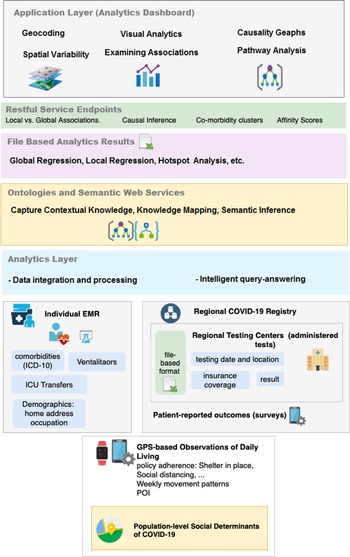
1. Design and implementation of an “Urban Population Health Observatory” (UPHO) Reference Brakefield, Ammar, Olusanya and Shaban-Nejad13–Reference Brakefield, Ammar and Shaban-Nejad15 —an integrated multimodal and multi-dimensional (clinical, social determinants, environmental, etc) knowledge-based system (Figure 1) empowering large-scale population health surveillance. This platform consists of several distributed data sources, including neighborhood level data sourced from local community data partners such as the Memphis Property Hub, 16 national consumer data providers, 17 the Centers for Disease Control 500 Cities Project data set, 18 private third-party data sources such as PolicyMap, 19 IBM MarketScan 20 and/or the Environmental Systems Research Institute, 21 and publicly available US Census data. 22
Figure 1.Schematic representation of the UPHO knowledge-based surveillance platform. Different data types are integrated within the UPHO environment to facilitate rapid evidence-based decision, leveraging a tiered informatics architecture that incorporates semantics, applications, analytics, and data layers.

-
2. An immediately accessible, continuously updated analytics layer to identify individuals and groups at risk for COVID-19 infection and morbidity, while enumerating spatiotemporal and social factors associated with elevated risk. As an integral part of UPHO, the analytics layer is also responsible for data processing and query-answering.
-
3. Open, HIPAA compliant access for health care providers, community partners, public officials, and other relevant stakeholders to aggregated data through an intuitive graphical user interface that can be effectively used by different types of users, with different levels of expertise and requirements. Several use-case scenarios have been demonstrated Reference Brakefield, Ammar, Olusanya and Shaban-Nejad13 to show how different users (including public health practitioners and policy-makers) can benefit from such a development.
-
4. An application layer and an intuitive public Web-based dashboard to identify and display geocoded data to visualize highly impacted neighborhoods, populations, and regions. This is scheduled to include an intervention evaluation and quality enhancement module Reference Brenas and Shaban-Nejad23,Reference Shaban-Nejad, Okhmatovskaia and Shin24 to permit stakeholders to see what specific health policy interventions could provide the largest return on investment.

Exploring transmission and wider health care impact of COVID-19 transmission across Memphis
As required by state and federal responses to the public health emergency, the Shelby County Health Department (SCHD) mapped case numbers by home zip code, aggregated to protect the privacy of individuals. While the SCHD collected detailed data from contact tracing about infected individuals, including self-reported information regarding work-related and social activities, no publicly published information has been available about specific traits of individuals and neighborhoods. County 25 and state 26 public health departments have also not published data specific to COVID-19 exposure history, preexisting medical issues, presenting symptoms, and/or high-risk occupation (first responder/health care worker status). The MEMPHI-SYS registry directly collected this information from each patient as part of test scheduling. Last, SCHD limited its scope to include only residents in Shelby County, TN. Our registry, on the other hand, contains individuals from the full Memphis Metropolitan Statistical Area including (1) Fayette, Shelby, and Tipton Counties in Tennessee; (2) Benton, DeSoto, Marshall, Tate, and Tunica Counties in Mississippi; and (3) Crittenden County in Arkansas.
Since MEMPHI-SYS has been directly linked to COVID-19 test collection, we have been positioned to correlate pandemic spread with demographic and social risk factor data. These include location of home residence, race/ethnicity, gender, age group, and profession (health care workers, essential/non-essential industries, etc), all of which can be potentially linked with fixed community resources and environmental conditions.
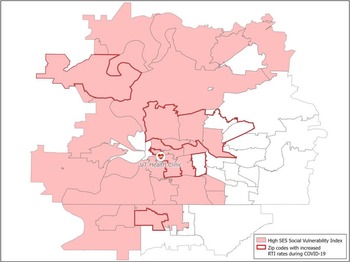
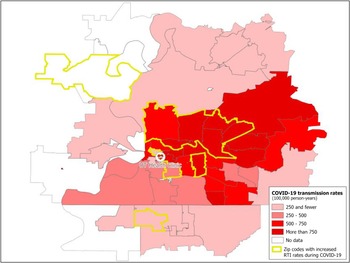
To give an example of how our COVID-19 testing data set can be correlated with social risk and other important health outcomes, we directly mapped individual COVID-19 test results with a seemingly unrelated health care delivery outcome, radiation cancer treatment interruption rates (defined as > 1 week interruption), across Memphis during the first year of COVID-19. Frequency of radiation interruption at our academic center was mapped at the level of cancer patient home zip code and stratified according to race and health insurance coverage status. Zip code-level Social Vulnerability Index 27 and COVID-19 case mapping were performed using data obtained from MEMPHI-SYS as well as the current subscription version of the national PolicyMap database. 19 Geographic distribution of elevated major treatment interruption rates shifted from baseline during COVID-19 to a limited number of residential zip codes downtown and directly north and south of the central urban corridor. Black race and “at-risk” insurance status co-localized with highest treatment interruption rates. Zip codes experiencing increased interruption rates during COVID-19 overlapped or approximated zip codes with high social vulnerability index scores (Figure 2a) and COVID-19 activity (Figure 2b). Standard population-level statistical analysis can fail to demonstrate these important geographic shifts in pandemic era-associated cancer treatment access disruption. Nonetheless, these associations were not perfectly predicted by neighborhood-level social vulnerability or pandemic activity. Some of the high treatment interruption zip codes were in higher-income (Eastern metro) regions or areas with relatively fewer COVID-19-positive tests (South-Central metro). Likewise, many Eastern suburban zip codes with higher rates of COVID-19 positive tests did not experience increased cancer treatment interruption rates. These findings signal that detailed localization of highest-risk communities could help focus cancer treatment access interventions during and after public health emergencies such as COVID-19.
Geospatial location of zip codes with increased rates of cancer radiation treatment interruption (RTI, outlined in red) rates during COVID-19 relative to zip codes with baseline high-risk socioeconomic (SES) social vulnerability index scores (colored in pink). The location of our home academic center is labeled UT Health Clinic.

Geospatial location of zip codes with increased cancer radiation treatment interruption rates (RTI, outlined in yellow) during COVID-19 relative to zip codes with high COVID-19 transmission activity (color-coded in red, shaded according to case rates/100 000) during the first year of the pandemic. The location of our home academic center is labeled UT Health Clinic.

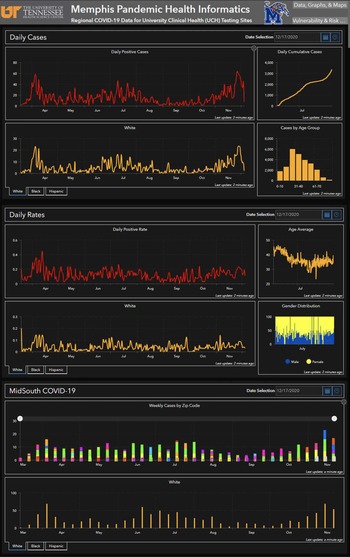
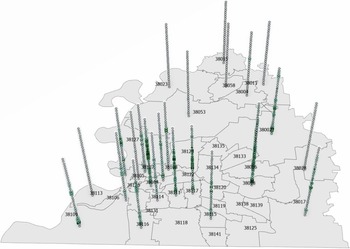
Our geoinformatics team has created GIS Web-based portals (Figure 3) to dashboard COVID-19 testing results. Figure 4 shows refinement of our data visualization in “space-time cube” format, allowing the evaluation of spatiotemporal data more clearly in time-series. The dashboard provides an interactive platform to explore COVID-19 testing results within the context of specific racial and socioeconomic demographic groups, neighborhood-level fixed resources, and other social health determinants. We have created time-enabled maps to reveal how infections spread through specific neighborhoods and populations, and where policy interventions could be targeted. COVID-19 disproportionately impacts certain demographics such as the elderly, racial and ethnic minorities, and those with underlying health conditions. Reference Brakefield, Olusanya, White and Shaban-Nejad4 Mapping social vulnerability, age, and the geographic distribution of various diseases and conditions, which are associated with susceptibility to COVID-19, would permit timely monitoring of highest risk populations for exposure and transmission. Reference Karmakar, Lantz and Tipirneni28 Finally, we are exploring whether communities with a higher density of racial and ethnic minorities had less testing and more confirmed COVID-19 cases relative to wealthier, white-majority communities. We can compare outbreak data with other location-based information (eg, locations of hospital and ICU beds, social vulnerability index, population density, percent of population age 65+, percent of population age 65+ in labor force, percent of population age 65+ living alone, percent self-identifying as non-white race, percent lacking health insurance coverage) to individualize community-level interventions and preventive activities. This could include correlation with fixed health care, social support, and commercial resources to understand mechanistic impact of metropolitan-level functions on COVID-19 transmission.
MEMPHI-SYS COVID-19 dashboard. The dashboard encourages real-time interaction with Memphis metropolitan case rate data across time, including infection activity relevant to specific demographic groups, races, patient characteristics, home zip codes, and social determinants.

Space-time cube representation of COVID-19 activity. Each colored cube represents weekly confirmed case numbers, stacked on top of one another by successive weeks, for each zip code. Absolute numbers of cases are represented by the intensity of green color.

Early verification of platform performance has been conducted via rapid prototyping and multiple use cases. Reference Brakefield, Ammar, Olusanya and Shaban-Nejad13,Reference Brakefield, Ammar and Shaban-Nejad29 Some of the registry functions described in this manuscript have been refined and evaluated within established frameworks Reference Brakefield, Ammar, Olusanya and Shaban-Nejad13,Reference Ammar and Shaban-Nejad30,Reference Al Manir, Brenas, Baker and Shaban-Nejad31 used for other surveillance activities. We have automated evaluation of MEMPHIS-SYS analytics and the platform’s underlying knowledge base, using semantic reasoners such as Fact++ Reference Tsarkov and Horrocks32 to ensure the consistency and satisfiability of our conceptual models. We plan for end-to-end, user-focused assessment following the build-out of the full registry platform to ensure comprehensive validation of accuracy, usability, coverage, adaptability, and scalability of the system. Our overriding goal is to confirm the clinical utility and community impact of MEMPHI-SYS for real-world public health policy-making and emergency event responses.
Part 3. The Future of MEMPHI-SYS—Investing in Data-Informed Public Engagement to Achieve Durable Community Health Gains
Although the COVID-19 pandemic remains a global public health emergency, it has more recently transitioned into an ongoing phase of vaccination and surveillance in the United States. Public health benefits from our investment in MEMPHI-SYS must remain durable and relevant to any endemic or future public health problem. We have identified specific paths for our pandemic-focused work to be efficiently pivoted toward establishing a more equitable health system for underserved populations in Memphis.
Two of this manuscript’s co-authors (AS and LH) also play key leadership roles in the UTHSC College of Medicine’s Office of Community Health Engagement (OCHE). The OCHE works directly with UTHSC primary care and specialty clinical staff, the UTHSC Communications and Marketing Department, local community-based organizations, and community leaders. Through its partnerships and collaborative efforts, OCHE has established the capacity to connect individuals in COVID-19 infection hotspots to primary care, social support, education, outreach, and testing resources. Additionally, OCHE provides regional leadership for the Tennessee COVID-19 Community-Engaged Research Coalition. This project has been supported by the National Institutes of Health-funded “Community-Engaged Alliance Against COVID-19” (CEAL) grant mechanism to enhance COVID-19 awareness and education, particularly in underserved populations. MEMPHI-SYS will play an additional role in 2 other COVID-19-related programs: (1) The “Tennessee COVID-19 Health Disparities Initiative,” funded by the Centers for Disease Control and Prevention (CDC); and (2) The “Advancing Health Literacy to Enhance Equitable Community Responses to COVID-19 Program,” awarded to the City of Memphis by the Department of Health and Human Services Office of Minority Health. Both programs are designed to increase testing, vaccination, and health literacy in safety-net populations, and will engage these communities to ensure better access to primary care to mitigate chronic conditions, which heighten vulnerability to COVID-19.
Ultimately, the multidimensional, community-focused data warehouse created for MEMPHI-SYS will promote broader application of practical, hypothesis-driven interventions to reduce health and social risks in disadvantaged neighborhoods. OCHE formally plans to utilize MEMPHI-SYS-sourced data to triage outreach toward neighborhoods most in need, directing distribution of medical, behavioral, and social resources. Such collaboration holds promise to transform MEMPHI-SYS from a data warehouse into an analytics platform guiding distribution of personnel, equipment, and other professional services to community partners. Reference Ammar and Shaban-Nejad30 Our goal with this work is to support community resiliency, accelerate recovery, and reduce longstanding health disparities well past the current pandemic’s end.
Lessons Learned for the Challenges to Come
MEMPHI-SYS has relied upon unprecedented coordination of large-scale community-based COVID-19 testing and centralized multi-dimensional data management across a full metropolitan region. Preexisting public health data infrastructure would have accelerated deployment of community-tailored pandemic containment strategies. The urgency of COVID-19 accelerated our first steps but laid bare longstanding neglect of public health infrastructure. Public health response gaps brought into focus include (1) poor baseline understanding and monitoring of neighborhood health status and needs; (2) limited spatiotemporal resolution of community-based health and social resource data; and (3) insufficient coordination of data collection, interoperability, and availability to policy-makers, providers, and community stakeholders.
The most direct way for improvements in these areas to impact the future trajectory of the pandemic would be through data-guided vaccine distribution and delivery. Since initial approval, vaccines have reached disadvantaged communities last and least effectively. Root causes include limited vaccine access and differential uptake. National surveys collected at the time of emergency approval in late 2020 confirmed that baseline COVID-19 vaccine hesitancy in black individuals was as high as 35–40%. Reference Neergaard and Fingerhut33,34 Targeted information campaigns subsequently reduced vaccine hesitancy, and broadly targeted efforts were introduced to distribute vaccine to minority communities. Preexisting lack of health and social resources continue to make access to vaccination more challenging in disadvantaged neighborhoods. Reference Johnson35 No more than half of US states have incorporated race, ethnicity, or community socioeconomic distress information into their initial or ongoing vaccine distribution planning. A survey Reference Artiga and Kates36 performed by the Kaiser Family Foundation of state vaccination rollout plans published immediately prior to emergency vaccine approval revealed that only 25 states explicitly recognized health equity issues as part of their allocation policies, in line with acute national-level health equity shortfalls in early vaccine distribution. Reference Jean-Jacques and Bauchner37 Not surprisingly, vaccination rates in at-risk minority groups lagged for months following the introduction of shots. 34,Reference Recht and Weber38 Taken together, without data-driven improvements in the deployment and acceptance of vaccination, COVID-19 transmission could persist indefinitely in segregated minority communities already disproportionately burdened by chronic illness, resource shortfalls, and distrust.
The principles of tracking large-scale infectious events are well established Reference Rigdon and Fricker39 and have been applied successfully to swine and bird flu, Ebola, and now COVID-19. MEMPHI-SYS is a rational next step toward rapidly linking local data with health policy strategies to guide nimble responses to acute and chronic community health issues. We intentionally designed MEMPHI-SYS to provide infrastructural scaffolding for resilient regional health informatics for data-driven management of future public health crises, whether these are emergent events or the continuation of endemic chronic disease, such as obesity Reference Brakefield, Ammar and Shaban-Nejad29 or diabetes. Reference Ammar, Bailey, Davis and Shaban-Nejad40 We are positioned to not only automate the collection of health and social risk factor data for historically disengaged communities, but also to leverage partnerships with those communities to transform data into effective interventions promoting equitable health. The next pandemic will undoubtedly not duplicate COVID-19, and it will result from a different pathogen, with different host populations, transmission patterns, clinical manifestations, and health impact. Given the extreme financial and human cost resulting from unprepared COVID-19 responses, no one can afford a repeat performance. MEMPHI-SYS provides a path toward preparation.
Acknowledgments
The authors acknowledge Dr Scott Strome, Dr Jon McCullers, Dr Steve Schwab, and Dr Kennard Brown for their administrative support of this project. The authors also acknowledge the following faculty, student, trainee, and staff: Jim Bailey, Nariman Ammar, Whitney Brakefield, Olufunto Olusanya, Irma Singarella, Berkay Tok, William Gordy, Cem Akkus, Satya Surbhi, Bo Jiang, Grace McCarthy, Sarah Shore, Felicia Thomas, Andrea Briggs, and Jay Thomas. Drs Schwartz, Thomas, and Johnson serve on the City of Memphis and Shelby County COVID-19 Joint Task Force. Opinions expressed in this article are those of the authors and do not necessarily represent those of the City of Memphis and Shelby County COVID-19 Joint Task Force.
Author contributions
Conception and design: All authors
Administrative support: David L. Schwartz
Funding: David L. Schwartz, Esra Ozdenerol
Collection and assembly of data: David L. Schwartz, Altha Stewart, Laura Harris, Esra Ozdenerol, Fridtjof Thomas, Arash Shaban-Nejad
Data analysis and interpretation: David L. Schwartz, Altha Stewart, Laura Harris, Esra Ozdenerol, Fridtjof Thomas, Arash Shaban-Nejad
Manuscript writing: David L. Schwartz, Altha Stewart, Laura Harris, Esra Ozdenerol, Fridtjof Thomas, Arash Shaban-Nejad
Final manuscript approval: All authors
Accountable for all aspects of work: All authors
Funding statement
This project was funded in part by the University of Tennessee Health Science Center—University of Memphis SARS-CoV-2/COVID-19 Research CORNET Award.
Conflict(s) of interest
The authors have no potential conflicts of interest to disclose.