





1. Introduction
Relative clauses (RCs) are fundamental and critical structures of human languages (Cinque, Reference Cinque2020), functioning as subordinate clauses that modify the head of nominal phrases, commonly referred to as the head noun (HN), as illustrated in example (1). Syntacticians often hypothesise an empty position as a movement trace within the subordinate clause, from which a displaced element receives its thematic role (Chomsky, Reference Chomsky1981). Psycholinguists refer to this position as a ‘gap’ and the relative pronoun whom – the displaced element co-referring to the HN – as the “filler”. RC processing studies examine how readers parse this filler-gap dependency during sentence comprehension. Specifically, researchers investigate how parsers handle the filler before encountering the gap and how they integrate it once a legitimate gap is identified. One influential framework, the Active Filler Hypothesis (AFH), posits that readers actively predict and search for a gap position as soon as they recognise the filler (Clifton & Frazier, Reference Clifton, Frazier, Carlson and Tanenhaus1989; Frazier, Reference Frazier1987; Frazier & Clifton, Reference Frazier and Clifton1989; Frazier & Flores d’Arcais, Reference Frazier and Flores d’Arcais1989).
-
(1) The reporter i whom [RC the senator attacked [gap i]] admitted the error.
Although the AFH is supported by extensive empirical studies (e.g., Gouvea et al., Reference Gouvea, Phillips, Kazanina and Poeppel2010; Pickering & Traxler, Reference Pickering and Traxler2001; Stowe, Reference Stowe1986; Traxler & Pickering, Reference Traxler and Pickering1996; Wagers & Phillips, Reference Wagers and Phillips2009), it is based on the processing of head-initial languages, such as English. In contrast, Mandarin and other East Asian languages, such as Japanese and Korean, have head-final RCs. For instance, in (2), the HN 记者 ‘reporter’ follows the subordinate clause 议员攻击 ‘the senator attacked’. Consequently, readers need to process gap-filler rather than filler-gap dependencies in Mandarin RCs.
(2)
[RC议员
攻击
[gap
i
]]
的
记者
i
承认了
错误。
[RC yìyuán
gōngjī
[gap
i
]]
de
jìzhě
i
chéngrèn-le
cuòwù.
senator
attack
gap
i
REL
reporter
i
admit-ASP
error
‘The reporter who the senator attacked admitted the error’.
The processing of gap-filler dependencies may differ substantially from that of filler-gap dependencies. For example, unlike in (1), where readers immediately recognise an RC upon encountering the relative pronoun whom, Mandarin RCs lack such an early cue. Moreover, the head-final feature of Mandarin RCs makes the prenominal clause temporarily possible for a non-clause reading. For example, in an object-extracted RC like (2), the subordinate clause 议员攻击 ‘the senator attacked’ shares the same initial word order as a simple SVO sentence in Mandarin. Before encountering the relativiser 的 ‘de’, readers have no reason to hypothesise that they are processing an RC. Under the Minimal Attachment Principle (Frazier, Reference Frazier1979; Frazier & Fodor, Reference Frazier and Fodor1978), readers initially attempt to interpret input in terms of the simplest syntactic structure. Thus, the string 议员攻击 ‘the senator attacked’ is most likely interpreted as part of a simple sentence 议员攻击记者 ‘the senator attacked the reporter’, rather than as a subordinate clause.
Moreover, unlike relative pronouns that clearly signal the presence of a subordinate clause, 的 ‘de’ is one of the most frequent and multifunctional morphemes in Mandarin. Apart from functioning as the relativiser, 的 ‘de’ also marks adjectives, adverbs, possessives and appositives. The combination of Mandarin’s head-final structure and the multifunctionality of 的 ‘de’ leads to high levels of local ambiguity when parsing RCs (for a detailed illustration, see Jäger et al., Reference Jäger, Chen, Li, Lin and Vasishth2015).
The present study examined two relatively understudied types of Mandarin RCs: adjunct relative clauses (ARCs) and possessive relative clauses (PRCs), illustrated in (3) and (4) respectively. In Section 2, we show that ARCs are gapless RC structures, whereas PRCs involve a gap within the subordinate clause. This structural contrast allows us to address a classic question in sentence processing: are gapless constructions easier to process than constructions involving filler-gap or gap-filler dependencies, or are they associated with greater processing costs? Our first experiment addresses this question.
(3)
[
RC
老王
受伤]
的
原因
非常
奇怪。
[
RC
Lǎo Wáng
shòushāng]
de
yuányīn
fēicháng
qíguài.
Lao-Wang
hurt
REL
reason
very
strange
‘The reason why Lao-Wang was hurt is very strange’
(4)
[
RC
老王
[gap
i
]
受伤]
的
胳膊
i
还没
恢复。
[
RC
Lǎo Wáng
[gap
i
]
shòushāng]
de
gēbó
háiméi
huīfù
Lao-Wang
gap
i
hurt
REL
arm
still-not
recover
‘Lao-Wang’s arm, which were injured, have not yet recovered’.
We next turn to PRCs to further investigate the processing of constructions involving gap-filler dependencies. Specifically, we examined whether the semantic tightness of the possessive relation between the possessor and possessum – that is, the strength of the non-local dependency – affects processing difficulty. By comparing PRCs expressing inalienable and alienable possessive relations, illustrated in (5a) and (5b), Experiment 2 tests whether semantic integration between dependent nouns affects the online processing of non-local dependencies.
(5)
a.
胳膊
被
晒伤
的
老王
很
伤心。
Gēbó
bèi
shàishāng
de
Lǎowáng
hěn
shāngxīn
arm
PASS
burn-hurt
REL
Lao-Wang
very
sad
‘Lao-Wang, whose arm got sunburned, is very sad’.
b.
庄稼
被
晒伤
的
老王
很
伤心。
Zhuāngjià
bèi
shàishāng
de
Lǎowáng
hěn
shāngxīn
crops
PASS
burn-hurt
REL
Lao-Wang
very
sad
‘Lao-Wang, whose crops got sunburned, is very sad’.
In addition, we propose that a body-part noun appearing at the beginning of the sentence serves as a cue to the presence of a gap, whereas the common noun in (5b) does not (see Section 3 for further discussion). This contrast within Mandarin PRCs, which involves non-local possessum–possessor dependencies, provides an opportunity to examine the parser’s response to a potential gap site. More specifically, does the presence of a potential gap trigger an active search for its filler, or does processing remain largely unaffected until the filler is encountered, with the effect of alienability emerging only at that point?
The remainder of this paper is structured as follows. We first review existing syntactic analyses of Mandarin ARCs and PRCs and highlight their differences, thereby motivating the choice of these two constructions for comparison. We then consider how alienability in possessum–possessor relations may shape processing and how this manipulation can be used to address key questions concerning gap-filler dependency processing. Next, we present our two experiments. Experiment 1 examines whether readers process ARCs and PRCs differently. Based on its results, we propose that the semantic tightness between the clause and the HN plays a major role in processing, and Experiment 2 evaluates this hypothesis by focusing on PRCs. We conclude with a general discussion of how the findings inform theoretical frameworks originally developed for languages with head-initial RCs and advance our understanding of non-local dependency processing in head-final structures.
2. Adjunct relative clauses and possessive relative clauses in Mandarin
In Mandarin, the syntactic structure of the so-called ‘adjunct’ RCs is under debate. In (6a), the prenominal clause 李华打人 ‘Lihua hit people’ modifies the HN 地点 ‘location’, providing detailed information about what happened in that place and restricting the discussion to a particular location. Except that the HN is postnominal and uses 的 ‘de’ rather than a relative pronoun where to link the HN and the RC, this example resembles the English RC structure and can be directly translated into (7). In English, RCs with why, when, where and how as the relative pronoun usually denote reason, time, location or method, and the HN can be analysed as the adjunct within the clause. For this reason, Mandarin RCs like (6a) are also referred to as adjunct RCs. Note that they are termed adjunct RCs also to show their contrast with argument RCs like (8), where the HN functions as the object within the RC. Ning (Reference Ning1993) proposed that, like argument RCs, there is a potential internal location within the clause’s structure in ARCs, as shown in (9). Therefore, as in argument RCs, the HN in Mandarin ARCs also forms the gap-filler relationship, and the default adjunct position in the clause is the gap position for the HN. However, as noted in Aoun and Li (Reference Aoun and Li2003), Zhang (Reference Zhang2008), Huang et al. (Reference Huang, Li and Li2009) and Lin (Reference Lin2018), several problems exist in analysing Manarin ARCs as counterparts of English ARCs, as in (7).
(6)
a.
[
RC
李华
打
人]
的
地点
是
市中心。
[
RC
Lǐ Huá
dǎ
rén]
de
dìdiǎn
shì
shìzhōngxīn
Lihua
hit
people
REL
location
is
downtown
‘The location where Lihua hit people is downtown’.
b.
[
RC
李华
打
人]
的
速度
非常
快。
[
RC
Lǐ Huá
dǎ
rén]
de
sùdù
fēicháng
kuài
Lihua
hit
people
REL
speed
very
fast
‘The speed of Lihua hitting people is very fast’.
c.
[
RC
李华
打
人]
的
后果
非常
严重。
[
RC
Lǐ Huá
dǎ
rén]
de
hòuguǒ
fēicháng
yánzhòng
Lihua
hit
people
REL
consequence
very
serious
‘The consequences of Lihua hitting people are very serious’.
(7) The location where Lihua hit people is downtown.
(8)
[RC李华
打
[gap
i
]]
的
人
i
非常
有名。
[RC Lǐ Huá
dǎ
[gap
i
]]
de
rén
i
fēicháng
yóumíng
Lihua
hit
gap
i
REL
people
i
very
famous
‘The person who Lihua hit is very famous’.
(9)
[Op
i
[[李华
t
i
打
人]
的]]
地点
i
[Op
i
[[Lǐ Huá
t
i
dǎ
rén]
de]]
dìdiǎn
i
Lihua
t
i
hit
people
REL
location
‘The location where Lihua hit people’
First, (6b) and (6c) have a parallel surface structure to the so-called adjunct RC in (6a), but their HNs cannot be interpreted as adjuncts within the subordinate clause. HNs in this type of Mandarin RC have ‘intrinsic characteristics of an eventuality’ (Zhang, Reference Zhang2008, p. 1007) and are licensed directly by the clause. They may be interpreted with respect to different kinds of eventualities, including both event-related readings, as in (6b), and more stative or resultant readings, as in (6c). According to Tsai (Reference Tsai1997) and Cheng and Sybesma (Reference Cheng, Sybesma, Broekhuis, Corver, Huybregts, Kleinhenz and Koster2006), 速度 ‘speed’ in (6b) and 后果 ‘consequence’ in (6c) reflect the ‘aboutness’ of the clause, similar to a gapless topicalisation construction as described by Li and Thompson (Reference Li, Thompson and Li1976), presented here as (10). Also, unlike (6a), examples like (6b) and (6c) cannot be translated into English structures with RCs. The ungrammaticality of this is shown in (11a): an attempt to directly translate (6c). In English, such relations are usually realised using gerunds and prepositions, as shown in (11b).
(10)
那
场
大
火,
幸亏
消防队
来
得
快。
nà
chǎng
dà
huǒ,
xìngkuī
xiāofáng-duì
lái
de
kuài
that
CL
big
fire
fortunately
fire-brigade
come
DE
fast
‘Speaking of that big fire, the fire brigade quickly came (in time), fortunately’.
(11)
a. *The consequences that Lihua hit people are serious.
b. The consequences of Lihua hitting people are serious.
Second, no matter in (6a) or in (6b) and (6c), a reconstruction of the RC is impossible when hypothesising that the HN takes the adjunct position inside the clause. (12) illustrates this ungrammaticality.Footnote
1
(12)
a.
*李华
地点
打
人
*Lǐ Huá
dìdiǎn
dǎ
rén
Lihua
location
hit
people
‘*Lihua location hit people’
b.
*李华
速度
打
人
*Lǐ Huá
sùdù
dǎ
rén
Lihua
speed
hit
people
‘*Lihua speed hit people’
c.
*李华
后果
打
人
*Lǐ Huá
hòuguǒ
dǎ
rén
Lihua
consequence
hit
people
‘*Lihua consequences hit people’
Therefore, Lin (Reference Lin2018) argued that ‘The prenominal clauses of ARCs are therefore best analysed as argument-complete clause’ (p. 765), and that the HN ‘is integrated with the whole prenominal clause and not tied to a particular gap position inside the clause’ (p. 766), following Huang et al.’s (Reference Huang, Li and Li2009) proposal. In this paper, we did not differentiate the RCs in (6a) from those in (6b–c), as recent syntactic studies have moved toward unified analyses of these constructions (e.g., Patterson, Reference Patterson2020; Wen, Reference Wen2020). For convenience, we refer to the constructions in (6a–c) collectively as ARCs, but this terminology should not be taken to imply endorsement of an adjunct-gap analysis for the HN. Nor do we take a position on whether the clause in these constructions should be analysed as a modifier or as a complement of the HN (Huang et al., Reference Huang, Li and Li2009). What matters for the present study is the shared view that the prenominal clause contains no syntactic gap position for the HN, contrary to Ning’s (Reference Ning1993) proposal. More importantly, ARCs contrast clearly with PRCs, as discussed in the sections that follow.
PRCs are constructions in which the HN stands in a possessive relationship with the embedded noun. As illustrated in (13), the HN 胳膊 ‘arm’ is the possessum of the embedded noun 老王 ‘Lǎowáng’. Most previous studies assume that semantically possessive relations are relational (Partee & Borschev, Reference Partee, Borschev, Cooper and Gamkrelidze1998, Reference Partee and Borschev2000). In Mandarin, the syntactic status of possessors has been a topic of debate, either as an argument (e.g., Hsu, Reference Hsu2009, Reference Hsu, Fowler, Lavine and Feldstein2023; Li, Reference Li1999) or as an adjunct (e.g., Saito et al., Reference Saito, Lin and Murasugi2008), partly because – like nominal modifiers (e.g., 聪明的朋友 ‘smart friend’) – they are introduced by 的 ‘de’ (e.g., 我的朋友 ‘my friend’). Regardless of the specific analysis, what is crucial here is that the HN is associated with a particular NP inside the clause, rather than with the clause as a whole. This contrast between ARCs and PRCs is substantiated by several diagnostics discussed below.
(13)
老王
i
受伤
的
胳膊
i
Lǎo Wáng
shòushāng
de
gēbó
Laowang
hurt
REL
arm
‘Lao Wang’s arm that was injured’
First, as shown in (14), PRCs can be reformulated using the copular 是 ‘be’ construction to identify the HN, whereas ARCs cannot. This diagnostic is grounded in the idea that the post-copular NP identifies the value of a nominal variable made available by the clause (Mikkelsen, Reference Mikkelsen2005). In PRCs, this value can be recovered from a clause-internal nominal relation (e.g., the possessive relation 老王的胳膊 ‘Lao Wang’s arm’), but no such recoverable nominal variable is available in ARCs.
(14)
a.
老王
受伤
的
是
胳膊。
Lǎo Wáng
shòushāng
de
shì
gēbó
Laowang
hurt
DE
be
arm
‘It was Laowang’s arm that was injured’.
b.
*老王
受伤
的
是
原因。
*Lǎo Wáng
shòushāng
de
shì
yuányīn
Laowang
hurt
DE
be
reason
Intended ‘It was the cause that Laowang was injured’.
Second, as demonstrated in (12) (repeated as (15b)), ARCs do not permit a reconstruction reading, but PRCs do, as illustrated in (15a).
(15)
a.
老王
胳膊
受伤。
Lǎo Wáng
gēbó
shòushāng
Laowang
arm
hurt
‘Lao Wang’s arm was injured’.
b.
*老王
原因
受伤。
*Lǎo Wáng
yuányīn
shòushāng
Laowang
reason
hurt
‘*Lao Wang reason was injured’.
Third, it is possible to use the particle 所 ‘SUO’ in PRCs, but it is not grammatical to do so in ARCs. The particle 所 ‘SUO’ is usually analysed as a marker of the object, preceding a transitive verb (e.g., Chao, Reference Chao1965; Zhu, Reference Zhu1983). In an object-extracted RC such as (16), 所 ‘SUO’ can appear in the subordinate clause because a gap position is available. When the object is not relativised, however, 所 ‘SUO’ cannot be used: the object position is already filled, and no alternative position is available for 所 ‘SUO’ to be realised, as the ungrammatical example in (17) shows. In a PRC like (18a), the embedded verb 受伤 ‘hurt’ is intransitive, and its sole argument position is already occupied by the subject 老王 ‘Laowang’. The fact that 所 ‘SUO’ is nevertheless grammatical indicates that the clause must contain a gap. In contrast, the ARC in (18b) is gapless, and the addition of 所 “SUO” within the clause is ungrammatical.
(16)
老王
所
买
的
书
Lǎo Wáng
suǒ
mǎi
de
shū
Laowang
SUO
buy
REL
book
‘The book that Laowang bought’
(17)
*老王
所
买
书
*Lǎo Wáng
suǒ
mǎi
shū
Laowang
SUO
buy
book
Intended ‘Laowang bought the book’.
(18)
a.
老王
所
受伤
的
胳膊。
Lǎo Wáng
suǒ
shòushāng
de
gēbó
Laowang
SUO
hurt
REL
arm
‘Lao Wang’s arm that was injured’.
b.
*老王
所
受伤
的
原因。
*Lǎo Wáng
suǒ
shòushāng
de
yuányīn
Laowang
SUO
hurt
REL
reason
Intended ‘It was the cause that Lao Wang was injured’.
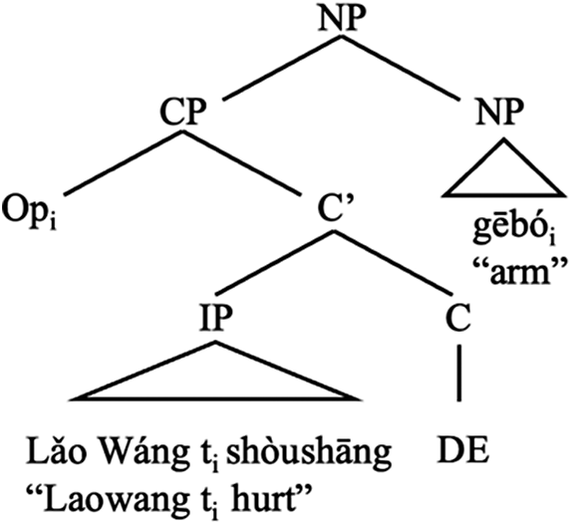
Based on the above analysis, we propose the structural representations for ARCs and PRCs in (19) and (20),Footnote
2 respectively. The key distinction between the two constructions concerns the presence or absence of a gap position in the prenominal clause for the HN. Accordingly, our discussion of the processing differences between ARCs and PRCs is situated within the broader debate on how gapped and gapless structures are processed.
(19)
Mandarin ARC
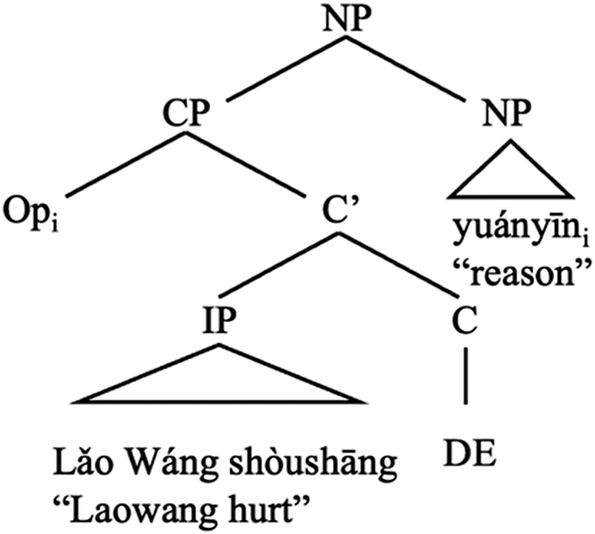
(20)
Mandarin PRC
When discussing the processing of filler-gap dependency, the Minimal Chain Principle (De Vincenzi, Reference De Vincenzi1991) is one of the most extensively tested hypotheses, and much empirical evidence appears to support it. The Minimal Chain Principle states:
Avoid postulating unnecessary chain members at S-structure, but do not delay required chain members (De Vincenzi, Reference De Vincenzi1991, p. 13)
The second part of the Minimal Chain Principle is aligned with the AFH, supported by evidence of the ‘filled-gap effect’. For example, processors are sensitive to the ungrammatical structure ‘the book that they bought *it yesterday’ at the early stage of processing, indicating they predict a gap position after the verb bought. The first part of the Minimal Chain Principle predicts that the analysis of a gap should be avoided unless necessary. Psycholinguists have tested this by comparing the processing of structures with and without gaps: if a gapless structure is preferred over a gapped structure, the first part of the Minimal Chain Principle is confirmed.
Previous studies on head-initial RCs report that gapless structures are easier to process, and that readers tend to avoid analyses involving gaps (Konrad et al., Reference Konrad, Burattin, Cecchetto, Foppolo, Staub and Donati2021; Staub et al., Reference Staub, Foppolo, Donati and Cecchetto2018). For example, in (21), before readers encounter the object a cure in the subordinate clause, the sentence allows either a gapless complement-clause reading (21a) or a gapped relative-clause reading (21b). Staub et al. (Reference Staub, Foppolo, Donati and Cecchetto2018) found that readers experienced difficulty upon reaching the main-clause verb reassured in (21b), suggesting that a reanalysis occurred and that readers initially interpreted the clause as a complement clause, as in (21a). This reanalysis effect is interpreted as readers’ avoidance of gapped analyses. This finding indicates that gapped structures are more difficult to process than gapless structures, supporting the Minimal Chain Principle.
(21)
a. The information that the health department provided a cure reassured the tour operators.
b. The information that the health department provided reassured the tour operators
(Example from Staub et al., Reference Staub, Foppolo, Donati and Cecchetto2018, p. 27)
A recent study by Qian and Packard (Reference Qian and Packard2022) investigated Mandarin RCs, comparing the processing costs of argument RCs containing gaps with gapless structures, as in (22a) and (22b). The difference between gapped and gapless RCs in their design emerges very early at the embedded verb. Although the study draws attention to the understudied gapless structure, its design may be subject to confounding factors, as the embedded verb in the gapless condition is inherently more complex than that in the gapped condition. Specifically, the embedded verb (烧菜, ‘cook-food’) in the gapless condition is a VO compound verb that contains an internal object (菜, ‘food’) within the verbal phrase, whereas the embedded verb in the gapped condition is a simple verb. This potential confounding issue could be resolved by using PRCs – which have a gap position in the prenominal clause, but do not require manipulation of the embedded verb to create the counterpart gapless condition.
(22)
a.
教授
设计
的
[gap
i
]
那个
独特的
广告i
挽救了
jiàoshòu
shèjì
de
[gap
i
]
nàgè
dútè-de
guǎnggào
wǎnjiù-le
professor
design
REL
[gap
i
]
that-CL
special
ad
save-ASP
公司。
gōngsī
company
‘That special advertisement that the professor designed saved the company’.
b.
教授
烧菜
的
那个
独特的
广告
挽救了
jiàoshòu
shāocài
de
nàgè
dútè-de
guǎnggào
wǎnjiù-le
professor
cook-food
REL
that-CL
special
ad
save-ASP
公司。
gōngsī
company
‘That special advertisement about the professor’s food cooking saved the company’.
As shown in (23a) and (23b), the surface structures of the prenominal clauses between the gapped and gapless conditions are identical; thus, the discussion of the processing cost between gapless and gapped structures can be precisely located after the HN is encountered. Lin (Reference Lin2018) conducted pioneering work on the processing of ARCs and PRCs, focusing on the effects of frequency and linear distance on resolving non-local dependencies, but did not directly compare the processing cost between ARCs and PRCs. He used three different structures for the prenominal clauses, namely canonical SVO, ba-construction as SOV and passive construction as OVS, and examined whether prenominal clauses with different word orders influenced the processing difficulty of ARCs and PRCs in the same way. The current study was inspired by Lin’s (Reference Lin2018) design, but focuses on the processing differences between gapless and gapped structures. Thus, unlike Lin (Reference Lin2018), we directly compare the processing of ARCs and PRCs, which allows us to address our first research question: whether gapless constructions (i.e., ARCs) are more straightforward or more difficult to process than constructions with a gap-filler dependency (i.e., PRCs).
(23)
a.
[
RC
李华
得
奖]
的
原因
非常
有趣。
[
RC
Lǐhuá
dé
jiǎng]
de
yuányīn
fēicháng
yǒuqù
Lihua
win
prize
REL
reason
very
interesting
‘The reason why Li Hua won the prize is very interesting’.
b.
[RC李华
得
奖]
的
女儿
非常
有趣。
[
RC
Lǐhuá
dé
jiǎng]
de
nǚér
fēicháng
yǒuqù
Lihua
win
prize
REL
daughter
very
interesting
‘Lihua’s daughter, who won the prize, is very funny’.
3. The effect of alienability in Mandarin possessive relative clauses
Besides extracting the possessum as the HN, it is also possible to relativise the possessor in Mandarin PRCs. The difference between the examples in (24) and (25) lies in the relative positions of the possessor and possessum. When the possessum is relativised as the HN (e.g., 胳膊 ‘arm’ and 庄稼 ‘crops’ in (24)), although the possessor is far from its possessum, this non-local dependency still follows the canonical possessor–possessum word order in Mandarin. In (25), on the other hand, the possessum is in front of its possessor, forming a non-canonical possessum–possessor word order. Though it is not our purpose here to directly compare these two types of PRCs, they allow us to discuss multiple critical questions about processing gap-filler dependencies.
(24)
a.
老王
被
晒伤
的
胳膊
还没
恢复。
Lǎowáng
bèi
shàishāng
de
gēbó
háiméi
huīfù
Lao-Wang
PASS
burn-hurt
REL
arm
still-not
recover
‘Lao-Wang’s arm, which were sunburned, have not yet recovered’.
b.
老王
被
晒伤
的
庄稼
收成
不好。
Lǎowáng
bèi
shàishāng
de
zhuāngjià
shōuchéng
bùhǎo
Lao-Wang
PASS
burn-hurt
REL
crops
harvest
not-good
‘Lao-Wang’s crops, which were sunburned, had a poor harvest’.
(25)
a.
胳膊
被
晒伤
的
老王
很
伤心。
Gēbó
bèi
shàishāng
de
Lǎowáng
hěn
shāngxīn
arm
PASS
burn-hurt
REL
Lao-Wang
very
sad
‘Lao-Wang, whose arm got sunburned, is very sad’.
b.
庄稼
被
晒伤
的
老王
很
伤心。
Zhuāngjià
bèi
shàishāng
de
Lǎowáng
hěn
shāngxīn
crops
PASS
burn-hurt
REL
Lao-Wang
very
sad
‘Lao-Wang, whose crops got sunburned, is very sad’.
One question is whether the semantic tightness between the possessor and possessum facilitates the integration of non-local dependencies in Mandarin PRCs. Lin (Reference Lin2007) found that when the possessum is inalienable from the possessor, such as kinship terms (e.g., father), the reading time was faster than for alienable ones (e.g., employee). The current study aims to investigate whether the alienability effect observed in kinship relations can be extended to other types of inalienable relations, such as part-whole relations. When the possessum is a body part, as shown in (25a), would the resolution of the gap-filler dependency be easier than when the possessum is an alienable common noun, as shown in (25b)?
Another question is when readers identify the gap position in the prenominal clause. As reviewed in the introduction section, the AFH holds that readers actively look for a gap once a filler is encountered in processing filler-gap dependency. Still, it does not specify whether processing would also be incremental and predictive if the gap were encountered first. Some researchers believe that gap-filler dependency is a subtype of filler-gap dependency, and that their processing patterns share the same characteristics. Ng and Wicha (Reference Ng and Wicha2014) proposed that a gap is posited once a possible gap site is identified during the processing of head-final structures. Their account suggests that gap-filler processing is as incremental as filler-gap processing. Furthermore, they argued that upon recognising a gap, readers actively search for a valid filler, in a neat reversal of the same rationale whereby readers look for a potential gap position for an identified filler when resolving filler-gap dependency. Through two sentence completion tasks and two self-paced reading experiments, Ng and Wicha (Reference Ng and Wicha2014) demonstrated that readers prioritise resolving gap dependencies over maintaining structural simplicity, even when the simpler analysis remains viable. These findings suggest that once a gap has been identified, then upon encountering a potential filler, readers immediately engage in a more complex structural analysis to integrate the gap. This finding is consistent with an earlier study by Ng (Reference Ng, Chan and Kang2008), in which a plausible decoy noun was mistakenly interpreted as the filler, leading to a reanalysis effect, as reflected in a slowdown in reading time when the actual filler was encountered later. Based on these results, the authors proposed an ‘Active Gap Strategy’ in gap-filler processing: readers maintain the gap in mind and are prepared to resolve it as soon as cues for a suitable filler emerge.
However, the aforementioned studies primarily focused on argument RCs. As a result, it is unclear whether the ‘active gap’ effect observed in previous studies represents a linguistic universal that applies to all gap-filler dependencies or whether it is specific to the structures investigated. In particular, whether readers employ an ‘Active Gap Strategy’ for other types of RCs remains uncertain. In PRCs, when the possessum appears at the beginning of a sentence, as in (25), the contrast between the alienable and inalienable possessions allows us to explore this question. Specifically, readers have reason to hypothesise a gap in inalienable PRCs but not in alienable PRCs.
In (25a), we hypothesise that parsers detect a gap at the clause-initial word for two reasons. First, a body part typically requires a possessor and cannot stand alone. Second, canonical possessive relations in Mandarin follow a possessor–possessum order, whereas in (25a) the possessum appears first. This non-canonical order signals to readers that they are likely within an embedded structure rather than a simple clause, prompting the parser to anticipate a gap where the possessor would be realised. As illustrated in (26a), a relational noun appearing without its dependent element is unnatural. Readers would therefore expect a possessor for 胳膊 ‘arm’ to be present. In contrast, in (25b), there is no motivation to posit a gap when encountering the initial word. The alienable common noun itself can function as a legitimate subject, allowing the prenominal clause in (26b) to be interpreted as a dependent sentence. This contrast enables us to investigate whether readers actively search for a filler when a potential gap is detected.
(26)
a.?
胳膊
被
晒伤
了。
Gēbó
bèi
shàishāng
le
arm
PASS
burn-hurt
ASP
‘?Arm was sunburned’.
b.
庄稼
被
晒伤
了。
Zhuāngjià
bèi
shàishāng
le
crops
PASS
burn-hurt
ASP
‘Crops were sunburned’.
If readers actively predict a filler after identifying the gap associated with an inalienable possessum, we expect different reading patterns between PRCs with inalienable and alienable possessums. Previous research has suggested that the storage cost of unresolved elements incurs processing costs (Chen et al., Reference Chen, Gibson and Wolf2005; Gibson, Reference Gibson1998, Reference Gibson, Marantz, Miyashita and O’Neil2000; Ness & Meltzer-Asscher, Reference Ness and Meltzer-Asscher2019; Stepanov & Stateva, Reference Stepanov and Stateva2015). If encountering a gap triggers anticipation of a filler, then maintaining this predicted filler could impose memory demands, leading to increased reading times before the filler – that is, the HN – is encountered. By contrast, if readers do not actively predict a filler during gap-filler dependency processing, the effect of alienability may emerge only after the HN is encountered.
4. The current experiments
Based on the above analyses, the present study uses ARCs and PRCs to address the following research questions about the processing of non-local dependencies in Mandarin head-final structures:
-
1) Is a construction with a gap-filler dependency (i.e., PRCs) more straightforward or more difficult to process than a gapless construction (i.e., ARCs)? (Experiment 1)
-
2) Does semantic tightness, operated as inalienability in the current study, between the two dependent nouns in PRCs influence the processing of non-local dependencies? (Experiment 2)
-
3) Do parsers actively search for a potential filler if a gap is encountered first? (Experiment 2)
4.1. Experiment 1: Adjunct and possessive relative clauses
4.1.1. Methods
Participants. Ninety-eight native Mandarin speakers (Male: 27, Female: 71; Mean age: 25 years, Age range: 19–34) were recruited and compensated with HK$60 (about US$7.7) in cash for their participation. All of them had normal or corrected-to-normal vision, and none reported any reading disorder. Due to the poor quality of ten participants’ eye-tracking data, characterised by large drifts, incessant blinks and frequent track loss, ten participants were excluded, resulting in a final sample of 88 participants for analysis. This project and its procedures were approved by the Hong Kong Polytechnic University’s Human Subjects Ethics Review Board (HSEARS20210315014).
Materials.
The critical items were 20 sentences with ARCs (hereafter, the ‘ARC condition’, as exemplified in (27a)) and 20 with PRCs (the ‘PRC condition’, as exemplified in (27b)). Each item was introduced by a concise context describing the background of an event, aiming to make sentences with complicated structures read more naturally. The HNs of these two types of RCs were inherently different, due to our manipulations. Potential confounding effects of visual complexity and frequency have previously been found to influence eye-movement measures (e.g., Liversedge et al., Reference Liversedge, Zang, Zhang, Bai, Yan and Drieghe2014). To minimise these effects, we controlled the stroke count and corpus frequency of the HNs between conditions, with corpus frequency obtained from the Beijing Language and Culture University Corpus Center (BCC) Corpus (Xun et al., Reference Xun, Rao, Xiao and Zang2016). All embedded clauses involved the passive structure with the passive marker 被 ‘BEI’. The passive structure was chosen for the following reasons: first, it lengthens the clause, providing a larger eye-tracking region of interest (ROI) for analysis; second, it extends the non-local dependency between the possessor and possessum in the PRC condition, allowing clearer observation of reader attention to regions with potential regressions; third, the use of passive construction provides a wider range of verbs, enabling us to create more comparable ARCs and PRCs.
(27)
Context:
在
这起
持械
伤人
案
中
,
Zài
zhèqǐ
chíxiè
shāngrén
àn
zhōng
,
In
this-CL
hold-weapon
harm-people
case
in
In this armed-assault case,
a.
The ARC condition:
阿华
被
凶手
击中
的
结局
让人
Ā-huá
bèi
xiōngshǒu
jīzhòng
de
jiéjú
ràngrén
A-hua
PASS
assaulter
hit
REL
outcome
make-people
难受。
nánshòu。
distressed
‘The outcome of A-hua being struck by the assaulter makes people distressed’.
b.
The PRC condition:
阿华
被
凶手
击中
的
眼睛
伤得
严重。
Ā-huá
bèi
xiōngshǒu
jīzhòng
de
yǎnjīng
shāngde
yánzhòng
A-hua
PASS
assaulter
hit
REL
eye
hurt
serious
‘A-hua’s eye, which was struck by the assaulter, is seriously injured’.
The original versions of the items were rated by 54 native Mandarin speakers who did not participate in the formal experiment. They rated each item on a scale ranging from 1 (‘totally unacceptable’) to 5 (‘totally acceptable’). Some items received average ratings lower than 3.00, indicating that native speakers might not accept them as legitimate or natural sentences. We therefore discarded or modified them before conducting one further round of online acceptability-judgement tasks with another 66 native Mandarin speakers. The average ratings for the final versions of the conditions were 4.15 for ARC and 3.88 for PRC. The results of a by-item two-tailed dependent t-test suggest that sentences in the ARC condition were rated as significantly more acceptable than those in the PRC condition, t(19) = 2.662, p = .015, 95% CI [0.059–0.495].
The critical items were distributed into two counterbalanced lists, such that the same participant would not read both members of the same set. Each list also included 20 filler sentences of similar length to the others. All sentences were followed by a true-or-false comprehension question targeting different regions of the sentences, guiding participants to read the whole sentence for comprehension.
Procedure. Participants completed an online questionnaire about their linguistic and general backgrounds before coming to the lab. Informed consent was obtained from all participants before the start of the eye-tracking experiment. The eye-tracker was an Eyelink 1000 Plus with a sampling rate of 1000 Hz. The texts were displayed in black 40-point Songti SC against a light grey background on a 1024 × 768-pixel LCD monitor, located 80 cm from the participant. After reading the instructions and finishing calibration, all participants were provided with four practice trials to familiarise themselves with the procedure.
In all trials, the item was presented across two lines: the first being the context, ending with a comma and the second being the rest of the sentence, including the RC. Figure 1 illustrates this format. The comprehension question appeared after the participant finished reading the sentence and pressed the space bar. The participants used two keys (‘Q’ for ‘True’ and ‘P’ for ‘False’) to answer the comprehension question, after which they moved on to the next trial. The sequence of trials was semi-randomised for each participant using the built-in function of Experiment Builder (SR Research Ltd, 2020b), to avoid sentences from the same condition appearing consecutively and to minimise potential sequence effects. Including setup and calibration, each person’s experimental session lasted about 20 minutes.
Example material presentation from one trial.

Figure 1. Long description
A long black arrow points diagonally down from the top-left to the bottom-right, indicating the progression of three overlapping rectangular screens.
1. Top-left screen: Labeled Drift checking. The screen is grey with a single black dot in the upper-left quadrant.
2. Middle screen: Labeled Eye-tracking while reading. The screen contains two lines of Chinese text. The first line reads: 在这起持械伤人案中, and the second line reads: 阿华被凶手击中的结局让人难受。
3. Bottom-right screen: Labeled Answering the comprehension question. The screen displays a central line of Chinese text: 这起案件有人受伤。 Below this, there are two response options: Q—对 on the left and P—错 on the right.
4.1.2. Data analysis
The items’ first-line contexts were irrelevant to the manipulation between conditions, so they were excluded from data analysis. We divided the rest of the sentence into five regions, as shown in Figure 2. These were the sentence-initial proper name (Region 1), the embedded passive structure including the relativiser (Region 2), the HN (Region 3), the first word after the HN (Region 4) and the last word of the sentence (Region 5). The primary ROI was Region 3, where the reader encountered one of the two types of HN and needed to resolve it with its dependent words in previous regions. Regions 4 and 5 were also analysed for potential spill-over and wrap-up effects.
Region of Interests with mocked-up fixations.

Figure 2. Long description
The layout is divided into five vertical zones labeled Region 1 through Region 5 from left to right.
* Region 1 contains the Chinese characters for A-hua and fixation circle 1.
* Region 2 contains characters for P A S S, assaulter, hit, and R E L, with fixation circles 2, 3, 4, 7, and 8.
* Region 3 is highlighted with an orange background and contains the characters for outcome with fixation circles 5, 6, and 9.
* Region 4 contains characters for make-people with fixation circles 10 and 11.
* Region 5 contains the characters for distressed and a period.
A blue arrowed path connects the fixation circles in numerical order. The path starts at 1 in Region 1, moves right through 2, 3, and 4 in Region 2, then to 5 and 6 in Region 3. It then regresses back to 7 and 8 in Region 2, moves forward to 9 in Region 3, and finally to 10 and 11 in Region 4.
We adopted five eye-tracking measures for statistical analysis. These were first fixation duration (FFD), first-pass time (FPT), regression-path duration (RPD), total reading time (TRT) and the possibility of regression out (ROUT). FFD is the duration of the initial fixation within a given ROI. For Region 3, for example, it would be the duration of fixation #5 shown in Figure 2. The FPT refers to the sum of fixation durations in one ROI from when it is first visited until it is first exited, whether to the left or to the right; for example, the summed durations of fixations #5 and #6. If the region was skipped in the first view, it was treated as a missing value for FFD and FPT. RPD refers to the sum of the durations of all fixations from when a given ROI is entered until it is exited to the right. In Figure 2, Region 3’s RPD comprises the summed durations of fixations #5, #6, #7, #8 and #9. TRT is the sum of the durations of all fixations located in one ROI, which is the summed duration of fixations #5, #6, #9 and #11. Lastly, ROUT is a binary measure indicating whether the reader exits the current ROI to an earlier part of the sentence. For instance, in Figure 2, there are fixations in Region 2 (#7 and #8) after Region 3 is visited, so ROUT for Region 3 is positive and coded as ‘1’. If the reader had gone on to later parts of the sentence, Region 3’s ROUT would have been ‘0’.
In addition to the five commonly adopted eye-tracking measures described above, we analysed which region was entered immediately after the HN (Region 3). In particular, we wanted to know, first, whether readers regressed more into the initial word (Region 1) in the PRC condition than in the ARC condition, due to the semantic dependency between the possessor and possessum; and second, whether Region 2 was less frequently fixated in regressions in the PRC condition, given that readers might not need to revisit previous parts other than the one with a direct dependency relationship to the HN. In the ARC condition, by contrast, readers might need to revisit the whole RC (Regions 1 and 2) because the HN has a dependency relationship with the entire embedded clause. In Figure 2, Region 2 is visited immediately after the reader encounters the HN (fixation #7), so for Region 2, the measure ‘immediate visit after HN’ (AfterHN) was coded as ‘1’. Region 4 is visited right after the second pass of Region 3 (fixation #10), so its AfterHN was also coded as ‘1’. No other regions were visited immediately after the HN, so for Regions 1 and 5, AfterHN was ‘0’.
Data trimming used the built-in Four-Stage Fixation Cleaning function in DataViewer (SR Research Ltd, 2020a; 2020b). Durational data were then log-transformed to approximate a normal distribution of the residuals. We next discarded outliers that deviated more than 2.5 standard deviations (SDs) from the mean, calculated separately for each participant. This led to deletions ranging from 0.057% to 0.795%, depending on the measure and the ROI. We built linear mixed-effects models using the lmer() and glmer() functions (lmer4 package, Version 1.1-35.3, Bates et al., Reference Bates, Maechler, Bolker, Walker, Christensen, Singmann, Dai, Grothendieck, Green and Bolker2015) in R (Version 4.4.0, R Core Team, 2024). The fixed effect was condition: ARC or PRC, using dummy coding with ARC as the reference level. A maximal random-effects structure with random intercepts and slopes of items and participants was included in initial models, but the by-item and by-participant slopes were deleted if the model failed to converge. The final models are the maximal ones supported by the design and data.
4.1.3. Results
The participants’ accuracy in responding to comprehension questions was near ceiling (96.1% for the ARC condition and 95.5% for the PRC condition), indicating that they were attentive to the tasks. Therefore, all trials were included in the data analysis. Table 1 presents the descriptive results of the five eye-tracking measures in the three ROIs.
Descriptive results (Mean [SD]) for the five eye-tracking measures in Experiment 1’s three Region of Interests

Table 1. Long description
The table is organized with five eye-tracking measures in the first column and three Regions of Interest (R O I) across the top, each subdivided into A R C (adjunct relative clause) and P R C (possessive relative clause) conditions. Values are presented as Mean followed by Standard Deviation in parentheses.
* Region 3 (head noun):
- First fixation duration: A R C 249 (82), P R C 238 (78).
- First-pass time: A R C 266 (109), P R C 252 (106).
- Regression-path duration: A R C 668 (684), P R C 627 (737).
- Total reading time: A R C 387 (230), P R C 396 (288).
- Regression out: A R C 0.378 (0.485), P R C 0.310 (0.463).
* Region 4 (head noun plus 1):
- First fixation duration: A R C 248 (88), P R C 249 (95).
- First-pass time: A R C 270 (125), P R C 279 (133).
- Regression-path duration: A R C 1077 (1004), P R C 1131 (1154).
- Total reading time: A R C 386 (242), P R C 418 (279).
- Regression out: A R C 0.672 (0.470), P R C 0.654 (0.476).
* Region 5 (End):
- First fixation duration: A R C 250 (93), P R C 245 (102).
- First-pass time: A R C 286 (169), P R C 264 (150).
- Regression-path duration: A R C 1551 (1336), P R C 1446 (1423).
- Total reading time: A R C 366 (264), P R C 345 (277).
- Regression out: A R C 0.842 (0.365), P R C 0.844 (0.364).
Note: ARC, adjunct relative clause; PRC, possessive relative clause.
In Region 3, which is the HN and our primary ROI, a significant effect of condition was found for every eye-tracking measure apart from TRT: PRCs were read faster and were less likely to be regressed out of than ARCs. The results are summarised in Table 2.
Statistical results from mixed-effects models of Region 3, Experiment 1

Table 2. Long description
The table contains six columns: Measure, Parameter, Estimate, S E, t/z, and p. It details results for five measures, each with an Intercept and a P R C (possessive relative clause) parameter.
* First fixation duration: Intercept (Estimate 5.466, S E 0.017, t/z 324.829, p < .001); P R C (Estimate -0.042, S E 0.016, t/z -2.672, p .009).
* First-pass time: Intercept (Estimate 5.511, S E 0.018, t/z 298.401, p < .001); P R C (Estimate -0.05, S E 0.018, t/z -2.755, p .007).
* Regression-path duration: Intercept (Estimate 6.123, S E 0.053, t/z 116.577, p < .001); P R C (Estimate -0.103, S E 0.039, t/z -2.609, p .009).
* Total reading time: Intercept (Estimate 5.789, S E 0.039, t/z 147.95, p < .001); P R C (Estimate -0.029, S E 0.035, t/z -0.836, p .412).
* Regression out: Intercept (Estimate -0.618, S E 0.149, t/z -4.141, p < .001); P R C (Estimate -0.398, S E 0.129, t/z -3.090, p .002).
Values for P R C are bolded for all measures except Total reading time, indicating statistical significance.
Note: PRC, possessive relative clause.
In Region 4, the word after the HN, no significant differences between ARCs and PRCs were found across any of the five eye-tracking measures. The statistical results are presented in Table 3.
Statistical results from mixed-effects models of Region 4, Experiment 1

Table 3. Long description
The table contains six columns: Measure, Parameter, Estimate, S E, t/z, and p.
* First fixation duration: Intercept has an estimate of 5.453, S E 0.018, t/z 303.255, p less than .001. P R C has an estimate of minus 0.001, S E 0.016, t/z minus 0.044, p .965.
* First-pass time: Intercept has an estimate of 5.508, S E 0.021, t/z 260.778, p less than .001. P R C has an estimate of 0.023, S E 0.021, t/z 1.068, p .288.
* Regression-path duration: Intercept has an estimate of 6.597, S E 0.059, t/z 111.99, p less than .001. P R C has an estimate of minus 0.012, S E 0.049, t/z minus 0.250, p .805.
* Total reading time: Intercept has an estimate of 5.774, S E 0.036, t/z 159.334, p less than .001. P R C has an estimate of 0.057, S E 0.036, t/z 1.601, p .124.
* Regression out: Intercept has an estimate of 0.834, S E 0.129, t/z 6.461, p less than .001. P R C has an estimate of minus 0.041, S E 0.134, t/z minus 0.308, p .758.
Note: P R C stands for possessive relative clause.
Note: PRC, possessive relative clause.
In Region 5, which is the last word of the sentence and is presumed to have some wrap-up effect, a significant difference between ARCs and PRCs was found in two eye-tracking measures: FPT and TRT. The direction of this effect was the same as for Region 3: PRCs were read faster than ARCs. The statistical results are presented in Table 4.
Statistical results from mixed-effects models of Region 5, Experiment 1

Table 4. Long description
The table contains six columns: Measure, Parameter, Estimate, S E, t/z, and p.
* First fixation duration: Intercept has an estimate of 5.441, S E 0.025, t/z 214.391, p less than .001. P R C has an estimate of minus 0.034, S E 0.024, t/z minus 1.386, p .166.
* First-pass time: Intercept has an estimate of 5.511, S E 0.029, t/z 188.612, p less than .001. P R C has a significant estimate of minus 0.074, S E 0.03, t/z minus 2.463, p .014.
* Regression-path duration: Intercept has an estimate of 6.859, S E 0.084, t/z 81.491, p less than .001. P R C has an estimate of minus 0.1, S E 0.058, t/z minus 1.709, p .088.
* Total reading time: Intercept has an estimate of 5.644, S E 0.043, t/z 132.629, p less than .001. P R C has a significant estimate of minus 0.08, S E 0.038, t/z minus 2.122, p .034.
* Regression out: Intercept has an estimate of 2.179, S E 0.282, t/z 7.720, p less than .001. P R C has an estimate of minus 0.004, S E 0.242, t/z minus 0.015, p .988.
Note: P R C stands for possessive relative clause.
Note: PRC, possessive relative clause.
We also performed a fixation-sequence analysis to establish which regions the participants visited right after they encountered the HN. Different patterns were found between the two conditions: readers made significantly fewer visits to Region 2 after they encountered the HN in the PRC condition than in the ARC condition (β = −0.305, SE = 0.112, z = −2.717, p = .007). Conversely, they made significantly more visits to Region 4 after reading the HN in the PRC condition than in the ARC condition (β = 0.305, SE = 0.149, z = 2.051, p = .040). No significant differences between conditions were found in other regions. The patterns are visualised in Figure 3.
Percentages of visits to different regions after encountering the head noun.
Note: Percentages represent the proportion of visits to each plotted region out of all visits made after first exiting the head noun. Because visits to the contextual region preceding the critical sentence are omitted from the figure, the displayed percentages do not sum to 100%. Error bars represent 95% CI. Asterisks indicate statistically significant differences between conditions (*p < .05, **p < .01).

Figure 3. Long description
The y-axis is labeled Percentage of Visit, ranging from 0 percent to 40 percent in increments of 10. The x-axis is labeled Regions, containing five categories: Region 1, Region 2, Region 3, Region 4, and Region 5. A legend at the top identifies salmon-colored bars as Adjunct Relative Clause and teal-colored bars as Possessive Relative Clause.
* Region 1: Both conditions are low, approximately 5 percent.
* Region 2: Adjunct Relative Clause is significantly higher at approximately 31 percent, marked with two asterisks, while Possessive Relative Clause is approximately 25 percent.
* Region 3: Both conditions are low, approximately 6 to 7 percent.
* Region 4: Possessive Relative Clause is significantly higher at approximately 41 percent, marked with one asterisk, while Adjunct Relative Clause is approximately 36 percent.
* Region 5: Both conditions are low, approximately 12 to 13 percent.
All bars include vertical error bars representing 95 percent C I.
4.1.4. Discussion
The consistent and robust results of Experiment 1 indicate that processing PRCs is more straightforward than processing ARCs. In the HN, the region where readers determined whether they were dealing with a PRC or an ARC, both early and late eye-tracking measures showed that PRCs enjoyed a processing advantage. This pattern suggests that the participants immediately noticed the difference between these two types of RCs, and continued to adopt different processing patterns when engaged in later-stage analysis. This PRC advantage was also observed at sentence endings, probably reflecting a wrap-up effect driven by the different syntactic structures of the two RC types.
While determining which RC type is easier to process was not our ultimate goal, we also sought to identify the sources of the observed differences in processing load. One possibility is that, to interpret the meaning of the HN in an ARC, readers must first successfully parse the entire RC. Due to the head-final feature of Mandarin RCs, we expected more regressions to previous parts of the sentence in ARCs than in PRCs, as readers of PRCs may only need to resolve the possessor–possessum relationship between the sentence’s initial word (Region 1) and the HN. The remainder of the PRC (Region 2) might be less relevant, as it only serves to describe the HN, functioning as Supplementary Information. The fixation-sequence analysis results supported this hypothesis: after encountering the HN, there were more regressions to Region 2 in the ARC condition than in the PRC condition.
We also expected to see multiple regressions into the initial word of the sentence after readers encountered the HN in the PRC condition, as they might revisit the possessor to build the semantic dependency between it and its possessum. However, this hypothesised pattern was not observed in our data. The regression rate into the initial word of the sentence was very low in the PRC condition (less than 10%) and did not differ significantly from that in the ARC condition. One possible explanation is that, as reported by von der Malsburg and Vasishth (Reference von der Malsburg and Vasishth2011), regressions that directly target the area needing reanalysis are rare. More often, regressions tend to go to the region just before reanalysis is triggered. Consequently, even though the PRC condition involves a dependency between the initial word and the HN, the saccades might not be precisely located on the clause’s initial noun. Another possible explanation is that the possessor and possessum in the PRC condition formed an inalienable whole-part relationship that did not require many cognitive resources to resolve; thus, readers were confident to move forward through the sentence without revisiting the possessor. This raised an important question: if the semantic dependency between the two nouns is not as tight as a whole-part relationship, will the resolution become more demanding? We conducted Experiment 2 to answer this question.
4.2. Experiment 2: Alienable and inalienable possessive relative clauses
4.2.1. Methods
Participants. The participants in Experiment 2 were the same as those in Experiment 1. The two experiments were separated by a short rest break. Half of the participants completed Experiment 1 first, while the other half completed Experiment 2 first.
Materials.
Experiment 2 involved only PRCs, but the semantic relationship between the possessor and possessum varied between conditions. Example (28a) illustrates the alienable condition, where the RC’s first noun is a common noun serving as the possessum (here, 手表 ‘watch’) and its HN is a proper name serving as the possessor (阿华 ‘A-hua’). Example (28b) illustrates the inalienable condition, where the possessum (眼睛 ‘eye’) is a body part of the possessor. As in Experiment 1, a brief contextual section was introduced to make the critical sentence read more naturally.
(28)
Context:
在
这起
持械
伤人
案
中
,
Zài
zhèqǐ
chíxiè
shāngrén
àn
zhōng
,
In
this-CL
hold-weapon
harm-people
case
in
‘In this armed assault case’,
a.
The alienable condition:
手表
被
凶手
击中
的
阿华
非常
气愤。
shǒubiǎo
bèi
xiōngshǒu
jīzhòng
de
Ā-huá
fēicháng
qìfèn。
watch
PASS
assaulter
hit
REL
A-hua
very
angry
‘A-hua, whose watch was hit by the assaulter, is very angry’.
b.
The inalienable condition:
眼睛
被
凶手
击中
的
阿华
非常
气愤。
yǎnjing
bèi
xiōngshǒu
jīzhòng
de
Ā-huá
fēicháng
qìfèn。
eye
PASS
assaulter
hit
REL
A-hua
very
angry
‘A-hua, whose eye was hit by the assaulter, is very angry’.
Unlike the PRCs in Experiment 1, where the initial word of the RC was the possessor and the HN was the possessum, the relative positions of the possessor and possessum were reversed in Experiment 2. Apart from the reasons mentioned in the previous section, the possessum–possessor word order has the following characteristics. First, although both possessor and possessum can be relativised in Mandarin PRCs, Lin (Reference Lin2018) reported that acceptability ratings were higher when the possessor was relativised as the HN than when the possessum was the HN. Our acceptability-judgement task data for sentences like those in examples (27b) and (28b) support this conclusion (rating results can be found in Supplementary Materials at https://osf.io/3kqvf/). Second, the default order for expressing possession in Mandarin is to place the possessor before the possessum. Only a few structures, notably including PRCs, allow the reversed possessum–possessor order. We decided to examine the structure with a possessum-first and possessor-far-behind semantic dependency, to shed light on the processing patterns of this relatively understudied syntactic construction. Therefore, the region of manipulation in Experiment 2 was the initial word of the RC, that is, the possessum. The stroke numbers and frequency of the possessum between conditions were controlled.
The norming procedure was the same as in Experiment 1. The average rating for the final version of the items was 3.94 for the alienable condition and 4.28 for the inalienable condition, suggesting that these sentences were acceptable to native speakers. The results of a by-item two-tailed dependent t-test indicate that the inalienable condition was rated significantly more acceptable than the alienable condition, t(19) = 3.326, p = .004, 95% CI [0.125–0.548].
We created 20 versions of PRCs with either alienable or inalienable possessive relations and divided them into two counterbalanced lists so that items from the same version were not read by the same participant. Each list also included 20 filler sentences of similar length. Again, each sentence was followed by a true-or-false comprehension question, guiding participants to read for comprehension.
Procedure. The procedures for Experiment 2 were identical to those used in Experiment 1.
4.2.2. Data analysis
The ROIs for Experiment 2 were the initial word of the RC (the possessum), the HN (the possessor), the next word of the HN for potential spill-over effect and the last word of the sentence. For the last three ROIs, we adopted the same five eye-tracking measures as in Experiment 1 (FFD, FPT, RPD, TRT and ROUT). For the initial word of the RC, because our primary interest was whether this region was entered at different rates in different conditions, the possibility of regression-in (RIN) rather than ROUT was adopted. RPD was not analysed for the initial word of the RC, as there was no reason to assume a conditional difference in regressions into the same context at the very beginning of the critical sentence. Our procedures for data cleaning, outlier trimming (leading to deletions ranging from 0.113% to 0.966% across different measures and regions) and model selection were the same as in Experiment 1.
4.2.3. Results
The comprehension questions had an average accuracy of 93.6% in the alienable condition and 92.7% in the inalienable condition, indicating that the participants were completing the task with attention. Therefore, all trials were included in the data analysis. The descriptive results of Experiment 2, as shown in Table 5, demonstrate clear effects of inalienability: compared with the alienable condition, PRCs with inalienable possessive relations had shorter TRT on the possessum and the possessor; fewer regressions out of the possessor; fewer regressions into the possessum; and shorter RPD on the possessor and the words after it. The statistical results of the linear-mixed effects models confirmed the effect of inalienability.
Descriptive results (Mean [SD]) of eye-tracking measures in Experiment 2’s four Region of Interests

Table 5. Long description
The table presents descriptive results for five eye-tracking measures across four Regions of Interest (R O I). Each cell contains the Mean followed by the Standard Deviation in brackets.
1. First fixation duration:
- Initial word (possessum): Alienable 265 [104], Inalienable 254 [91].
- Head noun (possessor): Alienable 250 [86], Inalienable 249 [85].
- Head noun plus 1: Alienable 254 [91], Inalienable 260 [99].
- Sentence end: Alienable 247 [100], Inalienable 250 [98].
2. First-pass time:
- Initial word: Alienable 337 [210], Inalienable 321 [202].
- Head noun: Alienable 280 [140], Inalienable 269 [113].
- Head noun plus 1: Alienable 282 [130], Inalienable 287 [137].
- Sentence end: Alienable 274 [143], Inalienable 279 [144].
3. Regression-path duration:
- Initial word: n dot a dot for both.
- Head noun: Alienable 766 [882], Inalienable 650 [771].
- Head noun plus 1: Alienable 1171 [1177], Inalienable 1054 [983].
- Sentence end: Alienable 1601 [1552], Inalienable 1400 [1258].
4. Total reading time:
- Initial word: Alienable 527 [392], Inalienable 466 [313].
- Head noun: Alienable 438 [230], Inalienable 392 [234].
- Head noun plus 1: Alienable 424 [270], Inalienable 393 [231].
- Sentence end: Alienable 348 [225], Inalienable 350 [257].
5. Regression in/out:
- Initial word: Alienable 0.766 [0.424], Inalienable 0.665 [0.472].
- Head noun: Alienable 0.352 [0.478], Inalienable 0.296 [0.457].
- Head noun plus 1: Alienable 0.654 [0.476], Inalienable 0.659 [0.474].
- Sentence end: Alienable 0.824 [0.366], Inalienable 0.812 [0.391].
We identified the effect of inalienability at the initial word of the sentence through the late eye-tracking measures TRT and RIN. Alienable possessums like 手表 ‘watch’ had longer TRT and more RIN than inalienable ones such as 胳膊 ‘arm’. Statistical results can be found in Table 6. Similar results were also found in the HN region in RPD, TRT and ROUT, and in the HN + 1 region via TRT, as listed in Tables 7 and 8. There were no significant differences between the alienable and inalienable conditions at sentence end, as listed in Table 9.
Statistical results from mixed-effects models of the initial word region, Experiment 2

Table 6. Long description
The table consists of six columns: Measure, Parameter, Estimate, S E, t/z, and p.
* First fixation duration: Intercept has an estimate of 5.510, S E 0.017, t/z 317.239, p less than .001. Inalienable has an estimate of minus 0.034, S E 0.019, t/z minus 1.836, p .067.
* First-pass time: Intercept has an estimate of 5.657, S E 0.030, t/z 189.355, p less than .001. Inalienable has an estimate of minus 0.046, S E 0.024, t/z minus 1.902, p .058.
* Total reading time: Intercept has an estimate of 5.986, S E 0.050, t/z 118.610, p less than .001. Inalienable (bolded) has an estimate of minus 0.105, S E 0.049, t/z minus 2.130, p .047.
* Regression in: Intercept has an estimate of 1.469, S E 0.181, t/z 8.121, p less than .001. Inalienable (bolded) has an estimate of minus 0.483, S E 0.239, t/z minus 2.022, p .043.
Statistical results from mixed-effects models of the head noun region, Experiment 2

Table 7. Long description
The table contains six columns: Measure, Parameter, Estimate, S E, t/z, and p.
* First fixation duration: Intercept has an estimate of 5.465, S E 0.017, t/z 305.405, p less than .001. Inalienable has an estimate of minus 0.040, S E 0.015, t/z minus 0.271, p .787.
* First-pass time: Intercept has an estimate of 5.537, S E 0.024, t/z 232.363, p less than .001. Inalienable has an estimate of minus 0.023, S E 0.018, t/z minus 1.223, p .225.
* Regression-path duration: Intercept has an estimate of 6.182, S E 0.056, t/z 109.454, p less than .001. Inalienable (bolded) has an estimate of minus 0.138, S E 0.040, t/z minus 3.443, p .001.
* Total reading time: Intercept has an estimate of 5.861, S E 0.039, t/z 150.325, p less than .001. Inalienable (bolded) has an estimate of minus 0.071, S E 0.028, t/z minus 2.531, p .013.
* Regression out: Intercept has an estimate of minus 0.748, S E 0.154, t/z minus 4.850, p less than .001. Inalienable (bolded) has an estimate of minus 0.328, S E 0.126, t/z minus 2.606, p .009.
Statistical results from mixed-effects models of the word following the head noun region, Experiment 2

Table 8. Long description
A table with six columns: Measure, Parameter, Estimate, S E, t/z, and p.
* First fixation duration:
- Intercept: Estimate 5.477, S E 0.017, t/z 321.251, p less than .001.
- Inalienable: Estimate 0.017, S E 0.016, t/z 1.063, p .288.
* First-pass time:
- Intercept: Estimate 5.549, S E 0.022, t/z 253.502, p less than .001.
- Inalienable: Estimate 0.012, S E 0.021, t/z 0.531, p .597.
* Regression-path duration:
- Intercept: Estimate 6.634, S E 0.059, t/z 112.140, p less than .001.
- Inalienable: Estimate minus 0.062, S E 0.042, t/z minus 1.478, p .140.
* Total reading time:
- Intercept: Estimate 5.853, S E 0.035, t/z 167.523, p less than .001.
- Inalienable (bolded): Estimate minus 0.057, S E 0.026, t/z minus 2.185, p .029.
* Regression out:
- Intercept: Estimate 0.796, S E 0.170, t/z 4.681, p less than .001.
- Inalienable: Estimate 0.074, S E 0.199, t/z 0.370, p .711.
Statistical results from mixed-effects models of sentence end region, Experiment 2

Table 9. Long description
The table contains six columns: Measure, Parameter, Estimate, S E, t/z, and p. It is organized into five eye-tracking measures, each with two parameters: Intercept and Inalienable.
* First fixation duration: Intercept has an estimate of 5.436, S E 0.021, t/z 257.746, p less than .001. Inalienable has an estimate of 0.009, S E 0.026, t/z 0.348, p .728.
* First-pass time: Intercept has an estimate of 5.491, S E 0.030, t/z 185.296, p less than .001. Inalienable has an estimate of 0.015, S E 0.036, t/z 0.411, p .683.
* Regression-path duration: Intercept has an estimate of 6.856, S E 0.079, t/z 86.616, p less than .001. Inalienable has an estimate of minus 0.116, S E 0.065, t/z minus 1.787, p .074.
* Total reading time: Intercept has an estimate of 5.647, S E 0.039, t/z 146.276, p less than .001. Inalienable has an estimate of minus 0.021, S E 0.047, t/z minus 0.449, p .660.
* Regression out: Intercept has an estimate of 1.842, S E 0.233, t/z 7.902, p less than .001. Inalienable has an estimate of minus 0.153, S E 0.229, t/z minus 0.668, p .504.
4.2.4. Discussion
The results of Experiment 2 reveal a robust effect of inalienability: participants found it easier to resolve long-distance possessor–possessum relationships when the possessive relation was inalienable compared to when it was alienable. However, this effect was only found in late measures, with no significant differences in earlier measures, especially in the sentence-initial region.
This pattern has two critical implications. First, the absence of effects on early measures, particularly in the sentence-initial region, indicates that our efforts to control potential confounding factors, such as word frequency and visual complexity, were effective. The initial word of each sentence was manipulated to create alienable and inalienable possessive relations. By matching the manipulated words for frequency and visual complexity, we minimised the risk of confounding, and the lack of early effects provides empirical validation of this control. The inter-condition differences found in late measures were unlikely to be due to the processes of lexical-level word recognition, and can be more confidently attributed to the impact of alienability on the resolution of possessive relationships.
Second, the distinction between early and late measures sheds light on the stages of resolving gap-filler dependency in Mandarin RCs. As Mandarin RCs are head-final and the gap appears before the filler, understanding the timing and sequence of gap identification and processing is theoretically important. In the inalienable condition, the initial word of the sentence was a body part, which typically requires a possessor. Thus, readers may realise a potential gap as soon as they encounter a word of a body part standing alone at the initial position of the sentence. However, no such gap could have been predicted in the alienable condition, where the sentence’s initial word was a common noun that did not require a dependent element.
If readers predict a filler in the inalienable condition, we expect to see a delay in early reading measures due to the cognitive load of holding the predicted filler in mind. This effect is expected to be observed in the early measures, but not in late measures, which may capture processing time after the actual filler is encountered. Yet our results did not show any differences between conditions in FFD and FPT at the initial word. This indicates that although there might be a valid gap before the body part, readers mostly did not posit it during their first pass through the sentence. We address this issue in more detail in the next section.
5. General discussion
Based on the results of the above experiments, our research questions can be answered as follows.
-
1) PRCs are more straightforward to process than ARCs because a) they were read faster than ARCs in both the HN and sentence-end regions; and b) after encountering the HN, ARCs had more regressions into the clause than PRCs.
-
2) Inalienability between the possessum and possessor facilitates the processing of non-local dependencies. The inalienable condition showed a processing advantage in late eye-tracking measures in the initial-word, HN, and HN + 1 regions.
-
3) There is no evidence to suggest that parsers postulate a gap and actively search for a potential filler when a body part appears at the initial position of the sentence. Although the inalienable condition motivates a gap at the sentence initial region, differences between the inalienable and alienable conditions only appear once the filler (HN) was encountered.
5.1. Gapped structures are not necessarily more complicated than gapless ones
Our findings are inconsistent with previous studies on processing filler-gap dependencies in head-initial languages. Contrary to the observed gap-avoidance strategy adopted by speakers of French, Italian (Konrad et al., Reference Konrad, Burattin, Cecchetto, Foppolo, Staub and Donati2021) and English (Staub et al., Reference Staub, Foppolo, Donati and Cecchetto2018) to pursue structural simplicity, our current results showed that in Mandarin, the gapped structure (i.e., PRCs) was read faster and had fewer regressions than the gapless structure (i.e., ARCs). These divergent results can be attributed to the structural differences between Mandarin and European languages, and to the different structures examined in the different languages.
The first and most obvious distinction is initial- versus final-headedness itself. The head-final feature of Mandarin RCs forces the resolution of dependency to follow a gap-first rather than a filler-first order, as emphasised in previous sections. Neither condition in Experiment 1 motivated any gap analysis until the HN was encountered. Once that had happened, the gapped condition encouraged the participants to find a specific position for the filler, whereas the gapless condition provided no hints about how the HN should be integrated. Thus, a legitimate gap can aid the resolution of gap-filler dependency by saving readers’ time: that is, they do not need to revisit every part of the previous sentence. This process is distinct from the processing of filler-gap dependency, where one of the most critical questions is whether, and where, to position a gap after a filler is encountered.
A second probable reason for the differing findings in European languages and Mandarin pertains to the characteristics of the gap. The RCs discussed by Staub et al. (Reference Staub, Foppolo, Donati and Cecchetto2018) and Konrad et al. (Reference Konrad, Burattin, Cecchetto, Foppolo, Staub and Donati2021) were object-extracted RCs in which the HN served as a critical argument in the clause. In other words, the gap was a clear syntactic gap, and both the syntactic and the thematic structures of the subordinate clause were unfulfilled until the filler-gap dependency was resolved. As a result, resolution was likely to require great effort, or in any case, enough effort to prompt some individuals to avoid gap analysis altogether. On the other hand, the nature of the gap in Mandarin PRCs remains under debate. If Li’s (Reference Li1999) and Hsu’s (Reference Hsu, Fowler, Lavine and Feldstein2023) analysis of treating possessors as arguments is correct, then the gap in PRCs should be much like the one in argument RCs. However, our results do not seem to support this analysis. The processing of PRCs is quite different from that of argument RCs. The possessum is less critical than the subject or the object, which are essential to the subordinate clause. Without the HN, the subject-extracted and object-extracted clauses cannot be interpreted. The possessum in ORCs functions more like additional, detailed information and the subordinate clause can stand alone without being interpreted as lacking arguments. Readers engaged in shallow processing can even arrive at a plausible interpretation of sentences containing such PRCs without fine-grained analysis of their HNs. For instance, in example (28b), repeated here as (29), a syntactically shallower parsing like (30) is possible in the absence of an RC analysis. That is, once the semantic relation between the possessor and possessum is established, a reasonable interpretation of the sentence can be achieved, even if it is potentially inaccurate regarding syntactic structure.
(29)
阿华
被
凶手
击中
的
眼睛
伤得
严重。
Ā-huá
bèi
xiōngshǒu
jīzhòng
de
yǎnjīng
shāngde
yánzhòng
A-hua
PASS
assaulter
hit
REL
eye
hurt
serious
‘A-hua’s eyes, which were struck by the assaulter, are seriously injured’.
(30)
阿华
被
凶手
击中了,
他的
眼睛
伤得
严重。
Ā-huá
bèi
xiōngshǒu
jīzhòng-le
tāde
yǎnjīng
shāngde
yánzhòng
A-hua
PASS
assaulter
hit-ASP
his
eye
hurt
serious
‘A-hua was struck by the assaulter, and his eyes are seriously injured’.
Even though the structures discussed in the current study differ from those used in head-initial structures with filler-gap dependencies, we emphasise our finding that gapped structures are not necessarily more difficult than gapless ones. This possibility was also highlighted in a pioneering study on Mandarin PRCs and ARCs by Lin (Reference Lin2018). Although Lin (Reference Lin2018) did not perform a direct statistical comparison of PRC and ARC reading times, it can be seen from his graph (p. 780) that the tested ARCs had longer reading times than the PRCs in both the HN and HN + 1 regions; and this greater reading time was even more marked in sentences with passive structures, like the ones in the present study.
5.2. Reflections on the active gap strategy
The AFH holds that a reader ‘is immediately predisposed to postulate a gap once a “filler” has been identified’ (Frazier & Flores d’Arcais, Reference Frazier and Flores d’Arcais1989, p. 332). Following this logic, in a head-final structure where the gap is linearly ahead of the filler, an ‘Active Gap Strategy’ predicts that the reader postulates a filler as soon as a gap is identified, as suggested by Ng (Reference Ng, Chan and Kang2008) and Ng and Wicha (Reference Ng and Wicha2014). Our results do not support this Active Gap Strategy. As explained above, in the inalienable condition, a gap is motivated as soon as the reader encounters the initial word of the clause, whereas in its alienable counterpart, no such gap is motivated. If readers posit a gap in the inalienable condition and predict a filler, the cognitive burden of holding the predicted element in mind will result in longer reading times at the posited region (the first word of the clause) compared to the alienable condition, where no filler is predicted. Moreover, if a filler were postulated before being met, there would be an immediate advantage to the inalienable condition at the HN region, reflected in early eye-tracking measures such as FFD or FPT, when integrating the HN as the legitimate filler. However, in our results, the inalienable condition exhibited neither a more prolonged reading time in the initial-word region nor any advantage in the HN region. Its processing advantage in the HN region was only reflected in late eye-tracking measures, which we attribute to the semantic tightness between the possessum and possessor.
These results suggest that readers of Mandarin may not actively predict a filler for the gap when processing gap-filler dependency. Nevertheless, we want to emphasise that the nature of the gaps in our materials might be a critical factor, by making the processing ‘inactive’. Like most studies of the processing of filler-gap dependency, previous research on gap-filler dependency in head-final structures has also focused on clearly syntactic ones, such as subject/object-extracted RCs. The authors arrived at the ‘Active Gap Strategy’ due to the nature of their materials: the clause has unresolved syntactic elements that will lead to ungrammaticality if the gap is not eventually filled. In contrast, the nature of gaps in PRCs remains debated as a result of argument-extraction or adjunct-extraction, and a gap with no filler leads to unnaturalness rather than ungrammaticality, as illustrated in example (26a). As suggested by the Minimal Chain Principle (De Vincenzi, Reference De Vincenzi1991), a gap should be avoided if it is not necessary. In our materials, a gap is motivated if semantic integrity is considered, but it may not be a syntactic necessity. Future research on Mandarin and other head-final languages could explore whether speakers recognise or circumvent gaps created by possessive relations, and whether they process different types of gaps in various ways.
To conclude, our results demonstrate the critical role of semantic resolution in sentence processing. When interpreting Mandarin ARCs, readers must associate the HN with the whole subordinate clause, resulting in prolonged reading times. In contrast, when parsing Mandarin PRCs, they only need to figure out the relation between the possessor and the possessum, making the resolution of gap-filler dependency straightforward. This result also suggests that gapped structures are not necessarily more demanding than gapless ones. However, how semantic relations are resolved influences processing difficulty. The effect of inalienability plays a critical role in the resolution of gap-filler dependency in PRCs. Inalienable possessions were processed faster than alienable ones, even though Mandarin does not have overt morphosyntactic markings of inalienability. Therefore, we call for future research to focus more on the role of semantics in sentence processing, even under syntactically driven frameworks such as filler-gap dependency resolution. While some semantic phenomena, such as animacy, have been thoroughly studied, others, such as inalienability, remain understudied. Investigating these semantic features would provide a more nuanced and complete understanding of sentence comprehension.
Data availability statement
The materials, data and coding for statistical analyses are available at: https://osf.io/3kqvf/.
Funding statement
This study is supported by The Hong Kong Polytechnic University’s Areas of Excellence – Large Equipment Fund (No. P0045115 (1-BC7N)), and the 2025–2026 Special Research Project of the China Center for International People-to-People Exchange and the Institute for Teachers’ Intercultural Competence Development (Grant No. HNUJL202504).
Competing interests
The authors declare none.
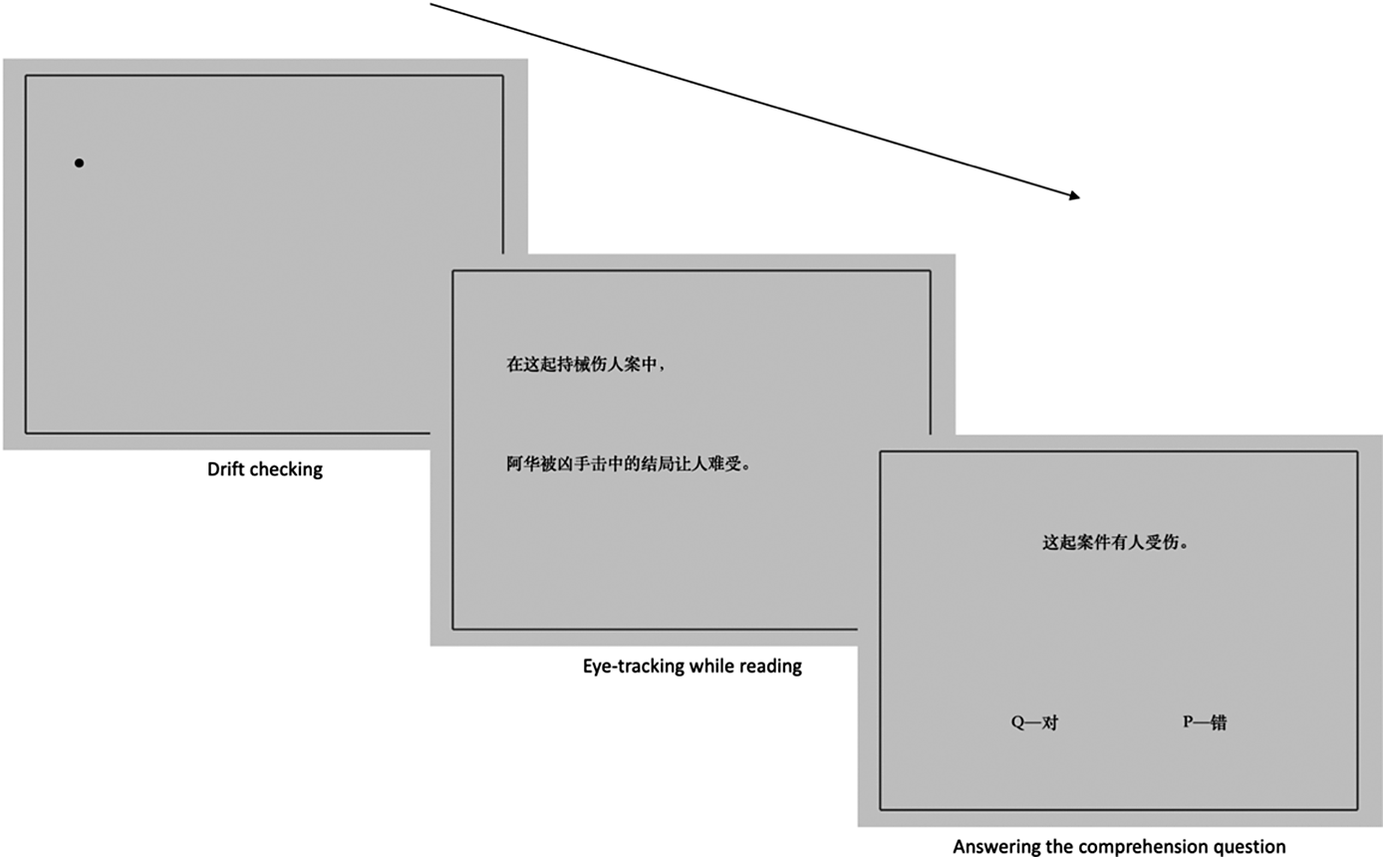


 Open access

