Receipt during childhood and adolescence of parenting characterized by frequent striking and shouting (which we term harsh parenting here in this article) has been associated consistently with learning difficulties, anxiety, depression, and aggression (Cicchetti & Toth, Reference Cicchetti and Toth2005). Recent research also indicates that harsh parenting exerts less visible adverse effects on youths’ vulnerability to chronic diseases of aging, particularly those in the cardiometabolic domain, such as diabetes, heart disease, and stroke (Miller, Chen, & Parker, Reference Miller, Chen and Parker2011). For example, the Adverse Childhood Experiences Study assessed the medical histories of more than 17,000 adults and found that the rates of cardiovascular disease, autoimmune disorders, and premature death were 1.5 to 2.0 times higher among respondents who were exposed to family violence than among those who were not exposed (Dube et al., Reference Dube, Fairweather, Pearson, Felitti, Anda and Croft2009). Other studies reveal that adults reared in harsher home environments evince higher blood pressure, poorer metabolic profiles, greater inflammatory activity, and higher levels of depressive symptoms than do adults reared in less harsh households (Miller et al., Reference Miller, Chen and Parker2011; Repetti, Taylor, & Seeman, Reference Repetti, Taylor and Seeman2002).
Using a 10-year multiple-wave, multiple-informant research design, in the present study we sought to advance understanding of the association between harsh parenting practices and health status by testing hypotheses involving prospective pathways among child temperament, harsh parenting, and health outcomes with a representative sample of rural African American adolescents. Specifically, the study was designed to clarify several conceptual and empirical issues in the emerging literature on harsh parenting practices and children's later health outcomes. First, past research addressing links between exposure to harsh parenting and indicators of health has depicted children as passive recipients of parental behavior. Children, however, are part of a dynamic system in which their behavioral styles and temperaments contribute to the rearing practices they receive (Lengua & Kovacs, Reference Lengua and Kovacs2005). Second, with one exception (Danese et al., Reference Danese, Moffitt, Harrington, Milne, Polanczyk and Pariante2009), existing research has relied primarily on retrospective reports of receipt of harsh parenting. This design precludes investigation into processes of change and has the potential to confound harsh parenting with family conflict, family violence, and neighborhood violence. Third, research has not considered the possibility that children's physiological responses to harsh parenting can differ depending on their genetic makeup. Previous research has revealed genetic moderation effects on the association between parental maltreatment and children's mental and behavioral health (Belsky & Pluess, Reference Belsky and Pluess2009; Cicchetti & Rogosch, Reference Cicchetti and Rogosch2012; Kim-Cohen et al., Reference Kim-Cohen, Caspi, Taylor, Williams, Newcombe and Craig2006). To circumvent these limitations, this study used a longitudinal research design to examine questions concerning temporal relations among child temperament, harsh parenting, and allostatic load (AL), and the moderation of these relations by a variant in the oxytocin receptor gene (OXTR rs53576).
The study outcome, AL, is the toll that stress exacts on the body by changing multiple, interconnected systems. AL is often operationalized as a composite reflecting various mediators and outcomes of the stress response, including the sympathetic–adrenomedullary system, the hypothalamus–pituitary–adrenal axis, lipid metabolism, fat deposition, indices of inflammation, and immune functioning (McEwen, Reference McEwen2000). AL composites have been shown to predict the onset of cardiovascular disease and all-case mortality later in life (Karlamangla, Singer, & Seeman, Reference Karlamangla, Singer and Seeman2006). We hypothesized that emotionally intense and distractible temperaments, to which researchers often refer as “difficult,” during preadolescence would forecast elevated levels of AL in young adulthood, with this effect mediated by increased exposure to harsh parenting during adolescence. In the following sections, we discuss the hypothesized prospective associations among child temperament, harsh parenting, and poor health, along with the moderating effect of a variant in OXTR.
Child Temperament, Harsh Parenting, and Health
To address the first purpose of this study, we investigated prospective relations among child temperament in preadolescence, changes in harsh parenting during adolescence, and cardiovascular health risk in late adolescence as measured by an AL index. Most research conducted with adolescents has focused on parents’ influence on youths, whereas youths’ influence on parents has been understudied (Laursen & Collins, Reference Laursen, Collins, Lerner and Steinberg2009). This stands in contrast to an established body of research that has highlighted reciprocity in the parent–child relationship and children's contributions to the rearing practices they receive (Lengua & Kovacs, Reference Lengua and Kovacs2005). For example, child temperament has been shown to have an evocative effect on parenting. The literature on determinants of parenting indicates that rearing a child with a difficult temperament, which includes characteristics such as low levels of positivity, highly intense reactions, and distractibility (Laukkanen, Ojansuu, Tolvanen, Alatupa, & Aunola, Reference Laukkanen, Ojansuu, Tolvanen, Alatupa and Aunola2014), can tax caregivers, leading even the most capable parents to use harsh parenting practices (Sanson & Rothbart, Reference Sanson, Rothbart and Bornstein1995).
Temperament refers to biologically rooted and relatively stable individual differences in emotional, physiological, and attentional reactivity and regulation (Posner & Rothbart, Reference Posner and Rothbart2007). Childhood temperament is widely understood to be a multifaceted construct, involving dimensions related to areas such as negative affectivity, effortful control, and surgency (Else-Quest, Hyde, Goldsmith, & Van Hulle, Reference Else-Quest, Hyde, Goldsmith and Van Hulle2006). The current study included two dimensions of temperament, negative affectivity and distractibility. Negative affectivity describes general tendencies to express negative emotions, including distress, anger, or fear (Rothbart & Bates, Reference Rothbart, Bates and Damon1998). Distractibility describes the inability to focus attention; it is a behavioral indicator of the broad temperament domain of effortful control (Else-Quest et al., Reference Else-Quest, Hyde, Goldsmith and Van Hulle2006). Both negative emotionality and distractibility persist as distinct characteristics across childhood, adolescence, and adulthood (Putnam, Ellis, & Rothbart, Reference Putnam, Ellis, Rothbart, Eliasz and Angleitner2001). Further, children and adolescents displaying such temperaments often receive elevated levels of negative parenting, as documented in both observational (Davenport, Yap, Simmons, Sheeber, & Allen, Reference Davenport, Yap, Simmons, Sheeber and Allen2011; Kim, Conger, Lorenz, & Elder, Reference Kim, Conger, Lorenz and Elder2001) and self-report (Laukkanen et al., Reference Laukkanen, Ojansuu, Tolvanen, Alatupa and Aunola2014) studies. This association between children's negative emotionality and unsupportive parenting appears to be stronger in low socioeconomic status (SES) families and among ethnic minorities (Paulussen-Hoogeboom, Stams, Hermanns, & Peetsma, Reference Paulussen-Hoogeboom, Stams, Hermanns and Peetsma2007), such as the families in the current sample.
In addition to influencing parenting practices, emerging research also suggests childhood temperament may be associated with physical health into adulthood. The findings from the Cardiovascular Risk in Young Finns Study (a population-based study in Finland spanning more than 20 years) document the ways in which aspects of youth temperament prospectively predict elevated body mass index (Pulkki-Råback, Elovainio, Kivimäki, Raitakari, & Keltikangas-Järvinen, Reference Pulkki-Råback, Elovainio, Kivimäki, Raitakari and Keltikangas-Järvinen2005); low parasympathetic activity (Puttonen et al., Reference Puttonen, Elovainio, Kivimäki, Koskinen, Pulkki-Råback and Viikari2008), high systolic blood pressure; and, in women only, intima media thickness (a risk factor for atherosclerosis; Keltikangas-Järvinen, Pulkki-Råback, Puttonen, Viikari, & Raitakari, Reference Keltikangas-Järvinen, Pulkki-Råback, Puttonen, Viikari and Raitakari2006). These effects of child temperament on young adult health appeared independent of childhood and adulthood risk factors for adult obesity. Beyond direct effects, however, few investigations have examined pathways that account for this effect, including the quality of the parenting that difficult temperament elicits.
OXTR as a Moderator
Regarding the second purpose of this study, we investigated the reasons why many caregivers, despite rearing a child with a difficult temperament, do not use harsh parenting practices and why many youths, despite exposure to harsh parenting, do not show elevated levels of AL. The current study specifically considered whether, for genetic reasons, parents and children differ in the extent to which they are affected by aspects of their environment. During the past decade, research investigated the hypothesis that particular genetic polymorphisms amplify individuals’ reactions to stressful conditions in their environment, thereby enhancing the probability of compromised behavioral, mental, or physical health functioning (Way & Taylor, Reference Way and Taylor2010). Some of this research has investigated the hypothesis that oxytocin has anxiolytic or calming effects. Oxytocin moderates neural and behavioral responses to aversive stimuli and attenuates cardiovascular and neuroendocrine reactivity to laboratory stressors (Campbell, Reference Campbell2010). Some of the individual differences in social interaction reactivity as a function of oxytocin are conferred by polymorphisms in the gene that codes for OXTR. One of the most studied polymorphisms is rs53576, a single nucleotide variant involving a silent G to A change in the third intron of OXTR (Klahr, Klump, & Burt, Reference Klahr, Klump and Burt2015).
Two bodies of research support the proposition that OXTR genotype will moderate the associations among difficult temperament, harsh parenting, and AL. The first was generated by scientists who sought to determine whether polymorphisms in OXTR affected social behavior. The results from this line of research indicated that, compared to carriers of the GG genotype, persons with the A allele (the A+ genotype) exhibited diminished positive affect (Lucht et al., Reference Lucht, Barnow, Sonnenfeld, Rosenberger, Grabe and Schroeder2009) and prosocial behavior (Kogan et al., Reference Kogan, Saslow, Impett, Oveis, Keltner and Rodrigues Saturn2011), along with low maternal warmth (Klahr et al., Reference Klahr, Klump and Burt2015). Additional research suggests A+ allele carriers experience heightened depressive symptomology, with this effect largely mediated by the influence of OXTR on individuals’ lack of psychological resources such as optimism, mastery, and self-esteem (Saphire-Bernstein, Way, Kim, Shermna, & Taylor, Reference Saphire-Bernstein, Way, Kim, Sherman and Taylor2011). Findings on the effects of OXTR on social temperament and social relationships have been replicated in studies with individuals of European and African ancestry (Creswell et al., Reference Creswell, Wright, Troxel, Ferrell, Flory and Manuck2015). However, a study by Michalska et al. (Reference Michalska, Decety, Liu, Chen, Martz and Jacob2014) did not replicate this pattern; rather, they found higher levels of positive parenting among carriers of the A+ genotype than among GG carriers. These main effects of OXTR genotype should be interpreted with caution (Bakermans-Kranenburg & van IJzendoorn, Reference Bakermans-Kranenburg and van IJzendoorn2014), but such divergent findings should not rule out the possibility that parents and their offspring who carry the A+ genotype are more reactive to difficult temperament and harsh parenting, respectively, than are carriers of the GG genotype.
The second body of research was conducted by scientists testing hypotheses involving OXTR and exposure to stressful life events. These studies described the ways in which genetic variability at OXTR alters individuals’ reactivity to stressful life conditions. To date, evidence is somewhat mixed regarding the nature of the polymorphisms at OXTR rs53576 that confer heightened susceptibility. One body of research has found that adults carrying the G allele at rs53576, relative to those who carry the A allele, are more susceptible to both supportive (Chen et al., Reference Chen, Kumsta, von Dawans, Monakhov, Ebstein and Heinrichs2011) and harsh (Bradley et al., Reference Bradley, Westen, Mercer, Binder, Jovanovic and Crain2011) social interactions. In the one OXTR moderation study we identified with an exclusively African American sample, carriers of the GG genotype exhibited greater emotional dysregulation and disorganized attachment as a result of childhood maltreatment than did A+ carriers (Bradley et al., Reference Bradley, Westen, Mercer, Binder, Jovanovic and Crain2011). Conversely, a second body of research suggests that individuals carrying the A allele at rs53576 are more responsive to contextual stressors. These studies suggest that carriers of the A+ genotype display more behavioral, neural, and affective reactivity to interpersonal stressors than do persons with the GG genotype (Poulin, Holman, & Buffone, Reference Poulin, Holman and Buffone2012; Rodrigues, Saslow, Garcia, John, & Keltner, Reference Rodrigues, Saslow, Garcia, John and Keltner2009; Thompson et al., Reference Thompson, Hammen, Starr and Najman2014; Tost et al., Reference Tost, Kolachana, Hakimi, Lemaitre, Verchinski and Mattay2010).Footnote 1 While the literature is not consistent, we resonated to the results of the aforementioned second body of research and translated those findings into the study hypotheses. Specifically, we hypothesized that (a) parents who carry the A+ OXTR genotype would increase their use of harsh parenting over time, more than will carriers of the GG OXTR genotype, when their child was noted as having a difficult temperament; and (b) youth who carry the A+ OXTR genotype will show higher AL levels at ages 20 and 21, relative to carriers of the GG OXTR genotype, when they receive higher levels of harsh parenting.
We also considered in the present study whether carriers of the A+ genotype would respond to environmental conditions in a manner consistent with differential susceptibility theory (Belsky, Reference Belsky1997; Belsky & Pluess, Reference Belsky and Pluess2009). Differential susceptibility theory posits that many putative sources of vulnerability, including genetic polymorphisms, are more accurately conceptualized as plasticity factors that not only amplify risk for maladaptation in poor environments but also increase the probability of positive adaptation in favorable environments (Roisman et al., Reference Roisman, Newman, Fraley, Haltigan, Groh and Haydon2012). Various genetic polymorphisms have been noted as functioning consistently with differential susceptibility tenets; to date, such polymorphisms have primarily related to genes associated with serotonergic (e.g., serotonin transporter linked polymorphic region [5-HTTLPR]) and dopaminergic (e.g., dopamine receptor D4 [DRD4]) systems (see Belsky & Pluess, Reference Belsky and Pluess2009). In the present study, we examined the possibility that single nucleotide polymorphisms (SNPs) associated with the oxytonergic system may also conform to a differential susceptibility pattern, with carriers of the A+ genotype being both more vulnerable to negative (high levels of harsh parenting) and more responsive to positive (low levels of harsh parenting) environmental influences.
Summary of the Study Hypotheses and Research Design
We conducted this study with rural African American youths and their primary caregivers using procedures that have been shown in developmental psychopathology research to yield reliable data. These procedures include computer-based interviewing, matching of interviewers and participants by ethnicity, and extensive reassurances concerning confidentiality of the data (Brody et al., Reference Brody, Murry, Gerrard, Gibbons, Molgaard and McNair2004; Patrick et al., Reference Patrick, Cheadle, Thompson, Diehr, Koepsell and Kinne1994). We obtained genetic data from youths and parents using procedures developed in partnership with rural African American community members.
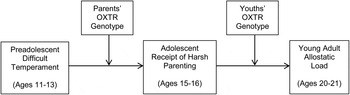
We predicted that teacher assessments of preadolescent temperament as emotionally intense and distractible would forecast increases in harsh parenting from preadolescence to adolescence. Receipt of harsh parenting, in turn, was hypothesized to forecast heightened levels of AL during young adulthood. Consistent with a differential susceptibility framework, parents’ and youths’ genetic statuses were hypothesized to moderate these associations (see Figure 1 for a conceptual model). For genetic moderation, we evaluated three specific prospective hypotheses. First, we expected difficult preadolescent temperament to presage the use of harsh parenting more strongly among parents with the A+ genotype than the GG genotype. Second, we expected to find a stronger association between receipt of harsh parenting and AL among youths with the A+ than the GG genotype. Third, we predicted a moderated-mediational scenario, wherein difficult temperament leads to harsh parenting, which in turns forecasts greater AL for families in which both the parent and adolescent carry the A+ genotype of OXTR.
Conceptual model of study hypotheses.

A 10-year prospective design for testing the aforementioned hypotheses included 303 participants. The data gathered comprised teacher-rated youth temperament during preadolescence (ages 11 to 13), adolescents’ self-reports of receipt of harsh parenting (at ages 11 to 13 and ages 15 and 16), genotyping of parents and adolescents for OXTR rs53576 polymorphisms, and a composite indicator of AL at ages 20 and 21. Although underpowered by current standards for molecular genetic studies, the present study represents one of the largest longitudinal molecular genetic studies in the literature that involves parents and youths. The composite reflects mediators and outcomes of activation of the stress response system, including the sympathetic–adrenomedullary system, the hypothalamus–pituitary–adrenal axis, and fat deposition as measured by body mass index. Composites of these indicators, which contribute to AL, predict the onset of hypertension, cardiac disease, diabetes, and all-cause mortality (Seeman, Singer, Ryff, Dienberg Love, & Levy-Storms, Reference Seeman, Singer, Ryff, Dienberg Love and Levy-Storms2002).
Method
Participants
The data for this study were drawn from the Strong African American Families Healthy Adult Panel study (Brody et al., Reference Brody, Yu, Chen, Kogan, Evans and Beach2013). The Institutional Review Board at the University of Georgia approved all procedures. A target youth from each family and the parent who was identified as the youth's primary caregiver participated in annual data collections. Youths’ mean age was 11.2 years (SD = 0.34) at the first assessment and 21.1 years (SD = 0.71) at the last assessment. Of the youths in the sample, 53% were female. At the first assessment, 78% of the caregivers had completed high school or earned a General Equivalency Diploma. The families resided in nine rural counties in Georgia, in small towns and communities in which poverty rates are among the highest in the nation and unemployment rates are above the national average (Proctor & Dalaker, Reference Proctor and Dalaker2003). Although the parents in the sample worked an average of 39.4 hours per week (SD = 11.51) at the first assessment, 46.3% lived below federal poverty standards with a median monthly family income of $1,655; at the last assessment, the proportion was 48.5% with a median monthly income of $1,914. Overall, the families can be described as working poor.
At the first assessment, 667 families were selected randomly from lists of fifth-grade students that schools provided. From a sample of 561 at the age 18 data collection (retention rate of 84%), 500 families were selected randomly to take part in an assessment of AL at ages 20 and 21. The selection of a random subsample was necessary because of financial constraints associated with the costs of assaying catecholamines and cortisol from urine samples. Of this subsample, 491 agreed to provide AL data at age 20, age 21, or both (479 provided data at age 20, 453 provided data at age 21). The subsample that provided AL data was comparable to the full age 18 sample on difficult temperament and family SES risk during preadolescence. The 491 families with AL data reported higher levels of harsh parenting during adolescence (M = 5.59, SD = 1.29) than did those who did not provide these data (M = 5.31, SD = 0.95), t (590) = 2.54, p = .012. The participating families, therefore, should be a higher risk sample than the larger sample from which they were drawn.
Of the 491 families for whom youths’ AL data had been collected, 350 had provided, at the age 16 assessment, DNA samples both from the youth and one of the parents, which were successfully genotyped at OXTR rs53576. Parents in 303 of these 350 families were the youths’ biological parents. These 303 families constituted the sample for the present study (295 biological mothers, 8 biological fathers). Comparisons on the demographic and study variables, using independent t tests and chi-square tests, between the 303 families who were included and the 188 who were not included in the analyses revealed two differences. On average, the families who were included in the analyses reported higher levels of harsh parenting (M = 5.71, SD = 1.42) and higher levels of parental depressive symptoms (M = 10.35, SD = 8.35) than did those who were not included in the analyses (M = 5.38, SD = 1.02), t (477) = 2.65, p = .008, for harsh parenting (M = 8.71, SD = 7.91), t (478) = 2.11, p = .035, for parent depressive symptoms. Again, these findings suggest that the analytic sample here is at higher risk than is the broader study population from which they were drawn.
Procedure
All data were collected in participants’ homes using a standardized protocol. At each wave of data collection, two African American field researchers conducted one home visit that lasted approximately 2 hr. Interviews were conducted privately, with no other family members present or able to overhear the conversation. Informed consent was obtained at each data collection wave. Participants were told that the purpose of the study was to identify the predictors of health and well-being among rural African American adolescents. They were compensated $100 at each wave of data collection. Primary caregivers consented to minor youths’ participation in the study, and youths assented or consented to their own participation.
Measures
Preadolescent difficult temperament
Each youth's English or social studies teacher assessed temperament at each of the three waves of preadolescent data collection (ages 11, 12, and 13). Difficult temperament was assessed using the seven-item irritability subscale and the six-item distractibility subscale of the Early Adolescent Temperament Scale (Capaldi & Rothbart, Reference Capaldi and Rothbart1992). Each item was rated on a Likert scale ranging from 0 (very false) to 5 (very true). Irritability entails unpleasant affect in response to stimulation; a sample item is “This child hates it when people do not agree with her/him.” The distractibility subscale assessed the ability to focus and shift attention; a sample item is “This child often is in the middle of doing one thing, and then goes off to do something else, without finishing it.” Both the irritability and the distractibility subscales load on a difficult temperament factor (Capaldi & Rothbart, Reference Capaldi and Rothbart1992). They have been shown to predict harsh parenting behaviors (Davenport et al., Reference Davenport, Yap, Simmons, Sheeber and Allen2011). Difficult temperament was operationalized as the average of the teachers’ ratings across the three assessments (α = 0.92).
Harsh parenting in preadolescence and adolescence
Youths assessed receipt of harsh parenting during preadolescence and adolescence. Four items that index harsh parenting, the Harsh/Inconsistent Parenting Scale (Brody et al., Reference Brody, Ge, Conger, Gibbons, Murry and Gerrard2001), assessed parents’ use of striking and shouting to discipline the youths. Youths rated each item on a scale of 1 (never) to 4 (always) during preadolescence (ages 11 to 13) and adolescence (ages 15 and 16). Harsh parenting was operationalized as the average of the youths’ ratings across the preadolescent (α = 0.74) and adolescent (α = 0.71) assessments.
Young adult AL
The protocol for measuring AL when youths were 20 and 21 years of age was based on procedures developed for field studies involving children and adolescents (Evans, Reference Evans2003). Resting blood pressure was monitored with a Critikon Dinamap Pro 100 (Critikon; Tampa, FL) while the youth sat reading quietly. Three readings were taken every 2 min, and the average of the last two systolic readings and last two diastolic readings were used as resting blood pressure indices. This procedure yields highly reliable indices of chronic resting blood pressure (Kamarck et al., Reference Kamarck, Jennings, Debski, Glickman-Weiss, Johnson and Eddy1992). Overnight urinary catecholamines and cortisol were assayed. Beginning on the evening of data collection, all urine that the young adult voided from 8 p.m. to 8 a.m. was stored on ice in a container with metabisulfite as a preservative. Urine was delivered to the Emory University Hospital medical laboratory in Atlanta, Georgia, for assaying. Total unbound cortisol was assessed with a radioimmune assay (Contreras, Hane, & Tyrrell, Reference Contreras, Hane and Tyrrell1986). Epinephrine and norepinephrine were assayed with high-pressure liquid chromatography with electrochemical detection (Riggin & Kissinger, Reference Riggin and Kissinger1977). Creatinine was assayed to control for differences in body size and incomplete urine voiding. Technicians blind to the study assayed the samples.
The AL composite was calculated by summing the standardized scores of six indicators: overnight cortisol, epinephrine, and norepinephrine; resting diastolic blood pressure and systolic blood pressure; and body mass index (weight in kilograms divided by the square of height in meters). Prior studies in adults (Seeman et al., Reference Seeman, Singer, Ryff, Dienberg Love and Levy-Storms2002) and in children (Evans, Reference Evans2003) used similar metrics, combining multiple physiological indicators of risk into a composite. Scores at ages 20 and 21 were highly correlated (r = .51, p < .001) and were averaged to form the young adulthood AL composite.
Genotyping
DNA was obtained from youths and parents using Oragene DNA kits (DNA Genotek, Kanata, ON, Canada). Participants rinsed their mouths with tap water and then deposited 4 ml of saliva in the Oragene sample vial. The vial was sealed, inverted, and shipped via courier to a central laboratory in Iowa City, Iowa, where samples were prepared according to the manufacturer's specifications. The genotype at OXTR SNP rs53576 was determined for each sample using TaqMan SNP Genotyping technology (Life Technologies, Grand Island, NY). Detailed information about extraction and genotyping procedures is available from the authors. Of the youths’ samples, 5.6% (n = 17) were homozygous for the A allele, 33.3% (n = 101) were heterozygous, and 61.1% (n = 185) were homozygous for the G allele. Of the parents’ samples, 6.9% (n = 21) were homozygous for the A allele, 31.4% (n = 95) were heterozygous, and 61.7% (n = 187) were homozygous for the G allele. Genotype frequencies were checked for Hardy–Weinberg equilibrium (χ2 = 0.42, p = .51 for youths’ sample; χ2 = 3.28, p = .07 for parents’ sample). No gender differences could be detected (χ2 = 2.50, df = 2, p = .29 for youths; χ2 = 0.51, df = 2, p = .78 for parents). For tests of the Gene × Environment (G × E) hypotheses, OXTR rs53576 was coded as GG (1) vs. A+ (0) to ensure sufficient power for the analyses. A significant χ2 indicated that parents’ and youths’ genotypes were associated, χ2 (1) = 52.256, p < .001. Of the 303 families, in 144 (47.5%) both youths and one of their parents were homozygous for the G allele, whereas 75 (24.8%) youth–parent pairs both carried the A+ genotype. In 43 families (14.2%), youths were homozygous for the G allele and one of their parents carried the A+ genotype, whereas 41 (13.5%) youths who carried the A+ genotype had a parent who was homozygous for the G allele.
Control variables
Youth gender and family cumulative socioeconomic risk during preadolescence were controlled in all analyses. Cumulative risk was defined as the mean of the sums of six socioeconomic risk factors measured during each annual preadolescent assessment. This yielded a cumulative risk index that ranged from 0 to 6 (M = 2.37, SD = 1.31). The six risk indicators were family poverty as assessed using United States government criteria (income to needs ratio ≤ 1.5), primary caregiver noncompletion of high school or an equivalent, primary caregiver unemployment, single-parent family structure, family receipt of Temporary Assistance for Needy Families, and income rated by the primary caregiver as inadequate to meet all needs. Gender was dummy coded, with male youths coded 1 and female youths coded 0.
Given previous literature in this area (Miller et al., Reference Miller, Chen and Parker2011), we also considered the possibility that the predicted associations would be confounded by depressive symptoms and health practices. Accordingly, adolescents’ depressive symptoms were measured by using the Children's Depression Inventory (Kovacs, Reference Kovacs1979), a 27-item self-report assessing depressive symptoms experienced in the past 2 weeks. The Children's Depression Inventory is a widely used self-report measure for children and youth 7 to 17 years of age (α = 0.85); it was included in the analysis of predictors of harsh parenting. Parents’ depressive symptoms during the youths’ adolescence, measured by self-report on the Center for Epidemiologic Studies Depression Scale (Radloff, Reference Radloff1977), was also controlled in the analysis of predictors of harsh parenting. Parents rated each of 20 symptoms on a scale of 0 (rarely or none of the time), 1 (some or a little of the time), 2 (occasionally or a moderate amount of time), or 3 (most or all of the time) during the past week. The alpha value was 0.87. Youths’ alcohol use, smoking, and depressive symptoms at ages 20 and 21 were also controlled in the analyses of AL. Youths were asked how much they had engaged in each form of substance use. A 7-point response set ranging from not at all to about two packs a day was used for cigarette smoking; a 6-point scale ranging from none to 20 or more days was used for alcohol use (Brody et al., Reference Brody, Chen, Kogan, Yu, Molgaard and DiClemente2012). Because the distributions of both smoking and alcohol use were skewed, we applied a log transformation to normalize the ratings. Young adults’ depressive symptoms were measured via self-report on the Center for Epidemiologic Studies Depression Scale. The alpha value was 0.85.
Results
Plan of analysis
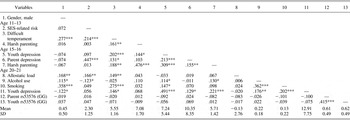
Bivariate correlations and descriptive statistics for the study variables are presented in Table 1. Linear regression analyses were executed to test the study hypotheses. All interaction analyses were executed according to prescribed conventions whereby difficult temperament and harsh parenting indicators are standardized before the interaction terms are calculated (Aiken & West, Reference Aiken and West1991). Benefits of standardized weights in the interaction models include making coefficients easier to interpret, reducing multicollinearity, and making the simple slope easier to test (Aiken & West, Reference Aiken and West1991). The conceptual model presented earlier in Figure 1 illustrates the study hypotheses. We hypothesized that the link between difficult temperament and increases in harsh parenting would be moderated by parents’ OXTR genotypes, whereas the link between harsh parenting and young adults’ AL would be moderated by youths’ OXTR genotypes. The size of the indirect effect of difficult temperament on youths’ AL through harsh parenting, therefore, depends on both parents’ and youths’ genotypes. We calculated the conditional indirect effects (moderated mediation) of difficult temperament on AL through harsh parenting (Preacher, Rucker, & Hayes, Reference Preacher, Rucker and Hayes2007). Regression coefficients were obtained for the path between difficult temperament and harsh parenting (a 1) and the path between Difficult Temperament × Parents’ Genotype and harsh parenting (a 2). The regression coefficients (simple slopes) were calculated for the association between difficult temperament and harsh parenting for each parental genotype using the formula, simple slope a = (a 1 + a 2) × parental genotype. Regression coefficients then were obtained for the path between harsh parenting and AL (b 1) and the path between Harsh Parenting × Youths’ Genotype and AL (b 2). The regression coefficients (simple slopes) were calculated for the association between harsh parenting and AL for each youth genotype using the formula, simple slope b = (b 1 + b 2) × youth genotype. Finally, the conditional indirect effect in which harsh parenting serves as a link connecting preadolescent temperament to AL was quantified as the product of the two simple slopes: indirect effect = (simple slope a) × (simple slope b). In addition, nonparametric bootstrapping, which has been found to be sensitive in mediational analyses (Preacher et al., Reference Preacher, Rucker and Hayes2007), was used to obtain the bias-corrected and accelerated confidence intervals of the parameter estimates for significance testing. The parameter estimate was calculated 1,000 times using random sampling with replacement to build a sampling distribution.
Descriptive statistics and correlations among study variables (N = 303)

Note: SES, Socioeconomic status.
*p < .05. **p < .01. ***p < .001.
Several authors (Belsky & Pluess, Reference Belsky and Pluess2009; Roisman et al., Reference Roisman, Newman, Fraley, Haltigan, Groh and Haydon2012) have outlined recommendations for documenting differential susceptibility and, in particular, distinguishing it from other models of risk and developmental adaptation (e.g., diathesis–stress; Monroe & Simons, Reference Monroe and Simons1991). Establishing differential susceptibility involves probing the interaction and statistically testing for the presence of a crossover (or disordinal) interaction. Methodology pertaining to a proportion of the interaction (PoI) index (Roisman et al., Reference Roisman, Newman, Fraley, Haltigan, Groh and Haydon2012) offers a technique for testing explicitly whether a Gene × Environment moderation effect is consistent with the type of disordinal interaction that characterizes differential susceptibility. Because differential sensitivity predicts that individuals carrying “plasticity” agents will exhibit worse outcomes in difficult environments and better outcomes in supportive environments, the PoI quantifies the equality of the regions on the left (i.e., worse outcomes) and right (i.e., better outcomes) sides of the crossover point. An interaction model consistent with differential susceptibility theory produces relatively equal regions of significance on both sides of the graph. Values approximating 0.50 offer strong support for differential susceptibility, whereas values under 0.16 favor a diathesis–stress model (for more details, see Roisman et al., Reference Roisman, Newman, Fraley, Haltigan, Groh and Haydon2012). In the present study, PoI values supporting tenets of differential susceptibility would indicate that the A+ genotype of OXTR renders parents more vulnerable to rearing a child with a challenging temperament and render youths more vulnerable to the receipt of harsh parenting.
Difficult temperament at ages 11 to 13, parents’ genotype, and harsh parenting at ages 15 and 16
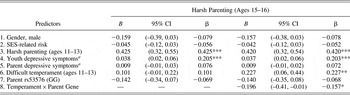
The first model, presented in Table 2, was designed to determine whether preadolescent temperament interacts with variations in parents’ OXTR SNP rs53576 to forecast increases in harsh parenting during adolescence. This analysis did not reveal a significant main effect of difficult temperament during preadolescence on receipt of harsh parenting during adolescence after controlling for youths’ gender, family SES-related risk, preadolescent receipt of harsh parenting, and depression in parents and adolescents. There was, however, a significant interaction between difficult temperament and parents’ rs53576 genotype, b = –0.196, 95% confidence interval = (–0.41, –0.01), p < .05. To interpret this interaction, we followed previous guidelines (Aiken & West, Reference Aiken and West1991) to plot graphically and to calculate the simple slope of difficult temperament on harsh parenting by each parental genotype group (A+ vs. GG).
Difficult temperament and parents’ rs53576 status as predictors of increases in harsh parenting (N = 303)

Note: SES, Socioeconomic status.
a Assessed when youths were ages 15–16.
*p ≤ .05. **p ≤ .01. ***p ≤ .001.
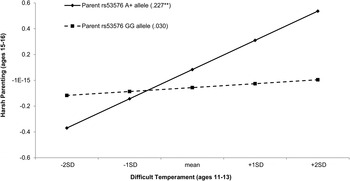
As shown in Figure 2, parents’ rs53576 genotype moderated the association of preadolescent difficult temperament with increases in harsh parenting. Difficult temperament at ages 11 to 13 was significantly associated with increased harsh parenting at ages 15 and 16 among youths whose parents carried the A+ genotype at rs53576 (simple slope = 0.227, SE = 0.083, p = .007). Preadolescent difficult temperament was not associated with increases in receipt of harsh parenting during adolescence among youths whose parents carried GG alleles at rs53576 (simple slope = 0.030, SE = 0.064, p = .473). An examination of Figure 2 suggested that the interaction obtained for parents carrying the A+ genotype may have conformed to a differential susceptibility pattern (Belsky & Pluess, Reference Belsky and Pluess2009). We explored that pattern to see if it characterized carriers of the A+ genotype. To determine whether the effect of the Child Temperament × Parent Genotype interaction on harsh parenting assumed a form that differential susceptibility theory predicted, we calculated the PoI index to test for the equality of the regions on the left and right sides of the crossover point. The value was 0.18, suggesting a differential susceptibility pattern with the A allele as a plasticity gene.
The effect of difficult temperament on harsh parenting by parent rs53576 genotype. The numbers in parentheses refer to slopes for each genotype group. **p < .01.

Harsh parenting at ages 15 and 16, youths’ genotypes, and AL at ages 20 and 21
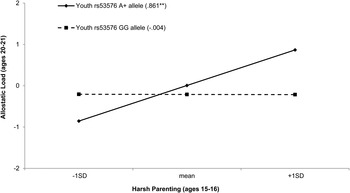
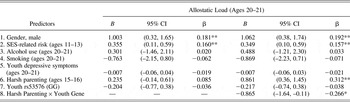
The second model, presented in Table 3, did not detect a significant main effect of harsh parenting on AL. A significant interaction emerged between receipt of harsh parenting and youths’ rs53576 genotype, b = –0.965, 95% confidence interval = (–1.64, –0.11), p < .05. To interpret this interaction, we plotted estimated levels of AL at low versus high levels of harsh parenting ranging from –1 to +1 SD from the mean for each genotype group (see Figure 3). The results of the analysis were not plotted from –2 to +2 SD from the mean of harsh parenting because the range of adolescent receipt of harsh parenting ranged from –1.2 to +5.3 SD from the mean. As hypothesized, youths’ rs53576 genotype interacted with receipt of harsh parenting to forecast AL. Receipt of harsh parenting at ages 15 and 16 was significantly associated with greater AL at ages 20 and 21 among youths who carried the A+ genotype at rs53576 (simple slope = 0.861, SE = 0.297, p = .004). Receipt of harsh parenting was not associated with AL among youths carrying GG alleles at rs53576 (simple slope = –0.004, SE = 0.186, p = .98). Again, we examined the A allele's function as a plasticity gene inducing adolescents’ differential susceptibility to harsh parenting. The PoI test was conducted once more to determine directly whether the data conformed to a differential susceptibility pattern. The PoI index of 0.38 for the moderating role of youths’ genotype in the link between receipt of harsh parenting and AL was within the range of values supporting differential susceptibility theory, demonstrating that the A allele functioned as a plasticity gene in separate analyses involving parents and adolescents. Finally, analyses were conducted to determine whether participant gender conditioned any of these findings. No moderating gender effects were detected.
The effect of harsh parenting on cardiometabolic risk by youth rs53575 genotype. The numbers in parentheses refer to slopes for each genotype group. **p < .01.

Harsh parenting and youths’ rs53576 as predictors of allostatic load (N = 303)

Note: SES, Socioeconomic status.
*p ≤ .05. **p ≤ .01.
Indirect effects analyses linking difficult temperament, harsh parenting, and AL
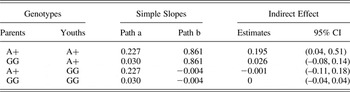
Alternative potential interactions of Difficult Temperament × Youths’ Genotype, Harsh Parenting × Parents’ Genotype, Difficult Temperament × Youths’ Genotype × Parents’ Genotype, and Harsh Parenting × Parents’ Genotype × Youths’ Genotype were tested. None of these interaction terms was significant. The conditional indirect effects were calculated for each Parent × Youth Genotype group (see Table 4). A significant indirect effect linking difficult temperament during preadolescence to AL during young adulthood via increases in harsh parenting during adolescence only emerged when both the parent and youth carried the A+ genotype at rs53576. No indirect effects emerged for other genotype combinations. This analysis supported a moderated mediation pathway linking preadolescent temperament to AL via increases in harsh parenting when both parents and adolescents carried the A+ genotype at rs53576.
Conditional indirect effects (moderated mediation effects) for parent and youth OXTR rs53576 genotype groups

Note: Path a, Temperament to harsh parenting; Path b, harsh parenting to allostatic load; Estimates, Path a × Path b; 95% CI, 95% confidence interval with 1,000 bootstraps.
Discussion
We used a 10-year multiple-wave, multiple-informant design to investigate the operation of childhood temperament, harsh parenting, and OXTR gene polymorphisms in affecting rural African American youths’ AL. The results indicated that difficult temperament predicted increases in harsh parenting and forecasted greater AL, but only when both parents and youths carried the A+ genotype at OXTR rs53576. In addition to replicating findings documented previously relating child temperament to parenting practices (Lengua & Kovacs, Reference Lengua and Kovacs2005) and harsh parenting to offspring physical health (Repetti et al., Reference Repetti, Taylor and Seeman2002), these results also extend the current literature by identifying genetic polymorphisms that explain why some caregivers’ parenting is more or less affected by children's difficult temperaments and, similarly, why some youths’ physical health is more or less affected by harsh parenting.
These results converge with a growing amount of evidence on the stress-buffering and stress-amplifying effects of OXTR allelic variants (Chen et al., Reference Chen, Kumsta, von Dawans, Monakhov, Ebstein and Heinrichs2011; Poulin et al., Reference Poulin, Holman and Buffone2012; Rodrigues et al., Reference Rodrigues, Saslow, Garcia, John and Keltner2009; Tost et al., Reference Tost, Kolachana, Hakimi, Lemaitre, Verchinski and Mattay2010). The study findings are consistent with a central hypothesis about the functions of oxytocin. It induces physiological anxiolytic effects for individuals homogeneous for the G allele by decreasing cortisol levels, inhibiting physiological responses to stress, and attenuating amygdala responsivity to emotional stimuli (Campbell, Reference Campbell2010). These findings have important implications for understanding how naturally occurring variations in the oxytocin system affect both parent–child relationships and offspring health.
The results are also consistent with an emerging literature that addresses the possibility that individual differences in parenting may be partially a function of genetic differences. Genes that influence the oxytocin system recently have attracted empirical attention. Several studies have examined associations between OXTR rs53576 genotype and parental behavior. The A allele has been found to be associated with reduced positive affect (Lucht et al., Reference Lucht, Barnow, Sonnenfeld, Rosenberger, Grabe and Schroeder2009), diminished prosocial behavior (Israel et al., Reference Israel, Lerer, Shalev, Uzefovsky, Riebold and Laiba2009), attachment insecurity (Costa et al., Reference Costa, Pini, Gabelloni, Abelli, Lari and Cardini2009), and low empathy (Rodrigues et al., Reference Rodrigues, Saslow, Garcia, John and Keltner2009), phenotypes that detract from warm and sensitive parental behavior. In most studies, the OXTR rs53576 A allele's association with this phenotype has been confirmed for parents with toddlers (Bakermans-Kranenburg & van IJzendoorn, Reference Bakermans-Kranenburg and van IJzendoorn2008) and school-age children (Klahr et al., Reference Klahr, Klump and Burt2015). These findings suggest that the stronger association found in this study between difficult temperament and subsequent increases in the use of harsh parenting among carriers of A+ alleles may have been due to (a) a lower tolerance for difficult child behavior (anxiolytic effects), (b) a propensity for disinterested parenting, or (c) a combination of both. Future research is needed to examine these potential explanations.
The disparate patterns by genotype are striking and support differential susceptibility theory (Belsky & Pluess, Reference Belsky and Pluess2009). The rs53576 A allele seemed to function as a marker of plasticity; it not only appeared to render parents and adolescents more susceptible to temperament difficulty and harsh parenting but also provided benefits under conditions of easy temperament and good parenting. These results raise the possibility that the A+ polymorphism is not invariably detrimental, but only in conjunction with certain behavioral characteristics and rearing practices. Accordingly, results from the study are consistent with other recent findings showing differential susceptibility effects for genes associated with the oxytonergic systems (e.g., Sturge-Apple, Cicchetti, Davies, & Suor, Reference Sturge-Apple, Cicchetti, Davies and Suor2012; Hammen, Bower, & Cole, Reference Hammen, Bower and Cole2015); furthermore, differential susceptibility effects involving OXTR rs53576 were evinced in two G × E interactions: one involving African American adult caregivers in relation to child temperament and the second involving African American adolescents in relation to harsh parenting.
The results from the current study add to the growing literature supporting the proposition that poor health in adulthood is tied to experiences earlier in life, particularly for persons reared in harsh family environments. This body of research has documented the effects of harsh parenting on a range of health outcomes, including inflammatory activity (Miller & Cole, Reference Miller and Cole2012), telomere length (Beach, Lei, Brody, Yu, & Philibert, Reference Beach, Lei, Brody, Yu and Philibert2014), AL (Danese & McEwen, Reference Danese and McEwen2012), and, as identified in the current study, AL. As an important qualification, results from the current study indicated that these parenting effects on AL were only evident for youth with a particular genetic status. Consistent with our expectations, individuals’ OXTR genotype explained why some youth, despite exposure to harsh parenting, do not present compromised physical health biomarkers. In addition to informing the literature on factors that set boundary conditions determining when particular family environments do (and do not) affect offspring physical health, these genetic moderation findings also inform research on youth resilience. To date, the locus of resilience effects has been situated in multilevel contextual processes (e.g., family, peer, school, or neighborhood) that promote positive development in the midst of adverse conditions. As others have suggested (Caspi, Hariri, Holmes, Uher, & Moffitt, Reference Caspi, Hariri, Holmes, Uher and Moffitt2010; Rutter, Reference Rutter2012), the present results indicate that innate biological characteristics of the individual also contribute to youth resilience, at least with respect to physical health outcomes.
The limitations of this study should be noted. Further replications with hard end points such as diabetes, metabolic syndrome, and asthma are indicated. Only one genetic polymorphism was examined; this does not represent all of the variation that could place individuals at greater susceptibility to influences from their environment. Many genetic variants may heighten risk (or conversely, promote positive adaptation), the expression of which may emerge only under particular contextual conditions. It also is not known whether the results generalize to Caucasian or Latino families living in rural or urban communities. The findings’ applicability with ethnically, socioeconomically, and residentially diverse participants must be established empirically. Caution is also warranted in interpreting and generalizing the plasticity effects of the OXTR genotype to all rural African American emerging adults. Parent and youth genetic status may confer differential susceptibility to environmental conditions in some outcomes of interest (i.e., parenting and physical health, respectively), but be less sensitive in predicting other outcomes, such as aspects of vocational/academic achievement and risk behaviors. Although genetically influenced difficult youth temperament can be confounded with symptoms of attention-deficit/hyperactivity disorder, we did not collect clinical data on diagnosable behavior disorders. The OXTR genotype was not associated with environmental conditions in the present study, ruling out gene–environment correlation as an alternative explanation for the results. Given previous findings linking OXTR to observed parenting behavior (Bakermans-Kranenburg & van IJzendoorn, Reference Bakermans-Kranenburg and van IJzendoorn2008), however, future studies in this area that explore G × E hypotheses should continue to consider potential gene–environment correlation confounds. Finally, body mass index was used as the indicator for adiposity; future research should consider more direct assessments of adiposity such as fasting leptin and insulin levels or dual-energy X-ray absorptiometry.
The strengths of the study included a 10-year prospective research design with multiple waves of data on temperament, harsh parenting, and AL, as well as OXTR genotypes for parents and children. Assessments were collected from multiple reporters (i.e., teachers, parents, and youths), reducing concerns about common method variance. Implications for prevention should also be considered. The present results suggest that parents who have a sensitivity gene or other factors that predispose them to be particularly reactive to their environment who also are rearing a child with a difficult temperament are at high risk for maladaptive parenting processes. Similarly, youths with such sensitivities to environmental conditions who receive harsh parenting appear to be at heightened risk for compromised physical health. Research on the design of preventive intervention for these youths and parents may yield approaches that are effective in promoting positive parenting processes and overall health within the family.