Introduction
Research demonstrates a genetic component in the etiology of substance use and misuse in both sexes (McGue et al. Reference McGue, Pickens and Svikis1992; van den Bree et al. Reference van den Bree, Johnson, Neale and Pickens1998; Kendler et al. Reference Kendler, Karkowski and Prescott1999, Reference Kendler, Jacobson, Prescott and Neale2000; Agrawal & Lynskey, Reference Agrawal and Lynskey2008). However, heritabilities tend to be greater in adult males compared to adult females for substance misuse (Sivkis et al. Reference Svikis, Velez and Pickens1994; van den Bree et al. Reference van den Bree, Johnson, Neale and Pickens1998; Li et al. Reference Li, Cheng, Ma and Swan2003). Environmental variables such as peer group and family dysfunctions also play a role (Petraitis et al. Reference Petraitis, Flay and Miller1995), particularly at younger ages. In contrast to adults, however, a sex difference in etiology has not been exhibited in adolescence (McGue et al. Reference McGue, Elkins and Iacono2000; Rhee et al. Reference Rhee, Hewitt, Young, Corley, Crowley and Stallings2003). The results of this research are intriguing and suggest that genetic factors are important in adulthood, shared environmental factors are important at younger ages, and sex differences in these factors are only found in adulthood. Longitudinal twin designs have supported this (Koopmans et al. Reference Koopmans, Doornen and Boomsma1997; Viken et al. Reference Viken, Kaprio, Koskenvuo and Rose1999; White et al. Reference White, Hopper, Wearing and Hill2003; Malone et al. Reference Malone, Taylor, Marmorstein, McGue and Iacono2004; Hicks et al. Reference Hicks, Blonigen, Kramer, Krueger, Patrick, Iacono and McGue2007; Kendler et al. Reference Kendler, Gardner, Annas and Lichtenstein2008a,b,c) but no study has examined sex differences in this developmental process.
Additionally, recent work has begun to examine whether the genetic and environmental risk factors for substance use are substance specific. In general, the results indicate that risk for substance use is not substance specific but places individuals at risk to use a wide range of substances (Tsuang et al. Reference Tsuang, Lyons, Meyer, Doyle, Eisen, Goldberg, True, Lin, Toomey and Eaves1998; Kendler et al. Reference Kendler, Jacobson, Prescott and Neale2003; Young et al. Reference Young, Rhee, Stallings, Corley and Hewitt2006). Moreover, this general vulnerability impacts across substances classes (Han et al. Reference Han, McGue and Iacono1999; Young et al. Reference Young, Rhee, Stallings, Corley and Hewitt2006; Kendler et al. Reference Kendler, Myers and Prescott2007). Importantly, this general vulnerability has yet to be examined developmentally.
Overall, there is substantial evidence for both genetic and shared environmental influences on substance use. The importance of these factors changes throughout development, with increasing genetic and decreasing shared environmental effects. These factors also seem to be largely non-specific in nature. In this report we examine, for the first time to our knowledge, three important questions about risk for substance use: (1) Is there a general vulnerability from early adolescence to young adulthood? (2) If so, do the genetic and environmental influences on this vulnerability, and also any substance-specific risks, change across development? (3) Do these developmental processes differ in males and females? We hypothesized that a general vulnerability factor would impact on consumption of alcohol, tobacco and illicit substances across development, with genetic factors increasing and shared environmental factors decreasing in importance, and there would be no sex differences in these developmental processes.
Method
Sample and assessment
The present sample, the Swedish Twin Study of Child and Adolescent Development, began with all twin pairs born in Sweden between May 1985 and December 1986 (Lichtenstein et al. Reference Lichtenstein, Tuvblad, Larsson and Carlstrom2007). Twins were recruited through linkage to the Medical Birth Registry and twins and parents identified were sent study questionnaires (Lichtenstein & Svartengren, Reference Lichtenstein and Svartengren1997). Participants had completed four assessment waves and information from waves 2–4 was used for the present study, when twins were aged 13–14, 16–17 and 19–20 years. Responses rates for each wave were 78, 82 and 59% respectively. The Ethics Committee of Karolinska Institutet, Stockholm, Sweden, approved the questionnaires used. In Sweden, responding to the questionnaire constitutes consent.
The current report included 246 female–female and 238 male–male monozygotic (MZ) twin pairs, 181 female–female and 169 male–male dizygotic (DZ) twin pairs, and 392 opposite-sex twin pairs. Zygosity was determined based on computer algorithms of questionnaire responses created from analyses of twin pairs participating in the clinical study with known zygosity (Lichtenstein et al. Reference Lichtenstein, Tuvblad, Larsson and Carlstrom2007).
Self-reported alcohol, tobacco and illicit drug consumption was assessed. Unfortunately, the same assessment items were not used at all time waves so categories were created to make questions comparable across waves. Categories were based on wave 2 questions, where specific frequency options were identified as ‘never’, ‘sometimes’ and ‘often’. In all waves, twins were asked to consider the previous 12 months.
For tobacco consumption, three categories were created to reflect regular smoking: 0=not a regular smoker, 1=smoke sometimes/once in a while (i.e. only sometimes, only at parties, only on weekends), and 2=smoke often (i.e. almost daily, daily). The ‘not a regular smoker’ category includes those individuals who stated they had never smoked and also those who indicated that they had only ‘tried it’ or ‘quit’. This was done because of the phrasing of the question at waves 3 and 4. Participants were asked: ‘Do you smoke?’ with two responses stating: ‘No, I've only tried it’ or ‘No, I quit’.
Three alcohol consumption categories were generated and reflect frequency of alcohol intoxication. Categories indicate whether the participant (0) had ever been intoxicated (never), (1) had been intoxicated sometimes (i.e. seldom, sometimes when drinking), or (2) had been intoxicated often (i.e. every time drinking, always). Never intoxicated includes non-drinkers and those participants who responded ‘No’ to ‘Have you ever drank so much that you got drunk?’ Categories reflect alcohol intoxication because general alcohol use was not assessed. A binary category was created for any illicit drug consumption reflecting use or no use because wave 2 participants were only asked if they had ever tried marijuana or illicit drugs (e.g. amphetamine, heroin, ecstasy or ‘something similar’) and were not asked to identify the drugs.
Statistical analysis
To examine whether a general vulnerability exists for substance consumption at each assessment wave, common and independent pathway models were fit to the three substances within each wave, separately in males and females (excluding members of opposite-sex pairs). Both models assume that a common factor influences the observed variables but differ in the way the common factor(s) influence the variables. In the independent pathway model, the common genetic and environmental factors influence the observed variables directly, with separate genetic and environmental components estimated for each of the variable residuals.
The common pathway model asserts that there is a latent factor underlying the observed variables. The variance in this factor is partitioned into genetic and environmental components, and residual genetic and environmental components not encompassed by this factor are also estimated for each variable. This model uses fewer parameters and is more parsimonious than the independent pathway model. Therefore, if this model fits as well as the independent pathway model, it is preferred.
Longitudinal twin model
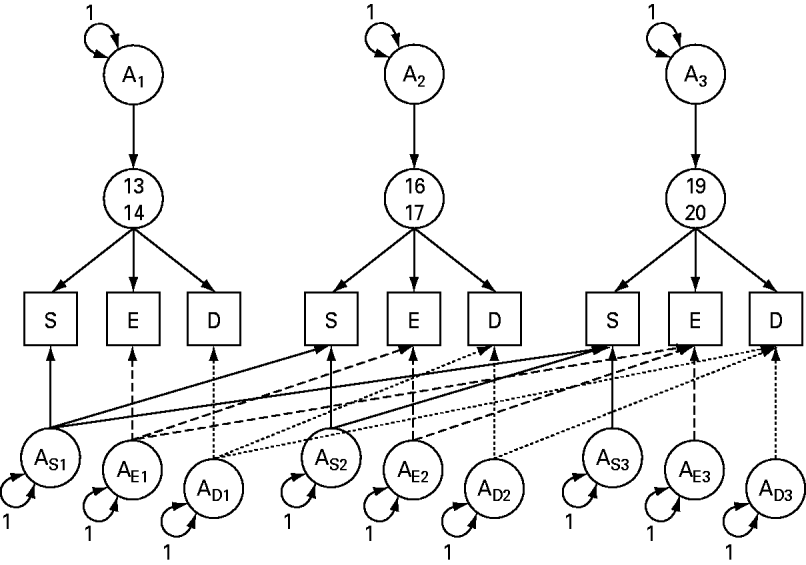
To examine whether the genetic and environmental influences on substance consumption are ‘developmentally stable’ or ‘developmentally dynamic’, we used the model presented in Fig. 1, which illustrates additive genetic sources only. This model is based on a common pathway model and has three main features. First, the model contains a substance consumption factor for each wave that encompasses those influences that impact on all three substances. There are paths from each of the common factors to the specific substances at each time wave that indicate the degree to which the liability for each specific substance is reflected by the common factor.
Genetic components of the full model fitted to self-report measures of smoking (S), alcohol intoxication (E), and illicit drug consumption (D) at ages 13–14, 16–17 and 19–20 years. A1, A2 and A3, additive genetic effects for ages 13–14, 16–17 and 19–20 respectively; As1, Ae1 and Ad1, specific additive genetic effects for smoking, alcohol intoxication and illicit drug use respectively at age 13–14; As2, Ae2 and Ad2, specific additive genetic effects for smoking, alcohol intoxication and illicit drug use respectively at age 16–17; As3, Ae3 and Ad3, specific additive genetic effects for smoking, alcohol intoxication and illicit drug use respectively at age 19–20.
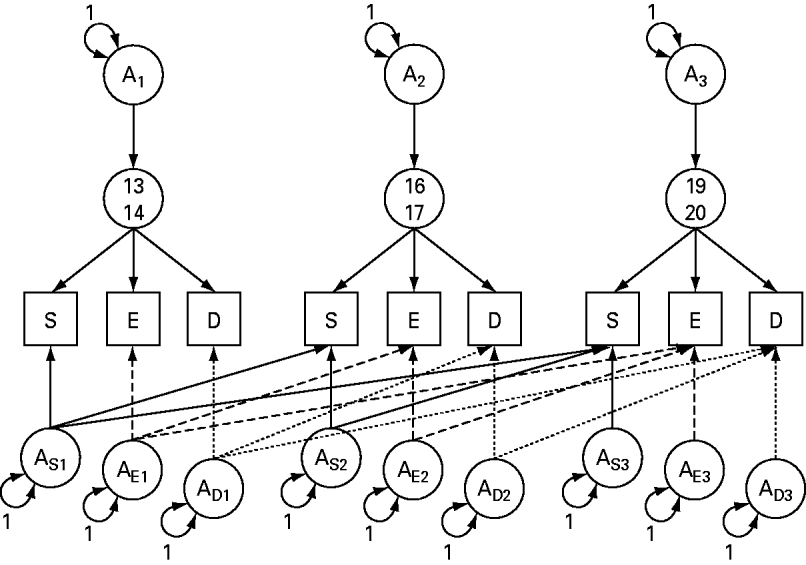
Second, these common factors are influenced by genetic and environmental parameters, which are parameterized as a trivariate Cholesky decomposition. Within this decomposition, the first genetic factor influences the common substance consumption factor at all three waves. The second genetic factor influences the common factor at waves 2 and 3 whereas the third genetic factor only influences the common factor at wave 3. If the genetic liability to the common factors is developmentally stable, we would expect all of the genetic liability to substance consumption to be captured in the first factor, with no evidence for innovation at the latter two. If liability is developmentally dynamic, we would expect to see innovation or new genetic variance in the second and third factors.
Third, this model includes residual genetic and environmental influences that are specific to each substance. These factors are also modeled as a Cholesky decomposition over time and include effects that are time and substance specific and also cross paths within substance cross-time. The magnitude of these paths is interpreted as described above.
Sex differences
The longitudinal model included all five zygosity groups, allowing for the examination of quantitative and qualitative sex differences. Quantitative effects examine whether the magnitude of genetic or environmental effects differs between the sexes (Kendler & Prescott, Reference Kendler and Prescott2006). Qualitative effects examine whether the same genes are involved in the etiology of substance consumption in the sexes and are measured by the genetic correlation (r g). This correlation reflects the degree of resemblance between the genetic risk factors for males and females and can vary from zero (i.e. entirely distinct set of genes) to one (i.e. identical genetic factors). When examining for sex differences it is assumed there is only one correlation structure for both sexes, but males and females may have different loadings on these factors (Neale et al. Reference Neale, Roysamb and Jacobson2006). However, the Choleksy decomposition allows for different correlation structures to be estimated for males and females. Thus, a constraint was added to constrain male and female correlation structures to equality (Carey, Reference Carey2005; Neale et al. Reference Neale, Roysamb and Jacobson2006).
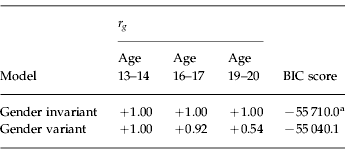
Given the complexity of the model, the large number of possible simplifications, our moderate sample size and evidence that full models can best capture subtle genetic and environmental effects (Sullivan & Eaves, Reference Sullivan and Eaves2002), we tested only two models. The first assumed no quantitative or qualitative sex effects by constraining path coefficients across males and females and constraining r g to 1.0 at all waves. The second model included both quantitative and qualitative sex effects. The Bayesian information criterion (BIC), which performs well with complex models (Markon & Krueger, Reference Markon and Krueger2004), was used to determine the best-fit model. Analyses were conducted using an ordinal, raw data approach in the statistical package Mx (Neale, Reference Neale1997), which allows data from both incomplete and complete twin pairs to be used. Thresholds were unconstrained across sex and allowed to be freely estimated.
Results
Descriptive statistics
Substance consumption frequency increased across waves. Examining the ‘have consumed’ categories, very few participants endorsed smoking often (2%), becoming intoxicated often (1.1%) or having used an illicit drug (1.1%) at age 13–14. At age 16–17, more participants reported alcohol intoxication sometimes (35.1%) and often (25%) compared to smoking sometimes (14%) or often (8%). Five percent of the sample reported illicit drug use at this age. Finally, at age 19–20, 15% of participants reported smoking sometimes, 12% reported smoking often, 47% reported intoxication sometimes, and 41% reported drinking to intoxication often. Illicit drug use rates more than doubled at this age to 13.3%.
Before beginning the twin analyses we examined whether the categories created for smoking and alcohol consumption were within the same continuum of liability. This was done by estimating the tetrachoric correlations (and thresholds) separately for each of the zygosity groups for these variables. χ2 was not significant for smoking or alcohol consumption at wave 2 (χ2=8.4, p=0.21; χ2=7.0, p=0.32) or wave 4 (χ2=6.4, p=0.37; χ2=6.0, p=0.42), suggesting that these variables satisfy assumptions of multivariate normality. However, χ2 was significant for both substances at wave 3 (χ2=14.6, p<0.05; χ2=19.5, p<0.05). Analyses were repeated separating twins by age (>16.5 or ⩽16.5 years) and χ2 was no longer significant. This suggests that wave 3 variables are approximately multivariate normal and the differences detected in our initial analysis are due to age.
Twin analyses
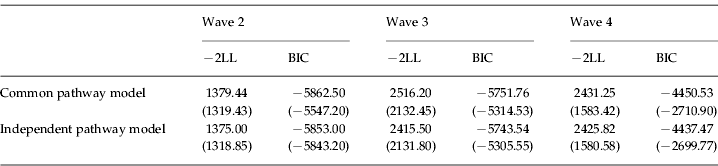
The best-fitting model for all waves for both sexes was the common pathway model, so this model was used in follow-up longitudinal analyses (Table 1). For the longitudinal models, the best BIC value was obtained for the model assuming no quantitative or qualitative sex effects (Table 2).
BIC scores for within-wave common and independent pathway models
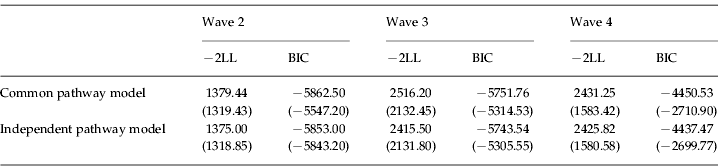
BIC, Bayesian Information Criterion; LL, log likelihood.
Male model fits shown in parentheses.
BIC scores for qualitative and quantitative sex-effects models
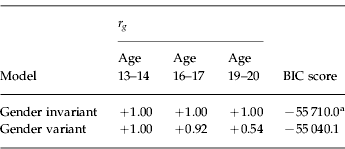
BIC, Bayesian Information Criterion; r g, genetic correlation, which assesses the degree of qualitative sex effects.
a Best-fit model by BIC criterion.
Longitudinal twin analysis
Common genetic and environmental effects
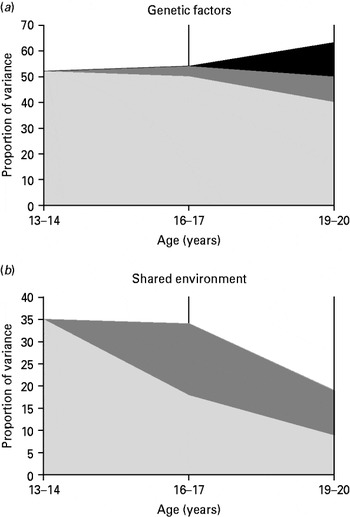
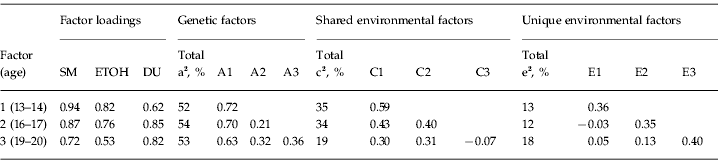
Examining the ‘upper portion’ of the model, six results are noteworthy (Table 3). First, illicit drug use becomes a better representative of the latent factor with increasing age whereas smoking and alcohol intoxication become less representative. Second, heritabilities for the common factors remained stable across development, estimated at 52% for age 13–14, 54% for age 16–17, and 53% for age 19–20. Third, these genetic effects demonstrated evidence for stable and dynamic risk. As illustrated in Fig. 2a, genetic factors at age 13–14 (shown in gray) accounted for a majority of the genetic effects at ages 16–17 and 19–20. However, innovation was also exhibited. Of the total genetic influences at age 16–17, 7% (4% out of a total of 54%) are new genetic factors (shown in dark gray), and at wave 4, 25% (13% out of a total of 53%) of the genetic influences are new factors specific to this age (shown in black).
Proportion of total variance in substance consumption common factors accounted for by (a) genetic and (b) shared environmental effects at ages 13–14 ( , Factor 1), 16–17 (
 , Factor 2) and 19–20 (▪, Factor 3). The y axis represents the total phenotypic variance so the sum of all the factors equals total heritability.

Path estimates for the best-fit model of substance consumptionFootnote a
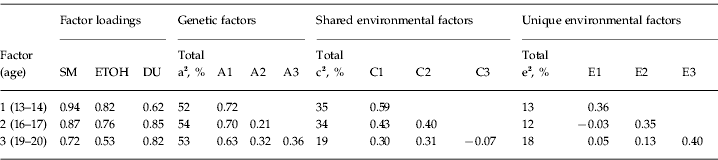
Factor loading, depicted in Fig. 1, connects the common factor to self-reported substance use; a2, heritability or proportion of variance in substance use resulting from genetic factors; c2, proportion of variance in substance use resulting from shared environmental factors; e2, proportion of variance in substance use resulting from unique environmental factors; A1, A2 and A3, additive genetic path estimates at ages 13–14, 16–17 and 19–20 respectively; C1, C2 and C3, shared environment path estimates at ages 13–14, 16–17 and 19–20 respectively; E1, E2 and E3, unique environment path estimates at ages 13–14, 16–17 and 19–20 respectively; SM, regular smoking; ETOH, alcohol intoxication; DU, illicit drug use.
a Results for ‘upper portion’ of the model only (Fig. 1).
Fourth, shared environmental effects on the latent factors were more important at younger ages, and new effects almost disappeared in young adulthood. Fifth, these effects demonstrated evidence of stability and developmental attenuation. As illustrated in Fig. 2b, shared environmental factors at age 13–14 (shown in gray) accounted for 53% (18% out of a total of 34%) of the variance at age 16–17 and 47% (9% out of a total of 19%) at age 19–20. A small amount of new effects were introduced at age 16–17 (shown in dark gray). Finally, total common unique environmental effects also remained similar across development, being estimated at 13, 12 and 18% respectively, and showed almost no continuity.
Substance-specific effects
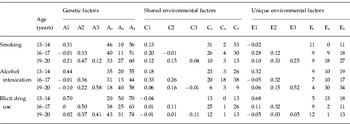
Several noteworthy substance-specific results were obtained, as shown in Table 4. For the reader's reference, genetic and environmental effects for each substance were calculated as follows using smoking at age 16–17 as an example: total common genetic effects were determined by multiplying the factor loading for this age (0.70) by the common genetic estimates for this age (0.87 and 0.21), provided in Table 3, squaring these results, and then adding them [(0.70×0.87)2+(0.70×0.21)2]. Residual smoking-specific genetic and environmental effects were determined by squaring the residual estimates provided in Table 4. Smoking-specific genetic effects at age 16–17 were calculated as [(–0.012)+(0.332)]. Adding the results of these two calculations provided the total genetic/environmental effects for the substance.
Path estimates for residual genetic and environmental effectsFootnote a and total genetic and environmental influences on smoking, alcohol intoxication and illicit drug useFootnote b

A1, A2 and A3, additive genetic path estimates at ages 13–14 , 16–17 and 19–20 respectively; Ac, percentage of genetic effects due to common factors; As, percentage of genetic effects due to specific factors; At, total genetic effects; C1, C2 and C3, shared environment path estimates at ages 13–14, 16–17 and 19–20 respectively; Cc, percentage of shared environmental effects due to common factors; Cs, percentage of shared environmental effects due to specific factors; Ct, total shared environmental effects; E1, E2 and E3, unique environment path estimates at ages 13–14, 16–17 and 19–20 respectively; Ec, percentage of unique environmental effects due to common factors; Es, percentage of unique environmental effects due to specific factors; Et, total unique environmental effects. Totals may not equal 100% due to rounding error.
a Results for ‘lower portion’ of the model only (Fig. 1).
b Total genetic and environmental influences on smoking, alcohol intoxication, and illicit drug use at waves 2–4, including common and substance-specific/residual influences.
Smoking
There was a minimal increase in total genetic estimates for smoking from age 13–14 to age 19–20 (56% v. 60%). However, these effects decreased from age 13–14 to age 16–17. By contrast, examining the common genetic effects and smoking-specific genetic effects reveals a consistent trend, with common genetic effects decreasing and smoking-specific genetic effects increasing across development. Additionally, of all the substances, the cross-time continuity of the residual genetic effects was highest for smoking, with almost no new specific genetic effects estimated at age 19–20.
Total shared environmental estimates decreased consistently across the age groups. There was also a decrease in common shared environmental effects. Of note, smoking-specific shared environmental effects were minimal yet consistent across the ages. The specific shared environmental effects at age 13–14 accounted for a small amount of the variance of specific effects at age 16–17.
Total unique environmental effects revealed a consistent trend to increase in importance with age. Smoking-specific unique environmental effects also increased in importance whereas common unique environmental effects remained fairly consistent across development. Of note, at age 13–14 all of the unique environmental variance was accounted for by the common factor. A small amount of cross-time continuity for specific unique environmental effects was shown between ages 13–14 and 16–17 and ages 16–17 and 19–20.
Alcohol intoxication
Total genetic effects for alcohol intoxication did not reveal a clear trend of increasing or decreasing across development. Total genetic effects decreased from age 13–14 to age 16–17 (55% v. 44%). However, these effects increased to 58% at age 19–20. Similar to smoking, however, genetic effects became more specific across development, with common genetic estimates decreasing and alcohol intoxication-specific genetic estimates increasing. Finally, examining the cross-time continuity of the alcohol-specific genetic effects indicated that alcohol intoxication had the lowest continuity, with 87% of the specific genetic effects at 19–20 being new.
Total shared environmental effects decreased in importance. This same trend was shown for common shared environmental effects as these effects became almost non-existent by age 19–20. However, the trend was less consistent for alcohol intoxication-specific shared environmental effects. At ages 13–14 and 19–20 specific estimates were equal (3%) whereas there was a spike in these effects at age 16–17 (18%). The cross-time continuity of the residual shared environmental estimates was minimal.
Total and alcohol intoxication-specific unique environmental effects increased consistently across development. In addition, there was no cross-time continuity of the specific effects. Common unique environmental effects were minimal and decreased slightly across age.
Illicit drugs
Total genetic effects for illicit drug consumption decreased slightly from age 13–14 to age 16–17 (70% v. 63%) yet increased at age 19–20 (74%). In contrast to smoking and alcohol intoxication, common genetic effects increased consistently across the age groups whereas specific effects decreased by almost half from age 13–14 (50%) to ages 16–17 (25%) and 19–20 (31%).
The picture for environmental effects was slightly different for illicit drugs. Total shared environmental effects were the same at ages 13–14 and 19–20 (13%). However, these effects doubled (26%) at age 16–17. Additionally, a majority of the shared environmental effects were accounted for by the common factors. Total unique environmental estimates decreased minimally across the ages whereas common estimates increased. Specific unique environmental estimates dropped sharply from age 13–14 (13%) to age 16–17 (2%) and 19–20 (1%) and no cross-time continuity was revealed.
Discussion
As hypothesized, the results show a general vulnerability to substance consumption from early adolescence to young adulthood. However, the representativeness of the factors changes across development. This could indicate that the common genetic factors reflect a more severe liability to substance use, indexed by smoking and alcohol consumption at younger ages, due to the low prevalence of illicit drug use at younger ages.
The results also indicate that the genetic and environmental effects on this general vulnerability are developmentally dynamic and stable, although evidence is stronger for stability. Common genetic effects at age 13–14 accounted for a majority of the common genetic effects at ages 16–17 and 19–20. In contrast to our hypothesis, we did not see common genetic effects increase with age. However, there was a general trend for substance-specific genetic effects to increase with age. This is perhaps our most intriguing finding. That is, with increasing age, genetic influences on substance consumption become more specific in their effect.
Common shared environmental effects also showed substantial continuity and, as hypothesized, decreased in importance across development, on both the common factor and substance-specific residuals. There was, however, a small peak of new effects during adolescence. In addition, for alcohol and illicit drug consumption, shared environmental effects were greatest at this age. This is in contrast to previous studies, which have shown a smooth decline (Koopmans & Boomsma, Reference Koopmans and Boomsma1996; Koopmans et al. Reference Koopmans, Doornen and Boomsma1997; Viken et al. Reference Viken, Kaprio, Koskenvuo and Rose1999). These new effects may be due to a life transition in the lives of participants during this age. For example, at the age of 16, Swedish adolescents move to ‘upper secondary school’, which is the equivalent of high school in the USA. During this time, students choose the type of studies they will pursue (e.g. vocational versus university preparation).
There was almost no continuity in common unique environmental effects. This is not surprising, given these effects are confounded with measurement error, which would have a time-specific impact. The impact of unique environment might also be expected to increase with age as twins spend more time outside of the family, yet the results revealed only a slight increase. This may be reflected in the increase in substance-specific genetic effects as choice of non-familial environments might be genetically influenced (Viken et al. Reference Viken, Kaprio, Koskenvuo and Rose1999). However, for smoking and alcohol intoxication, specific unique environmental effects did increase with age.
We were also interested in whether the substance-specific genetic and environmental influences were developmentally dynamic or stable. In general, the results suggest that these influences are almost entirely dynamic in nature as genetic and environmental effects at age 13–14 attenuated over time. Additionally, confirming our final hypothesis, we found no evidence for sex differences.
Comparison to prior studies
To our knowledge, no single previous report has examined the same three questions investigated here. However, we are able to make comparisons to previous studies. First, our report confirms a general vulnerability to substance use (Swan et al. Reference Swan, Carmelli and Cardon1996; Tsuang et al. Reference Tsuang, Lyons, Meyer, Doyle, Eisen, Goldberg, True, Lin, Toomey and Eaves1998; Hettema et al. Reference Hettema, Corey and Kendler1999; Kendler et al. Reference Kendler, Jacobson, Prescott and Neale2003, Reference Kendler, Myers and Prescott2007). A previous examination of the covariation between tobacco, alcohol and other substance use at ages 17–18 also showed that a common factor was responsible for covariance (Han et al. Reference Han, McGue and Iacono1999). However, Han et al. (Reference Han, McGue and Iacono1999) reported the heritability of the substance use factor at 23% whereas shared environment contributed 62%. Our estimates at age 16–17 were 54% and 34% respectively. The reasons for this discrepancy are difficult to determine but may be due to sample characteristics, length of assessment period or differing definitions of substance use.
Comparing results to the developmental processes of specific substances also shows similarities. For example, genetic factors increase whereas shared environmental factors decrease with age for a variety of substances (Koopmans & Boomsma, Reference Koopmans and Boomsma1996; Koopmans et al. Reference Koopmans, Doornen and Boomsma1997; Pagan et al. Reference Pagan, Rose, Viken, Pulkkinen, Kaprio and Dick2006). Our modeling confirms this by showing, in general, a decrease in both common and residual shared environmental effects and an increase in substance-specific genetic effects across age.
No previous report has examined qualitative sex differences in adolescence. However, several reports show no evidence for quantitative sex differences for tobacco initiation, use, problem use and dependence, illicit drug use or abuse, and alcohol initiation, frequency of use, intoxication, problem use and frequency of intoxication during adolescence (Han et al. Reference Han, McGue and Iacono1999; Viken et al. Reference Viken, Kaprio, Koskenvuo and Rose1999; McGue et al. Reference McGue, Elkins and Iacono2000; Rhee et al. Reference Rhee, Hewitt, Young, Corley, Crowley and Stallings2003; Poelen et al. Reference Poelen, Derks, Engels, van Leeuwe, Scholte, Willemsen and Boomsma2008). Additionally, two studies examined quantitative effects on a ‘general vulnerability’ to substance use in adolescence. One report showed no significant sex differences (Han et al. Reference Han, McGue and Iacono1999) whereas the second reported increasing heritability estimates for males and increasing environmental variance for females on an ‘externalizing factor’ (including nicotine, alcohol and illicit drug dependence) from age 17 to 24 (Hicks et al. Reference Hicks, Blonigen, Kramer, Krueger, Patrick, Iacono and McGue2007).
There are several limitations to this report that warrant discussion. First is the sample size and associated modest statistical power, especially for the detection of sex effects (Prescott & Gottesman, Reference Prescott and Gottesman1993). It is possible that we did not have the power to detect these differences. Second are the limitations with the substance use measure. Most notably is that the questions asked were not consistent across waves so we were forced to create comparable categories. A self-report questionnaire was also used that was mailed to the participant's home. However, participants may be more likely to reveal private information in this manner.
Third, the sample comes from a single birth cohort in Sweden, and substance use rates may differ between the USA and Sweden. Sweden, along with most European countries, has more liberal laws and attitudes with regard to alcohol use, which are thought to foster more responsible drinking in young people. However, European youth in fact drink alcohol and become intoxicated more often than American youth (U.S. Department of Justice, 2005).
Within our own sample, rates of alcohol intoxication (58% of the total sample having been intoxicated) for 16- to 17-year-olds were greater than the annual prevalence of 10th graders in the USA (30%) (Monitoring the Future, 2008). Additionally, the 16- to 17-year-olds had a dramatically lower prevalence of illicit drug use (4.4% of the total sample) compared to the 12-month prevalence of 10th graders in the USA (27%) (Monitoring the Future, 2008). However, 10th-grader lifetime rates (12-month prevalence not assessed) of smoking (31.7%) were similar to the 12-month prevalence (22%) for our 16- to 17-year-olds (Monitoring the Future, 2008). These differences could impact the generalizability of results outside of a Swedish/European population. Importantly, our substance use rates appear in line with rates of use in Sweden. The European School Survey Project on Alcohol and Other Drugs (ESPAD, 2003) reported that 81% of Swedish 17- to 18-year-olds had been intoxicated, 8% had used marijuana, and 2% had used other illicit drugs in the previous 12 months.
Conclusions
This report has important implications for psychiatric genetics. Although the results showed continuity, genetic and environmental changes were also revealed. Psychiatric genetics often assumes a static genome, and the findings of the current study suggest that, to a small extent, this assumption is incorrect. Therefore, gene identification studies need to take into consideration the age of the sample, and that genes (and environments) found to be important within one age group may not be important in another. Another important implication is the increasing specificity of genetic effects. It is unclear what neurobiological or psychological processes are responsible for the increasing specialization of genetic effects.
Acknowledgments
This research was supported by T32-MH-020030 (J.H.B. and H.H.M.). A portion of the analyses conducted was supported by T32-DA-007027 (J.H.B.). This research was also supported by funds from the Swedish Council for Working Life and Social Research (P.L.), the Swedish Research Council (P.L.) and the Virginia Tobacco Settlement Foundation (H.H.M. and K.S.K.), and grants R01-DA018673 (H.H.M.), R01-DA022989 (H.H.M.), U01-DA024413 (H.H.M.), AA-011408 (K.S.K.) and DA-011287 (K.S.K.).
Declaration of Interest
None.