INTRODUCTION
Hemodialysis is a palliative and often long-term treatment for patients with established renal failure (ERF). One of the most challenging aspects of managing life on hemodialysis for patients with minimal or absent urinary output is that of restricting their fluid intake in between each dialysis session. Weight gain in between each dialysis treatment is used as an indirect index of the amount of fluid ingested by the patient during that period. Each patient is advised on the maximum amount of weight to be gained during the interdialytic period, if they are to remain well. Unfortunately, poor fluid management (i.e., exceeding the advised amount of fluid and thus weight gain), resulting in volume overload, is a common problem for hemodialysis patients with low urinary output. There is an increased risk of mortality if patients exceed more than 5.7% of their dry weight in between each dialysis (Leggat et al., 1998; Saran et al., 2003), and volume overload is a known contributor to predialysis hypertension and a cause of pulmonary edema. Patients also experience unpleasant symptoms including breathlessness and a sensation of “sluggishness” on a regular basis as a result of poor fluid management, and volume-overloaded patients tend to experience more hypotensive episodes during dialysis (Levy et al., 2001). Anecdotal evidence suggests that the ill effects of these episodes can carry over to the postdialytic period and then the interdialytic interval, when patients complain of increased fatigue and feeling less well. In combination, these experiences further erode quality of life in a clinical population already subject to a profoundly compromised lifestyle. Furthermore, patients who repeatedly present for dialysis in a volume-overloaded state can easily generate tension on busy dialysis units with limited resources. This is simply because it is often distressing, difficult, and time-consuming for staff to know how best to help such patients.
Pragmatic and effective ways of helping patients with fluid management are lacking, and overall the results of intervention studies in this area have been disappointing (Sharp et al., 2005a). Cognitive behavior therapy (CBT) is a structured psychological approach aimed at helping patients to change their beliefs and thus behavior to effect change. CBT is thought to bridge the intention–behavior gap and has been used to improve fluid management with some effect (Sharp et al., 2005b). Motivational interviewing (MI) is a counseling technique to help patients to explore and resolve ambivalence to the same end (Rollnick et al., 1999). The aims of this case series were twofold: to explore the extent to which the principles of MI and CBT could be used to improve fluid management and to determine the acceptability of the intervention to this patient group. There were two hypotheses of equal importance. The first was that the delivery of a psychological intervention drawing on the traditions of CBT and MI would be associated with a reduction in interdialytic weight gain. The second hypothesis was that patients would experience this approach to fluid management positively.
METHODS
Three men and two women were recruited from a satellite hemodialysis unit. Patients were referred by nursing staff on the unit and were regarded as having problems with fluid management. Each patient had a urinary output of 500 ml or less per day. Details were collected on age, sex, and marital and occupational status. Ethnicity was also recorded for each subject.
Data on interdialytic fluid gains were collected for 12 dialysis sessions prior to the intervention, during the intervention period, and then during two 3-month follow-up periods. The first follow-up period comprised the time between discharge and 3-month follow-up and the second, the time between 3- and 6-month follow-ups. Fluid gains for each interdialytic period were calculated in absolute terms and then as a percentage of dry weight gained. A distinction was made between fluid gained during an interdialytic interval of a single day (short interval gain) and those gains resulting from a two-day interval (long interval gains, normally spanning the weekend period).
A treatment evaluation form was used to assess each patient's perception of the intervention, and patients were asked about their experience of the intervention as the study progressed.
A CBT framework (addressing beliefs, behaviors, and emotional and physical feelings) was used to elicit and assess the relative contribution of self-reported factors influencing thirst and drinking. Each patient was offered up to 12 treatment sessions. Standard dietetic advice regarding sodium intake was reinforced during the intervention period and each patient was offered a small plastic jug so that intake could be measured with relative ease and accuracy. Patients were also provided with a daily thirst, fluid, and activity diary that they were encouraged to keep for at least 2 weeks. This was intended to provide a profile of drinking throughout the week and elicit relevant dietetic and psychosocial factors, so patients could identify triggering circumstances for fluid intake.
Interdialytic fluid gains for the 3 months prior to intervention were reviewed with each patient. All gains below 3% of the current dry weight for that time were highlighted as examples of successful periods of fluid management by the patient (Levy et al., 2001). A further distinction was also made between fluid gains during the long-interval and those made during the short-interval period. Lower long-interval gains were then also highlighted as examples of more successful fluid management given the configuration of dialysis services at the unit. An exercise demonstrating the effect of attention on thirst intensity and the value of distraction was also carried out with each of the patients (Fisher, 2004). During the intervention period interdialytic weight gains were recorded for patients as feedback. As the study progressed, graphs indicating the 3% dry weight gain threshold for each patient were used and patients were encouraged to plot interdialytic weight gain at each session to track progress with fluid management. Long-interval gains were annotated.
Informed, written, and witnessed consent was obtained from each patient before they took part and local ethical approval had been obtained prior to the start of the study.
RESULTS
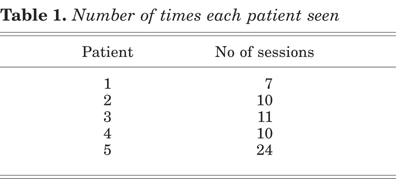
The exact details of each patient have been omitted to preserve anonymity, although the age of the patients ranged from 28 to 77 years. Please see Table 1 for the number of times each patient was seen.
Number of times each patient seen

A single patient was employed part time, but the remaining patients were unemployed for the duration of the intervention and follow-up period. Four patients were active on the transplant list. Four patients were of Afro-Caribbean origin and one was a white European.
Interdialytic Weight Gains
Both the degree (indicating severity) of volume overload and frequency of volume overload were examined for each patient. Less than 3% of dry weight was used as an acceptable interdialytic weight gain (Levy et al., 2001).
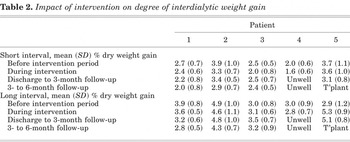
Patients 1, 2, and 4 made clear reductions in fluid intake (degree), indexed by mean percentage of dry weight gain during both the short and long interdialytic period. This change in drinking behavior was maintained at 6-month follow-up for Patients 1 and 2. Patient 4 became unwell during the follow-up period and therefore it was not possible to collect further data beyond this point. Patient 5 began drinking excessively over weekends toward the end of the intervention period, although he or she reduced fluid intake during the week. Patient 3 made only minimal changes in fluid intake over the intervention and follow-up period. (Please see Table 2.)
Impact of intervention on degree of interdialytic weight gain

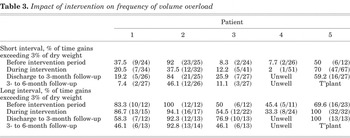
Patients 1, 2, and 4 reduced the number of times they exceeded 3% of dry weight (frequency) during both the short and long interdialytic periods. Again, for patients 1 and 2 this change was maintained at 6-month follow-up. (Please see Table 3.)
Impact of intervention on frequency of volume overload

Patient Participation and Evaluation of the Intervention
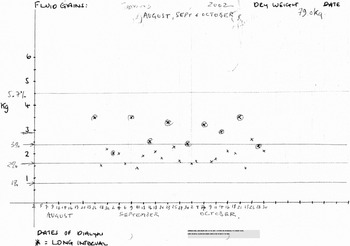
Three patients rated the intervention that they had received as “very useful” and one as “useful.” Two patients rated satisfaction with the outcome of the intervention as “moderate,” one patient “slight,” and the last patient “very satisfied.” Three patients rated their overall fluid management as “a little better,” one as much better. One patient did not complete the measure. Three patients kept their own line graph of interdialytic weight gain for several weeks either during or after the intervention period. (Please see Fig. 1). One patient was taught CBT techniques to use to manage episodes of low mood, which appeared to trigger drinking.

Line graph kept by patient.
DISCUSSION
The simple figures on interdialytic weight gain from this small group of hemodialysis patients partially supports the hypotheses that a psychological intervention based on the principles of both CBT and MI would be associated with a reduction in interdialytic weight gain and received favorably by patients. Three patients made clear reductions in fluid intake over the intervention and two of the three during the follow-up period. Four of the five patients experienced the intervention positively on dimensions of satisfaction, outcome, and utility.
It is not possible to draw any firm conclusions from this small case series, although it appears that there may have been a positive effect on interdialytic weight gain for some of the patients. However, this case series does raise two important issues for research in this area.
First, most dialysis sheets are designed for staff use, cover only a small number of dialysis sessions at a time and are complex in appearance with diverse data in table form. As a result, patients are not easily able to use freely available information on interdialytic weight gain to help themselves with fluid management. Within the context of this small study, a pragmatic solution to this problem consisted of a behavioral intervention to allow patients to monitor their interdialytic weight gain as a percentage of their dry weight over long periods of time. Each patient was encouraged to keep a line graph that was anchored by a commonly used cutoff for “safe drinking” (Levy et al., 2001) and a series of either clinically or patient-relevant reference points (3%, 4%, and 5.7% thresholds). A visual display of two dimensions of interdialytic weight gain, that is, degree (or severity) and frequency, ensured accurate and meaningful feedback each time that the patient dialyzed (Fisher, 2005). Even very modest improvements by the patients were easily observable, able to be acknowledged, and thus used to promote self-efficacy, a psychological construct that seems to be emerging as an important factor in fluid management (Zrinyi et al., 2003). Less successful periods of fluid management were approached with neutrality.
Second, most earlier intervention studies have consisted of a large educational component (content), assuming increased knowledge to be the main mechanism of change in improving fluid management. Overall, there has been much less attention paid to methods of mobilizing patient resources and optimizing professional relationships with patients as vehicles of change (process). This is in spite of the fact that active participation is known to be a crucial factor in effective fluid management, and the available research in this area is suggestive of the importance of staff–patient relationships in treatment concordance and perception of care (Kovac et al., 2002; Saran et al., 2003).
Perhaps importantly in this clinical setting, CBT is a collaborative approach in which a “shared understanding” of the patient's problem occupies a central position. The relationship between the patient and professional is also pivotal within a MI framework, and specifically, the collaborative “spirit” or “tenor” of both of these approaches is viewed as instrumental in helping the patient to move toward healthy behavior change. The use of these techniques can also help to preserve patient–staff relationships over protracted periods of time when “success” often seems difficult to achieve. Because of these characteristics, the sort of intervention used with these patients is appropriate for inclusion in a repertoire of skills for use in what is essentially a palliative population, but where, nevertheless, patient cooperation is essential. With the exception of the patient who was drinking excessively, none of the patients required the 12 sessions offered. Sessions were short, some extremely brief (minutes), and the patient who made the most progress required least contact time of all. Relationships with all of the patients, both during the intervention the in the follow-up period and after, were good, and one patient was keen to record her interdialytic weight gains for several weeks after the study had stopped.
In summary, this case series approach used a psychological intervention that may be helpful in improving fluid management and appeared to have been favorably received. The intervention was also consistent with the requirements of current guidelines and consultation documents with regard to supporting patients living with the demands of a life-limiting illness (Department of Health, 2004). Importantly, it brings to the fore the notion of psychological intervention as an integral component of supportive care where patient participation is essential (until disease progression or patient preference dictates otherwise), for optimizing quality of life (Levy et al., 2004). Future investigations might aim at evaluating the effect of psychological interventions on perceptions of care as well as volume overload, consequent symptom burden, and acceptability of use to dialysis staff.
ACKNOWLEDGMENTS
The study was funded by Guy's & St. Thomas' Charitable Foundation.
With grateful thanks to the patients who took part in the study and to the dialysis nurses for their support.