





Impact statement
Childhood maltreatment can have psychological consequences that extend a lifetime, well beyond childhood itself. This research underscores the potential importance of maltreatment experiences in body-focused repetitive behaviors such as skin picking and hairpulling and the severity of these behaviors, partially through the indirect effect of loneliness. The results suggest loneliness as a significant psychological pathway, providing a wider perspective on the sustained association between early adverse experiences and adult emotional health and conduct. This study is especially important because body-focused repetitive behaviors are often misdiagnosed, concealed because of shame or dismissed as simple habits and not complex mental health conditions. Our results show that the feeling of loneliness was associated with the severity of these behaviors and statistically mediated the association between child maltreatment and both skin picking and hairpulling. This highlights the need for clinicians and mental health professionals to address not only experiences of child maltreatment but also their associated social and emotional consequences, such as loneliness. Additionally, the persistence of a direct association between child maltreatment and skin picking and hairpulling after accounting for loneliness suggests that other factors may also contribute to the observed associations between early adverse experiences and these behaviors. This research also provides important evidence from Arabic-speaking populations, which are still under-represented in psychological research on trauma and body-focused repetitive behaviors. Increased representation of multiple cultural backgrounds may help improve culturally sensitive prevention and intervention approaches. Overall, the findings support the importance of early psychological support for those exposed to childhood maltreatment and indicate that interventions targeting loneliness may help reduce the severity of skin-picking and hair-pulling behaviors and improve long-term mental health outcomes.
Introduction
Obsessive-compulsive disorder (OCD) is a mental disorder in which individuals describe obsessions as repetitive, undesired and unpleasant thoughts, urges or images. In order to reduce the thoughts, patients with OCD experience a strong urge to perform repetitive behaviors (i.e., compulsions), which causes a significant emotional distress, disrupting the individual’s everyday activities (American Psychiatric Association, 2013). Obsessive-compulsive and related disorders (OCRDs) were introduced as an additional category that differs from previous DSM-IV anxiety disorders in the Diagnostic and Statistical Manual of Mental Disorders–Fifth edition (DSM-5). Obsessive-compulsive disorder, body dysmorphic disorder (BDD), hoarding disorder (HD), excoriation (skin-picking disorder, SPD) and trichotillomania (hair-pulling disorder, HPD) are the five main disorders that make up OCRDs (American Psychiatric Association, 2013). These disorders share fundamental clinical characteristics, including repetitive behaviors and/or recurring thoughts, which may differ in their underlying cognitive and emotional processes across disorders (Arikawa et al., Reference Arikawa, Mito, Motoyama, Yamanishi, Hayashida, Maebayashi and Matsunaga2015). Among obsessive-compulsive and related disorders, excoriation disorder and trichotillomania are particularly relevant to our study.
Skin-picking disorder is a psychiatric disorder defined by recurrent skin picking contributing to skin lesions or tissue damage with a clinical variability in severity (American Psychiatric Association). It is commonly identified as excoriation disorder (ED), dermatillomania or psychogenic skin excoriations, and is considered an obsessive-compulsive and related disorder that is categorized with other body-focused repetitive behavior disorders in the latest edition of the DSM (Jafferany and Patel, Reference Jafferany and Patel2019). The prevalence of ED was 3.45% (95% CI: 2.55%, 4.65%), and a female predominance was reported in a meta-analysis and systematic review (Farhat et al., Reference Farhat, Reid, Bloch and Olfson2023). Moreover, various styles of skin picking were analyzed depending on the level of awareness during the episode. Gallinat et al. report that “automatic skin picking” happens with low awareness and is thought to be connected to specific (regular) circumstances and passive activities, whereas “focused skin picking” is characterized by higher awareness and in reaction to desires or challenging emotions (Gallinat et al., Reference Gallinat, Moessner, Wilhelm, Keuthen and Bauer2024). The distribution of focused and automatic skin picking appears to vary greatly. However, according to a recent study, as people age, they start transitioning from focused to more automatic skin picking (Lin et al., Reference Lin, Farhat, Flores, Levine, Fernandez, Bloch and Olfson2023).
The hallmark of trichotillomania, alternatively identified as hair-pulling disorder, is the recurrent pulling out of one’s own hair, which results in hair loss and clinically important functional impairment. Although trichotillomania often affects the scalp, eyebrows and eyelashes, it can also affect any area of the body that has hair, such as the pubic area (Grant and Chamberlain, Reference Grant and Chamberlain2021). In addition, as mentioned in DSM-5, some people may pull hair from other sources (pets, dolls, carpets, etc.). The DSM-5 classifies trichotillomania as an obsessive-compulsive and related disorder (American Psychiatric Association, 2013). Low self-esteem, depressive symptoms, psychosocial impairment and a generally reduced quality of life are often linked to the disorder (Grant et al., Reference Grant, Collins, Chesivoir and Chamberlain2023). Although pulling behaviors can start at any age, hairpulling usually starts in adolescence (Grant et al., Reference Grant, Collins, Chesivoir and Chamberlain2023). Thus, in a previous meta-analysis, the prevalence of hair-pulling disorder was 1.14% (95% CI: 0.66%, 1.96%), and findings suggest that women were more likely to pluck their hair if remarkable hair loss was considered a required diagnostic criterion, whereas no gender difference was observed when this criterion was not required (Thomson et al., Reference Thomson, Farhat, Olfson, Levine and Bloch2022).
Given that skin-picking as well as hair-pulling behaviors often emerge during adolescence, it is a must to consider previous childhood events, particularly child maltreatment, and assess whether they may affect their presence and persistence or not, while also taking into consideration that these behaviors may be associated with several factors (psychological, developmental, etc.) (Grant and Chamberlain, Reference Grant and Chamberlain2021). Child maltreatment refers to any behavior that puts a child’s health, growth or dignity at danger through any of the different types of child maltreatment according to the World Health Organization (WHO) (Suniega et al., Reference Suniega, Krenek and Stewart2022). Four types of child maltreatment are identified: physical (physical harm whether intentional or not), sexual (any sexual behavior done with a kid whether it is oral sex, rape, sexual intercourse or touching the child in an inappropriate way), emotional (any behavior that endangers a child’s social or mental development) and neglect (more common than the other types, defined by the failure to satisfy a child’s basic needs rather than doing a specific type of harm to the child) (El Zouki et al., Reference El Zouki, Chahine, El Tawil, Jaalouk, Hallit and Obeid2024). These behaviors take place in relationships that are characterized by responsibility, confidence or authority and endanger a child’s growth, well-being and self-respect (Suniega et al., Reference Suniega, Krenek and Stewart2022). According to a 2022 case–control study, participants with pathological skin picking had considerably higher scores on the childhood trauma questionnaire that assessed childhood maltreatment across neglect and abuse domains (Daley et al., Reference Daley, Gonzalez, Bethencourt Mirabal and Afzal2025). In addition, according to previous research about the connection between psychological trauma and trichotillomania, as well as excoriation disorder, affected individuals had higher levels of childhood trauma, including neglect, violence and abuse, when compared to non-affected individuals (Spitzer et al., Reference Spitzer, Lubke, Muller, Lindstadt and Gallinat2022).
While many studies found a link between child maltreatment and body-focused repetitive behavior disorders, previous findings showed that loneliness has been linked to exposure to child maltreatment (de Heer et al., Reference de Heer, Bi, Finkenauer, Alink and Maes2024). Loneliness refers to the uncomfortable feeling that people experience after noticing a certain lack in their social relationships, whether quantitative or qualitative (de Heer et al., Reference de Heer, Bi, Finkenauer, Alink and Maes2024). This indicates that individuals either have fewer relationships than desired or that more intimacy from their actual relationships is needed (de Heer et al., Reference de Heer, Bi, Finkenauer, Alink and Maes2024). A systematic review conducted in 2022 found that those with histories of maltreatment – particularly people who previously underwent emotional abuse or neglect – were more prone to feel lonely than people without such histories (de Heer et al., Reference de Heer, Bi, Finkenauer, Alink and Maes2024). Additionally, another study also found that child maltreatment is linked to several internalizing problems, including anxiety, depression and loneliness, especially in emerging adulthood (Brown et al., Reference Brown, Fite, Stone and Bortolato2016). Furthermore, evidence from a prior study suggests that many participants experiencing skin picking frequently describe specific cognitive and contextual factors that support the skin-picking behavior and lessen their capacity to resist it, which may be related to feelings such as boredom or loneliness (Anderson et al., Reference Anderson, Clarke and Thomas2023). Moreover, up to now, some psychological factors have been found to influence skin picking’s frequency. These include negative emotional states (whether increased tension [e.g., anxiety] and diminished stimulation [e.g., loneliness and boredom]) that have been shown to increase the urge for skin picking, therefore influencing the course of this disorder (Klosowska and Prochwicz, Reference Klosowska and Prochwicz2021). In fact, individuals with skin-picking disorder often experience negative states such as boredom or loneliness preceding their skin-picking behavior, then relief after skin-picking, leading to the persistence of these behaviors over time (Klosowska and Prochwicz, Reference Klosowska and Prochwicz2021; Anderson et al., Reference Anderson, Clarke and Thomas2023). In addition, some situations linked to negative emotions (anxiety and loneliness) are known triggers for hair pulling (Da Fonseca et al., Reference Da Fonseca, Cury, Fakra, Rufo, Poinso, Bounoua and Huguet2008). For instance, in a study evaluating the personal experiences of people with trichotillomania, individuals reported negative emotions, and most notably, they reported feelings of social isolation (Banafshi and Khatony, Reference Banafshi and Khatony2025). Some studies even show that trichotillomania may be associated with a cycle that contributes to hair-pulling behavior since patients experience a rising tension prior to the behavior followed by a temporary relief (Diefenbach et al., Reference Diefenbach, Miller, Porter, Peters, Stefanek, Leventhal, Lewis, Haviland-Jones and Barrett2008).
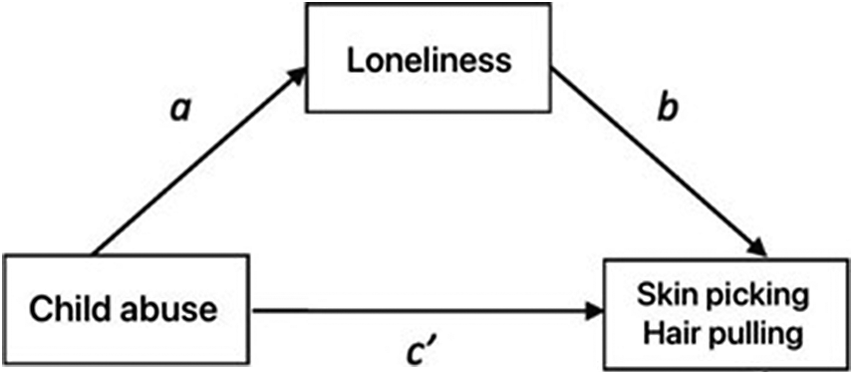
Therefore, based on the existing literature that explains the way child maltreatment is linked to greater loneliness levels (Brown et al., Reference Brown, Fite, Stone and Bortolato2016; de Heer et al., Reference de Heer, Bi, Finkenauer, Alink and Maes2024) and the way loneliness is linked to body-focused repetitive behavior disorders (such as skin picking and hairpulling) (Da Fonseca et al., Reference Da Fonseca, Cury, Fakra, Rufo, Poinso, Bounoua and Huguet2008; Klosowska and Prochwicz, Reference Klosowska and Prochwicz2021; Anderson et al., Reference Anderson, Clarke and Thomas2023; Banafshi and Khatony, Reference Banafshi and Khatony2025), we developed a theoretical framework that describes the relationship between child maltreatment, loneliness and skin picking, as well as hairpulling (Figure 1).
Theoretical framework describing the relationship between child maltreatment, loneliness and skin picking, as well as hairpulling.

The present study
In the Arab region, there appears to be a high prevalence of child maltreatment. In 2017, the Lebanese child protector sector reported 10,825 cases of child maltreatment, and 90% were deemed to be medium to high risk according to the ESCAPE screening tool, which classifies the risk of cases (low, medium and high) based on certain clinical criteria of maltreatment risk (Bakhos et al., Reference Bakhos, Sleilaty, Gerbaka, Nehme, Hamzeh, Chammas, Kheireddine, Bakhos and Saliba2022). Similarly, cases of child maltreatment and violence against children have also been reported in other Arab populations, such as the Kingdom of Saudi Arabia (Al-Eissa et al., Reference Al-Eissa, Saleheen, AlMadani, AlBuhairan, Weber, Fluke, Almuneef and Casillas2016), Jordan (UNICEF), Palestine (UNICEF) and Egypt (Moawad et al., Reference Moawad, Moawad, Mahrous, Zein and Mahmoud2024). Since laws are rarely fully followed and child maltreatment is quite common across the region, Arab societies hardly ever punish the maltreatment of children, whether physical or psychological (Attrash-Najjar and Katz, Reference Attrash-Najjar and Katz2023). In Lebanon, with the worsening of the nation’s condition, including the economic collapse and government failure, the risk of children’s aggression and exploitation is increasing (Abouzeid et al., Reference Abouzeid, Halwani, Mokdad and Habib2021). Comparable social and economic conditions have been identified in some Arabic regions where instability and the lack of resources increase the risk of child maltreatment (Attrash-Najjar and Katz, Reference Attrash-Najjar and Katz2023). However, an important lack of reporting of violence and the absence of strong legal systems to control and prevent violence are noted (El Zouki et al., Reference El Zouki, Chahine, El Tawil, Jaalouk, Hallit and Obeid2024). This alarming condition of child maltreatment shows the need to investigate the long-term psychological effects of such maltreatment. On the other hand, evidence also shows the presence of body-focused repetitive behaviors in Arab countries; for example, research from the Kingdom of Saudi Arabia has identified both hair-pulling and skin-picking behaviors, with suspected trichotillomania noted in 1.8% of a community sample (Subki et al., Reference Subki, Khatib, Butt, Jamjoom, Alharbi, Shaikhoon, Alharbi, Shaikhoon, al-Zaben, Alghamdi and Koenig2022) and skin-picking disorder symptoms reported in 1.2% of adults (Khatib et al., Reference Khatib, Alghamdi, Subki, Butt, Alsallum, Alsulaimani, Alnajjar, Alzaidi, Alasmari, Alshamrani, al-Zaben and Koenig2022). Moreover, several studies across Arab-speaking populations identified loneliness as an important psychological concern that is not only prevalent in Arab populations but also linked to serious negative consequences (Youssef et al., Reference Youssef, Hallit, Kheir, Obeid and Hallit2020; Dadras and Wang, Reference Dadras and Wang2023; Tarabay et al., Reference Tarabay, Gerges, Sarray El Dine, Malaeb, Obeid, Hallit and Soufia2023; Alhazmi and Alhazmi, Reference Alhazmi and Alhazmi2026). So, although child maltreatment, loneliness and skin picking and hairpulling have been documented in Arabic countries, their relationship remains unclear, particularly the link between child maltreatment, loneliness and skin picking and hairpulling that creates a gap in the literature. Therefore, the objective of this study was to assess the mediating effect of loneliness between child maltreatment and skin picking and hairpulling across a sample of Arabic-speaking adults.
Methods
Study design and participants
Google Forms was used to collect data between December 2024 and January 2025. The survey link was disseminated through the researchers’ personal and professional networks, including social media platforms and messaging applications commonly used in the target countries. No incentives or compensation were provided for participation. The survey was open to Arabic-speaking adults (≥18 years old) from the Kingdom of Saudi Arabia, Egypt, Lebanon, Palestine and Jordan. No formal clinical diagnosis of body-focused repetitive behavior was required for participation. Individuals were eligible if they were Arabic-speaking adults currently residing in one of the target countries at the time of survey completion, regardless of nationality or country of birth. No minimum duration of residence was required for eligibility, and participation was voluntary. Participants younger than 18 years of age or those who did not provide informed consent were excluded.
We used the snowball technique, where participants were encouraged to share the Google Form link with their friends, who then shared it with their own networks. This recruitment strategy was used to reach a broader sample of eligible participants. Since many individuals with BFRBs do not seek professional help, the study focused on a nonclinical population to capture the broader Arabic-speaking community rather than focusing exclusively on clinically diagnosed or treatment-seeking individuals. The data were safely stored in the principal investigator’s Google account, which was secured through authentication credentials, including a unique username and password, to ensure restricted access.
Minimal sample size calculation
A minimum sample of 411 participants was considered necessary to ensure sufficient statistical power, based on the Fritz and Mackinnon formula
$ n=\frac{L}{f2}+k+1 $
 null (Fritz and Mackinnon, Reference Fritz and Mackinnon2007), taking f = 0.14 for a small effect size and k = 9 variables to be entered in the mediation model.
Questionnaire
In the questionnaire developed in Arabic, participants provided their age, sex (Male/Female), country of residence (Lebanon, Jordan, Egypt, Kingdom of Saudi Arabia [KSA] and Palestine), smoking (Yes/No), alcohol (Yes/No) and lifetime use of cannabis (Yes/No). These variables were assessed as binary self-report measures and, therefore, reflect the presence or absence of use rather than frequency, quantity or severity. The personal mental history was assessed as a binary self-report variable (Yes/No), indicating whether participants had ever been diagnosed with or experienced any mental health disorder as reported by the participant. The questionnaire did not differentiate between current and past conditions. Therefore, this variable reflects lifetime self-reported mental history rather than current psychiatric status.
As for the Household Crowding Index (HCI), it was added to measure the socioeconomic and household living conditions that may be associated with the study’s variables (Evans et al., Reference Evans2003). HCI is obtained by dividing the total number of residents in a house, except for a newborn, by the total number of rooms in that house, except for the kitchen (Melki et al., Reference Melki, Beydoun, Khogali, Tamim and Yunis2004). Additionally, participants were instructed to complete the scales outlined below.
-
• Skin Picking Scale–Revised (SPS–R). Eight items make up the SPS-R, a self-report tool that evaluates symptoms of skin picking over the past week in two domains: the symptom severity domain, which includes four items, and the functional impairment domain, which also consists of four items. Participants rate each item using a five-point rating system, where each point represents a brief description of how severe a particular behavior or experience was during the week prior to the test (scoring from 0 = absence of behavior to 4 = extreme behavior). Higher scores indicate more severe skin picking (Snorrason et al., Reference Snorrason, Ólafsson, Flessner, Keuthen, Franklin and Woods2012) (Cronbach’s α = 0.89). This scale has been validated in Arabic across five Arab countries: Lebanon, Jordan, Egypt, the Kingdom of Saudi Arabia and Palestine (article under review). In the Arabic validation, the confirmatory factor analysis results showed that the fit indices of the two-factor model were acceptable (χ 2(19) = 91.13, p < 0.001, RMSEA = 0.050 (90% CI: 0.040, 0.061), SRMR = 0.044, CFI = 0.998, TLI = 0.997).
-
• Trichotillomania Dimensional Scale (TTM-D). The TTM-D is a five-item self-administered tool used to evaluate trichotillomania symptom intensity over the preceding 7 days. The scale examines and considers multiple factors related to trichotillomania (frequency of the symptoms, distress and avoidance of activities due to the symptoms, control over the symptoms and the extent to which these symptoms interfere with the individual’s life). Respondents use a 5-point Likert scale to rate their responses. The total scores are summed up and vary between 0 and 20. Greater scores indicate more severe symptoms (Cheyne et al., Reference Cheyne, del Pozo de Bolger and Wootton2018) (Cronbach’s α = 0.85). The Arabic validation of the Trichotillomania Dimensional Scale has been validated across five Arab countries: Lebanon, Jordan, Egypt, the Kingdom of Saudi Arabia and Palestine (article under review). In the Arabic validation, the confirmatory factor analysis results showed that the fit indices of the one-factor model were excellent (χ 2(5) = 39.19; RMSEA = 0.068 (90% CI: 0.049, 0.088), SRMR = 0.033, CFI = 0.998, TLI = 0.997).
-
• Child Abuse Self-Report Scale (CASRS-12). This scale consists of 12 items to evaluate 4 aspects of child maltreatment: neglect, physical, sexual and psychological abuse. The scale uses a 0–3 rating system (never to always). Greater scores suggest more intense childhood maltreatment. This scale has already been validated in Arabic in Lebanon (Fekih-Romdhane et al., Reference Fekih-Romdhane, Dabbous, Hallit, Malaeb, Sawma, Obeid and Hallit2022) (Cronbach’s α = 0.77).
-
• The De Jong Gierveld Loneliness Scale (five items). Validated in Arabic among Lebanese university students (Awad et al., Reference Awad, Rogoza, Gerges, Obeid and Hallit2024), the modified De Jong-Gierveld Loneliness Scale was used to measure loneliness. The scale consists of five closed-ended items, with participants responding to each item with either “yes” or “no.” A “yes” response was assigned a score of 1, whereas a “no” response was assigned a score of 0, with higher total scores indicating greater levels of loneliness (Cronbach’s α = 0.78).
Statistical analysis
The SPSS version 27 software was employed for the statistical analysis. The skin picking and hair-pulling scores were not normally distributed as the skewness and kurtosis values were outside the −1 and + 1 range. Base-10 logarithmic transformation fulfilled the before-mentioned conditions, which was used throughout the analysis. Bivariate analyses were conducted to examine the relationships of child maltreatment, loneliness and the two behavioral outcomes – skin-picking and hair-pulling symptoms – with the sociodemographic and clinical characteristics of the participants. Independent samples t-test was employed to compare the mean scores of continuous variables across dichotomous groups, including sex, smoking status, alcohol use, lifetime cannabis use and personal history of mental illness. Pearson’s correlation test was used to correlate two continuous variables, including child maltreatment, loneliness age, household crowding index and the skin-picking and hair-pulling scores. One-way analysis of variance (ANOVA) was used for the comparison of three or more means, such as the country of residence. The mediation analysis was conducted employing PROCESS Macro version 3.4 Model 4, with the number of 5,000 bootstrap samples and a 95% confidence interval. Mediation was considered statistically significant when the confidence interval for the indirect effect did not include zero. Consistent with the purposeful selection described by Bursac et al. (Reference Bursac, Gauss, Williams and Hosmer2008), variables showing a p-value <0.25 in the bivariate analysis (Bursac et al., Reference Bursac, Gauss, Williams and Hosmer2008) were retained as candidate covariates for inclusion in the multivariable model. This relatively liberal threshold was chosen to avoid excluding potentially important confounders that may become significant after adjustment for other variables included (age, sex, country of residence, lifetime cannabis use, alcohol use, household crowding index and personal history of mental illness). Statistical significance was set at p-value <0.05.
Results
Participants
In total, 1,494 participants participated in this study. Participants had a mean age of 24.97 years (SD = 9.09; range: 18–99 years), and 74.5% were females. Table 1 presents other descriptive statistics of the sample.
Sociodemographic and other characteristics of the sample (N = 1,494)

Table 1. Long description
The table is divided into two main sections.
Section 1: Categorical Variables (N and percentage)
* Sex: 381 Male (25.5 percent) and 1,113 Female (74.5 percent).
* Country: Lebanon 389 (26.0 percent), Jordan 308 (20.6 percent), Egypt 298 (19.9 percent), K S A 282 (18.9 percent), and Palestine 217 (14.5 percent).
* Smoking: 1,058 No (70.8 percent) and 436 Yes (29.2 percent).
* Alcohol: 1,445 No (96.7 percent) and 49 Yes (3.3 percent).
* Lifetime cannabis: 1,439 No (96.3 percent) and 55 Yes (3.7 percent).
* Personal mental history: 1,341 No (89.8 percent) and 153 Yes (10.2 percent).
Section 2: Continuous Variables (Mean plus or minus S D)
* Age (years): 24.97 plus or minus 9.09.
* Household crowding index: 1.16 plus or minus 0.52.
* Hair pulling total score: 1.62 plus or minus 2.95.
* Skin picking total score: 2.25 plus or minus 4.00.
* Child abuse total score: 7.60 plus or minus 5.19.
* Loneliness total score: 1.79 plus or minus 1.75.
Bivariate analysis of factors associated with hair-pulling and skin-picking scores
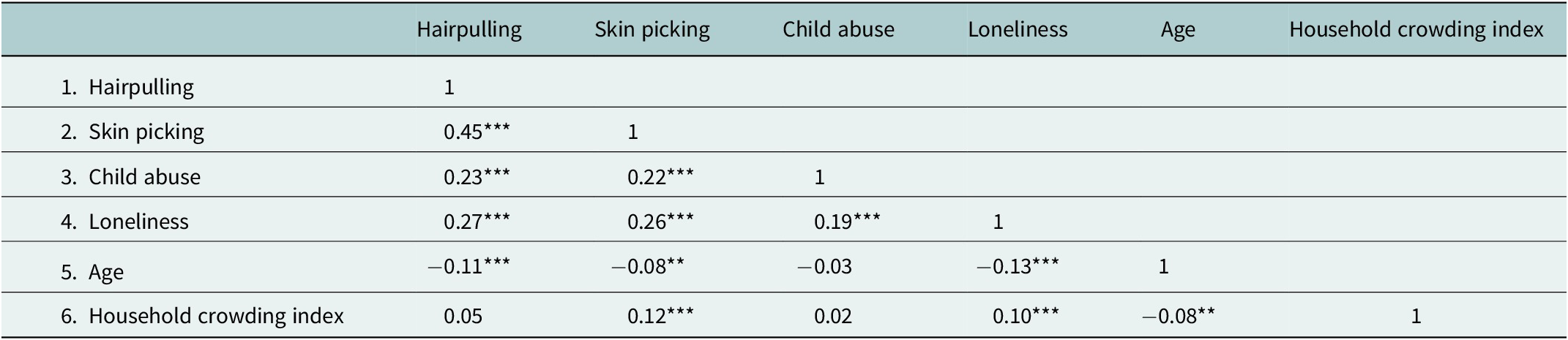
Females versus males (p = 0.017), living in Palestine compared to other participating countries (p = 0.006) and documenting a past history of mental illness (p < 0.001) were significantly associated with higher hair-pulling symptom severity. Living in Palestine compared to the other participating countries (p < 0.001), drinking alcohol (p = 0.026), having ever used cannabis (p < 0.001) and reporting a personal history of mental illness (p < 0.001) were significantly correlated with higher skin-picking symptom severity (Table 2). Analysis across participating countries showed comparable mean scores for hairpulling and skin picking, especially participants from Palestine who showed slightly higher skin-picking scores compared to participants from other countries. In addition, a higher household crowding index was significantly associated with greater skin-picking symptom severity (r = 0.12, p < 0.001), whereas higher child maltreatment and loneliness scores were associated with higher levels of both skin-picking and hair-pulling symptom severity. Moreover, older age was significantly associated with lower skin-picking and hair-pulling symptom severity (Table 3).
Bivariate analysis of factors associated with hair-pulling and skin-picking scores

Table 2. Long description
The table is organized into seven columns. The first column lists the Variable, followed by two main sections: Hairpulling and Skin picking. Each section contains three sub-columns: Mean plus or minus S D, p-value, and Effect size (Cohen’s d). All scores are based on L O G transformations.
* Sex: For Hairpulling, Male is 0.16 plus or minus 0.30 and Female is 0.20 plus or minus 0.34 (p = 0.017). For Skin picking, Male is 0.21 plus or minus 0.36 and Female is 0.25 plus or minus 0.39 (p = 0.130).
* Country: Significant p-values for both Hairpulling (p = 0.006) and Skin picking (p < 0.001). Palestine shows the highest means for both: 0.25 plus or minus 0.37 for Hairpulling and 0.33 plus or minus 0.41 for Skin picking.
* Smoking: No significant association for either category (p = 0.714 for Hairpulling; p = 0.979 for Skin picking).
* Alcohol: Significant for Skin picking (p = 0.026) with ‘Yes’ at 0.39 plus or minus 0.46 versus ‘No’ at 0.23 plus or minus 0.38.
* Lifetime cannabis: Highly significant for Skin picking (p < 0.001) with ‘Yes’ at 0.45 plus or minus 0.45 versus ‘No’ at 0.23 plus or minus 0.38.
* Personal mental history: Highly significant for both. Hairpulling ‘Yes’ is 0.29 plus or minus 0.38 (p < 0.001). Skin picking ‘Yes’ is 0.42 plus or minus 0.47 (p < 0.001).
Note: Numbers in bold indicate statistically significant p values (p < 0.05). The LOG transformation of the skin-picking and hair-pulling scores were used in the analysis.
Pearson correlation matrix

Table 3. Long description
A lower triangular matrix presenting Pearson correlation coefficients among six variables.
* Hairpulling (1) correlates with:
- Skin picking: 0.45 (p < 0.001)
- Child abuse: 0.23 (p < 0.001)
- Loneliness: 0.27 (p < 0.001)
- Age: minus 0.11 (p < 0.001)
- Household crowding index: 0.05 (not significant)
* Skin picking (2) correlates with:
- Child abuse: 0.22 (p < 0.001)
- Loneliness: 0.26 (p < 0.001)
- Age: minus 0.08 (p < 0.010)
- Household crowding index: 0.12 (p < 0.001)
* Child abuse (3) correlates with:
- Loneliness: 0.19 (p < 0.001)
- Age: minus 0.03 (not significant)
- Household crowding index: 0.02 (not significant)
* Loneliness (4) correlates with:
- Age: minus 0.13 (p < 0.001)
- Household crowding index: 0.10 (p < 0.001)
* Age (5) correlates with:
- Household crowding index: minus 0.08 (p < 0.010)
All diagonal values are 1. Note that LOG transformations were used for skin-picking and hair-pulling scores.
Note: The LOG transformation of the skin-picking and hair-pulling scores were used in the analysis.
*p < 0.05; **p < 0.010; ***p < 0.001.
Analysis of mediation
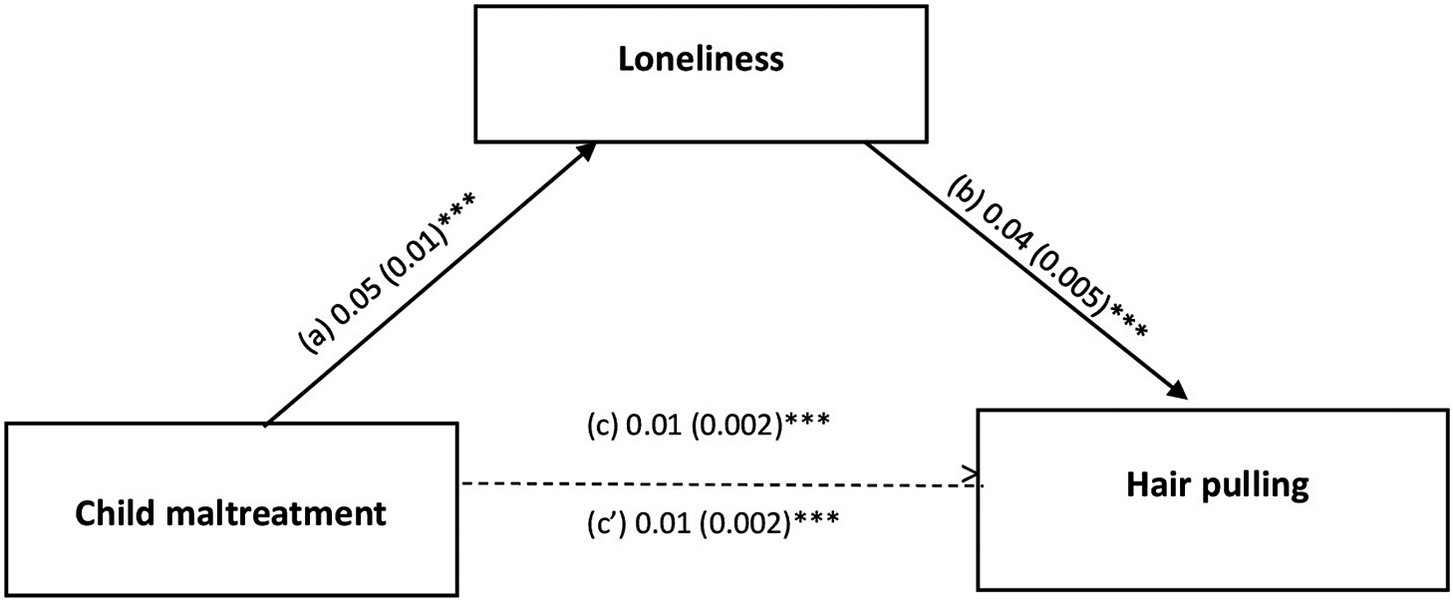
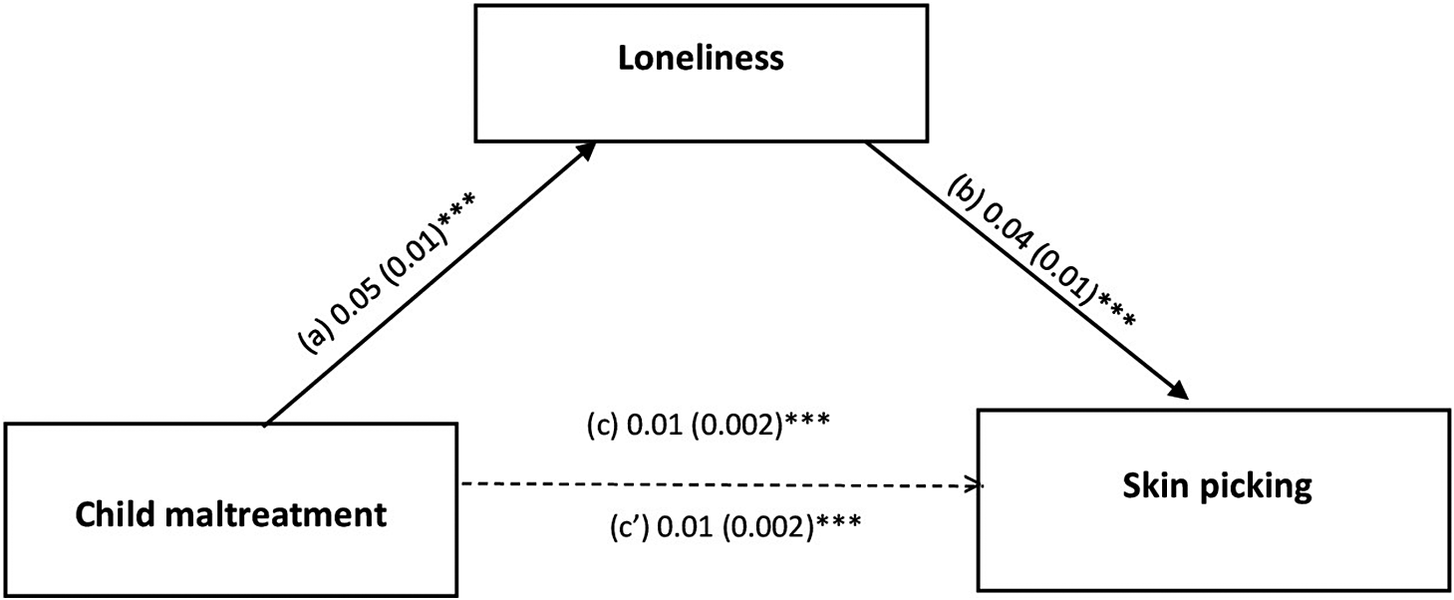
The mediation analyses considering hair-pulling and skin-picking scores as the dependent variables were adjusted for the following covariates: sex, country, alcohol, age, lifetime cannabis use, personal mental history and household crowding index. Loneliness partially mediated the relationship between child maltreatment and both skin picking and hair pulling (indirect effect: Beta = 0.002; Boot SE = 0.001; Boot CI = 0.001; 0.003). Higher child maltreatment was significantly associated with higher loneliness (p < 0.001), which in turn was significantly associated with higher skin-picking and hair-pulling symptom severity (both p < 0.001). Moreover, the direct association between child maltreatment and body-focused repetitive behaviors remained statistically significant even after including loneliness in the model (both p < 0.001), indicating partial rather than full mediation (Figures 2 and 3).
Mediation model examining the indirect effect of loneliness on the association between child maltreatment and hair-pulling symptom severity: (a) relation between child maltreatment and hair pulling (R 2 = 0.100); (b) relation between loneliness and hairpulling (R 2 = 0.116); (c) total effect of child maltreatment on hairpulling (R 2 = 0.078); (c’) direct effect of child maltreatment on hairpulling. The numbers represent regression coefficients and their standard errors. ***p < 0.001.

Mediation model examining the indirect effect of loneliness on the association between child maltreatment and skin-picking symptom severity: (a) relation between child maltreatment and skin picking (R 2 = 0.100); (b) relation between loneliness and skin picking (R 2 = 0.130); (c) total effect of child maltreatment on skin picking (R 2 = 0.098); (c’) direct effect of child maltreatment on skin picking. The numbers represent regression coefficients and their standard errors. ***p < 0.001.

Discussion
The main objective of the present study was to assess the mediating effect of loneliness between child maltreatment and skin picking, as well as hairpulling among a sample of Arabic-speaking adults. Our findings demonstrated that higher child maltreatment scores were significantly associated with greater skin-picking and hair-pulling scores. Moreover, loneliness was found to be a partial mediator of this relationship, suggesting that people who experienced maltreatment as children may be at greater risk of exhibiting these behaviors in part because of increased feelings of loneliness.
Consistent with recent literature (Spitzer et al., Reference Spitzer, Lubke, Muller, Lindstadt and Gallinat2022; Daley et al., Reference Daley, Gonzalez, Bethencourt Mirabal and Afzal2025), our study showed a direct association between child maltreatment and both skin-picking and hair-pulling behaviors, highlighting the important association between early negative experiences and greater body-focused repetitive behaviors symptom severity. In fact, child maltreatment has been linked to long-term issues with stress management and emotion regulation, which can lead to a greater dependence on repetitive behaviors as an ineffective technique to deal with negative affect or internal tension (Bohne et al., Reference Bohne, Wilhelm, Keuthen, Baer and Jenike2002). Therefore, skin picking and hairpulling may be associated with coping responses to temporarily ease discomfort and reduce stress, especially in traumatized individuals who have trouble with emotional regulation and relief from negative emotional experiences (Swisher et al., Reference Swisher, Ricketts, Peris, Jones, Dunning, Valle, Cavic, Lochner, Stein, Dougherty, O’Neill, Woods, Grant, Piacentini and Keuthen2026). Emotional regulation difficulties are considered one of the factors associated with greater severity of skin-picking and hair-pulling behaviors; however, some studies show that these behaviors are multifactorial and that other factors may also be involved (Snorrason et al., Reference Snorrason, Ólafsson, Flessner, Keuthen, Franklin and Woods2012).
The findings of this study indicate a strong association between higher levels of child maltreatment and greater loneliness among participants. This matches earlier research stating that experiences of childhood maltreatment, whether physical, emotional or neglectful, often relate to higher feelings of social and emotional isolation later in life (Landry et al., Reference Landry, Asokumar, Crump, Anisman and Matheson2022; de Heer et al., Reference de Heer, Bi, Finkenauer, Alink and Maes2024; Xiang et al., Reference Xiang, Wang, Kong and Habash2026). In fact, individuals who faced child maltreatment may develop trouble with secure attachments and negative thoughts about relationships (Landry et al., Reference Landry, Asokumar, Crump, Anisman and Matheson2022). This includes less trust in others and a greater sensitivity to rejection, criticism or neglect from others, which leads to avoidance of intimate relationships and close connections, hence increasing their social withdrawal and sense of isolation. Moreover, the chronic stress and emotional dysregulation associated with early maltreatment may inhibit the development of adaptive social behaviors and the persistence of supportive relationships, which can further contribute to feelings of loneliness.
On the other hand, our study findings indicated that higher levels of loneliness were significantly associated with increased skin-picking and hair-pulling behaviors, suggesting that individuals experiencing greater social and emotional isolation may exhibit more pronounced body-focused repetitive behaviors. This finding supports prior research demonstrating that skin-picking and hair-pulling behaviors may be triggered by negative emotions such as loneliness and boredom (Klosowska and Prochwicz, Reference Klosowska and Prochwicz2021; Anderson et al., Reference Anderson, Clarke and Thomas2023; Banafshi and Khatony, Reference Banafshi and Khatony2025). More precisely, loneliness may contribute to these behaviors through maladaptive emotion regulation processes. When people feel alone or disconnected, they may exhibit more severe body-focused repetitive behaviors or even social withdrawal and ruminative thinking (Cacioppo and Hawkley, Reference Cacioppo and Hawkley2009) as coping mechanisms to deal with tension, distress or negative emotions, especially when they lack social support. With time, these repetitive behaviors may become reinforced since they offer temporary relief from unpleasant emotional states even though they may worsen long-term psychosocial functioning.
Moreover, loneliness was found to be a partial mediator between childhood maltreatment and both skin picking and hairpulling, suggesting that these associations may be explained by the emotional consequences of childhood maltreatment. Having said that, individuals who reported higher levels of child maltreatment also reported higher levels of loneliness, which was associated with greater skin-picking and hair-pulling symptom severity. This implies that early traumatic events may exacerbate feelings of emotional and social alienation, which may make people more susceptible to skin picking and hairpulling as maladaptive coping mechanisms. However, this mediation is partial since loneliness may explain part, but not all, of the association between child maltreatment and skin picking and hairpulling; therefore, other psychological pathways may also be involved. This interpretation is consistent with previous evidence that people who experienced more adverse childhood experiences, including the various types of child maltreatment, also experienced higher levels of loneliness and social disconnection later in life (Xiang et al., Reference Xiang, Wang, Kong and Habash2026). Although most of the previous literature has concentrated on emotional and psychological outcomes, particularly anxiety and depression, that result from childhood maltreatment (Li et al., Reference Li, Tu and Jiang2022), several studies show that loneliness itself is a significant emotional correlate of early trauma and predicts a variety of maladaptive behaviors and psychological symptoms (Shevlin et al., Reference Shevlin, McElroy and Murphy2015). From a psychological point of view, child maltreatment can alter the development of secure attachments, causing individuals to develop beliefs that they are unworthy of relationships and different from their peers, which increase their feelings of loneliness and make them more sensitive to rejection. Therefore, in the absence of supportive relationships and effective emotion regulation skills, individuals may start exhibiting maladaptive repetitive behaviors, specifically skin picking or hairpulling, as coping mechanisms to manage negative emotions and gain relief from the negative states (Snorrason et al., Reference Snorrason, Ólafsson, Flessner, Keuthen, Franklin and Woods2012).
Since our sample involved participants recruited from different Arab countries, it is important to note that broadly similar findings concerning symptoms of skin picking and hairpulling were detected among participants, with slightly higher skin-picking scores detected in participants from Palestine. The similar findings may reflect common sociocultural profiles shared by Arab populations, as shown in previous meta-analyses stating that although heterogeneous, Arab countries share some religious and social characteristics playing a role in the expression of mental health difficulties (Alshawwa and Caldwell-Harris, Reference Alshawwa and Caldwell-Harris2026). It is also important to note that in the present study, we found that the household crowding index was associated with greater skin-picking severity. In fact, the household crowding index may represent socioeconomic adversity and high levels of environmental stress, both of which have been associated with worse mental health outcomes and higher psychological distress (Evans, Reference Evans2003).
Adding to that, younger age was associated with greater hair-pulling and skin-picking symptom severity, suggesting that BFRB symptoms may be more pronounced among younger individuals, potentially reflecting differences in coping strategies or exposure to psychological stressors (Gupta et al., Reference Gupta, Gupta and Knapp2015; Grant and Chamberlain, Reference Grant and Chamberlain2020). Females reported greater hair-pulling severity than males, which is consistent with the greater representation of females reported in hair-pulling disorder (Gupta et al., Reference Gupta, Gupta and Knapp2015). Alcohol use and lifetime cannabis use were associated with greater skin-picking severity, possibly reflecting shared underlying psychological distress or maladaptive coping, although causality cannot be inferred (Grant and Boutouis, Reference Grant and Boutouis2025). Finally, a history of mental illness was associated with greater hair-pulling and skin-picking severity, highlighting the potential role of co-occurring psychological difficulties in BFRB symptom severity (Gupta et al., Reference Gupta, Gupta and Knapp2015).
Clinical implications
This study’s results have notable clinical implications for the evaluation and treatment of skin-picking and hair-pulling behaviors. A history of child maltreatment may be associated with greater risk for the development of these behaviors, and it should be routinely investigated in clinical settings. Integrating interventions targeting loneliness such as improving social skills, fostering social connectedness and strengthening interpersonal relationships may be useful. Moreover, some interventions that reduce feelings of shame and avoidance in individuals with skin-picking or hair-pulling disorders may be useful since these individuals do not necessarily lack social skills; rather, they avoid social situations due to feelings of embarrassment, shame and fear. Early detection of individuals experiencing child maltreatment and loneliness (by applying school-based awareness and detection, pediatrician detection, NGO’s detection, social workers’ support, etc.) may enable more thorough, individualized and preventive therapeutic approaches designed to address repetitive behaviors as well as their underlying psychological factors.
Limitations
Several limitations to this study warrant consideration. Given its cross-sectional design, it is difficult to figure out cause–effect relationships between variables. Therefore, to verify the temporal relationship between child maltreatment, loneliness and skin picking or hairpulling, longitudinal studies may be necessary. In addition, given that loneliness is a partial mediator, the association between child maltreatment and skin picking/hairpulling may be further explained by other mechanisms that were not examined in this study (such as emotional regulation inability, impulsivity), thus requiring additional research. Furthermore, information regarding dermatological, neurological or other medical/psychiatric conditions that may contribute to skin-picking or hair-pulling behaviors was not collected. Similarly, although smoking, alcohol use and lifetime cannabis use were assessed, information regarding other substances or medications potentially associated with body-focused repetitive behaviors was not available. Therefore, residual confounding related to medical conditions, psychiatric disorders and substance use cannot be excluded. Moreover, recall and social desirability biases may be introduced because a self-report questionnaire is used. In fact, individuals may find it difficult to remember early childhood experiences, especially the ones related to sensitive topics like childhood maltreatment or emotional distress. Another limitation of this study is that the educational level was not assessed, so we could not study the potential influence of this variable on skin picking and hairpulling. Furthermore, we may face some limitations related to subjectivity and interpretation; as the self-reported questionnaire used in this study relies on the participant’s understanding of the questions, different participants may interpret the questions differently, which may have affected the reliability of the answers. On the other hand, this study has some remarkable strengths, such as participants from several Middle Eastern countries and a large sample size. Finally, the findings should be interpreted in light of the study’s focus on a nonclinical, community-based sample. Because participants were not recruited from clinical settings and were not required to have a formal diagnosis of a BFRB, the results may not be generalizable to clinically diagnosed or treatment-seeking individuals. Future research should examine whether the observed findings are replicated in clinical populations.
Conclusion
In summary, the actual study shows that the association between child maltreatment and skin-picking and hair-pulling behaviors is partially mediated by loneliness. These results highlight loneliness as a crucial, though not exclusive, pathway in the psychological processes connecting early traumatic experiences to body-focused repetitive behaviors. From a clinical standpoint, the findings highlight the importance of evaluating social disconnection and childhood trauma in people exhibiting these behaviors, and they imply that interpersonal functioning-focused interventions may complement trauma-focused strategies. Future longitudinal studies are required to better understand causal pathways and investigate other mediating mechanisms that might further explain this relationship.
Open peer review
To view the open peer review materials for this article, please visit http://doi.org/10.1017/gmh.2026.10299.
Acknowledgments
The authors would like to thank all participants.
Author contribution
FFR, SH and SO designed the study. MI drafted the manuscript. DM, MF, NOS, NM, RA, WS, MB and RM collected the data. SH carried out the analysis and interpreted the results. All authors reviewed the paper for intellectual content. All authors reviewed the final manuscript and gave their consent.
Funding statement
This research received no specific grant from any funding agency in the public, commercial, or not-for-profit sectors.
Competing interest
The authors have nothing to disclose.
Data availability statement
The datasets generated and/or analyzed during the current study are not publicly available but are available from the corresponding author on reasonable request (SH).
Ethics and approvals
The Institutional Review Board office of Rayak University Hospital granted this study ethical approval (ECO-R-410). Written informed consent was obtained from all participants; the online submission of the soft copy was considered equivalent to receiving a written informed consent. Every step of the process was carried out in compliance with all applicable laws and rules (such as the Declaration of Helsinki).



 Open access

