Introduction
Protozoan of the genus Leishmania are parasites whose developmental stages alternate between female sand flies and mammalian hosts. Promastigotes, which are flagellated forms, are found in the midgut of the sand flies, while amastigotes, lacking the external flagella, live inside mammalian macrophages causing a spectrum of disease manifestations known as leishmaniasis. Infection of mammalian hosts starts with the inoculation of promastigotes by sand flies during bloodmeal. Promastigotes development in sand flies is associated with an increase of virulence, a process known as metacyclogenesis (Sacks and Perkins, Reference Sacks and Perkins1985). A proportion of parasites undergo a sequential development transition from uninfective (procyclic) to infective (metacyclic) promastigotes after a period of replication, which terminates approximately upon the complete digestion of the bloodmeal (Sacks and Perkins, Reference Sacks and Perkins1984). The metacyclogenesis process can also occur in in vitro axenic cultures, where parasites from the log-phase of growth resemble procyclic promastigotes and, entering into stationary phase, a fraction of them differentiates into promastigotes with properties reminiscent of authentic sand fly metacyclic promastigotes (Giannini, Reference Giannini1974; Sacks and Perkins, Reference Sacks and Perkins1984; Sacks and Perkins, Reference Sacks and Perkins1985; Da Silva and Sacks, Reference Da Silva and Sacks1987; Howard et al., Reference Howard, Sayers and Miles1987; Sacks et al., Reference Sacks, Pimenta, McConville, Schneider and Turco1995; Lira et al., Reference Lira, Méndez, Carrera, Jaffe, Neva and Sacks1998). In vitro metacyclogenesis occurs in different species of the genus Leishmania, as observed by several groups (Sacks and Da Silva, Reference Sacks and Da Silva1987; Louassini et al., Reference Louassini, Adroher, Foulquié and Benítez1998; Zakai et al., Reference Zakai, Chance and Bates1998; Pinto-da-Silva et al., Reference Pinto-da-Silva, Camurate, Costa, Oliveira, Da Cunha-e-Silva and Saraiva2002; Almeida et al., Reference Almeida, Vilhena, Barral and Barral-Netto2003; Gamboa et al., Reference Gamboa, Torres, De Doncker, Zimic, Arevalo and Dujardin2008).
The infective metacyclic stage of all Leishmania species is morphologically distinct from the procyclic non-infective promastigotes, with a shorter, narrower body and a longer flagellum, which usually reach more than twice the body size in length (Sacks and Perkins, Reference Sacks and Perkins1984; Zakai et al., Reference Zakai, Chance and Bates1998). Metacyclogenesis, both in the sand fly gut and in in vitro axenic cultures, is also associated with changes in gene expression and structural modifications, particularly in the composition of the parasite surface glycocalyx, which is composed of a variety of glycosylphosphatidylinositol-anchored molecules. These molecules include the abundant glycolipid lipophosphoglycan (LPG) and the protease gp63 (Sacks and Da Silva, Reference Sacks and Da Silva1987; McConville et al., Reference McConville, Turco, Ferguson and Sacks1992; Turco and Descoteaux, Reference Turco and Descoteaux1992), known to play important roles in infectivity (Sacks et al., Reference Sacks, Brodin and Turco1990; Brodin et al., Reference Brodin, Heath and Sacks1992; Marín et al., Reference Marín, Muskus, Ramírez, Arbelaez, Alzate and Berberich2000; Ramos et al., Reference Ramos, Franco, Smith and Uliana2004, Reference Ramos, Yokoyama-Yasunaka, Guerra-Giraldez, Price, Mortara, Smith and Uliana2011). Some molecules, such as the META proteins (Uliana et al., Reference Uliana, Goyal, Freymüller and Smith1999; Ramos et al., Reference Ramos, Yokoyama-Yasunaka, Guerra-Giraldez, Price, Mortara, Smith and Uliana2011; Santos et al., Reference Santos, Silva, Zampieri, Lafraia and Floeter-Winte2011) and the MAT-1 transcript (Brodin et al., Reference Brodin, Heath and Sacks1992; Saraiva et al., Reference Saraiva, Pimenta, Brodin, Rowton, Modi and Sacks1995; Marín et al., Reference Marín, Muskus, Ramírez, Arbelaez, Alzate and Berberich2000) are expressed only in metacyclic forms and are considered virulence factors. Differential regulation of genes also results in expression of proteins known as HASP and SHERP, essential for differentiation of Leishmania major in its sand fly vector (Sádlová et al., Reference Sádlová, Price, Smith, Votýpka, Volf and Smith2000), only in infective stage parasites (McKean et al., Reference McKean, Denny, Knuepfer, Keen and Smith2001).
The mechanism accounting for the differentiation into metacyclic forms is poorly understood. It is known that, in vitro, acidification of culture media and the scarcity of nutrients, typical of the stationary phase of growth, seem to be the main stimuli that determine the differentiation of promastigotes from procyclic to metacyclic forms (Bates, Reference Bates2008). Moreover, Cunningham et al. (Reference Cunningham, Titus, Turco and Beverley2001) showed that pteridin metabolism is relevant to metacyclogenesis in L. major. Likewise, Serafim et al. (Reference Serafim, Figueiredo, Costa, Marques-da-Silva, Gonçalves, de Moura, Gontijo, da Silva, Michakick, Meyer-Fernandes, de Carvalho, Uliana, Fietto and Afonso2012) demonstrated that this process may be controlled by purines, particularly adenosine.
Leishmania promastigotes inoculated in mammalians by the sand fly must survive microbicidal defence mechanisms to which they are exposed within vertebrate hosts. These defences include the lytic effects of alternative complement pathway activation (Jokiranta et al., Reference Jokiranta, Jokipii and Meri1995) as well as the microbicidal mechanisms of the phagocytic cells (Camus et al., Reference Camus, Zalis, Vannier-Santos and Banic1995; Bogdan et al., Reference Bogdan, Gessner, Solbach and Röllinghoff1996). In fact, metacyclic promastigotes are more resistant to lysis by fresh normal serum than procyclic forms of several species of Leishmania, including L. donovani, L. panamensis, L.major, L. mexicana, L. amazonensis and L. braziliensis (Franke et al., Reference Franke, McGreevy, Katz and Sacks1985; Puentes et al., Reference Puentes, Sacks, Silva and Joiner1988; Louassini et al., Reference Louassini, Adroher, Foulquié and Benítez1998). Resistance to complement-mediated lysis was related to the elongation of LPG chain in metacyclic promastigotes surface, which seems to protect the parasite from lysis acting like a physical barrier that block membrane attack complex insertion into parasite plasma membrane (Franke et al., Reference Franke, McGreevy, Katz and Sacks1985; Puentes et al., Reference Puentes, Sacks, Silva and Joiner1988). The increase in the surface metalloprotease gp63 expression in metacyclic forms also seems to play a role in the resistance to complement-mediated lysis (Brittingham et al., Reference Brittingham, Morrison, McMaster, McGwire, Chang and Mosser1995) due to the proteolytical inactivation of C3b bound to parasite surface (Mosser and Brittingham, Reference Mosser and Brittingham1997).
As described for L. major and L. donovani (Da Silva and Sacks, Reference Da Silva and Sacks1987; McConville et al., Reference McConville, Turco, Ferguson and Sacks1992; Sacks et al., Reference Sacks, Pimenta, McConville, Schneider and Turco1995), developmental changes in LPG structure result in downregulation of lectin-binding sites. In both species, metacyclic promastigotes can be purified by negative selection, due to loss of the ability of being agglutinated by peanut lectin and concanavalin A. It was also shown that L. tropica (Lira et al., Reference Lira, Méndez, Carrera, Jaffe, Neva and Sacks1998) and L. amazonensis (Courret et al., Reference Courret, Prina, Mougneau, Saraiva, Sacks, Glaichenhaus and Antoine1999) metacyclic promastigotes can be purified from axenic cultures using antilipophosphoglycan monoclonal antibodies. Leishmania braziliensis metacyclic promastigotes also can be purified by negative selection using Bauhinia purpurea lectin (BPL), based on the changes promastigotes undergo on outer membrane carbohydrates during metacyclogenesis (Pinto-da-Silva et al., Reference Pinto-da-Silva, Camurate, Costa, Oliveira, Da Cunha-e-Silva and Saraiva2002).
Although L. guyanensis is the causative agent of cutaneous leishmaniasis in the New World and one of the most important species in Brazil and several other countries in South America, there are no studies concerning L. guyanensis metacyclogenesis. Moreover, as a consequence, no technique for obtaining metacyclic promastigotes for the study of infections by this species is presently available.
The present work aimed to study the main features of metacyclogenesis transformation of L. guyanensis in axenic culture. Our results describe a series of characteristics, such as changes in morphology and size, sensitivity to complement-mediated lysis, surface carbohydrates and infectivity, associated with promastigotes metacyclogenesis transformation. Importantly, we were able to purify L. guyanensis metacyclic promastigotes using the methodology described by Pinto-da-Silva et al. (Reference Pinto-da-Silva, Camurate, Costa, Oliveira, Da Cunha-e-Silva and Saraiva2002) for L. braziliensis using BPL, showing that L. guyanensis promastigotes not agglutinated by BPL exhibit the same morphology, resistance to complement and infectivity in vitro of metacyclic promastigotes.
Material and methods
Parasites and growth assessment
Leishmania (Viannia) guyanensis [M4147 strain (MHOM/BR/75/M4147) and M1176 strain (MHOM/BR/1975/M1176)] promastigotes were cultured in Schneider's insect medium (Sigma Chemical Co., St Louis, MD, USA) supplemented with 10% heat-inactivated fetal calf serum (Cripion, Andradina, SP, Brazil), and 50 mg L−1 gentamicin, pH 7.2, at 25 °C. Parasites used herein are well-characterized strains of L. guyanensis kindly provided by Dr Maria Norma Melo (Departamento de Parasitologia, Universidade Federal de Minas Gerais), formerly typed by their isoenzymes profile differences (Lainson et al. (Reference Lainson, Shaw, Miles and Póvoa1982) and by antibodies (Jennings et al., Reference Jennings, de Souza, Ishikawa, Shaw, Lainson and Silveira2014) and later by ITS1 RFLP, using Hae III, according to Schönian et al. (Reference Schönian, Nasereddin, Dinse, Schweynoch, Schallig, Presber and Jaffe2003). Parasite cultures were initiated from frozen stocks at 1 × 10⁶ parasites mL−1. Promastigotes were harvested mainly in the 2nd, 4th, 7th and 10th days of culture throughout this work, maintained in the above conditions for a maximum of ten passages to prevent loss of metacyclic characteristics, such as virulence. Growth assessments were carried out by daily haemocytometer counting of promastigotes from an initial load of 1 × 10⁶ parasites mL−1. M4147 strain of L. guyanensis was used throughout this work, except for a couple of experiments performed with the M1176 strain.
Morphological analysis
Parasites were fixed in glass slides after spinning of 100 µL of the culture at 3500×g for 30 s in a cytospin centrifuge (Fanem, São Paulo, Brazil). Parasites were then stained with Instant Prov Kit (Laborclin, Pinhais, PR, Brazil). Morphological evaluation of metacyclogenesis was performed under light microscopy (1000×) by digital photography. The images were analysed and measurements of promastigote cell body size and flagellum lengths were made using Image J software (National Institute of Health Bethesda, MD, USA).
Agglutination with BPL
Negative selection of L. guyanensis promastigotes was performed, using BPL (Vector Laboratories, Burlingame, CA, USA), as previously described for L. braziliensis (Pinto-da-Silva et al., Reference Pinto-da-Silva, Camurate, Costa, Oliveira, Da Cunha-e-Silva and Saraiva2002). Briefly, non-agglutinated promastigotes from different phases of culture were washed in Hank's balanced salt solution (HBSS), pH 7.4, supplemented with 50 mg L−1 gentamicin and quantified in a haemocytometer. Promastigotes (108 parasites mL−1) were washed and incubated with 50 µg mL−1 of BPL at room temperature. After 30 min, the suspension was centrifuged at 40×g for 5 min to sediment agglutinated forms. Non-agglutinated promastigotes, obtained in the supernatant, were washed in HBSS twice at 3000×g for 15 min. The percentage of metacyclic forms was determined in relation to total parasites and used in the experiments.
Complement-mediated lysis assay
Total or BPL non-agglutinated promastigotes (5 × 10⁵ parasites) from different days of culture (2nd, 4th, 7th or 10th day) were incubated with 10% of rabbit serum (Low-tox-M Rabbit Complement – Cerdalane Laboratories, Burlington, Canada) in 200 µl of HBSS, pH 7.4, at 34 °C. After 1 h, the tubes were placed on ice and the number of surviving parasites determined by light microscopy using a haemocytometer, as described (Howard et al., Reference Howard, Sayers and Miles1987; Lincoln et al., Reference Lincoln, Ozaki, Donelson and Beetham2004; da Silva et al., Reference Da Silva, Morato, Quixabeira, Pereira, Dorta, de Oliveira, Horta and Ribeiro-Dias2015). Live promastigotes (intact, motile and translucent) are readily distinguished from dead parasites (with loss of morphological integrity, non-motile and opaque or granular) (‘ghost cells’). Results were expressed as the percentage of parasite survival compared with controls that were not exposed to serum.
Infection of macrophages
Peripheral blood monocytes were obtained by venipuncture of healthy donors (n = 12) from Blood Bank of Instituto Goiano de Hematologia e Oncologia (Goiânia, Goiás, Brazil) in EDTA-vacuum tubes (Greiner bio-one, Vacuette, Americana, SP, Brazil). Blood sample was layered on Ficoll gradient (GE Healthcare Bio-Sciences AB, Uppsala, Uppsala län, Sweden) and centrifuged at 1000×g, at room temperature for 20 min. Mononuclear cells (5 × 10⁵ cells) were sedimented in 24 wells plate onto round coverslips in 500 µL RPMI 1640 medium supplemented with 2% of heat-inactivated human serum, 11 mm sodium bicarbonate, 2 mm l-glutamine, 100 U mL−1 penicillin and 100 µg mL−1 streptomycin (all reagents from Sigma). Mononuclear cells were then derived to macrophages by 7 days in culture at 37 °C and 5% CO2, changing the culture medium completely each 48 h. Macrophages were then incubated with promastigotes (1:1 parasite:macrophage ratio) for 4 h, washed three times with warmed RPMI medium to remove extracellular parasites, and incubated until 24 or 48 h at 34 °C and 5% CO2. Cells were then fixed and stained with Instant Prov kit (Newprov) and analysed under a light microscope (1000×). Number of infected and uninfected cells and number of parasites per cell were determined in at least 300 macrophages per coverslip. Infection index represents the percentage of infected cells × mean number of parasites per infected cell.
Flow cytometry analysis
Parasites (1 × 10⁶ mL−1) were analysed for light scatter by flow cytometry (FACScan, Becton Dickinson) in order to evaluate the size of parasites as described by Saraiva et al. (Reference Saraiva, Pinto-da-Silva, Wanderley, Bonomo, Barcinski and Moreira2005). Size of parasites was analysed after plotting FSC vs SSC using the software FlowJo (TreeStar).
MTT assay for analysis of parasites viability
The viability of promastigotes during in vitro culture was accessed by the MTT colorimetric assay based on the ability of viable parasites to reduce the tetrazolium salt to an insoluble formazan product, as described by Dutta et al. (Reference Dutta, Bandyopadhyay, Mandal and Chatterjee2005). Briefly, 1 × 10⁵ parasites were incubated with 2 mg mL−1 of MTT in phenol red-free RPMI 1640 medium for 4 h in the dark at 34 °C. The microplate were centrifuged 3000×g for 5 min, the supernatant was removed, the pellet was dissolved with DMSO and absorbance was measured as 492 nm in a spectrophotometer (Molecular Devices, Sunnyvale, CA, USA).
Results
Analysis of metacyclogenesis of L. guyanensis promastigotes in axenic culture
Growth
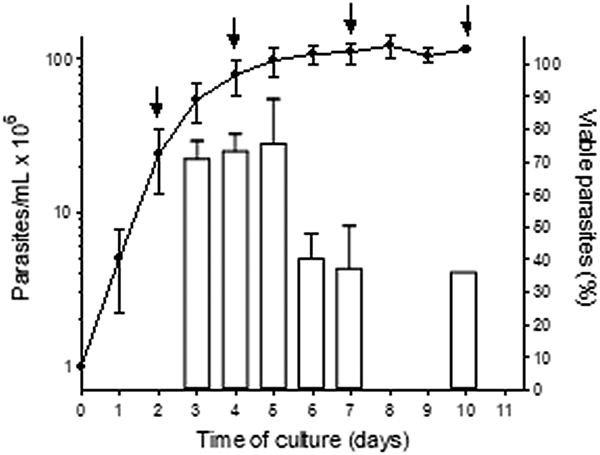
Initially, promastigote growth was verified by counting the parasites daily under light microscope. Parasites proliferate exponentially until the 3rd day in culture, characterizing the logarithmic (log) phase, and continue to grow until the 4th or 5th day after which proliferation stops, characterizing the stationary phase (Fig. 1). During in vitro promastigote growth, parasites are around 70–80% viable up to the 5th day of culture, but viability decreases from the 6th day on (Fig. 1). The following analyses on the main changes that occur during promastigote metacyclogenesis were performed in parasites harvested on 2nd (log phase), 4th (early stationary phase), 7th and, occasionally, on 10th (late stationary phase) days, indicated by the arrows (Fig. 1).
Growth curve and viability of Leishmania guyanensis promastigotes in axenic culture. Parasites (1 × 10⁶ mL−1 initial load) were cultured in Schneider's insect medium and counted daily in a haemocytometer. Arrows mark the days when parasites were harvested for analysis, corresponding log, early stationary and late stationary phases. Viability was determined by the MTT assay, as described in ‘Material and methods’ section. Each point represents the mean±s.e. of three independent experiments carried out in duplicates.

Size
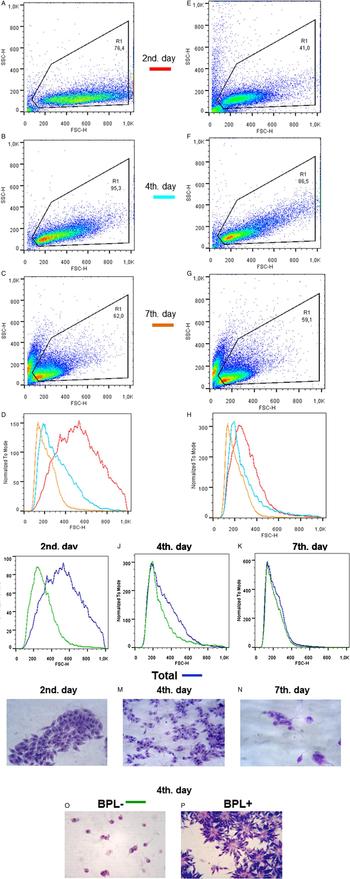
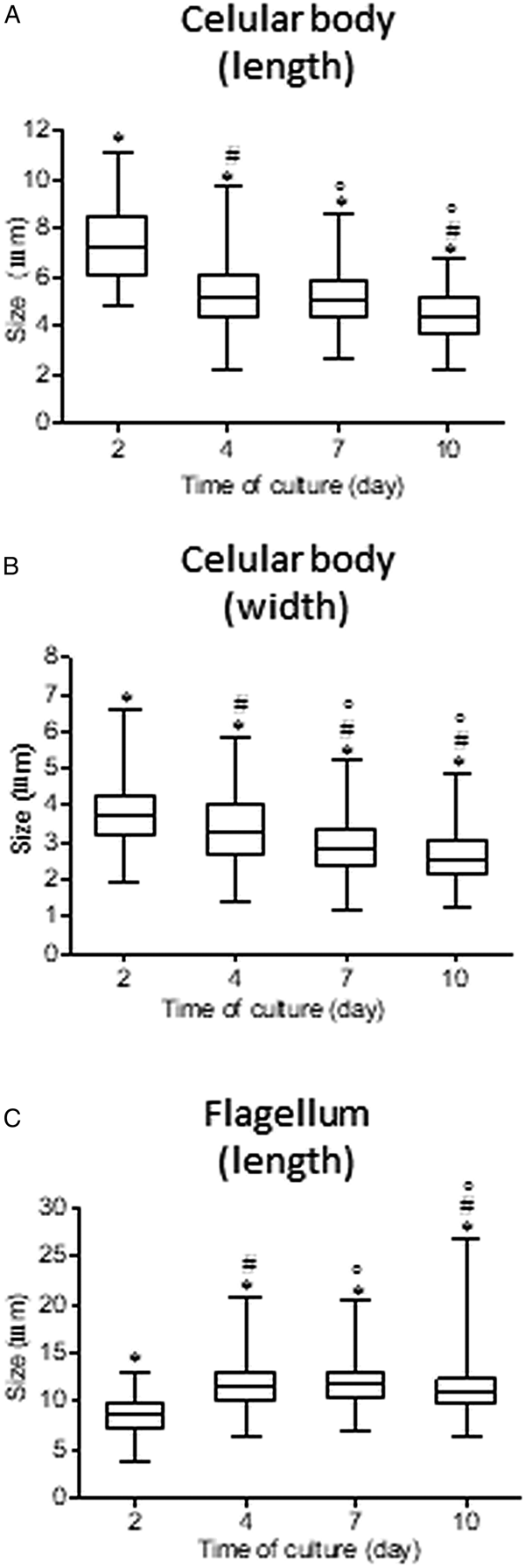
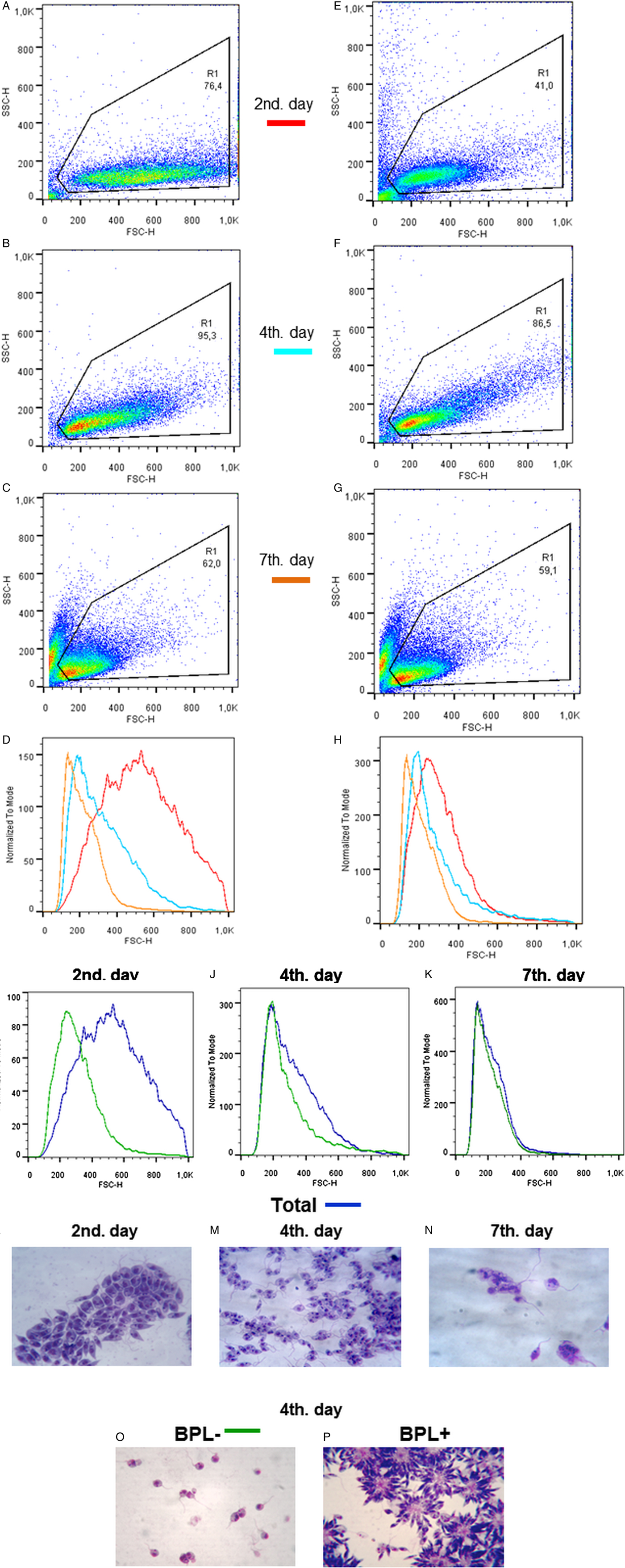
(1) Flow cytometry: Parasites were analysed for light scatter by flow cytometry to determine changes in size during in vitro growth. We analysed forward scatter (FSC), which reflects the size and side scatter (SSC), which reflects the granularity of parasites. Figure 2A–C shows a sample analysis of 2nd, 4th and 7th day of culture. Analysis were performed inside the gate depicted in the figure, which excluded a defined population of very small size (which is frequent on the 2nd day) and intense granularity (which appears on the 7th day), that we assume to be dead parasites, due to the results on viability (Fig. 1). We can observe that the population of promastigotes gradually decreases in size during in vitro growth. The histogram of frequency of cells of different sizes shows that the majority of parasites on the 2nd day are larger than those on the 4th or 7th day (Fig. 2D). By comparison with other descriptions, metacyclic promastigotes should be the low FSC and SSC parasites. (2) Morphology and morphometry: We also evaluated the morphological alterations by visualization in light microscopy (Fig. 2L–N) and by measuring (Fig. 3) stained promastigotes during in vitro growth to identify metacyclic forms in cultures, according to their body and flagellum sizes. Total promastigotes from the 2nd day of culture were mostly slender and fusiform with the flagellum size equivalent to the body length (Fig. 2L). On the 4th day, parasites start losing their fusiform shape, becoming smaller (Fig. 2M) and rounded, in a mix population. On the 7th day, they completely assume a round/balloon shape (Fig. 2N). Parasite measures (Fig. 3) show a progressive decrease in the cellular body size (length and width) and an increase in the flagellum length during time, much like in other species of Leishmania, mainly from 2nd to 4th day, indicating that metacyclogenesis is occurring in axenic L. guyanensis culture. These results corroborate what we observed in flow cytometry. It is interesting to notice, looking at the median, that cellular body width decrease is more gradual than cellular body length decrease or flagellum length increase, which seems to change more quickly.
Analysis of Leishmania guyanensis promastigote sizes by morphometry. Parasites were fixed in glass slides and stained. Morphological evaluation of metacyclogenesis was performed under light microscopy (1000×) by digital photography. Measurements of promastigote cell body lengths (A), body widths (B) and flagellum lengths (C) were made using Image J software. Values represent the median, superior and inferior quartiles, and maximal and minimal sizes of four independent experiments in which the size of 60 parasites/experiment was determined (*P < 0.0001 compared with 2nd day; #P < 0.0001 compared with 4th day; °P < 0.0001 compared with each other).
Resistance to complement-mediated lysis
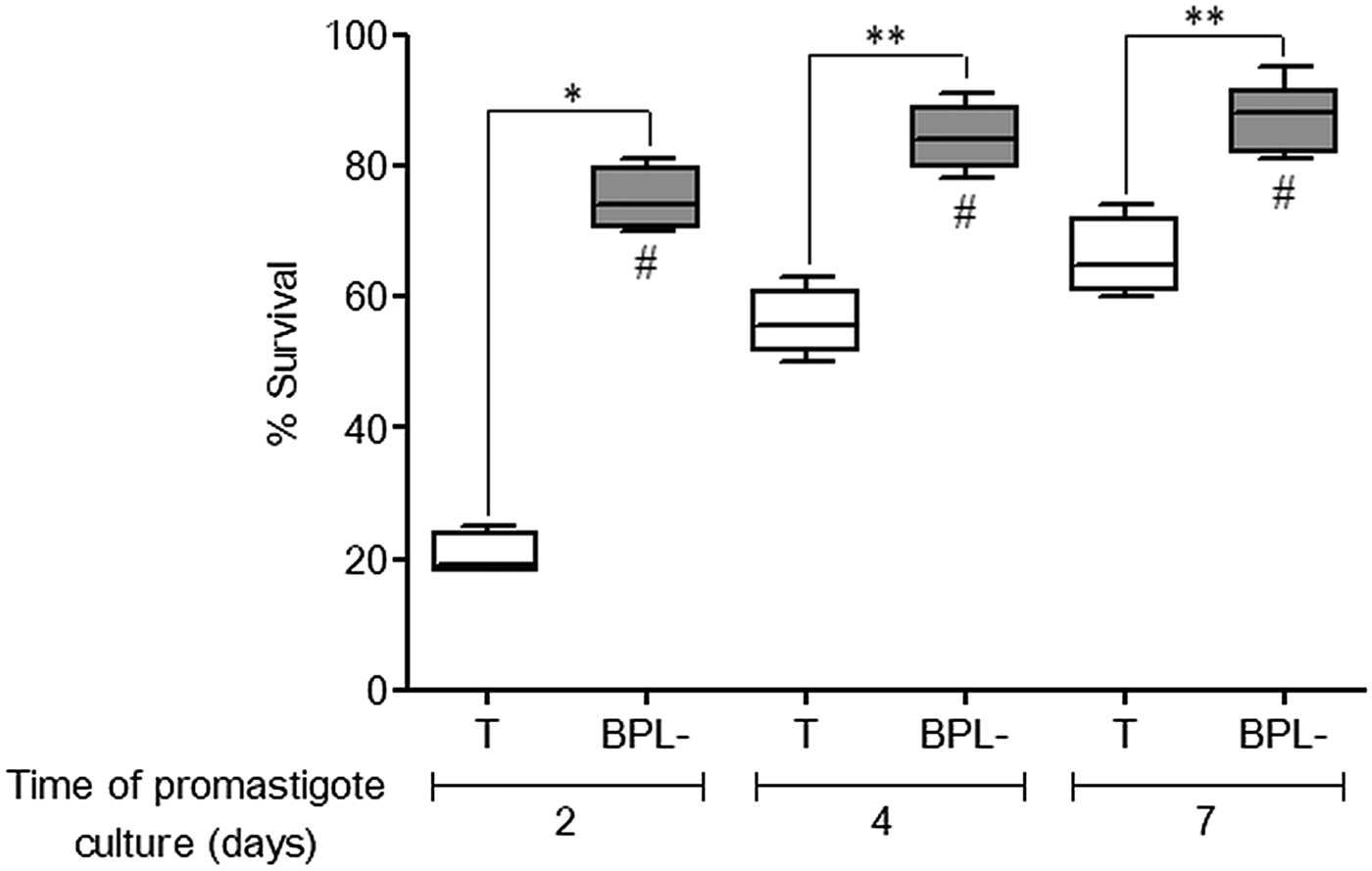
In other species of Leishmania, transformation of procyclic into metacyclic form in promastigotes is accompanied by an increase in the capacity of parasites to resist to lysis mediated by the complement system. We performed this assay utilizing fresh rabbit serum as source of complement proteins to evaluate the degree of resistance of axenic promastigotes to complement-mediated lysis in vitro. We verified that parasites from the stationary phase (4th and 7th day of culture) are more resistant to lysis than those from log phase (2nd day of culture) (Fig. 4, clear boxes). Parasite resistance reaches up to 90% at the 10th day (not shown) as compared with around 20% at the 2nd day. Total parasites from the 2nd day incubated with heat-inactivated rabbit serum have an average survival rate of 97% (not shown). These results corroborate the occurrence of metacyclogenesis in axenic culture of L. guyanensis.
Infectivity
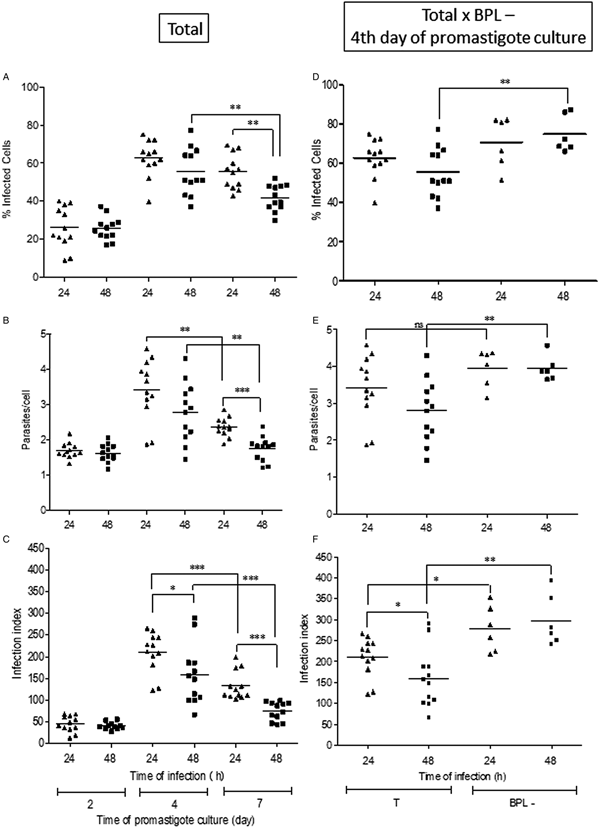
Since metacyclic forms are more infective to macrophages, promastigotes were evaluated for their infectivity to human macrophages. Figure 5 shows that, at 24 h, total promastigotes from log phase (2nd day) infect around 25% of macrophages (A) which have less than two parasites average per cell (B). This rate of infection does no vary in 48 h. On the other hand, parasites from 4th day infect around 65% of macrophages (A), each macrophage containing more than three parasites average (B) at 24 h, and somewhat decreased at 48 h to 55% with less than three parasites average. When the population of promastigotes from the 7th day of culture is used, the percentage of infected macrophages did not vary much (55%) at 24 h but the number of parasites inside cells dropped to more than two parasites average (B). At 48 h the percentage of infected macrophages decreased to 40% and the number of parasites per cell to less than two, average. The infection index (C) reflects more accurately the infectivity of these populations of promastigotes, showing that promastigotes from the 4th and 7th day of culture are far more infective than promastigotes from the 2nd day of culture, although the population of promastigotes from the 7th day of culture is less infective than the population from the 4th day.
Agglutination mediated by BPL
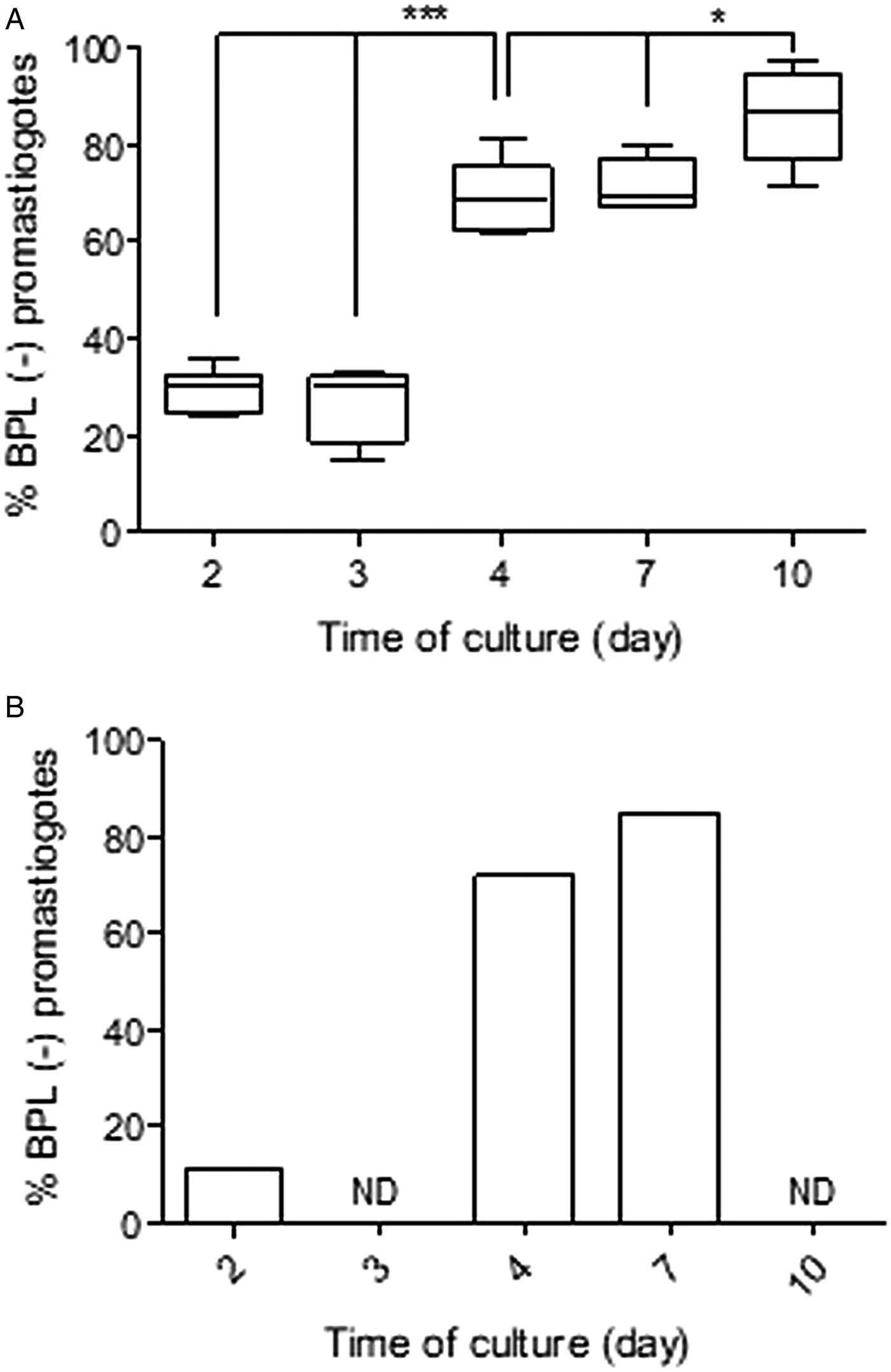
In an attempt to purify the metacyclic promastigotes from total culture, parasites were incubated with BPL, which is known to selectively agglutinate procyclic forms of L. braziliensis (Pinto-da-Silva et al., Reference Pinto-da-Silva, Camurate, Costa, Oliveira, Da Cunha-e-Silva and Saraiva2002). It had already been shown that L. guyanensis binds BPL (Gazola et al., Reference Gazola, Ferreira, Anacleto, Michalick, Andrade and Moreira2001), but there are no studies about selective agglutination of promastigotes during the different phases of growth. In Fig. 6, we show that incubation of promastigotes from the different days of axenic culture with BPL led to selective agglutination of parasites (Fig. 6A). In this experiment, we included parasites from the 3rd day to verify whether the changes in the ability to bind BPL occurred from 2nd to 3rd or from 3rd to 4th day and from the 10th day to verify whether metacyclics persisted at a late phase growth. We observed that this procedure leaves only 25–30% of non-agglutinated parasites on the 2nd and 3rd day, while 60–80% of parasites did not agglutinate on the 4th and 7th days, reaching almost 100% on the 10th day, showing a remarkable increase of forms that do not bind BPL from the log phase of culture. Purified parasites keep their viability similarly to that of parasites from 4-day cultures, but are somewhat less viable than the parasites from 7th or 10th day cultures (not shown). These data confirm that forms that bind BPL, which must be the procyclic forms, predominate at log phase of growth of parasites in axenic culture, while those that do not bind BPL, which must be the metacyclic forms, predominate at the beginning of stationary phase in the culture up to the 3rd day. Agglutination by BPL is disrupted by lactose, a BPL-binding inhibitor, confirming the specificity of the binding (not shown). BPL differential promastigote agglutination is not a feature unique for the M4147 strain of L. guyanensis used throughout this work, since promastigotes from the M1176 strain are also differentially agglutinated by BPL, following the same proportions of agglutination, as evaluated on days 2, 4 and 7 of in vitro growth (Fig. 6B).
Analysis of L. guyanensis promastigotes negatively selected with BPL
Size as evaluated by flow cytometry
Negatively selected parasites from 2nd, 4th and 7th day cultures were analysed by flow cytometry (Fig. 2E–H). We observed that, on the 2nd day, the population that does not bind BPL (Fig. 2E) displays much smaller size when compared with populations of total culture (Fig. 2A). It is possible that either they are metacyclics from the previous culture or parasites that precociously became metacyclics. When we look at the population of negatively selected promastigotes from the 4th or 7th day (Fig. 2F and G), there is little or no difference in size, respectively, when compared with total culture (Fig. 2B and C), showing that these are stages in which most or all promastigotes had already become metacyclic in total culture. The differences in the appearance of the BPL-non-agglutinated and BPL-agglutinated parasites are striking when analysed by light microscopy. Non-agglutinated (BPL−) promastigotes (Fig. 2O) are round with long flagella, whereas agglutinated (BPL+) parasites (Fig. 2P) are much thinner and fusiform. We can see that on the 2nd day, BPL-negative population is still somewhat heterogeneous, but most parasites are smaller when compared with the whole population. BPL-negative promastigotes from days 4 and 7 are practically all small and homogenous in size. Figure 2I–J shows a comparison between the frequency of sizes in total culture and negatively selected culture. These data are compatible with those found by morphometry, which show a decrease of the cellular size, concomitant with the appearance of metacyclic forms in culture. BPL-negative population of M1176 strain also shows the same size and appearance as M4147 strain, used throughout this work, as accessed by flow cytometry and microscopy, respectively (not shown), also showing that the selected parasites have the typical features of metacyclic promastigotes.
Resistance to complement-mediated lysis
BPL-negative promastigote forms were also evaluated as to their resistance to complement-mediated lysis. Our results show that BPL-negative parasites (Fig. 4, shaded boxes) are indeed enriched in forms more resistant to complement-mediated lysis. Even with parasites from the 2nd day, we already may observe 70–80% of survival of purified parasites in comparison to around 20% in the total culture, reaching more than 80% in parasites from the 4th or 7th day. These data show that we were able to enrich in complement-resistant promastigotes since the beginning of the stationary phase, corroborating that the parasites not agglutinated by BPL are the metacyclic forms.
Infectivity
The results of this experiment, carried out with parasites on the 4th day of culture, also corroborate that agglutination with BPL causes an enrichment of metacyclic forms at the culture, since BPL-negative parasites proved to be more infective than the parasites of total culture (Fig. 5D-F). Purified metacyclic forms were also shown to be more resistant to elimination by macrophages, since the rate of infection and parasites per cell are maintained from 24 to 48 h, as opposed to parasites of total culture at 4th day (Fig. 5A–C, repeated in Fig. 5D–E for better comparison) or 7th day (Fig. 5A–C).
Discussion
In a recent study, Pires et al. (Reference Pires, Borges, Cappellazzo-Coelho, Dorta, Lino-Junior, Pereira, Pinto, Pelli-de-Oliveira, de Matos, Abrahamsohn, Uliana, Lima and Ribeiro-Dias2015), reporting the characterization of an isolate of L. guyanensis from a patient in Goiás, Brazil, emphasized the crucial importance of correct identification and characterization of species of the subgenus Leishmania Viannia, suggesting that the presence of L. guyanensis may be underestimated in endemic regions. Despite the epidemiologic importance of L. guyanensis, in PubMed web site (https://www.ncbi.nlm.nih.gov/pubmed), as accessed 12 December 2018, of the 13 134 hits containing the keyword Leishmania in the title of the article, only 93 (0.71%) contains the words Leishmania and guyanensis, demonstrating the remarkable lack of data concerning this important species. No articles were found on L. guyanensis metacyclogenesis and no technique is described to isolate metacyclic promastigotes from axenic cultures, an important step to study infection in vitro and in vivo in animal models. Here, we have thoroughly studied the metacyclogenesis process in L. guyanensis in axenic cultures, and tested and validated a method currently used to purify L. braziliensis metacyclic promastigote (Pinto-da-Silva et al., Reference Pinto-da-Silva, Camurate, Costa, Oliveira, Da Cunha-e-Silva and Saraiva2002).
Like other Leishmania species (da Silva and Sacks, Reference Da Silva and Sacks1987), L. guyanensis grows in vitro, presenting a standard growth curve with a log phase, which lasts up to the 4th day, from where a stationary phase starts (Fig. 1). Due to morphological and biochemical differences among the various developmental forms, it is possible to identify metacyclic and procyclic promastigotes in different species of Leishmania spp (Sacks and Da Silva, Reference Sacks and Da Silva1987; Louassini et al., Reference Louassini, Adroher, Foulquié and Benítez1998; Zakai et al., Reference Zakai, Chance and Bates1998; Pinto-da-Silva et al., Reference Pinto-da-Silva, Camurate, Costa, Oliveira, Da Cunha-e-Silva and Saraiva2002; Almeida et al., Reference Almeida, Vilhena, Barral and Barral-Netto2003; Gamboa et al., Reference Gamboa, Torres, De Doncker, Zimic, Arevalo and Dujardin2008). Here, we found that, during axenic culture, L. guyanensis undergoes the same types of changes that characterize metacyclogenesis. One is the morphological transformations regarding cell and flagellum sizes. These changes were gradual, with a decrease in cell body size and increased flagellum length (Figs 2 and 3). Promastigotes are considered to have a metacyclic morphology when presenting small body cell size and long flagellum (twice or more the body length) (Zakai et al., Reference Zakai, Chance and Bates1998) and these forms were mainly found from the 4th day on. By flow cytometry, the changes in parasite size were readily and more accurately observable than by morphometry. Interestingly, however, the morphology of metacyclic L. guyanensis promastigotes are rather different from other species, although all have small bodies, L. guyanensis metacyclics have a balloon-shaped body (Fig. 2), whereas metacyclics from other species exhibit a slender appearance (Saraiva et al., Reference Saraiva, Pinto-da-Silva, Wanderley, Bonomo, Barcinski and Moreira2005). Leishmania braziliensis, a closely related species, have been described as having either slender (Pinto-da-Silva et al., Reference Pinto-da-Silva, Camurate, Costa, Oliveira, Da Cunha-e-Silva and Saraiva2002) or round/oval shapes (Almeida et al., Reference Almeida, Cuba, de Sá, Pharoah, Howard and Miles1993). Our results demonstrated that, like in other species, the size of the parasites decreases over time in axenic culture, indicating that metacyclogenesis is taking place.
Just as in the digestive tract of the vector, Leishmania promastigotes in axenic culture, transform from a non-infective to a highly infective stage, a central feature of metacyclogenesis. During this process, parasites become pre-adapted to survive within vertebrates, as they need to escape host cells microbicidal mechanisms. Complement-mediated lysis is one such mechanism. Metacyclic promastigotes, abundant during stationary phase of growth, have been proven to be much more resistant to complement-mediated lysis than procyclic forms mostly present during log phase (Sacks, Reference Sacks1989). Corroborating these findings, we demonstrated that stationary phase L. guyanensis promastigotes are far more resistant to complement-mediated lysis than log phase parasites (Fig. 4), confirming our previous findings that the frequency of L. guyanensis metacyclic promastigotes is much higher in stationary phase (Sousa-Franco et al., Reference Sousa-Franco, Araújo-Mendes, Silva-Jardim, Lima-Santos, Faria, Dutra and Horta2006). It is noteworthy that, as from the 4th day (early stationary phase), the frequency of small parasites and parasites resistant to complement-mediated lysis is comparable to the frequency on the 7th or 10th day (late stationary phase), indicating that L. guyanensis metacyclogenesis is mostly completed in the early stationary phase, also confirmed by infectivity and BPL binding, as discussed later.
Infectivity of the parasite in vitro or in vivo is also a manner of evaluating metacyclogenesis, since metacyclic promastigote forms are more infective to their host cells than procyclic forms (Louassini et al., Reference Louassini, Adroher, Foulquié and Benítez1998; Pinto-da-Silva et al., Reference Pinto-da-Silva, Camurate, Costa, Oliveira, Da Cunha-e-Silva and Saraiva2002; Yao et al., Reference Yao, Chen, Sudan, Donelson and Wilson2008; Serafim et al., Reference Serafim, Figueiredo, Costa, Marques-da-Silva, Gonçalves, de Moura, Gontijo, da Silva, Michakick, Meyer-Fernandes, de Carvalho, Uliana, Fietto and Afonso2012; Da Silva et al., Reference Da Silva, Morato, Quixabeira, Pereira, Dorta, de Oliveira, Horta and Ribeiro-Dias2015). Our experiments demonstrated that L. guyanensis early (4th day) or late (7th day) stationary phase promastigotes are more infective to human macrophages in vitro than those in the log phase (Fig. 5), as observed both from the number of infected macrophages and the number of parasites inside macrophages, reflected in the great difference between the infection index on days 2 and 4. Parasites from the early stationary phase (4th day) are more successful in macrophage infection than parasites from the late stationary phase (7th day) (Fig. 5), possibly due to the higher number of viable parasites in the early stationary phase (Fig. 1). One interesting fact is that, at 48 h, the infection index is lower than at 24 h, suggesting that a number of invading parasites are being eliminated by the macrophages. These parasites may correspond to procyclic forms still in culture (observe that this does not occur with the purified metacyclic forms).
Another expressive shift that occurs during differentiation into metacyclic form in several species of Leishmania is the modification in LPG molecules. Changes in the composition of LPG carbohydrates associated with metacyclogenesis have been demonstrated in experiments where metacyclic forms lose their ability to bind to insect gut (Pinto-da Silva et al., Reference Pinto-da-Silva, Camurate, Costa, Oliveira, Da Cunha-e-Silva and Saraiva2002; Serafim et al., Reference Serafim, Figueiredo, Costa, Marques-da-Silva, Gonçalves, de Moura, Gontijo, da Silva, Michakick, Meyer-Fernandes, de Carvalho, Uliana, Fietto and Afonso2012). In L. major, LPG almost doubles the mean number of repeating units per molecule and arabinose (Ara) covers the galactose (Gal) side chains (Sacks et al., Reference Sacks, Brodin and Turco1990). Metacyclic forms of L. braziliensis also undergo modifications in the LPG molecule by adding glucose residues and increasing the galactose–mannose (Gal–Man) repeating units (Soares et al., Reference Soares, Cardoso, Barron, Araujo and Turco2005). These changes may be identified by differential binding of parasites to lectins (Sacks and Da Silva, Reference Sacks and Da Silva1987; Sacks et al., Reference Sacks, Pimenta, McConville, Schneider and Turco1995) or anti-LPG antibodies (Lira et al., Reference Lira, Méndez, Carrera, Jaffe, Neva and Sacks1998; Mahoney et al., Reference Mahoney, Sacks, Saraiva, Modi and Turco1999; Chaves et al., Reference Chaves, Soares, Silva and Saraiva2003; Pinto-da-Silva et al., Reference Pinto-da-Silva, Fampa, Soares, Oliveira, Souto-Padron and Saraiva2005), which allows parasites to be purified or enriched by negative selection.
Here, we defined a method for purification of L. guyanensis metacyclic forms, employing the method used with L. braziliensis, first shown by Pinto-da-Silva et al. (Reference Pinto-da-Silva, Camurate, Costa, Oliveira, Da Cunha-e-Silva and Saraiva2002). Gazola et al. (Reference Gazola, Ferreira, Anacleto, Michalick, Andrade and Moreira2001), in a study with several plant lectins, had already shown that BPL, which attaches to galactosyl (β-1, 3) N-acetylgalactosamine [β-gal (1–3)-GalNAc] residues, binds to L. guyanensis promastigotes, without, however, analysing whether this feature is shared by all promastigote forms during axenic growth of promastigotes. Our results corroborate these data and here, we further followed this feature during metacyclogenesis. At any point of the growth curve, we could see that BPL selectively agglutinated L. guyanensis promastigotes allowing the separation of two populations. The fact that, in the log phase of growth, more parasites are agglutinated and the opposite occurred from the early stationary phase (Fig. 6) indicated that BPL selectively binds to procyclic promastigotes. Indeed, analysis of the non-agglutinated forms, to compare their features with those of metacyclic forms, showed that these forms shared all the characteristics of metacyclic promastigotes studied here, namely morphology, resistance to complement-mediated lysis and in vitro macrophage infectivity (Figs 2–5).
Analysis of total culture or BPL-negative Leishmania guyanensis promastigote sizes by flow cytometry. Total (A–C) or BPL-negative (E–G) promastigotes from 2nd, 4th or 7th day of culture were analysed as to their size (FSC) and granulosity (SSC). The frequency of events inside defined gates are plotted together (D, H and I–K) for better comparison.

Complement-mediated lysis of total or BPL-negative Leishmania guyanensis promastigotes. Total (T) or BPL-negative (BPL−) promastigotes from 2nd, 4th or 7th day of culture were incubated with 10% fresh or heat-inactivated rabbit serum for 1 h at 37 °C, and parasite viability was evaluated. Parasites incubated in culture medium only were used as controls. Values represent the median, superior and inferior quartiles, and maximal and minimal percentages of resistant parasites of three independent experiments (*P < 0.05; #P < 0.05 compared with total 2nd day; **P < 0.005).

Infectivity of total and BPL-negative Leishmania guyanensis promastigotes. Total (T) or BPL-negative (BPL−) parasites from 2nd, 4th or 7th day were incubated with human macrophages. Infectivity was evaluated after 24 (triangles) and 48 (squares) h after infection. Values represent the mean of infectivity of promastigotes to 12 or six different donors in five independent experiments (*P < 0.05; **P < 0.005; ***P < 0.0005). Infectivity of total promastigotes on the 4th day (A–C) is repeated on the second column (D–E) for easier comparison.

Leishmania guyanensis promastigotes profile of agglutination by Bauhinia purpurea lectin (BPL). Parasite cultures of M4147 (A) or M1176 (B) strain were washed and incubated with 50 µg mL−1 BPL. Values of experiment in (A) represent the median, superior and inferior quartiles, and maximal and minimal percentages of non-agglutinated BPL-negative parasites of three independent experiments (*P < 0.005). Experiment in (B) is a unique experiment, performed merely to validate the method for other strain. ND, not determined.

In Leishmania, LPG is an interspecies polymorphic polysaccharide with variations in carbohydrates branching from the conserved column of Gal (β1, 4) Man (α1) −PO4 repeat units and cap oligosaccharides. In L. braziliensis, metacyclic forms also undergo modifications in the LPG molecule with the addition of glucose residues and increasing in mannose–galactose repeating units (Soares et al., Reference Soares, Cardoso, Barron, Araujo and Turco2005). In L. major, during metacyclogenesis, there is also an increase in the number of repeating units per molecule and a decrease of repetitive units with β Gal or Gal β 1–3 Gal β 1− side chains and an increase of both repeating units without side chains or side chains containing Arapα 1–2 Gal β1−, and other structural changes (McConville et al., Reference McConville, Turco, Ferguson and Sacks1992). In L. guyanensis, there are no reports of which are the changes, but the differential agglutination of promastigotes by BPL shows that there must also be such modifications. Since BPL binds β-gal (1–3)-GalNAc residues, our results show that, like in other species, these modifications are most likely the decrease in mannose–galactose residues. This corroborates the results obtained by Muskus et al. (Reference Muskus, Segura, Oddone, Turco, Leiby, Toro, Robledos and Saravia1997), which showed that lectins and antibodies specific for the disaccharide units of L. donovani are able to distinguish L. guyanensis, L. panamensis and L. braziliensis promastigotes from the log and the stationary phases.
The results discussed so far show evidence that, from early stationary phase (4th day), the vast majority of promastigotes already have metacyclic characteristics, such as small size, resistance to complement-mediated lysis, loss of ability to be agglutinated by BPL and infectivity. Here, we could enrich the population of metacyclic promastigotes of L. guyanensis in culture, by negative selection of promastigotes by agglutination by BPL, using both log phase promastigotes (2nd day) and stationary phase parasites from early (4th day) or late phase (7th day). The efficacy of this method was verified by the same parameters described here. Purified parasites stay viable during the purification process, following the same pattern of the total culture (not shown). BPL (−) promastigotes viability is also patent given their strong ability to infect macrophages (Fig. 5).
Regarding the size, the frequency of non-agglutinated parasites obtained from log phase (2nd day) differs considerably from the total parasites in culture. On the other hand, in cultures from early stationary phase (4th day), we can see that almost all parasites have the same size as observed in total culture and 100% of the late stationary phase parasites (7th day) already have the same size as parasites from total culture (Fig. 2).
Non-agglutinated parasites, from both log phase and stationary phases, were more resistant to complement-mediated lysis than the total parasite culture (Fig. 4). Likewise, non-agglutinated parasites from initial stationary phase proved to be more infective to macrophages than those from total culture (Fig. 5). Furthermore, macrophages were not able to eliminate intracellular amastigotes derived from infection with parasites not agglutinated by BPL, contrary to what happens with the total population of promastigotes in culture whose infection rate is lower at 48 h (Fig. 5). It is likely that the increased resistance to complement-mediated lysis of promastigotes not agglutinated by BPL is due to changes of LPG, as it has been shown for L. major (Späth et al., Reference Späth, Garraway, Turco and Beverley2003; Gaur et al., Reference Gaur, Showalter, Hickerson, Dalvi, Turco, Wilson and Beverley2009), L. mexicana and L. donovani (Gaur et al., Reference Gaur, Showalter, Hickerson, Dalvi, Turco, Wilson and Beverley2009). For L. major and L. donovani (Gaur et al., Reference Gaur, Showalter, Hickerson, Dalvi, Turco, Wilson and Beverley2009), it has been shown that LPG in metacyclic forms is an important structure for the macrophage–parasite binding/infection of these cells. Here, we found a correlation between infectivity and agglutination by BPL, and it is also possible that the change in L. guyanensis LPG contributes for its infectivity.
Evaluation of parasites not agglutinated by BPL by methods well established for metacyclogenesis analysis of various species of Leishmania shows that, also in L. guyanensis, they display characteristics defined as metacyclogenesis markers, such as reduced cell body and flagellum longer than cell body, increased resistance to complement-mediated lysis and increased infectivity for macrophages, in agreement with the various works cited here. Therefore, we can conclude from the present data that parasites that are not agglutinated by BPL are the metacyclic forms of L. guyanensis.
It is expected that, even in cultures at stationary phase, heterogeneous populations of promastigote can be found in axenic cultures of L. major (Sacks, Reference Sacks1989) and in sandflies infected with L. braziliensis and L. amazonensis (Nieves and Pimenta, Reference Nieves and Pimenta2000). The presence of metacyclic forms in all stages of culture (log and early or late stationary) and all times evaluated were noted in our experiments. This indicates that metacyclogenesis can occur in an unsynchronized way, considering the entire population of parasites in culture. However, we did find an enrichment of metacyclic forms in the stationary phase, as expected. The results found in experiments using flow cytometry and morphometry showed a more gradual appearance pattern of morphological changes, even in stationary phase (Figs 2 and 3). Conversely, data obtained from complement-mediated lysis assay and by agglutination with BPL show that in stationary phase the population of metacyclic forms is more homogeneous as far as the changes in surface molecules are concerned (Figs 4 and 6). We can see that the size of total parasites and BPL-enriched parasites is almost the same on day 4 and the same on day 7. Despite the similar size, around 30% of promastigotes are still agglutinated by BPL (Fig. 6) or sensitive to complement-mediated death (Fig. 4). This indicates that two different populations may still co-exist at the stationary phase. It is possible however that the minor population of the 4th day that still did not reach the final smallest size of BPL-enriched parasites could by the population that also binds BPL (Fig. 6). Metacyclogenesis is actually not a single step for all features and metacyclic promastigotes are characterized by all of them together. In this case, it looks like that the size is one of the first features to change. Thus, the size of the parasites, at least in this species, may not be a good metacyclogenesis marker. That is why we believe BPL enrichment is important, since BPL-enriched parasites are also complement-resistance-enriched parasites, more infective-enriched parasites and also have the smallest size.
Approaches for metacyclic purification have been described, exploring these morphological features. Späth and Beverley (Reference Späth and Beverley2001) purified L. major metacyclics by density gradient centrifugation, obtaining cells with typical metacyclic features at the 8–10% Ficoll interface. These distinct morphologies also allowed a description of a method to analyse metacyclic infective forms of Leishmania spp within the whole stationary population by non-fluorimetric parameters of flow cytometry (Saraiva et al., Reference Saraiva, Pinto-da-Silva, Wanderley, Bonomo, Barcinski and Moreira2005), which was used here. In conclusion, this is the first report describing metacyclogenesis in L. guyanensis axenic promastigotes, based on morphology and size, sensitivity to complement-mediated lysis, surface carbohydrates and infectivity. We have also described a simple and efficient method for the purification of metacyclic forms of L. guyanensis by negative selection using BPL. The method was proved suitable for two strains of L. guyanensis, suggesting that it is applicable for all parasites from this species. Furthermore, we have established a model of human macrophage infection with L. guyanensis, important for the study of other infection features.
Author ORCIDs
Ildefonso Alves da Silva Jr. 0000-0001-8184-9863; Thiago Castro-Gomes 0000-0003-1564-4645; Leda Quércia Vieira 0000-0001-5481-9618; Fátima Ribeiro-Dias 0000-0002-7950-3414; Maria Fátima Horta 0000-0002-9009-2716.
Acknowledgements
We thank Elimar Faria for the valuable technical assistance.
Financial support
This work was funded by Conselho Nacional de Desenvolvimento Científico e Tecnológico (CNPq), Fundação de Amparo à Pesquisa do Estado de Minas Gerais (FAPEMIG) and Coordenação de Aperfeiçoamento de Pessoal de Nível Superior (CAPES).
Conflict of interest
None.
Ethical standards
All procedures for macrophage derivation were approved by local Ethical Committee (Hospital das Clínicas/UFG, prot. 132/2012).