

1 Introduction
The 2008 financial crisis has caused macroeconomists and financial economists to reconsider much received wisdom. In particular, the question about how to secure a robust banking sector, via a combination of improved monetary policies and banking and financial regulations, has once again risen to prominence. The belief, popular during the last years of the Great Moderation, that responsible macroeconomic stewardship on the part of monetary policy makers had “beaten the business cycle” is no longer tenable. We contend that there must be a realistic reappraisal of foundational features of monetary institutions, namely central banking. Achieving robustness in banking, including its attendant desirable macroeconomic effects, will require broadening the analysis to include political economy considerations.
Robust banking can be viewed at different levels of generality. First, at the policy level, we can evaluate specific monetary policies taken by central banks, as well as various banking and financial regulations. Second, at the comparative institutions level, we can compare the operation of central banking systems and centrally regulated private banks, with alternative banking systems, such as free banking, which operates in a decentralized fashion. Third, at the highest level of abstraction, we can try to think about banking starting from “first principles,” i.e., based on broader theories of public goods governance.
In this paper, we take this third path, showing how a well-developed and widely recognized theory of governance, advanced by Nobel Prize winner Elinor Ostrom and her collaboratorsFootnote 1 , can be applied to banking, with a particular focus on the governance conditions conducive to macroeconomic stability.Footnote 2 Although we adopt this general perspective, when we turn to details, we unavoidably overlap with the existing literature at the lower two levels.
Our analysis builds on the work of several scholars who have turned a critical eye towards central banks’, and the Fed's in particular, records in mitigating macroeconomic turmoil. SomeFootnote 3 argue that the Fed may bear some of the responsibility for the unsustainable credit expansion and run-up in asset prices that preceded the bust. OthersFootnote 4 hold that the asset boom and bust was not the responsibility of the Fed, but the significant monetary contraction following the bust was. This literature has sparked significant debate about the performance of central banking, and the task of devising and implementing a good monetary policy.Footnote 5
In addition to such critiques of central bank performance, another post-crisis literature, again using the Fed as representative, can be read as questioning central banking in general.Footnote 6 These critiques are institutional in nature, and can be generalized to cover central banks that have a better track record than the Fed. Combined with the narrower monetary policy literature, the institutional literature provides a powerful impetus to reexamine the theoretical desirability of central banking, as well as arguments for various alternative monetary regimes.
This institutional literature suggests that a broader public economics perspective would provide intriguing and useful insights. Banking institutions face the same kind of general problems in terms of knowledge, incentives, and transaction costs, as other institutional arrangements addressing collective issues. Furthermore, the opposition between monocentric and polycentric governance, which we bring to bear on central banking, has been at the center of numerous other debates concerning the governance of public goods and of communal property.Footnote 7 To our knowledge, no one has noticed the relevance of these debates to the governance of banking systems, and, as a result, important insights from the institutional literature have not yet been properly incorporated in the post-crisis literature.
Once we look at the problem from the more general perspective of Ostrom's “design principles” for robust institutions of governance,Footnote 8 and in particular from the point of view of the theory of polycentricity,Footnote 9 we are able to develop (a) a much stronger argument for the superiority of free banking over central banking, and (b) explain which version of the many possible free banking systems is likely to work well. In other words, the structural weaknesses of central banking appear in a new light, and the concept of free banking is developed beyond the mere idea of a decentralized banking system. The polycentric perspective leads us to ask which rules are necessary to assure that a decentralized system will work well. We refer to a free banking system operating under proper over-arching rules, i.e. rules that effectively prevent commons problems such as the over-expansion of credit, as polycentric banking, and we argue that the proper over-arching rules are indeed discovered by a process of self-governance similar to the one described by Elinor Ostrom in Governing the Commons.
Our purpose in this paper is to, on the one hand, lay out the deep reasons for why monocentric banking is vulnerable to systematic problems that are virtually impossible to fix, and, on the other hand, to explain the polycentric alternative. The real world banking arrangements may sometimes fall in between. We do not contend that only a free banking system can be a polycentric banking system. In principle, some systems with central banks can qualify as polycentric, provided the central bank does not dominate the banking network due to legal privilege. The present-day monetary institutions of Australia, Canada, and New Zealand share some of the club-like features of polycentric banking. Their central banks play a somewhat less monopolistic role than in the United States, relying on cooperative arrangements with the other banks. For example, the Bank of Canada delegates the operation of its payment system to a privately operated clearinghouse, with which it also shares a collateral facility. Such arrangements are important in practice, but, for the purpose of this paper, we are interested in laying out the principles of polycentric banking. It is important to understand these principles for what they are: an alternative to monocentric banking. As such, in the interest of conceptual clarity, we abstract to some extent from the complexities of real-world banking arrangements, including the complexities of shadow banking and of hybrid banking arrangements mixing principles of central banking with those of polycentric banking. Exploring the example of free banking allows us to illustrate the self-governing task of discovering and implementing the proper over-arching rules. Furthermore, in our view, the optimal polycentric form is full-blown free banking, rather than some hybrid form.
The remainder of this paper is organized as follows: In Section 2 we discuss the relevance to currency systems, and thus banking as well, of several related political economy perspectives, especially that of E. Ostrom. In section 3, we build on the perspective developed earlier to explain the nature of behavioral political economy problems within a central banking system. In Section 4 we contrast monocentric central banking to polycentric free banking, and, using the theory of polycentricity and E. Ostrom's “design principles,” we explain the conditions under which free banking will be able to meet challenges that central banking cannot, and hence provide a more robust monetary system. In Section 5 we conclude by discussing possible paths from central banking to polycentric banking.
2 Governance systems: the polycentric perspective
There are several reasons why monetary systems might be characterized by externalities of sufficient magnitude that sound governance institutions are required to align individual behavior with economic wellbeing. The natural outgrowth of banking from moneyFootnote 10 means that bank behavior has monetary consequences. For example, it is at least conceivable that banks might strategically attempt to benefit at each others’ expense by over-issuing liabilities, which are frequently used as money. Furthermore, it is also conceivable that banks’ incentives to issue liabilities are not aligned with the magnitude required to track the public's demand for nominal money balances. Both of these possibilities may or may not be problematic, depending on the particular institutions governing money and banking. What is certain is that, given the above possibilities, macroeconomic stability via monetary equilibrium is not automatic. The governance of money and banking systems matters, and matters crucially for macroeconomic stability.
From the point of view of banks, a currency issued by one but accepted by many, exhibits properties of a common-pool resource. On the one hand, it is very difficult for the currency issuer to exclude undesired parties from using their currency. On the other hand, because of the over-issuing possibility, negative externalities among banks exist.Footnote 11 To put it differently, there are benefits for banks to accept each others’ liabilities, but there are also risks involved in doing so. A robust institutional banking arrangement creates a structure of incentives under which such risks are diminished. When the conditions exist for such robust institutional arrangements to be created in a bottom-up fashion, we refer to it as “polycentric banking.”
These possibilities alone do not imply that money should be a government operation. As pointed out by Buchanan and TullockFootnote 12 , when a market failure occurs, such as a tragedy of the commons, government involvement is still only justified if the social costs of the government operation are lower than the social costs of the market failure. The question of how money and banking systems should be governed such that they yield macroeconomic stability requires careful comparative institutional analysis.
The crucial link between money and banking is that bank liabilities are overwhelmingly used in commercial transactions. The structure of fundamental monetary institutions will affect a bank's behavior in generating the familiar monetary aggregates, with well-known macroeconomic effects. In our case, we need to compare the social costs of the decentralized and polycentric governance of macroeconomic stability to the social costs of the centralized and monocentric governance of macroeconomic stability. This comparison is quite difficult to perform accurately, but some authors have tried to approximate it by measuring macroeconomic performance across monetary institutions. For example, RomerFootnote 13 shows that pre-Fed and post-WWII output losses due to recessions have been approximately the same, but post-WWII there have been fewer recessions and the standard deviation of losses is smaller, i.e., the Fed may have improved stability, although, when it has failed, the output losses have been greater on average than they used to be before the Fed. Selgin, Lastrapes, and WhiteFootnote 14 challenge this relatively favorable assessment, arguing that the Fed's performance was, in fact, worse than the admittedly flawed National Banking System that preceded it. One can attempt a variety of other such peak-trough analyses of a given economy or perform cross-country institutional comparisons. We take a different approach here. While perhaps it may eventually be possible to achieve consensus by such purely empirical assessments, we can also think about this comparison in an indirect manner, by exploring the fundamental questions underlying governance systems, as applied to money and banking.
It is here that polycentric theories of governance enter the picture. Most famously developed by E. Ostrom, these theories provide a framework for understanding under which conditions the interactions of many agents tend to lead to an emergent order that approximates the optimum—i.e., a productive social order. In other words, they developed the process-based institutional theory of how people can arrive in practice at relatively efficient public and collective goods governance structures. The underlining microeconomic logic behind this endeavor, referred to by E. OstromFootnote 15 as “a behavioral approach to the rational choice theory of collective action,” and more recently as “robust political economy,”Footnote 16 focuses on the idea that institutional arrangements are robust if they lead to productive social outcomes even when the agents involved suffer from cognitive biases, lack complete information, and are self-interested. By contrast, fragile institutional arrangements only work well under restrictive assumptions about rationality, knowledge, and incentives. Economists often pursue models under such restrictive assumptions because they are easier to analyze mathematically. But, when we venture into the public policy arena, we need to move our attention toward robust arrangements because people have limited knowledge and cannot be trusted to be altruistic.
Attaining good social outcomes may be difficult because the knowledge necessary to solve the problems is dispersed, and knowledge aggregation mechanisms may be faulty. Moreover, as pointed out by HayekFootnote 17 , the knowledge may not even be created under certain institutional arrangements. HayekFootnote 18 notes, that the market order not only aggregates the information about costs and values into prices, but it also creates this knowledge, because without the trading process preferences cannot be accurately revealed. Similarly, HayekFootnote 19 argues that the knowledge about the best solutions to collective problems is less likely to be discovered outside of liberal democratic arrangements in which all affected people have the opportunity of voice and exit, and they face an actual choice among a plurality of candidates and parties. Other examples include the common law, federalism, and the scientific community. What all these examples have in common is the idea that knowledge can be more easily and reliably created by means of genuine choice among real-world alternatives, as compared to the case when the alternatives are merely hypothetical and imagined. Polycentric structures thus possess significant knowledge-creating capacities.
We also must consider whether decision-makers have the incentive to actually implement what they know to be the best solution. What is best personally for the decision-maker may not correspond with what is best from a general welfare perspective. To give the example of markets again, as the Bertrand competition model shows, when free entry exists, firms are forced to satisfy consumer demands because that is the only way in which they can make profits. This “invisible hand” idea can be extended to certain non-market contexts as well. For example, a polycentric system of public administration is more likely to satisfy citizens’ preferences than a centralized system.Footnote 20 The mechanism is the same: The threat of the beneficiaries’ exit creates strong incentives on the part of the providers to take the beneficiaries’ preferences into account. Once again, we get the same conclusion: A polycentric order is more robust than a monocentric one.
Finally, in addition to the standard homo economicus considerations of information and incentives, we also need to consider the possibility of cognitive biases, and the institutions under which the deleterious effects of these biases are minimized. Robust solutions to people's cognitive biases involve “ecological rationality.”Footnote 21 As Gigerenzer writes, “a realistic alternative to the ideal of optimization, whether unbounded or constrained”Footnote 22 is the use of heuristics, i.e., simple context-dependent if-then algorithms, and “[a] heuristic is ecologically rational to the degree that it is adapted to the structure of an environment.” Such heuristics are used to escape the complexity of various situations, a complexity which makes a rational optimization calculus impossible to perform with satisfactory precision; they are “better than rational.”Footnote 23 But precisely because heuristics are a substitute for rational optimization, they are discovered by trial-and-error. This requires a polycentric environment, which allows a diversity of approaches to co-exist.Footnote 24
While monocentric systems can still use heuristics, they are very inefficient at improving these heuristics—or at discovering them in the first place. For example, central banks use some rules of thumb (e.g., Taylor rules) although not very reliably. Strictly speaking, trial-and-error only requires many observations, not necessarily a polycentric environment. However, there are two major problems with this, making the system far less resilient: (1) trial-and-error by central banks affects an entire economy at once, and, hence, errors are very costly; (2) there is considerably less data to build upon, including less data for accounting for various cofounding factors. In contrast, in a polycentric system when part of the system fails it can be helped by the successful parts.Footnote 25 The cost of errors is significantly reduced. Monocentric systems usually rely on analytic methods, which try to comprehensively and explicitly evaluate all possible outcomes. This means that, when complexity rises, monocentric solutions are much more vulnerable to the failures of rational optimization, and, also, they hamper the discovery of valuable heuristics to substitute for rational optimization. By contrast, polycentric systems create the conditions for trial-and-error learning, including the discovery of useful heuristics, and limit the impact of costly errors.
Putting these three elements together, we have reason to question monocentric monetary arrangements. Let us explore these reasons in more detail, first, the explicit application of this “robust political economy” idea to central banking, in order to see if the above insights are indeed useful for thinking about banking, and, second, the more detailed elaboration of this idea of robustness into what E. Ostrom has called the “design principles” for a robust system of governance.
3 Ignorance and self-interest: The roots of the social costs of central bankingFootnote 26
Central banks possess a monopoly on the issuance of base money. This means that a nation's central bank (or group of nations, as with the European Central Bank) is ultimately responsible for the amelioration of macroeconomic turbulence resulting from an excess demand for, or supply of, money. Although central banks obviously do not have tight control over the broader monetary aggregates, the supply of base money is a crucial determinant for whether the banking system is able to supply the public with their desired nominal money balances at the prevailing price level. Monetary policy under (modern) central banking is thus monocentric. The central bank is the “decider of last resort” as to the stance of monetary tightness or looseness. Errors committed by the central bank in the course of its operation thus affect the entire domestic economy, and frequently the international economy as well. Because so much rests on the central bank, it is imperative to ascertain whether monetary policy makers have the incentives, information and rationality necessary to behave in a manner conducive to macroeconomic stability. In other words, although their decision-making costs may be very low, the external costs can be substantial.
Our contention is that monocentric monetary policy, in the form of modern central banking, is fragile because its institutional architecture makes it vulnerable to a host of problems involving ignorance of relevant facts necessary to take a correct decision, incentive to act upon the facts (assuming one could get them), and restraint from indulging in irrational biases such as wishful thinking and groupthink. Even in a perfect world, there are difficulties with central banks’ exercise of monetary control.Footnote 27 Relaxing the assumptions that yield this world raise additional problems. The “robust political economy” of monocentric monetary policy not only raise important issues regarding information, incentives, and rationality, but also suggests these issues are unlikely to be easily overcome.
3.1 Information
The informational environment of monocentric monetary policy, in the context of central banking, is unfavorable. Decisions concerning monetary policy are made by a small committee of individuals. Despite their admittedly impressive credentials, resting the stance of base money—and hence the foundation for the larger banking and financial system—on a committee decision process, the “social intelligence” of markets is subsumed by the limited intelligence of policymakers. The knowledge required to prevent monetary disequilibria from having deleterious real effects, like all economically-relevant knowledge, is divided throughout the economy and cannot be effectively harnessed in real-time by monetary policy makers.Footnote 28 While central bankers have access to a great deal of information, this information takes the form of statistical aggregates that are unable to substitute for the contextual and market-generated knowledge necessary to undo disequilibria in the market for money balances.Footnote 29 That this is a live concern is obvious from the literature cited in the Introduction.
Going beyond the stance of base money in isolation and considering short-run interest rates, ubiquitously used as a target for monetary policy, the problems are compounded by a lack of market feedback. For example, regarding the Fed's interest-on-deposit policy, “The Fed has effectively replaced the entire interbank money market and large segments of other markets with itself—i.e., the Fed determines the interest rate by declaring what it will pay on bank deposits at the Fed without regard for the supply and demand for money.”Footnote 30 The rate paid on deposits at the Fed is obviously not the same as the Fed funds rate, but their relative magnitudes obviously matter at the margin for allocation of scarce capital. Interest is a crucial factor in coordinating production, and errors in setting the interest rates for excess reserve payments and discount window loans can result in the private sector engaging in production projects that will prove infeasible once these errors are discovered. Since production projects come with a degree of unrecoverable investment,Footnote 31 errors resulting from mismanagement of interest rates are socially costly. These problems stem from lack of market feedback, which is due in part to a lack of ownership, the informational role of which is often overlooked at the expense of the incentive role.Footnote 32
The above was focused on the information problems confronting monetary policy makers, but the information problems confronting market actors, given monetary monocentrism, are important as well. The most obvious one is the uncertainty stemming from unclear monetary policy. Because central banks are public organizations, they are not constrained by profit and loss criteria in the same manner as private organizations; thus their behavior is more unpredictable.Footnote 33 If market actors are unclear as to how the central bank will behave, they will also be uncertain as to how to structure their contracts such that the prices (including wages) agreed to in these contracts are consistent with the central bank's ‘nominal anchor.’ Ex ante, this necessitates the expenditure of significant resources on central bank watching, as evidenced by the financial press leading up to the FOMC's interest rate decisions in recent months. Ex post, this necessitates market actors correcting errors arising from incorrectly predicting central banks’ activity. Both of these are costly to society. In addition, there is some concern that central bank behavior may impact the structure of relative prices in unpredictable ways.Footnote 34 If true and empirically significant, this is another costly aspect of central banking on the incentive margin.
3.2 Incentives
Informational problems associated with central banking have received significant attention. By contrast, treatment of incentive problems is much rarer. But issues of incentive-alignment for monetary policy makers are real, and they can have a significant effect on the practice of monetary policy making. Unfortunately, these effects are frequently harmful.
Monetary policy makers are specialized and highly trained macroeconomic practitioners. They are also bureaucrats, and thus standard political-economic analyses of bureaucratic behaviorFootnote 35 can apply to them as well. For starters, monetary policy makers often resist incorporating advances in economic theory into their practices. Commenting on the memoirs of academic-turned-central-banker Lawrence Mayer, Mankiw writes,
Recent developments in business cycle theory, promulgated by both new classicals and new Keynesians, have had close to zero impact on practical policymaking. Meyer's analysis of economic fluctuations and monetary policy is intelligent and nuanced, but it shows no traces of modern macroeconomic theory. It would seem almost completely familiar to someone who was schooled in the neoclassical-Keynesian synthesis that prevailed around 1970 and has ignored the scholarly literature ever since. Meyer's worldview would be easy to dismiss as outdated if it were idiosyncratic, but it's not. It is typical of economists who have held top positions in the world's central banks.Footnote 36
A more recent example would be central bankers’ frequent insistence that the ‘zero lower bound’ problem during the Great Recession made monetary policy impotent. Despite the fact that many prominent economists held monetary policy could still be expansionary during liquidity traps, central bankers frequently acted as if the matter was out of their hands.Footnote 37 This behavior fits an insight of the bureaucracy literature, which is that bureaucracies are highly process-oriented and thus resistant to updating and streamlining, since updating and streamlining frequently entails private costs for those involved in contributing to the process.
The incentive environment for market actors created by monetary monocentrism is also unfavorable to economic wellbeing. Central banks’ monopoly on base money issuance introduces a ‘soft budget constraint’ into the financial system.Footnote 38 Given central banks have been unwilling to follow a last-resort lending rule that punishes imprudent financial firms,Footnote 39 it is unsurprising that financial firms have constructed portfolios under the tacit assumption that, should they face bankruptcy, they would be bailed out. Moral hazard is a feature of modern financial systems largely due to market actors perceiving monetary policy makers’ unwillingness not to err on the side of underwriting losses. The benefits of bailouts are experienced by current monetary policy practitioners and private financial stakeholders, while the costs are pushed onto those who will bear the brunt of the next crisis. This in turn stems from the monetary ex nihilo that exists under monetary monocentrism.
4 Free banking as a discovery procedure
Concerns about rationality, information, and incentives are, by themselves, insufficient to compel reflection on the structure of monetary institutions. An economist always asks, “Compared to what?” There must be some monetary institutional order not subject to the above critiques in order for the critiques to damn monetary monocentrism and its most popular manifestation, modern central banking. Below we use the existing extensive literature on free bankingFootnote 40 to show there is such an alternative order and that its net benefits over central banking stem from its polycentric structure.Footnote 41
Systems characterized by several decision nodes tend to be more stable than systems with a single decision node, because a single point of failure is sufficient to cause systemic turbulence in the latter, but frequently is not in the former.Footnote 42 It is important to bear in mind that what matters here is the decision centers. For example, central banks take decisions based on discussions between a more or less diverse variety of experts, but, nonetheless, they ultimately are a single decision node. A free banking system is such a decentralized system and this logic suggests that, under certain conditions, it may be more robust. The key question is if no legal restrictions on banks other than the ordinary law of contract, property, and torts, are sufficient for determining each bank to play their part in implementing an efficient monetary policy. From this perspective, “monetary policy” is an emergent order, rather than an actual policy. Of course, no bank thinks of its activities this way; it is merely trying to maximize profits. Hence, the key question regarding what kinds of constraints need to exist such that each bank's activities, in concert with other banks in the system, will tend to result in an appropriate nominal quantity of money to satisfy the public's money demand.
Not all imaginable decentralized systems count as polycentric. The key idea about polycentricity is that decentralization operates under certain over-arching rules which assure that the emergent order is a productive one.Footnote 43 Importantly, these over-arching rules do generally not need a single, monopolistic enforcer acting as an outsider regulator. On the contrary, as documented by many examples, collectives often succeed in creating systems of mutual monitoring and mutual rule enforcement.Footnote 44 The literature on free banking reveals that, indeed, in a variety of historical examples, banks have created collective arrangements for monitoring and enforcing rules against reckless behaviors (Selgin and White Reference Selgin and White1994; White Reference White1989; Dowd Reference Dowd, Boettke and Coyne2015). The institution of the clearinghouse has served as the main mechanism for creating and enforcing such rules.
It is in this sense that free banking systems are polycentric. Polycentricity requires a system of organizations with overlapping spheres of activity that cooperate and (non-coercively) compete within an overarching set of rules which they themselves create, monitor, and enforce. Polycentricity is a feature of governance systems that are decentralized and operate in an environment where agents with decision-making capacity confront an array of incentives and information appropriate for welfare-enhancing governance. The features of free banking systems that render them polycentric are the source of their robustness. Importantly, as argued earlier, central banking necessarily lacks this stability-enhancing institutional architecture.
4.1 Polycentric free banking and robustness
Unlike central banking, a free banking system looks better equipped to deal with information, incentive, and rationality problems. Banks confront, in the form of interest paid on deposits and interest received for loans, both the information and the incentive as to how to respond to changes in the demand for money—as revealed by the actual behavior of depositors and borrowers. Moreover, in a complex system, different banks may respond to different sectors of the economy or to different geographical locations, and hence a large-scale polycentric banking system can deal with a diversity of demands for money. By contrast, central banking has access to no comparable method of discovering the true demand for money, and, moreover, necessarily imposes an inefficient one-size-fits-all monetary policy. This is not mitigated by modern central banks’ admittedly-impressive data collection and analysis. Again, statistical aggregates may constitute policy-relevant information but not market-relevant knowledge. The latter, both generated by and fed back in to the competitive market process, is what enables coordination in markets, including money markets.Footnote 45 Furthermore, as argued earlier, central banking employees do not have the proper incentives to implement the proper monetary policy, even if they would know it. By contrast, the profit-and-loss system in an environment of polycentric banking aligns bank incentives and provides banks with the necessary information, to act in a manner that (unintentionally) promotes macroeconomic stability.
As far as rationality is concerned, applying Caplan's theoryFootnote 46 one more time, we are also led to the conclusion that, because the costs of irrational biases are much higher in a tight profit-and-loss institutional setting—leading to bank-runs, facing higher interest rates, and even bankruptcy if these biases are not actively checked—the banks are less likely to engage in them. Furthermore, because of the diversity allowed by the polycentric system, including a diversity of governance rules that evolve in the clearinghouse, banks are more likely to discover useful heuristics, and, hence overcome the limitations of rational analysis.
Another important aspect of free banking is that the unexpected activity by any one individual bank is unlikely to destabilize the financial system in the same manner as unexpected activity by a central bank. In addition, unexpected activity is itself less likely under free banking, since each bank is a for-profit organization that must adhere to the general laws governing commercial activity, as well as accounting conventions and budget constraints. While the larger number of organizations capable of creating and destroying money means the number of relative price effects from changes in the money supply may also be larger, empirically each effect is likely to be smaller, simply because no bank in a free banking system has the capacity for money creation and destruction that a monopoly central bank has.
Incentive-wise, the macroeconomic effect of a free banking system is a currency elastic to the needs of trade. Banks will issue liabilities when the public's demand to hold a bank's liabilities rise and will fall when the public's demand to hold a bank's liabilities falls. Failure to issue additional liabilities when money demand rises would mean banks are failing to take advantage of a zero-interest loan from the public to the bank. Under the real-world free banking systems, the failure to contract liabilities when money demand had fallen resulted in banks losing specie reserves, threatening their continued viability unless they changed their course of action. Because of this type of feed-back mechanism, free banking affords a higher degree of macroeconomic stability, since automatic mechanisms exist to ameliorate monetary disequilibrium.Footnote 47
Free banking also provides better incentives for market actors in the financial system more generally. Under free banking, the system as a whole has a hard budget constraint; there is no lender of last resort who can step in to provide emergency liquidity ex nihilo. Rather than being a source of instability, this prevents moral hazard, giving banks and other financial organizations strong incentives not to construct portfolios that, should the realization of risk prove unfavorable, push these organizations toward insolvency.Footnote 48
The stabilizing effects, due to informational and incentive robustness, of free banking systems only exists in virtue of its status as a de facto polycentric governance structure. Competition between banks for customers drives the results. Without overlapping jurisdictions (that is, if banks could not compete for the same customers) the adverse clearings process would be significantly weakened, which would erode banks’ incentives and information to contribute to macroeconomic stability. This is why the international system of many central banks is not a polycentric system. Without profit-seeking behavior there would be no incentive- and information-alignment possible in the first place. Both of these in conjunction are necessary to drive the free banking system.
Importantly, macroeconomic stability under free banking is an emergent consequence, i.e., a system-level characteristic that exists because of the behaviors of individual banks, but is not reducible to the intentions of individual banks.Footnote 49 If by ‘policy’ we mean ‘consciously crafted plans by a public organization chartered to contribute to the common good in a specific manner,’ then free banking of course does not qualify on the policy dimension of “monetary policy.” But we believe the important part of policy, in the sense in which the word is ordinarily used, is a means-ends relationship between institutional technology and a desired outcome. Since policy is ultimately goal-oriented, it is still reasonable to apply the label to a system that achieves this goal, even if the intentions of the system's constituent organizations are conceptually unrelated to the goal.Footnote 50
4.2 Asymmetric information problems under free banking
The above analysis has one obvious weakness: Different people might estimate differently the probability that a given bank is insolvent. This is a typical asymmetric information problem. For example, depositors might not know exactly what shares of deposits the bank actually lends, and, hence, they might overestimate the probability of a bank-run. To make matters worse, in such an environment of limited transparency, “panics” might spread about a bank, even if (unknown to the customers) the bank's fundamentals are sound. Since a bank's ability to maintain monetary equilibrium depends on the profitability of business-as-usual in banking activity, in addition to the possibility of a financial panic, these problems also pose a threat to the ordinary maintenance of macroeconomic stability.Footnote 51
In practice, asymmetric information problems were overcome by the mechanisms that evolved to facilitate regular interbank clearing of liabilities. In the course of business, banks come to acquire each others’ liabilities. Initially banks may refuse to accept liabilities of a competitor bank, but find there are benefits to doing so. The first is the possibility of acquiring large stocks of competitor bank liabilities and presenting them for redemption en masse.Footnote 52 The second is to engage in mutual agreements for note acceptance, to increase the float of their own notes. This raises the need for banks to clear liabilities between them: If Bank A has more liabilities of Bank B than Bank B has of Bank A, Bank B will make payment in specie to Bank A during the clearing period. Initially banks clear multilaterally: each bank clears with every other bank individually. Eventually banks realize that multilateral clearing is needlessly costly and they make arrangements for bilateral clearings. As bilateral clearing becomes formalized through repeated interaction, it becomes a crucial institution: the clearinghouse. In addition to facilitating liability clearing, clearinghouses also maintain industry standards, such as capital requirements, facilitate emergency liquidity transfers, and pool information. This ‘self-regulation’ is feasible because membership in the clearing association is a valuable capital asset certifying bank quality to potential customers.
In other words, in real-world free banking systems the problem of asymmetric information was addressed by means of mutual bank monitoring within clearinghouses. Being accepted within a clearinghouse provided a costly and hard to fake signal to depositors that the bank was not engaged in reckless lending of their money. The depositors could thus be reassured because, as part of the clearinghouse, the bank was being monitored, and received financial support from the other member banks in case a bank-run did occur. The monitoring was credible, because the other members of the clearinghouse had a strong incentive to curb reckless behavior of any other bank as they would want to avoid having to step in and save a bank from its bank run. Moreover, when bank runs did happen, the saved bank was forced to pay a relatively high interest rate to the other banks—which acted as a strong deterrent from getting into that situation in the first place. The prevailing legal code for property, contracts, and torts acted as a relevant framework of rules within which associations of banks could discover and develop the more detailed, operational rules of banking activity.Footnote 53
4.3 Clearinghouses and Elinor Ostrom's design principles for systemic resilience
As we argued above, the broad framework of property, contracts laws, and torts, provides the necessary and sufficient conditions for banking associations to devise specific self-governing regulations that would assure the long-term survival of the system. These laws are sufficient because they provide the means to counteract fraud. But, the stability of a free banking system depends on the specific rules that banking associations (or, more generally, currency and credit providers) set up. The history of free banking provides an interesting insight. But we want here to address the problem more generally, by appealing to Elinor Ostrom's “design principles.”
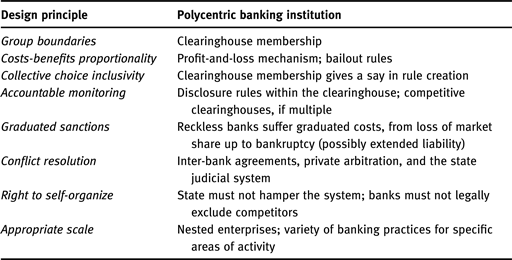
These “design principles derived from studies of long-enduring institutions for governing sustainable resources”Footnote 54 give us a broad perspective about institutional efficiency. They do not point to a single set of universal rules, but are broad ideas mainly about how to design different kinds of systems of operational and collective choice rules under different contexts characterized by different sources of uncertainty. They are a set of institutional heuristics that have been shown empiricallyFootnote 55 and theoreticallyFootnote 56 to lead to robust outcomes. Our claim here is that these design principles also provide useful insight about the kind of rules that would need to govern free banking systems in order for macroeconomic stability to prevail. Historical free banking systems have adhered to these design principles much more closely than central banking. These principles underlie the macroeconomic stability generated by free banking systems, as identified in the literature on free banking cited above, but it is important to emphasize that they are not crafted to achieve consciously macroeconomic stability. The design principles are the background conditions for the polycentric governance of a free banking system, out of which macroeconomic stability arises as a spontaneous order. We list these design principles, and the features that satisfy them, in Table 1 below.
Design principles applied to free banking

The design principlesFootnote 57 are:
-
(1) Clearly defined group boundaries. In the case of polycentric banking, clearinghouses establish these boundaries. The membership in a given clearinghouse signals the adherence to certain rules, and access to certain services from other banks. For example, services such as deposit insurance may be provided either by clearinghouses or by regular insurance companies under the condition that the bank is certified by some clearinghouses.
-
(2) Proportionality between the benefits and costs of various actors. This criterion is largely satisfied simply due to the operation of the price system. For example, banks that discover useful innovations will have higher profits. However, clearinghouses might establish other, less obvious rules. For example, when a group of banks bails out another member bank (who has, e.g., suffered a bank run), and different banks provide different amounts to the troubled bank, they should proportionally benefit more or less from the higher interest rate paid by the troubled bank when it returns the borrowed money. Such rules may seem obvious, but because they are not established automatically by the operation of the price system, members should bear them in mind when negotiating various agreements. Such proportionality rules reflect the basic idea that addressing fairness concerns leads to more robust systems because it diminishes conflicts.
-
(3) Most individuals affected by the rules are included in the collective choice group that can modify these rules. This is one of the main differences between polycentric free banking and central banking. In the case of central banking, banks are regulated by an outsider and may often have little say. Polycentric banking is a self-governing system in which banks form voluntary clubs. Even so, clearinghouses may create certain rules for non-member banks. For example, a bank that wishes to enter the clearinghouse may initially operate under a period of probation during which it would not have full membership privileges. Such situations should be carefully analyzed. Similarly, one should consider to what extent a bank's customers should be more involved. These are all difficult questions, and we are not going to try to provide answers here. Our purpose is only to highlight the types of concerns which require a great deal of attention.
-
(4) Monitors and enforcers of rules are accountable for their actions. Clearinghouse activities, for example punishing member banks that drift into recklessness, need to be accountable themselves. Monitoring is undertaken by a combination of bank shareholders, whose incentives and information are a function of market mechanisms and informal self-regulation within the clearinghouse. Perhaps the biggest theoretical problems faced by such a system is the possibility of quasi-monopolies. However, historically, clearinghouses have limited their cooperative activities to the orderly maintenance of the background conditions necessary for banking systems to function. In absence of competition-reducing political privileges,Footnote 58 there is little historical evidence to suggest that the economies of scale in banking are sufficiently large for a central bank to emerge naturally, or for banks to use the clearinghouse as an instrument of collusion for protecting rents. To the extent that the clearinghouse is able to facilitate rule monitoring and enforcement, it is likely to be endogenous self-regulation rather than exogenous imposition.Footnote 59 Thus there is a reciprocal checking of possible predation by the clearinghouse on banks, and banks on the clearinghouse, with no one agent in a privileged position to impose costs without recourse or fear of reprisal.
-
(5) Graduated sanctions for breaking the rules. Graduated sanctions for rule violations exist both in the form of lost market share for failing to follow the rules governing appropriate inside money provision, as well as civil procedures for infringement on the legal background conditions that make free banking possible in the first place. The price mechanism provides the most opportunities to create graduated penalties. Reckless banks don't immediately go bankrupt. At first, when doubts about their activities first appear, they face higher interest rates on deposits and the share price of the bank declines. When such a situation appears, the management of the bank faces a greater likelihood of a hostile takeover, which would restructure the bank, and, presumably, put it back on a sounder track. Even greater penalties can occur. As mentioned earlier, when a bank faces a bank run, it is usually saved by other members of the clearinghouse, but this is done under substantially higher interest rates. Only if the bank's recklessness has been prolonged and truly staggering, is the bank allowed to go bankrupt, which can be seen as the highest penalty.
-
(6) Access to low-cost local arenas for conflict-resolution providing decisions perceived as fair. Because banks acquire each other's liabilities, conflicts can occur. The judicial system may often provide an exceedingly costly method of solving such conflicts. As such, members of clearinghouses may either devise internal conflict resolution mechanisms or contract this service with existing adjudication companies.Footnote 60 Dispute resolution can thus be accessible both informally through interbank agreements, especially through the clearinghouse, and formally through civil procedures; private arbitration is also a possibility.
-
(7) External governmental authorities recognize, at least to some extent, the right to self-organize. In the past, the biggest obstacle faced by free banking systems was the downright abolition of the system by governments.Footnote 61 For example, Scottish free banking was severely hampered by the privileges gained by the Bank of England with the passage of Peel's Bank Act of 1844.Footnote 62 This continues to be the biggest difficulty faced by even meager alternatives to the money provided by central banks. We thus tend to be relatively skeptical towards the over-optimism of various techno-utopians who imagine that a free banking system, e.g., based on crypto-currencies, would be able to take over the world in spite of government opposition. It follows from this “design principle” that any transition towards polycentric banking would necessarily be thanks to an explicit change in public policy. This principle also addresses the common Panglossian critique: If polycentric banking is so efficient, how come we only see central banking? As in many other areas of economic life, the political factors have been decisive, outbidding the issue of economic efficiency. It is for this reason that polycentric banking requires a political opening—not so much as full support, but credible tolerance. This being said, international institutional competition between countries seeking to build financial centers can lead to a gradual spread of polycentric banking. If we are correct about its greater stability, the first movers will have an advantage, and, subsequently, other countries may try to imitate their success.
-
(8) “Appropriation, provision, monitoring, enforcement, conflict resolution, and governance activities are organized in multiple layers of nested enterprises.”Footnote 63 Responsibility mechanisms are nested within banks, between banks, and over the banking system as a whole through the standard mixture of profitability constraints, cooperative agreements, group self-regulation, and civil procedures, in ascending level of generality. The idea of nested enterprises may be the most difficult to understand due to the intuition created by central banking. Even the literature on free banking usually frames the discussion from the same one-size-fits-all perspective. We should point out, however, that a polycentric banking system may invent a wide variety of credit tools specifically designed for certain activities. The existing monetary system itself provides a very simple version of diversity in the form of different currency denominations. But the same reason for why different denominations exist may operate at a much deeper level. A polycentric banking system allowed to freely operate will tend to discover all such needs for different credit tools and provide them at the lowest possible cost. It is thus very difficult to make explicit predictions about what exactly a polycentric banking system would offer, in terms of specific services such as credit instruments or currency denominations. We obviously don't know. What we do know is that the nested enterprises are conducive to the satisfaction of consumer wants, as well as overall macroeconomic stability. Our comparative institutional study identifies the process that tends to discover and satisfy such wants.
Central banking, in contrast, fails on several of the above margins. The rules governing resource provision, in this case the procedure of the committee deciding the goals and stance of monetary policy, are opaque. Those who are subject to the rules regime are not necessarily empowered to participate in modifying the rules of the regime; with the possible exception of ‘systemically important institutions,’ financial organizations must take underlying central bank conditions as exogenous. Within- and between-bank governance procedures are frequently overridden by central bank decisions.Footnote 64 The ability to monitor monetary policy makers is extremely limited, as are the possibilities for enacting any penalties for actions that prove to be contrary to macroeconomic stability. Central banks, especially the Federal Reserve, have refused to punish reckless banks by refusing bailouts.Footnote 65 ‘Take it or leave it’ decisions by central bankers replace dispute resolution criteria. Finally, the organizational form for monetary policy decisions is not nested within the larger financial system, but is exogenous, for the purported purpose of increasing monetary policy efficacy. In light of the above, it is clear why central banking, qua monocentric monetary policy, not only exists in a less favored information and incentive environment than free banking, but it clearly fails the basic criteria for robust institutions that have been laid out in the broader governance and public economics literature. By contrast, historical free banking systems have zeroed-in upon those “design principles” and have implemented them within the institution of the clearinghouse.
5 Conclusion: Possible roads to polycentric banking
Our analysis strongly suggests that macroeconomic stability is more likely to be adequately provided as the unintentional result of polycentric governance structures under free banking, than the intentional result of monocentric attempts to target stability directly. There are, of course, other important issues that remain to be addressed. How would a free banking system constituted as we have described function in a world of internationally-integrated economies, especially if other countries’ financial systems were not governed by a similarly robust set of checks and balances? Are the governance structures of free banking adequate to address other concerns, such as the emergence of ‘shadow banking’? Even though these questions deserve careful consideration, we believe the efficiency and stability properties of free banking systems, qua polycentric governance systems, are sufficiently attractive that it is worth exploring what a move away from monocentric banking would look like, at least at the margin.
We anticipate several criticisms of our argument. The first is that we have not acknowledged central banking's strongest features, thus overstating the strength of free banking (a polycentric system) compared to central banking (a monocentric system). To our mind, the strength of a discretionary central banking system is greatly overstated, with respect to macroeconomic stability. While some argue the freedom and discretion of central banks to fight recessions is a social benefit, economists have long recognized that this freedom may inadvertently be the cause of central bank ineffectiveness.Footnote 66 Other arguments are stronger, such as having a central bank act as a lender of last resort, provided it strictly follows Bagehot's rules and does not create moral hazard. But this argument is about financial stability, rather than aggregate demand stability. Obviously there are spillover effects between bank balance sheets and aggregate demand, but still they are conceptually separate problems. We intended to address only the latter here.
Second, and more troubling, is why polycentric banking systems of the kind we describe do not exist anymore. If central banking does such a poor job, why are monetary arrangements of the world's polities dominated by central banks? Our answer is that central banking systems, while of questionable economic sense, make great political sense. As shown by Calomiris and Haber,Footnote 67 politically-privileged banks enable mutually beneficial bargains between political and financial elites that have little to do with macroeconomic stability. Some of these banks, such as the Bank of England, are centuries old and have their roots in war finance. Others, such as the Federal Reserve, are only decades old, but were intended to solve very different problems—initially, the Federal Reserve Act was merely supposed to formalize the interbank clearing system.
Ultimately, central banks exist and persist because they are successful competitors in the political realm. This does not mean central banks cannot be responsibly run, nor that they cannot do anything conducive to macroeconomic stability. But it does mean we are not entitled to infer, from the prevalence of central banking systems today, that they are more conducive to macroeconomic stability than free banking systems. The third argument is closely related to the second. Haven't polycentric banking systems been tried and found wanting? The experience of the United States under the National Banking System is frequently used to refute the efficacy of free banking systems. Critics point to the failure of the clearinghouse system to stem periodic panics resulting from the banking system's inability to transform base money into broader money. However, as scholars have long noted,Footnote 68 this inelasticity of the currency was due to legal restrictions that prevented banks from meeting changes in money demand with changes in its supply. Since banks were restricted from issuing additional currency above a legally-defined amount (based on the amount of government bonds posted as collateral against notes), increases in money demand could not be met with increases in note issue. In successful free banking systems, such as that of Scotland, Sweden, and Canada, the mechanisms outlined in this paper were sufficient for banks to approximately meet changes in money demand with changes in money supply, contributing to short-run macroeconomic stability.
Having addressed the most obvious objections, we can now consider how a transition away to monetary monocentrism would work. If the end goal is a free banking system of the kind that existed in eighteenth century Scotland, nineteenth century Sweden, or Canada before the World War I, the transition costs would obviously be enormous. Given the robustness of the evolved mechanisms of free banking systems in history, however, institutional transaction costs can be economized on not by overseeing a transition from monocentric to polycentric monetary institutions—it is questionable that this transition could be achieved in a top-down fashion anyway—but by removing existing legal barriers that stand in the way of monetary polycentricity. This will almost certainly involve creating an environment conducive to experimentation among multiple currencies, bank-issued or otherwise, on a level playing field. We will conduct the following discussion with respect to the United States specifically, although much of what we say will be generalizable.
There are four categories of barriers that must be overcome before a transition in the direction of free banking is feasible.Footnote 69 The first is legal tender laws, which, due to historical circumstances, could be used by U.S. courts as grounds to refuse to enforce private contracts specifying nondollar payments. Second, special capital gains and sales taxes on the use of precious metals disincentivize their use as alternative monies. Third, statues explicitly forbid private coinage. Fourth, parts of anti-money laundering laws, bank secrecy laws, and laws requiring licenses for money transmitting have been used to target payment systems that choose not to use dollars, as described by White.Footnote 70 In the same vein as the above, HayekFootnote 71 recommends the public sector not privilege any monetary unit, including its own, at the expense of other monetary units. If market actors are free to contract in any currency they wish, the effects of any particular monetary authority to tinker with its monetary base may be diminished. A step further would involve governments accepting each other's currencies for the discharge of liabilities owed to the government. Given the strong network effects associated with the use of a monetary standard, this would probably not result in an explosion of the number of monetary standards. But it would, at the margin, be a movement towards an environment where individuals, banks, and other organizations could experiment with monetary standards that serve their needs better than the currently existing standards managed by public monetary authorities. For example, transaction costs in import-export industries would be diminished.
Admittedly the above barriers make competition in currency more costly, and thus select for monetary monocentrism. This provides the Federal Reserve with a high degree of control, since the ability to substitute away from the monetary base is limited. While this has traditionally been perceived as desirable, since this capacity makes it far easier for monetary policy makers to influence the macroeconomy, our analysis suggests that the inherent flaws in monetary monocentrism render these barriers costs rather than benefits. Given the strong network effects that prevail in the use of currency, which seem to (at the margin) dwarf considerations of purchasing power predictability, there is no guarantee that removing these barriers will be sufficient to engender the redevelopment of polycentric governance structures that existed in historical free banking systems. But if we are correct that monetary monocentrism is systematically less likely to deliver macroeconomic stability than monetary polycentrism, we probably have little to lose in exploring their removal.