


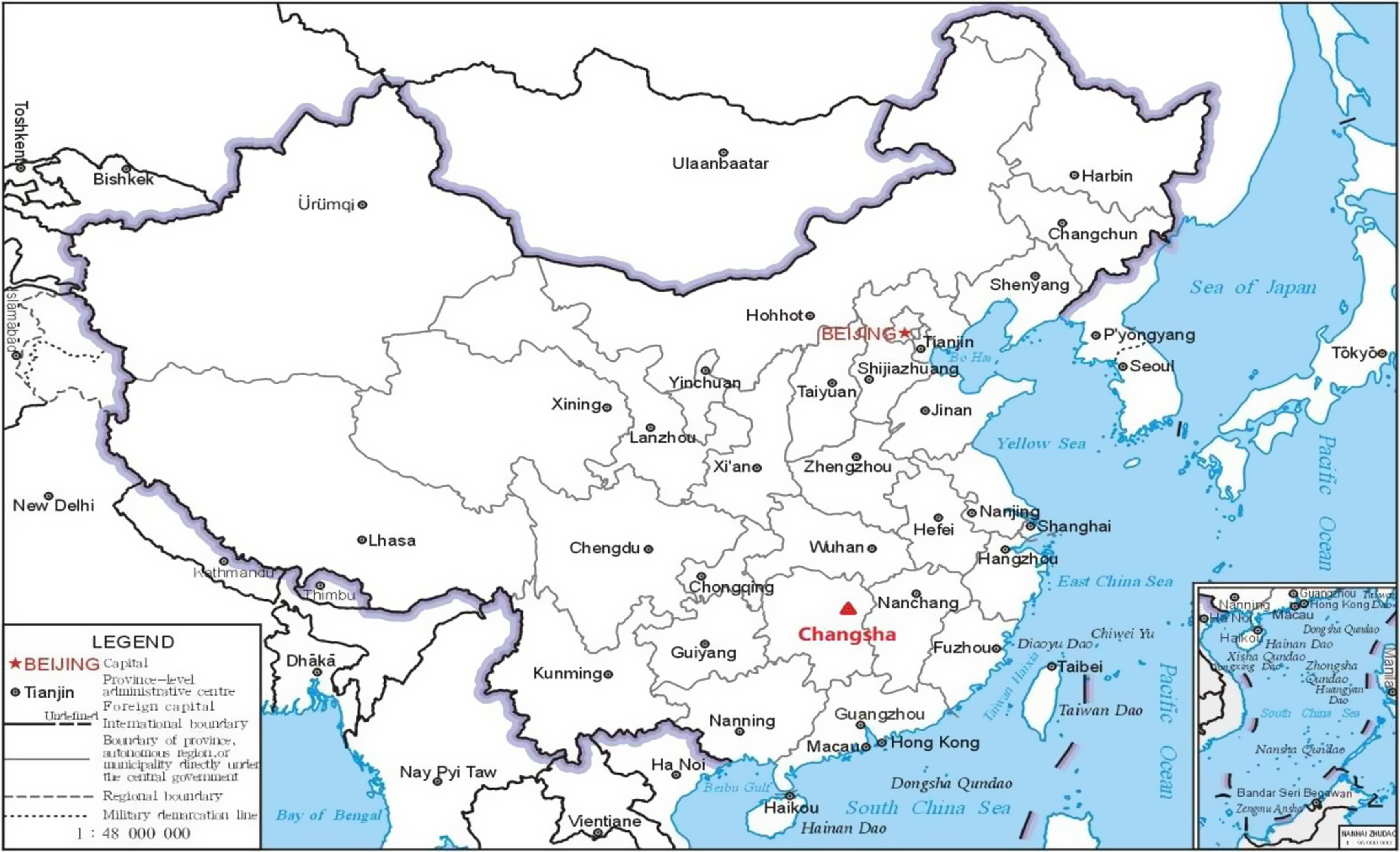
Changsha Chinese is a Xiang dialect (ISO 639-3: [hsn]) spoken in the city of Changsha (CN-430100), the capital of Hunan province (CN-43) in China. Changsha is the political, economic, cultural, scientific, and educational centre of Hunan. As of 2021, Changsha had a resident population of approximately seven million in urban areas. Figure 1 shows the location of Changsha on the map of China.
Location of Changsha on the map of China.
Xiang belongs to the ten major dialect groups of Chinese (LAC 2012) and can be conventionally divided into two subgroups: New Xiang and Old Xiang (Zhou & You Reference Zhou and You1985, Yuan Reference Yuan2001, Bao Reference Bao2006). The most widely recognized difference between New Xiang and Old Xiang is that Old Xiang has preserved voiced obstruents, e.g. /b d ɡ/ (Zeng Reference Ting2019), which are considered features of Middle Chinese, while New Xiang has lost voiced obstruents.
Changsha is often cited as a representative dialect of New Xiang (Bao Reference Bao2001), whereas Xiangxiang (Zeng Reference Ting2019) is cited as a representative dialect of Old Xiang. Putonghua (or Mandarin, Standard Chinese, Lee & Zee Reference Lee and Zee2003), the official national language of China, has heavily influenced Changsha Chinese. In contrast, native speakers tend to retain some features of Changsha Chinese when speaking Putonghua, resulting in a strong local accent called ‘plastic Putonghua’. Notably, differences exist between the new and old style of Changsha Chinese. The difference between so-called new and old-style Changsha Chinese lies in the historical and phonological features, not the age of the speakers. According to Li & Liu (Reference Bing and Yanni2006) and Zhou (Reference Zhou2013), modern Changsha Chinese possesses a smaller consonant inventory as the historical class of retroflex consonants are merged with the alveolar-palatals. Additionally, new style Changsha Chinese has a smaller number of diphthongs and triphthongs as old style Changsha Chinese contains two nasal finals (/-n/ and /-ŋ/), while new style Changsha Chinese contains only one (/-n/).
The present description focuses on the new style Changsha Chinese, based on phonetic data collected from a male native speaker. He was born in 1949 and lived throughout his life in Changsha. He always uses Changsha Chinese for daily communication and does not speak any other language. The equipment employed for speech signal acquisition, included a laptop computer (Lenovo, V110, Lenovo, Beijing, China), an external sound card (Sound Blaster X-Fi Surround 5.1 Pro, Creative Labs, Singapore), a mixing console (Behringer XENYX502, MUSIC Group Macao Commercial Offshore Limited, Zhongshan, Guangdong, China), a unidirectional collar clip microphone (ECM-44B, SONY, Tokyo, Japan), and recording software (Adobe Audition 3.0, Adobe Systems Incorporated, San Jose, CA, USA). The basic speech parameters are acquired from Praat software. It should be noted that Chao numerals are applied to transcribe the tones throughout this article (Chao Reference Chao1980).
Consonants
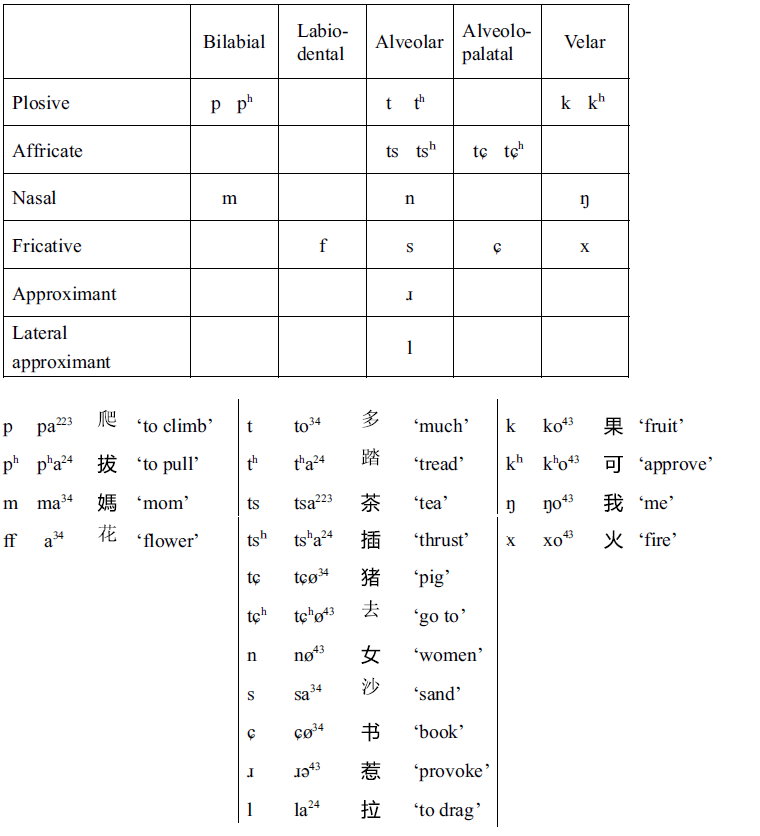
The consonant inventory of Changsha Chinese comprises 19 phonemes. The list above presents corresponding key words/bound morphemes of the consonants. The plosives and affricates show a general two-way distinction between voiceless unaspirated and voiceless aspirated.
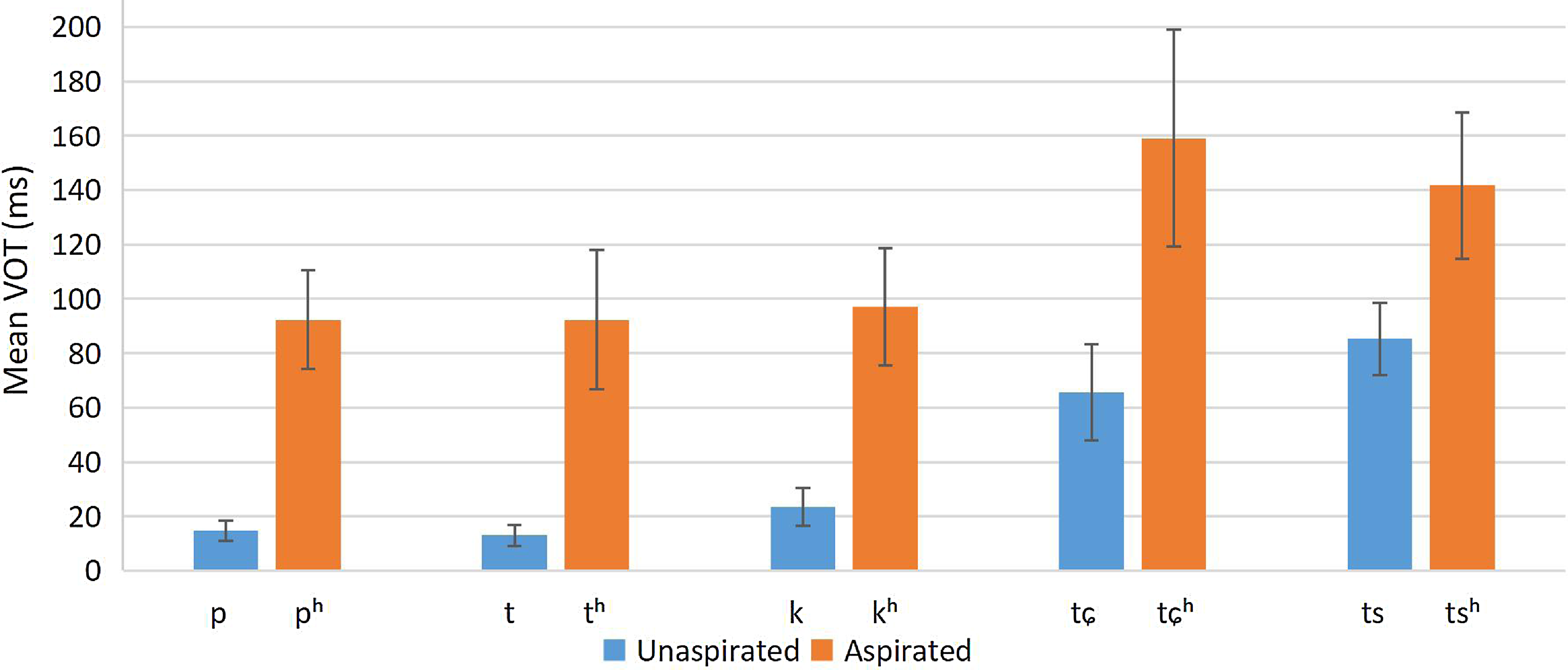
As shown in Figure 2, the voice onset time (VOT) of unaspirated plosives, that is, /p t k/, is shorter with the release and voicing onset occurring within approximately 20 ms. On the other hand, the VOT of aspirated plosives, that is, /ph th kh/, is about 90 ms. The VOT of aspirated or unaspirated affricates is significantly longer than the VOT of plosives due to their frication phase. For instance, the mean VOT of /tɕ/ and /tɕh/ (both based on eight tokens) is approximately 66 ms and 160 ms, respectively; while the VOT of /t/ and /th/ (both based on eight tokens) is approximately 14 ms and 92 ms, respectively. Moreover, the VOT of affricates have a larger standard deviation of values than the VOT of plosives, whether aspirated or not.
VOT of plosives and affricates in Changsha Chinese, the unaspirated and aspirated are indicated by distinct colors. The mean and standard deviation were calculated using eight tokens of each plosive and affricate from a single speaker.
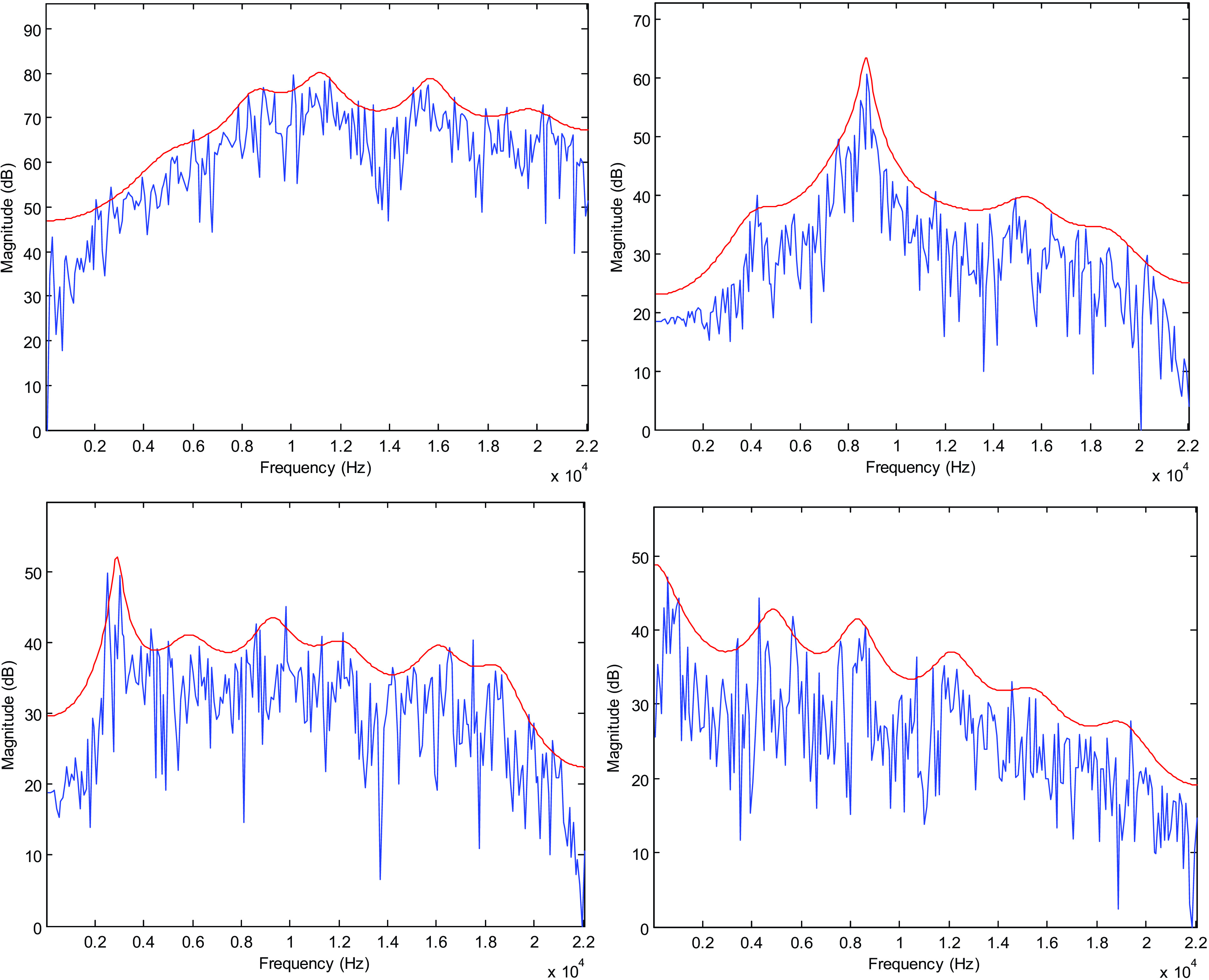
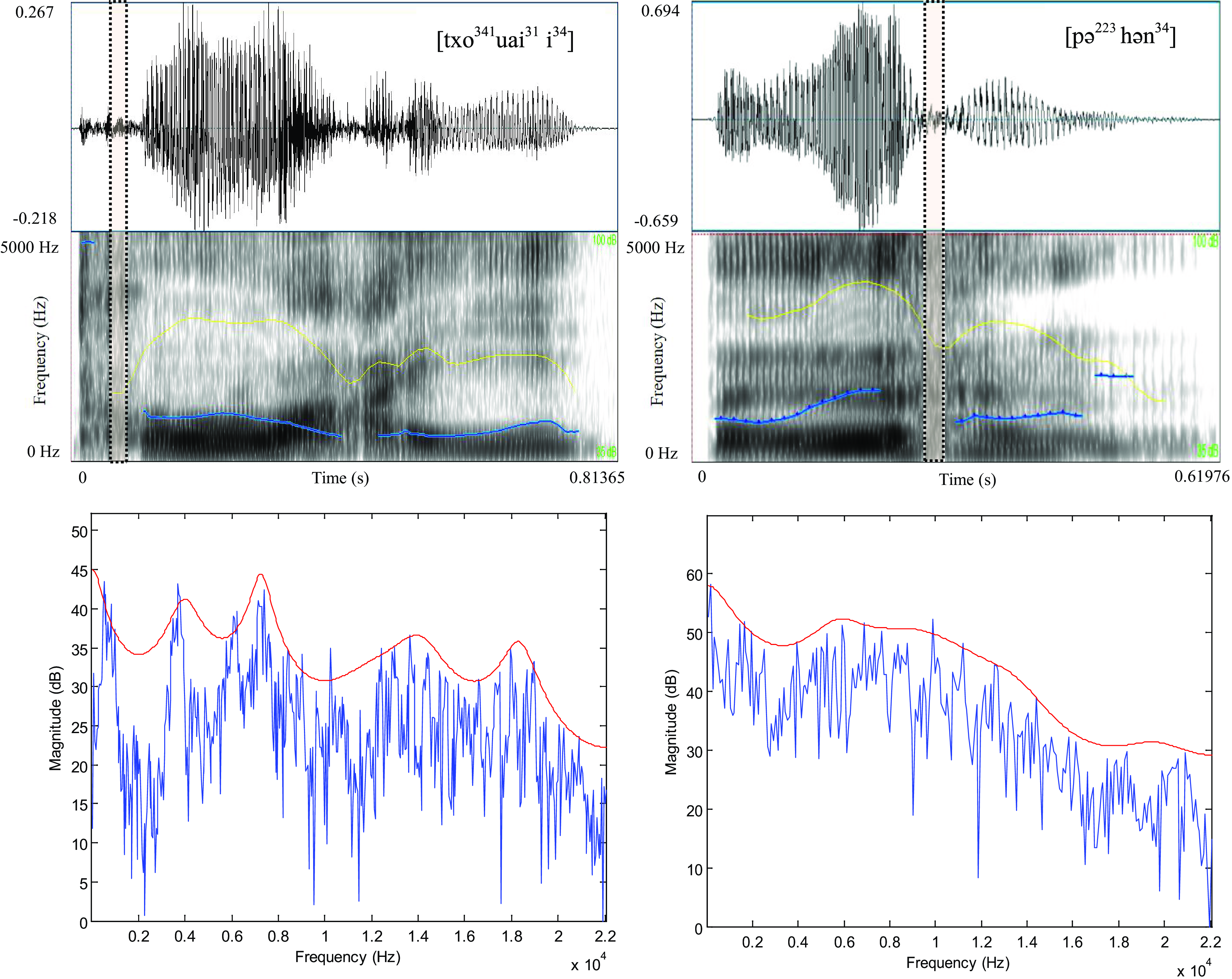
There are four fricatives in Changsha Chinese, namely, /f/ (as in /fa34/ ‘flower’), /s/ (as in /sa34/ ‘sand’), /ɕ/ (as in /ɕø34/ ‘book’), and /x/ (as in /xo43/ ‘fire’). Figure 3 shows the spectra of the frication (made with a 23 ms window centred at the peak of noise intensity) in four fricative samples. There is a correlation between the frequency region with the greatest energy and the place of articulation. The farther back the fricative’s articulation, the lower the frequency region with the greatest energy tends to become. However, there is also variation between velar frication and glottal aspiration, both for the fricative /x/ and for aspirated stops. For instance, in the passage ‘The North Wind and the Sun’, /x/ in /pə223 xən34/ ‘north wind’ (北风) was pronounced as [pə223 hən34] and /tho24 uai31 i34/ ‘undress’ (脱外衣) was realized as [txo341 uai31 i34], as shown by Figure 4.
FFT (Fast Fourier Transform, blue) and LPC (Linear Predictive Coding, red) spectra (made with a 23 ms window centred on the peak of noise intensity) of the frication in /fa34/ ‘flower’, /sa34/ ‘sand’, /ɕø34/ ‘book’ and /xo43/ ‘fire’.
Waveforms and spectrograms of [txo341 uai31 i34] ‘undress’ (脱外衣) and [pə223 hən34] ‘north wind’ (北风). FFT (Fast Fourier Transform, blue) and LPC (Linear Predictive Coding, red) spectra were made with a 23 ms window centred on the midpoint of the fricative duration in [txo341 uai31 i34] ‘undress’ (脱外衣) and [pə223 hən34] ‘north wind’ (北风), respectively.
Some conventions regarding Changsha Chinese consonants should be clarified. /tɕ tɕh ɕ/ are in complementary distribution with /k kʰ x/ and /ts tsh s/. While /tɕ tɕh ɕ/ are followed by only /i/, /jV/ and /ø/, as in, for example, /tɕja43/ ‘fake’, /ɕjo223/ ‘to peel’ and /ɕø34/ ‘book’, /k kʰ x/ and /ts tsh s/ are followed by other vowels besides /i/, /jV/ and /ø/, as in /ko43/ ‘fruit’, /kho43/ ‘approve’, /xo43/ ‘fire’ and /tsa223/ ‘tea’, /tsha24/ ‘thrust’, /sa34/ ‘sand’. To a certain extent, then, it is reasonable to treat /tɕ tɕh ɕ/ as allophones of /k kʰ x/ or /ts tsh s/. However, /tɕ tɕh ɕ/ are treated as distinct phonemes in keeping with the Chinese tradition in this Illustration (Bao et al. Reference Bao, Cui, Shen and Wu1998, Lee & Zee Reference Lee and Zee2003, Zeng Reference Ting2019), same as /tɕ tɕh ɕ/ in Mandarin (Lee & Zee Reference Lee and Zee2003).
Changsha Chinese has three nasals: /m n ŋ/, /m/ (as in /ma34/ ‘mom’) and /ŋ/ (as in /ŋo43/ ‘me’) occur only in syllable-initial position, while /n/ (as in /nø43/ ‘women’ and /pin34/ ‘soldier’) can occur both in syllable-initial and syllable-final position. It should be noted that, when occurring in syllable-initial position, /n/ is followed by only /i/ and /ø/, while /ŋ/ is followed by other vowels besides /i/ and /ø/. Thus, the contrast between /n/ and /ŋ/ is neutralized in syllable-initial position. Moreover, it is important to mention that when followed by /i/ or /ø/, /n/ is realized as an alveolo-palatal, which could be transcribed as [ȵ] (a symbol which presently does not occur in the IPA).
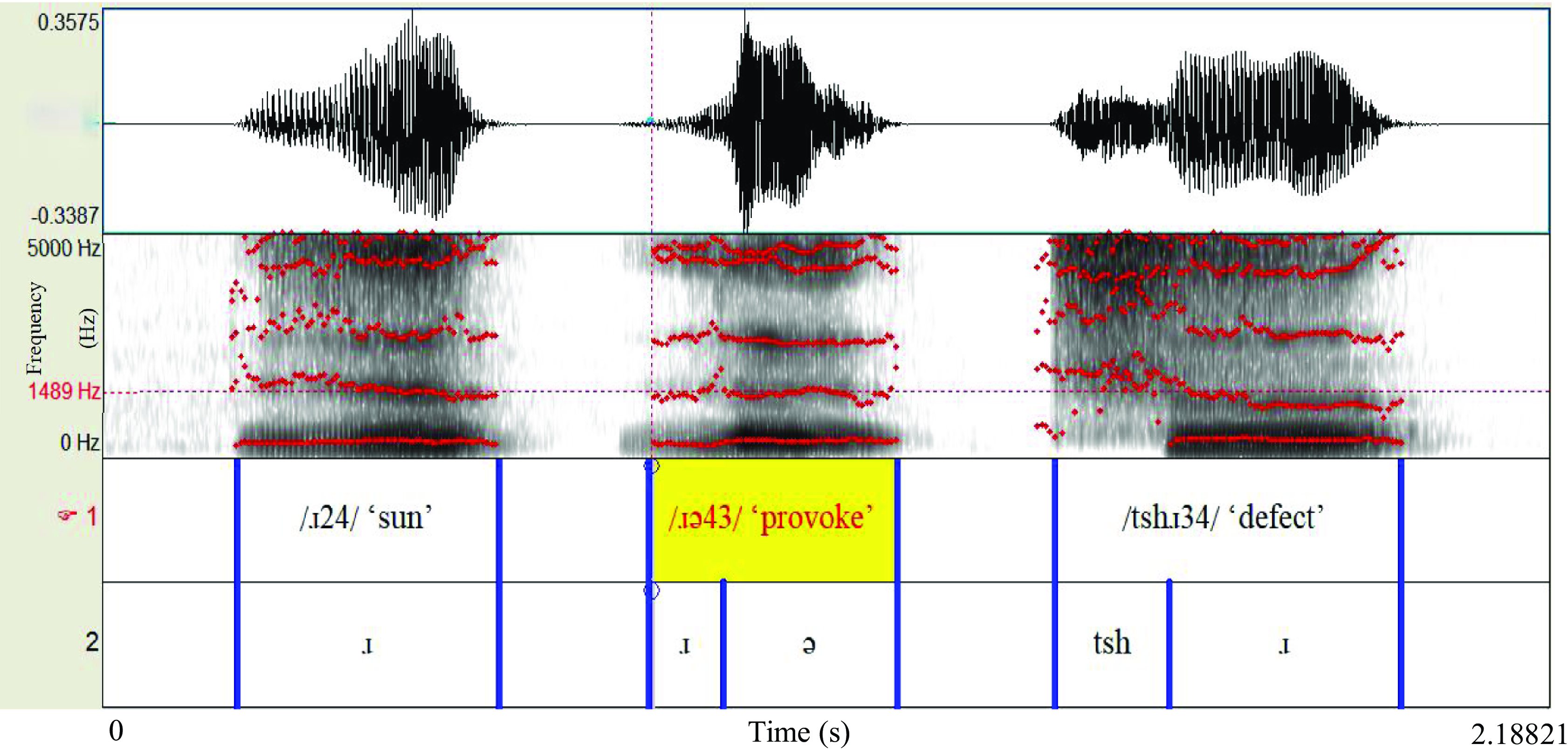
/ɹ/ occurs in isolation in both syllable-initial and syllable-final positions. However, there are some distributional restrictions. /ɹ/ can only occur in syllable-initial position if preceding /a ə/ and in syllable-final position following /ts tsʰ s/. /ɹ/ in isolation (as in /ɹ24/ ‘sun’) or in syllable-initial position (as in /ɹə43/ ‘provoke’) is an alveolar approximant. When occurring in syllable-final position after /ts tsʰ s/ (as in /tsɹ43/ ‘purple’, /tshɹ34/ ‘defect’ and /sɹ34/ ‘silk’), /ɹ/ is realized as a syllabic apical (or laminal) denti-alveolar approximant, which is the same case with Putonghua (or Standard Chinese, Lee & Zee Reference Lee and Zee2003), and could be transcribed as [ɿ] – another symbol widely applied in the Chinese phonetic tradition which normally appears after /ts tsʰ s/ and does not have an IPA counterpart.
Waveforms and spectrograms for /ɹ/ in isolation, syllable-initial, and syllable-final positions. The red dot on the spectrogram marks the formants.
F1/F2 and F2/F3 of /ɹ/ occurring in syllable-initial and syllable-final positions. The mean and standard deviation of each formant were calculated from seven tokens. /ɹ/ in isolation was not included, because there is only a single token in Changsha Chinese, i.e. /ɹ24/ ‘sun’.
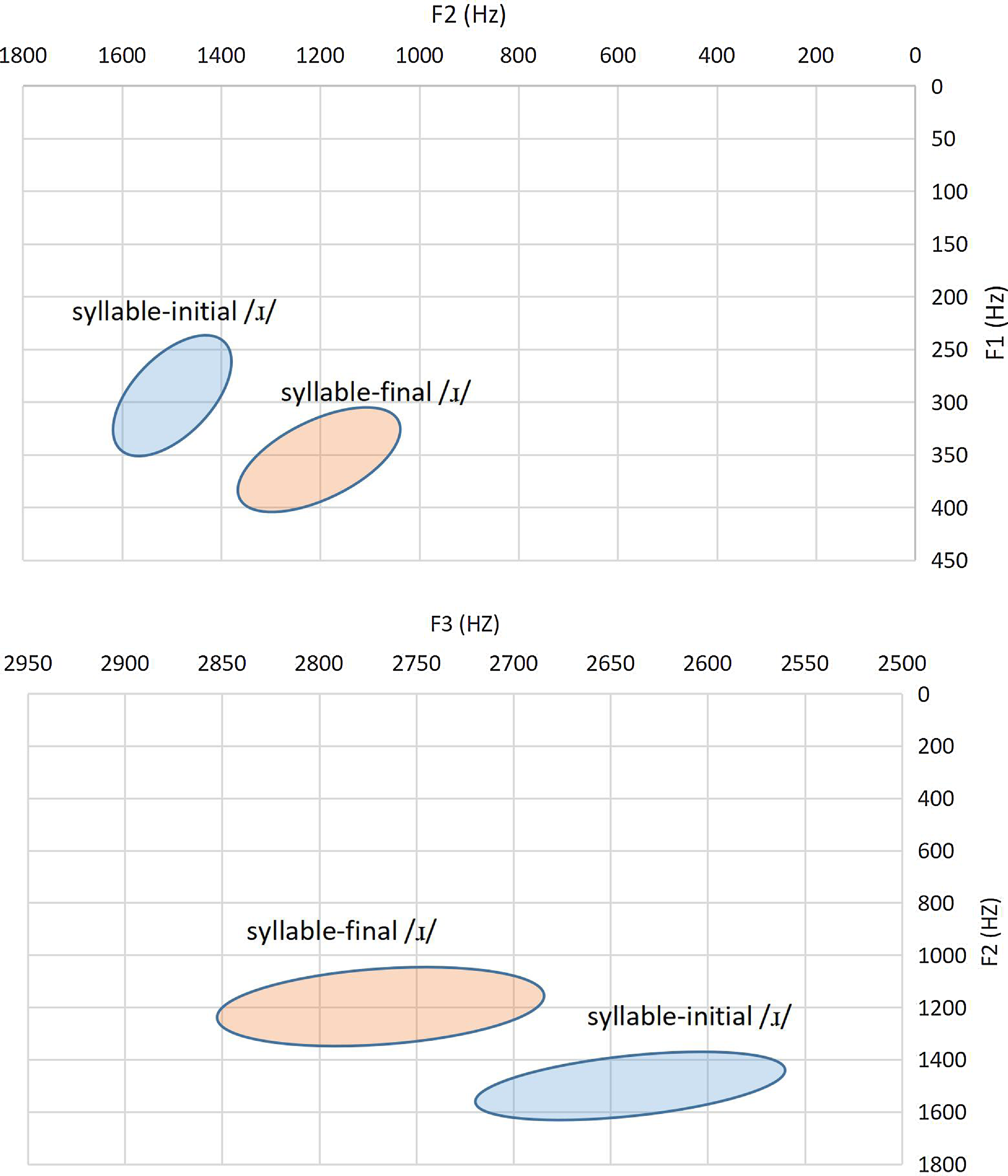
Figure 5 shows the waveforms and spectrograms of /ɹ/ occurring in isolation, syllable-initial, and syllable-final positions. The formants of each syllable are marked by red dots on the spectrograms. Figure 6 reveals acoustic plots of /ɹ/ occurring in syllable-initial and syllable-final positions, and each category was calculated from seven tokens. F2 of /ɹ/ occurring in syllable-final position (as in /tshɹ34/ ‘defect’) is lower than /ɹ/ occurring syllable-initial position (as in /ɹə43/ ‘provoke’), suggesting a more retracted tongue position. F3 of /ɹ/ occurring in syllable-final position is higher than for /ɹ/ occurring in syllable-initial position, suggesting less lip rounding syllable-finally. /ɹ/ in isolation was not included in Figure 6, because there is only a single token in Changsha Chinese, i.e. /ɹ24/ ‘sun’.
Vowels
Monophthongs
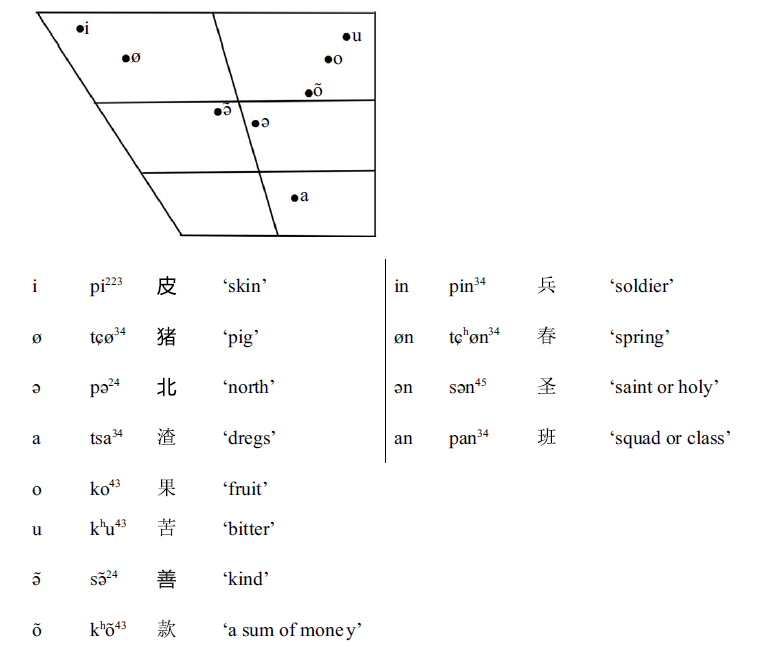
There are six monophthongs in the basic inventory of Changsha Chinese. /i ø ə a/ occur in open syllables, including syllables closed by a nasal like /pi223/ ‘skin’ and /pin34/ ‘soldier’, while /u o/ occurs only in open syllables as in /ko43/ ‘fruit’ and /khu43/ ‘bitter’. There are two nasal vowels in Changsha Chinese: /õ ə̃/, which can only occur in open syllables, as in /sə̃24/ ‘kind’ and /khõ43/ ‘a sum of money’.
Acoustic plots for the vowels of Changsha Chinese, F1, F2 and F3 of each vowel were based on mean formant values of eight open syllables.
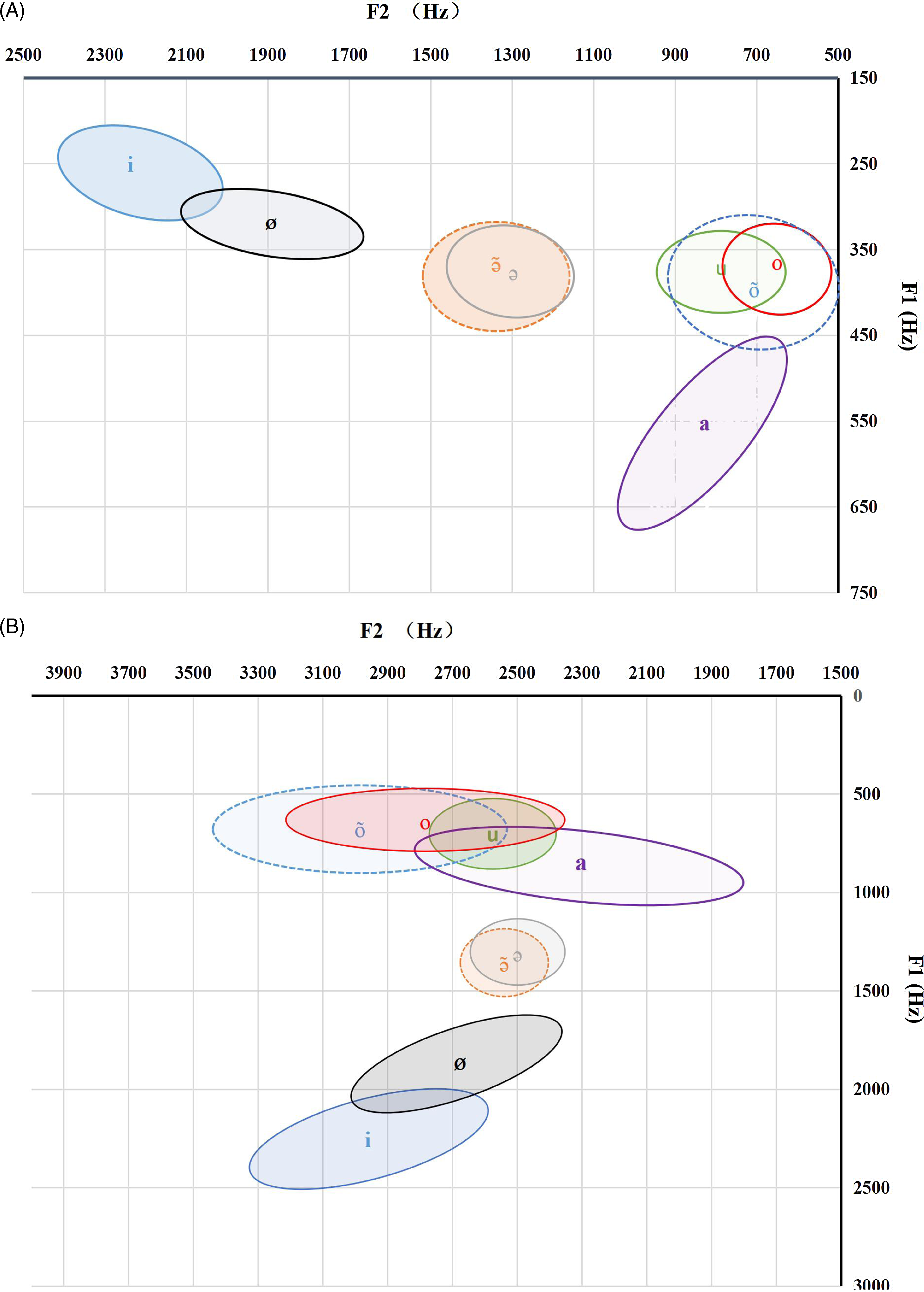
Figure 7 shows the formant plots for the vowels of Changsha Chinese. F1, F2 and F3 of each vowel were based on the mean formant values of eight open syllables. There might exist some controversy about the symbol used for /ø/, since /ʏ/ is also a rational choice based on auditory quality and the formants shown in Figure 7. In fact, /ø/ functions phonologically as a close-mid front vowel, in terms of the behavior of the nasal onsets and the triggers for onset velars becoming alveolo-palatals (as in /tɕø34/ ‘pig’ and /tɕhøn34/ ‘spring’). /a/ is positioned to the lower right because F2 of /a/ is lower, so it is also reasonable to transcribe /a/ as /ɑ/. However, /a/ is adopted here typographically for convenience and as a symbol for two allophones: when occurring in open syllables, /a/ is realized as [ɑ]; when /a/ is not preceded by /i/ and occurs in syllables closed by a nasal, /a/ is realized as [ɐ] (as in /pan34/ ‘squad or class’ or /kuan34/ ‘close’).
Additionally, /u/ is adopted here typographically for convenience since it is a symbol for two allophones. When occurring in non-open syllables, /u/ is realized as [u]; when occurring in open syllables, /u/ is realized as [ʊ]. Therefore, the position of /u/ in Figure 7(A) is much more fronted than expected as the eight tokens for /u/ are all open syllables. This further explains why /u/ and /o/ are positioned relatively lower than /i/ and /ø/ in Figure 7(A); when /u/ is realized as [ʊ] with a lower F1 compared to the close front counterpart /i/, /o/ is also affected compared to its close-mid front counterpart /ø/.
Diphthongs
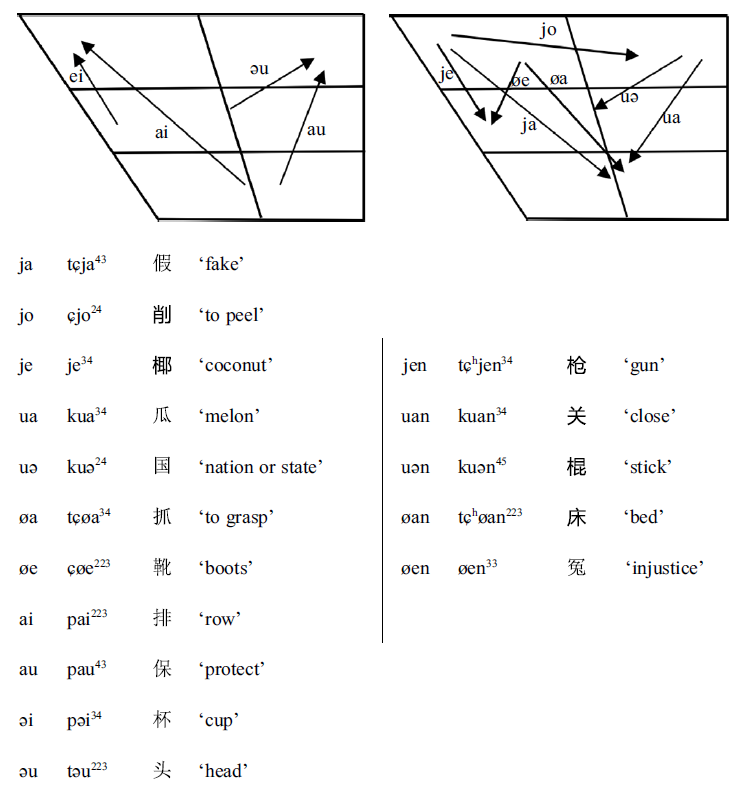
As shown in the above vowel diagrams (rising and falling diphthongs are presented separately to provide a better view), Changsha Chinese has 11 diphthongs, illustrated in the left-hand-side list above. Note that /ja jo je jen/ are only preceded by /tɕ tɕh ɕ/. The [i] quality arises from coarticulation with the alveolopalatal onset. Among the 11 diphthongs, /ja jo ai au ei əu/ occur only in open syllables, and /je ua uə øa øe/ occur in open syllables with syllables closed by /n/ (as in /tɕhjen34/ ‘gun’, /kuan34/ ‘close’, /kuən45/ ‘stick’, /tɕhøan223/ ‘bed’, /øen33/ ‘injustice’).
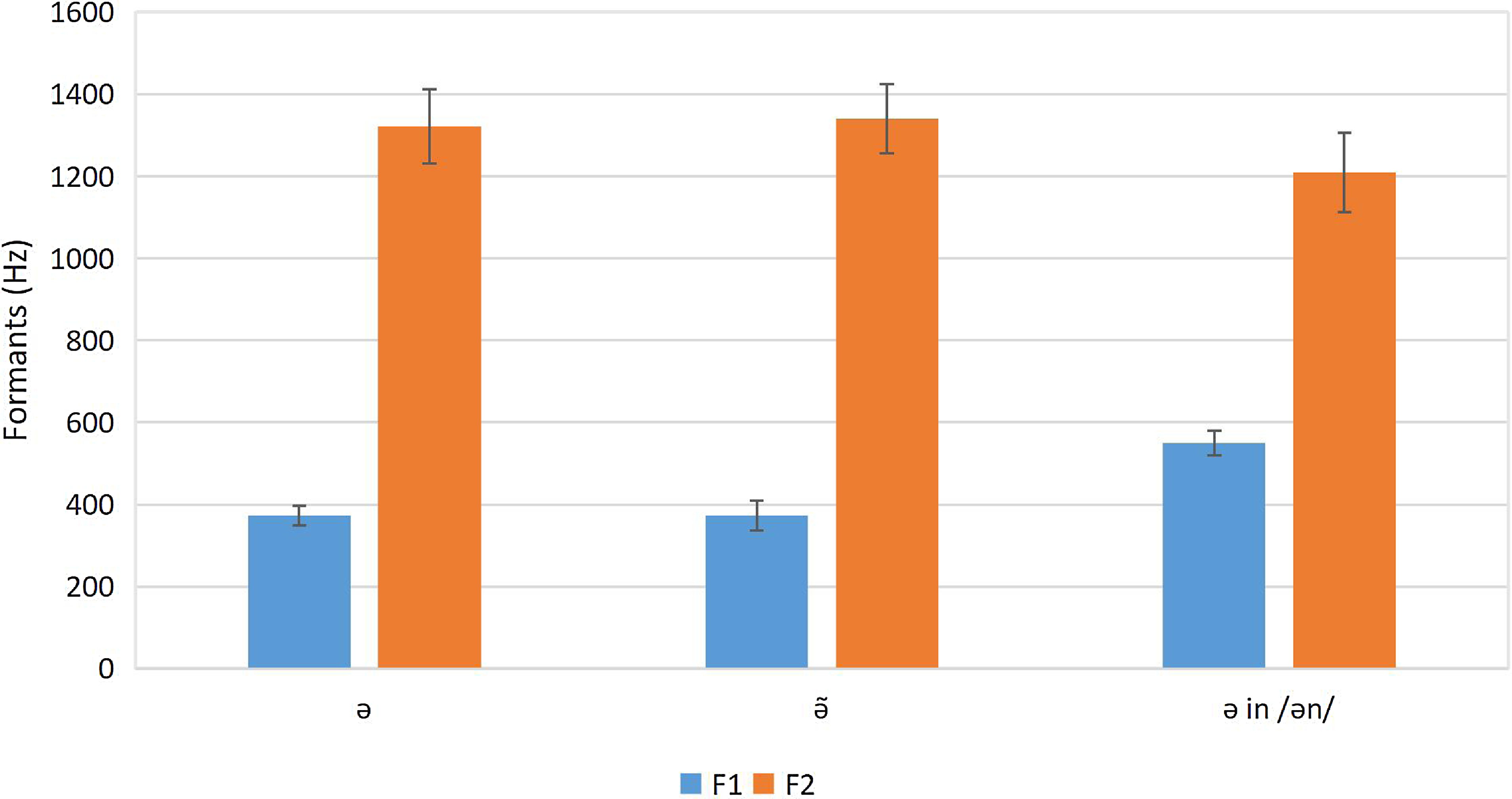
It is important to note that /ə/ occurring as an allophonically nasalized vowel before a nasal consonant (as /kuən45/ ‘stick’) is different from /ə/ occurring as a single vowel (as /pə24/ ‘north’) and as a nasal vowel (as /sə̃24/ ‘kind’). In fact, phonemic nasal vowels do not occur before nasal consonants, but oral vowels are contextually nasalized before nasal consonants. As shown by Figure 8, F1 of /ə/ in /ən/ is significantly higher than F1 of /ə/ and /ə̃/, while F2 of /ə/ in /ən/ is significantly lower than F2 of /ə/ and /ə̃/. Significant difference between the formants of /ə/ and /ə̃/ is not present.
F1 and F2 of /ə/ (as single vowel, nasal vowel, and allophonically nasalized vowel before an underlying nasal consonant). The mean and standard deviation of each formant were calculated from seven tokens.
The vowel /e/ appears only in specific diphthongs (i.e. /je øe/) and triphthongs (/uei/, as in /kuei43/ ‘ghost’). Its origin is unclear but may be due to the influence of Putonghua since most native speakers speak both Putonghua and Changsha Chinese in their daily life. In fact, /e/ is in a complementary distribution with /ə/. /e/ occurs only in /je øe uei/, while /ə/ occurs in isolation or diphthongs and triphthongs except /je øe uei/.
Triphthongs
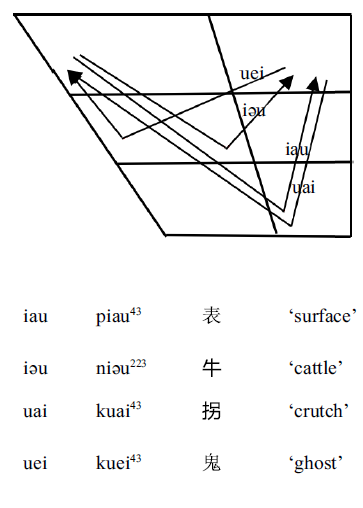
As shown in the above triphthong diagram, Changsha Chinese has four triphthongs: /iau/ (as in /piau43/ ‘surface’), /iəu/ (as in /niəu223/ ‘cattle’), /uai/ (as in /kuai43/ ‘crutch’), and /uei/ (as in /kuei43/ ‘ghost’). All triphthongs occur only in the open syllables.
Tones
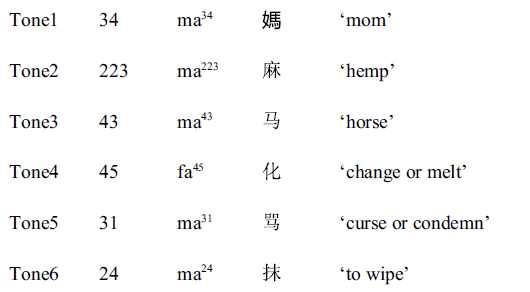
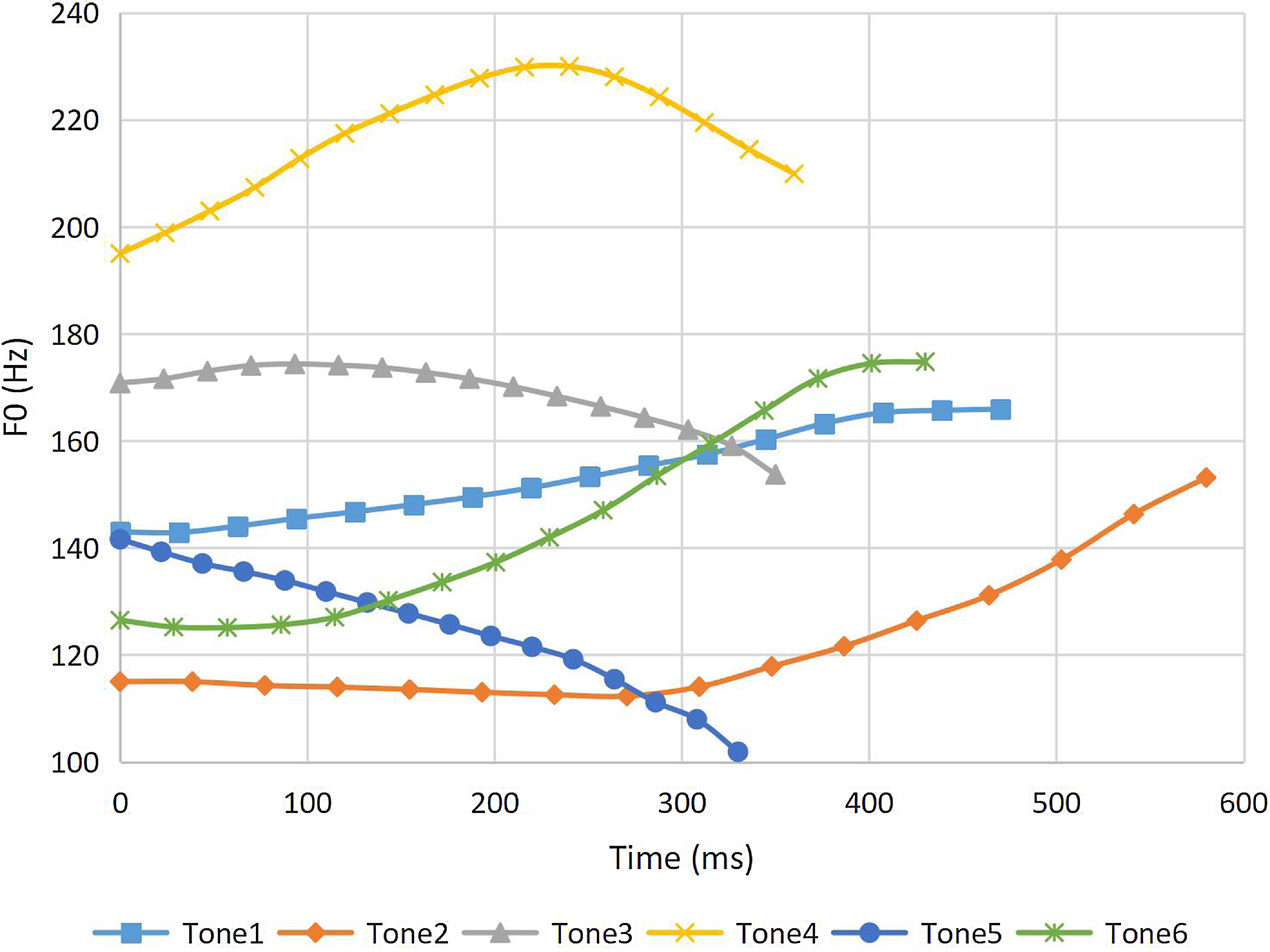
This study confirms previous studies (Zhong Reference Zhong2003, Li & Liu Reference Bing and Yanni2006, Xiang & Shi 2007) that there are six citation tones in the inventory of Changsha Chinese. Though the specific Chao numerals for each one might be unique, essential differences do not exist between this transcription and the previous studies. Tone1, conventionally named Yingping, is a mid rising tone that has a stable pitch in the middle of the pitch range and is transcribed as 34. Tone2, conventionally named Yangping, is a low-rising tone with a longer duration and is transcribed as 223. Tone3, conventionally named Shangsheng, is a mid-falling tone transcribed as 43. Tone4, conventionally named Yingqu, is a high-rising tone transcribed as 45. Tone5, conventionally named Yangqu, is a medium-falling tone transcribed as 31, which reaches the lowest point of the pitch range. Tone6 is a rising tone and is transcribed as 24. Note that Tone6 is conventionally named Rusheng (also known as ‘entering tone’ or ‘checked tone’), which is commonly represented by one digit in Chinese literature, due to its short duration which is normally about 200 ms; while in the case of Changsha Chinese, Rusheng is represented by two digits since its average duration is about 430 ms and not significantly different from other tones, as shown in Figure 9.
The pitch trajectory of tones in Changsha Chinese in terms of absolute duration (based on mean pitch values of eight randomly selected words).
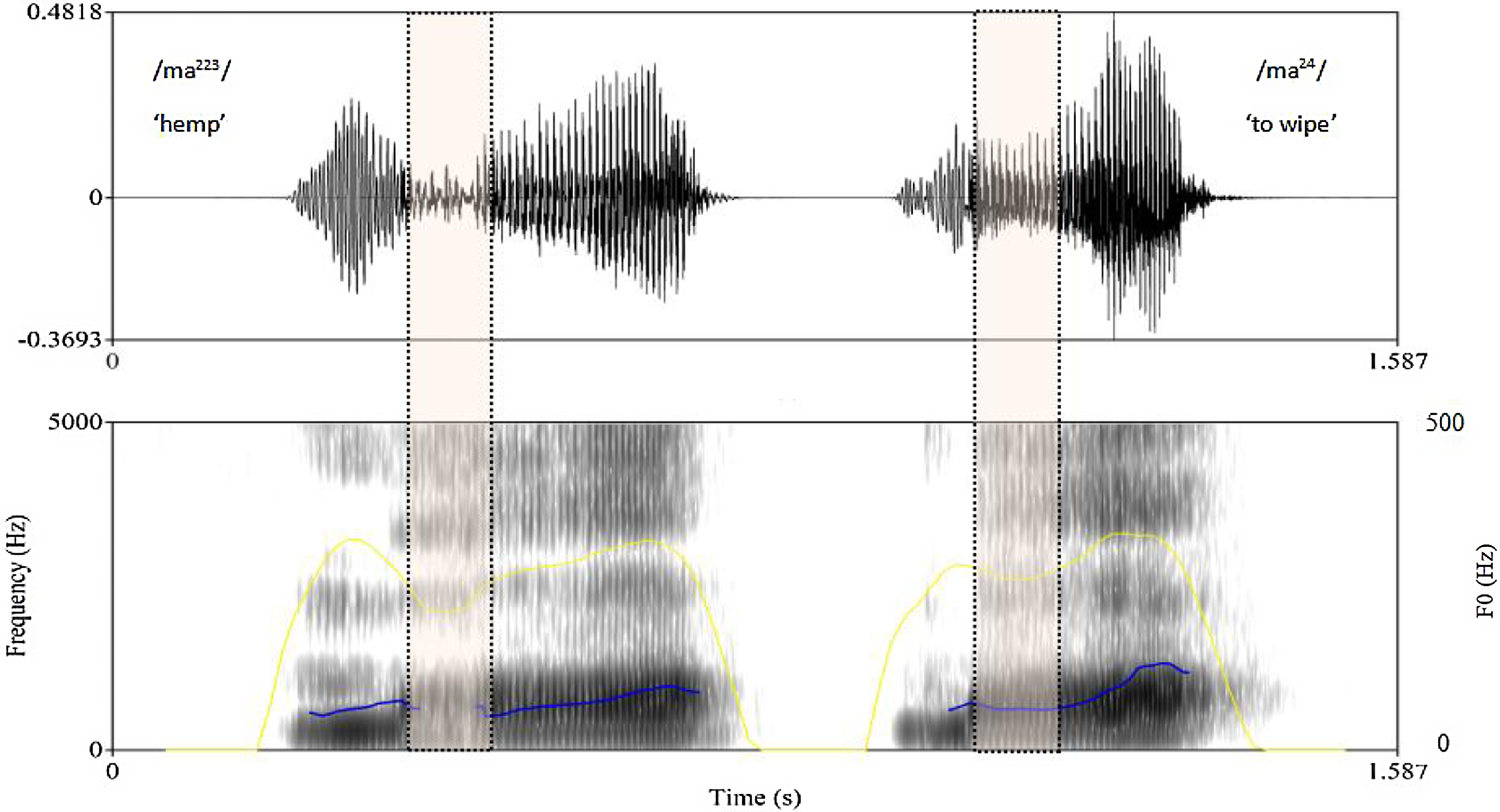
Creaky voice of rising tones in Changsha Chinese (/ma223/ ‘hemp’ and /ma24/ ‘to wipe’ are taken as examples here). Creaky voice causes a dip in amplitude (as shown by yellow line) and f0 could be discontinuous (as shown by blue line).
The pitch trajectory of each tone in terms of absolute duration is shown in Figure 9. The f0 values of each tone were extracted using the Praat software. It is noteworthy that the pitch trajectory of tones in Figure 9 might contradict the transcription in terms of Chao numerals. For instance, in Figure 9, the pitch trajectory of Tone4 is rising-falling, so in addition, Tone3 could be transcribed as 454 using Chao numerals. However, since the falling part of Tone3 is ignored by listeners, it is preferable to transcribe Tone3 as 45.
Creaky voice tends to be associated with the two rising tones, that is, Tone2 and Tone6, in Changsha Chinese. A period of creaky voice appears to take place in the middle of the vowel, in the form of voicing irregularities and a dip in amplitude. As shown in Figure 10, the f0 of /ma223/ ‘hemp’ is discontinuous when the amplitude contour has a dip. However creaky voice does not always occur with rising tones in Changsha Chinese, since some words have not shown any kind of dip in amplitude or voicing irregularity, more work is needed to determine the factors that condition its occurrence.
There tends to be creaky voice associated with the low-pitch targets of tones 31 and 43, As shown in Figure 11, the end of f0 contour of /ma31/ ‘curse or condemn’ and /ko43/ ‘fruit’ are missing because f0 algorithm has failed as the falling f0 contour reaches a certain threshold. The waveforms and spectrograms showed certain voicing irregularities, and the pitch periods in the pink region were significantly larger than that in other parts of the syllable.
Creaky voice of falling tones in Changsha Chinese (/ma31/ ‘curse or condemn’ and /ko43/ ‘fruit’ are taken as examples here).

Sandhi patterns for bisyllabic words of Changsha Chinese are complex. For more information, please refer to Zhong (Reference Zhong2003) and Li & Liu (Reference Bing and Yanni2006).
Syllable structure
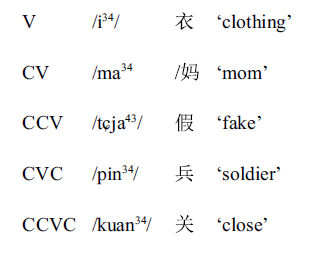
The syllable structure of Changsha Chinese is (C)(C)V(C), so consonant clusters are allowed only in syllable-initial but not syllable-final position. The nucleus (vowel, or V) must have at least one vowel and cannot exceed three vowels since Changsha Chinese has only monophthongs, diphthongs, and triphthongs. The other elements in the syllable are optional. All Cs (consonants) occur in syllable-initial position but the only permissible syllable-final consonant is /n/ (as in /pin34/ ‘soldier’). Moreover, it is important to mention that all words in Changsha Chinese are monosyllabic. Here are examples of all possible syllable structures in Changsha Chinese:
Further phonotactic restrictions may be noted in Changsha Chinese. First, while /tɕ tɕh ɕ/ are followed by only the high front vowels/glides (/i ø j/), /k kʰ x/ and /ts tsh s/ are followed by other vowels besides the high front vowels/glides (/i ø j/). Second, while the alveolar sibilants /ts tsh s/ are not allowed before the high front vowels/glides (/i ø j/), /ɹ/ occurs precisely after these consonants or occurs in syllable-initial position by preceding /a ə/. Third, among all three nasals, /m ŋ/ occur only in syllable-initial position, while /n/ can occur both in syllable-initial and syllable-final position. When occurring in syllable-initial position, /n/ is followed by only the high front vowels/glides (/i ø j/), while /ŋ/ is followed by other vowels besides the high front vowels/glides (/i ø j/). Fourth, among all six monophthongs, /i ø ə a/ occur in open syllables, including syllables closed by a nasal, while /u o/ occur only in open syllables. The two nasal vowels /õ ə̃/ can only occur in open syllables. Fifth, among the 11 diphthongs, /ja jo ai au ei əu/ occur only in open syllables, while /je ua uə øa øe/ occur in open syllables and syllables closed by /n/. Sixth, the four triphthongs (/iau iəu uai uei/) occur only in open syllables. Finally, the new vowel /e/, which might come from borrowed words, appears only in /je øe uei/ and /e/ is in a complementary distribution with /ə/. /e/ occurs only in /je øe uei/, while /ə/ occurs in isolation or diphthongs and triphthongs except /je øe uei/. However, /e/ is not taken as an allophone of the phoneme /ə/ because its auditory quality sounds quite different, even to native speakers.
Transcription of the recorded passage
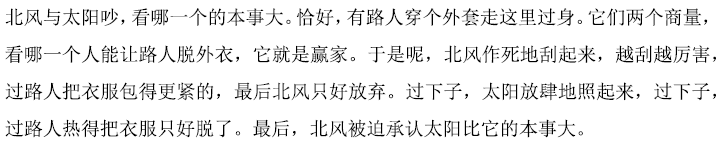
The passage is the Changsha Chinese version of ‘The North Wind and the Sun’ story. It is transcribed phonemically. The tones are marked for each syllable and transcribed in terms of Chao numerals. The symbol ‘ǀ’ marks the end of an intonational phrase within an utterance, whereas ‘ǁ’ marks the end of an utterance.
pə223 xən34 | y31 thai45 ien53 tshau43 ǁ khan45 na43 i43 kə31 ti31 pən34 sɹ31 tai31 ǁ tɕhja24 xau43 | iəu43 ləu31 ɹən223 | tɕhyn34 kə43 uai31 thau43 | tsəu43 ko24 li43 ko43 sən223ǁ tha34 mən43 lien34 kə43 san34 lən43 ǁ khan45 na43 i43 kə31| na43 i43 kə31ɹən43 ɹan34 ləu31 ɹən223 tho24 uai31 i34 ǁ tha34 tɕjəu43 sɹ31 in24 tɕja34 ǁ y24 sɹ43 lə34 | pə223 xən34 tso24 sɹ31 ti43 kua24 tɕhj45 lai43 ǁ uie24 kua24 uie24 li45 xai43 ǁ ko34 ləu43 ɹən223 | pa34 i24 fu43 pau43 tə34 pən45 tɕjn43 ti43 ǁ tsei45 xau43 ǁ pə223 xən34 tsɹ223 xau43 fan34 tɕhi43 ǁ ko24 xa43 tsɹ31 | thai45 ien53 fan34 sɹ43 ti43 tsau45 tɕhi34 lai31 ǁ ko24 xa43 tsɹ31| ko34 ləu43 ɹən223 ɹə24 ti43 pa43 i24 fu43 | tsɹ223 xau43 tho24 liau43 ǁ tsei45 xau43 | pə223 xən34 | pei31 phə24 tsən24 ɹən43 | thai45 ien53 | pi34 tha34 ti43 pən34 sɹ31 tai31ǁ
Orthographic version
Acknowledgements
This research was supported by the Key Program of the Chinese Ministry of Education (Grant No. 17JJD740001), the Fundamental Research Funds for the Central Universities (Grant No. 19JNYH05) and the National Social Science Fund of China (Grant No. 16ZDA211). I would like to thank the editors of JIPA and anonymous reviewers for their detailed and insightful comments. I am also very grateful to audio assistant André Radtke and copy-editor Ewa Jaworska for their constructive suggestions.
Supplementary material
To view supplementary material for this article, please visit https://doi.org/10.1017/S0025100323000075.



