Introduction
The erosion of plant genetic resources for food and agriculture (PGRFA) poses a threat to world food security. Recognizing this, several international agreements, including the Convention on Biological Diversity and the International Treaty on Plant Genetic Resources for Food and Agriculture (International Treaty), stress the need to pay greater attention to the conservation and use of crops essential for food security, including on-farm management (OFM) of local crops and varieties. Most countries have developed a national PGRFA programme (NPGRP) to spearhead efforts regarding the conservation and use of PGRFA. As emphasized in the Second Global Plan of Action for PGRFA, an effective NPGRP should provide enabling policies, support strategies and action plans, allocate resources, distribute roles and responsibilities, and strengthen linkages between all relevant stakeholders in the country (Food and Agriculture Organization of the United Nations (FAO), 2012). While many NPGRPs consider different conservation strategies as complementary, their focus so far is largely on ex situ strategies, rather than on the use and maintenance of local crops and varieties by farmers and farming communities (FAO, 2010). Despite increasing scientific and public interest in OFM, and greater expertise in the field, major gaps remain in its effective implementation (FAO, 2010; de Boef et al., Reference de Boef, Subedi, Peroni, Thijssen and O'Keeffe2012). A major challenge for NPGRPs and conservation professionals is to identify and support OFM practices that match the livelihood strategies and circumstances of different communities and small-scale farmers (Jarvis et al., Reference Jarvis, Hodgkin, Sthapit, Fadda and Lopez-Noriega2011). Moreover, OFM is closely aligned with objectives such as food security and sovereignty, promotion of community resilience, and sustainable agriculture and livelihood development. Therefore, many stakeholders, who work directly with farmers and farming communities, indirectly contribute to OFM and NPGRPs, but are unaware of their contribution (de Boef et al., Reference de Boef, Subedi, Peroni, Thijssen and O'Keeffe2013).
Experimental
The FAO, together with the Centre for Development Innovation (CDI) at Wageningen University and Research Centre, designed a global survey in order to identify interventions and practices that contribute to the maintenance and use of local crops and varieties, and to explore the degree of connectivity between ‘OFM practitioners’ and ‘NPGRP managers and policy-makers’. The survey was available in English, French and Spanish, and disseminated electronically using Survey Monkey (www.surveymonkey.com). It targeted the national PGRFA focal points of the FAO and the International Treaty, professionals engaged in NPGRPs, alumni of PGRFA training programmes of the CDI, as well as those involved in OFM through their work in governmental and non-governmental organizations, academia, research institutions, initiatives and projects, including grantees of the Benefit-sharing Fund of the International Treaty. Organizations and networks such as the Centre for Learning on Sustainable Agriculture (ILEIA), which are not primarily associated with the conservation of genetic resources or OFM, were also surveyed. The survey was structured to match two categories: ‘OFM practitioners’ and ‘NPGRP managers and policy-makers’. To gain insights into the relationship between these two groups, a set of complementary questions was directed to respondents of both profiles. ‘OFM practitioners’ and ‘NPGRP managers and policy-makers’ were each requested to indicate whether they were aware of the activities of the other group and to assess the synergies that existed between them. Of the total number of 1168 respondents, 70% (818) classified themselves as ‘OFM practitioners’, while 30% (350) identified themselves as ‘NPGRP managers and policy-makers’. The survey had a global coverage, with 39% of the respondents from Africa, 27% from the Americas, 21% from Asia and the Pacific and 13% from other regions.
Discussion
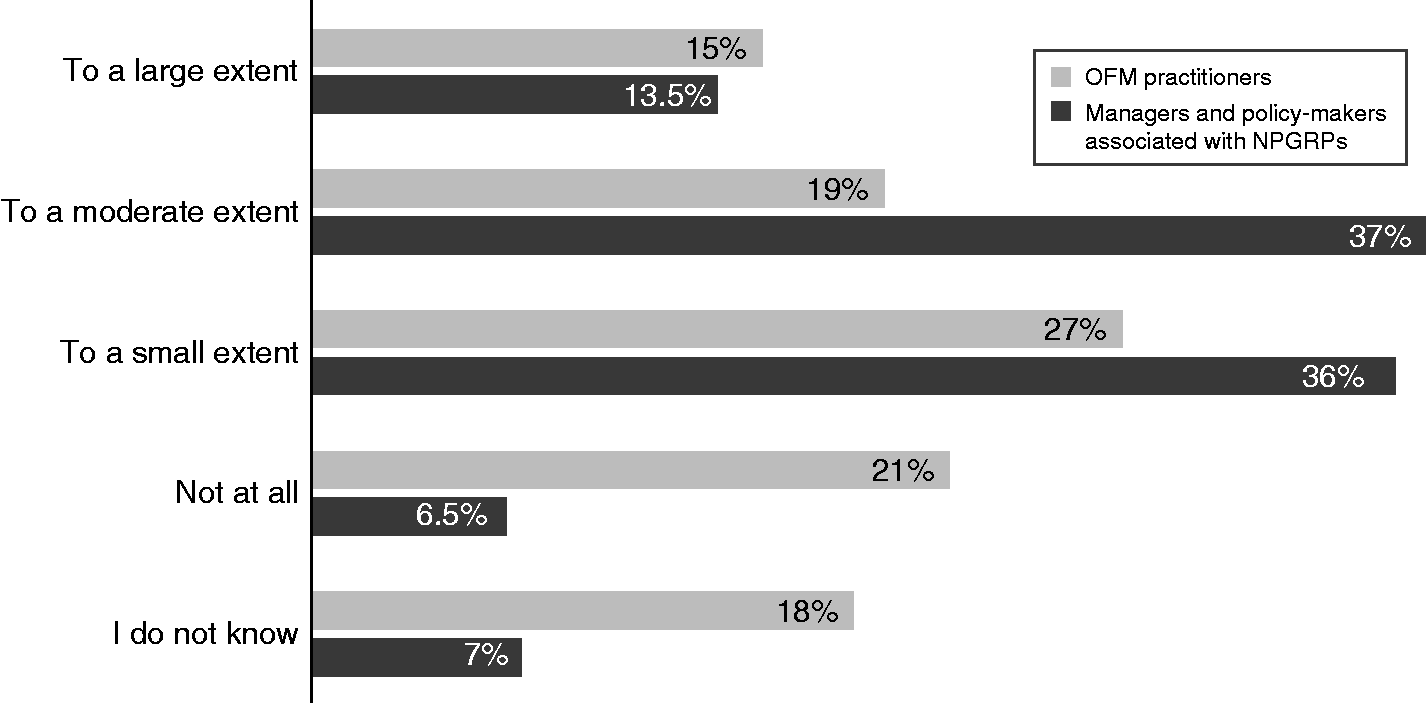
The results from the survey clearly indicated that OFM is currently not well reflected within many NPGRPs, and suggest that many OFM practitioners are working outside the direct sphere of influence and control of national programmes. As shown in Fig. 1, a high percentage of ‘OFM practitioners’ are either unaware of (18%) or do not consider their work to be any part of (21%) the NPGRP. This is supported by the ‘NPGRP managers and policy-makers’, the majority of whom consider OFM to be only moderately (37%), or to a limited extent (36%), part of the NPGRP.
Extent to which OFM is considered part of NPGRPs, according to OFM practitioners and the managers and policy-makers associated with NPGRPs. Notes: n= 877.

The results of the survey also identified a discrepancy in the level of collaboration between the groups, and awareness on each other's work. Only 2% of the ‘NPGRP managers and policy-makers’ claimed to have no knowledge of the work of OFM practitioners, while 60% declared to have good or comprehensive knowledge of their work. In contrast, over half of the ‘OFM practitioners’ (56%) reported that they were unfamiliar with the NPGRP in their country. This indicates that direct linkage between the groups is very limited.
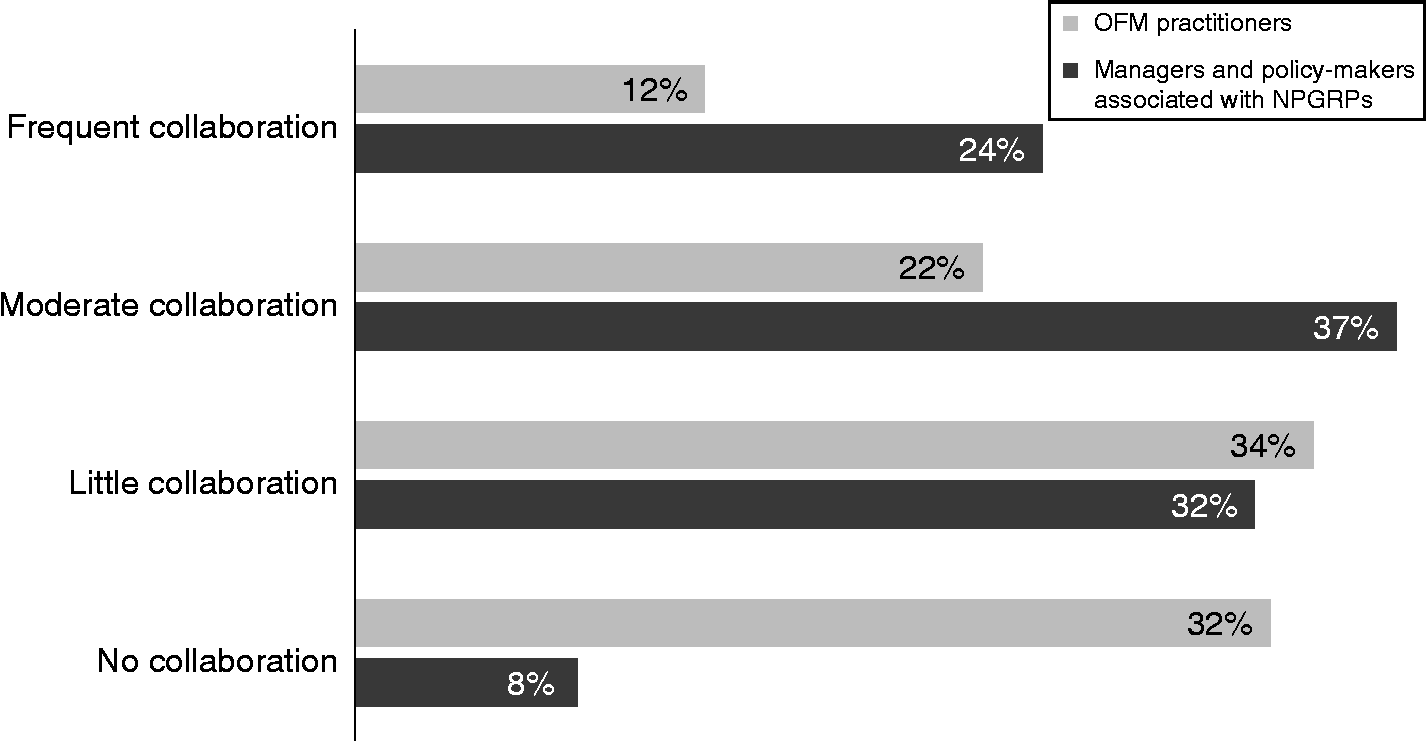
Figure 2 illustrates the perceptions of the two groups of respondents with regard to their level of collaboration. While more than 60% of the ‘NPGRP managers and policy-makers’ indicated ‘frequent collaboration’ or ‘moderate collaboration’ with OFM practitioners, the majority of OFM practitioners (66%) indicated that there was ‘little collaboration’ or ‘no collaboration’ with the other group. This suggests that many NPGRP managers and policy-makers collaborate with a limited set of OFM practitioners, and may be unaware of other, less obvious practitioners and the role that they play in the implementation of OFM. The fact that a large number of OFM practitioners are also unaware of the NPGRP could imply that they consider their work as not directly associated with the conservation and management of PGRFA. This supports the assumption that OFM is closely aligned with objectives and programmes such as sustainable agriculture and livelihood development, and that the implementation of OFM is largely carried out by organizations outside the direct influence or reach of NPGRPs. Failing to integrate these stakeholders will contribute to the isolation of NPGRPs from related objectives and activities, such as food security, poverty alleviation and sustainable agriculture. Involving a wider range of stakeholders and networks in a unified and coherent NPGRP will have implications on its objectives, composition, decision-making processes and implementation. Such a reorientation might be essential in ensuring better results and enhancing the impact of NPGRPs in the area of OFM, and thus contributing to the commitments of several international agreements to safeguard plant genetic resources through complementary conservation strategies.
Frequency of collaboration between OFM practitioners and the managers and policy-makers associated with NPGRPs, as perceived by both groups. Notes: n= 877.

Acknowledgements
Mohammad Ehsan Dulloo and Walter Simon de Boef contributed to this communication while occupying their previous positions as Senior Policy Officer in the FAO's Plant Production and Protection Division and Associate Consultant at the CDI at Wageningen University and Research Centre, respectively.
The authors would like to express their appreciation to all the respondents of the survey. The assessment was only possible due to the participation and feedback of more than a thousand individuals. We would also like to thank the FAO and CDI, and the many other organizations and individuals who contributed by providing valuable and constructive suggestions throughout the planning, preparation and testing of the survey, including Bioversity International, the Centre for Learning on Sustainable Agriculture (ILEIA), the Secretariat of the International Treaty on Plant Genetic Resources for Food and Agriculture (ITPGRFA) and the Secretariat of the Commission on Genetic Resources for Food and Agriculture (CGRFA). A special recognition goes to Elizabeth O'Keeffe, Kurshid Dulloo, Rafael Vidal, Georgina Catacora-Vargas, Petra Straberg and Manon van Lent for the support in editing, translating and disseminating the survey.
The views expressed in this information product are those of the author(s) and do not necessarily reflect the views or policies of the FAO, the current and previous employers and contributors to the implementation of the survey.