Human milk oligosaccharides (HMO) represent a diverse class of non-digestible carbohydrates, constituting the third largest solid component in human breast milk after lipids and lactose(Reference Zivkovic, German and Lebrilla1). With over 200 structurally distinct isomers identified, HMO have garnered significant scientific interest due to their multifaceted roles in infant health, particularly as selective prebiotics and potent immunomodulators(Reference Chen, He and Fan2). Recent advancements in biotechnological synthesis and structural characterisation have now expanded their applications beyond neonatal medicine, positioning HMO as promising candidates for high-fidelity functional foods and livestock additives(Reference Walsh, Lane and Van Sinderen3). In animal nutrition, pigs have emerged as a critical translational model due to the profound anatomical and physiological similarities between the porcine and human gastrointestinal tracts(Reference Tompkins, Hoover and Havton4). However, the porcine milk glycome is notably less complex than that of humans, being primarily dominated by sialylated structures with only trace amounts of the fucosylated glycans that characterise human milk(Reference Wei, Wang and Wang5–Reference Comstock, Wang and Hester7). This structural disparity suggests that neonatal piglets may face a natural glycome deficiency during the critical suckling-to-weaning transition. Intestinal disorders during this period, such as post-weaning diarrhoea, remain a primary cause of economic loss and mortality in the swine industry, driving an urgent global demand for alternatives to antibiotic growth promoters(Reference Jang and Kim8,Reference Difilippo, Bettonvil and Willems9) . While well-established, low-cost prebiotics such as fructo-oligosaccharides and galacto-oligosaccharides are widely utilised in commercial swine feed, they primarily function as non-specific metabolic substrates for a broad range of gut bacteria(Reference González-Solé, Solà-Oriol and Ramayo-Caldas10). In contrast, HMO offer unique biological capabilities derived from their structural homology to host cell surface glycans(Reference Middelkoop, Costermans and Kemp11). This structural complexity allows them to function as soluble decoy receptors that competitively bind pathogens, such as Escherichia coli and Salmonella, preventing their adherence to the intestinal mucosa, a protective mechanism absent in simpler prebiotic scaffolds(Reference Van Berlo, Wallinga and Van Acker12). Furthermore, while porcine milk contains endogenous oligosaccharides (PMO), these are predominantly sialylated(Reference Durham, Wei and Lemay13); domestic porcine models are naturally deficient in neutral fucosylated structures like 2’-fucosyllactose (2’-FL)(Reference Wei, Wang and Wang5).
Supplementing neonatal piglets with human-type HMO effectively bridges this fucose gap, providing a precision nutritional tool to selectively recruit specialised glycan-degrading taxa, such as Akkermansia (Reference Padilla, Fricker and Luna14), which are essential for establishing mucosal resilience and priming the gut barrier during the high-risk weaning transition. HMOs offer a strategic, science-based solution to these challenges. Their inherent resistance to upper gastrointestinal digestion allows them to reach the large intestine intact, where they selectively modulate the gut microbiota by promoting the expansion of beneficial Bifidobacterium and Lactobacillus populations while competitively inhibiting pathogens such as Escherichia coli through glycan mimicry(Reference Al-Khafaji, Jepsen and Christensen15–Reference Zheng, Xu and Fang17). Furthermore, HMO have been shown to fortify mucosal barrier integrity and regulate local immune responses, providing a resilient framework against enteric infections(Reference Musilova, Rada and Vlkova18,Reference Cilieborg, Sangild and Jensen19) . Despite this potential, a critical synthesis of evidence regarding long-term impacts and the economic feasibility of HMO in livestock production remains necessary to bridge current research gaps.
Literature search strategy
To ensure a comprehensive and transparent evaluation of the available evidence, a systematic literature search was conducted across the PubMed, Web of Science, and Scopus databases. The search focused on peer-reviewed original research and review articles published between 2000 and 2025. Primary keywords utilised included ‘human milk oligosaccharides’, ‘swine gut health’, ‘piglet nutrition’, ‘prebiotics’ and ‘intestinal barrier function’. Inclusion criteria were restricted to studies involving porcine models, in vitro models of porcine intestinal cells or human clinical trials with high translational relevance to swine physiology. Articles focusing exclusively on non-mammalian models or simple carbohydrate chemistry without biological application were excluded.
Human milk oligosaccharides: structure and production
Structural diversity of human milk oligosaccharides
HMO are complex non-digestible carbohydrates comprising galactose, glucose, fucose, N-acetylglucosamine and sialic acid units linked by specific glycosidic bonds(Reference Zivkovic, German and Lebrilla1). As the third most abundant solid component in human milk, HMO concentrations range from 20–23 g/l in colostrum to 7–12 g/l in mature milk(Reference Boehm and Stahl20). Structurally, HMO are classified into three main groups based on their core elongation and terminal modifications: (1) neutral oligosaccharides, represented by lacto-N-tetraose (LNT) and lacto-N-neotetraose (LNnT); (2) fucosylated HMO, characterised by a neutral core with fucose units attached via α 1–2 or α 1–3/4 linkages, with 2’-FL being the most prevalent; and (3) sialylated HMO, which predominantly include 3’-sialyllactose (3’-SL) and 6’-sialyllactose (6’-SL), containing N-acetylneuraminic acid via α 2–3 or α 2–6 linkages(Reference Urashima, Fukuda and Messer21,Reference Bode22) . All HMO share a lactose core (Gal β1–4Glc) at the reducing end, which can be extended through β 1–3 or β 1–6 linkages to form linear or branched structures containing 3 to over 20 monosaccharide units(Reference Chen, Horton and Stivala23).
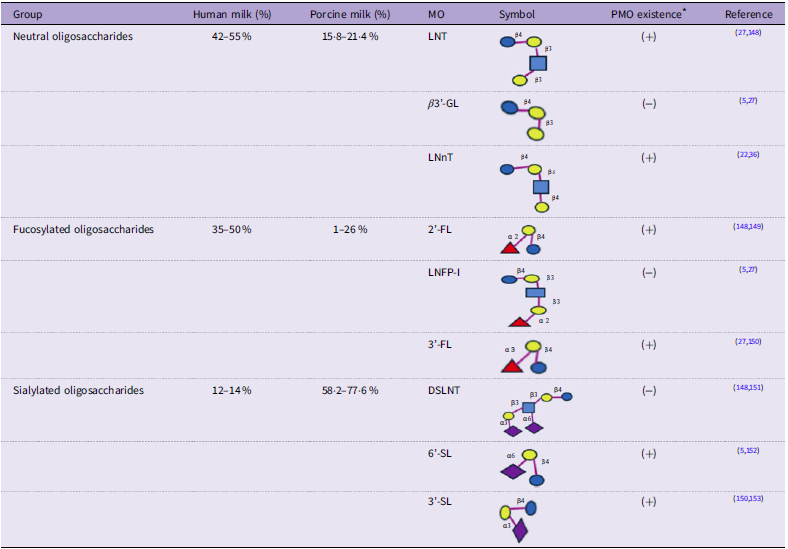
These structural features confer critical biological functions including gut microbiota regulation, immune system modulation and pathogen adhesion prevention(Reference Zeuner, Teze and Muschiol24). Specifically, the resistance of β1–3 linkages to host digestive enzymes and the prebiotic effects of these modifications make HMO particularly relevant for enhancing gut health(Reference Hill, Chow and Buck25). Importantly, HMO demonstrate significantly higher structural complexity and levels of fucosylation compared with PMO (Figure 1), which contain only fifty-five characterised structures with less diversity(Reference Wei, Wang and Wang5,Reference Zhu, Zhang and Zhang26) . Table 1 highlights these structural distinctions, emphasising that while humans possess a high-output fucosylated phenotype, porcine milk is naturally dominated by sialylated structures, particularly 3’-SL(Reference Salcedo, Frese and Mills27). This structural disparity provides the physiological rationale for supplementing neonatal piglets with human-type HMO to bridge the natural porcine glycome deficiency.
Structural divergence between human milk oligosaccharides (HMO) and porcine milk oligosaccharides (PMO). (a) HMO exhibit high structural diversity, characterised by a high degree of fucosylation (α1–2 and α1–3/4 linkages) and complex branching that facilitate pathogen decoy activity and immune signalling. (b) PMO are structurally less diverse, predominantly composed of sialylated core like 3’-SL, 6’-SL and neutral oligosaccharides such as isoglobotriose. Key glycosidic linkages are indicated: α1–2 fucose, α2–3/6 sialic acid, β1–3/4/6 N-acetylglucosamine, β1–4 glucose and β1–3/4 galactose. Figure is created with BioRender.com. 2’-FL, 2’-fucosyllactose; 3’-SL, 3’-sialyllactose; 6’-SL, 6’-sialyllactose; Fuc, L-fucose; Gal, D-galactose; Glc, D-glucose; GlcNAc, N-acetylglucosamine; LDFT, lacto-N-difucohexaose I; LNH, lacto-N-hexaose; LNFP, lacto-N-fucopentaose; LNT, lacto-N-tetraose; Neu5Ac, N-acetylneuraminic acid.

Comparative abundance of human and porcine milk oligosaccharides

Table 1. Long description
This table details the percentage of neutral (42-55% human vs 15.8-21.4% porcine), fucosylated (35-50% human vs 1-26% porcine), and sialylated (12-14% human vs 58.2-77.6% porcine) oligosaccharides. It lists specific molecules like 2’-FL, 3’-SL, and 6’-SL, noting their existence or absence in porcine milk.
PMO, porcine milk oligosaccharides; LNT, lacto-N-tetraose; β3’GL, 3’-galactosyllactose; LNnT, lacto-N-neotetraose; 2’-FL, 2’-fucosyllactose; LNFP-I, lacto-N-fucopentaose I; 3’-FL, 3’-fucosyllactose; DSLNT, disialyllacto-N-tetraose; 3’-SL, 3’-sialyllactose; 6’-SL, 6’-sialyllactose.
*Existence in PMO: (+) indicates existence in porcine milk; (−) indicates non-existence or levels below detection limits in current studies.
Biosynthetic pathways of human milk oligosaccharides
HMO are synthesised in the Golgi apparatus of mammary epithelial cells, beginning with the lactose core formed by lactose synthase, a heterodimer composed of β1,4-galactosyltransferase 1 (β4GalT1) and α-lactalbumin(Reference Chen, Horton and Stivala23). Subsequent elongation and branching are catalysed by glycosyltransferases such as β3-N-acetylglucosaminyltransferase and β6-N-acetylglucosaminyltransferase, which generate diverse linear and branched structures(Reference Urashima, Katayama and Sakanaka28). Final post-elongation modifications, including fucosylation and sialylation, mediated by fucosyltransferase such as FUT2, FUT3 and sialyltransferases (ST3GAL1and ST6GAL1), resulting in over 200 structurally distinct glycans(Reference Zheng, Xu and Fang17,Reference Jantscher-Krenn, Lauwaet and Bliss29) . HMO biosynthesis is governed by a complex interplay of genetic, physiological and environmental factors. Genetic determinants, particularly polymorphisms in the FUT2 (secretor) and FUT3 (Lewis) genes, define the individual fucosylation landscape, which significantly impacts neonatal gut colonisation and pathogen resistance patterns(Reference Jacobs, Lee and Rechtman30,Reference Bering31) . Furthermore, maternal factors such as BMI, geographic location and parity have been shown to modulate HMO profiles, while recent evidence suggests that environmental pollutants may further alter these bioactive compositions(Reference Naik, Holzhausen and Chalifour32,Reference Matharu, Ponsero and Lengyel33) .
Biotechnological advances in human milk oligosaccharides production
To replicate natural biosynthesis, multiple production strategies have been developed, representing transformative advances in infant nutrition with significant potential for novel therapeutic and livestock health applications(Reference Walsh, Lane and Van Sinderen3). Chemical synthesis allows for precise structural control but necessitates complex protection–deprotection steps and high reagent costs, which currently limit large-scale commercial feasibility for the swine industry(Reference Walsh, Lane and Van Sinderen3). In contrast, enzymatic synthesis offers high selectivity and avoids extensive protection steps; however, the substantial costs of purified enzymes and sugar-nucleotide substrates remain major economic barriers(Reference Chen, Horton and Stivala23,Reference Zeuner, Teze and Muschiol24) . Chemoenzymatic approaches attempt to bridge these advantages by using multi-enzyme systems to construct complex HMO, yet challenges regarding yield and scalability persist(Reference Zheng, Xu and Fang17). While mammary cell culture closely mimics natural biosynthesis, it remains technically complex and cost-prohibitive for agricultural applications(Reference Walsh, Lane and Van Sinderen3,Reference Guzmán-Rodríguez, Alatorre-Santamaría, Cruz-Guerrero, Jafari, Rashidinejad and Simal-Gandara34) .
Among the emerging platforms, microbial fermentation using engineered Escherichia coli, Saccharomyces cerevisiae or Bacillus subtilis is currently the most promising strategy. This approach enables scalable and cost-effective production with high yields of specific HMO, such as 2’-FL and LNnT(Reference Walsh, Lane and Van Sinderen3,Reference Palur, Pressley and Atsumi35) . Additionally, engineered plants have been explored as innovative biofactories to produce diverse HMO with bifidogenic properties(Reference Barnum, Paviani and Couture36). Recent techno-economic analyses suggest that plant-based systems could reduce production costs, substantially improving the economic competitiveness of HMO compared with traditional microbial methods(Reference Barnum, Paviani and Couture36). For the swine industry, where profit margins are narrow, achieving these lower price points via plant or high-yield microbial platforms is the critical threshold required for the transition from experimental trials to routine dietary supplementation in commercial herds.
Mechanisms of human milk oligosaccharides in promoting intestinal health
Impact of human milk oligosaccharides on intestinal physiology and function
The intestinal epithelium is a dynamic, permselective barrier where the regulation of macromolecules and ions is governed by tight junction complexes(Reference Pearce, Mani and Boddicker37). Recent evidence in swine models indicates that divergent selection for feed efficiency significantly alters duodenal transcriptomic responses, particularly in genes associated with both nutrient transport and barrier stability(Reference Devailly, Fève and Saci38). HMO promote a synchronised maturation programme of this architecture by increasing transepithelial electrical resistance and modulating the expression of critical tight junction proteins, including ZO-1, occludin and specific claudins (claudin-5 and claudin-8) (Figure 2)(Reference Šuligoj, Vigsnæs and Abbeele39). These effects are likely mediated through the induction of cellular differentiation via mitogen-activated protein kinase pathways(Reference Comstock, Wang and Hester7,Reference Sun, O’Riordan, Laskin, Sariaslani and Gadd40) . The structural fortification of the gut barrier serves as the essential foundation for optimised nutrient absorption(Reference Chen, Horton and Stivala23).
Advanced mechanisms of human milk oligosaccharides (HMO) in supporting porcine intestinal homeostasis. Supplemental HMO fortify the intestinal barrier by upregulating the expression of tight junction proteins (ZO-1, Occludin, Claudin-5, Claudin-8), thereby reducing paracellular permeability. They modulate immune ontogeny by suppressing pro-inflammatory mediators (IL-1, IL-6, IL-8, IL-4 and TNF-α) through inhibition of the TLR4/MyD88/NF-κB signalling axis, while promoting anti-inflammatory pathways by enhancing IFN-γ and IL-10 secretion. Fermentation of HMO by Bifidobacteria produces SCFA, transported via MCT1/SMCT1, which support enterocyte energetics, MUC production and nutrient acquisition via SGLT1. Figure created with BioRender.com. 2’-FL, 2’-fucosyllactose; 3’-SL, 3’-sialyllactose; Fuc, L-fucose; Gal, D-galactose; Glc, D-glucose; GlcNAc, N-acetylglucosamine; IFN-γ, interferon-gamma; LNH, lacto-N-hexaose; LPS, lipopolysaccharide; MCT1, monocarboxylate transporter 1; MUC, mucin; MyD88, myeloid differentiation primary response 88; Neu5Ac, N-acetylneuraminic acid; PRR, pattern recognition receptors; SGLT1, sodium-glucose linked transporter 1; SMCT1, sodium-coupled monocarboxylate transporter 1; TLR4, Toll-like receptor 4; ZO-1, zonula occludens-1.

While much of the mechanistic evidence regarding nutrient transport and cell differentiation currently relies on in vitro human cell models like Caco-2Bbe, the profound anatomical and physiological similarities between the porcine and human gastrointestinal tracts suggest these pathways are highly conserved(Reference Patterson, Lei and Miller41). However, porcine-specific verification of these transcriptional triggers and their downstream protein-level outcomes remains a priority to account for the piglet’s significantly faster maturation rate compared with human infants. In parallel with barrier strengthening, HMO upregulate alkaline phosphatase as demonstrated by Kunz et al. (2014) which is an enzyme critical for inactivating pro-inflammatory lipopolysaccharides, thereby maintaining a non-inflammatory environment conducive to transport(Reference Kunz, Kuntz, Rudloff, Moreno and Sanz42). These glycans also mitigate mitochondrial dysfunction and enhance intestinal epithelial cell viability, ensuring the energetic demands of active nutrient transport are met(Reference Zhang, Chen and Hu43).
In parallel with barrier strengthening, HMO upregulate alkaline phosphatase, an enzyme critical for inactivating pro-inflammatory lipopolysaccharides, thereby maintaining a non-inflammatory environment conducive to transport(Reference Kunz, Kuntz, Rudloff, Moreno and Sanz42). These glycans also mitigate mitochondrial dysfunction and enhance intestinal epithelial cell viability, ensuring the energetic demands of active nutrient transport are met(Reference Zhang, Lu and Chen44). Furthermore, specific structures such as 2’-FL have been shown to modulate intracellular signalling, particularly the palmitoylation–depalmitoylation cycle of STAT3 (signal transducer and activator of transcription 3), which accelerates mucosal recovery and reinforces the physical shield against pathogens(Reference Li, Lin and Mao45).
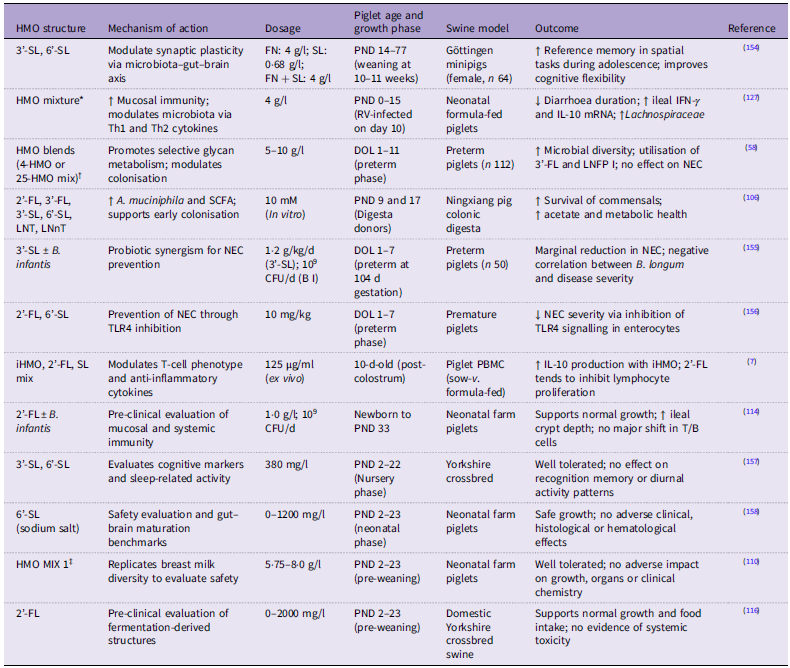
This integrated improvement is reflected in measurable physiological upgrades across the porcine gut. Supplementation with HMO blends significantly increases villus height and crypt depth, effectively expanding the surface area available for digestion and absorption (Table 2). Beyond the cellular level, HMO support the intestinal mucus layer by selectively enriching bacterial species that do not degrade mucin, resulting in a thicker, more resilient barrier(Reference Kong, Elderman and Cheng46–Reference Versluis, Wijtkamp and Looijesteijn49). Additionally, fucosylated HMO may directly influence gut motility by interacting with neuronally dependent motor complexes, potentially optimising the transit time of nutrients for brush-border contact(Reference Cilieborg, Sangild and Jensen19,Reference Bienenstock, Buck and Linke50) . While much of the mechanistic evidence currently relies on in vitro human cell models, the profound anatomical and physiological similarities between the porcine and human gastrointestinal tracts suggest these pathways are highly conserved and provide a robust framework for enhancing growth performance in the neonatal pig(Reference Patterson, Lei and Miller41).
Functional roles of human milk oligosaccharides (HMO) in swine models

Table 2. Long description
This comprehensive table lists multiple studies, specifying the HMOs used (e.g., 3’-SL, 2’-FL, HMO mixtures), dosages, piglet age, swine model, and significant outcomes. Outcomes include improved memory, reduced diarrhea duration, increased microbial diversity, and prevention of necrotizing enterocolitis.
3’-SL, 3’-sialyllactose; 6’-SL, 6’-sialyllactose; FN, formula with neutral oligosaccharides; SL, sialyllactose; PND, postnatal day; RV, rotavirus; IFN-γ, interferon-gamma; DOL, day of life; 2’-FL, 2’-fucosyllactose; 3’-FL, 3’-fucosyllactose; LNFP I, lacto-N-fucopentaose I; NEC, necrotising enterocolitis; LNT, lacto-N-tetraose; LNnT, lacto-N-neotetraose; TLR, Toll-like receptor; iHMO, isolated human milk oligosaccharides; PBMC, peripheral blood mononuclear cells; SA, sialic acid; LST, lacto-N-sialotetraose; DSLNT, disialyllacto-N-tetraose; CFU, colony-forming unit.
*HMO mixture: 40 % 2’-FL, 35 % LNnT, 10 % 6’-SL, 5 % 3’-SL, 10 % free SA. †HMO blends: 4-HMO (2’-FL, LNnT, LNT, 6’-SL); 25-HMO (complex mix including 3’-FL, 2′,3-Difucosyllactose, LNFP I/II/III, LST a/c, 3’-SL and DSLNT). ‡HMO MIX 1:49·1 % 2’-FL, 10·4 % 3’-FL, 19·9 % LNT, 3·5 % 3’-SL and 4·2 % 6’-SL.
Regulation of immune responses
HMO exert significant immunomodulatory effects within the gut, influencing both innate and adaptive immune responses through direct interactions with immune cell receptors and modulation of key signalling pathways(Reference Van Kooyk and Rabinovich51). These glycans enhance pathogen recognition by antigen-presenting cells via interactions with C-type lectin receptors. As reported by Van Kooyk and Rabinovich (2008), C-type lectin receptors recognise α-fucosylated and mannose-rich structures on HMO, thereby facilitating pathogen clearance and antigen presentation to adaptive immune cells(Reference Van Kooyk and Rabinovich51). While these fundamental immunomodulatory mechanisms were initially characterised in human and rodent systems, they are highly relevant to swine nutrition due to the remarkably similar proportional developments of natural killer cells(Reference Thorum, Comstock and Hester52).
Nevertheless, specific signalling axes identified in mice, such as the aryl hydrocarbon receptor (AHR)-IL-22 axis in innate lymphoid cells(Reference Rothhammer and Quintana53), require further validation in porcine-derived primary cells to confirm their role in regulating the piglet’s unique mucosal response to weaning stress(Reference Thorum, Comstock and Hester52,Reference Andersson, Hammarström and Lönnerdal54,Reference Hawkes, Neumann and Gibson55) .
For instance, HMO inhibit the attachment of pathogens such as Norovirus to histo-blood group antigens, lowering the risk of diarrhoeal and respiratory infections(Reference Koromyslova, Morozov and Hefele56). In neonatal models, HMO have been implicated in preventing necrotising enterocolitis by suppressing the activation of the TLR4/NF-κB pathway, a central signalling cascade in inflammatory responses (Figure 2)(Reference Muñoz-Provencio and Yebra57). This is particularly critical in the porcine model, as preterm piglets supplemented with HMO blends show structure-specific bacterial preferences that actively mitigate inflammatory signalling(Reference Rudloff, Kuntz and Ostenfeldt Rasmussen58). Additional innate immune mechanisms involve glycan mimicry. As demonstrated by Hirabayashi et al. (2002), HMO structurally resemble host glycans such as N-acetyllactosamine and lactose, enabling competitive binding to galectins on T cells and intestinal epithelial cells(Reference Hirabayashi, Hashidate and Arata59). This mimicry disrupts galectin-mediated immune suppression and modulates T-cell activity(Reference Hirabayashi, Hashidate and Arata59). Furthermore, sialylated and fucosylated HMO interact with endothelial selectins to inhibit leucocyte adhesion and recruitment, reducing inflammatory cell trafficking(Reference Rudloff, Kuntz and Ostenfeldt Rasmussen58). Specific HMO structures exert distinct immunological effects. Recent studies indicate that 2’-FL attenuates inflammation in murine colitis models by down-regulating lipopolysaccharide-binding protein and suppressing the expression of the CD14 gene, thereby limiting TLR4 activation(Reference Li, Kou and Wang60). Similarly, 6’-SL reduces pro-inflammatory chemokine secretion such as IL-8, CCL20 in a dose-dependent manner by suppressing AP-1 (activator protein 1) and NF-κB activity through PPARγ-dependent pathways(Reference Azcutia, Kelm and Fink61,Reference Zehra, Khambati and Vierhout62) .
Given that porcine and human infants display nearly identical Th-cell-mediated inflammation patterns, these mechanistic insights provide a robust scientific basis for using HMO as precision tools to temper early-life immune dysregulation in swine(Reference Comstock, Wang and Hester7,Reference Liu, Comstock and Shunk63,Reference Carver, Pimentel and Barness64) . Likewise, 3’-SL has been shown to inhibit TLR4-mediated inflammation in macrophages and endothelial cells by activating liver X receptor (LXR) and sterol regulatory element-binding protein-1 (SREBP-1) pathways, ultimately reducing pro-inflammatory gene expression(Reference Pessentheiner, Spann and Autran65).
Beyond innate mechanisms, HMO also regulate adaptive immune responses; acidic HMO enhance interferon-γ (IFN-γ) and IL-10 secretion while suppressing IL-4 production in cord blood T cells (Figure 2), shifting the immune balance away from allergic responses associated with Th2 activity(Reference Eiwegger, Stahl and Haidl66). In addition, HMO interact with Siglecs (sialic acid-binding Ig-type lectins) on leucocytes to suppress excessive activation(Reference Alphey, Attrill and Crocker67). These glycans also promote regulatory T-cell (Treg) differentiation, which is crucial for maintaining immune tolerance(Reference Ríos-Covián, Ruas-Madiedo and Margolles68). This effect is partly mediated by microbial metabolites such as butyrate produced during HMO fermentation in the porcine hindgut, which enhances the expression of the Foxp3 gene through the inhibition of histone deacetylases(Reference Ríos-Covián, Ruas-Madiedo and Margolles68,Reference Vinjamuri, Davis and Totten69) . Collectively, these findings underscore the dual role of HMO in dampening excessive inflammation while fostering balanced Th1/Th2 immunity essential for preventing early-life inflammatory disorders(Reference Boll, Lopez and Terne70). While much of this research has focused on infant health, emerging evidence indicates broader applications in animal nutrition. Cheng et al. (2020) demonstrated that structural classes of HMO exert divergent effects through Toll-like receptors (TLR); specifically, LNT-II may activate TLR signalling, whereas fucosylated and sialylated HMO like 2’-FL and 6’-SL inhibit pro-inflammatory responses(Reference Cheng, Kong and Walvoort71). However, although associations between HMO and reduced autoimmune disease risk have been reported in humans, such links remain underexplored in pigs(Reference Dutta, Hullett and Roenneburg72).
Future studies should examine how HMO shape immune function across distinct developmental stages and evaluate their potential to prevent autoimmune and allergic conditions in swine(Reference Wong, Huang and Ning73).
Modulation of the intestinal microbiome
HMO are pivotal determinants of gut microbial ecology, primarily through their selective bifidogenic activity. Bifidobacterium longum subsp. infantis dominates the microbiota of breastfed infants due to its specialised enzymatic capacity to metabolise complex HMO(Reference Ward, Niñonuevo and Mills74). Longitudinal studies demonstrate that B. infantis becomes predominant within weeks post-birth, coinciding with the depletion of faecal fucosylated and sialylated glycans, which underscores its metabolic specialisation(Reference Cheng, Kong and Walvoort71). Other bifidobacteria, such as B. bifidum and B. breve, also benefit from HMO particularly core structures like lacto-N-biose, whereas non-bifidobacterial species such as Lactobacillus and Enterococcus display limited adaptability(Reference Kiyohara, Tachizawa and Nishimoto75,Reference Xiao, Takahashi and Nishimoto76) . These species-specific adaptations illustrate a co-evolutionary relationship, wherein HMO act as both a nutrient source and a prebiotic scaffold to foster microbial resilience(Reference Yu, Chen and Newburg77). While much of this mechanistic framework is derived from human neonatal studies, its translational relevance to swine is increasingly evident.
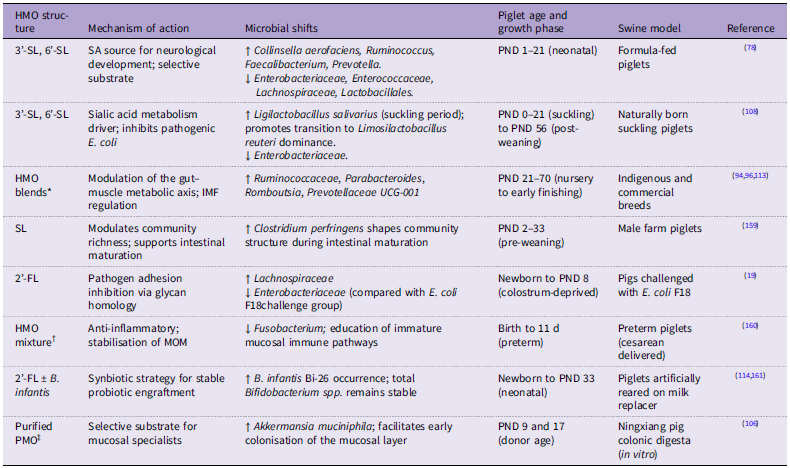
In pigs, supplementation with sialyllactose (SL) at physiological concentrations significantly enriches Lactobacillus, Bifidobacterium and Bacillus populations in the caecum while suppressing potentially harmful Enterobacteriaceae and Enterococcaceae (Table 3)(Reference Jacobi, Yatsunenko and Li78,Reference Duan, Chen and Zheng79) . Different microbial clusters employ distinct strategies to exploit supplemental HMO; for instance, synbiotic strategies using 2’-FL can facilitate the stable engraftment of B. infantis Bi-26 in the neonatal piglet gut (Table 3).
Modulation of the porcine gut microbiome by milk oligosaccharides

Table 3. Long description
This table details how different HMO structures drive specific microbial shifts. For example, sialyllactose enriches Collinsella and Faecalibacterium, while 2’-FL enriches Lachnospiraceae and supports Bifidobacterium engraftment. It also notes the association between certain taxa and intramuscular fat (IMF) regulation.
HMO, human milk oligosaccharides; 3’-SL, 3’-sialyllactose; 6’-SL, 6’-sialyllactose; SL, sialyllactose; PND, postnatal day; IMF, intramuscular fat; E. coli, Escherichia coli; MOM, milk-oriented microbiome; 2’-FL, 2’-fucosyllactose; B. infantis, Bifidobacterium longum subsp. infantis; PMO, porcine milk oligosaccharides.
*HMO blend composition: These mixtures often contain approximately 49·1 % 2’-FL, 19·9 % LNT, 10·4 % 3’-FL, 4·2 % 6’-SL and 3·5 % 3’-SL to mimic the natural ratios found in human milk.
†HMO mixture typically includes 2’-FL, LNnT, 3’-SL and 6’-SL.
‡Purified PMO include 3’-FL, 3’-SL, LNT and LNnT purified from Ningxiang pig colostrum.
Furthermore, the microbial response to HMO is dynamic and follows a temporal pattern of ecological succession. As observed by Jacobs et al. (2023), HMO supplementation may trigger an initial Bifidobacterium bloom followed by the expansion of Bacteroides and Proteobacteria, reflecting complex cross-feeding networks that are critical for restoring diversity after weaning-induced dysbiosis(Reference Jacobs, Lee and Rechtman30,Reference Engfer, Stahl and Finke80) .These temporal patterns suggest that HMO interventions should be strategically timed to coincide with the rapid microbial expansion phase during the first 14 d post-weaning to maximise therapeutic efficacy. Beyond their bifidogenic role, HMO serve as potent anti-adhesive agents against enteric pathogens.
Fucosylated and sialylated HMO competitively inhibit the colonisation of Campylobacter jejuni, Escherichia coli and Salmonella spp. by acting as decoy receptors that prevent bacterial attachment to the intestinal mucosa (Figure 3)(Reference Newburg81). Similarly, 2’-FL and 3’-fucosyllactose (3’-FL) have been shown to block the adhesion of Pseudomonas aeruginosa to epithelial cells, while LNT prevents Entamoeba histolytica cytotoxicity(Reference Weichert, Jennewein and Hüfner82,Reference Jantscher-Krenn, Treichler and Brandl83) . In the context of swine production, these anti-adhesive properties provide a non-antibiotic strategy to mitigate post-weaning diarrhoea, effectively protecting the intestinal niche by supporting commensal dominance over opportunistic pathogens. These findings suggest that HMO protect the intestinal niche by limiting pathogen colonisation and supporting commensal dominance. However, microbiome responses to HMO supplementation are dynamic and characterised by distinct temporal patterns. As observed by Jacobs et al. (2023), initial HMO exposure may trigger a transient decline in overall microbial diversity by day 7, coinciding with a marked Bifidobacterium bloom, followed by the restoration of diversity and the expansion of Bacteroides and Proteobacteria by day 14(Reference Jacobs, Lee and Rechtman30). In swine production, these ecological successions may provide a blueprint for precision dosing strategies aimed at sustaining beneficial taxa during the vulnerable window of weaning, a period typically defined by severe dysbiosis(Reference Jacobs, Lee and Rechtman30,Reference Li, Guo and Wen84) .
Multifaceted mechanisms and production applications of human milk oligosaccharides (HMO) in swine. Supplemental HMO function as soluble decoy receptors, utilising their structural homology to host glycans to trap pathogens such as E. coli and prevent fimbriae-mediated adherence to the intestinal epithelium. This protective effect facilitates the establishment of a MOM, selectively enriching beneficial taxa such as Bifidobacterium and Akkermansia. In the absence of HMO (without HMO), the porcine gut is susceptible to pathogen adherence, intestinal atrophy (short, atrophied villi) and increased paracellular permeability (leaky gut), leading to a pro-inflammatory state characterised by the up-regulation of TNF-α, IL-6 and IL-1β. Conversely, with HMO supplementation (with HMO), microbial fermentation generates SCFA like acetate and butyrate. These metabolites travel through the systemic circulation (SCFA uptake by muscle) to regulate the gut–muscle metabolic axis, enhancing IMF deposition (marbling) and improving oxidative stability. This systemic programming ultimately optimises production outcomes, including significantly improved ADG and feed efficiency. Figure created with BioRender.com. 2’-FL, 2’-fucosyllactose; ADG, average daily gain; IMF, intramuscular fat; MOM, milk-oriented microbiome.

Figure 3. Long description
A diagram of the molecular decoy mechanism and benefits of human milk oligosaccharides (HMO) in swine nutrition. The diagram is divided into two main sections: without HMO and with HMO. Without HMO: E. coli pathogens with surface fimbriae interact with complex HMOs glycans. This leads to mucin degradation by Akkermansia and Bifidobacterium, resulting in short-chain fatty acid production via microbial fermentation. The absence of HMO results in a leaky gut, pathogen adherence, short atrophied villi, and increased levels of TNF-alpha, IL-6, and IL-1 beta, leading to a pro-inflammatory state. With HMO: The presence of HMO prevents pathogen adherence, promoting the establishment of a milk-oriented microbiome (MOM) that enriches beneficial taxa such as Bifidobacterium and Akkermansia. Microbial fermentation produces short-chain fatty acids like acetate and butyrate, which regulate the gut-muscle metabolic axis. This enhances intramuscular fat (IMF) deposition, improves oxidative stability, and optimizes production outcomes, including improved average daily gain (ADG) and feed efficiency.
The biological impact of these shifts is largely driven by the fermentation of HMO into specialised metabolites. The metabolic activity of Bifidobacterium and Bacteroides generates SCFA notably acetate and butyrate which reduce luminal pH to suppress the growth of acid-sensitive pathogens while regulating local mucin production (Figure 3)(Reference Vinjamuri, Davis and Totten69,Reference Chia, Mank and Blijenberg85) . Beyond simple prebiotic effects, HMO can facilitate stable colonisation even in resistant microbial ecosystems. Sustained supplementation in adults has been shown to support long-term B. infantis engraftment(Reference Button, Autran and Reens86), a finding with profound translational relevance for managing the piglet gut during transitions between liquid and solid feed. Emerging evidence further links this microbiota modulation to systemic host outcomes via the gut–brain axis. While studies in various models suggest potential benefits for neurodevelopment(Reference Jandhyala87), specific porcine data confirms that supplementation with SL increases caecal levels of acetate, propionate and butyrate while enriching Lactobacillus, Bifidobacterium and Bacillus populations (Table 3)(Reference Jacobi, Yatsunenko and Li78). Similarly, metabolic profiling in preterm piglets receiving HMO blends (5–10 g/l) confirms active bacterial fermentation, with a preferential utilisation of fucosylated structures such as 3’-FL(Reference Rudloff, Kuntz and Ostenfeldt Rasmussen58). Importantly, this selective fermentation not only shapes the local environment but also increases sialic acid concentrations in critical brain regions, including the corpus callosum and cerebellum, directly linking hindgut microbial metabolism to central nervous system maturation in the neonatal pig(Reference Jacobi, Yatsunenko and Li78).
Physiological considerations for the sustained use of human milk oligosaccharides in swine
Potential risks of dysbiosis and pathogen resistance
The growing interest in HMO as bioactive supplements is accompanied by critical questions regarding their long-term safety, particularly concerning gut microbial equilibrium and the potential for microbial adaptation(Reference Jacobs, Lee and Rechtman30).
While short-term porcine trials indicate that HMO supplementation is well tolerated and promotes structural gut maturation, a high-level ecological analysis reveals potential risks associated with the specialisation bottleneck(Reference Dinleyici, Barbieur and Dinleyici88,Reference Pitt, Bond and Roper89) . This principle suggests that the selective enrichment of high-affinity HMO metabolisers, such as Bifidobacterium and Akkermansia, may occur at the expense of overall functional redundancy, which is the ecosystem’s ability to maintain metabolic processes when primary taxa are disrupted(Reference Parkin, Christophersen and Verhasselt90,Reference Merenda, Tomacheuski and Trindade91) . In the commercial swine industry, where piglets undergo severe weaning-induced dysbiosis, over-reliance on a single prebiotic scaffold could inadvertently reduce microbial α-diversity. HMO effectively shift the neonatal gut towards a breastfed-like profile; however, the long-term implications of sustaining this narrowed microbial focus remain underexplored(Reference Dinleyici, Barbieur and Dinleyici88,Reference Schönknecht, Moreno Tovar and Jensen92) . Furthermore, the antimicrobial mechanisms of HMO, including receptor decoy activity and biofilm disruption, could theoretically exert evolutionary pressure on pathogens to adapt. For instance, specific structures inhibit the biofilm formation of Acinetobacter baumannii by blocking initial bacterial adhesion, a mechanism that may eventually select for alternative colonisation strategies in more resilient strains(Reference Spicer, Gaddy and Townsend93).
Concerns are also raised by the synergistic interactions between HMO and traditional antibiotics. While HMO can temporarily enhance therapeutic efficacy by reducing minimum inhibitory concentrations, prolonged prophylactic exposure alongside antimicrobial agents in commercial operations could accelerate the emergence of multidrug-resistant strains through co-selection for resistance traits(Reference Merenda, Tomacheuski and Trindade91,Reference Spicer, Gaddy and Townsend93) . Crucially, the impact of HMO extends beyond the nursery phase to include long-term carcass characteristics. Recent evidence identifies a significant correlation between early-life gut microbiota and intramuscular fat (IMF) deposition, a key determinant of meat quality traits such as tenderness and marbling(Reference Wu, Lyu and Hong94,Reference Lei, Wang and Li95) .
Specific microbial taxa, including members of the Ruminococcaceae, Parabacteroides and Romboutsia families, are positively associated with lipid metabolism and IMF content in breeds such as Duroc and Enshi pigs (Table 3)(Reference Bergamaschi, Tiezzi and Howard96,Reference Tang, Guo and Fan97) . These observations imply that HMO supplementation could be tailored by breed to optimise both gut health and carcass characteristics, provided that longitudinal evidence confirms these early-life nutritional programmes translate into measurable economic returns (Figure 3)(Reference Bergamaschi, Tiezzi and Howard96,Reference Stygar, Chantziaras and Maes98) . Finally, economic feasibility models suggest that for HMO to become a viable component of modern swine production, the intervention must demonstrate a profitable reduction in pre-weaning mortality or a significant improvement in feed efficiency that offsets the cost of supplementation(Reference Stygar, Chantziaras and Maes98,Reference Vonderohe, Brizgys and Richert99) .
Interactions with SCFA and probiotics
Emerging research highlights complex interactions between HMO, butyrate and probiotics, revealing both synergistic benefits and context-dependent risks that are critical for neonatal piglet development. The chronological succession of the porcine gut microbiota transitioning from pioneer facultative anaerobes to strict anaerobes can be orchestrated through synbiotic interventions aimed at establishing a milk-oriented microbiome (Figure 3)(Reference Bourlioux, Koletzko and Guarner100,Reference Jost, Lacroix and Braegger101) . In this framework, HMO such as 2’-FL and 3’-FL serve as selective substrates that can be amplified by specific probiotic strains to maximise metabolic output. For instance, butyrate (0·5 mM) has been shown to modulate the effects of fucosylated HMO on the crosstalk between intestinal epithelial cells, dendritic cells and T cells, enhancing anti-inflammatory responses through its role as a histone deacetylase inhibitor and its ability to suppress NF-κB activation(Reference Zuurveld, van Witzenburg and Garssen102). However, from an ecological perspective, these interactions are governed by the principle of metabolic cross-feeding.
In the absence of specialised partners, HMO may inadvertently promote Bacteroidaceae overgrowth at the expense of butyrate-producing Clostridia, potentially lowering faecal butyrate levels and compromising the primary energy source for enterocytes(Reference Chia, Mank and Blijenberg85,Reference Holst, Jois and Laursen103) . Co-administration with Bifidobacterium longum subsp. infantis mitigates this risk by fostering specialised networks that convert HMO into acetate, which secondary fermenters like Anaerostipes caccae subsequently metabolise into butyrate (Figure 3)(Reference Button, Autran and Reens86,Reference De Bruyn, James and Cottenet104) . Such probiotic–HMO synbiotics demonstrate dose-dependent efficacy; in porcine models, these combinations have been shown to elevate total SCFA production by up to 40 % compared with individual components, reflecting a synergistic metabolic relationship essential for sustaining the vulnerable window of weaning(Reference Jacobs, Lee and Rechtman30,Reference Button, Autran and Reens86,Reference De Bruyn, James and Cottenet104) . Despite these benefits, antagonistic outcomes may arise if the host microbiota lacks necessary keystone species. As observed in murine models, 3’-FL can reduce Lacrimispora abundance and butyrate synthesis when bifidobacterial partners are absent, a finding that underscores the necessity of precision synbiotics in commercial swine operations where microbial diversity may be low(Reference Chia, Mank and Blijenberg85,Reference Holst, Jois and Laursen103) . Furthermore, there is a theoretical risk of immune overmodulation; excessive HMO–butyrate combinations may dampen cytokine production to a degree that compromises pathogen clearance in immunocompromised piglets(Reference Zuurveld, van Witzenburg and Garssen102).
Incomplete fermentation by non-specialised probiotics also risks colonic gas distension or osmotic diarrhoea, particularly if the physiological ceiling of the hindgut’s fermentative capacity is exceeded(Reference Xu, Feng and Ding105). These findings emphasise that the future of swine nutrition lies in strain-specific formulations that consider the baseline ecological context of the porcine gut to ensure that supplemental HMO translate into measurable improvements in gut resilience and growth performance.
Metabolic pathways of human milk oligosaccharides in swine
Fucosylation pathways
Fucosylated HMO, particularly 2’-FL, exhibit high resistance to host-derived enzymes such as pancreatic α-amylase and brush-border lactase, enabling them to reach the distal gut nearly intact(Reference Zivkovic, German and Lebrilla1,Reference Engfer, Stahl and Finke80) . Once in the intestinal tract, 2’-FL displays a distinctive region-specific fermentation profile that differentiates the neonatal pig from other animal models. In vitro evaluations of porcine digesta indicate that 2’-FL undergoes differential fermentability between the jejunum and the colon, producing significantly lower gas volumes in the proximal segments compared with other prebiotic oligosaccharides(Reference Zhang, Wu and Kang106). This regional specialisation is driven by unique microbial successions. In the jejunum, the fermentation of 2’-FL selectively enriches Bacteroides, Prevotella and Blautia while concurrently reducing the abundance of Streptococcus and Lactobacillus (Reference Zhang, Wu and Kang106). This upstream microbial activity shifts the metabolic output towards increased propionate and reduced lactate levels, a critical finding given that the small intestine is the primary site for active nutrient transport and rapid enterocyte turnover. In contrast, colonic fermentation follows a more traditional prebiotic trajectory, preferentially stimulating acetate production through the expansion of Blautia, Faecalibacterium and members of the Lachnospiraceae family(Reference Zhang, Wu and Kang106).
Metabolomic analyses provide a robust human–pig bridge by demonstrating that fucose, liberated as a primary byproduct of HMO degradation, acts as a key metabolic intermediate detectable in both intestinal contents and systemic circulation(Reference Rosa, Matazel and Elolimy107). Human milk-fed piglets exhibit significantly higher fucose concentrations in jejunal contents and urine compared with formula-fed controls, indicating that fucosylated HMO metabolism begins earlier in the digestive tract than previously assumed(Reference Rosa, Matazel and Elolimy107). This liberated fucose not only supports the growth of specialised fucose-utilising bacteria within the Bacteroidetes phylum but also enters the systemic circulation, where it may serve as a signalling molecule for extra-intestinal development(Reference Salcedo, Frese and Mills27,Reference Sun, O’Riordan, Laskin, Sariaslani and Gadd40) .
From a critical perspective, these region-specific metabolic fingerprints suggest that 2’-FL does not merely function as a colonic prebiotic; rather, it programmes a biochemical gradient that supports the proximal small intestine’s high energy demands while maintaining a protective commensal niche in the distal gut.
Sialylation pathways
Sialylated glycans, including 3’-SL and 6’-SL, undergo specialised bacterial degradation processes that are fundamental to shaping the early-life porcine gut. Recent longitudinal studies indicate that 3’-SL is the predominant oligosaccharide in porcine milk, with Ligilactobacillus salivarius acting as the primary metabolic driver during the suckling period(Reference Hashimoto, Nishiyama and Namai108). This selective metabolism promotes the dominance of L. salivarius in milk-fed piglets, which subsequently transitions to Limosilactobacillus reuteri dominance following weaning(Reference Hashimoto, Nishiyama and Namai108). The biochemical fate of these acidic HMO involves the enzymatic release of sialic acid by bacterial sialidases, particularly from Bifidobacterium species that possess specialised sialic acid utilisation pathways(Reference Kiyohara, Tachizawa and Nishimoto75,Reference Chen, Xu and Chen109) .
From a functional perspective, co-culture models demonstrate that when L. salivarius metabolises 3’-SL in tandem with Bacteroides thetaiotaomicron, the metabolic output shifts from lactate to acetate, significantly enhancing the host’s resistance against enterotoxigenic Escherichia coli (Reference Hashimoto, Nishiyama and Namai108,Reference Hanlon110) . Dietary supplementation of 3’-SL and 6’-SL at physiological concentrations (2–4 g/l) markedly modifies the colonic landscape, enriching beneficial taxa such as Collinsella aerofaciens, Ruminococcus, Faecalibacterium and Prevotella, while suppressing potentially harmful Enterobacteriaceae and Enterococcaceae populations (Table 3)(Reference Jacobi, Yatsunenko and Li78). These shifts are accompanied by increased concentrations of acetate, propionate and butyrate in caecal contents, effectively creating a growth-permissive environment that supports long-term phenotypic maturation(Reference Jacobi, Yatsunenko and Li78,Reference Hashimoto, Nishiyama and Namai108) . Importantly, the structural similarity between human and porcine milk profiles both of which contain abundant 3’-SL, LNT and 2’-FL validates the pig as a superior model for HMO bioavailability studies (Figure 1)(Reference Salcedo, Frese and Mills27). In preterm piglets, HMO supplementation results in the detection of both intact and partially degraded oligosaccharides in colonic contents and urine, with structure-specific bacterial preferences for molecules such as 3’-FL and lacto-N-fucopentaose I (LNFP I)(Reference Rudloff, Kuntz and Ostenfeldt Rasmussen58). Crucially, dietary SL has been shown to increase ganglioside-bound sialic acid in critical brain regions, including the corpus callosum and cerebellum(Reference Jacobi, Yatsunenko and Li78). This provides a definitive link between hindgut microbial metabolism and central nervous system development, positioning sialylated HMO as essential tools for nutritional programming of cognitive and physiological traits in the neonatal pig (Figure 3).
Towards effective implementation
Dosage considerations
The therapeutic dosage ranges of HMO are fundamentally defined by regulatory frameworks and structure-specific efficacy patterns. For 2’-FL, the most abundant HMO in human milk, clinical studies demonstrate safety and efficacy at 0·2–2·4 g/l in infant formula, providing a benchmark for replicating natural concentrations(Reference Rousseaux, Brosseau and Le Gall111). The European Food Safety Authority (EFSA) has established maximum daily intakes of 3 g for children (4–18 years) and 1·2 g for toddlers, while LNnT is approved at concentrations up to 0·6 g/l(Reference Turck and Bohn112). However, from a critical animal science perspective, a human–pig bridge must account for the divergent physiological maturation rates between species. While human-relevant concentrations (∼1·0 g/l) support normal growth, translational evidence in swine suggests that these levels often fail to trigger the systemic growth response required for industrial profitability(Reference Devailly, Fève and Saci38,Reference Wang, Zhu and Wang113) .
As observed by Daniels (2021), piglets supplemented with 1·0 g/l 2’-FL exhibited standard growth patterns but showed no significant improvement in average daily gain or total weight gain compared with control groups(Reference Daniels114). Conversely, preclinical rodent models receiving significantly higher doses have exhibited more pronounced weight gain and superior nutritional acquisition by the end of the suckling period(Reference Azagra-Boronat, Massot-Cladera and Mayneris-Perxachs115). Despite these potentially higher requirements, safety margins remain exceptionally wide. Preclinical evaluations report no observed adverse effect levels as high as 5000 mg/kg/d, and specific porcine safety trials have confirmed that complex HMO blends (including 2’-FL, 3’-FL, LNT, 3’-SL and 6’-SL) at inclusion levels up to 8·0 g/l are well tolerated with no adverse clinical or histological effects(Reference Hanlon110,Reference Hanlon and Thorsrud116) . These observations emphasise a critical research gap: the need to move beyond simple human mimicry to define species-specific biological thresholds for the neonatal pig(Reference Jang and Kim8). Establishing these precision thresholds is essential for ensuring that supplemental HMO translate into the robust improvements in feed efficiency and average daily gain demanded by modern commercial production.
Stability during feed processing and life-cycle strategy
Incorporating HMO into porcine diets requires rigorous consideration of their structural stability during thermal and mechanical processing. In commercial swine production, standard feed pelleting involves conditioning at 70–90°C followed by high-pressure pressing and cooling(Reference Südekum, Schröder and Fiebelkorn117,Reference Lozada-Soto, Maltecca and Wackel118) . Evidence regarding the thermal resilience of oligosaccharides indicates that a higher degree of polymerisation confers superior stability; specifically, pentasaccharides demonstrate greater resilience to degradation than trisaccharides(Reference Südekum, Schröder and Fiebelkorn117,Reference Vega and Zuniga-Hansen119) . While mild thermal treatment (≤65°C) has negligible effects on HMO concentrations, extreme conditions (≥135°C) trigger substantial structural degradation, potentially compromising the decoy receptor functionality and prebiotic specificity of the molecules(Reference Yao, Gao and Wang120).
Consequently, HMO are expected to remain largely intact under standard pelleting conditions, though high-temperature extrusion must be carefully monitored to preserve biological activity. From a life-cycle perspective, the efficacy of HMO utilisation is fundamentally age-and breed-dependent. Piglets exhibit peak responsiveness to HMO during the first 14 d of post-weaning, a period characterised by rapid microbial expansion and immature intestinal architecture(Reference Luo, Zhang and Yang121,Reference Chen, Chen and Faas122) . As demonstrated in preterm porcine models, supplementation at this stage leads to structure-specific metabolism of complex glycans like LNFP I and 3’-FL, which are detectable in both colonic contents and urine, reflecting active systemic uptake(Reference Rudloff, Kuntz and Ostenfeldt Rasmussen58). In contrast, finishing pigs exhibit limited responsiveness due to an established, stable microbiome and a mature digestive capacity that lacks the niche space for additional prebiotic intervention(Reference Liu, Chen and Wang123).
Translational applications in swine nutrition and production
Immune and physiological mimicry
The increasing availability of biotechnologically produced HMO has opened new frontiers for their application in livestock nutrition, particularly as bioactive agents in neonatal piglet development. Pigs represent a superior translational model for human infants due to striking similarities in immune ontogeny; for example, the proportion of natural killer cells in piglets (6–12 %) closely parallels human neonatal levels(Reference Thorum, Comstock and Hester52,Reference Andersson, Hammarström and Lönnerdal54,Reference Hawkes, Neumann and Gibson55) . Both species exhibit a distinct formula-fed immune signature characterised by lower natural killer cell activity and heightened T-helper (Th) cell-mediated inflammation, a phenotype that can be shifted towards a more resilient breastfed-like profile through HMO supplementation (Figure 2)(Reference Comstock, Wang and Hester7). Beyond simple immune modulation, translational evidence suggests that HMO act as biochemical triggers for intestinal programming. While conventional milk replacer formulations prioritise macronutrients, the addition of HMO replicates the protective architecture of maternal milk(Reference Gormley, Garavito-Duarte and Kim124).
Recent transcriptomic evidence indicates that nutritional cues during the suckling period can alter the duodenal and jejunal expression of genes related to nutrient transport and barrier regulation, effectively preparing the neonatal gut for the metabolic demands of solid feed intake(Reference Devailly, Fève and Saci38,Reference Kim and Kim125) . These shifts are often accompanied by structural maturation, including increased villus height and upregulated brush-border enzyme activity (Table 2), which provide the physiological foundation for superior growth performance (Figure 3)(Reference Jang and Kim8,Reference Monaco, Wang and Pan126) .
Pathogen resistance and barrier fortification
Controlled porcine trials provide robust evidence for the protective efficacy of specific HMO structural classes against enteric pathogens.
Supplementation with sialylated HMO has been shown to increase serum concentrations of IgA, IgG and IgM while suppressing pro-inflammatory cascades such as TNF-α, IL-1β and IL-6 following Escherichia coli challenge, resulting in faster recovery and improved clinical outcomes (Figure 2)(Reference Duan, Chen and Zheng79). Similarly, HMO mixtures have been demonstrated to shorten the duration of rotavirus-induced diarrhoea by protecting intestinal niche space and enhancing the abundance of beneficial fermenters (Table 2)(Reference Li, Monaco, Wang and Comstock127). These effects are further supported by structural mechanisms; HMO enhance goblet cell activity and mucus secretion via the up-regulation of mucin genes under stress conditions, while also interacting with TLR to mitigate systemic inflammation (Figure 2)(Reference Jang and Kim8,Reference Rudloff, Kuntz and Ostenfeldt Rasmussen58) . Due to their structural homology with galacto-oligosaccharides, HMO may synergise with existing prebiotics to foster a specialised milk-oriented microbiome that is more resilient than those supported by simple lactose-based diets (Figure 3)(Reference Difilippo, Bettonvil and Willems9). By serving as soluble decoy receptors that prevent fimbriae-mediated adherence, HMO provide a robust non-antibiotic strategy to maintain intestinal homeostasis during the high-risk weaning transition (Figure 3).
Meat quality and the microbiota–intramuscular fat axis
Crucially, the impact of early-life HMO intervention extends beyond the nursery phase to include long-term carcass characteristics. Emerging evidence identifies a significant correlation between HMO-enriched taxa and IMF deposition, a key determinant of tenderness and marbling in premium pork production (Figure 3)(Reference Wu, Lyu and Hong94,Reference Lei, Wang and Li95) . Specific microbial families, including Ruminococcaceae, Parabacteroides and Romboutsia, are positively associated with lipid metabolism and IMF content (Table 3)(Reference Wu, Lyu and Hong94,Reference Wang, Zhu and Wang113) . In Indigenous breeds such as the Enshi pig, IMF deposition is strongly linked to the abundance of Prevotellaceae UCG-001, while breed-specific differences in Duroc pigs further shape microbial colonisation patterns and meat quality traits(Reference Bergamaschi, Tiezzi and Howard96,Reference Tang, Guo and Fan97) .
These observations imply that HMO supplementation could be tailored by breed to optimise both gut health and carcass characteristics, provided that supplemental SCFA particularly butyrate effectively regulate the gut–muscle metabolic axis to promote intramuscular adipogenesis (Figure 3)(Reference Qi, Men and Wu128). By establishing this systemic microbiota–host axis, HMO offer a precision nutritional tool to enhance both production efficiency and the sensory qualities of pork (Figure 3).
Safety and economic strategy
The practical feasibility of HMO in modern swine production is governed by the techno-economic gap between production costs and commercial feed margins. From the specific viewpoint of pig nutrition, we estimate that an affordable extra cost for supplemental bioactives is approximately €0·40–0·60 per piglet(Reference Atuahene, Sam and Idan129).
To reach this low production cost, the industry must transition away from high-cost chemical synthesis towards scalable photosynthetic or fermentation platforms. Techno-economic analyses performed by Barnum et al. (2024) indicate that engineered plant systems, such as Nicotiana benthamiana, could reduce production costs for complex structures like 2’-FL to approximately $4·90–18·40/kg, significantly improving economic competitiveness compared with current microbial methods(Reference Barnum, Paviani and Couture130). Furthermore, the industrial adoption of HMO is supported by the mortality–profit equilibrium model described by Stygar et al. (2022)(Reference Stygar, Chantziaras and Maes98). In this framework, the investment in high-inclusion neonatal diets is economically justified if the bioactive intervention yields a measurable reduction in pre-weaning mortality or a significant improvement in the post-weaning feed conversion ratio(Reference David, Juliano and Ridoutt131). Achieving high fermentation titres (>150 g/l) remains the essential threshold required to lower the minimum selling price of these bioactives to a level competitive with traditional specialty feed ingredients, such as plasma or high-quality whey proteins(Reference Atuahene, Sam and Idan129).
Future perspectives and strategic framework
The transition of supplemental HMO from human clinical research to the global swine industry requires a bifurcated strategy that balances immediate industrial feasibility with deep mechanistic discovery.
Near-term applied research: scalability and economic value
The primary hurdle for industrial adoption is bridging the techno-economic gap between production costs and commercial feed margins(Reference Yart, Wijaya and Lima132,Reference Augustin, Hartley and Maloney133) . While plant-based biofactories offer one solution, future efforts must also optimise precision fermentation platforms(Reference Graham and Ledesma-Amaro134).
Recent techno-economic assessments indicate that achieving high fermentation titres (>150 g/l) is the critical threshold required to lower the minimum selling price of bioactives to a level competitive with traditional feed ingredients(Reference David, Juliano and Ridoutt131). Furthermore, the scalability of transient plant-based platforms, such as Nicotiana benthamiana, allows for a unilateral flow from upstream biomass production to downstream purification, which is essential for meeting the high-volume demands of the livestock sector(Reference Nandi, Kwong and Holtz135).
To prove industrial value, research must transition towards large-scale longitudinal trials that utilise a mortality–profit equilibrium model(Reference Rösler and Hartung136). For supplemental HMO to be viable, the investment per piglet (estimated at €0·40–0·50) must be offset by a measurable reduction in pre-weaning mortality or significant gains in the post-weaning feed conversion ratio(Reference Stygar, Chantziaras and Maes98,Reference Atuahene, Sam and Idan129) . Beyond direct performance, future strategies should explore the role of HMO in the carbon market. By improving nutrient utilisation efficiency, supplemental HMO may allow producers to generate carbon credit units or participate in low-emission roadmaps, providing an additional layer of economic incentive through the sale of verified emission reductions(Reference David, Juliano and Ridoutt131,Reference Copley, McGahan and McCormack137) .
Long-term fundamental goals: multi-omics and sustainability
Beyond immediate production gains, the future of HMO research lies in established precision nutritional programming. Future studies must utilise multi-omics technologies including metagenomics and metatranscriptomics to track the metabolic trajectory of HMO in the porcine intestine at a molecular level(Reference Cai, Zhang and Song138). This involves the functional annotation of the microbiome to identify specific glycoside hydrolase (GH) families, such as GH2, GH20 and GH33, which are essential for the degradation of sialylated and fucosylated glycans(Reference Rumeau, Chadi and Pepke139).
Mapping these pathways will allow for the rational design of precision synbiotics that ensure supplemental HMO are utilised by beneficial commensals rather than remaining unfermented and inducing osmotic distress(Reference Atuahene, Sam and Idan129,Reference Rumeau, Chadi and Pepke139) . Additionally, the integration of HMO offers a transformative path for environmental sustainability. By leveraging the ability of taxa like Ruminococcaceae and Prevotellaceae to optimise nitrogen utilisation efficiency, producers can significantly reduce ammonia and greenhouse gas emissions from manure management systems(Reference Atuahene, Sam and Idan129,Reference Burlakova and Dimitrov140,Reference Millet, Aluwé and Van Den Broeke141) .
A paradigm shift towards defining species-specific biological thresholds is essential to move HMO research beyond human mimicry models. A critical knowledge gap currently missing in the porcine model is the protein-level validation like Western blot or proteomics of proposed signalling pathways regulating intestinal identity and maturation(Reference Kumar, Tsai and Chen142). To date, much of the evidence in pigs relies on transcriptomic signatures and Spearman’s correlations(Reference Zhang, Wu and Kang106); consequently, the integration of AHR-mediated antioxidant defence mechanisms requires functional resolution(Reference Yao, Fan and Zheng143). Furthermore, future research utilising fecal microbiota transplantation or porcine organoid-based signalling inhibition is required to definitively establish the causal directionality of the HMO-mediated developmental programme in commercial swine production(Reference Xiang, Wu and Pan144). Additionally, knowledge gaps remain regarding the breed-specific responsiveness of the gut–muscle metabolic axis. While early-life HMO supplementation shows promise in Indigenous breeds like the Enshi pig, it remains unknown if these effects translate to the extreme metabolic demands of commercial Duroc or Large White hyper-prolific lines(Reference Bergamaschi, Tiezzi and Howard96,Reference Tang, Guo and Fan97) . Finally, the swine industry requires evidence of the multi-generational impact of these glycans; specifically, whether early-life nutritional programming of the nucleus herd can improve the long-term reproductive fecundity and semen quality of boars, a gap that is unique to livestock production and absent in human neonatal research(Reference Maltecca, Dunn and He145,Reference Li, Li and Cheng146) .
The scope of the microbiota–host profile should be expanded to include reproductive performance. Emerging evidence links specific gut taxa, such as Rikenellaceae and Prevotella, to boar semen quality and sperm vitality, suggesting that early-life glycan interventions could have life-long impacts on the fecundity of the nucleus herd(Reference Maltecca, Dunn and He145,Reference Li, Li and Cheng146) . By establishing these precision thresholds and multidisciplinary benchmarks, the swine industry can ensure that the biological benefits of HMO translate into a sustainable, antibiotic-free and profitable production paradigm (Figure 3)(Reference Atuahene, Sam and Idan129,Reference Patience and Ramirez147) .
Conclusion
HMO offer a robust strategy to enhance swine health by orchestrating a milk-oriented microbiome, fortifying the intestinal barrier and modulating immune ontogeny during the critical weaning window. Beyond the gut, early-life supplementation influences long-term production traits, including IMF deposition and boar reproductive performance, establishing a systemic microbiota–host axis that determines carcass quality and herd fecundity. While translational adoption faces significant techno-economic hurdles, the integration of transient plant-based biofactories and high-titre precision fermentation provides a viable path to industrial scalability. Future success depends on leveraging multi-omics to define species-specific biological thresholds and utilising HMO to improve nitrogen utilisation efficiency, ultimately positioning these complex glycans as essential components of a sustainable, carbon-conscious and antibiotic-free production paradigm.
Data availability statement
Data sharing is not applicable to this article as no new data were created or analyzed in this study.
Acknowledgements
The authors thank the broader scientific community whose foundational research into milk bioactives and porcine physiology made this review possible.
This work was supported by the National Key R&D Program of China (grant number 2023YFF1103802) and the Sichuan Science and Technology Program (grant number 2026YFHZ0011). The funders had no role in the design, analysis or writing of this article.
The authors declare that there are no conflicts of interest.
R. E. B.: Conceptualisation-Equal, Investigation-Equal, Visualisation-Equal, Writing – original draft-Equal; Q. H.: Resources-Equal, Writing – review and editing-Equal; J. Z.: Funding acquisition-Equal, Investigation-Equal; P. Z.: Supervision-Equal, Validation-Equal; Y. Z.: Resources-Equal, Validation-Equal; L. L.: Supervision-Equal, Validation-Equal; H. Y.: Supervision-Equal, Validation-Equal. All authors have read and approved the final manuscript for submission.
Not applicable. This is a review article synthesising previously published literature; it does not involve new primary research with human participants or animal models.