1. Introduction
Samuel Prideaux Tregelles recounted a curious feature of MS 33 (Paris, Bibliothèque nationale de France, grec 14) and the difficulties it presented. When he examined the manuscript in 1850, he noticed that the some leaves were ‘so firmly stuck together, that, when they were separated, the ink had adhered rather to the opposite page than to its own’.Footnote 1 Lest someone accuse him of carelessness for giving the text of 33 where it had been previously thought to be illegible, Tregelles assured his readers: ‘I thus obtained the reading of every line for many pages, where nothing could be seen on the page itself: in some places, where part of a leaf is wholly gone from decay, the writing which was once on it can be read from the set-off.’Footnote 2
Tregelles was not the only scholar to decipher a manuscript by reading a mirror image of offset ink transferred to a facing page. Among the plates in his work Manuscripts of the Greek Bible, Bruce Metzger included an image of minuscule 700 (London, British Library, Egerton 2610) and mentioned that some paratextual features from the facing page are present in mirror image.Footnote 3 More recently, Paul Foster described using this method to read a few words in the Gospel of Peter in the Akhmîm Codex (P.Cair. 10759) that have been preserved through ink transferred to the opposite page.Footnote 4 Timothy W. Pepper was even able to determine the direction in which a papyrus in the Zenon archive was rolled by making measurements and calculations based on the offset ink.Footnote 5
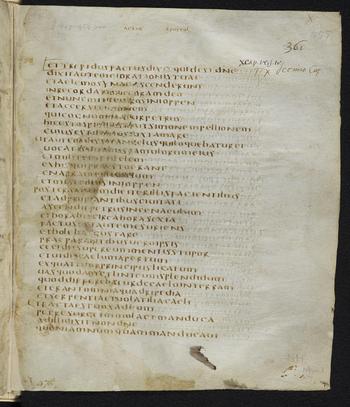
In at least one instance, Codex Bezae (Cambridge, University Library, Nn. ii. 41) suffered a similar fate.Footnote 6 Damage to the manuscript on fol. 455a has pulled some ink from the now-lost page containing the Greek text of Acts 10.4–14 onto the surviving Latin side.Footnote 7 By reversing the high-resolution images of Codex Bezae available from the Cambridge Digital Library with photo-editing software, some previously lost Greek text can be recovered and read for the first time.Footnote 8 Admittedly, only a few letters per line are preserved, and not every line contains offset ink. Still, Josep Rius-Camps and Jenny Read-Heimerdinger exclaimed, ‘If ever the missing pages of Codex Bezae come to light, they may well bring some surprises!’, and a careful examination of the reversed images can shed some new light on this well-studied manuscript.Footnote 9
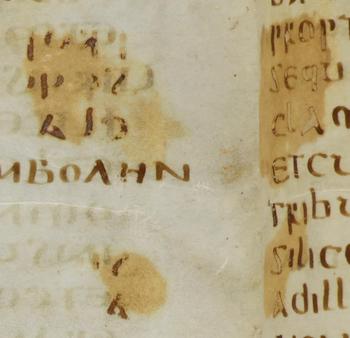
A test case from Acts 22 can illustrate the process used to decipher the Greek text of Acts 10.4–9. On fol. 508a, some type of contamination has caused ink from the Latin text (VL 5) at the beginning of lines 9–11, 14 to transfer to the facing Greek side (05, fol. 507b). Short sense lines allow the reversed Latin text to be read without obstruction from the Greek side, and the recovered letters can be compared to their known source, which is still extant (Fig. 1).
Unaltered image of fols. 507b–508a in Codex Bezae (detail). Reproduced by kind permission of the Syndics of Cambridge University Library (classmark Nn. II. 41).

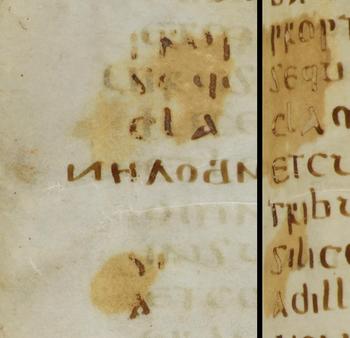
Using photo-editing software, the image can be split so that the Greek side is reversed. A black line is added at the spine to provide a visual division between the two folios, and the part of the image to the left of the black line (fol. 507b) is reversed. Reading the offset Latin text from the altered image is somewhat akin to reading a fragmentary papyrus or the under-text of a palimpsest. The first few letters of five lines (prop, sẹqụ, cla, [two blank lines] sị and a) are visible (Fig. 2).
Fol. 507b reversed, facing fol. 508a unaltered (detail). Reproduced by permission of Cambridge University Library.

Transcribing the offset ink is easier in this test case, but some Greek letters from the page containing Acts 10.4–9 can be recovered by the same method (Fig. 3). The transcription is admittedly uncertain at points, but in the commentary that follows, a justification for the transcribed text is given, accompanied by a reversed image of the line that has just been discussed. Incomplete letters are dotted unless enough ink is extant to rule out any other possible identifications. A transcription of the Latin text of each line discussed is given in the commentary. When Latin letters are used to describe the location(s) of the traces of offset Greek, the Latin must be read in reverse. The accompanying images have all been reversed so that the offset Greek text can be read normally, but no other alterations have been made to the images.
Codex Bezae, fol. 455a. Reproduced by permission of Cambridge University Library.

2. Transcription and Commentary

Line 3 Some traces are visible over na of aelemosynae and possibly on the following a (Fig. 4).
Line 3, reversed (detail). Reproduced by permission of Cambridge University Library.

Line 4 εν]ω̣[π]ι̣ο̣ν τ̣[ου θυ; in recordatione coram deo: The first visible trace is over o in coram. It looks curved and consistent with ω both in appearance and distance from later traces. The next visible trace is consistent with ι but not with θ, and it occurs just before the left half of a curved letter. The only certain letter is ν; both verticals and the beginning of the oblique are visible. The letter following ν looks curved, but this could be from the incomplete preservation of the ink. Here, 05 apparently agrees with C E H4 L P Ψ 049 056 33 and the majority of MSS against ἔμπροσθεν in P74 א B A 81 88 1175 1646 1739 and 1891.Footnote 10 The identification of this reading as the text of 05 is admittedly tenuous here, but perhaps an ut videtur judgement could be justified (Figs. 5 and 5a).
Line 4, reversed (detail). Reproduced by permission of Cambridge University Library.

Line 4, reversed with digital reconstruction (detail). Reproduced by permission of Cambridge University Library.

Line 5 ε]ι̣ϲ̣ ιοπ̣π̣[ην; et nunc mitte uiros in ioppen: Above r in uiros, a trace of a vertical is visible. A curved letter follows. What looks like the horizontal of ε is the top of ϲ showing through from fol. 455b.Footnote 11 The remaining visible ink on the line is consistent with ιοππ (Figs. 6 and 6a).
Line 5, reversed (detail). Reproduced by permission of Cambridge University Library.

Line 5, reversed with digital reconstruction (detail). Reproduced by permission of Cambridge University Library.

Line 6 ]α̣[; et accersi simonem: Only two thick obliques are visible. The right oblique is lower on the line of writing than the left, which is consistent with this scribe's α but not λ. Perhaps this letter is the second α in μεταπεμψαι (Fig. 7).
Line 6, reversed (detail). Reproduced by permission of Cambridge University Library.

Line 7 πε]τ̣ρον; qui cognominatur petrus: Only τρον of πετρον is preserved. It appears that 05 has (τον επικαλουμενον) πετρον here, with E L Ψ 33 323 614 1241 1505 and the majority of MSS against (ος επικαλειται) πετρος in P74vid א A B C 81 945 1175 1739 2818 Irlat (Fig. 8).
Line 7, reversed (detail). Reproduced by permission of Cambridge University Library.

Line 8 π̣α̣ρα̣ ϲιμω̣[νι; hic est ospitans aput simonem pellionem: Most of the letters are visible, though only traces of π remain. The darker speck of ink within i of ospitans is probably from ω. The omission of τινι is singular among Greek MSS, and only VL 5 and VL 20 lack the equivalent in Latin MSS. It is possible that 05 simply transposed τινι after ϲιμωνι as in C 69, but it is more likely that 05 omitted τινι altogether (Fig. 9).Footnote 12
Line 8, reversed (detail). Reproduced by permission of Cambridge University Library.

Line 9 θ̣α̣λ̣αϲ̣ϲ̣α̣; cuius est domus iuxta mare: The dark speck of ink in i of iuxta is consistent with the left curve of θ. The next three letters have thick right obliques, and the third is clearly α. Two curved letters follow, and the final letter is consistent with α (Fig. 10).
Line 9, reversed (detail). Reproduced by permission of Cambridge University Library.

Line 10 αγγελο]ϲ̣ ο̣ λ̣αλω̣ν α̣[υτω; ut autem dissit angelus qui loquebatur ei: The left curve of ϲ is visible. The darker traces of ink in n in angelus are traces of ο. The right thick oblique of λ follows before -αλ-. Dark traces over ss in dissit are consistent with ω, and dark specks from all three strokes of ν are visible. Traces consistent with α are present over m in autem. It appears that a small line of ink from υ is preserved in the open space of m in autem. The ink is so slight, however, that υ is bracketed on the side of caution, though υ̣ might be justifiable. 05 agrees with P74 א A B C E 81 323 945 1175 1656 1739 1891 and 2344 against the reading τῷ Κορνηλίῳ in a number of other MSS and is adopted by Robinson–Pierpont as the reading of the Byzantine Textform.Footnote 13 As VL 5, 05 also lacks the addition after 10.6 found in a few witnesses (Fig. 11).
Line 10, reversed (detail). Reproduced by permission of Cambridge University Library.

Line 11 οικε]τ̣ω̣ν̣ α̣[υ]του; uocatis duobus famulorum eius: The vertical of τ is offset over f in duobus famulorum. Traces of the two curves and the centre vertical of ω are over -us in duobus, though nothing from the lower part of the letter survives. The darker spot of ink within the ink of -u- is from the first vertical of ν, and the second vertical is preserved in the vertical cluster of specks inside -b-. Traces of the angled point of α are visible between o and b, and the thick oblique of α is clear. The slightest of specks over -u – the dark spot over the lighter ink in the image – is probably from υ, but the letter is bracketed as not extant on the side of caution. The letters του are the most clearly preserved on this line. 05 agrees with the majority of MSS in the addition of αυτου here (Acts 10.7) against P74 א A B C E 81 1175 1646 and the NA28, which lack αυτου (Fig. 12).
Line 11, reversed (detail). Reproduced by permission of Cambridge University Library.

Line 13 α̣υ̣τ̣ω̣; ex his qui erant praesto: Traces of the thick obliques of α and υ, the descender of υ, the vertical of τ and the second half of ω are all visible. Traces between the vertical of τ and the visible round ink from ω are consistent in shape and spacing with the first curve of ω. The presence of αυτω here marks a point of divergence between 05 and VL 5, which lacks an equivalent (usually illi among Latin witnesses, though Wordsworth and White report ei in VL 189 and ΣT and sibi in VL 50 and VL 54),Footnote 14 but the phrase in VL 5, qui erant praesto ‘who were present’, does not need an accompanying pronoun (Fig. 13).
Line 13, reversed (detail). Reproduced by permission of Cambridge University Library.

Line 14 τ]ο ορα̣μ̣α̣; enarrauit illis uisum: After ο ορ, which are clear, part of the thick oblique of α is impressed over the vertical of the first u in uisum. Ink from both verticals of μ as well as what look like remnants of the bowl are visible over ill-, and traces of the thick oblique of α is also visible. This reading is singular among Greek MSS but parallels what can be found in some versional witnesses.Footnote 15 Codex Glazier (New York, Morgan Library, MS.G.67) has ϩⲁϥϫⲱ ⲉⲣⲁⲩ ⲙⲡϩⲟⲣⲟⲙⲁ, ‘He said to them the vision’.Footnote 16 The Greek reading in 05 parallels that of VL 5. The phrase has additional attestation in VL 51 syp (Fig. 14).
Line 14, reversed (detail). Reproduced by permission of Cambridge University Library.

Line 15 ιοπ]π̣η̣ν; et misit illos in ioppen: Traces of the second vertical of π and verticals of η and ν are visible. Specks of the horizontal of η protrude from the verticals, and the oblique of ν is visible (Fig. 15).
Line 15, reversed (detail). Reproduced by permission of Cambridge University Library.

Line 16 οδοιπορουντω]ν̣ α̣υτ̣ω̣[ν; postera autem die iter illis facientibus: Traces of the oblique and second vertical of ν are visible over e in autem, though what comes before the letter is only speculation. The thick obliques of α and υ are clear, as well as traces of the descender and the thin, second oblique of υ. The vertical of τ is clearly visible, followed by the first part of a curved letter and a few more traces, consistent with the first curve and vertical of ω. The letters on line 16 are at the extreme end of what has been preserved, suggesting that they close a long sense line. If the identification of the preceding word is correct, 05 agrees with P74 א A E L Ψ 33 81 323 614 945 1175 1505 1739 2818 pm sy against ἐκείνων in B C 6 1241 latt, the Majority Text adopted by Robinson–Pierpont and the NA28 (Fig. 16).
Line 16, reversed (detail). Reproduced by permission of Cambridge University Library.

Line 24 ]ν̣[; et uidit caelum apertum: A vertical and part of an oblique of ν are visible (Fig. 17).
Line 24, reversed (detail). Reproduced by permission of Cambridge University Library.

Lines 25–7 A few indecipherable specks of ink are visible.
3. Codex Bezae and the D-text at Acts 10.4–9
Witnesses to the D-text of Acts are especially sparse in Acts 10.4–9.Footnote 17 P127 (P.Oxy. 4968) is a related Greek manuscript of Acts from the fifth century, but it is not extant before Acts 10.32.Footnote 18 James Hardy Ropes reports only a single marginal reading in the Harklean Syriac version for this passage, which is the indefinite pronoun in Acts 10.5.Footnote 19 The leading Latin member of the D-text cluster, the Fleury Palimpsest (VL 55), is missing several sections of Acts, including 9.25–14.4.Footnote 20 The Greek minuscule 614 is extant in Acts 10.4–9, but it is considered to be a ‘secondary witness’ to the D-text of Acts.Footnote 21 Two significant versional witnesses to the D-text are extant in Acts 10.4–9: the Latin side of Codex Bezae (VL 5) and the Middle Egyptian Coptic Codex Glazier, edited by Hans-Martin Schenke.Footnote 22
Though they have relied primarily on 05, several scholars have offered reconstructions of the D-text of Acts. Ropes did not propose a full text of Acts where Bezae is not extant, but he did offer some conjectures about D-text readings in those sections.Footnote 23 A. C. Clark printed a full text of Acts, restoring the Greek of the D-text from other witnesses and using sense lines in Codex Bezae. At Acts 10.4–9, Clark used the sense lines preserved in VL 5 to present his proposed Greek text.Footnote 24 More recently, Marie-Émile Boismard and Arnaud Lamouille have published a reconstruction of the D-text and an accompanying critical apparatus, to which Boismard provided a more recent update.Footnote 25 Josep Rius-Camps and Jenny Read-Heimerdinger offer a few conjectures on the D-text in their four-volume work, The Message of Acts in Codex Bezae, but they reconstruct the text of 05 for Acts 10.4b–14a in its entirety on the basis of the surviving Latin page in their edition of the Bezan text of Luke-Acts, Luke's Demonstration to Theophilus.Footnote 26 Admittedly, not all of these reconstructions were made with the same goals. Boismard and Lamouille provide an eclectic text, but Rius-Camps and Read-Heimerdinger explicitly attempt to reconstruct the text of 05.
Ultimately, 05 is the primary Greek witness to the D-text. Regardless of the precise goals of those who offered reconstructions of the D-text, it can still be valuable to determine whether or not the primary witness supports those reconstructions. It is at this point that the traces of the Bezan text of Acts 10.4–9 can offer somewhat of a control group for the experiment of retroverting versional variants into Greek. Such a control group is especially helpful in light of the application of the Coherence-Based Genealogical Method (CBGM) for the Novum Testamentum Graecum: Editio Critica Maior (ECM), which can only use evidence from versions and patristic quotations insofar as they are correctly retroverted into the Greek text of their presumed Vorlagen.Footnote 27 The complexities of reconstructing presumed Greek Vorlagen of versional witnesses are described elsewhere; for our purposes, it is enough to compare Acts 10.4–9 in 05 both with reconstructions of the D-text and with other witnesses in the D-text cluster.Footnote 28
3.1 Acts 10.4
The Greek text at Acts 10.4 is divided between ἔμπροσθεν and ἐνώπιον (τοῦ θεοῦ). Codex Glazier has ⲙⲡⲉⲙⲧⲁ ⲉⲃⲁⲗ ⲙⲡ̅ϯ̅, but either Greek preposition can be translated into Middle Egyptian as ⲙⲡⲉⲙⲧⲁ ⲉⲃⲁⲗ.Footnote 29 The reading in VL 5 (and also VL 51) is coram (deo), which Rius-Camps and Read-Heimerdinger admit ‘is rare, being found only on one other occasion in Luke-Acts at Acts 7.26, where it corresponds to ἐναντίον’.Footnote 30 Most Latin MSS have in conspectu at 10.4, which usually corresponds to ἐνώπιον but can be used to translate ἔμπροσθεν as well.Footnote 31 If the restoration of 05 at 10.4 as ἐνώπιον is correct, it aligns with the majority of MSS, even if other witnesses of the ‘D-text’ are ambiguous. Clark and Read-Heimerdinger/Rius-Camps restore the text of Acts as ἐνώπιον τοῦ θεοῦ.Footnote 32 Boismard/Lamouille reconstruct the D-text as ἔμπροσθεν τοῦ θεοῦ.Footnote 33
3.2 Acts 10.5
Most discussion of the D-text at 10.5 is concerned with the presence or absence of τινα, and the offset ink in 05 can shed no new light on that variant. However, at the end of the verse, 05 apparently has the phrase found in the majority of Greek MSS, τον επικαλουμενον πετρον. Codex Glazier renders the phrase as ‘the one whose name is Peter’ (ⲡⲉⲧⲉ ⲡⲉϥⲣⲉⲛ ⲡⲉ ⲡⲉⲧⲣⲟⲥ).Footnote 34 Askeland writes: ‘Since there was no distinct Coptic participle or single equivalent to the Greek participle, the Coptic versions variously rendered Greek participles with indicative, relative, circumstantial and temporal forms.’Footnote 35 Consequently, nothing can be said with confidence about the Greek reading behind the translation in Codex Glazier. Boismard/Lamouille admit in their critical apparatus that it is possible that versions support τὸν ἐπικαλούμενον πέτρον, but their text, along with that of Clark and of Read-Heimerdinger/Rius-Camps, reads ὅς ἐπικαλεῖται Πέτρος.Footnote 36 Ropes does not speculate on the text of 05 for this variation unit.
3.3 Acts 10.6
At 10.6, it is again difficult to determine whether the readings of 05 and VL 5 align with the D-textual cluster. At a fundamental level, it is uncertain whether 05 omits τινι or transposes it with C 69, though the former is more likely. As mentioned earlier, only VL 5 and VL 54 lack an equivalent among Latin MSS. The Coptic evidence for the presence or absence of τινι is inconclusive. Codex Glazier has ⲟⲩⲉ ϫⲉ ⲥⲓⲙⲱⲛ ⲡⲃⲁⲕϣⲉⲣ’ (‘one certain Simon the tanner’). Gerd Mink gives a few examples as reasons not to draw firm conclusions about the underlying Greek when the Coptic has ⲟⲩⲁ/ⲟⲩⲉ or the indefinite article (ⲟⲩ-).Footnote 37 It could be that the apparent omission of τινι from Acts 10.6 in D is simply a variant created by the scribe of Codex Bezae.
Even if the scribe of Codex Bezae omitted τινι and this instance is one in which either the Greek or the Latin side influenced the text of the other, most scholars still failed to predict the preposition used here. Only Clark proposed the preposition παρά, which, again, is the reading of the majority of MSS. Ropes, Rius-Camps/Read-Heimerdinger (both editions) and Boismard (restated in the second edition) all affirm πρός as the preposition of the D-text here, though they are silent on other, more speculative readings. Boismard/Lamouille do not mention παρά as a variant within the D-text, and Rius-Camps/Read-Heimerdinger explicitly retroverted the reading of VL 5 at this passage, conjecturing the reading of 05 as πρὸς Σίμονα βυρσέα.Footnote 38
3.4 Acts 10.7
Clark, Boismard/Lamouille and Read-Heimerdinger/Rius-Camps offer a reconstruction of the D-text at Acts 10.7. In the first part of the verse, 05 breaks from the majority of MSS with ὁ λαλῶν αὐτῷ (not τῷ Κορνηλίῳ). This reading is not specific to the D-text cluster; it is shared by some of the early Greek majuscules. The Coptic versions (including Codex Glazier) do not name Cornelius here, nor do the Latin witnesses. All three editions have ὁ λαλῶν αὐτῷ.
Conversely, 05 has the majority reading at 10.7b, the addition of αυτου after οικετων. Codex 614 also has the majority reading here. The Sahidic tradition and Codex Glazier use pronominal infixes (ⲛ̅ⲛⲉ ϥϩⲙ̅ϩⲁⲗ and ⲛⲉ ϥϩⲙϩⲉⲗ, respectively),Footnote 39 but a translator could have added the pronominal as a way to render the sense of the passage, even if the underlying Greek lacked αὐτοῦ. Leonard mentions that Coptic has a ‘tendency to expand the article to include a pronominal intermediate’.Footnote 40 Most Latin MSS include a possessive pronoun (domesticos suos; famulorum eius in VL 5), though VL 50 and VL 51 omit it. Still, the presence of αὐτοῦ in the majority of MSS suggests that the word is a natural addition to the sense of the passage. No conclusions should be drawn from the presence of versional equivalents as they could occur as translational features with or without αὐτοῦ in a Greek Vorlage.Footnote 41 At 10.7b, both Clark and Boismard/Lamouille give the shorter text lacking αὐτοῦ, but Read-Heimerdinger/Rius-Camps correctly predicted the longer text.Footnote 42
3.5 Acts 10.8
The reading at Acts 10.8 in 05 is singular among Greek manuscripts. Enough offset ink has been preserved to show that 05 had το οραμα, parallelling uisum in VL 5, though το οραμα is singular among Greek witnesses (which have ἅπαντα). The reading is rare among versional witnesses as well. Ropes does not offer any conjectures about the reading of Acts 10.8, but despite the rarity of the reading, all of the reconstructions of the D-text correctly predicted αὐτοῖς τὸ ὅραμα or a transposition thereof.Footnote 43
3.6 Acts 10.9
The NA28 does not assign a majority reading at 10.9, but the Robinson–Pierpont majority text has ἐκείνων after ὁδοιπορούντων. The ECM assigns ἐκείνων as the Byz reading, but the majority of MSS cited by the ECM have αὐτῶν, as does 05. The translational possibilities for each reading are too numerous to support any kind of genetic relationship between 05 and the versional witnesses. However, 614 also has the αὐτῶν at this point. Clark, Boismard/Lamouille and Read-Heimerdinger/Rius-Camps offer a reconstruction of the D-text here, and each edition gives ὁδοιπορούντων ἐκείνων as the reading.
3.7 Conclusions on Acts 10.4–9 in 05 and the D-text
It seems that τὸ ὅραμα might have some validity as a D-text reading. The reading is a non-equivalent substitution (i.e. ἅπαντα ≠ τὸ ὅραμα) that can be ‘triangulated’ by a primary witness in each of three languages supported by a secondary Latin witness – 05, VL 5 (supported by VL 51) and Codex Glazier.Footnote 44 It is possible that it arose as a harmonisation to Acts 10.3 in Codex Bezae and coincidentally also as a function of language translation in Codex Glazier and VL 51, but it seems more likely that it is a genuine pre-05 reading of the D-text that lost its textual footing to the majority reading. Despite its status as a singular Greek substitution, every edition surveyed here correctly conjectured this reading in the D-text at Acts 10.8.
The general trend – and general must be emphasised here, because the trend does not hold true of every editor in every case in Acts 10.4–9 – is that editors have successfully predicted the reading of the D-text where it differs from the majority text, but they have been unsuccessful where 05 has a majority reading.Footnote 45 At Acts 10.4, 05 has the majority reading and both Clark and Read-Heimerdinger/Rius-Camps correctly predicted it – an example of the exception to the trend. However, the three editions that conjectured at 10.5 were incorrect; 05 has the majority reading there. With regard to the preposition at 10.6, only one out of six editions predicted correctly that 05 would align with the majority of Greek MSS. At 10.7, there are two noteworthy variants – at 10.7a, 05 breaks from the majority reading, and the three editions that conjecture with regard to the reading were correct. However, at 10.7b, 05 has the majority reading along with 614, considered by the editors to be a ‘secondary’ D-text manuscript, and yet two of the three editions failed to make a correct conjecture there.Footnote 46 All six editions correctly predicted the substitution at 10.8, despite the fact that it is a singular reading among Greek manuscripts and only supported by three non-Greek witnesses. Finally, at 10.9, it is difficult to assign a majority reading, and each of the three conjecturing editions incorrectly predicted the D-text. There are, of course, several caveats to these data. Not all editions intended to reproduce the Greek text of 05, though some explicitly did (Ropes and Rius-Camps/Read-Heimerdinger), and in several cases, the versional witnesses are unhelpful with regard to a Greek reconstruction.
Still, it is significant that of five editions attempting to reconstruct the Greek D-text, the primary witness of the D-text either confirms or repudiates their predictions according to whether or not it has the majority reading. This general trend suggests two thoughts. First, the trend reiterates the warning that retroversions into Greek should be used only in rare cases in which one can be confident of the underlying Greek text. Others have given this caveat before, but the data here seem to be yet another reminder.Footnote 47 False retroversions could skew the results of analysis in the CBGM by forcing versional witnesses into single readings, when in reality their respective Greek Vorlagen could have contained one or more of many alternative readings within any given variation unit. Second, one wonders how great a shadow the majority text casts over New Testament textual transmission, even in its early forms. Codex Bezae is well known for its differences – its uniqueness among New Testament manuscripts. Perhaps it is this notorious uniqueness of Codex Bezae that has generally prevented editors from predicting accurately the majority readings in 05 in the examples given here.
4. Summary and Conclusion
The contamination on fol. 455 subsequent to the loss of fol. 454 is, in a sense, a felix culpa. It is always unfortunate when a manuscript suffers damage or material contamination – especially one as significant as Codex Bezae. The contamination to fol. 455 is bittersweet, however, because it preserved remnants of the lost Greek text of Acts 10.4–9. Although only a few traces of letters can be recovered, the sense-line format of Codex Bezae and the ability to process high-resolution images through photo-editing software allows the traces to be read with the relative degree of certainty one might have for a palimpsest or a fragmentary papyrus. As a result, a few new readings of Codex Bezae have been recovered, including a singular reading (among Greek MSS) at Acts 10.8 and a probable singular reading at 10.6. Unfortunately, these newly discovered readings of 05 do not shed much new light on the so-called ‘Western’ or D-text and its witnesses, but, as stated already, it does seem that τὸ ὅραμα is a pre-05 reading of the D-text at Acts 10.8. Other agreements between 05 and some of the versional witnesses are more likely due to features of translation than to a close genetic relationship.
More broadly, two concluding thoughts are appropriate. First, the offset ink was discovered and read because of the freely available high-resolution images made available by the Cambridge University Digital Library, and photo-editing software assisted the process greatly. Until relatively recently in the long life of Codex Bezae, there has been no widely available, high-resolution, colour access to the manuscript, nor has there been the ability to manipulate images of the codex digitally. Perhaps multi-spectral imaging of fol. 455a or future technological advances could confirm the readings presented here or, better, find other lost text in Codex Bezae preserved somehow. Second, the offset ink could still have been discovered and read without high-resolution, colour images and photo-editing software, albeit with difficulty and perhaps with less certainty. The ink is visible in the 1899 facsimile, though it is significantly more difficult to read.Footnote 48 If, after 450 years of scholarly use, one of the most-studied manuscripts in New Testament textual scholarship still has secrets to be revealed, what else is hidden in plain sight, waiting to be discovered?
Supplementary material
To view supplementary material for this article visit https://doi.org/10.1017/S0028688517000339