Introduction
From local political arenas to global public policy networks, bureaucratic organisations use policy ideasFootnote 2 as crucial resources for strengthening both their legitimacy and their influence. In Economy and Society, Max Weber identified specialised knowledge as the major instrument by which bureaucratic organisations build their superiority over citizens and private interests in society (Weber, Reference Weber1978: 223–225). Following Weber, many scholars have paid particular attention to the role of information, knowledge, and expertise as a way to analyse the influence of public administrations on society. The ability to create, mobilise, or disseminate policy ideas thus provides critical resources for administrations, through which they build up their capacity to influence other institutions’ choices and policies. Creating categories and norms, fixing meanings, constructing classifications, enforcing global values, or simply collecting and disseminating information on public policies, are core activities of many administrations, including those that are considered as technical or operational organisations. These normative or intellectual activities contribute to strengthening their autonomy vis-à-vis political authorities, help consolidate their authority over their various partners and publics (constituents, stakeholders, citizens) and ultimately facilitate and legitimate their expansion in their own environment.
This paper is based on an empirical analysis of the Joint United Nations (UN) Programme on HIV/AIDS – better known as UNAIDS. It focuses on policy-making activities and partnerships bringing together efforts and resources of the UNAIDS Secretariat and the ten multilateral organisations that are members of UNAIDSFootnote 3 (UNHCR, UNICEF, WFP, UNDP, UNFPA, UNODC, ILO, UNESCO, WHO and the World Bank). It draws on “policy transfer” as an analytical framework to study the spread of policy ideas in a multi-organisational context. It particularly emphasises the dynamic processes by which ideas can fuel policy development on AIDS in the UN system. It argues that policy transfer is a social construction involving state and non-state actors who actively participate in the elaboration of policy-oriented information and knowledge. Depending on the context, these actors may be professionals, experts and decision-makers working within UN organisations, as well as a wide variety of policy partners, stakeholders and observers working in contact with these organisations (such as non-governmental organisations (NGOs), civil society organisations (CSOs), advocacy coalitions, consultants, scientific networks, universities, think tanks, foundations, the private sector and the media). They borrow, adapt and put forward policy approaches and options, most frequently with a view to promoting the interests of their organisation and their constituents.
This analysis highlights the interdependency between the development of institutions, the circulation of ideas and the promotion of interests. It pays attention to the role of intentions, opportunities and choice in the dissemination of policy ideas. It relates to analytical approaches that stress the role of actors who make ideas circulate. Political scientists have called these actors “policy entrepreneurs” (Kingdon, Reference Kingdon1984), “idea brokers” (Smith, Reference Smith1993), “carriers, exporters, and inducers” of ideas (Stone, Reference Stone2000), “generalist actors” (Nay and Smith, Reference Nay and Smith2002), “transfer entrepreneurs” (Dolowitz and Marsh, Reference Dolowitz and Marsh1996), “transfer agents” (Stone, Reference Stone2004) and “norm entrepreneurs” (Finnemore and Sikkink, Reference Finnemore and Sikkink1998; Slagter, Reference Slagter2004). Their activities may take place in various settings, such as public organisations or non-state organisations dedicated to producing ideas and norms, policy forums and networks, epistemic communities or advocacy coalitions.
Following this perspective, this paper draws particular attention to the UNAIDS Secretariat as an idea broker and policy entrepreneur. This choice derives from empirical observations on policy development within UNAIDS in the last decade: it suggests that the Secretariat, despite limited technical and financial resources, has incrementally expanded its influence throughout the UN system by developing the capacity to convey and disseminate innovative ideas on AIDS policy responses. Consequently, through the study of policy transfer dynamics within the UN, the following discussion addresses the issue of bureaucratic influence. It argues that bureaucracies cannot be conceived only as “agents” dependent on decisions made by their executive board, but are also policy actors, which may gain in autonomy and authority by controlling information and knowledge.
This article is divided into two parts. In the first part, I discuss the analytical framework through which I propose to analyse the relationship between bureaucratic influence and policy transfer. In the second part, I elaborate on the extension of the UNAIDS Secretariat's activity as an idea broker through the collection and dissemination of policy ideas about HIV and AIDS.
Policy ideas and bureaucratic influence
As an international programme joining the efforts of ten UN organisations assisted by a Secretariat, UNAIDS provides interesting insights for the analysis of transverse bureaucratic activities through which policy ideas circulate within the UN system. The following discussion first considers various analytical ways of examining how international administrations can strengthen their influence in their environment, including through the construction and dissemination of policy-oriented information and knowledge. Second, it argues that the “policy transfer” model is a valuable analytical framework for studying the activities through which international bureaucracies strive to gain such influence.
Three sources of bureaucratic influence
This paper concentrates on the influence of the UNAIDS Secretariat considered as a transfer entrepreneur. It links to research agendas that draw attention to the authority of international bureaucraciesFootnote 4 (Finnemore, Reference Finnemore1993; Reinalda and Verbeek, Reference Reinalda and Verbeek1998; Barnett and Finnemore, Reference Barnett and Finnemore2004; Joachim, Reinalda and Verbeek, Reference Joachim, Reinalda and Verbeek2007; German Law Journal, 2008), with a particular interest in those addressing the influence of international secretariatsFootnote 5 (Beach, Reference Beach2004; Busch, Reference Busch2006; Bauer, Reference Bauer2006; Mathiason, Reference Mathiason2007; Biermann and Siebenhüner, Reference Biermann and Siebenhüner2009).
It addresses one major question: “Which factors might explain the increasing influence of the UNAIDS Secretariat, despite a mandate limited to coordination, advocacy and knowledge building?” In other words, what are the specific resources associated with a UN Secretariat's mandate that is primarily dedicated to providing administrative and technical secretarial assistance to other organisations? There are two interconnected spheres within which the Secretariat's influence can be examined: one may consider its influence within the organisational environment of the UN system, or its influence in broader AIDS-related policy networks joining various state and non-state actors. Here, I look primarily at the first of these, while paying attention to the interrelation between internal influence and the external relationships established with various partners.
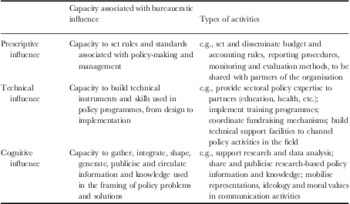
The influence of international administrations may also be characterised using three analytical perspectives.Footnote 6
The first lens is prescriptive influence, a capacity to elaborate regulatory rules and norms with an impact on policy-building processes, policy instruments and management rules. This influence has both a legal and a bureaucratic dimension: it is associated with the capacity to prepare, influence or implement legal regulations endorsed by decision-making bodies (such as executive entities) and to develop the standard procedures and formal rules followed by partners; it is also connected to the capacity to shape informal rules, practical solutions and routines to be used in organisational cooperation and the establishing of agreements.
Since international administrations cannot take binding decisions, the prescriptive influence strongly depends on their legitimacy in the international environment. High legitimacy strengthens the administration's authorityFootnote 7 and, consequently, its autonomy. It results both from the past activities of the administration, if shown to be well performed, and from the political support provided by state actors. In this regard, both the performance of the response to development policy issues on the one hand (“bureaucratic legitimacy”), and the greater political support provided by influential governments on the other hand (“political legitimacy”), may contribute to expand a bureaucracy's capacity to influence other organisations in its environment. In a seminal article, DiMaggio and Powell (Reference DiMaggio and Powell1983) argued that norms and procedures established by an organisation may be reproduced by another organisation if the activities of the first one are perceived as efficient and/or legitimate by the second one.
Yet another lens focuses on the technical influence of international administrations that results from the development of specific technical instruments and skills by which the administration increases its capacity to assist policy actors to establish agreements, design programmes and implement decisions. This influence increases when a bureaucracy has the capacity to shape policy tools and expertise that can be shared with a large number of partners and recipients of public policies (e.g., other administrations, political authorities, non-state actors and local populations, among others). It can relate to activities at several levels: international (e.g., fund-raising mechanisms), regional (e.g., support facilities) and national (e.g., technical assistance to operational actors in the field).
Technical influence is strongly associated with the performance of international administrations. It usually depends on their capacity to exercise control over coordination procedures, funding instruments, field-based interventions and recruitment of policy experts who may handle programme activities. It is therefore associated with the capacity to mobilise human and financial resources. For instance, the ability of international financial institutions to extend their influence over national economic strategies in developing countries results both from their control over funding mechanisms for development (loans, debt relief and financial aid) and from their numerous experts who provide technical assistance to state and non-state actors at the country level.
The last lens refers to the cognitive influence of international bureaucracies, described as the capacity to gather, integrate, shape, publicise and circulate information and knowledgeFootnote 8 used in international public policies. This intellectual activity is not limited to an “import/export” activity, which would consist of collecting relevant ideas in policy forums and then disseminating them to policy actors situated in various settings or jurisdictions.Footnote 9 It is also not restricted to elaborating “new ideas” that could be influential. To a great extent, it is the capacity to select some ideas based on scientific studies and field experimentation, and to reshape them in a way that makes sense for a large number of actors and can be accepted by organisations that have different interests, do not support the same policy priorities and do not share the same norms and beliefs. Finally, it refers to the capacity to frame policies by contributing to the identification of “policy problems” and the definition of “policy solutions” that will be selected on the public agenda thereafter.Footnote 10
Max Weber considered knowledge control to be a critical element of bureaucratic authority, and many researchers on international institutions have further developed this particular point (Haas, Reference Haas1992; Keohane and Martin, Reference Keohane and Martin1995; Martin and Simmons, Reference Martin and Simmons1998; Barnett and Finnemore, Reference Barnett and Finnemore2004; Venske, Reference Venske2008; De Wett, Reference De Wet2008). This view is rooted in the fact that many international administrations – UN administrations in particular – concentrate on developing ideas, norms and guidance because of the low enforceability of international public regulation. Unlike national legislation, which is binding, the enforcement of international laws depends to a great extent on the willingness of national authorities and on the views and beliefs of the many partners involved in each country.
The link between knowledge and bureaucratic authority can also be explained by examining the main characteristics of international organisations. One of the core aspects of the UN mandate is to elaborate and disseminate policy guidance in order to encourage national governments to go beyond their self-interest and build international consensus on key development issues (Marcussen, Reference Marcussen2004). UN organisations are meant to contribute to the political recognition of “common goods”, help governments to identify collective policy goals and agree on priorities, and support the development of policy rules and instruments to help implement international agreements. Despite their limited financial capacities and competing intellectual activities from non-state actors,Footnote 11 international administrations may succeed in circulating policy ideas if they are empowered with substantial legitimacy – a clear mandate, given by influential states, to act as facilitator in a particular field of activity – and if there is a significant political will to support multilateral mechanisms.
Influence of international bureaucracies

These three dimensions of bureaucratic influence should be viewed as Weberian “ideal types”. In real-world contexts, they are interdependent and often mutually reinforcing. Administrations’ cognitive influence is associated with their technical influence, as policy instruments are based on specific policy-relevant information and expert knowledge. Cognitive influence also combines with prescriptive influence, as the capacity to disseminate ideas is associated with the ability to implement standard rules for partnership. In sum, the capacity of international administrations to enforce collective rules and make some technical instruments more legitimate than others increases with the ability to control information and knowledge. Such control can bolster the influence of a public organisation over regulations that stabilise a particular governance system, and over policy instruments.
Policy transfer, ideas and interests
The literature on policy transfer provides a valuable analytical framework for the analysis of activities through which international administrations expand their influence in their direct environment.
Studies on policy transfer usually concentrate on actors, configurations and processes through which policy priorities and instruments, organisational standards and institutional patterns can be transferred from one jurisdiction (e.g., a country, a sector, an organisational field, a level of government, a political setting, a scientific discipline) to (an)other(s). The policy transfer literature examines various processes such as policy diffusion, copying, imitation, learning, convergence, transplantation and adaptation (Evans and Davies, Reference Evans and Davies1999; Stone, Reference Stone1999; Dolowitz and Marsh, Reference Dolowitz and Marsh2000; De Jong, Lalenis and Mamadouh, Reference De Jong, Lalenis and Mamadouh2008). It also deals with a variety of research objects: ideas, values, shared norms and interpretations, ideologies, policy frames, policy goals and objectives, information, knowledge, expertise, scientific paradigms, social representations, schemata and meanings, as well as management rules, policy instruments, decision-making, monitoring and evaluation procedures, and institutional practices, roles and routines.Footnote 12
The policy transfer approach may generate various analytical models that should not be confused. For example, “policy diffusion” and “convergence” perspectives lay the emphasis on cross-national processes through which policy goals, procedures and instruments can be conveyed beyond national borders (McAdam and Rush, Reference McAdam and Rush1993; Common, 1998; Radaelli, Reference Radaelli2000). New institutionalist studies concentrate on transfer processes by focusing on organisational processes that ensure the dominance of some institutional models (values, policy-oriented beliefs, routines, standard procedures, roles and patterns of behaviour, among others) and may result in “isomorphic processes” among organisations (DiMaggio and Powell, Reference DiMaggio and Powell1983; Meyer and Scott, Reference Meyer and Scott1992; Scott and Christensen, Reference Scott and Christensen1995). Such approaches lay emphasis on the adaptations and adjustments by which policy ideas circulate from one setting to others. They have the advantage of identifying “patterns” of policy transfer through holistic approaches concentrating primarily on structural factors and on macrosocial processes associated with the diffusion of policy standards and ideas. Nevertheless, they may underestimate the role of actors and the dynamics of power involved in transfer processes, and therefore contribute to an understanding of policy transfer as the result of apolitical and neutral processes (Peters, Reference Peters1997).
In contrast, other approaches examine the transfer of norms and ideas through interests, rational behaviours and power distribution among actors involved in public organisations and policy networks (Mintrom, Reference Mintrom1997; Finnemore and Sikkink, Reference Finnemore and Sikkink1998; Ladi, Reference Ladi2000; Dezalay and Garth, Reference Dezalay and Garth2002). They may thus concentrate, for example, on “lesson drawing” (Rose, 1991), “policy learning” (Bennett and Howlett, Reference Bennett and Howlett1992), and “norm localization” (Acharya, Reference Acharya2004). They show that transfers encompass voluntary processes and rational behaviours, are associated with different types of inducements and opportunities and also express forms of coercion (Dolowitz and Marsh, Reference Dolowitz and Marsh1996). They direct us towards an examination of intentions and motivations of the various actors involved in the production and dissemination of ideas (Wolman and Page, Reference Wolman and Page2002). These perspectives complement the new institutionalist approach to organisations – which builds on the premise that organisations frequently “import” ideas, objectives, rules, procedures and routines present in their environment, but hardly explains how this may occur – and the diffusionist approach – which concentrates on macro-level analysis of imitation and adaptation processes, but does not pay much attention to the micro- and meso-levels. For example, perspectives focusing on interest may look into the role of experts who seek, within organisations, to disseminate management rules that may appear more efficient or more legitimate (e.g., task teams in charge of management reforms, departments of human resources and internal oversight services). They may also pay attention to transactional actors positioned at the crossroads of different settings (e.g., organisations, policy fields, countries and international regimes), whether they are individuals (e.g., diplomats, international experts, consultants or officers working in national inter-ministerial bodies) or organisational units (e.g., regulatory agencies, international secretariats and think tanks).
The second section of this paper draws on the latter approach. It explores the activities by which the UNAIDS Secretariat has expanded its cognitive influence within the UN system by becoming increasingly involved in transferring policy ideas on AIDS. Many terms might describe what the Secretariat is doing in accordance with its mandate: facilitating, brokering, liaising, networking, coordinating, intermediating, conveying ideas, building bridges, disseminating, diffusing, relaying, integrating, merging and mainstreaming. Each term refers to a specific type of work, but they all relate to two broad sets of activities: firstly, establishing agreements among policy actors driven by self-interest (interest brokering); and secondly, shaping common understandings and shared perceptions regarding policy issues (idea brokering).Footnote 13 These two sets of activities rely on the ability to bring various actors together, strengthen cooperation and partnership, circulate information and knowledge, and help develop acceptable solutions for setting up institutional rules and matching policy priorities.
Following the policy transfer approach as a way to study bureaucratic influence, this paper argues that the UNAIDS Secretariat has been acting as a “policy entrepreneur” within the UN system. In the literature on public policy, this term refers to any individual or unit who develops the capacity to convey, introduce and implement innovative ideas into public organisations or into a public policy network (Kingdon, Reference Kingdon1984; Roberts and King, Reference Roberts and King1991; Weissert, Reference Weissert1991; McCown, Reference McCown2005). It can therefore be associated with the notion of “knowledge broker”, “idea broker” or “norm entrepreneur”. The following discussion argues that the UNAIDS Secretariat, while originally dedicated to restricted tasks, has moved beyond its official mandate and played a critical role in the spreading of policy ideas within the UN system.
Information and knowledge as a resource for bureaucratic influence: the case of the UNAIDS Secretariat
This section focuses on the contribution of the UNAIDS Secretariat to the collection, integration and dissemination of policy-relevant information and knowledge likely to be of use to the UN response to the AIDS epidemic. The following analysis first concentrates on the capacity of UN administrations to participate in the circulation of policy ideas in the field of development assistance (1.) and presents the UNAIDS programme as a multi-organisational system (2.). It then provides three empirical insights into the extension of the Secretariat's cognitive influence within the UN. It shows that: the Secretariat has been collecting and making available data and qualitative information that informs the UN programmes on AIDS (3.); it has actively contributed to redesigning the UNAIDS strategic framework by encouraging UN agencies to align their goals and priorities (4.); and it has also supported some emerging policy ideas so as to add them to the UN response to AIDS (5.).
1. The UN and the dissemination of policy ideas on development
To a large extent, the influence of the UN system can be assessed through its capacity to develop or at least to convey and circulate innovative ideas that are relevant to international policies regarding peace, security and development. In addition to funding or implementing operational support activities, UN organisations devote significant resources to producing expert knowledge and guiding values that may help to build consensus on policy options and shape international conventions or national policies in the field of development. This activity results from their model of legitimacy: as multilateral organisations, they are mandated to develop policy guidelines that correspond to universal values, which transcend individual state interests. However, this activity is also linked to the type of resources they can mobilise at the international level. With the notable exception of international financial institutions (such as the IMF and World Bank), most international organisations lack the financial capacities that could serve as incentives to encourage national governments to enforce their recommendations; they lack binding legal instruments to compel compliance with international conventions; and finally, their work is largely confined to pleading and advocating, with a view to persuading state and non-state actors to adapt their strategies and their practices in ways that meet international policy standards.
Within their field of intervention, all UN bodies – from the Secretariat General, the General Assembly and the Economic and Social Council (ECOSOC) to specialised agencies, programmes and funds – actively elaborate and circulate policy-relevant knowledge and information. This is true for institutions that are mandated with providing an intellectual contribution to peace and development (such as UNESCO) and those tasked with promoting normative guidance and international standards (such as WHO or ILO). But it is also true for technical agencies (such as UNDP) and operational organisations (such as WFP or UNHCR). It is even true for the World Bank, which dedicates major resources to carrying out studies, reports and guidelines in various fields of expertise, in addition to its funding activities. Thus, ideally, international organisations should be highly responsive to emerging issues regarding development challenges and serve as an “epistemic community” equipping other actors with universal norms, standards and scientific knowledge. Ernst B. Haas argued that international organisations are important “innovators” in international life, as learning institutions that demonstrate a capacity to adapt their methods for defining problems and subsequently to produce “consensual knowledge” for international policies (Haas, Reference Haas1992). Various observations during the last two decades may lead to a less optimistic view than that of Haas on the role of international organisations as innovators. In various policy fields, state and non-state actors developed critical ideas before they were appropriated and adapted by UN organisations. For instance, many policy norms and principles associated with environmental protection, human rights, gender issues and the fight against HIV/AIDS have been discussed in various political, scientific and community-based forums before being put on the agenda of international organisations (Park, 2005).
Three factors may explain the potential lack of innovative ideas in the multilateral system. Firstly, UN organisations are intergovernmental bodies in which only consensual knowledge is promoted. Controversial issues, despite being crucial for ensuring an efficient response to development challenges, are frequently censored by UN experts if they are likely to be rejected by a coalition of member states. Secondly, UN organisations are driven by bureaucracies confronted with compartmentalisation, complex decision-making procedures and sometimes internal competition, which may impede knowledge innovation. Thirdly, the field of development has become much more complex than it was in the early 1990s. UN organisations are operating in an international environment that is composed of interconnected global public policy networks bringing together state and non-state actors (Reinicke and Deng, Reference Reinicke and Deng2000). There are therefore many more actors contributing to the production of ideas, including NGOs, universities, civil society organisations (CSOs), think tanks, foundations and even the private sector, as well as globalised epistemic communities and transnational advocacy coalitions. In this new global landscape, UN organisations do not have the capacity to act as spearheads in the production of knowledge. They are reflective organisations among many others.
Although the role of multilateral organisations in the transfer of policy ideas on development assistance is uneven and challenged by non-state actors, expectations towards the UN have been very high in the field of HIV and AIDS since the mid-1990s. The many actors involved in the global governance of AIDS (including coalitions of activists and NGOs) have exerted great pressure on UNAIDS to create the conditions for international and national partners to converge towards a common understanding of policy priorities – while governments of the North have long been accused of not mobilising the level of resources needed to respond to the massive expansion of the epidemic in poor countries. Such a focus on the involvement of the UN in the production of policy ideas about AIDS also stems from the specificity of the epidemic, which requires paying special attention to information, education and communication (IEC) strategies to prevent the epidemic. Finally, at the same time, “advocacy campaigns” bringing together UN agencies, scientific communities and advocacy groups have also been strategic for involving national political elites and development partners who may have been reluctant to scale up the response to AIDS, or who have even been promoting ideological campaigns that hamper international efforts. In this context, the role of UN administrations is considered as key in collecting and disseminating AIDS-related policy standards, norms and knowledge based on scientific evidence and grounded in human rights. This is their core activity.
2. UNAIDS, a multi-organisational platform for policy convergence
The UNAIDS programme is a unique partnership mechanism within the UN system. Following a decision of the ECOSOC (1994), UNAIDS was launched in 1996. To a large extent, this creation resulted from the failure of WHO, in the early 1990s, to fulfil its ambition to lead a global partnership programme to respond to AIDS in association with other UN agencies (Lisk, Reference Lisk2010). Since 1996, UNAIDS has brought together the efforts and resources of UN organisations involved in the response to the epidemic.Footnote 14 Today, the ten members have the status of “cosponsoring organisations”, better known as “cosponsors”. They are supported by a secretariat whose task is to provide technical and administrative assistance to the cosponsors so they can coordinate their programmes on AIDS. UNAIDS operates under the authority of an executive board, which brings together 22 member states, the cosponsors and five representatives of NGOs, including associations of people living with HIV. Its budget reached US$484.8 million for 2008–2009 and has been kept flat for 2010–2011.Footnote 15
The global mission of UNAIDS is to lead a comprehensive response to the epidemic. It is to sustain care and support programmes for affected populations, and to assist national authorities in strategies aiming at mitigating the vulnerability to HIV and at alleviating the socioeconomic and human impacts of AIDS. Its mandate is twofold. On the one hand, UNAIDS operates as a global platform whose function is to bolster international cooperation and sustain policy dialogue. Thus, it aims to build partnerships with CSOs, NGOs, the media and the private sector, whose ideas and resources are strategic for ensuring efficient responses to AIDS. On the other hand, as a cosponsored programme, UNAIDS was also established with a view to improving the internal governance of the UN system. The programme functions as a cluster mechanism, assigned to strengthen inter-organisational collaboration among cosponsors. Therefore, within the UN, it is expected to ensure a convergence of policy goals, facilitate agreements on joint UN procedures and work practices, elaborate common tools and instruments, share knowledge and technical expertise, speak “with one voice” and, finally, jointly deliver at the country level. The programme challenges the cosponsors to work together, despite their administrations being complex organisational systems that are driven by their own norms, ideals and agendas, specific knowledge and technical expertise, and distinct internal management procedures and bureaucratic routines. The programme also aims to reduce competition in fundraising, fragmentation in decision-making and the overlap and duplication of provision of UN assistance to governments and key stakeholders.
To a great extent, the UNAIDS programme is a good example of the institutional reforms undertaken by the UN Secretariat since the mid-1990s to improve the UN governance mechanisms in the field of development. It provides a key illustration of the current restructuring efforts within the UN system to harmonise the programmes of the various UN bodies and improve coordination of their activities in the field (Nay, Reference Nay2011).
Like any small-size coordination body set up to support an international programme, the UNAIDS Secretariat has never had the political legitimacy, technical expertise or financial capacity to build leadership on policy development in the field of HIV/AIDS. As an interagency structure, it is mandated to assist the ten cosponsors in their effort to share knowledge, coordinate their action and identify policy priorities to be combined in the UNAIDS programme. According to its mandate, the Secretariat's mission is to act as a facilitator. It is required to support the cosponsors’ programmes on AIDS (UNHCR focusing on refugees, WHO on treatment delivery, UNICEF on orphans and mother-to-child transmission, WFP on AIDS and malnutrition, UNESCO on HIV prevention in educational settings, among others). It is not expected to replace them.
During the first years of the UNAIDS programme, the Secretariat kept a low profile as a coordination body. At the top-management level, it created the practical conditions for a policy dialogue between executive directors of UN agencies on the various aspects of the global response to the epidemic. But, at a technical level, its activity hardly provided any opportunity to induce cosponsors to build joint activities. Not only did the Secretariat have limited financial resources to fulfil this task,Footnote 16 but it also had to deal with the weak commitment of cosponsors’ executive teams before the early 2000s. To a great extent, the Secretariat's normative activities were restricted to collecting information on each cosponsor's programme, and to formalising a workplan and some policy documents (resolutions, guidance notes and reports) presented after the fact as a “Joint UN Programme”. The Secretariat's capacity to influence the cosponsors to develop technical partnerships, establish joint management rules, match cosponsors’ policy objectives or flag new AIDS-related policy issues remained exceptionally low.
Three sets of factors have played a part in the gradual growth of the Secretariat's authority within the UNAIDS system since the early 2000s. Firstly, growing pressure from the member states of UNAIDS – including donor states such as the United Kingdom, Canada or the Scandinavian states – has provided important symbolic resources for the Secretariat in its attempts to urge the cosponsors to move towards a more integrated UNAIDS programme. In 2000, the inclusion of the fight against HIV/AIDS in the Millennium Development Goals (MDGs), and subsequently, in 2001, the UN General Assembly's commitment to engage a massive response to the epidemic, gave greater responsibility and visibility to UNAIDS at the global level, and therefore higher pressure on the cosponsors. However, in the context of global high-level meetings on aid effectivenessFootnote 17 (2002–2005), some governments of OECD countries expressed strong criticisms about the deficit of multilateral coordination and the low policy results of the UN in the fight against AIDS. These criticisms weakened the credit of the cosponsors, which have been under scrutiny ever since (Kohlmorgen, Reference Kohlmorgen2007). But at the same time, they gave the Secretariat a greater legitimacy to push efforts towards new management standards within UNAIDS – such as pooling resources, undertaking joint programming, establishing common databases and knowledge networks, coordinating efforts in the provision of technical support, setting joint budgeting and accounting procedures, evaluating results and aligning UN policies to governmental plans (Nay, Reference Nay2011).
Secondly, greater participation of the Secretariat in the policy development of the UNAIDS programme also results from internal dynamics, including the choice of its executive team to expand intellectual activities in the early 2000s. Since the start of the programme, part of the mission assigned to the Secretariat has been to bring together cosponsors and build interagency partnerships, with the aim of encouraging a policy dialogue on AIDS. The Secretariat has thus been collecting factual data, significant ideas and contributions from various AIDS actors. It has published an annual report and a series of case studies assessing the relevance and impact of global, regional and national responses to the epidemic. By focusing and communicating on the trends of the epidemic, on country-led policy implementation experiences, as well as on global governance issues, it has contributed to the flow of information and knowledge that may come to be incorporated incrementally into the UNAIDS programme.Footnote 18 In these processes, the Secretariat's experts have a comparative advantage associated with their position within the UNAIDS architecture. They serve as liaison officers among cosponsors. They play a crucial role in information dissemination within UNAIDS, since they are in charge of the preparation of all the technical documents submitted to the executive board and finalisation of public materials released under UNAIDS auspices. They are at the heart of organisational routines and procedures. They also control the “backstage information” with which most actors develop their expectations and strategies. This capacity to collect, combine and circulate information and requests among UNAIDS partners is key, since they can filter the various inputs coming from cosponsors, member states and CSOs. Under the cover of coordinating and combining cosponsors’ strategies, the Secretariat's experts can shape some policy options of the UNAIDS programme by introducing inputs into substantive discussions at all levels.
Lastly, the Secretariat has never faced the same institutional regulations as the cosponsors. It has to report to a small-size executive board whose policy agenda concentrates only on AIDS. Conversely, most of the cosponsors are large UN entities that have to bring on board various “in-house” sectors and departments, which have their own agenda and are not bound to be involved in the response to AIDS. Moreover, their executive boards and plenary assemblies deal with a wide variety of objectives and are usually involved in longer and more complex endorsement procedures. In this context, the Secretariat can react more quickly to emerging inputs on AIDS and can therefore play a proactive role within UNAIDS.
The involvement of the UNAIDS Secretariat in the transfer of policy ideas on AIDS suggests that international secretariats cannot be conceived only as agents dependent on their executive board's decisions, but are also policy entrepreneurs that can gain in influence by taking part in the collection and dissemination of policy information and knowledge. The following discussion explores three different aspects of such cognitive influence.
3. Influence through dissemination of expert knowledge and scientific information
Over time, the Secretariat has developed a research capacity and built expert knowledge about trends in the epidemic. Although it does not have the capacity to perform in-depth research, it has succeeded in establishing an effective system for collecting, compiling, analysing and updating information on HIV/AIDS. It has pulled together numerous data collections and much policy-relevant knowledge from civil society, universities, private research institutes, national statistics institutes, other international organisations and the private sector. It has thus acquired greater intellectual influence on two levels: socio-demographic and economic projections on the evolution of the epidemic worldwide, and qualitative analysis of key policy results drawn from national programmes and grass-roots projects on prevention, treatment, care and support. The Secretariat has one of the most sophisticated data banks on the epidemic, and its annual report on the global AIDS epidemic provides data and projections that are used by most actors and stakeholders working on AIDS. It also publishes various reports, policy guidelines, abstracts and documents. It has been particularly active in developing partnerships with scientific networks and advocacy coalition (AIDS activists’ organisations, networks of people living with HIV, community leaders and associations representing vulnerable populations), which are pressing on the UN system to develop innovative responses to AIDS. The incorporation of civil society inputs has contributed to the introduction of ideas about grass-roots experiences into the UNAIDS programme, such as the issue of HIV/AIDS-related stigma and discrimination and the need for more inclusiveness of people living with HIV.
Through these activities, the Secretariat accumulates policy inputs emerging from experiences and actors in the field, with the goal of building up a corpus of evidence-based, innovative knowledge to serve as general guidance for all stakeholders, including the cosponsors. It thus contributes to the transfer of scientific information about successful country-led programmes. Of course, each of the UN agencies contributes in its own field of expertise (e.g., UNICEF on orphans and vulnerable children, WHO on HIV treatment, UNFPA on condom programming, UNODC on injecting drug users, UNESCO on HIV education). They consolidate data and disseminate policy ideas from their own constituencies. However, the Secretariat has made this catalyst role the core of its intellectual activities.
The expert knowledge assembled by the Secretariat might fuel reluctance of some cosponsors, as many of the Secretariat's case studies and data collections are done in policy fields already covered by the cosponsors. To avoid tensions, the Secretariat experts have always ensured that UNAIDS documents are jointly published when they fall under the mandate of a UN agency. Many information and guidance materials have thus been presented as a result of “interagency activities”.Footnote 19 In general, due to its fragile institutional legitimacy compared to well-established UN agencies or national institutions working on AIDS, the Secretariat has always considered establishing “intellectual coalitions” that could help reach consensus on policy results among a large number of partners as its favoured option – mostly with other international organisations, bilateral aid agencies, international NGOs, universities, foundations, advocacy groups and the private sector. Hence, it took advantage of the establishment of “UNAIDS Reference Groups”Footnote 20 bringing together actors from various horizons (UN specialists, academics, experts from national research institutes, foundations, NGOs and governmental organisations) in order to build its legitimacy as a brokering institution.
4. Influence through definition of policy problems and solutions
Agenda setting is a competitive process in which all policy actors and stakeholders seek to frame “policy problems” and to influence the identification of appropriate “solutions” to these problems. It is a social construction that has an important cognitive and normative dimension, those involved in the policy field regularly seeking to control the perceptions of the problems so as to impose their views, values and interests when it comes to defining policy solutions. In this perspective, the agenda-setting process goes with a competitive circulation of ideas, which mobilises the various state and non-state actors involved in the same public policy networks.
Although no actor has complete control on the normative and intellectual exchange that lead to the emergence of policy problems and solutions, one should not underestimate the role of policy entrepreneurs whose intention is to control the definition of policy problems in order to influence the public agenda. In the case of UNAIDS, the growing participation of the Secretariat in the definition of the programme since the mid-2000s demonstrates that it has become a key policy actor in the UN system, albeit its cognitive influence was regularly and openly contested by the cosponsors. One critical aspect of its involvement in policy development is associated with its growing capacity to influence policy dialogue and to frame the perception of social, economic and political problems related to AIDS. In particular, it has endeavoured to bring out some policy issues that could reduce cognitive dissonance among UN programmes, and subsequently could be endorsed and shared among cosponsors. UNAIDS experts did this framing effort through emphasising the “multidimensional” aspect of AIDS.
The Secretariat was not the first organisation to promote a multidimensional policy approach to the epidemic. This approach has been supported by NGOs and CSOs in the field of AIDS since the early 1990s. It was also suggested by the executive board of UNAIDS as early as 1995, without much impact on the cosponsors’ individual programmes. The UN General Assembly reiterated this objective in 2001. The argument stems from evidence-based observations: scattered and sectoral projects on AIDS usually lead to ineffective and costly solutions at country level. In contrast, comprehensive and coordinated programmes that articulate the various aspects of the response to the epidemic (epidemiological, medical, economic, financial, political, social and cultural) are likely to lead to more coherent and more effective AIDS policies (Whiteside, Reference Whiteside2007). Along the same lines, prevention, care, support, and treatment are mutually reinforcing elements and should be integrated at all levels, from community-based projects to international policies. In a nutshell, such a perspective frames the debate on AIDS: policy problems associated with the epidemic are multidimensional; therefore, policy solutions should be multisectoral.
Nevertheless, the fragmentation of the UN bureaucratic system, the lack of transversal coordination and communication within UNAIDS, as well as competition between the UN agencies were key factors that prevented the cosponsors from moving towards a multisectoral approach to AIDS. Conversely, as a coordinating body, the Secretariat was the only UNAIDS organisation that actively promoted a joint definition of AIDS-related priority issues, which originally appeared disconnected in the individual plans of cosponsors. In the early 2000s, the Secretariat's experts started promoting, within UNAIDS and to various governments and stakeholders, the urgent need for a multisectoral approach that would overcome the discrepancies between the cosponsors’ specific programmes. It regularly had to dispute the cosponsors’ inclination to launch separate initiatives and to uphold specific priorities that were liable to be dissociated: WHO on treatment access, UNICEF on childhood and maternity, UNESCO on formal education, UNFPA on prevention among vulnerable populations, and WFP on nutrition programmes, among others. While the cosponsors concentrated on technical support for policy sectors covered by their mandates, the Secretariat engaged in an important normative activity by encouraging the incorporation of sectoral initiatives into an overall UNAIDS strategic framework. The first successful attempt of the Secretariat was its effort to bring back a WHO global initiative on treatment access into the UNAIDS programme.Footnote 21 Since the mid-2000s, the Secretariat has also concentrated its efforts on the need for aligning cosponsors’ strategies for HIV prevention, which embrace a diversity of activities (communication, education plans, health care and social services, among others). The proactive role of the Secretariat on this aspect of HIV response resulted in the official recognition of its policy jurisdiction on the “overall policy, monitoring, and coordination on prevention” in 2005.
The same year, strengthened by the recommendations made by a high-level group of leaders (UNAIDS, 2005), by the G8 (2005 Gleneagles Summit) and by the UN General Assembly (2005 World Summit), the Secretariat gained greater legitimacy to push cosponsors to align their strategies on consensual cross-cutting objectives. Technical meetings set up by the Secretariat led to the definition of 16 “principal results” for the programme and 49 “key results” for individual cosponsors, which were used as the basis for implementing new results-based monitoring and evaluation procedures. By the end, the entire internal management of UNAIDS had been modified: the Secretariat no longer develops the UNAIDS programme as a compiling of the cosponsors’ individual plans; now it is the cosponsors’ responsibility to prove their capacity to align their own AIDS strategies with the UNAIDS programme.
5. Influence through importation of innovative ideas within the bureaucratic system
International administrations work under the pressure of their environment. While they are requested to identify specific solutions and build public standards that can be endorsed by their member states, international administrations also reappropriate ideas that circulate in public policy networks and discussion forums involving a wide variety of actors from civil society to the private sector. To some extent, their normative activity involves selecting and filtering policy issues in their environment to fuel the debate in the public sphere and help identify key issues likely to improve public policies. International administrations also face strategies of influence and intrusion of non-state actors who attempt to spread their ideas in public arenas through advocacy, lobbying and intellectual partnerships.
In the global AIDS governance, UN bureaucracies face pressure from activists’ organisations, international NGOs and scientific networks that call for innovative, responsive and large-scale action on AIDS. The response to the epidemic had always been subject to very sharp controversies about the most appropriate choices to operate effectively against AIDS. Since the 1990s, the UN system has been subjected to strong criticisms, firstly because of the strategies of resistance of many state delegations who refused to take in the full extent the AIDS challenge in developing countries, and secondly because of the low responsiveness of international administrations facing the spread of the epidemic, due to inefficient bureaucratic mechanisms and highly politicised decision-making procedures.
Although the Secretariat's experts have never been tasked with developing their own individual programme activities, they have demonstrated the capacity to import and introduce policy ideas in UNAIDS that proved to be critical in the global response to AIDS. They took advantage of the dual mandate of the Secretariat to achieve this brokering activity. On the one hand, the Secretariat is mandated to strengthen broad-based partnerships with advocacy groups, the medias and the private sector to promote global consensus on AIDS policies, and to support political and social mobilisation within countries. Through its office of partnerships and external relations, it has been involved in various advocacy campaigns and intellectual collaborations involving networks of NGOs and activist organisations.Footnote 22 On the other hand, within UNAIDS, the Secretariat is also mandated to help the cosponsors elaborate a joint UN programme that includes all critical aspects of the response. Through combining these two external and internal activities, the Secretariat's experts managed to seize the exposure of the UN to the pressure from non-state actors as a window of opportunity to capture and select some critical ideas circulating in global policy forums and networks, to reshape them in appropriate terms and, finally, to convey and disseminate them among the community of cosponsors.
The role of idea broker of Secretariat's experts has been twofold since the early 2000s. They have mobilised emerging policy ideas liable to improve the quality of the global response to the epidemic (e.g., the need to connect prevention and treatment strategies) and assembled ideas not properly addressed by governments or international organisations (e.g., the risk of stigma and discrimination). In particular, they have raised neglected issues that did not clearly fall under the mandate of the cosponsors or that were considered politically sensitive. They have therefore developed some new “programmatic niches” for which the Secretariat has become the main UN player.
The campaign on women and AIDS is a significant example. In the early 2000s, more and more evidence appeared on the particular vulnerability of young women and girls to the epidemic in sub-Saharan Africa. As no UNAIDS cosponsor had a specific mandate for the protection and promotion of women's rights, the Secretariat raised the question by publishing research studies on women and AIDS, participating in media campaigns and helping to build networks of women's organisations such as the Global Coalition on Women and AIDS in 2004.
Early on, the Secretariat experts also took the initiative to support the need to deal with the epidemic in the context of security, personnel in uniform and emergency settings. They seized the opportunity of a meeting of the UN Security Council on AIDS and security (2000) to initiate a discussion within UNAIDS and to start collecting data and survey results. As none of the cosponsors had a mandate in the field of security, the Secretariat was then officially recognised as a “lead organisation” in the 2005 Division of Labour, which describes the tasks of UNAIDS members in specialised areas of technical support.
The Secretariat experts have also actively participated in the incorporation of “cross-cutting” policy issues in the UNAIDS programme, which have been insufficiently tackled by cosponsors even though they have been proved to be essential to successful response to the epidemic. For instance, the Secretariat took an active part within UNAIDS in policy development with respect to the need to incorporate the fight against stigma and discrimination as a core element of national AIDS programmes. It has also advocated among UNAIDS partners for incorporating new approaches grounded in human rights into all UN programmes and national responses against AIDS.
The Secretariat has contributed to the dissemination of sensitive issues mishandled by some governments, for inappropriate reasons (political, electoral, moral, religious and cultural, or essentially financial) that were – and still are – strong barriers to an effective response. For instance, in the early 2000s the Secretariat introduced within UNAIDS the call by NGOs to combat the “AIDS denial” on the part of many governments who were underestimating the course of the epidemic. It has built some advocacy partnerships with NGOs, supported social movements and participated in media campaigns drawing attention to the need for strong political leadership on AIDS. It has also supported the idea of developing evidence-informed programmes to address sensitive issues in countries where these have not been appropriately addressed (e.g., sexual and reproductive health, the use of drugs, HIV in prisons). The Secretariat conveyed the call to promote inclusive programmes on AIDS that encourage youth participation, the role of CSOs and communities, and the greater involvement of people whose vulnerability to HIV infection is increased by social and economic factors (e.g., social discrimination, violence, unemployment, poverty, lack of education, poor access to health services). They have been instrumental in incorporating “people living with HIV” and other “vulnerable populations” as priority groups in the UN response to the epidemic (e.g., sex workers, injecting drug users, male homosexuals, women and girls, vulnerable children, migrants, transient workers, refugees and displaced persons, indigenous people, rural communities, prisoners, personnel in uniform, sex workers’ clients, street children and child soldiers). Through this cognitive influence, the Secretariat contributed to some extent to the recognition of the role of coalitions of NGOs and networks of people living with HIV by the cosponsors (e.g., GNP+, International Community of Women Living with HIV/AIDS).
The Secretariat has therefore contributed to two shifts in policy development within UNAIDS. The first shift is the development of a comprehensive and multidimensional approach that connects and merges the many aspects of the response to the epidemic. This change required breaking down the resistance of cosponsors keen to preserve their individual activities from external coordination and control. The second shift is the inclusion of new policy areas and cross-cutting issues within the UNAIDS programme. In the last ten years, most cosponsors have enclosed critical issues in their own plan, such as the fight against political denial, the questions of human rights and gender discrimination, and the requirement to address the specific needs of vulnerable and marginalised populations. These many examples illustrate the growing capacity of the Secretariat to work as an idea broker between various policy forums where these innovative issues came out (comprising NGOs, advocacy coalitions, and scientific networks) and the community of cosponsors.
Conclusions
The study of policy transfer within UNAIDS suggests that some international administrations may gain in influence through engaging in the sphere of ideas. Even though the analysis of entrepreneurial activities should not lead to a “heroic” picture of transfer entrepreneurs, the case of UNAIDS provides useful insights to understand the relationship between bureaucratic authority on the one hand, and the capacity to collect, build and spread policy-relevant information and expert knowledge on the other hand. Moreover, the analysis draws attention to the interdependency of ideas, institutions and interest. It shows that policy transfer is associated with the activity of policy entrepreneurs who mobilise resources and develop proactive strategies to expand their influence in their environment. Such an approach to policy transfer encourages taking into account the rational behaviours of top-level managers and senior policy experts within bureaucratic organisations. It is an invitation to pay greater attention to interests, power distribution, anticipations and strategies in order to explain the spread of ideas within bureaucratic systems.