Introduction
While there is a consensus that democratic regimes abstain from fighting wars against each other (MacMillan, Reference MacMillan2004), current research explores the causes of liberal wars and the variance in the use of force among democracies (see Geis et al., Reference Geis, Müller and Schörnig2013; Hegre, Reference Hegre2014; Müller, Reference Müller2014; Poznansky, Reference Poznansky2015). The legislative branch plays a central role in the logic of democratic peace theory and the domestic legitimization of liberal wars. Against this backdrop, scholars have started to analyze the role of legislatures in foreign and security policy more systematically by making use of comparative approaches and methods (Dieterich et al., Reference Dieterich, Hummel and Marschall2015; Kaarbo and Kenealy, Reference Kaarbo and Kenealy2017; Raunio and Wagner, Reference Raunio and Wagner2017; Mello and Peters, Reference Mello and Peters2018).
Our article contributes to the burgeoning literature by investigating the example of the US Congress drawing on both International Relations (IR) research and traditional US war powers studies. For the topic of parliamentary war powers, US Congress constitutes a highly relevant case: the only remaining global ‘superpower’ continues to rely on the use of force and Congress frequently clashes with the president over the issues of war powers and intervention policies. In this article, we therefore ask under which conditions members of Congress (MoC) assert themselves against the president in the politics of military interventions.
Previous research on US war powers focused on the influence of the president’s party power in Congress, divided government (Kriner, Reference Kriner2010), specific institutional norms (Weissman, Reference Weissman1995), or public opinion (Hildebrandt et al., Reference Hildebrandt, Hillebrecht, Holm and Pevehouse2013). In contrast, this article highlights the role of national security interests in conjunction with other domestic factors such as public opinion, divided government, and casualties for congressional response. Our research adds to the literature by providing a nuanced picture of executive–legislative relations regarding military interventions, which acknowledges that congressional actions exceed legally binding ex-ante authorization of wars, that is traditional war powers (see Mello and Peters, Reference Mello and Peters2018: 8).
Combining fuzzy-set qualitative comparative analysis (fsQCA) and case studies, our article argues that the lack of national security interests and divided government are important conditions for congressional critique. Interventions with mounting casualties and public discontent, which were unrelated to national security interests, also provoked assertiveness. The results indicate that domestic factors shaping the politics of military interventions, such as public opinion and partisanship, do not uniformly drive executive–legislative relations. Rather they need to be seen in conjunction with the question of concerns to US national security.
The article seeks to enable a better understanding of the sources of congressional war powers. It sheds light on humanitarian interventions and peacekeeping missions, which were criticized by a Republican Congress vis-à-vis a Democratic president (e.g. Kosovo 1999, Haiti 1994, Bosnia 1994, and Libya 2011). In cases where missions without clear connections to national security interests produced casualties and public discontent (e.g. Lebanon 1983, Somalia 1993, and Iraq 2007) Congress asserted itself, too. On the other hand, when the use of force was perceived to serve national security interests, such as the fight against terrorism or the preemption of weapons of mass destruction (e.g. Afghanistan 2002, 2009; interventions against Iraq 1991, 1992–2002, 2003; Drone War 2009–15; ISIS 2014–15; Libya 1986), congressional deference across partisan lines remained a frequent pattern.
Desiderata on US war powers and democratic wars
Traditional research on US war powers portrayed the legislative branch as uniformly weak and deferent toward the president (Weissman, Reference Weissman1995; Hendrickson, Reference Hendrickson2002; Fisher, Reference Fisher2004; Schlesinger, Reference Schlesinger2004). As a ‘broken branch’ (Mann and Ornstein, Reference Mann and Ornstein2006), Congress would not be able to fulfill its constitutional responsibilities in light of the ‘power to declare war’ (Article I, Section 8 US Constitution) and limit presidents prior to or during interventions.
From an institutional perspective, the framework of the War Powers Resolution (WPR, Public Law 93-148) clearly provides loopholes for presidential leadership (Haas, Reference Haas2017). Comparative studies also document that the war powers arrangement in the United States is weaker than in other democracies (e.g. NATO members Germany or Denmark; see Peters and Wagner, Reference Peters and Wagner2011: 178). Nevertheless, Congress possesses considerable legislative powers and oversight rights to control the executive if there is a majority opposing the ‘Commander in Chief’ (Howell and Kriner, Reference Howell and Kriner2009). In the course of the Vietnam War and during the Somalia intervention, Congress asserted itself by using its ‘power of the purse’ while traditional war powers (authorization, declaration of war, veto to troop deployment) remained weak (Zelizer, Reference Zelizer2010). During the Vietnam War, individual MoC, such as Senator William J. Fulbright (D-AK), also used their position in important congressional committees to publicly scrutinize presidential decisions and influence societal discourses of the war (Carter and Scott, Reference Carter and Scott2009: 108). Furthermore, the assumption that Congress acts as a unitary actor ignores that politics does not ‘stop at the water’s edge’ anymore (Trubowitz and Mellow, Reference Trubowitz and Mellow2011). According to Howell and Pevehouse (Reference Howell and Pevehouse2007), the partisan composition of Congress effects presidential decisions to use force abroad. Kriner (Reference Kriner2010) showed that intra-congressional divisions between Democrats and Republicans influence the politics of military interventions. Thus, the newer literature on congressional war powers highlighted the need to investigate the influence of legislative instruments beyond traditional authorization and veto powers. It is also necessary to open the black box of Congress by considering intra-partisan divisions.
Existing studies that examine the influence of Congress in a comparative and theory-based design (especially Howell and Pevehouse, Reference Howell and Pevehouse2007; Kriner, Reference Kriner2010) still leave room for further research. First, they mainly relied on quantitative methods that could be supplemented by qualitative approaches. Second, previous research tended to single-out one factor such as partisanship (Hildebrandt et al., Reference Hildebrandt, Hillebrecht, Holm and Pevehouse2013) or party-leadership (Hendrickson, Reference Hendrickson2015) but largely ignored their potential interplay with other variables. Third, war powers scholarship has been largely unconnected to the insights of IR research. This contributed to a partial blind spot regarding IR-related hypotheses. One of these variables is the connection between congressional politics and US national security interests. While previous studies, especially within the field of IR (Gourevitch, Reference Gourevitch1978; Gibler, Reference Gibler2010), suggested that congressional response to the use of force is shaped by the degree of perceived threats to national security interests, further research is needed to lend empirical heft to the claim.
Our approach takes on these desiderata: the method of fsQCA helps to focus on the individual settings of cases rather than the influence of singular factors. We also refrain from depicting Congress as a unitary actor by considering initiatives, which did not result in binding legislation. Finally, we follow Kaarbo’s (Reference Kaarbo2015: 190) advice to integrate both the insights of comparative politics (including traditional war powers studies) and IR research.
Theoretical framework
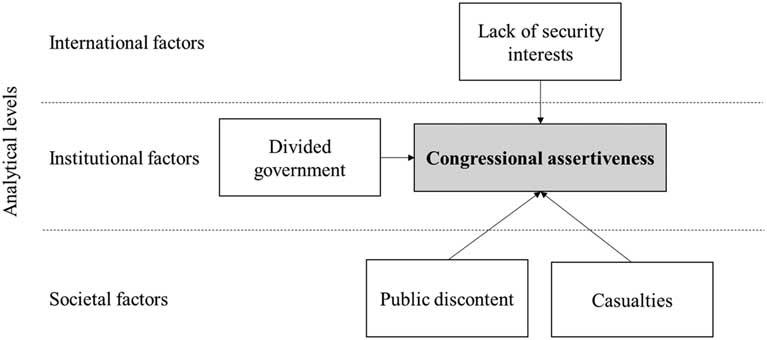
The politics of military interventions, with congressional–executive relations at its core, lies at the intersection of domestic and international politics. Consequently, our theoretical framework needs to consider three analytical levels: first, the societal input that MoC face regarding their voters; second, the institutional dimension of Congress; third, international factors, such as external threats, which affect the domestic decision-making process.
First, congressional and IR scholarship point out that legislators are responsive to their constituency (Risse-Kappen, Reference Risse-Kappen1991: 490; Meernik and Oldmixon, Reference Meernik and Oldmixon2004). In the field of military intervention, MoC should therefore evaluate public opinion and casualties (as a direct ‘cost’ for the constituency) when asked to support the president. This insight also fits into the expectations of democratic peace theory. In Kant’s (Reference Kant1796: 16) original argument, the risk-averse interests of the citizens were central to the idea that democracies do not wage wars, since the members of society themselves would have to bear the costs and casualties. Although both indicators are interrelated – casualties decrease public support for wars (Mueller, Reference Mueller2005) – they are not interchangeable. Some intervention may be unpopular even though few or no casualties occur (e.g. Haiti 1993–2000) while others receive support despite considerable deaths tolls (e.g. Iraq 1991).
The societal level thus yields two directional expectations: first, interventions unsupported by public opinion are prone to congressional assertiveness. Second, mounting casualties provide incentives for critique among MoC.
On the second analytical level, the institutional side of congressional politics matters for the war powers question. In recent years, party unity within Congress has increased and at the same time, bipartisanship in foreign policy waned (Milner and Tingley, Reference Milner and Tingley2015). The effect is that support for presidential war policies also hinges on partisan majorities and divided government presents a considerable institutional hurdle for presidents.
Hence, we can expect that congressional assertiveness is more likely during times of divided government.
Third, external threats resulting from the international system influence domestic politics without determining them (Gourevitch, Reference Gourevitch1978; Gibler, Reference Gibler2010). If crises threaten core national security interests, they create ‘the need for strong presidential leadership’ (Lindsay, Reference Lindsay2004: 186), which in turn suppresses congressional opposition. Although the question of national security interests often involves vigorous domestic debates on what constitutes a threat, leaders can ‘securitize’ (Buzan et al., Reference Buzan, Wæver and de Wilde1998: 30) issues such as terrorism, weapons of mass destruction or conflicts in regions of strategic and economic interests, easier than humanitarian crises.Footnote 1 Accordingly, if no threats to national security interests are perceived and the conflict is not successfully ‘securitized’, MoC have few incentives to support the president as the intervention seems not worth the costs and risks.
The directional expectation resulting from this insight is that military interventions, which lack clear connections to national security interests, will face congressional assertiveness.
Within this simplifiedFootnote 2 model (see Figure 1), the identified assumptions regarding societal inputs (public opinion, casualties), institutional factors (divided or unified government) and international variables (threats to national security interests) can interact and reinforce each other. Rather than providing exclusive explanatory power, we expect multiple paths to explain congressional assertiveness (see Haesebrouck, Reference Haesebrouck2017: 2241). For example, public discontent can be echoed more loudly in the case of divided government. After the 2006 midterm elections, the new Democratic majority voiced critique against an increasingly unpopular war in Iraq.Footnote 3 Possible interactions also involve the issue of national security interests. As the congressional debate on the Somalia intervention in 1994 shows, MoC, such as John McCain (R-AZ), would have accepted casualties if US security interests were threatened.Footnote 4 In this case, the perception that the intervention was unrelated to security interests spurred critique despite a broad partisan majority for the president in Congress.
Explanatory model for congressional assertiveness.

These complex patterns of interaction need to be evaluated carefully. To account for this, our research design combines a fsQCA, which is sensitive toward case-specific attributes, with two short case studies to review the interaction of the identified conditions.
fsQCA research design
The following fsQCA will address our theoretical considerations with corresponding conditions applied to all US military interventions from 1973, when the WPR was introduced, to 2017 (end of the Obama presidency). The selection includes 19 military interventions defined as a continuous use of military force against a territorial entity to enforce specific political goals.Footnote 5
FsQCA is a set theoretic method based on Boolean algebra and aims to identify necessary and sufficient (combinations of) conditions for an expected outcome (Ragin, Reference Ragin2008; Schneider and Wagemann, Reference Schneider and Wagemann2012). Instead of drawing causal inferences through large N statistical analysis (e.g. Howell and Pevehouse, Reference Howell and Pevehouse2007) or single case studies (Hendrickson, Reference Hendrickson2015) – the two most prominent methods in the war powers literature – fsQCA can account for varying configurations of conditions for the same outcome. It also allows for small to medium N-comparison within a case-oriented research design (Wagemann et al., Reference Wagemann, Buche and Siewert2015). Although both IR and foreign policy analysis increasingly use QCA (Mello, Reference Mello2014; Bretthauer, Reference Bretthauer2015; Haesebrouck, Reference Haesebrouck2018), and the context of our topic is well suited for a set-oriented comparison, so far, the issue of US war powers has not been examined through this method.
In the following fsQCA, we map our cases along their specific conditions on a four-value set. Based on the criteria outlined below, we evaluate whether a case is ‘fully in’ (1), ‘fully out’ (0), ‘more in than out’ (0.75), or ‘more out than in’ (0.25) a given set (outcome and conditions). In our view, this categorical concept makes sense for the topic as the response by Congress to military interventions can be evaluated on a four-value scale in a more meaningful way than by allotting fine-grained membership scores which might be artificial.Footnote 6
Operationalization of outcome and conditions
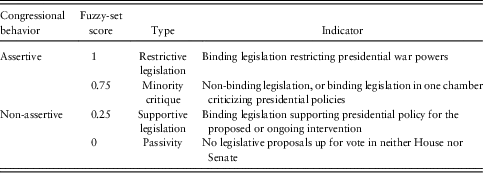
An assertive positioning of Congress toward the president figures as the outcome under investigation (assertiveness, see Table 1).Footnote 7 A fully assertive Congress aims to limit the ‘Commander in Chief’ via binding legislation, for example, by introducing budgetary restrictions to ongoing interventions (restrictive legislation, set value 1). If Congress passes critical non-binding resolutions, or if binding legislation reaches a majority in one chamber, congressional action is still classified as more assertive than not (minority critique, 0.75). Here, we acknowledge the influence of non-binding activities and minority opinions in Congress.
Conditions of congressional assertiveness in the politics of military interventions

If Congress issues binding legislation to support presidential policies for the proposed or ongoing intervention, the behavior is below the threshold of assertiveness (supportive legislation, 0.25). A fully deferent congress (passivity, 0) would act passively during a military intervention. Here, no legislative proposals in either House or Senate come up for a vote in order to provide authorization for the use of force. In this case, the absence of assertiveness is pronounced most clearly, as Congress defers its constitutional obligations completely to the president. In contrast, supportive legislation is more assertive since Congress at least goes on record to share political responsibility for the intervention. Supportive legislation is also less deferent since authorizations usually bind the executive with specific provisions regarding objective, mission, and aims of the interventions. For this reason, presidents oftentimes underscore that they do not need congressional authorizations to command the use of force (see Fisher, Reference Fisher2004: 172, 198).
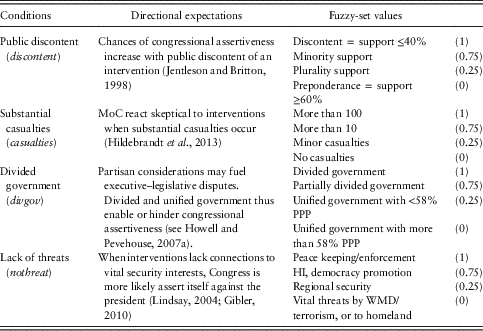
Drawing on our theoretical considerations, the fsQCA analyzes four conditions, which contribute to congressional assertiveness during military interventions (see Table 2).
1. Public discontent (discontent): both research on Congress and the IR literature suggest that pressure from the public creates incentives for MoC to act responsively in foreign policy. To model the impact of public opinion for the fsQCA, we follow the literature (Graham, Reference Graham1994; Canes-Wrone, Reference Canes-Wrone2015: 149), which points to 50% as a threshold for public opinion impact. We therefore expect that if average public approval of an intervention is lower than 50%, public discontent contributes to congressional assertiveness. Above 60%, Graham (Reference Graham1994: 190) assumes that public opinion becomes ‘preponderant’, making it difficult for MoC to be ignored.Footnote 8
2. Substantial casualties (casualties): an unsuccessful strategy that risks the lives of American soldiers is likely to create popular critique. In turn, legislative entrepreneurs can capitalize politically against the executive branch. This thesis also builds on research on American politics (Eichenberg, Reference Eichenberg2005: 174; Hildebrandt et al., Reference Hildebrandt, Hillebrecht, Holm and Pevehouse2013) and the democratic peace thesis (Russett and Oneal, Reference Russett and Oneal2001: 67). Hence, substantial numbers of US casualties should spur congressional assertiveness. Our analysis assumes a 0.5 anchor of 10 casualties. If 0 casualties occur, a case is fully out of the set, while 100 casualties serve as the 1 anchor.Footnote 9
3. Divided government (divgov): the more recent literature on US foreign policy suggests that politics does not ‘stop at the water’s edge’ (Howell and Pevehouse, Reference Howell and Pevehouse2007; Milner and Tingley, Reference Milner and Tingley2015).Footnote 10 We should therefore expect that the weaker the president’s party in Congress is, the more likely congressional critique will arise. A case is fully in the set divided government if both Senate and House are dominated by the opposition party (1.0). A situation of partially divided government is more in than out of the set (0.75). On the other side of the spectrum, we assume that unified government mutes congressional assertiveness.Footnote 11
4. Lack of national security interests (nothreat): drawing on the hypothesis that external threats influence domestic decision-making (Gibler, Reference Gibler2010), we expect that interventions, which lack clear connections to national security interests, will face congressional assertiveness.
Conditions of congressional assertiveness in the politics of military interventions

MoC=members of Congress; PPP=presidential party power.
To operationalize this condition, we follow Sarkesian et al. (Reference Sarkesian, Williams and Cimbala2008: 9), who provide a differentiation between a first (‘vital interests’) and a second order (‘critical interests’) of national security interests based on the consideration whether they effect the ‘survival’ of the United States or might become threatening to US homeland in the long run.Footnote 12 Above this threshold of immediate or latent threats, which are targeted at US homeland, we expect more congressional assertiveness. Accordingly, cases of self-defense and if vital threats (such as terrorism or weapons of mass destruction [WMDs]) are combated, this can be considered as most closely connected to US national security interests. Here, the ‘referent object’ (Stahl et al., Reference Stahl, Lucke and Felfeli2016) of the threat is the United States itself (set value 0). Historically, the United States also considers crises outside direct threats to its territory as relevant to its national security interests. Especially, events in its ‘periphery’ of the Americas and in the Middle East are included in this broader definition of national security interests (0.25).
At the other side of the spectrum, peacekeeping and peace enforcement missions have the least clear connection to US national security interests (1.0). Both in terms of their non-strategic goals and their multilateral setting under the auspices of the United Nations, these missions do not directly contribute to enhance US national security. Furthermore, humanitarian interventions and democracy promotion (0.75) also do not have a clear national security connection since they aim – at least ideally – at the promotion of universal goals and values.
As most interventions received considerable academic scrutiny, we draw on secondary sources for the classification of the cases and provide detailed documentation in the Appendix. Nonetheless, compared to the numeric thresholds of public opinion, casualties, and partisanship, the condition of national security interests rests on a purely qualitative typology, which makes the definition of sets more difficult. To be sure, MoC will debate the nature of national security interests in a certain crisis context and how the threat to these interests is perceived (Weldes, Reference Weldes1999: 48). To account for this, we also assess the plausibility of connected security interests for the cases of Libya 2011 and ISIS 2014—17 in the case study section of this article.
Results of the fsQCA
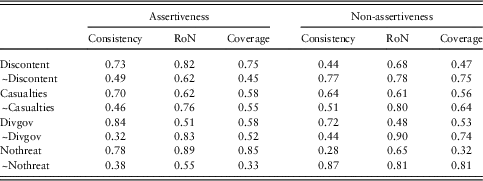
The analysis of necessary conditions for congressional assertiveness and the absence of assertiveness reveals no single factor beyond the threshold of 0.9 expected for necessary conditions (see Table 3). This result comes by no surprise due to the diverse setting of the 19 cases, among them 10 instances of an assertive Congress. As expected in our theoretical framework, singular factors, such as divided government, cannot account for this variance. We find cases, such as Somalia, where Congress asserted itself despite unified government or vice versa in the case of Iraq 1991. Similarly, the effect of public opinion is not monocausal: Republican majorities in Congress criticized Clinton and Obama for post-Cold War interventions (e.g. Kosovo, Libya) although a plurality of the public supported the use of force. In the case of Afghanistan 2009, Congress remained mute despite public discontent against Obama’s surge plan.
Analysis of necessary conditions for congressional assertiveness (assertiveness) and the absence of assertiveness (non-assertiveness)

RoN = Relevance of Necessity.
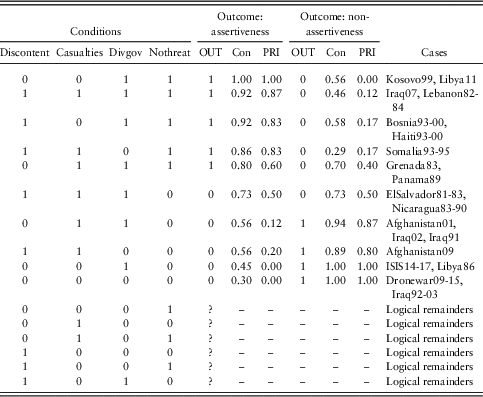
The truth table (Table 4) collects all possible configurations of conditions and evaluates whether each specific combination of conditions is sufficient for the outcome. Above a consistency value of 0.8, we assume an outcome value of 1.Footnote 13 Subsequently, the truth table is minimized in order to identify combinations of conditions, which are sufficient for the outcome under investigation. Depending on whether logical remainders (combinations of conditions without corresponding cases) are included, the analysis produces a complex, most parsimonious and intermediate solution. Since our conditions entail clear theoretical expectations on how they affect the outcome, we are making use of ‘easy counterfactuals’ and focus on the intermediate solution (see Schneider and Wagemann, Reference Schneider and Wagemann2012; Schneider, Reference Schneider2018).Footnote 14
Combined truth table for outcome congressional assertiveness and non-assertiveness

OUT=statement of sufficiency for the investigated outcome; Con=sufficiency inclusion score; PRI=proportional reduction in inconsistency.
Threshold for consistency levels is 0.8 (see Schneider and Wagemann, Reference Schneider and Wagemann2012: 185).
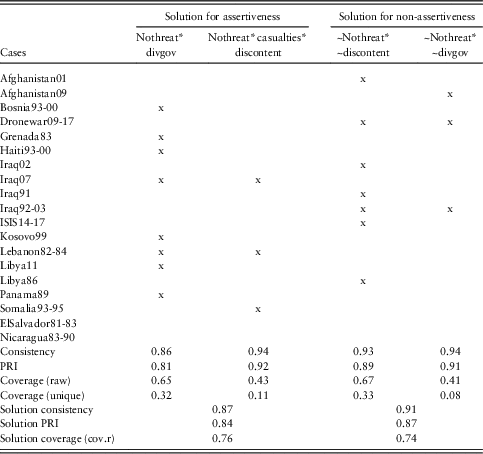
Looking at sufficient conditions for the tested outcome, we find two conjunctures for congressional assertiveness according to the intermediate solution term. Interventions, which were not connected to US national security interests, met congressional assertiveness during periods of divided government. This explanation applies to the post-Cold War era (Bosnia, Haiti, Kosovo, Libya) when Republican majorities criticized Democratic presidents for interventions that served universal values, such as human rights, rather than national security interests. The solution term also applies to interventions during the 1980s when Republican presidents faced congressional assertiveness for efforts of peacekeeping (Lebanon 1982–84) and democracy promotion (Grenada 1983). In a more recent case, Democratic majorities in the 107th Congress criticized President Bush’s Iraq policy. At that time (2007), the intervention was perceived as a mission to promote democracy since the war’s original purpose (preventing the threat of WMD) had been discredited (see Carothers, Reference Carothers2007: 8). Panama, 1989 represents a deviant case for the solution term as Congress did not act assertive as expected.Footnote 15
The second conjuncture combines the factors of lacking national security interests, casualties, and public discontent. It accounts for the cases of Somalia 1993–95, Lebanon 1982–84, and Iraq 2007 – however, only the case of Somalia is exclusively explained by this solution term. Here again, the lack of national security interests in the missions’ objective figures as one of the sufficient conditions. Evidently, the high numbers of casualties spurred public discontent and congressional critique in these cases. Robert Byrd’s (D-WV) statement during the 1994 debates on Somalia illustrates this context. The long-term senator from West-Virginia bemoaned that ‘Americans by the dozens are paying with their lives and limbs for a misplaced policy’ [Congressional Record (CR), 1994: S12876] and concluded: ‘Let the Commander in Chief put our men and women where our strategic interests are involved, and you will see how much credibility this Congress has’ (S13151). Byrd thus promised congressional support even in the case of mounting casualties, if national security interests were threatened.
The fuzzy-set analysis also identifies two conjunctures for non-assertiveness. First, the combination of public support and involved security interests implicates a deferent Congress. This solution term applies to the intervention in Libya 1986, the wars in Iraq (before 2007), and Afghanistan 2001, the policy of drone warfare since 2009, and the operation against ISIS since 2014. All interventions enjoyed public support and their goals aimed at fighting terrorism or aggressive dictators, which were considered as a threat to national security interests.Footnote 16
The second solution term for non-assertiveness consists of the combination of unified government and a clear threat to national security. It accounts for the cases of the drone warfare since 2009, the airstrikes against Iraq after the second Gulf War, and the case of Obama’s surge decision for the war in Afghanistan. In all cases, a domestic consensus on the threat to national security interests contributed to congressional deference. In addition, the president’s party held relatively large numbers of seats in both chambers.Footnote 17
The revealed cross-case pattern yields three insights, which are relevant also from a theoretical perspective. First, national security interests are a central piece to understand the puzzle of congressional response – the respective condition is part of each solution term. Second, legislators seem to evaluate their decision based on multiple considerations. Pressure from the public and partisan interests are connected to re-election concerns. Yet, MoC also perceive the international environment and debate the resulting national security interests for the United States. Third, concerns over national security and public opinion can overcome partisan interests. This applies to cases of bipartisan critique against the president as well as to broad majorities supporting interventions such as Iraq 2003 or the war against ISIS (Table 5).
Configurations in solutions for assertiveness and non-assertiveness (intermediate solutions)Footnote a

PRI=proportional reduction in inconsistency.
‘x’ indicates that a case is included in the solution term.
a Directional expectations for intermediate solution of assertiveness: discontent, casualties, divgov, nothreat = present. Directional expectations for non-assertiveness: discontent, casualties, divgov, nothreat = absent.
Congress and Obama’s wars
In order to assess the plausibility of the fsQCA, we illustrate the identified explanations on two typical cases of the solution terms with most coverage for congressional assertiveness as well as the absence of assertiveness.Footnote 18 We select the interventions against Libya 2011 (assertiveness) and ISIS 2014–17 (non-assertiveness) as the two most recent examples and the only wars initiated by President Obama.
Libya 2011
Congressional response toward the Libya intervention, which commenced on 19 March 2011, did not result in any binding legislation. However, the Republican-controlled House passed a non-binding resolution (H.Res. 292) and defeated an authorization proposal (H.J.Res. 68), thus criticizing President Obama for the intervention and his alleged disrespect for the WPR. The air campaign against Libya represents a case of a more assertive than deferent Congress (set value 0.75), which is critical of military interventions unrelated to security interest during phases of divided government.
As Obama explained in a letter to congressional leaders on 21 March 2011, the intervention in Libya intended ‘to prevent a humanitarian catastrophe and address the threat posed to international peace (…)’. The president stated that the ‘strikes will be limited in their nature, duration, and scope’ and that ‘their purpose is to support an international coalition as it takes all necessary measures to enforce the terms of UN. Security Council Resolution 1973’. Obama cited his ‘constitutional authority to conduct US foreign relations (…) as Commander in Chief and Chief Executive’, and stated that he would ‘keep the Congress fully informed, consistent with the War Powers Resolution’ (White House, 2011).
The Republican majority in the House criticized both the aim of the intervention and its legal justification. Democrats, on the other hand, tried to construct a national security narrative to summon congressional support for the intervention in Libya. According to Howard Berman (D-CA), ‘(t)here are critical interests at stake. The national security question is far beyond simply what is going to happen in Libya, but in its neighbors, Egypt and Tunisia, throughout the Middle East (…)’(CR, 2011: H4545). Arguments forwarded by proponents of the intervention also included an emphasis of NATO for US national interest. Henry Waxman (D-CA), for example, pointed out: ‘While Libya is not in our vital national security interest, standing with our NATO allies very much is’ (CR, 2011: H4539). Yet, these attempts to connect the Libya intervention to US security interests remained a minority position. Even some (liberal anti-interventionist) Democrats questioned the proposed national security interest narrative. Fortney Stark (D-CA) explained during the debate to authorize the use of force in June 2011: ‘At a time when we continue the wars in Afghanistan and Iraq, we cannot afford to pursue another military adventure that is not in our national security interest’ (CR, 2011, H4549). Supporters of the Libya intervention were undermined by President Obama’s own rationale for the intervention. Obama had elaborated, ‘there will be times (...) when our safety is not directly threatened, but our interests and our values are’, hence indicating that Libya is first and foremost a humanitarian intervention (White House, 2011). This reasoning invited critics, such as Ted Poe (R-TX), to deconstruct the war’s legitimacy: ‘I vote “no” on this resolution. We have no business in Libya. Even the administration has said it is not in the national security interest of the United States to be in Libya’ (CR, 2011, H4543). And Michael McCaul (R-TX) bemoaned: ‘(…) it is clear that the President failed to comply with the requirements to get congressional approval; and when we examine the merits of the case for involvement in Libya, this administration has wholly failed to define a clear national interest, mission, or goal’ (CR, 2011, H4552). Speaker John Boehner’s (R-OH) non-binding H.Res. 292 stated in a similar vein: ‘(T)he President has failed to provide Congress with a compelling rationale based upon United States national security interests for current United States military activities regarding Libya’. The resolution passed the House on 2 June 2011 with broad Republican support, while 45 Democrats joined the Republican speaker.
MoC also criticized the administration’s argument that a specific authorization would not be necessary. In a letter to Congress on 20 May 2011 (after the WPR’s 60-day limit expired), Obama contended, that US operations in Libya did not amount to hostilities in the sense of the WPR. The Republican majority in the House and liberal Democrats questioned this interpretation of congressional war powers. Paul Nugent (R-FL) accused Obama of misleading Congress on the issue of Libya: ‘Mr. Speaker, President Obama has put us in a trick bag with our NATO allies. He knew he was committing our military force and assets to a mission that would be unpopular, unjustifiable and unconstitutional’ (CR, 2011: H33966).
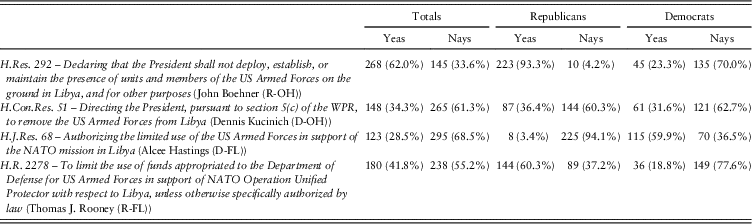
Despite the visible unease with the Libya intervention, critics failed to achieve a majority in Congress to issue binding legislation. As suggested by the fuzzy-set analysis, partisan consideration shaped this outcome of a not fully assertive Congress (see Hendrickson, Reference Hendrickson2015). As Table 6 shows, the key decisions in the House on Libya remained divisive between Republicans and Democrats. Boehner’s H.Res. 292, the defeated authorization resolution (H.Res. 68), and the defunding resolution (H.R. 2278) received support mostly from Republicans, while H.Con.Res. 51 (Dennis Kucinich, D-OH) – a potentially binding measure to withdraw all troops – failed to win majorities in both parties.
Votes on Libya 2011 intervention in the HouseFootnote a

a Library of Congress Database. ‘Non-voting’ and ‘present’ not listed in Table 6 (percentage do not round up to 100).
In the Democratic-controlled Senate, majority leader Harry Reid (D-NV) and Senate Foreign Relations Committee (SFRC) chair John Kerry (D-MA) successfully avoided to put any legislative proposal up for a vote. In addition to the attempt to protect ‘their’ president, the overall political climate in the smaller chamber was more favorable toward the intervention, even among Republicans.Footnote 19 As Stephen Weissman (Reference Weissman2017, p.141) observed, Republican and Democratic leaders in the Senate were reluctant to formulate an independent policy for the Libya intervention nor did they try to assert the WPR.
Notwithstanding that Republicans also lacked the necessary votes in the Senate to achieve binding restrictions for an intervention, which they criticized on constitutional and strategic grounds, the opposition party’s positioning itself remained ambiguous. While 94.1% of House Republicans rejected the authorization, only 60.3% supported to cut-off the operation’s funding.Footnote 20 It seems that the aim of the Republican leadership has been to signal political protest against the Democratic president, while stopping short of going on record with binding legislation (see Hendrickson and Juszczak, Reference Hendrickson and Juszczak2017: 53).Footnote 21 Representative Berman (D-CA) hinted at the ambiguity of Boehner’s resolution: ‘If the majority thinks (…) that current operations in Libya do not have a compelling national security rationale, it should support Mr. Kucinich’s approach. (…) If the majority has concerns with Mr. Kucinich’s approach (…) it should simply authorize the use of force in Libya’ (CR, 2011: H4000). In light of this critique, Boehner’s initiative in the House can be interpreted as a maneuver to give voice to the critics of the administration while avoiding to fully assert congressional war powers.
MoC certainly faced little electoral incentives to assert themselves beyond non-binding critique since a majority of the public supported the intervention (Polling Report, 2016). Although Congress did not fully assert itself, Obama reacted to the critique and stressed the ‘supportive role’ of the United States during the air campaign (White House, 2011), and limited the involvement by excluding the deployment of ground troops.
Overall, the congressional response to Obama’s course during the Libya crisis was driven by Republicans criticizing the ‘Commander in Chief’ for an intervention where they could not see vital US security interests involved. The response also reflects the divisive partisan climate, which characterized the 112th Congress.
ISIS 2014–17
The US-led military campaign against the so-called ‘Islamic State’ (ISIS), which started in August 2014, has not received a specific congressional authorization. To be sure, the Obama administration argued that the operation was legitimized by the two previously passed authorizations for the wars in Afghanistan and Iraq (P.L. 107-40 and 107-243) (see White House, 2014). This argumentation rests on shaky constitutional grounds (see Goldsmith and Waxman, Reference Goldsmith and Waxman2016: 15) as the intervention departed from previous operations by targeting new territories (Syria) and enemies (ISIS) after the war in Iraq was officially terminated by the Obama administration in 2011. In his January 2015 State of the Union Address, Obama indeed appealed to Congress to adopt a new authorization (White House, 2015). In the 114th Congress, senators and representatives introduced several proposals to authorize the intervention while none reached the floor for a vote (Weed, Reference Weed2016). Despite the lack of an authorization, several funding resolutions clearly demonstrated support for the intervention against ISIS. These binding measures passed with bipartisan majorities (Bendery, Reference Bendery2015). We therefore classified the behavior of Congress as supportive of the intervention (0.25).
The results of the fsQCA suggest that national security concerns, in conjunction with a supportive public opinion, contributed to congressional deference. In fact, analyzing the debates in congressional committees, it is clear that the stable consensus between the president and majorities of both parties on the question whether ISIS presented a threat to national security interests dampened congressional assertiveness. In September 2014, House Armed Services Committee chair Howard McKeon (R-CA), together with James Langevin (D-RI), Bradley Byrne (R-AL), and Adam Smith (D-WA), described the committee’s bipartisan agreement in a report: ‘(...) there was widespread agreement that ISIL is a threat to our allies and to the United States, (…) that ISIL must be defeated’ [House Armed Service Committee (HASC), 2014: 2]. Langevin asserted that ‘ISIL does pose a threat to the homeland and to our allies around the world’ (Langevin, HASC, 2014: 46). In a similar fashion, Byrne described ISIS as a ‘great threat facing the people of our country’ (Byrne, HASC, 2014: 48). The threat perception also entailed a distinct enemy image. Members of both parties depicted the terrorist group as a dangerous and barbaric enemy of the United States and the world. Patrick Leahy (D-VT) urged that ‘we need to work with our international partners to combat this barbaric terrorist group’ (Leahy, CR, 2014: S8479) and Lindsey Graham (R-SC) concluded ‘(i)t’s mankind against ISIL, it’s just not us against ISIL or Sunni Arab states against ISIL’ (Senate Armed Services Committee, 2014: 48). Another statement by Senator Robert Menendez (D-NJ) also reflected the classic ‘Vanderberg spirit’ of bipartisan agreement: ‘(W)e are strongest in the national challenge that we face when we speak with one voice, as Democrats, Republicans, and Independents together as Americans. (…) This is a moment in which politics must stop at the water’s edge’ (SFRC, 2014: 56).
Beneath the consensus on the threat posed by ISIS for national security, partisan differences were also present. While Democrats such as Sheila Lee Jackson (TX) commended the ‘Commander in Chief’s’ strategy (CR, 2015: E1170), several Republicans criticized Obama for his minimalist counter-ISIS approach. A group of Republican senators led by Marco Rubio (FL), McCain, and Bob Corker (TN) presented a joint statement criticizing the AUMF proposal (S.J.Res. 47) sponsored by Menendez: ‘In essence, the President has failed to provide Congress with a serious, convincing, and clear direction that could credibly lead to success on the stated goal of degrading and ultimately defeating ISIS’ (Minority Views, S.J.Res. 47: 7). Referring to Obama’s decision to end the war in Iraq in 2011, McCaul (R-TX) denounced: ‘We had a micromanaged war that I think didn’t allow our troops to win that war, and I don’t want to make the same mistake with ISIS’ (HFAC, 2015: 43).Footnote 22
Disagreement also emerged over the question whether and how Congress should issue a new authorization. The two most prominent schools of thought in Congress were represented by Republicans favoring broad authorities for the executive to combat ISIS, and Democrats who preferred a narrower authorization with restrictions such as a sunset provision, prohibition of ground forces and geographical limits (Chivvis and Liepman, Reference Chivvis and Liepman2016: 17). The contra-intuitive support for presidential prerogatives by the Republican leadership was again connected to the issue of national security interests. Senator Ron Johnson (R-WI) and Representative Matt Salmon (R-AZ), for example, legitimated their position with the imminent threat posed by ISIS to US security interests and the need for military flexibility (SFRC, 2015: 25). In the House, Salmon argued: ‘I very much support a very robust AUMF being given to the President which gives maximum flexibility to our generals so that they can prosecute this effort until we win and we do it quickly—as quickly as possible’ (HFAC, 2015: 48).
On the Democratic side, Senator Tim Kaine (D-VM) urged Congress to fulfill its constitutional responsibility and issue a new authorization: ‘(T)he 2001 and 2002 authorizations are not sufficient to cover this military action. But if we do not act to authorize it, I think from a legal and precedential standpoint, it would be somewhat catastrophic. (…) I cannot imagine asking people to risk their lives with us not having done our job’ (SFRC, 2015: 28). Interestingly, libertarian Republicans such as Rand Paul (KY) concurred with Kaine and stressed that ‘(t)his administration is in direct defiance of what Senator Obama ran on what he was elected upon. He said no country should go to war without the authority of Congress’ (SFRC, 2015: 50).
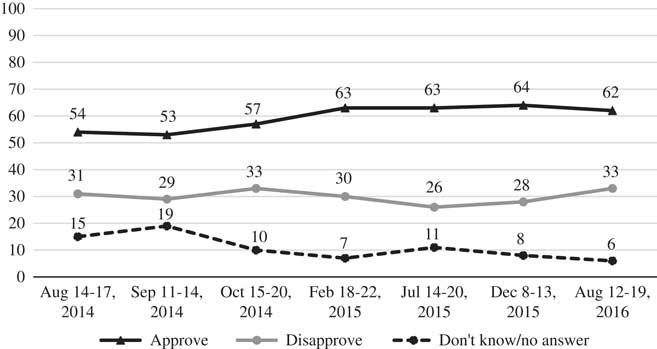
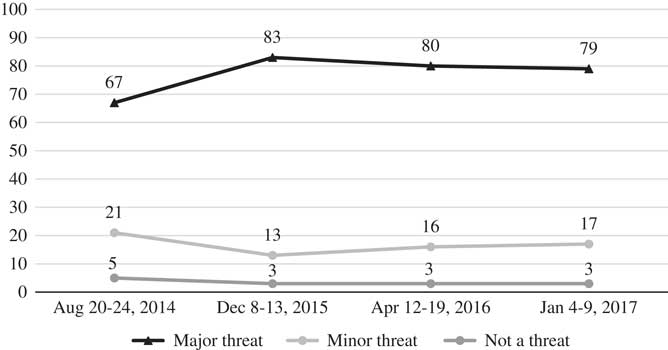
While some Republicans denounced Obama’s strategy and a minority publicly criticized the lack of a binding authorization of the intervention, Congress overall faced little electoral incentives to act more assertively. In addition to the threat perception on both sides of the aisle, the public clearly supported the intervention. On average, a majority of 59% favored the use of airstrikes against ISIS (see Figure 2). Public opinion data also shows a high societal perception of ISIS as an evolving, unpredictable and major threat (see Figure 3). A vote-seeking perspective on congressional behavior suggests that MoC act responsively toward public opinion in order to foster their chances of reelection. In this political climate of latent threat perceptions in elite and public discourses, MoC could not expect electoral advantages from challenging the ‘Commander in Chief’.
Overall, do you approve or disapprove of the US military campaign against Islamic militants in Iraq and Syria? (in percentage; Pew, 2017).

Do you think that the Islamic militant group in Iraq and Syria, known as ISIS, is a major threat, a minor threat, or not a threat to the well-being of the United States? (in percentage, don’t know/refused not shown; Pew, 2017).

In sum, the analysis shows that MoC understood the intervention against ISIS as serving direct US security interests. While Obama and the Democratic minorities in both chambers called for a new authorization, the Republican majorities in the 114th Congress and their chairpersons of the Armed Services and Foreign Relations Committees prevented votes on the introduced authorizing resolutions. In contrast to Howell and Pevehouse’s argument on the limiting role of partisanship for presidential war policies (Reference Howell and Pevehouse2007: 78), the perception on national security interests outweighed partisan considerations in this case. In fact, many Republicans shied away from a binding resolution as they did not want to limit the ‘Commander in Chief’s’ ability to fight a vital US security threat.
The case description therefore confirms the solution conjuncture of the fsQCA (positive public opinion and threat perception as sufficient conditions), while establishing a more nuanced picture on the legislative branch’s reaction to the president’s use of force against ISIS.
Conclusion
This article sought to make sense of congressional assertiveness in the politics of military interventions. Enlarging the scope of traditional war powers studies beyond formal legislative instruments, such as binding ex-ante authorization, we found considerable variance in congressional responses toward presidential wars. Budget-related legislation, non-binding congressional oversight activities, and minority critique led to an assertive positioning of Congress which impacted presidential policies, for example, in the cases of Nicaragua, Lebanon, several humanitarian interventions in the post-Cold War era, and Iraq 2007. In order to understand this pattern, it is not enough to single out factors such as presidential party power, as previous research did (e.g. Kriner, Reference Kriner2010). Applying the fsQCA method enabled us to identify the complex setting of individual cases and the interplay of factors, which affect the domestic politics of democratic wars.
Supplementing traditional war powers studies with insights from IR research, we expected that Congress’ response to presidential wars is shaped not only by domestic factors (public opinion, casualties, partisanship), but also influenced by international conditions. As the empirical analysis revealed, congressional assertiveness against humanitarian interventions and peacekeeping efforts was indeed connected to the perception that these missions would not serve direct national security interests. Thus, the interventions would not be worth the risks and costs, although they did not necessarily lead to casualties. Especially among Republicans, the liberal internationalist agenda of democracy promotion abroad raised critical voices. When the Republican Party gained majorities after the midterm elections in 1994 and again in 2010, MoC criticized presidents Clinton and Obama for interventions that lacked clear connections to national security interests. On the other hand, when wars were perceived as missions to counter threats to US security, congressional assertiveness remained frequently absent, even if such interventions produced considerable casualties, such as the ‘War on Terror’ after 9/11. The intervention in Iraq 2003–11 provides a case in point: the original purpose of the intervention (to prevent the threat of WMDs) received bipartisan support in a societal climate of hyperbole threat perception. When the war’s legitimization broke down and the United States found itself entangled in a civil war, Democrats asserted themselves in Congress after they won majorities in both chambers in 2006. With the rise of ISIS in 2014, this pattern converts into deference again: ISIS is perceived as a threat to US security interests and MoC avert to limit the president’s power to lead the use of force.
After Donald Trump succeeded Barack Obama as president, Congress continued to defer to the executive and avoided authorizing the ISIS mission despite critical minority views. As the closer examination of the Libya and ISIS cases showed, the role of congressional leaders, such as the party leadership and committee chairpersons, in shaping congressional actions is influential. These unit level factors are difficult to implement in a fuzzy-set analysis focusing on structural and societal conditions. This, however, underlines the necessity of multi-method approaches, combining case studies with large and medium N-analyses. Furthermore, as this article was limited to the case of US Congress, insights regarding the role of national interests in conjunction with domestic factors should also be reviewed in cross-country comparisons. Alongside the consideration of institutional resources of parliamentary war powers and partisan aspects (Mello, Reference Mello2014), the influence of national interests for parliamentary control of military missions has not yet received much attention. To understand these sources of parliamentary assertiveness (and its absence) is an important aspect to the study of democratic wars as the downside of the democratic peace.
Acknowledgments
Part of the research for this article emanates from the research cluster ‘Authority and Trust in American Culture, Society, History, and Politics’ (GRK 2244), funded by the German Research Foundation (DFG). For helpful comments, the authors thank the anonymous reviewers as well as David Eisler, Gordon Friedrichs, Steffen Hagemann, Lukas D. Herr, Patrick A. Mello, Helge Staff, Georg Wenzelburger, and Jürgen Wilzewski. The authors also benefited greatly from Markus B. Siewert’s feedback and suggestions on the fsQCA method.
Supplementary material
To view supplementary material for this article, please visit https://doi.org/10.1017/S1755773918000152