Introduction
As one of the most extreme environments on earth, Antarctica represents an increasingly popular tourism destination. In the 2018–19 season, 56,186 tourists visited Antarctica, an increase of 8% on the previous year (International Association of Antarctica Tour Operators, 2018), with the vast majority of tourists travelling on cruise vessels (Erceg, Reference Erceg2017; Liggett & Stewart, Reference Liggett and Stewart2017; Nichol, Reference Nichol, Leal Filho, Manolas, Azul, Azeiteiro and McGhie2018). Antarctic tourism operators emphasise that visiting the region first-hand enhances public awareness and concern for environmental issues (Eijgelaar, Thaper, & Peeters, Reference Eijgelaar, Thaper and Peeters2010; Powell, Kellert, & Ham, Reference Powell, Kellert and Ham2008; Vila, Costa, Angulo-Preckler, Sarda, & Avila, Reference Vila, Costa, Angulo-Preckler, Sarda and Avila2016). This is termed “ambassadorship”, a concept that is sometimes linked back to pioneering tourism operator Lars-Eric Lindblad, who organised regular Antarctic expedition cruises in the very early days of Antarctic cruise tourism in the 1960s and commissioned the first purpose-built ice-strengthened vessel solely for tourism purposes in 1969. Today, the term “Antarctic ambassador” is in common use, especially by tourist companies, and the creation of Antarctic ambassadors is an objective of the International Association of Antarctica Tour Operators. They, and others (identified in this article, e.g. youth groups) assume that (or argue that) individuals who forge a connection with the Antarctic, usually through the act of visiting it, will develop attitudes that will in some way benefit the region. But what exactly is an “Antarctic ambassador”? What are their characteristics? How do they forge various connections to Antarctica? Does one need to have first-hand experience of the Antarctic to become an ambassador for the continent?
In this paper, we probe the concept of the Antarctic ambassador and seek to clarify what it is thought to be, how a personal link is understood to be forged and what an Antarctic ambassador is expected to achieve. With increasing conflict between human use and conservation in the marine and terrestrial Antarctic environments (Brooks, Jabour, van den Hoff, & Bergstrom, Reference Brooks, Jabour, van den Hoff and Bergstrom2019; Hughes, Fretwell, Rae, Holmes, & Fleming, Reference Hughes, Fretwell, Rae, Holmes and Fleming2011), a better appreciation of the potential for Antarctic ambassadorship will be imperative for the effective management and regulation of human activity in the region. It is also important when considering what people can do to advocate for Antarctica and Antarctic values from afar. Indeed, in this paper, we intend to go beyond tourism in understanding what Antarctic ambassadorship is, and could be.
When examining the question of Antarctic ambassadors, researchers have given significant attention to Antarctic tourism, particularly to the character, management and regulation of activities (Bastmeijer, Lamers, & Harcha, Reference Bastmeijer, Lamers and Harcha2008; Haase, Lamers, & Amelung, Reference Haase, Lamers and Amelung2009; Jabour, Reference Jabour, Jones and Phillips2011; Liggett & Stewart, Reference Liggett and Stewart2017; Student, Amelung, & Lamers, Reference Student, Amelung and Lamers2016). Tourism is a regular agenda item at the Antarctic Treaty Consultative Meeting, where Consultative Parties, experts and observers discuss Antarctic issues, and Parties reach consensus on the way forward for each issue. However, there has been only very limited and inconclusive research on whether a significant number of tourists return from Antarctica as “ambassadors” for the continent (Maher et al., Reference Maher, Steel and McIntosh2003; Maher, Steel, & McIntosh, Reference Maher, Steel and McIntosh2003; Powell et al., Reference Powell, Kellert and Ham2008). Some studies have suggested that tourism has the potential to “educate the public to the importance of Antarctica” (Powell et al., Reference Powell, Kellert and Ham2008), while others concluded they could find no evidence of Antarctic tourism having an impact upon the overall environmental awareness or travel choices of tourists (Eijgelaar et al., Reference Eijgelaar, Thaper and Peeters2010). Moreover, there has been little attempt to determine whether travel to the Antarctic is or should be a necessary precondition of ambassadorship for the region.
The reason for limited and inconclusive research may be the contested nature of the concept of Antarctic ambassadorship itself. Indeed, without an established definition of the concept of Antarctic ambassador, the concept may just be creating “good feelings” while encouraging more visitors to the continent and compounding any issues that visitation may cause. Fundamentally, such research requires a shared understanding of the “ambassadorship” concept. In this paper, we provide a working definition to underpin future research. We argue that connection, knowledge and passion play key roles in fostering ambassadorship both as an identity and as a practice, and that first-hand experience of Antarctica is not a prerequisite for becoming an Antarctic ambassador.
In summary, the objectives of this conceptual paper are to lay the foundation for a research project that can evaluate whether the concept “Antarctic ambassador” has real meaning and measurable effects or is mostly a marketing tool. If the Antarctic ambassador effect is meaningful, what is it that creates the connection and does it require the act of personally visiting the Antarctic, or can the effects be duplicated by other means?
The contested nature of Antarctic ambassadorship
Etymologically, the English term ambassador originates from the Latin ambactus (servant, vassal and dependent), which entered into English via the Italian word ambasciator that was then adopted into French as ambassadeur and into English as embassa(i)adour in the 14th century (Collins Dictionary, 2019; Merriam Webster, 2019; Shorter Oxford English Dictionary, 2019). It is reasonable to assume that the related Old High German word ambaht (service), which shares the same origin with ambassador, is also related to the Scandinavian (Norwegian, Swedish and Danish) term ombud, which is incorporated into English as ombudsman, a public advocate or trustee. In its broadest sense, the term ambassador can be understood as a representative or messenger who serves a certain community or advocates on a certain issue. The term also has administrative and political connotations – for instance, when being used as an official representative of one sovereign state to another.
In a scholarly context, the concept of ambassadorship, other than in reference to official state representatives, has been used only sporadically and largely in the last couple of decades, with the frequency of its usage roughly doubling between 2010 and today as compared to the previous decade (based on a simple Google Scholar search). Rather than having been adopted into the theoretical framework of a specific discipline, the concept has been used across multiple fields of study and practice, including literature (Karmi, Reference Karmi2008), action research in developmental theory (Mullett, Jung, & Hills, Reference Mullett, Jung and Hills2004), training and communication programmes (Garner, Alley, Haas, Sontgerath, & Kaplan, Reference Garner, Alley, Haas, Sontgerath and Kaplan2017), medicine (Hubble & Solovey, Reference Hubble and Solovey1994), organisational citizenship (van Zoonen, Bartels, van Prooijen, & Schouten, Reference van Zoonen, Bartels, van Prooijen and Schouten2018) and place management and citizenry (Hamilton, Reference Hamilton2010; Taecharungroj, Reference Taecharungroj2016). It has also been adopted in strategies relating to the teaching of science, technology, engineering and maths (Anagnos, Lyman-Holt, Marin-Artieda, & Momsen, Reference Anagnos, Lyman-Holt, Marin-Artieda and Momsen2014; Garner, Haas, Alley, & Kaplan, Reference Garner, Haas, Alley and Kaplan2018; Lucas et al., Reference Lucas, Bakopoulos, Grano, Willis, Missingham, Kestell and Wright2014; Renaud & Renaud, Reference Renaud and Renaud2013; Talbot et al., Reference Talbot, Alley, Marshall, Haas, Zappe and Garner2013). Most frequently, it has been used in relation to marketing and branding (Debenedetti & Oppewal, Reference Debenedetti and Oppewal2012; Ghasemi, Del Chiappa, & Correia, Reference Ghasemi, Del Chiappa and Correia2017; McGregor, Reference McGregor2018), where brand ambassadors are commercially sought-after individuals who are convinced about the characteristics of a certain brand to the point where they advocate its use to others.
The concept of an ambassador for a place is closely linked to place attachment (a narrower concept than connection; an emotional bond specifically with a place, most often based on personal experience). A study exploring consumer attachment to places (Debenedetti & Oppewal, Reference Debenedetti and Oppewal2012) provides useful context for understanding human relationships with place. Debenedetti and Oppewal (Reference Debenedetti and Oppewal2012) engaged with individuals through in-depth interviews and retrospective essays to explore why people formed emotional bonds or attachments to certain (public) places. They identified three main themes that played a significant role in consumer place attachment: continuity, “homeyness” and ambassadorship. Arguing that “[a]mbassadorship is interpreted as a “form of sharing behavior and results in a perpetuation or reinforcement of the bond between the consumer and the place” (Debenedetti & Oppewal, Reference Debenedetti and Oppewal2012, p. 150), they emphasise that ambassadors of a place would advocate on behalf of said place and share their enthusiasm for this place with trusted contacts.
In fact, when focusing on any single place, the term ambassadorship has been employed most often by scholars in connection with Antarctic tourism. In the context of Antarctic tourism, however, ambassadorship is often assumed (Eijgelaar et al., Reference Eijgelaar, Thaper and Peeters2010; Erize, Reference Erize1987; Powell, Brownlee, Kellert, & Ham, Reference Powell, Brownlee, Kellert and Ham2012) and rarely questioned or analysed (e.g. see Maher, Steel, & McIntosh, Reference Maher, Steel and McIntosh2003; Powell et al., Reference Powell, Kellert and Ham2008; Vila et al., Reference Vila, Costa, Angulo-Preckler, Sarda and Avila2016). The same is true for much of the non-Antarctic scholarly literature, which also takes ambassadorship on face value as a given positive effect. Considering the rapid increase in Antarctic tourist numbers at present (International Association of Antarctica Tour Operators, 2018, 2019), it is timely to probe the extent to which experiencing the place, and possibly even forming a strong attachment to Antarctica, has a positive impact lasting long after the return home from the experience and results in active ambassadorship on behalf of the Antarctic and Southern Ocean.
The term “Antarctic ambassador” has been deployed in many formal and informal ways and interpreted differently by various stakeholders (Powell et al., Reference Powell, Kellert and Ham2008). It is useful to differentiate between “capital-A-Ambassadors”, who operate in the diplomatic realm in an official capacity, and “small-a-ambassadors”, who represent or promote a person, place, company or idea, at times as unofficial representatives (Merriam Webster, 2019). Both meanings of the term have been used in Antarctic discussions. France first appointed an Ambassador for Antarctic and Arctic Issues in 2009, making it the first non-Arctic state to appoint an ambassador-level diplomat specifically for the polar regions. In the Australian context, the Tasmanian government appoints an honorary Antarctic ambassador to champion local interest in the southern continent. Tasmania has close ties to the Antarctic region, with the city of Hobart commonly referred to as a “gateway” to East Antarctica (Tasmanian Government, 2017). In both instances, the idea of an Antarctic ambassador is closely aligned with other types of ambassadors, who serve as official representatives of a particular nation’s interests in the international arena. Although Article IV of the 1959 Antarctic Treaty states that “no acts or activities taking place while the present Treaty is in force shall constitute a basis for asserting, supporting or denying a claim to territorial sovereignty in Antarctica”, the appointment by claimant states of official ambassadors for Antarctica could be read as geopolitically problematic.
The concept of Antarctic ambassadorship has also been mobilised by non-governmental organisations and Antarctic trusts, where it has often been associated with ideas of protection for the non-human world. When campaigning for large-scale protection for key Antarctic Ocean ecosystems, the Antarctic Ocean Alliance enlisted celebrities or other prominent people spread their message about the importance of marine protected areas; their high-profile ambassadors include the actor Leonardo DiCaprio, oceanographer Sylvia Earle and explorer Liv Arnesen. The environmental non-governmental organisation Greenpeace also showcases a list of “artists, actors, scientists, explorers and more who recognise the responsibility we have, as a planet, to protect our most fragile places” (Greenpeace) under the heading of “Antarctic Ambassadors”. In this case, the ambassadors seek an Antarctic Ocean Sanctuary, arguing that this would “form a safe haven for penguins, whales and seals to recover from the pressures of climate change, pollution and overfishing” (Greenpeace). Decisions about Marine Protected Areas in the Southern Ocean are currently made by consensus in annual meetings of the Commission for the Conservation of Antarctic Marine Living Resources, which currently has 25 states and the European Union as members. Although none of Greenpeace’s “ambassadors” have an official voice in such a forum, they are able to leverage their celebrity in order to draw attention to challenges associated with managing Antarctic resources. In their role as ambassadors, they promote the idea of the protection of Antarctica.
Young people are often associated with the idea of Antarctic ambassadorship. Starting in 2007, the New Zealand based Sir Peter Blake Trust has partnered with agencies including Antarctica New Zealand, New Zealand’s National Institute of Water and Atmospheric Research, and the New Zealand Department of Conservation/Te Papa Atawhai to offer 18–25 year olds the chance to visit Antarctica as a “Blake Antarctic Ambassador” (BLAKE, 2016). The selection process has a strong focus on outreach and communication, with the chosen candidate being asked to “showcase to the rest of New Zealand what it’s like to work at Scott Base and conduct science on the ice using engaging content” (BLAKE, 2016), and to “develop new content that will share and promote the important role Antarctica New Zealand has supporting science and environmental protection” (BLAKE, 2018). The New Zealand Antarctic Heritage Trust offers similar opportunities for 18–30 year olds to take part in expeditions to and on the continent. In this case, the ambassadorship concept is closely tied to the sponsoring organisation rather than to the continent itself. Expeditioners are obliged to act as a (conservation) ambassador for the Antarctic Heritage Trust upon their return (Antarctic Heritage Trust, 2019) undertaking activities such as writing blogs, giving presentations to schools and working with local groups. Like Australia, New Zealand has a territorial claim in the Antarctic, and a focus on engagement with the wider public by “Antarctic ambassadors” also serves to highlight national interests in the Antarctic.
In other instances, the “ambassador” concept has been explicitly linked to concerns about a climate catastrophe more broadly, with Antarctica as the poster child for anthropogenic climate change. Robert Swan’s Antarctica 2041 (a name which refers to fears that the 1991 Protocol on Environmental Protection to the Antarctic Treaty might be reviewed 50 years after entry into force, although entry into force was actually 1998) foundation, which aims to “inspire, stimulate and connect organizations and communities who seek to protect our world and create a more sustainable, clean energy future” (2041 2013), ran an “Antarctic Youth Ambassador Program” in March 2014. This programme involved taking over 100 young people on a voyage to the Antarctic Peninsula, with the aim of “transforming young leaders into ambassadors for climate change” (Prolman, Reference Prolman2016), using the southern continent – which has well-documented associations with the trope of transformation (Leane, Reference Leane2012, p. 133) – as a backdrop.
Tourists as ambassadors
The International Association of Antarctica Tour Operators, formed in 1991, is the industry body that represents companies operating tours in the Antarctic. The association deploys the term ambassador in a much broader sense than the previous examples, using it to encompass any behaviour that raises the profile of or advocates for the protection of Antarctica. Visitors to the International Association of Antarctica Tour Operators website are invited to “[j]oin us for a journey to a remarkable area of the world and become an ‘Ambassador’ for the conservation of the Antarctic environment”. Recognising the importance of capitalising on tourists’ interest in Antarctica post-voyage, International Association of Antarctica Tour Operators also hosts an online presence badged under the “Antarctic Ambassadors” brand. The brand is active on twitter (@ANT_Ambassadors) and on Facebook, where the page has over 3000 followers. The “About Us” section visible on Facebook explains that
Antarctic Ambassadors are a collaboration of interested people and organizations who passionately care about Antarctica and Antarctic education. Through a platform of sharing first-hand experiences, scientific and other information we hope to empower a task force of Ambassadors amongst the general public to support the long-term conservation of Antarctica and planet Earth. (Antarctic Ambassadors, 2019)
The focus of this corps of Antarctic ambassadors is connection – both with others and with contemporary science, activities and trends in the Antarctic region. Connection with Antarctica, or with knowledge about Antarctica, has also been highlighted by individual tour operators since the 1990s. In 1997, for instance, Heritage Expeditions was suggesting that Antarctic tourism creates “‘ambassadors’ by raising awareness” of Antarctica’s history, natural history and conservation (Heritage Expeditions Ltd, 1997). Oceanwide Expeditions assert that “[t]ourism helps drive conservation on a large scale by exposing individuals to the awe-inspiring Antarctic environment, which then enables them to become ambassadors for the Antarctic’s pristine nature” (Oceanwide Expeditions, 2016), while Intrepid Travel urges potential tourists to “become an Antarctic ambassador – use this trip to change your day-to-day routine and educate others about the polar environment” (Shackle, Reference Shackle2016). In all cases, ambassadorship is associated with protecting a “pristine” environment that is vulnerable to the effects of human activity. Operators do not necessarily assume first-hand experience as a prerequisite for becoming an ambassador. For instance, Quark Expeditions published a blog post in 2013, detailing how a Google hangout session between school children and quark staff was “[c]reating New Antarctic Ambassadors” (Quark Expeditions, 2013).
In addition to grey and scholarly literature, a small body of literary works engaging with Antarctic cruise-ship travel have emerged since the mid-1990s. Prominent writers who have produced non-fiction accounts of their journeys to Antarctica include British novelist Jenny Diski, whose full-length memoir-cum-travel narrative is entitled Skating to Antarctica (Reference Diski1998); Australian novelist Helen Garner, whose essay “Adrift in the Floating World” (Reference Garner1998) was first published in the Age newspaper’s magazine “Good Weekend” and released as a standalone title entitled Regions of Thick-Ribbed Ice (Reference Garner2015); Thomas Keneally, another Australian novelist, whose essay “Captain Scott’s Biscuit” (2003), appeared in Granta magazine after initial publication in the Guardian newspaper and US novelist Jonathan Franzen, whose third essay collection The End of the End of the Earth (Reference Franzen2018) features as its final and title essay an Antarctic travel account first published in the New Yorker (Reference Franzen2016). These writers travelled at different times over a period of nearly 20 years, with a range of operators – Quark, Aurora and Lindblad Expeditions. Three of the four journeyed to the Antarctic Peninsula (Keneally travelled to the less visited Ross Sea region, and Franzen and Diski also stopped at South Georgia). Only Garner mentions any kind of official sponsorship, with the other three apparently travelling as paying passengers.
As acclaimed literary authors, these Antarctic voyagers might be expected to be reasonably self-reflective about their own and others’ motivations for travel as well as the impact of their journeys on the places they visit. While all four are certainly introspective, only Keneally and Franzen deal specifically with the ethics of Antarctic tourism itself. Keneally’s observation that the presence of five scientists on board the tour vessel, being ferried to Macquarie Island, “gave us tourists a sense of being part of a noble cause” (Keneally, Reference Keneally2003, p. 136) points towards the future popularity of citizen science on Antarctic cruises (e.g. with tourists counting seabirds or whale sightings) as a way of mitigating this sense of despoliation.
In Franzen’s essay, published 12 years later, the efforts of tour operators to promote environmental ambassadorship are more evident, although he views them cynically. Wondering why the operator had waited to schedule a lecture on climate change until the final day, he suggests that “The charitable explanation was that Lindblad, which prides itself on environmental consciousness, wanted to send us home fired up to do more to protect the natural grandeur we’d enjoyed”, but suspects the timetable has more to do with avoiding negative customer feedback (Franzen, Reference Franzen2018, p. 221). Neither Franzen nor Keneally explicitly mentions ambassadorship; rather, both writers skirt around the idea without showing any confidence in its efficacy. Franzen in particular exhibits a weariness and scepticism around ambassadorship as simply another exercise in branding, suggesting that some tourists understand the concept as a form of greenwashing.
One unusual and powerful literary contribution to the Antarctic travel writing corpus is US poet Elizabeth Bradfield’s Towards Antarctica (2019). Based on Bradfield’s season as a naturalist and guide on an Antarctic cruise ship and taking the form of telegraphic journal entries interspersed with haibun verse, her book gives a poetic insider’s account of Antarctic cruise-ship tourism. Like the other writers discussed, Bradfield says nothing explicit about ambassadorship, but an entry evoking her internal thoughts while preparing for and delivering an onboard lecture alludes to this idea. Bradfield urges herself, as educator-guide, to “be vulnerable and hopeful that some moment might snag, some image might spark, light might be shone and then linger, glimmering still once home, be fanned toward an act that will blaze” (Bradfield, Reference Bradfield2019, p. 82). The lines encapsulate a strong will to imbue tourists with a passion to protect the place they are visiting.
As we have seen, the concept of Antarctic ambassadorship has been used in many ways in many contexts: from the diplomatic officials to celebrities used to rally support, to tourists hoping to be part of a noble cause. There are also myriad notions attached to the concept: advocacy, place attachment, responsibility, voice, awareness, education, travel and branding. The aim of this study was to identify unifying aspects across this spectrum of understandings, to explore expert knowledge regarding the concept and to create a working definition which could help to pin down exactly what we mean when we refer to an “Antarctic ambassador”. There is currently a lack of analytical rigor regarding the concept. However, by providing a very clear definition coupled with a clear notion as to what an “ambassadorship” is supposed to achieve, we can move from wishful thinking or feel-good tourism to evaluating Antarctic ambassadorship as a means to achieve a specific end.
Methods
To investigate the concept of Antarctic ambassadors, the research team undertook a Delphi study with both online and workshop components. The Delphi method is a means by which to obtain expert opinion (Helmer & Rescher, Reference Helmer and Rescher1959) and has been used in other Antarctic tourism-related investigations (e.g. Haase, Reference Haase2008; Liggett, McIntosh, Thompson, Gilbert, & Storey, Reference Liggett, McIntosh, Thompson, Gilbert and Storey2011). We conceived this to be the most appropriate method for an exploration of expert knowledge regarding the Antarctic ambassador concept and for creating a working definition of the concept. The method involves multiple rounds of questionnaire surveys sent to a panel of experts. After each round, the responses are aggregated and shared with the group. The experts can adjust their answers in subsequent rounds, based on how they interpret the “group response” that has been provided to them. As multiple rounds of questions are asked, and the panel is told what the group thinks, the Delphi method seeks to reach consensus on the answers to the questions asked. The anonymity of such a process means that individual panellists do not have to worry about the repercussions of their argument or opinions. However, a live discussion can sometimes produce a better example of consensus as ideas and perceptions are introduced, broken down and re-assessed. For this reason, we chose to combine both processes, undertaking two rounds by questionnaire and one round by live discussion. While anonymity is lost in the process of a live discussion, the risk of this negatively impacting the Delphi study was considered to be very low as the experts consulted were all consummate professionals who were well established in their respective fields. Furthermore, the study topic is not linked to considerable personal gains or loss of face, irrespective of how radical and provocative individual opinions and viewpoints would be. The participants were united in their enthusiasm for and interest in Antarctic matters as well as a passion for Antarctica as a place.
The pre-workshop survey consisted of an online survey of 13 questions (see S1) sent to 48 experts around the world. These experts were identified based on existing networks of Antarctic researchers held by the authors. The survey asked questions relating to thoughts on ambassadorship in general and Antarctic ambassadorship specifically and collected demographical information. Importantly, the survey also asked respondents whether they considered themselves to be Antarctic ambassadors.
A two-day workshop was then held in Hobart, Tasmania, in November 2018. The anonymised results of the survey were presented to participants. Two Delphi rounds were then held: a round where survey responses were ranked by importance (and the data provided were again anonymous), then World-Café style forums to discuss the topics of highest importance based on the ranking session. The World Café method is used for hosting large group dialogue where the participants are split into three or more groups to address one question each. After a designated time, the group moves to address a different question, building upon the discussions of the previous group (Brown, Reference Brown2010).
Based on the results of the two Delphi rounds, we realised that the development of a working definition required more targeted efforts and discussion. Consequently, the experts were asked to each write down confidentially on a piece of paper their own full definitions of Antarctic ambassadorship. We then content-analysed the responses and compiled an overview of the themes arising from each of the definitions provided. The results of this content analysis were then shared and discussed with the group using an iterative discursive process.
All necessary analyses (ranking of survey responses and content analyses) were undertaken by the workshop facilitators in situ during session breaks.
Finally, the compiled results were fed back to participants post-workshop, and the participants were once again invited to carefully review and comment on the results as well as suggesting amendments to the definition of ambassadorship that was derived in the process of World Café discussions.
Results
Participant demographics
A total of 22 experts participated in the online survey, while 20 expert participants took part in the workshop.
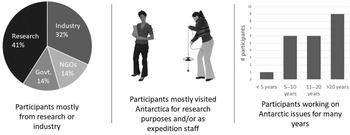
Survey participants were mostly researchers or tourism industry representatives (Fig. 1), although some also came from non-governmental organisations and government. Most had visited the Antarctic continent; only two of the participants had not. The participants were overwhelmingly female (80%). For those who had been to Antarctica, most had visited as a researcher and/or as expedition staff (50%; many researchers had operated in both roles). Other participants had visited as support staff (20%), as tourists (20%) or as distinguished visitors (10%). All but one had worked on Antarctic issues for more than five years, with the majority (41%) having worked on Antarctic issues for more than 20 years. Of the survey participants, 64% perceived themselves to be Antarctic ambassadors.
Survey participant demographics.

Due to the location of the workshop, the geographical spread of the participants in this part of the study had a southern hemisphere bias, with 70% from Australia and 14% from New Zealand. The splits for the workshop participants were similar as most of the survey participants attended the workshop. The working language of the workshop was English.
Survey responses and ranking
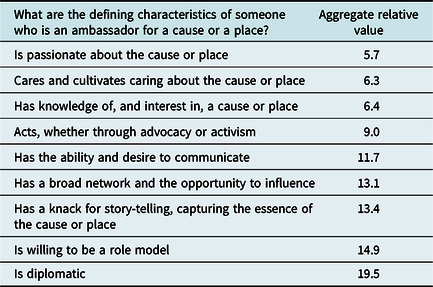
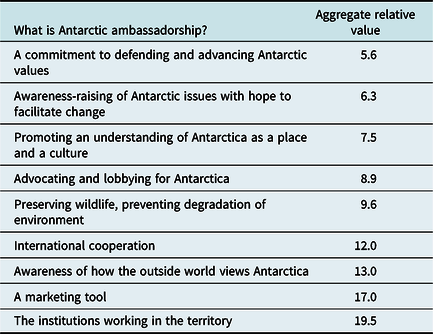
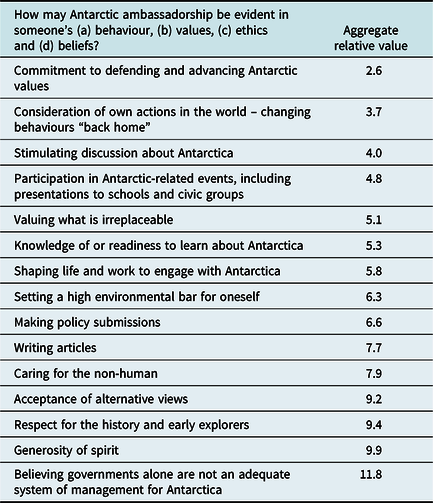
As the online survey collected qualitative data and used open-ended questions, many responses were received for each of the questions (Tables 1, 2 and 3). The responses received in round 1 of the Delphi Study were ranked by the participants of round 2 of the Delphi Study in order of importance, with 1 = of greatest importance and N = of least importance. N denotes the number of attributes identified in round 1, with 9 characteristics of Antarctic ambassadors being considered (Table 1), 9 different definitions of Antarctic ambassadorship being considered (Table 2) and 15 behaviours or actions related to ambassadorship being discussed (Table 3). A frequency count of the rankings for each of the questions was then undertaken and is provided as a relative frequency (out of 100%) to consider different rating systems used by some participants. These relative frequencies are provided in Tables 1, 2, and 3. The lower the aggregate relative values, the more important a feature/characteristic was being considered.
Responses relating to the defining characteristics of an ambassador

Responses relating to Antarctic ambassadorship

Responses relating to evidence of Antarctic ambassadorship

The key characteristics of an ambassador were considered to be passion, caring and knowledge (Table 1), while the key foci of the role that an Antarctic ambassador should play were a commitment to defending and advancing Antarctic values, awareness raising of Antarctic issues and promoting an understanding of Antarctica as a place and a culture (Table 2).
Expert respondents believed that the most important evidence of being an Antarctic ambassador was also a commitment to defending and advancing Antarctic values, consideration of one’s own actions in the world, stimulating discussion about Antarctica and participation in Antarctic-related events (Table 3).
World Café discussions
As part of the Hobart workshop, three World Café discussions were held to address specific issues that were raised during the survey process and in the workshop forums. One World Café discussion related to whether ambassadorship was the same as, or more than, advocacy. The expert participants collectively believed that ambassadorship should be considered as a more holistic concept than advocacy, which typically focussed on a single issue. The group believed that ambassadorship was a state of mind which did not necessarily require action, whereas advocacy was action. Ambassadors were seen as role model and knowledge brokers and included people who were more passive than advocates. Overall, though, there was agreement that ambassadors had to be “more than” advocates.
Another World Café discussion asked whether Antarctic ambassadorship was a transcendental and cross-cultural concept. The expert participants discussed the fact that both France and Australia have official polar ambassadors but noted that France’s and Australia’s understanding and interpretation of the term “ambassadorship” may not be the same. The group discussed the meanings of ambassadorship (legal and figurative), agreeing that the figurative meaning of the term was the focus here and that this was likely to be cross-cultural, but noted that the term did not directly translate into some languages, for example, Mandarin, Russian or Arabic. The group also believed that there are likely to be generational differences in the understanding of the term.
A third World Café discussion revolved around what it means to care about a cause or a place. The expert participants agreed that it was about having an emotional connection and having a reason for caring (be it personal, cultural or political). They believed that caring was about responsibility and self-sacrifice, about priority and that it went beyond a “9-5” duty or involvement. The group agreed that what caring looked like was dependent on the cultural and political context, and that there was a sliding scale of care, that is, that it was not always at 100%.
Passion about a cause or place was the focus of another World Café discussion. The expert group perceived this to comprise several qualities: enthusiasm, commitment, tenacity, energy, drive, responsibility, vulnerability and creativity. Passion was believed to be infectious, a motivator for action and a way of manifesting a relationship with place. The group noted that passion could be loud or quiet and that some cultures embraced passion more than others.
Finally, expert participants were asked to discuss how much and what sort of knowledge was required to underpin Antarctic ambassadorship. The group agreed that a broad base of generalist knowledge, which was solid and accurate, was important. Knowing where to find more information was also considered important. The group suggested that knowledge of the benefits of Antarctica to the global society would be useful. Expert participants believed that the type of knowledge could not be specified, and that there were many types of knowledge: scientific, cultural, economic, political, legal and historical (among others). They further agreed that it was important to be conscious of the social, cultural and political climate in which you were operating as an Antarctic ambassador.
Working definition
The following working definition of Antarctic ambassadorship was derived:
An Antarctic ambassador is someone [i.e., individual or group] who has a connection to, knowledge of and passion for the Antarctic (as a space, place or idea), who represents and champions Antarctica and its values, and who supports Antarctica through communication and behaviour.
While the expert group achieved full consensus on this working definition, several further considerations were raised to acknowledge the framework within which this definition was derived and to accommodate a range of different cultural perspectives and visions in relation to the use, or protection, of Antarctica. Firstly, we are not attempting to define what Antarctic values and interests are (although we acknowledge the explicit recognition of values, including intrinsic, wilderness and aesthetic values, within the Antarctic Treaty System). Secondly, it is implicit to the notion of ambassadorship that it occurs from within an individual’s own socio-political and cultural situation.
We acknowledge that the above definition is a first comprehensive definition of Antarctic ambassadorship that was derived collaboratively by Antarctic experts. We invite scholars and practitioners to critically examine this definition, to test its robustness and applicability to different modi of human engagement with the Antarctic and to fine-tune this definition as appropriate.
Discussion
The concept of “ambassador”, and in particular “Antarctic ambassador” has been understood in myriad ways. The aim of this study was to synthesise approaches, and draw on expert elicitation, to create a working definition that will allow for consistency within academic research on this topic into the future.
The key points raised by participants in this study were that (i) Antarctic ambassadors have a connection to, knowledge of and passion for Antarctica; (ii) evidence of being an Antarctic ambassador was a commitment to defending and advancing Antarctic values and (iii) Antarctic ambassadorship was about more than advocacy – such individuals consider their own actions in the world, stimulate discussion about Antarctica and participate in Antarctic-related events. Each of these findings will now be discussed further.
Connection, knowledge and passion
The first finding – that Antarctic ambassadors have a connection to, knowledge of and passion for Antarctica – indicates that first-hand contact with the continent is not pre-requisite for one to become an Antarctic ambassador. This further suggests that Antarctic ambassadorship has significance beyond the context of tourism. In fact, representations of Antarctica, of creating connections with place in the imagination, may be just as important. The social imaginary can be described as “the creative and symbolic dimension of the social world, the dimension through which human beings create their ways of living together and their ways of representing their collective life” (Thompson, Reference Thompson1984, p. 6). Imaginaries are also “the means by which individuals understand their identities and their place in the world” (Gaonkar, Reference Gaonkar2002, p. 4), and as such can influence collective behaviour (Salazar, Reference Salazar2012). The “Antarctic imaginary” is the set of values, tropes and ideas that people hold about this place, such as heroism, purity, extremity and fragility (Nielsen, Reference Nielsen2017). It has been suggested that these imaginaries influence the experiences of tourists visiting the continent regardless of the different encounters they have (Picard & Zuev, Reference Picard and Zuev2014). Perhaps such “imaginaries” could be moulded and used to facilitate Antarctic ambassadorship, both for those who visit and, more importantly, for those who do not. Research is already considering how Antarctica links to the identities of certain groups of people. For example, the “Antarctic Cities” project (http://www.circlesofsustainability.org/projects/antarctic-cities/ ) includes an investigation of the extent to which the Antarctic connection is important to the formation of contemporary urban identities in Antarctic “gateways”. In 2017, a massive open online course run by Victoria University of Wellington offered learners “a free virtual field trip to Antarctica” and found that learners completed the course with a new sense of interest in and protection of Antarctica (Priestley, Dohaney, Atkins, Salmon, & Robinson, Reference Priestley, Dohaney, Atkins, Salmon and Robinson2018). Considering the role of the Antarctic imaginary, and therefore identity, would allow for a broader exploration of what Antarctic ambassadorship may look like moving forward.
Defending and advancing Antarctic values
The second finding related to the importance of ambassadors having a commitment to defending and advancing Antarctic values. This is unsurprising given that the benefits of humans engaging with the natural environment are often viewed through a human values lens. However, what do we mean by Antarctic values? Antarctic values are explicitly named (though not defined) in the 1991 Environmental Protocol to the Antarctic Treaty (Madrid Protocol) as “the intrinsic value of Antarctica, including its wilderness and aesthetic values and its value as an area for the conduct of scientific research” (Art 3.1). However, it may be that values other than those mentioned in Antarctic Treaty System documents may influence our activities in, and governance of, Antarctica (Liggett & Hemmings, Reference Liggett and Hemmings2013). As such, the first workshop of the Scientific Committee on Antarctic Research Social Sciences Action Group developed a values typology consisting of six values groups: (i) political (cooperation and global commons); (ii) environmental (global health and biodiversity); (iii) societal (history and heritage and national identity); (iv) aesthetic (interpretation and imagination); (v) scientific (knowledge commons and pristine information) and (vi) economic (public and private resource pool) (Liggett and Hemmings, Reference Liggett and Hemmings2013). Since this time there has been substantial further intellectual engagement with the concept of Antarctic values (e.g. Engelbertz, Liggett, & Steel, Reference Engelbertz, Liggett and Steel2015; Shah, Reference Shah2015; Summerson & Tin, Reference Summerson and Tin2018; Tin, Peden, O’Reilly, Bastmeijer, & Maher, Reference Tin, Peden, O’Reilly, Bastmeijer and Maher2019). However, there still exists the question of what advancing these values may look like. This may be a matter of stimulating discussions around values or holding events which focus on values, or it could involve advancing values-based approaches to governance of Antarctica (such as those used in, e.g., Ramm, Graham, White, & Watson, Reference Ramm, Graham, White and Watson2017).
Behaviours and action
The third finding – that Antarctic ambassadorship is about the behaviours of individuals and the actions that they take in the world to champion Antarctica – highlights the importance of “walking the walk”, not just “talking the talk”. This would suggest that for tourists who visit the continent, returning home and telling a few friends about what a great trip it was and showing a few photos, may not constitute becoming an Antarctic ambassador. What then might such behaviour look like? Only a handful of studies have attempted to answer this question. One study found that immediately after participation in Antarctic tourism some respondents joined environmental organisations, donated money to Antarctic protection, avoided the use of environmentally harmful products and voted for election officials who supported environmental protection (Powell et al., Reference Powell, Kellert and Ham2008). Similarly, a study into cruise tourism in the Arctic found that participants expressed a slight increase in some environmentally oriented behaviours such as donating time or money to an organisation, attending meetings in the community about the environment or voting for elected officials that support environmental protection (Manley, Elliot, & Jacobs, Reference Manley, Elliot and Jacobs2017). However, as noted by Powell et al. (Reference Powell, Kellert and Ham2008), three months after the event, these behaviours changed only incrementally. In terms of how “virtual” experiences of Antarctica may change behaviour, we know even less.
Limitations of study
We recognise that there are a few limitations to this study. As noted in section 3.1, the majority of participants (and all of the authors) are based in the Antipodes; hence, the bias towards Antipodean references in the literature review. We also used a top-down expert elicitation method, where most experts were Anglophone. A more culturally diverse group may have led to different responses, particularly given that, as noted in section 3.3, understanding and interpretation of the term “ambassadorship” may not be the same across different cultures. It could also be argued that the term’s meaning should be derived from the way it is used in practice: would those who are being exhorted to act as ambassadors interpret the concept in the same way as the experts?
As with any research methods, there were also limitations to the Delphi method and the World Café approach. Limitations of the former include the potential for imposing preconceptions or own view during analysis and ignoring or not sufficiently investigating disagreements. Limitations of the latter include early conclusion of active debates due to the requirement to move to the next stage of the process frequently. However, we hope that by giving all participants the opportunity to contribute to/correct the final report of the study, these limitations were addressed. The process could also be repeated in future within other national and cultural contexts, in order to elicit alternative perspectives.
Suggestions for future research
We envisage that this paper could provide a foundation for an entire programme of research regarding Antarctic ambassadorship.
Conceptually, ambassadorship has been considered in a number of fields and professions (as identified in section 1.1), in some cases going beyond advocacy and including individual beliefs, values and goals. A next step may be to draw on research from other fields to ask questions about what it means to be an ambassador for a place, rather than for a field or profession. Questions also arise regarding how the concept of Antarctic ambassadorship translates across cultures and languages or whether it is, in fact, Anglo-centric. One of Antarctica’s largest growth markets is China; how does this concept translate not only for Chinese tourists but also for those from the country that cannot visit the continent?
As to how Antarctic ambassadorship plays out in reality, there are many more questions. There are questions linked directly to the definition itself. How do the different facets of ambassadorship (connection/knowledge/passion; defending and advancing values; behaviour and actions) develop and interact with each other? Are there aspects that evolve first, or do they co-emerge? How can such facets be created and/or fostered? Questions also arise regarding how developing such facets transforms an individual, and whether such a transformation could be a useful model for ambassadorship of other environmentally significant and vulnerable regions such as the Amazon and the Australian Great Barrier Reef.
Conclusions
In this article, we have presented a deep dive into the concept of Antarctic ambassadorship, particularly regarding the meaning and characteristics of the term. We argue that without this basic initial step, it is impossible to undertake any meaningful investigation into whether visitors to the continent do indeed become ambassadors, and what forms ambassadorship can take. A clearer understanding of the concept of Antarctic ambassadorship has important implications for policy, particularly regarding tourism practices and management. If the concept is well defined, it can in turn be well researched, and findings on how to maximise the positive effects of interactions with the place can feed into guidelines relating to best practice.
However, the proposed definition also has significance beyond the context of tourism. If the characteristics of an ambassador are passion about, care for, knowledge of and interest in a place, and promoting an understanding of Antarctica as a place and a culture, there is a potentially large pool of people who can inhabit the ambassador role from afar, as none of the characteristics necessitate first-hand contact with the continent. Investigating ways in which ambassadorship can be effectively fostered through a remote relationship with Antarctica (through, e.g., narratives or visual texts) is an important area of future research. This paper proposed the first comprehensive definition of Antarctic ambassadorship to provide a cornerstone upon which future research, and a more informed governance of Antarctic tourism, can be built.
Acknowledgements
The authors would like to thank the University of Tasmania for funding this research through the 2018 MAM Seed Grant fund.