INTRODUCTION
On this occasion, I am assessing a series of poetical and musical pieces of evidence linking the portrait of African and Afro-descendant populations in Hispanic America over the last 300 years (late 16th century to late 20th century). Specifically, I aim my interest on Siglo de Oro’sFootnote 1 artistic productions to the present-day tradition of Mexican Son Jarocho, singling out the son known as Son de los Negritos [Son of the Little Black Men].Footnote 2 Traditional Son Jarocho developed in the region known as the Sotavento in the Gulf of Mexico (Figueroa Hernández Reference Figueroa Hernández2007: 75). Scholars such as Daniel Sheehey (Reference Sheehy1979), Antonio García de León (Reference García de León2002a, Reference García de León2002b: 53–Reference Sanders70, Reference García de León2009), Rolando Pérez Fernández (Reference Pérez Fernández and Loza2003: 39-56), Rafael Figueroa Hernández (Reference Figueroa Hernández2007), and Ricardo Pérez Montfort (Reference Pérez Montfort, de Antuñano Maurer and Lara2004: 187–218, Reference Pérez Montfort2007, Reference Pérez Montfort2015) have researched this particular Mexican music and culture.
Veracruz, the main city in Sotavento, was the most important sea port in New Spain (present-day Mexico). Consequently, it became the main entry of European and African influences to the Viceroyalty. The arrival of the African influence in New Spain occurred mainly in the 16th and 17th centuries in two ways:
-
a) It arrived already mixed from the Iberian Peninsula and the Caribbean as a consequence of a long process of transculturation.
-
b) It arrived directly from Africa, especially from Angola and Kongo, due to the slave trade controlled by the Portuguese (Vila Vilar Reference Vila Vilar2014).
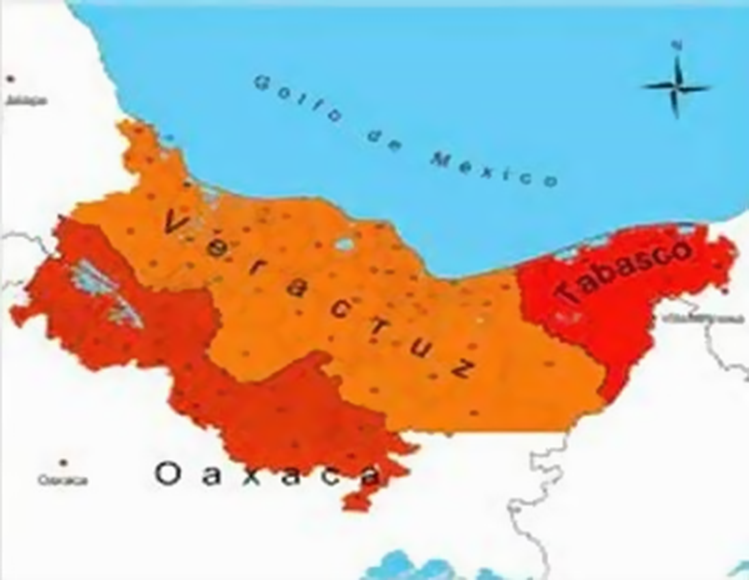
Precisely, among members of the Jarocho community, there is an increased interest in showing and constructing a sense of what is authentic around blackness in Jarocho tradition and the Gulf of Mexico (Figure 1). This inclination is a consequence of the historical discrimination against Afro-descendants and Indigenous communities in Mexico. To not only resist the narratives that tried to wipe out these cultural influences from Veracruz’s cultural history, but also to highlight them, some members of Jaranero and Jarocho communities founded and led the artistic construct of “Afrojarocho” (Barros de Oliveira and Chamorro Escalante Reference Barros de Oliveira, Escalante, del C. Luna Ruiz and Antele2018: 41).Footnote 4 In this posture, there are a number of sones, such as El Chuchumbé, El Toro Zacamandú, and the aforementioned Son de los Negritos, considered authentic historical links between present-day Jarochos and a sense of African past and the Modern Age slave trade (Alcántara López Reference Álcantara López2016: 117–148; Deiselene Barros y Chamorro Escalante Reference Barros de Oliveira, Escalante, del C. Luna Ruiz and Antele2018: 34–35; Guardarraya Son Jarocho 2019; Ramírez Uribe Reference Ramírez Uribe2020: 131–153; TeleUV 2022).
Sotavento’s region, in modern day Mexico.Footnote 3

Precisely, the 16th and 17th centuries were the period in which most amounts of people from different areas of West-Central Africa were transported and sold as slaves in New Spain.Footnote 5 The increase of African and Afro-descendant population in the Viceroyalty, mainly speakers of Kikongo, Umbundo, and Kimbundu, is linked to the Portuguese asiento contracts with the Spanish Crown between 1590 and 1640.Footnote 6 Following Margit Frenk (Reference Frenk2007, 27–29), there was a very intense transversely within cultural and social layers in the empires’ territories, which developed a common popular Hispanic American culture with adaptations in its different sub-regions. This process also included New Spain and the imagery around Africans and their descendants (Camba Ludlow Reference Camba Ludlow2008).Footnote 7 Nonetheless, it is fundamental to understand how these communities took agency, alongside how their cultures adapted to diverse territories, which included important cities in the Viceroyalty, such as Mexico City and Puebla de los Ángeles, and also rural areas like the hinterlands, coasts, and mountains in which Son Jarocho configured since the late 18th century onwards. Thus, several questions arise:
-
1. Is there any historical trace of African/Afro-descendant cultural-musical reality in Son de los Negritos?
-
2. Is this Son Jarocho just a reproduction of Siglo de Oro’s imagery around the Black communities?
-
3. Is the blackness around Son de los Negritos a modern Jarocho construct?
Tackling these research questions requires a close analysis and dissection of historical, poetic, and musical evidence. The sources selected span a timeline longer than three hundred years at different locations across the Atlantic Ocean, which once were all part of the political entity known as the Spanish Empire. I choose eight examples from the 17th century’s Spanish multi-cultural landscape, five from the Iberian Peninsula, and two from New Spain. Such evidences come from religious and secular repertoires that portray Black stereotypes, such as villancicos,Footnote 8 entremeses,Footnote 9 and mojigangas. Footnote 10 Jumping ahead to the 20th century, I mainly use my transcription of one version of Son de los Negritos recorded by the Utrera family (1996). However, different versions of this son were transcribed and reported throughout the 20th and 21st centuries. For instance, Daniel Sheehy (Reference Sheehy1979) and Antonio García de León (Reference García de León2009) had previously studied examples of this Son Jarocho.
Aside from seeking an answer to the afore-stated questions, this research also assesses the level of repertoire’s circulation and exchange within the social spheres and discourses in the transatlantic Spanish Empire. To weave this wide range of geographies, cultural landscapes, and epochs, I use a methodology that intertwines the analytical perspectives of oral and written traditions on the lyrical and musical content of the selected repertoire. On the first hand, by combining the methodological tools of “Thick Description” (Burke Reference Burke, Burke and Aristu1996: 287–305) and Jim Sharpe’s “History from Below” (Reference Sharpe, Burke and Aristu1996: 38–58) with Gwyn Prins’ perspectives on oral history (Reference Prins, Burke and Aristu1996: 144–176), I study the previously mentioned repertoire, considering its lyrical content and musical rhythmic and melodic lines within its cultural and temporal context. This last element considers the marginalized daily life that most African and Afro-descendant populations endured during the 17th century in Spain and its colonies. At the same time, this intertwining allows me to assess the continuity and adaptation of certain cultural elements inside a collective’s memory. On the other hand, the concept of the “indiciary paradigm,” which tries to reconstruct, or better said, construct, a historical narrative for subaltern groups by identifying hints within historical documents, finds an echo in the Mexican microhistorical perspective of Luis González (Ginzburg Reference Ginzburg1991, Reference Ginzburg1994). This last researcher proposes that oral tradition is a valid source for reconstructing the history of places, cultural groups, or societies usually neglected by mainstream history (González Reference González1968).
In the literary studies field, researchers such as Margit Frenk (Reference Frenk2006) and Mariana Masera (Reference Masera and Masera2002: 91–112; Reference Masera, Masera, Membrillo and Hernández2004: 174–188) have pushed forward to identify and comprehend the presence of oral tradition inside the written word. Frenk emphasizes that the poetical verse is not only a sonic phenomenon, but also a written one (Reference Frenk2006: 160–161). At the same time, she insists that the transmission of poetry during Siglo de Oro mostly occurred through oral channels such as reading out loud, recitation, and singing of memorized verses (Frenk Reference Frenk2006: 159). Also, Clara Bejarano, in her descriptive essay about the musical market in Seville during Siglo de Oro, indicates that hearing was one of the most important senses to reach the population’s consciences (Reference Bejarano Pellicer2013: 223). These studies help to set a connection between different popular artistic manifestations during the 16th and 17th centuries in the Spanish territories and how materials and artists of different spheres interacted with each other. One example of such dynamics is the Spanish villancico. Thus, this meta-genre shows clear evidence of social realities; henceforward, it cannot be perceived as a pious entertainment any longer (Borrego Gutiérrez Reference Borrego Gutiérrez, Gutiérrez and López2019: 63, 64; Ramírez Uribe Reference Ramírez Uribe2021: 83–87).
POPULAR THEATRE AND RELIGIOUS VILLANCICO DURING SPANISH’S SIGLO de ORO
According to Maricarmen Gómez, villancico, as a popular poetical and musical form, started to be implemented in a religious sphere by orders of Queen Isabella I of Castile’s confessor and archbishop of Granada: fray Hernando de Talavera (Reference Gómez and Gómez2012: 165). The reason that led to this decision was its use to convert and indoctrinate Muslim and Jewish populations into Catholicism and the Castilian culture. Talavera identified vernacular Castilian language, characters, and themes as channels of hegemonic culture (Gómez Reference Gómez and Gómez2012: 165). Therefore, the religious villancico became a significant tool for controlling a heterogeneous and multi-cultural population. Moving forward into the 16th and 17th centuries, the appropriation and retransmission of popular and peripheral cultural manifestations to develop theatrical plots, characters, songs, and poetry increased in the Iberian Peninsula.
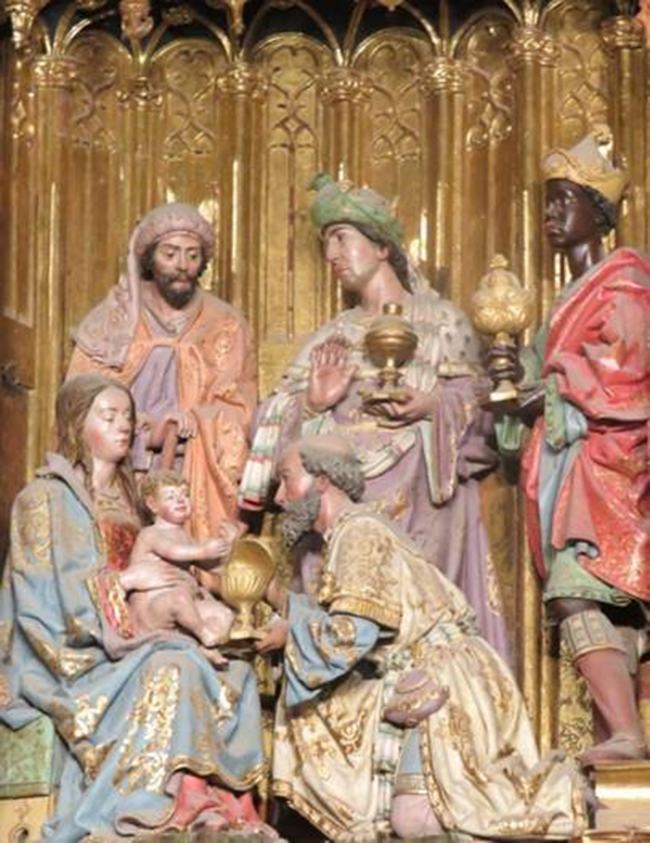
At the same time, these popular theatre expressions re-adapted as tools for creating a status quo within the boundaries of Spanish territories and interests. Church and State, as the highest artistic sponsors at the time, usually determined what, when, and how artistic manifestations happened. Thus, theatre, music, and other public art manifestations, according to María Condor’s proposals, were effective instruments of propaganda that sought to control people’s wills and mentalities to integrate them into a particular way of understanding and living within the Spanish society (Reference Condor2021: 36). To Bejarano, public celebrations, such as Christmas or Corpus Christi, were the ideal space for the ruling classes to reassure their status and to demonstrate how the rest of the population had to behave (Reference Bejarano Pellicer2013: 221, 222) (Figure 2).
Epiphany scene, Toledo’s Cathedral. Author’s photograph [Claudio Ramirez-Uribe].

Popular theatre and religious villancicos portrayed a multi-cultural society with clear limits and prejudice between the cultural and ethnic characters within Spanish imagery. In Condor’s words, people who dwelled in the boundaries of a determined society or went against it were expelled from it or reduced to an irrelevant role (Reference Condor2021: 34). That “other” or irrelevant role, inside the Spanish theatre of the 16th and 17th centuries was everyone who was not Castilian: Basques, Galicians, Catalonians, Black people, Indigenous people, Portuguese, French, Italians, Jewish people, Moriscos, Roma people, and vast etcetera.
Such multiple “other” was seen and interpreted from the hegemonic vision of the epoch and often became assimilated in social psychology through the constructions of parodies and stereotypes, commonly discriminative and alienating. Particularly concerning the Black character in this imagery, Isidoro Moreno describes the African and Afro-descendant portrayal as predominantly irrational, childish, and playful people (Reference Moreno Navarro, Espinoza and Hernández2018: 28–31). However, the most significant element in the construction of the Black stereotype was the way it pronounced the Castilian language (Ramírez Uribe Reference Ramírez Uribe2021: 88). In the case of this article, I am focusing my attention on a particular formula, or “word core,” following Gwyn Prins (Reference Prins, Burke and Aristu1996: 155), related with how the Black characters stereotypically talked. This formula was repeated, with some variations, in all the sources studied, including Son de los Negritos: “gurumbé, gurumbé, gurumbé/que faze nublara, que quele yové.”
GUINEO, CUMBÉ, AND ZARAMBEQUE
As Faustino Núñez indicates, for many centuries, the term Guinea, similar to Ethiopia, was a synonym for Africa in the Iberian Peninsula (Reference Núñez2021: 242). At the same time, since the 16th century, the term guineo was the label used in Spain to define an Afro-descendant song and dance without necessarily trying to link it to the African region of Guinea. Rodrigo de Reynosa, in his coplas [verses] written between 1516 and 1520, made the first mention, known up to this day, of guineo as a dance in the Spanish territories (de Reynosa, ca. 1516–1520: ff. 1–2v.) (Reynosa ca. Reference Reynosa1516–1520a: 1-2; ca.Reference Reynosa1516–1520b: 2v.). Also, in 1567, the governor of the Canary Islands, Eugenio de Salazar, mentioned that the Black militia “…sounds everything in resemblance of the gurumbé, or chanchamelé and other guineos…” (Swiadon Reference Swiadon Martínez and Masera2002: 44). Later on, Covarrubias wrote about the guineo as a Black people dance in his Tesoro de la Lengua Castellana (Reference Cobarruvias Orozco1611: f. 457v.). According to Cotarelo ([1911]Reference Cotarelo y Mori2000: ccl-ccli), Pujol-Coll (Reference Pujol-Coll2021: 55), and Núñez (Reference Núñez2021: 246) the verses “gurumá gurumé/que faze nublaro y quiere yové” or “gurrumé, gurrumé gurrumé/que faze nubrado y quiele yové” are part of this dance/song.
From her part, Meira Goldberg indicates that this poetical and musical formula relates to cumbé, another dance associated with Black people during the Spanish Modern Age (Reference Goldberg2019: 64). Núñes mentions that the oldest reference to this dance is from the early 18th century, but traceable to the guineo dance since the 16th century (Reference Núñez2021: 293). Craig Russell claims that, slowly, by the end of the 17th century and the beginning of the 18th, the term cumbé displaced the old term guineo. This researcher also describes the elements of this dance, such as the common change of musical meters between 6/8 and 3/4, or hemiola, the pause at the beginning of the musical phrase, and the use of harmonies that lean on the relation between the first and the fifth cord of a scale (Russell Reference Russell, Rodicio, López-Calo and de la Cuesta1999: 310). These characteristics are also identified by Núñez (Reference Núñez2021: 296). However, there is a third proposal linking this formula to another dance related to Black people in the Spanish Empire in the 17th century; according to José Luis Cortés, these verses also appeared as part of the zarambeque dance (Reference Cortés López2019: 381, 382). It is interesting to analyse how guineo, cumbé, and zarambeque were usually described with similar characteristics.
The Spanish Diccionario de Autoridades (RAE 1726–1739), in 1729, described cumbé as a “Black people’s dance that follows a tune of a cheerful twang named in the same way, consisting of wiggling the body profusely from one side to the other.” In the case of guineo, the description provided by this source in 1734 was: “Certain sort of dance or dancing performed by fast, rapid movements and indecent and ridicule gestures. It is a dance typical of Black people; this is why it has that name.” Finally, the Diccionario describes the zarambeque in 1739 as: “a very cheerful and bustling twang and dance that is very frequent amongst Black people.”Footnote 11 After comparing these descriptions, it is not surprising that, in Reference Roxo de Flores1793, Felipe Roxo de Flores linked these three dances with each other and the Black cultural experience in the Hispanic America (Reference Roxo de Flores1793: 104).
However, the first known appearance of the word “gurumbé” in a written document is in the well-known Christmas ensalada from around 1526 to 1535 by Mateo Flecha, the elder, La Negrina. Footnote 12 Researchers, such as Núñez (Reference Núñez2021: 245) and Cotarelo ([1911]Reference Cotarelo y Mori2000: ccl), link La Negrina with the guineo. Goldberg associates Flecha’s ensalada with the cumbé (Reference Goldberg2019: 64). Gómez, from her part, indicates that La Negrina presents lyrics in Spanish, Catalan, and Portuguese (Reference Gómez and Gómez2012: 192). It seems that Gómez identifies the language spoken by the Black characters in the ensalada as Portuguese, with verses such as “San sabeya gugurumbé/alangandanga gugurumbé,” but there is a reason for Gómez’s posture (Ramírez Uribe Reference Ramírez Uribe2024: 252, 322, 323).
RELATIONS AND INFLUENCES BETWEEN KONGO, NDONGO, AND PORTUGAL AND ITS IMPACT IN GURUMBÉ/GURUMBÁ: A KEYWORD
The first representations of Black stereotypes originated in Portugal around the late 15th century with authors such as Fernão de Silveira and Gil Vicente. One of the most significant elements in these early characters is the parody of how Africans might pronounce the Portuguese language, the so-called lingua de preto. When the Black Portuguese character arrived in Spanish domains in the 16th century, the lingua de preto was adapted to pronounce the Castilian language; however, this habla bozal, or habla de negro, as it was named, kept using Portuguese and possible African words in it, such as “gugurumbé” or “gurumbé.” It is pivotal to dwell on this word, since current members of the Jarocho community are constructing a narrative of an “authentic African past” around it (TeleUV 2022).
To do so, approaching Portugal’s commercial interests in Africa becomes essential. This can explain the development of the Black character in Portugal and the possible origin of the words gurumbá/gurumbé, such as the ones inserted in Mateo Flecha’s La Negrina, in Spain. Thus, I am proposing that the origins of the words gurumbá/gurumbé are traceable to the Kikongo, Umbundu, and Kimbundu languages and the Portuguese interactions with these African ethnic groups in the Kongo and Ndongo regions in the early 16th century, via the island of São Tomé. Despite that the major influence of the Bantu cultures of these regions in Spain and its colonies was a product of the Portuguese slave trade developed during the union of both Iberian kingdoms between 1580 and 1640 (Ngou-Mve Reference Ngou-Mve1994; Vila Vilar Reference Vila Vilar2014).
During the 15th century, seeking gold, ivory, and slaves, alongside founding trading posts to protect the sea route to India, pushed the Portuguese activities further south of the African continent. A pivotal geographical point for the commercial interaction between Portugal and the different kingdoms and regions in West Africa was the island of São Tomé in front of the Gulf of Guinea. According to Catherine Coquery-Vidrovitch and Éric Mesnard, the Portuguese first arrived in São Tomé in 1472 (Reference Coquery-Vidrovitch and Mesnard2015: 92). The fact that the island was inhabited catalysed the creation of an important human and economic laboratory for Portugal’s crown, based on sugar cane plantations powered by enslaved work (Oliveria Pinto Reference Oliveira Pinto2016: 165; Coquery-Vidrovitch and Mesnard Reference Coquery-Vidrovitch and Mesnard2015: 92). Gerhard Kubik indicates how this island was relevant for the cultural interchanges between Portugal and the African region of Angola (Reference Kubik and Castelo-Branco1997: 381).
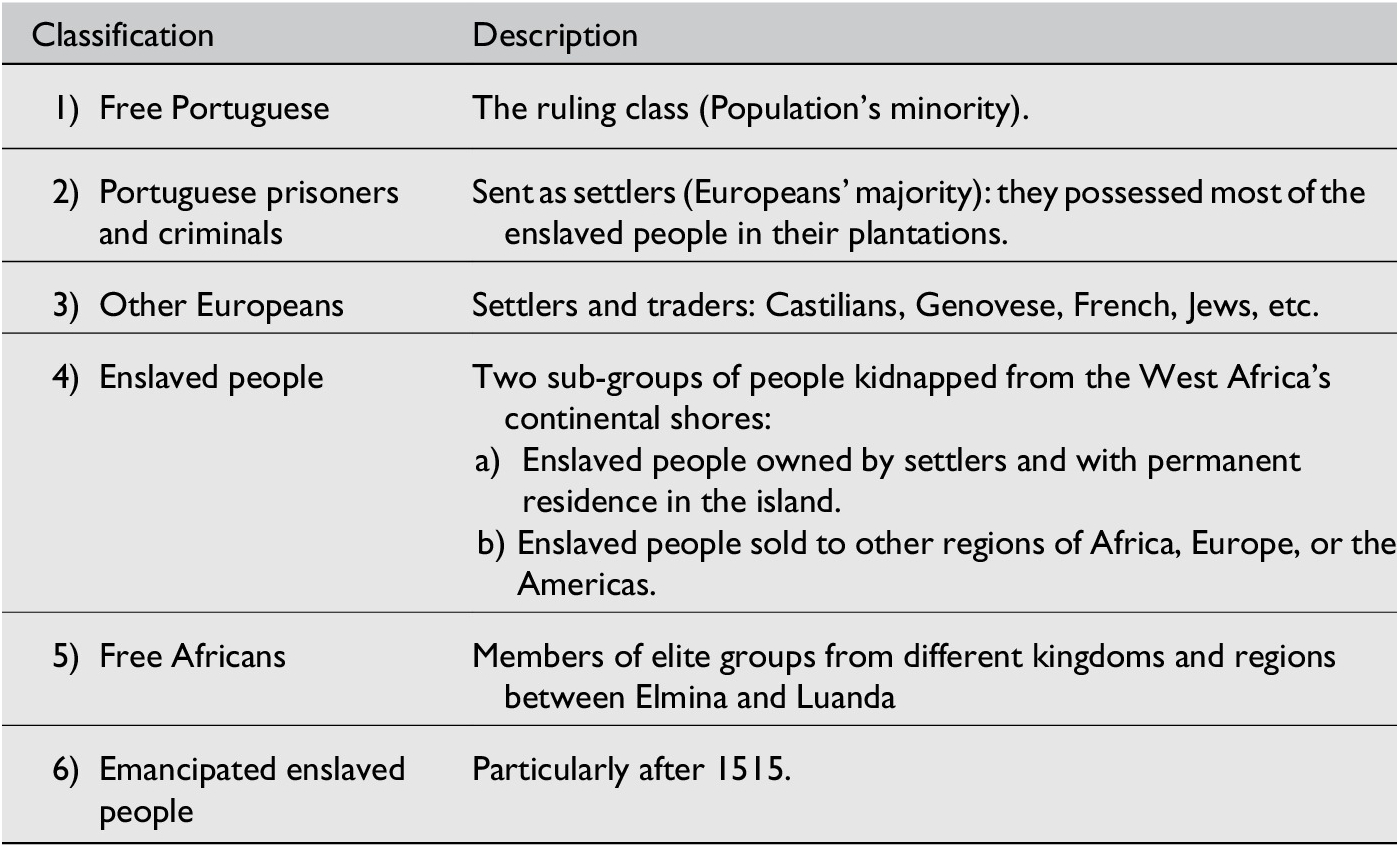
In 1485, João II, the King of Portugal, allowed the settlers of São Tomé to trade slaves and other goods, minus gold, in the area between the fortress of Elmina, in present-day Ghana, and the Kongo/Zaire River (Oliveira Pinto Reference Oliveira Pinto2016: 164). Around 1506, the island had 2000 enslaved people established in the region, kidnaped from the Niger River region, but mainly from Kongo; by 1540, their number increased to around 5000 or 6000 (Coquery-Vidrovitch and Mesnard Reference Coquery-Vidrovitch and Mesnard2015: 93). At the same time, the court at Lisbon often welcomed aristocracy from the Kongo Empire for their aid in the colonization of São Tomé and their involvement in the sugar production and slave trade. Likewise, since the 1490s, some emancipated Black slaves in Lisbon learned how to read and write or became priests with the sole purpose of going to São Tomé to work as interpreters or missionaries. Finally, as Oliveira Pinto indicates, the King of Portugal determined freedom for all enslaved African women in São Tomé who gave birth to a son with a European father. This dynamic, replicated in Congo and Angola, developed a link population of mixed people loyal to Portugal and, at the same time, that was capable of dealing with local African authorities (Oliveira Pinto Reference Oliveira Pinto2016: 165–168). Oliveira Pinto groups São Tomé’s settlers into six categories (Reference Oliveira Pinto2016: 165–168) (Table 1):
Oliveira Pinto’s Classification for São Tomé’s Settlers

The pressure of São Tomé settlers and slave traders in the kingdom of Kongo provoked that in the early 16th century, the Manicongo or Kongo-dia-Ntotila formally complained to his peer, the King of Portugal, via ambassadors and formal letters. Eventually, these political tensions encouraged the Portuguese to start commercial and political relations with the region of Ndongo and its ruler, the Ngola (Oliveira Pinto Reference Oliveira Pinto2016: 181–191). In 1514, the Ngola Kiluanji kia Samba sent emissaries to Lisbon, but they were retained at São Tomé. For this reason, in 1520, the King of Portugal sent Manuel Pacheco e de Baltasar do Castro to the Kingdom of Ndongo (Oliveira Pinto Reference Oliveira Pinto2016: 192). All this information allows me to set a relationship of influence between the cultures of Kongo and Ndongo, and Bantu languages like Kikongo, Kimbundu, and Umbundu, with the Portuguese commerce in Africa and the Iberian Peninsula since the early 16th century; at the same time, it enables me to establish a connection between gurumbé/gurumbá’s phonetics and the aforementioned languages.Footnote 13
To Craig Russell, gurumbé, meaning the word that appears in dances and villancicos in the environment of Siglo de Oro and the Jarocho Son de los Negritos, holds a close relation with cumbé and different variants, some of them from or posterior to the 17th century, such as paracumbé and maracumbé (Reference Russell, Rodicio, López-Calo and de la Cuesta1999: 310). García de León has indicated that all these terms intertwine by a phonetic similarity and a symbolic reference to fertility dances in which the dancers touch each other bellies (Reference García de León2002a: 170).
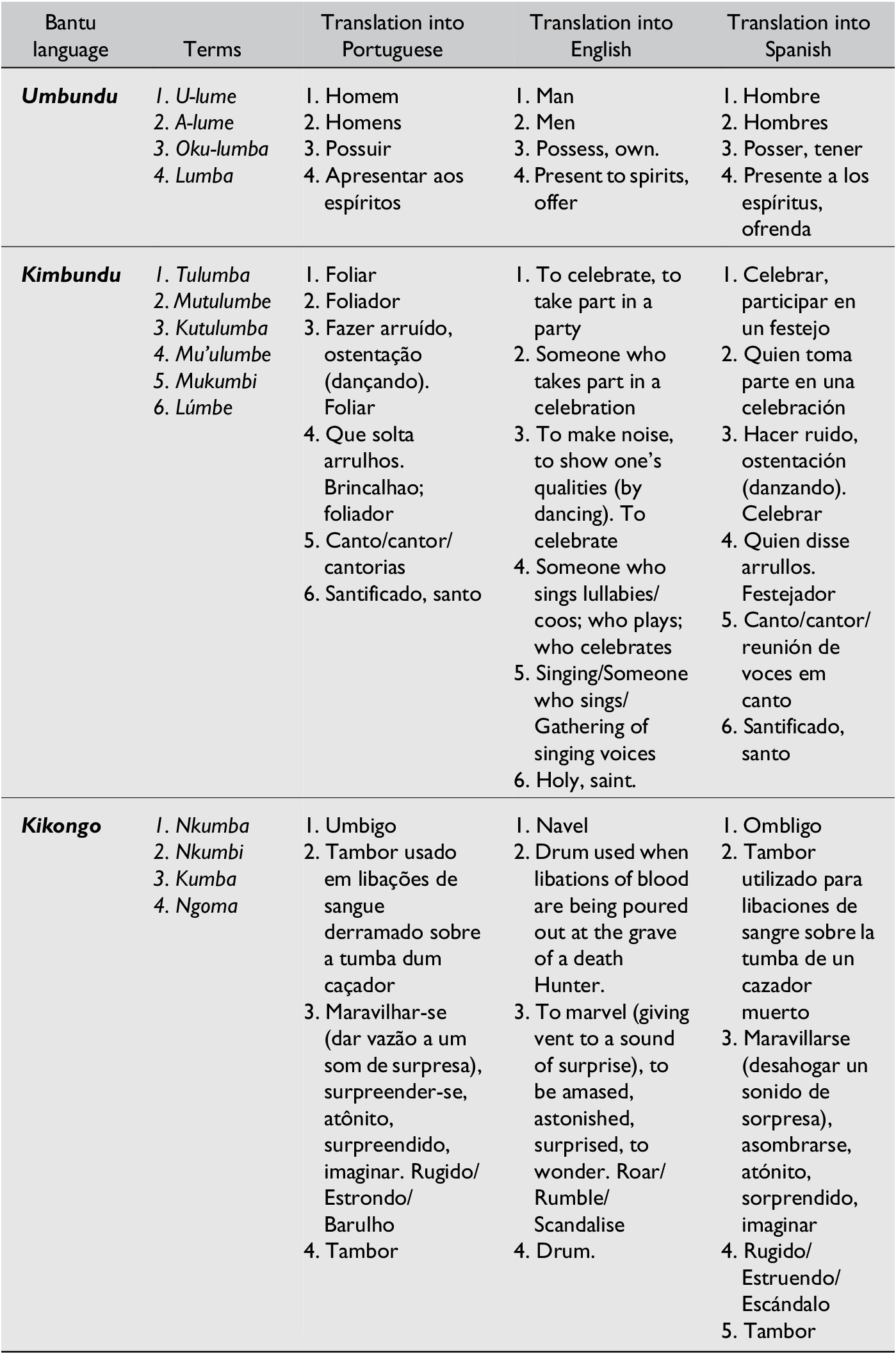
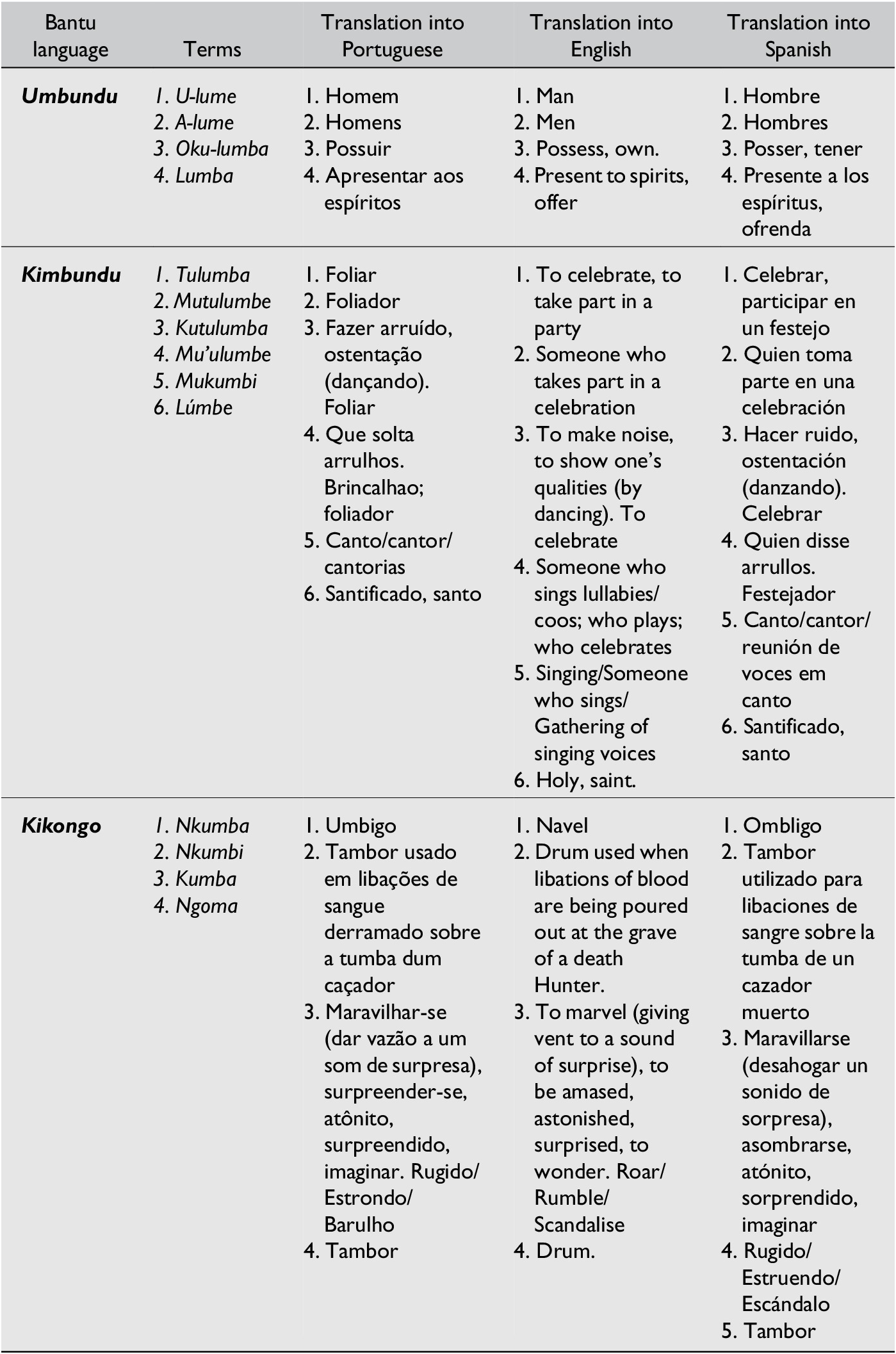
Meira Goldberg (Reference Goldberg2019: 64) and Nicholas Jones (Reference Jones2019: 55) relate gurumbé/gurumbá with cumbé and other dances with names ending in –umbe. What is relevant in Jones’ research is the mention of the Afro-Cuban term lumbe, presented, as he indicates, in the Kongo-descendant rituals of Regla de Palo (Reference Jones2019: 55). He describes lumbe as a word that: “…cannot be translated literally but instead operates as an exclamatory announcement that conjures one’s ancestors, ancestral home, and spirits of the dead…” (Reference Jones2019: 54). Although I do not believe that this term originated in Regla de Palo, which became firmly established until the 19th century, and that there is no literal translation of the word, it is interesting that Jones semantically relates gurumbé with lumbe (Jones Reference Jones2019: 55, 56). Mexican/Cuban researcher Rolando Pérez Fernández links the word gurumbá with the Kimbundu word tulumba [To celebrate].Footnote 14 I present a table with terms extracted from Kimbundu, Kikongo, and Umbundu (Table 2). I focused my search on terms related to music, celebration, or spirituality with a close phonetic relation to the words gurumbá/gurumbé and lumbe/cumbé.
Possible Bantu words related with gurumbá/gurumbé and their meaning (Sanders Reference Sanders2018 [1885]; Bentley Reference Bentley1887; Pereira do Nascimento Reference Pereira do Nascimento1903; Laman, Reference Laman1936; Assis Junior Reference Assis Junior1949; Silva Maia Reference Silva Maia1994 [1961]).
ANALYSED EXAMPLES FROM SIGLO de ORO
Considering all the information presented so far, it is possible to determine a long process of transculturation, appropriation, and re-signification (or AREPOs) of Bantu meanings in the Iberian Peninsula, first in Portugal and afterwards in Spain and its colonies. Concretely, the “word core” gurumbé/gurumbá holds a special signification since it became a symbol to signify Black music, as it was deeply associated with popular Hispanic and Hispanic American dances such as guineo, cumbé, and zarambeque. However, the complex process of portraying Black characters in the Spanish imagery incentivized religious and theatrical repertoires to adopt these Afro-descendant words to develop a literary reference of African communities and their descendants in the Spanish Empire’s spectrum.
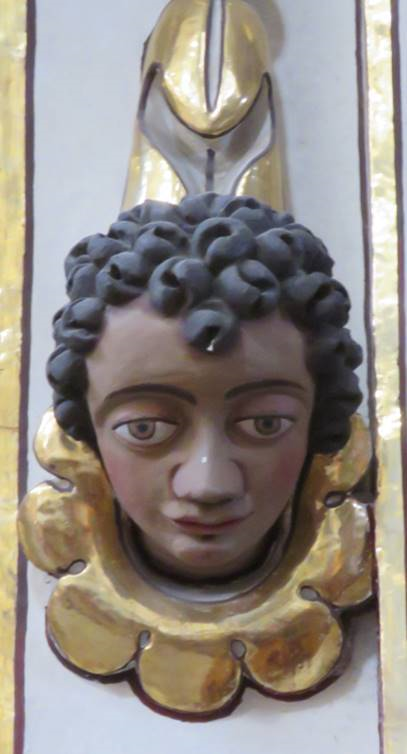
I expose and translate eight excerpts from seventh century poetical references that quote variations of the previously mentioned “word core.” In doing so, it is essential to situate the repertoire in its historical context. As Sharpe indicates, by framing traits, situations, and social groups into their historical and cultural spectrum, it becomes possible to surpass a merely descriptive study and have a broader analysis (Reference Sharpe, Burke and Aristu1996: 54). The Black character in the Hispanic American started as a parody of Afro-descendant practices in the wide Hispanic American range. Thus, Black characters eventually moved from being musical and literary representations to models of how Black people “should behave,” talked or being, or were expected to by the hegemonic and popular imagery (Figure 3).
Rosario’s Chapel, Puebla (Mexico)—Excerpt showing a Black man’s head from the 17th century. Author’s photograph [Claudio Ramírez-Uribe].

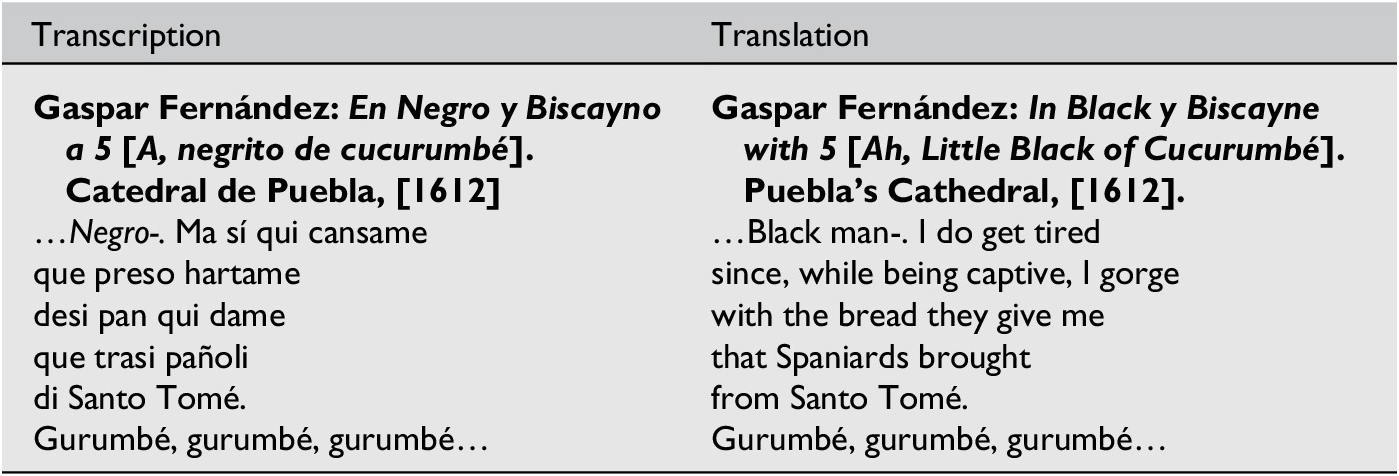
Gaspar Fernández, chapel master in Puebla de los Ángeles’ Cathedral, in New Spain, musicalized the first example in 1612 (Table 3). It is a religious villancico for to the Corpus Christi celebration, which contains only the first verse of the poetical formula of “gurumbé, gurumbé, gurumbé/que faze nublara, que quele yové” (Fernández [Reference Fernández1612]: ff. 120v.–121).
First Example

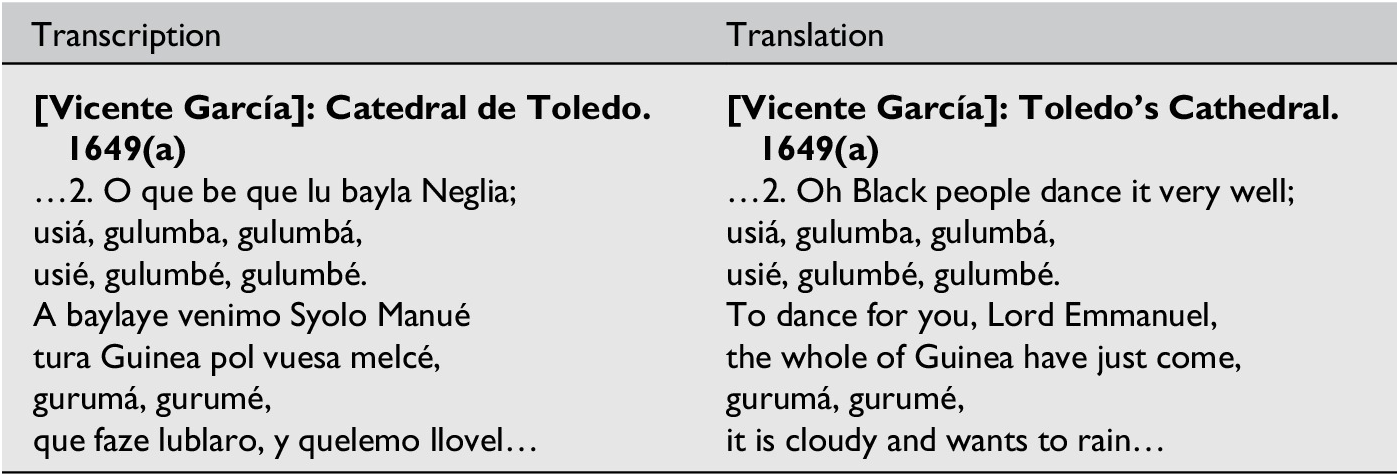
The second reference (Table 4), published in Toledo’s Cathedral, Spain, in 1649, represents the first mention I can identify of the verse “que faze nublara, que quele yové,” or at least one variant. This Christmas villancico also presents a variation of gurumbé/gulumbe/gurumé, presenting also gulumbá/gurumé ([García] Reference García1649: ff. 5-5v.).
Second Example

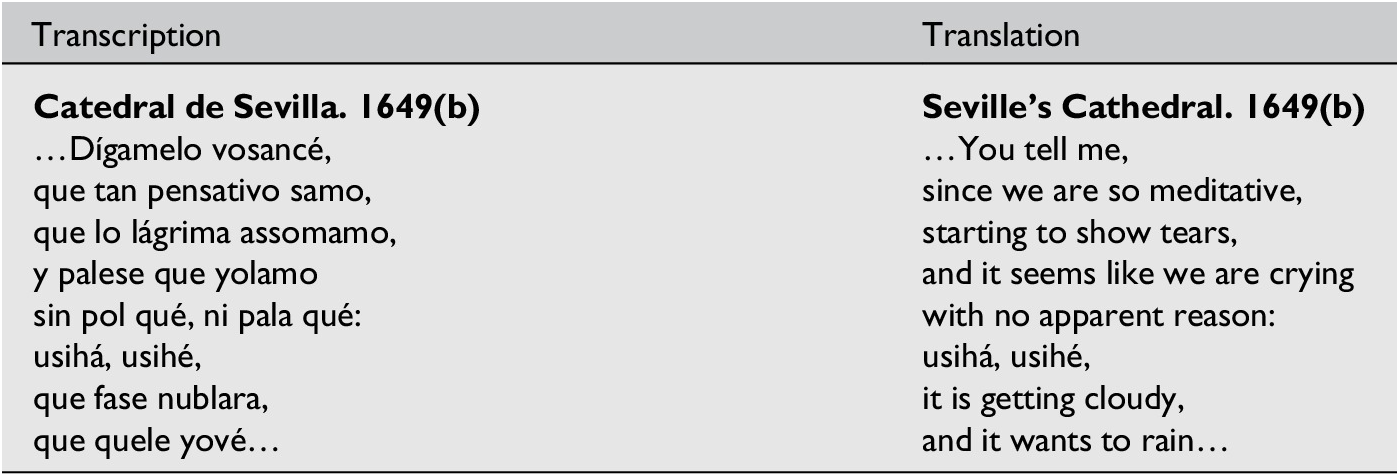
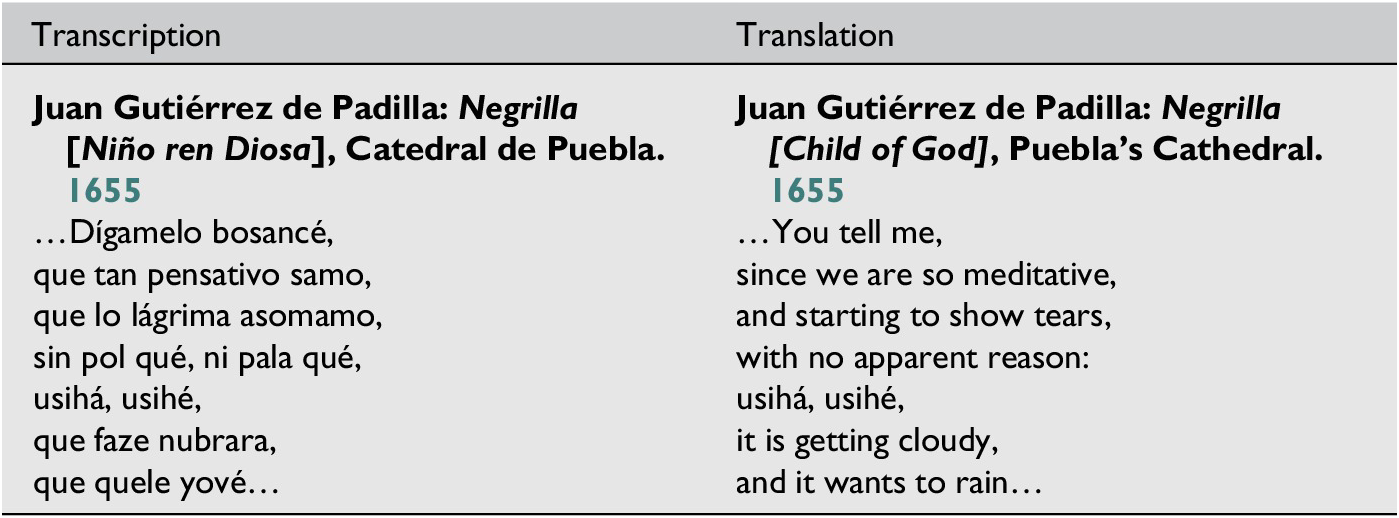
Also from 1649, but in this case from Seville’s Cathedral, Spain, the third example is another Christmas villancico (Table 5). Interestingly, the author completely replaced the words gurumbé or gurumbá for usihá, usihé another literary formula that was common in different villancicos that represented Black characters (n.a. 1649: ff. 3-3v.).
Third Example

Six years later, in 1655, this exact villancico was included by Puebla’s next chapel master, Juan Gutiérrez de Padilla, in his Christmas cycle (Table 6). The lyrics between the previous example and the latter are practically the same, minus minimum local variants and the organization of the stanzas (Gutiérrez de Padilla 1655: Altus 2° booklet) (Stanford Reference Stanford2002; Tello, Franco, and Maní Andrade Reference Tello, Franco and Andrade2015). What is relevant about this example, alongside with Fernández’s, is that it contains written music that can be analysed and compared with other sources. Likewise, this is a testimony of how the Black stereotype in Hispanic America has to be included, with regional shades, in the transatlantic circulation of musical and poetical repertoires between Spain and its territories.
Fourth Example

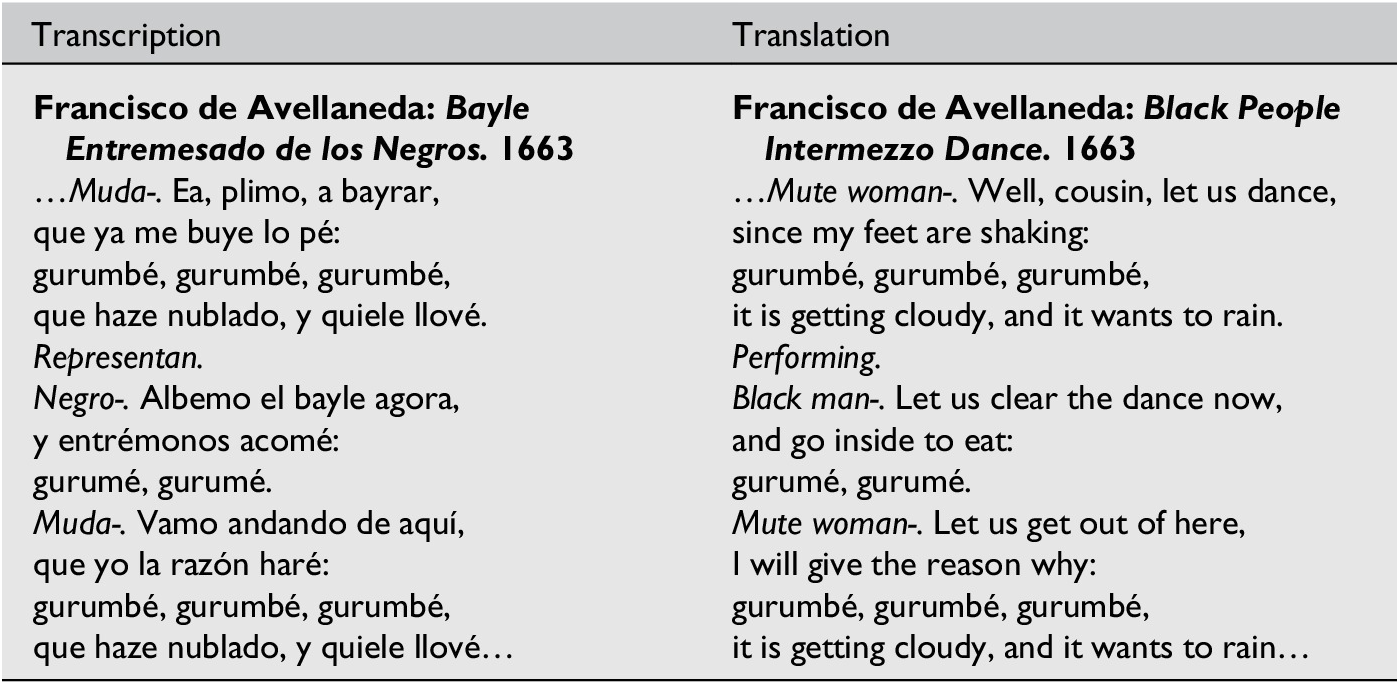
The fifth example, extracted from the popular secular theatre, is entitled Baile Entremesado de los Negros. It was written in Madrid, Spain, by Francisco de Avellaneda, a priest, in 1663. This entremés is the first example that uses the complete poetical formula, “gurumbé, gurumbé, gurumbé/que faze nublara, que quele yové,” that will prevail, with just slight changes in the pronunciation of its words, until the 20th century and Son de los Negritos (Avellaneda Reference Avellaneda and Merinero1663: ff. 67–70) (Table 7).
Fifth Example

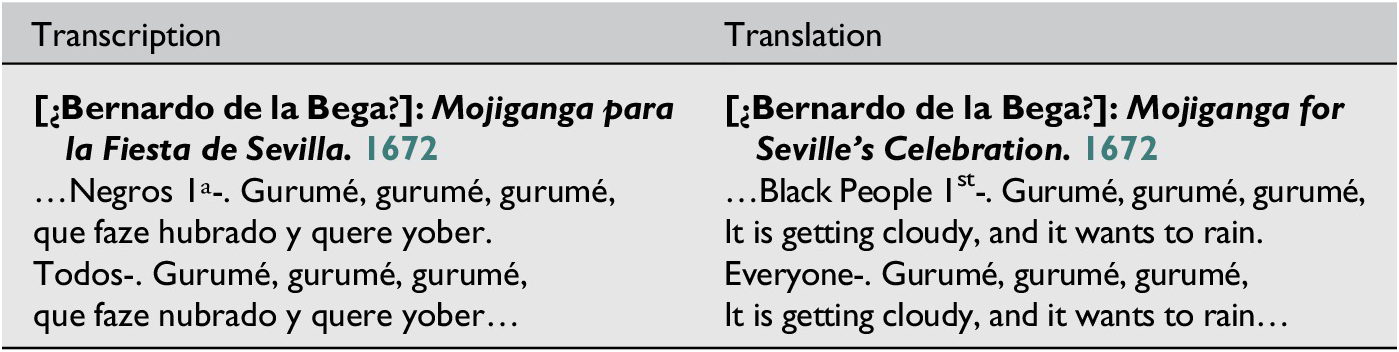
Also from popular theatre, the sixth example is a mojiganga written for Seville’s celebrations of 1672 ([¿de la Bega, Bernardo] Reference Bega1672: ff. 5–5v.) (Table 8). According to José Luis Cortés, that theatrical piece was performed during Seville’s Corpus Christi (2019: 380).
Sixth Example

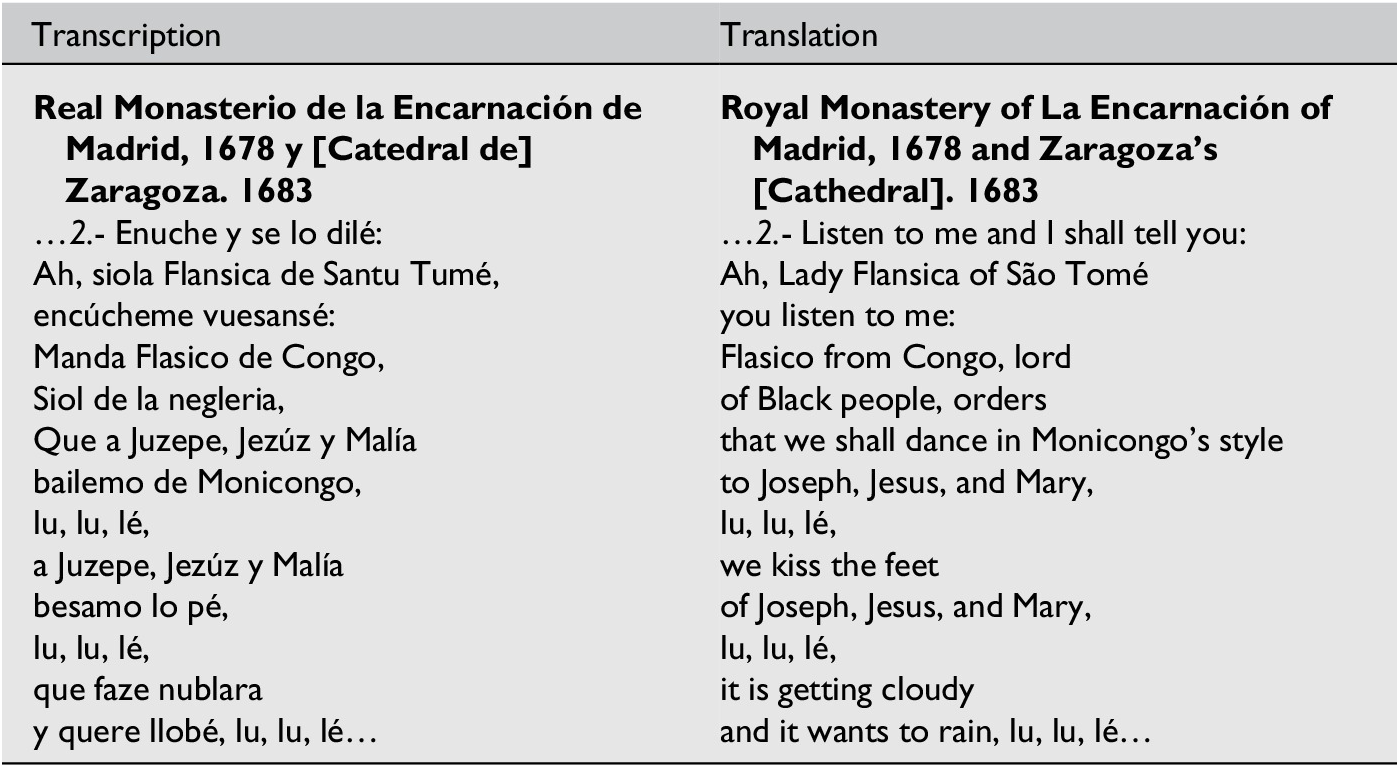
The seventh example, extracted from Josep Pujol-Coll’s Ph.D. dissertation (Table 9), belongs to the religious repertoire. It is a villancico performed in Madrid for the Christmas celebration of 1678 and then recycled in Zaragoza for the Ephypany celebration of 1683 (Pujol-Coll Reference Pujol-Coll2015: 89). In this case, all references to the words gurumbé/gurumbá have disappeared; in exchange, there are verses related to a Nativity scene with Jesus, Mary, and Joseph and how the Black characters honoured them by dancing and kissing their feet.
Seventh Example

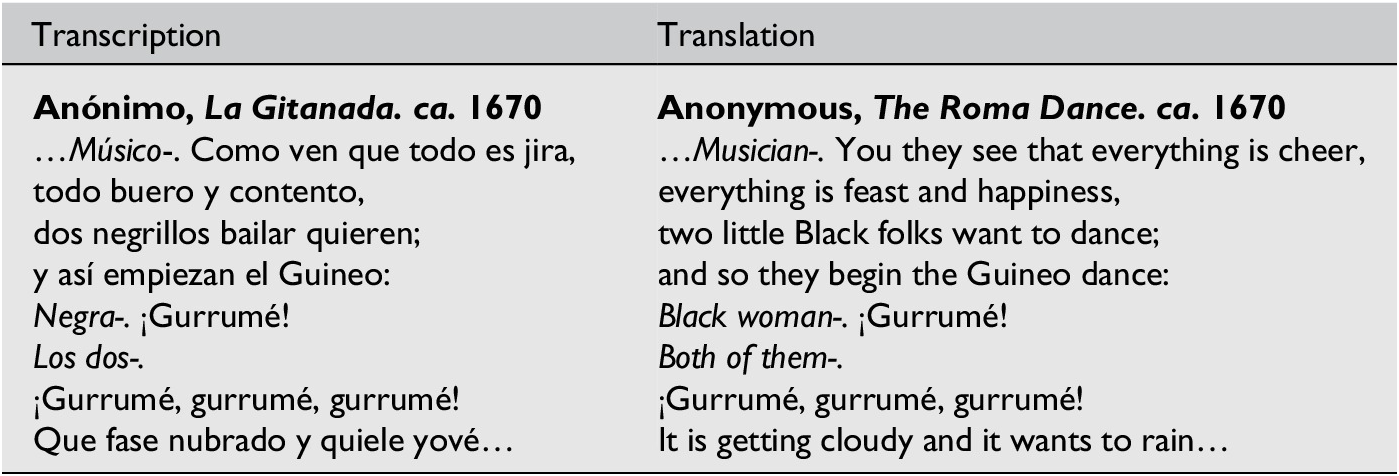
The last example (Table 10), identified by Emilio Cotarelo as an anonymous mojiganga from around 1670, is named La Gitanada ([1911]Reference Cotarelo y Mori2000: ccl). In this case, the musicians indicate that two Black characters will dance the guineo.
Eigth Example

There is a transcontinental continuity in this repertoire. For more than 50 years, the Hispanic American repertoire consolidated the “word core” of “gurumbé, gurumbé, gurumbé/que faze nublara, que quele yové” as a significant element in portraying stereotypical Black characters in literature and music. However, what is even more relevant is the preservation of such a “word core” by the living culture in Hispanic America of Son Jarocho and the example of Son de los Negritos; a Mexican tradition that emerged from a transculturation process in which the Afro-descendant influence is fundamental.
SON JAROCHO AND SON de los NEGRITOS
In the late 20th century, as previously mentioned in this article, there has been an interest in vindicating the African and Indigenous heritage in the Sotavento and Jarocho identity. Jarocho, as Pérez Montfort explains, was a colonial term used by the Spaniards to mock the rural population of the area, mostly mixed between Black and Indigenous people (Reference Pérez Montfort, de Antuñano Maurer and Lara2004: 189, 190). Seemingly, Sheehy indicates that the suffix “-ocho” was pejorative. Likewise, he describes how the Arabic-descent word “jara” means, in Spanish, a stick or pointed arrow. Thus, the whole word “Jarocho” was considered, in the colonial era, as an offense cast over the Afro-Indigenous peasants and militiamen in Sotavento (Sheehy Reference Sheehy1979: 47, 48; Serna Reference Serna and Escamilla2005: 61–74). However, since the 20th century, the term Jarocho and the music of the Son Jarocho became symbols of regional pride and resistance in the Mexican state of Veracruz (Pérez Montfort Reference Pérez Montfort2007: 185–210).
Even in the 19th and 20th centuries, travellers and intellectuals, such as Antonio López Matoso, Miguel Lerdo de Tejada, José María Esteva, or Juan Rejano still described Jarochos, meaning the inhabitants of Sotavento and some from the port of Veracruz, as a mixture of mainly Afro-descendants and Indigenous people (Esteva Reference Esteva1998: 186–190; Pérez Montfort Reference Pérez Montfort, de Antuñano Maurer and Lara2004: 189, 190; Pérez Montfort Reference Pérez Montfort2015: 68). At the same time, Pérez Montfort indicates that the core of Son Jarocho’s repertoire is traceable to popular Spanish poetry and music from the 17th century (Reference Pérez Montfort2015: 21); precisely, the repertoire studied in the previous section. Precisely, the Spanish/Iberian culture imposed its parameters on Indigenous and Afro-descendant groups from the beginning of the colonial period. The Spanish theatre and poetry, introduced partially as indoctrination and propaganda tools, impacted the local New Spain’s religious villancico and secular popular manifestations (Ramírez Uribe Reference Ramírez Uribe2024).
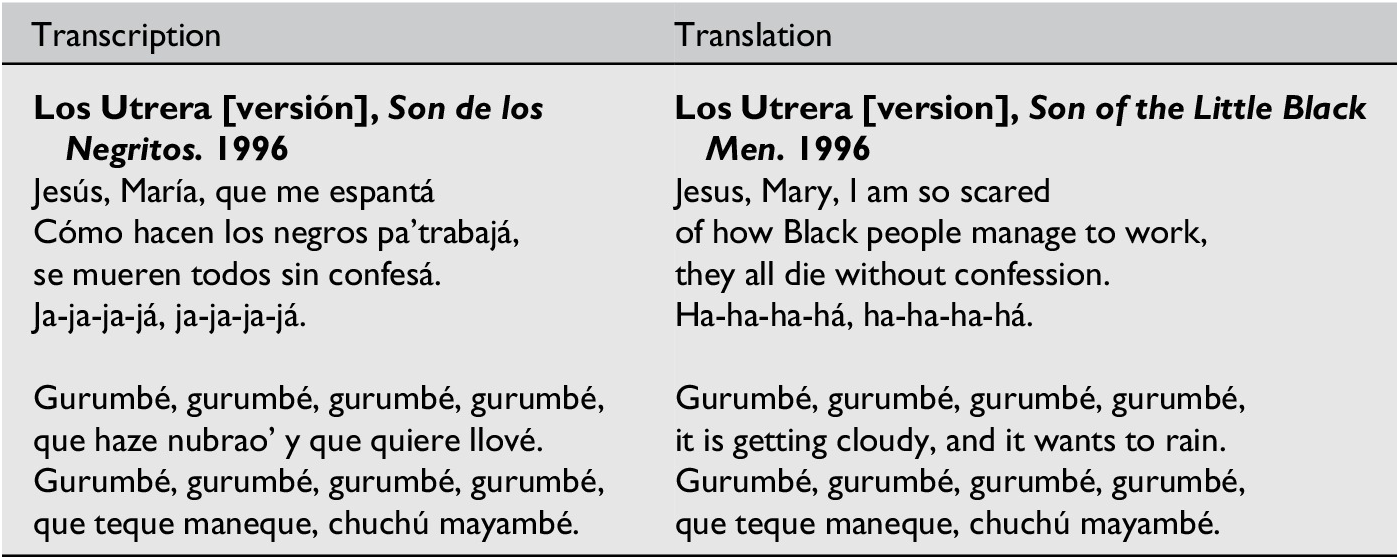
García de León explains how carnival processions, mojigangas, and public religious celebrations in cities such as Puebla, Mexico City, and Veracruz consolidated the influence of Siglo de Oro’s poetry and music in New Spain (Reference García de León2009: 26–28). Two examples of this complex dynamics between layers of representation are Gaspar Fernández’s and Juan Gutiérrez de Padilla’s villancicos from 1612 and 1655. These two cases are linked to each other by the quotation of variants of “gurumbé, gurumbé gurumbé/que haze nublaro que quiele yové.” Likewsie, this same formula is present in modern-day Son de los Negritos (Table 11).
(Utrera family: 1996 [transcribed by the author])

Sheehy and García de León describe this son as danced by five couples of men and women (Reference Sheehy1979: 237; Reference García de León2009: 26). Sheehy even includes it in a particular list of pantomime sones, which might link it with the parodied representations of Black people in Spain and New Spain during Siglo de Oro (Reference Sheehy1979: 151). To validate this posture, I align with Frenk’s methodology of literary studies, which is relatable to the microhistorical “Indicary paradigm” and González perspectives. When the modern oral tradition preserves a particular chant or stanza documented in more than one source from Siglo de Oro or the Modern Age, as Frenk indicates, it is valid to assure the authenticity of this old testimony (2008: 162). For instance, the Coliseum Theatre in Mexico City organized different musical representations by the late 18th century. Among them, Gabriel Saldívar enlists numerous Sonecitos de la Tierra [Short Songs from the Homeland], such as La India, La Jarana, and Los Negritos. To this researcher, these are early versions of modern-day Mexican sones but staged more inclined with the gallant taste of the last decades of the colonial period elite’s musical arrangements (Reference Saldívar1934: 256).
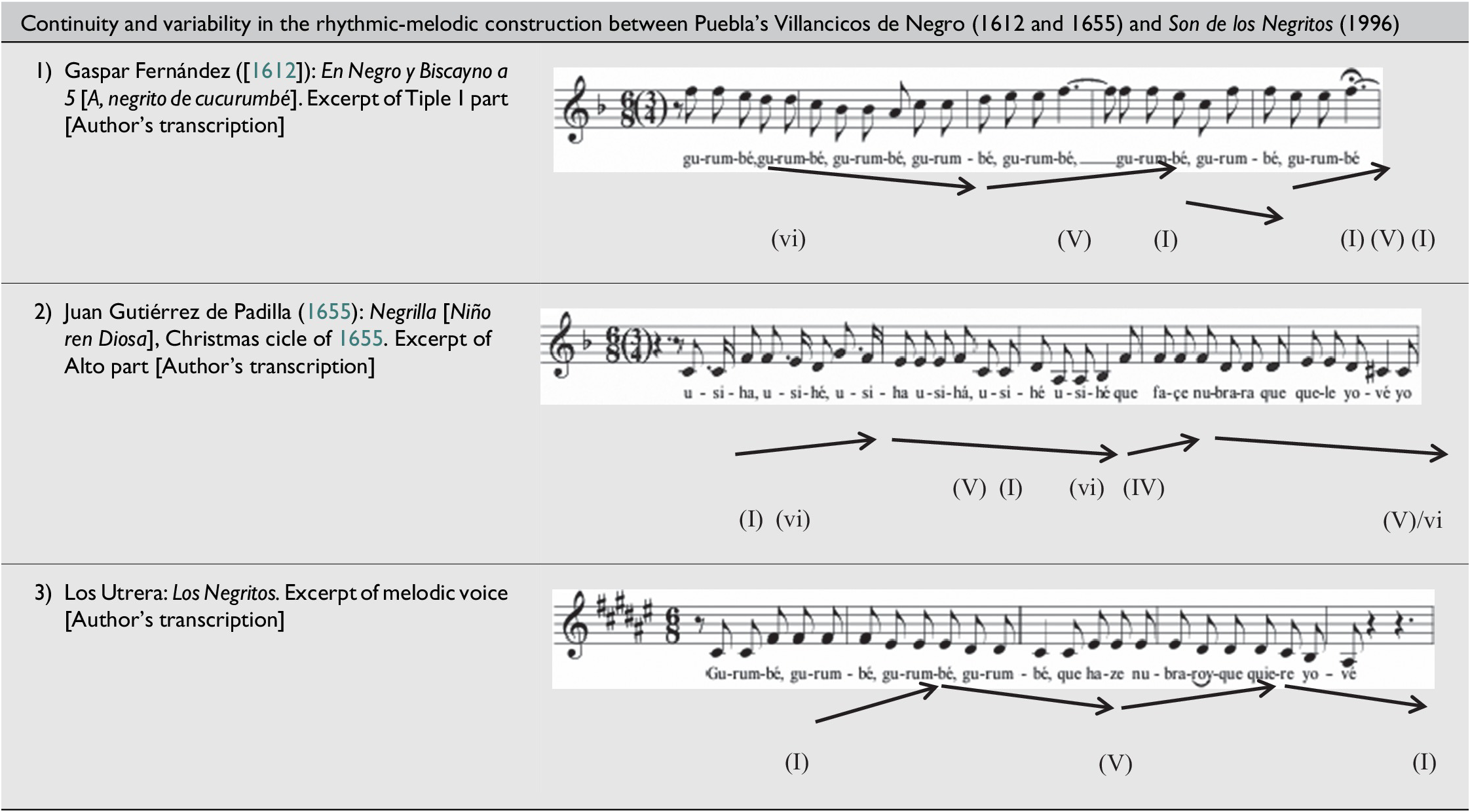
Up next, I compare my transcriptions of Gaspar Fernández’s and Juan Gutiérrez de Padilla’s villancicos ([Reference Fernández1612]: f. 120v.; 1655: Altus 2° booklet) with the Utrera family’s recording of Son de los Negritos (Los Utrera 1996) (Table 12). By applying Ginzburg’s “indiciary paradigm,” I analyse the continuity and the modification of poetical and musical elements between sources separated by more than 300 years. The comparison of such examples indicates that there are similarities between the three assessed musical examples with Siglo de Oro’s guineo/cumbé dance, such as:
-
a) Headless starts of the melody.
-
b) Use of “word cores,” like as gurumbé/gulumbé, or “que haze nublaro que quiele yové.”
Comparing Negrillas of Gaspar Fernández and Juan Gutiérrez de Padilla With the Utrera’s Family Version of Son de los Negritos

Concretely, all three examples, in which the arrows in the table below represent the melodic movement, have a pivotal transitional space in the middle of the melody; likewise, they have similar melodic and rhythmic figurations. Also, all examples start off-beat—the rhythmic-melodic lines commence with a silence. This characteristic is similar to how Russell describes guineo and cumbé. Nonetheless, the analysed chapel masters’ compositions have a more profound development of the harmonic-melodic line than Son de los Negritos; Gutiérrez de Padilla, in particular, presents a more complex harmony movement by modulating to the sixth degree minor (vi), at the end of the phrase. It is also interesting to assess how Gutiérrez de Padilla’s villancico and Son de los Negritos are similar in the melodic interval of fourth, at the beginning of the phrase, and the melodies’ shapes coincide with each other.
Thus, the musicological analysis shows that the continuity in this repertoire is not only perceived at a literary level but in the musical one as well. Henceforward, this exercise allows me to propose the concept of “musical cores.” Inspired by Prins’ notion of “word core,” a “musical core,” as a hint to reconstruct subaltern historical/cultural realities from music studies, identifies melodic, harmonic, and rhythmic traits that establish a sense of continuity in musical cultures, particularly in oral traditions (Frenk Reference Frenk2006: 162; Ramírez Uribe Reference Ramírez Uribe2024: 28). In this case, “musical cores,” as “indiciary paradigms,” work in two levels:
-
1. Following Sharpe’s proposals, a “musical core” aids in assessing levels of African and Afro-descendant historical and cultural realities within the parody and stereotype of the Black character.
-
2. The “musical core” demonstrates how oral tradition in Son Jarocho preserved musical and poetical traces of the Black character from the 16th and 17th centuries Hispanic America. This process is more significant since an important element of Jarocho culture is Afro-descendant.
CONCLUSIONS
This article aims to increase the debate regarding the influence of African cultures in Hispanic America, more precisely, the ones located in the western areas of Kongo and Angola. This on-going research emphasizes how languages such as Kikongo, Kimbundu, and Umbundu could have passed to Portugal and Spain since the early 16th century and then parodied, along with other cultural African references, in the stereotyped Iberian Black character. The relation, continuity, and circulation of themes, characters, and plots are identifiable in the studied pieces of evidence: religious villancicos, entremeses, ensaladas, and mojigangas. In the case of New Spain, such Black characters arrived alongside the Siglo de Oro repertoire; proof of that is the presence of “word cores” such as gurumbé/gurumbá on both sides of the Atlantic. At the same time, this circulation of repertoires inside the Spanish Empire occurred when the Viceroyalty of New Spain received the most enslaved people from Africa—late 16th century and half of the 17th century.
There is an increasing importance in intertwining diverse epistemological perspectives in musical studies. In the case of this article, oral studies are fundamental in my approach to written texts, usually tackled solely by philology, history of literature, or historical musicology. Precisely, the methodology implemented in this article allowed me to determine how musical patterns and verses from the 17th century stayed in the Mexican tradition of Son Jarocho, concretely in Son de los Negritos. Likewise, it frames the “musical core” as a new analytical tool for musicological and ethnomusicological research. Although this article accepts the variability inherent to oral transmission of knowledge, these parameters can be valid for the diachronic study of the Black character repertoire in Siglo de Oro’s period and its impact on the present Ibero-American territories.
It is possible that such “word cores” and “musical cores,” produced in the Afro-Hispanic interchanges in the 16th and 17th centuries, developed a particular meaning for the Afro-descendant communities in the Gulf of Mexico. Despite the verses “gurumbé, gurumbé gurumbé/que haze nublaro que quiele yové” being ingrained in the hegemonic stereotype around Black characters, the historical Jarocho communities adapted it to their immediate socio-cultural landscape. As indicated by Sharpe, it is fundamental to always consider the historical context, since it provides a deeper level of analysis around cultural practices and studied evidence.
Despite the hegemonic power in Modernity’s Hispanic America censored and controlled religious villancicos and major public celebrations, there was a representation of Black communities in such spaces, one that dwelled in a constant tension of inclusion and alienation. The Hispanic imagery included them as part of the sociocultural landscape. But at the same time, Black characters portray a stereotype with hegemonic expectations over African and Afro-descendant communities. Nonetheless, as this article shows, it is pivotal to keep researching and discussing these representations since they are precious sources of sociocultural and historical realities of these communities due to their parody in the Modern Age’s Hispanic American panorama.
Thus, it seems that there are at least two historical realities around this repertoire. First, they represent the unavoidable hegemonic representation of stereotypical Africans and their descendants. Second, there is a far more interesting permanence of Afro-descendant traits in the parody and following Black stereotype. Written literary repertoires of the 17th century recorded such hints. Likewise, oral tradition preserved them up to present-day Mexico. However, as indicated in this article, the word “gurumbé” is not “authentically African” as some members of the Jarocho community assume, but rather Afro-descendant/Afro-Hispanic. It is true that there are significant linguistic and metro-rhythmic elements relating gurumbé with Bantu Africa. Nonetheless, these connections span way back in time, up to the 15th and 16th centuries, and the interactions between the kingdoms of Kongo, Ndongo, and Portugal, via São Tomé. Thus, the word “gurumbé” becomes a testimony of the rich cultural interchanges along the Iberian Peninsula, Hispanic America, and West-Central Africa. Likewise, it is evidence of how Afro-descendant communities kept elements of their culture in the Spanish Empire, which eventually were transculturated and adopted by diverse cultural groups up to the present-day Mexico. Thus, the historical realities around Son de los Negritos portray conflicts, cultural interchanges, and identities that surpass the Sotavento and Jarocho region and go way back in time, up to the Afro-Hispanic spectrum of Siglo de Oro in Hispanic America.