I. IntroductionFootnote 1
Historians of early Islamic Central Asia are greatly indebted to the untiring travails of pioneering scholars such as V.V. Barthold, C.E. Bosworth, R.N. Frye and M.A. Shaban.Footnote 2 Most of the discourse shaped by them has focused on military campaigns, dynastic histories and conversion narratives. Attempts at writing a social history, on the other hand, are still slight. Elton Daniel's The Political and Social History of Khurasan under Abbasid Rule, 747–820 presents a notable exception, describing a number of social movements in early Islamic Khurāsān based on a wide spectrum of Arabic and Persian narrative texts, including local histories.Footnote 3
In recent decades, the discovery of a series of legal and administrative documents from a previously understudied part of northern Afghanistan in a region known historically as Ṭukhāristān has provided fertile ground for translations, editions and philological debates. The corpus consists of 195 documents and fragments drafted between the fourth and eighth centuries ad in various cities of Ṭukhāristān, notably Rōb, which lies between Balkh and Bāmiyān.Footnote 4 Thanks to the efforts of Nicholas Sims-Williams and Geoffrey Khan, we now have English translations of what are commonly referred to as “the Bactrian documents”. One set is written in the Bactrian language – an Iranian language using a cursive Greek scriptFootnote 5– and another in Arabic.Footnote 6 These texts provide fresh data that can be brought into the historical discourse on the development of Central Asian zones from late antiquity to the rise and consolidation of Islam. Some historians have already started to do so. Patricia Crone, Étienne de la Vaissière and Khodadad Rezakhani have considered selected documents in order to answer questions on religious conversion, nationality (of the Hephthalites), and economic history, respectively.
A historical study based on the full corpus of Bactrian documents is still outstanding. Used thus, the Bactrian documents can fill a number of lacunae in the secondary sources. First, they enable us to understand early Islamic Central Asia at the local level and from a home-grown perspective, thus adding to existing knowledge based on the long and medium-distance perspectives of caliphal agents working at central command points in Baghdad and the provincial capitals of Umayyad and early ʿAbbāsid Khurāsān (Merv and Balkh). The documents reveal rural Ṭukhārians' everyday concerns and events, and how caliphal actions may or may not have impacted upon their lives. The impact could have been felt in a number of arenas, notably the politico-administrative, socio-economic and cultural. This paper will focus on the latter two, and a particular emphasis will be placed on the changes in Bactrian religious and marriage practices brought about by the consolidation of caliphal rule in this part of Ṭukhāristān.
A second gap in the secondary literature concerns the minor settlements in Central Asia. While larger urban centres, such as Balkh, Merv and Bukhara, have been studied to a certain extent, it is the “places in between” that are hardly understood.Footnote 7 It remains to be determined whether these lesser settlements were food-producing satellites for the major population centres or if they interacted as autonomous networks. Balkh, in particular, which is the closest major city of the caliphate, may provide a reference for this study, but as will be seen, it should not be taken as a template in a region in which considerable social variation existed. The Balkh metropolis, a major Umayyad and early ʿAbbāsid city in the region, was still more than 130 kilometres from Rōb. Balkh is, in fact, mentioned once in the Bactrian documents, and then only tangentially in an undated document as a place from which linen shirts were delivered.Footnote 8 This already suggests the limited influence Balkh may have had on social and economic life in this part of Ṭukhāristān.
The documents: provenance, geography, dating and type
Scholars did not find the Bactrian documents in situ, and so their more precise provenance must be deduced from internal evidence.Footnote 9 The total number of documents includes 163 Bactrian-language and 32 Arabic documents. Most of this study will focus on the legal documents written on parchment. Forty-seven of the dated documents belong to the early Islamic period, and of this group, 32 are written in Arabic while 15 are drafted in Bactrian.Footnote 10 The 15 Bactrian-language documents cover 140 years of the existence of the Islamic caliphate (only towards the end of the period is there evidence that the Muslims had taken control in this area), while the Arabic documents pertain to the last 22 years of this period, which corresponds to the early decades of ʿAbbāsid rule. The corpus is thus of a bilingual nature, containing a subset of documents that date to the same years and refer to the same persons. Therein lies an important story of co-existence and dual administration to which I shall return shortly.
The documents are rare not only for Bactrian history, but for the entire medieval Islamic world. Egyptian papyri and documents from al-Andalus, Sicily and Fārs, as well as the Geniza documents from Fatimid Egypt, provide important comparanda for the administrative protocols and documentary practices, as well as the palaeography of the Arabic Bactrian legal documents.Footnote 11 Geoffrey Khan, having edited two sets of eighth-century documents from distant ends of the caliphate (Egyptian papyri and Bactrian Arabic parchment-based documents), has pointed out the astounding levels of coherence across the two sets, indicative of a high degree of central control from Nile to Oxus during the reign of the second ʿAbbāsid caliph al-Manṣūr (r. 136–158 h/ad 754–775). Khan rightly points out that from the Bactrian corpus it would appear that the ʿAbbāsid administrative reach did not extend much beyond taxation.Footnote 12 While the assumption here is that taxes are purely fiscal in nature, their socio-economic impact should not be underestimated and lies at the core of this study.
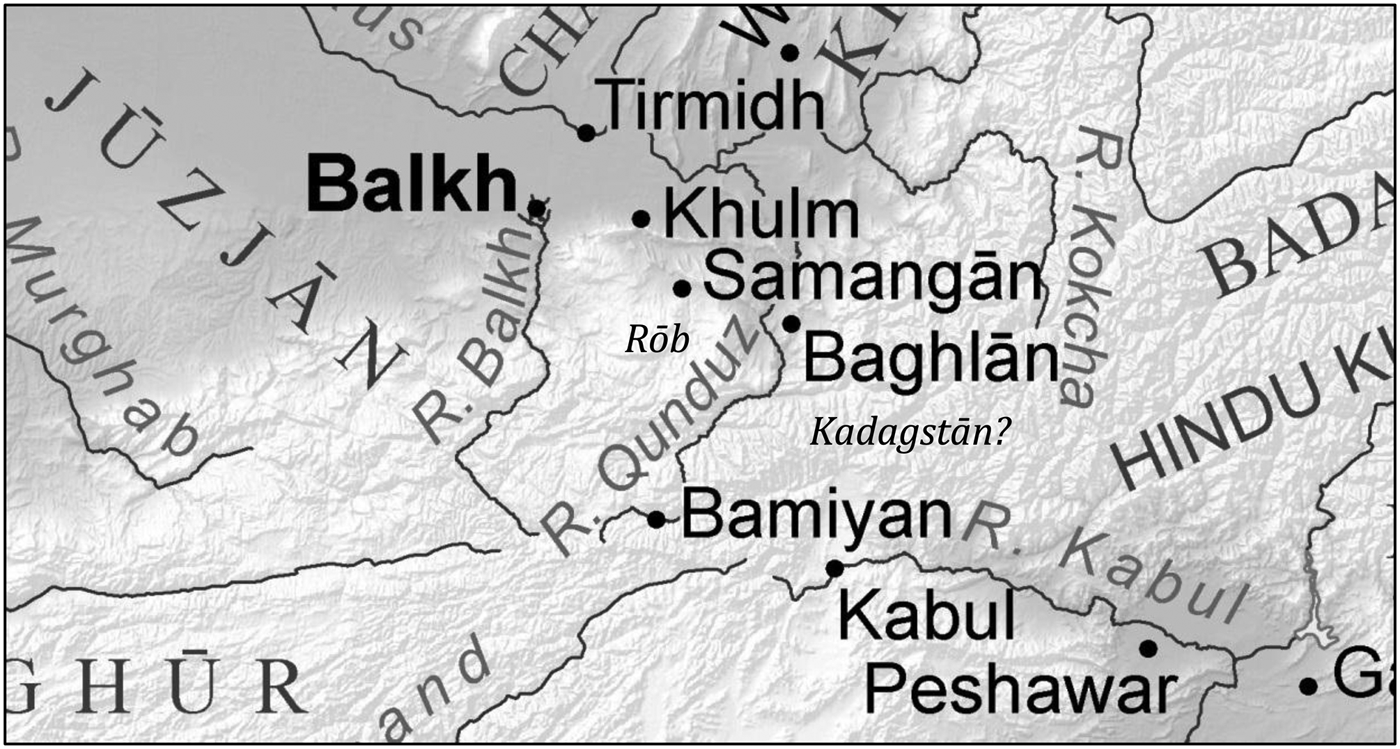
It is not hard to find evidence of provenance embedded within the text of the documents. A number of particular places are mentioned and most are identifiable on a map of northern Afghanistan today, including Rōb (Ar. Ruʾb, modern-day Rūy-i DuābFootnote 13), Samangān (Ar. Siminjān), Bāmiyān and a certain Kadagstān (see map, Figure 1). A significant number of the documents seem to belong to a family archive from Rōb. Rōb, Samangān and Bāmiyān, which are central to the Bactrian documents, are mentioned by Ibn Khurradādbih (d. c. 300/911) and al-Ṭabarī (d. 310/923) as pertaining to “Ṭukhāristān district”, which they position, in turn, in the eastern part of Khurāsān province. Ṭukhāristān is divided into a western part, centred in ancient Balkh and including Bāmiyān; and an eastern segment aligned along towns such as Tālaqān, Andarāb and Walwālīj. Ṭukhāristān comprised the modern Afghan provinces of Fāryāb, Jūzjān, Balkh, Samangān, Qunduz, Ṭakhār and Badakhshān. Chinese historians and visitors, such as Xuanzang (c. ad 633) also travelled to, and described, T'u-hu-lo (cognate with the Hellenistic Greek “Tokharoi”, i.e. the people of Ṭukhāristān).Footnote 14
(Colour online) Kamird-Far family tree (after Nicholas Sims-Williams and François de Blois, Studies in the Chronology of the Bactrian Documents from Northern Afghanistan, forthcoming)

An important debate is ongoing around the dating of the Bactrian documents. At issue is the exact start date of the Bactrian calendar. Nicholas Sims-Williams initially revised Helmut Humbach's start date of 232 to 233 ad.Footnote 15 He has since revised the era of the Bactrian documents (ebd) to Nawrūz/October 223 ad in the reworked edition of the Bactrian Documents, following the argumentation of François de Blois. It is this dating that I will use for reasons of simplicity and because the variance with credible alternative interpretations is minimal enough not to have a major impact on the socio-economic analysis that I attempt.Footnote 16 The Arabic documents all use hijrī dates only.Footnote 17
In terms of type and content, the dated Bactrian-language documents deal with a vast array of issues, including keeping the peace between feuding parties, the purchase of land or goods, slave manumission, gifts, leases, declarations of trust (or impost?), loan receipts, and marriage. There is also a judicial declaration in the form of an open letter. The Arabic documents, on the other hand, cover a more limited set of four issues: tax receipts issued by caliphal governors and financial agents; land survey reports; contracts of slave manumission; and dowry attestations. While such documents may not make for the most riveting literary prose, their beauty to the historian is that they are devoid of rhetoric and propaganda. They served a practical and immediate use and are testaments to citizens' daily affairs in this rural entrepôt of eastern Khurāsān.
II. Social organization and social diversity in eighth-century Bactria
For this socio-economic study, we need first to ascertain the type of society to which the documents pertain. From the Bactrian documents we can glean a complex eighth-century society that was socially stratified, with one or more leaders at the top, followed by members of the bureaucracy and landed aristocracy. The next stratum consists of artisans, merchants and other freemen and women, followed by peasants and slaves at the bottom. The local ruler of Rōb, for example, held the title of khar and held court (BT I U dated 490 ebd/ad 713). The Turkic residents were led by a ser, a title that is evidenced in seventh-century coins from the region.Footnote 18 Thus, members of the Kamird-far family, to whom the bilingual Bactrian documents archive seems to have belonged (see Figure 2), are characterized as “servants of the ser” in BT I W (dated 525 ebd/ad 748). “The lord ser” is further qualified as “the king of the people of Kadag” in BT I Y (dated 549 ebd/ad 771–2). In the latter document, the ser issues a judicial declaration to vouchsafe the property (irrigated land and a vineyard) of Mir of the Kamird-far family from his brother Bab who has left. A Turkic leader called “Sävüglig, the lord of the Wargun (people)”, and a Turkish princess of the Khalaj people and her spokesman and ambassador appear in BT I T (478 ebd/ad 700).Footnote 19 One leadership title appears in its uncorrupted Turkic form of iltäbär and is attributed to the khar of Rōb (e.g. BT I N, P1, Q).Footnote 20
Map of the region
The upper middle layer of the hierarchy consisted of landowners, for example the family of Kamird-far and his descendants. The Arabic land surveyor's document (Ar. 24, dated 154 h/ad 771–2) distinguishes between two types of land: “land” (Ar. ar ḍ) and uncultivated orchards (Ar. al-kurūm al-ghāmara). The lands owned by landowning families produced raw goods, such as wheat and onions. Livestock were held, including oxen and sheep, as well as horses, donkeys and mules. There is no mention of camels, but wine was produced in vineyards (BT I U, dated 490 ebd/ad 713).Footnote 21 Freemen working as mid-level local administrators in the Bactrian institutions – such as, treasurers (BT-I R, BT-I S, BT-I Y) and town stewards (BT-I U, BT-I W) – served as witnesses to the Bactrian-language contracts.
While the documents remain silent on the peasants, they tell us a good deal about slaves, who seem to have performed domestic rather than agricultural labour. Slaves were already part of pre-Islamic Bactrian society as can be seen from the pre-Islamic Bactrian-language documents in this corpus. After the Muslim conquest of the territory in question, female and male slaves were emancipated either unconditionally (ʿitq) as an act of pious charity (Ar. 29–30 dated 138 h/ad 755 and 160 h/ad 777 respectively), or through a contract-based purchase of their own freedom in instalments (Ar. 31–2 dated 146 h/ad 763 and 148 h/ad 765 respectively). Slaves could serve as in-kind currency, for example to pay a fine for defaulting on a loan (c.f. BT I Q dated 449 ebd/ad 672), or as gifts. One slave girl was donated to a priest for healing the royal infant of a Turkic queen. The girl was given for the priest's “pleasure” and “use” (BT I T dated 478 ebd/ad 700). Geoffrey Khan stresses that the documentary evidence on the legal status and use of Bactrian slaves provides a rare example of implementation of what is discussed in fiqh literature that appears in its earliest form only half a century later.Footnote 22
Bactrian society was not only stratified but also heterogeneous. While indigenous communities (“men of Rōb”, “men of Bāmiyān”, etc.) made up a large segment of the populations of the towns mentioned in the Bactrian documents, “Turks” and “Arabs” also lived in these places.Footnote 23 Thus, for example, Bactrian-language document BT I W (525 ebd/ad 748) on the sale of land states that: “no one has authority to withhold or seize land or commit violence, neither men of Rōb, nor of Bāmiyān, nor Turks, nor Arabs, nor locals …”. The Arabs referred to here are probably first- or second-generation Muslim residents, some of whom worked as administrators. In the 22 years covered by Ar. 1–32 (138–160/ad 755–777), there were at least 19 different senior ʿAbbāsid administrators (ʿāmil and amīr) based in this relatively rural but productive part of Bactria. Some of the Turks were Khalaj Turks whose princess and entourage were mentioned earlier, but the reference to other Turkic leaders (sēr, qaghan) indicates there were more Turks living here.
Diversity in early Islamic Bactria also manifested itself in the religions that were practised in places such as Rōb and Bāmiyān. Local deities are invoked repeatedly in the documents and seals, such as “Wakhsh, the king of gods” (BT I O and U dated 440 ebd/ad 663 and 490 ebd/ad 713 respectively), a god called Ram-set (BT I P and Q, dated 446 ebd/ad 669 and 449 ebd/ad 672 respectively), and “Kamird, the king of gods” (BT I T, dated 478 ebd/ad 700). In the latter document, the religious figure of Kamird even has active legal agency in the person of a priest, Kamird-far, who represents him. The priest is the executor of a particular contract on behalf of Kamird. Indications of religious practices and influences are also given in the theophoric names of people mentioned in the documents. For example, the name of Zhun-lad derives from the local god “Zhun”. The Zhun cult, which exhibits a blend of Indian, Iranian and Central Asian belief systems, was centred in eastern Afghanistan (Zābulistān and Zamīndāwar).Footnote 24
Somewhat surprisingly, Buddhism is not evidenced in the contracts. The corpus does include four undated Buddhist texts.Footnote 25 BT II za and zb are lists of names of buddhas, bōdhisattvas and various other important gods and spirits. The names are invoked for protection and written down for meritmaking, and the importance of the bodhisāttvas indicates that these texts probably come from a Mahāyāna background.Footnote 26 Although not directly mentioning Buddhism, one Bactrian-language land sale contract (BT I V dated 507 ebd/ad 730) includes a formulaic stipulation allowing for the use of land by “monasteries”. The term for monastery here is a local Bactrian word rather than the Sanskrit vihāra.Footnote 27
The absence of Buddhism in these documents is noteworthy, because of the general association of Buddhism with Bactria. Even if Buddhism played a major role in Balkh through the Naw Bahār temple-monastery complex, which we can deduce clearly from Chinese and Korean pilgrims' accounts of the seventh and eighth centuries ad, it does not seem to be the case for Rōb and its surroundings. The metropolis of Bactra became a major site of Buddhist worship and scholarship from the Kushan period of the first–third centuries ad, right up to the time of the Muslim conquests and well into the Umayyad and early ʿAbbāsid periods, if not longer. Balkh was famed in the Buddhist world for the fantastic wealth and scholarship of the Naw Bahār temple-monastery, as well as hundreds of lesser Buddhist monasteries, temples and shrines of the arhats (“saints”).Footnote 28 It is standard for Buddhist communities to invoke Buddhist deities in legal documents, which makes their absence from the Bactrian corpus more significant. A set of legal documents from a nineteenth-century Tibeto-Himalayan village archive, for example, contains abundant formulaic invocations to members of the Buddhist and indigenous (Bon) pantheon as witnesses to the contracts. Terms used include “the triple gem” and the “three jewels”,Footnote 29 “the Dharmapala of the [Buddhist] religion, the Bon-protector of the Bon[-religion]”,Footnote 30 and “the guardian deities of Buddhism and the guardian deities of Bon; the gods, serpent-spirits and local genii of the world, and the man-gods and foe-gods”.Footnote 31 And so, it would seem likely that if Buddhism was followed in this part of Bactria, that Buddhist deities would have been included as witnesses to the already colourful set of deities invoked in the Bactrian documents.
III. Family structures, marriage and taxation
Bactrian marriage practices evidenced in the Bactrian-language documents are particularly interesting. One of the two late documents (BT I X dated 527 ebd/ad 750) written in Bactrian points to the possible practice of fraternal polyandry until the mid-eighth century. This peace-making contract stipulates that three of the four grandsons of Kamird-far agreed to own the family homes and estates equally, and consented to “possessing” one woman (Ba. zin) called Zeran.Footnote 32 Patricia Crone has taken this as unequivocal evidence for “wife-sharing”, in the form of fraternal polyandry in the early ʿAbbāsid era.Footnote 33 The meaning of possessing a woman could, of course, also indicate that Zeran was a slave woman.Footnote 34 However, the rationale given for this transaction weighs in favour of the interpretation that the woman (perhaps previously a slave) was a wife, namely that it is “not necessary for us to destroy our House”. This clause provides a crucial key to understanding this triple-marriage of brothers to one woman as a response to the need to keep the family property together.
In what appears to be an unusual twist in the story, one of the brothers, also called Kamird-far (he later changes his name to Saʿīd, presumably having converted to Islam), did not partake in the fraternal agreement contained in BT I X, but five years later appears to be married (alone) to Zeran. Arabic document Ar. 29, dated 138 h/755 ad tells us that Saʿīd and Zeran had four children, all with Arabic names.Footnote 35 How do we explain this succession of marriages by the Kamird-far family brothers to Zeran around the time of the ʿAbbāsid revolution?
To answer this question we first need to understand the logic of the special coping strategy that fraternal polyandry represents, best explained in the lands that are contiguous with the Bactrian oasis – the South Asian and Tibeto-Himalayan regions. Fraternal polyandry already has a central role in the ancient Mahābhārata epic, thus influencing Hindu populations until this day.Footnote 36 In Tibet, the age-old practice of fraternal polyandry still continues.Footnote 37 Tibetologist Melvyn Goldstein argues that Tibetan fraternal polyandry is the “lesser evil”; a compromise strategy, stimulated by the need to pool human resources to meet excessive activity requirements of living in a harsh environment at high altitudes, and with limited rainfall in a semi-arid land, and high tax burdens. Goldstein argues that through fraternal polyandry landholdings maintain their economies of scale in relation to labour costs, and brothers share the property within a “stem family”.Footnote 38
Parallels can also be found in the Zoroastrian next-of-kin marriage (xwēdōdah), which was based on a rationale of not dividing up inherited property.Footnote 39 According to Zoroastrian family law, a woman could marry more than one man (cakar) to provide a legal heir and successor to her “authorized” (pātixšāy) husband (if he could not provide an heir or had died), and the natural father had no claim on the children. But the woman could not live with more than one man at a time, which gives the Bactrian case of fraternal polyandry a distinctly non-Sasanian, non-Zoroastrian character.Footnote 40
This is not the first time we read of fraternal polyandry in the Bactrian corpus. The very earliest document in the set (BT-I A dated 110 ebd/ad 333) is, in fact, a marriage contract between two brothers and one woman called Ralik. The contract emphasizes that this practice “is the established custom in the land”, meaning that it was already in existence before the mid-fourth century ad.Footnote 41 The contract refers to Ralik as a “fully privileged daughter-in-law”, a title that has a semantic parallel in “a lady possessing authority (pāt[ə]xšāwan waδu)” in a Sogdian marriage contract dated ad 709–10 and the Middle Persian kadagbānūg “mistress of the house”. The latter was a term defining a woman who has entered a pādixšāy-marriage. Ilya Yakubovich states that a reference to Ralik as “a lady possessing authority” (phinzo phromanzo) seems to indicate that this was the most traditional form of marriage, roughly equivalent to the “pādixšāy-marriage” of Sasanian law.Footnote 42 Additionally, the contract prohibits the two brothers, Bab and Piduk, from acquiring “in future another wife or concubine to whom Ralik should not agree”. For any contravention of this commitment, the relevant brother will have to pay a fine. The bride came into this marriage with a significant dowry – a blanket, pillow, bracelets, cloaks, sheep and wheat – important items for average income members of this rural society. The fourth-century document also includes a justifying clause about “the need to keep the House together”.
Thus, the practice of fraternal polyandry in the mid-eighth century may well be a continuation of an age-old custom in this part of Bactria. There may have been some truth to the references to unusual marriage practices in the Islamic heresiographical literature on rebel movements in eighth-century Khurāsān after all.Footnote 43 A strong case could be made now that, as late as ad 750 when the ʿAbbāsids took over the caliphal reins in Iraq, fraternal polyandry was being practised and had full legal standing in the caliphate.
Or is it? Perhaps the situation of the brothers in the House of Kamird-far is an example of a family experiencing the socio-economic effects of the Islamic conquests. Perhaps, the new order made the practice of fraternal polyandry untenable, not on moral or religious grounds, but because there was no longer a need for it. In order to understand better the rationale for the practice of fraternal polyandry, one needs to look more closely at tax systems. Anthropologists have shown that the tax burden in Tibet is a major contributing factor to the practice of fraternal polyandry. Taxes that were particularly onerous were the corvée, transportation duties, monk tax, and soldier tax, which could be met only by men. Men were also needed to take care of the household fields and the livestock, and if there were any men left over, these would go trading. Thus, surviving the fiscal system required a household with lots of men and only one line of succession, i.e. one wife.
The Bactrian documents, too, point to a major tax burden. In one land purchase contract, the seller explains the need to sell his land so that he can afford “the large Arab poll-tax and harvest tax” (BT-I W dated 525 ebd/ad 748).Footnote 44 We learn more about the ʿAbbāsid tax system from Ar. 1–23, all of which are tax quittances. The receipts are for six kinds of taxes: kharāj, and five supplemental taxes (qism). The kharāj is the most common tax in the receipts.Footnote 45 The supplemental taxes are for the upkeep of corvée animals, for the pack-animals used for the postal service (barīd), “for the expenses of the governor” (presumably the governors' administrative bureaucracy and military), “for the expenses of the land” (presumably repairs to constructions on the land for which the landholder is responsible), and “for the expense of the sustenance of al-Mahdī” (Ar. 3 dated 148 h/ad 765).Footnote 46
The tax periods are annual (“for the year 149”, etc., possibly different from a calendar year), with a time lag between the tax year and the date of the receipt of payment of between one and four years. Some receipts (e.g. Ar. 15) enumerate the taxes for multiple years for which individual receipts were already issued, perhaps as multi-annual aggregate statements of taxes paid. However, the tax amounts in the individual receipts do not add up to the aggregate amounts. Thus, one might tend to agree with Geoffrey Khan that the payment of tax was probably not completely regular, which would have caused difficulties to the taxpayers.Footnote 47
Excessive taxation did not begin with the ʿAbbāsids. The taxes of the Hephthalite “lords” on the House of Wyem and Bag-re-mareg were so large that they had “no other assets left in the House from which the Hephthalite tax might have been paid by us” (BT I J dated 295 ebd/ad 518).Footnote 48 There appears also to have been a time when the Sasanians (sic. “Persians”) and Hephthalites were both imposing taxes on the inhabitants, as is seen from the undated BT I al ([sic.] “Then every month (I) gave five dirhams (as) subsistence allowance for the Hephthalites and for the Persians … And I [gave towards] the Hephthalite levy…”).Footnote 49
And yet, something had changed with the ʿAbbāsids. Changes in tax systems instituted by the ʿAbbāsids after their takeover from the Umayyads have been identified elsewhere in the Caliphate, notably Syria, Iraq and Egypt. Reforms concerned the unit of assessment, e.g. a fixed rate based on area of arable land (masā ḥat), versus a rate based on the amount harvested and sold (muqāsama), with the latter being kinder to the peasants and guarding them from adverse conditions as instituted in the Sawād of Iraq. These are all important factors. However, in Bactria a far more basic change to the tax system had a disproportionate impact on family life.Footnote 50 While the Bactrians had previously paid their taxes in allocations to the “House” to which they belonged, the ʿAbbāsids now made them pay their taxes as individuals. The individualization of tax duties was entirely new to this part of Khurāsān. Thus, while previously the family of Kamird-far paid their taxes as “a House”, now each brother paid individually. Mīr b. Bek paid his taxes between 147 h/ad 764 and 154 h/ad 771 (Ar. 1–11), while his brother Bāb b. Bek paid taxes between 151 h/ad 768 and 155 h/ad 772 (Ar. 12–16), and Mīr's son Qārwāl paid taxes between 155 h/ad 772 and 158 h/ad 775 (Ar. 17–23). De Blois' fascinating discovery that the impots being imposed on the non-Muslims described in a Pahlavi poem lamenting the Arab conquests of Persia were done so on their “heads” (bar sarān) rather than their property also underlines this point.Footnote 51 The taxation of households, not individuals, provided the rationale for fraternally polyandrous marriages as a way to avoid the fragmentation of family estates. Once the ʿAbbāsids had changed the tax system to an individual one, the incentive for fraternal polyandry was lost.
We can consider the case further by studying the legal and economic bases that underpin marriage and inheritance practices in this part of Bactrian society. Unfortunately, we do not have at our disposal any surviving Bactrian law books, but that some sort of strict legal codification existed is evident from the formulaic stipulations that find their echoes in the Bactrian documents and comparanda from Sogdian and Pahlavi marriage contracts of the period.Footnote 52 In order for the economics of fraternal polyandry to work, no woman other than the wife could have marriage rights. This is alluded to in the restrictions in the marriage contract on the brothers Bab and Piduk, who:
shall not have the right to make another (woman our) wife, nor to keep a free (woman as a) concubine, to whom Ralik should not agree; and if I, Bab, or I, Piduk, should make another (woman our) wife, or keep a free (woman as a) concubine, to whom Ralik should not agree, then (we) shall give a fine to the royal treasury of twenty dinars of struck gold and the same to the opposite party.
The penalty of twenty dinars was prohibitively high and should serve as a major deterrent from taking a free woman for a concubine or mistress (if we compare with the sale price of six dinars of struck gold for a large plot of land). It is interesting that free women as concubines are listed in the exclusions, while slave women are not.Footnote 53 From this we can only adduce that children born to slave women were probably deprived of inheritance rights, and thus could not benefit from “House” privileges. Early Islamic fiqh certainly seems to have applied the principle of non-inheritance to slaves, which may be a continuation of previous practice. The legal framework also prohibited a master from selling a handmaid who had borne him a child, which may have been used to provide a safety net for the offspring of such unions.Footnote 54
What exactly was marriage, then, in this part of early Islamic Khurāsān? Marriage in both the Bactrian and Arabic documents is a legal, commercial transaction, in which dowries were given as a bride's gift to the groom's home (Ar. 26–8 from the 760s ad, BT I W dated 525 ebd/ad 747) and bride-prices were gifts given by the groom to the bride's home (BT I W, dated 525 ebd/ad 748)Footnote 55 Our evidence is too sparse to provide a diachronic analysis of the function of dowries in Bactrian marriages. The discovery of a Bactrian law book would be needed to elucidate the roles of dowries and bride-prices. We do not know whether dowries, for example, functioned as “pre-mortem inheritance” as per Islamic fiqh and practice.Footnote 56 In this configuration, dowries remained under women's exclusive ownership and control throughout marriage and through widowhood and divorce. From Ar. 28, we learn that dowries could be transferred to a woman's legatee upon the death of her husband, which would indicate that dowries remained under the widow's ownership – in this case, of Ḥamra, the daughter of Mīr b. Bek. The document Ar. 26, dated 147 h/ad 765, states that Ḥamra's dowry was worth 500 dirhams at the debased one-fifth rate, i.e. “one hundred at the rate of twenty” (al-mīʿa, ʿala ʿishrīn). With an actual value of 100 dirhams, the dowry is still high when compared to the value of a plot of land at sixty dirhams (BT I W, dated 525 ebd/ad 748)Footnote 57 The high value of her dowry may reflect a limited number of eligible women and increased pressure for their families to offer commensurate dowries.Footnote 58
Taxes and Ḥamra's dowry were calculated in cash, which points to the highly monetized nature of society in this part of eighth-century Ṭukhāristān. The kind of currencies traded during the century of 446–549 ebd/ad 669–772 were Sasanian-style silver coins (dirhams and danaqs) and gold dinars.Footnote 59 One seventh-century document refers specifically to “good, locally current Persian silver dirhams of (King) Kawād” (BT I P, dated 446 ebd/ad 669). These were probably imitations of the coins of King Kawād I (r. ad 488–96, 498–531) that were minted under the Umayyads before the coinage reform of ʿAbd al-Malik (r. ad 685–705), a number of which survive today. The currency payments outlined in the documents were to be made either directly in cash, or in kind and based on a cash value. The cash economy's sources of revenue were trade, agriculture (grain), textile-making and viniculture. Traders also engaged in the sale of a slave boy at Marogan market in Samangān (BT I M, dated 388 ebd/ad 611) and signed a loan agreement at the market town of Amber in BT I Ss, dated 476 ebd/ad 699. The cash reliance underscores the need for pooling resources within the House unit. Debts, too, were paid in cash.
Seen in this light, the Bactrian corpus provides a snapshot of the transition to Islam in Bactria at a time when the pre-existing and new systems were co-existing and colliding. Multiple streams of administration may have given the impression to the general population of “double-dipping” by administrators – old and new. That systems were running in parallel can be gleaned from the Bactrian and Arabic documents that were issued simultaneously within the same set of years by separate and distinct entities. The witnessing of the documents in Bactria, for example, was done exclusively by Bactrians (including the Turkic population).Footnote 60 In the Arabic set of documents, only a single Bactrian name surfaces; that of a certain Khāqān b. Frōda.Footnote 61 The execution of the Bactrian contracts was carried out at a number of ancient administrative centres.Footnote 62
IV. Conclusion
This study of the Bactrian and Arabic-language documents from Ṭukhāristān, centred around places such as Rōb, Samangān and Bāmiyān, gives us a rare snapshot of how the new caliphal administrative tax system may have affected the age-old practice of fraternal polyandry in Bactrian families. More concretely, this paper has suggested that the prerogatives of “the House” in Bactrian society, as well as existing inheritance and taxation systems, led to fraternally polyandrous families and concubinage. Thus, for example, in BT I X (dated 527 ebd/ad 750) three out of four (previously feuding) brothers agreed to own the family homes and estates equally and to possess one woman called Zeran, because “it is not necessary for us to destroy our House”. Meanwhile, a large number of the documents from the same period pointed to a disproportionately high tax burden. Thus, it may be that fraternal polyandry made “House” taxes affordable; and that this pressure was lifted after the individualized caliphal tax system came into effect. Comparisons with South Asian and Tibeto-Himalayan regions, where fraternal polyandry is still practised, often as the ideal domestic form, suggest that the arrangement may have been at least a lesser evil in this part of Bactria; a compromise strategy, stimulated by the need to pool human resources to meet excessive activity requirements of living in a harsh environment. Surviving the fiscal system necessitated a household with a large number of men and only one line of succession, i.e. one wife.
Thus, rather than by ideological design or religious bias against this practice, the new caliphal tax system rendered the financial logic of fraternal polyandry defunct. The new system taxed individuals, and no longer “Houses” requiring the pooling of tax resources in one family line, centred around a single, shared wife. The shift to individual taxation meant that brothers could now start their own families, and parents of girls no longer needed to marry off their daughters to two or three brothers. Exactly how the early Islamic economy was reconfigured is not known, and will, no doubt, provide fertile ground for further research.
But perhaps more than anything, this study has shown the immense value that documentary evidence has in developing our understanding of the impact of the Muslim conquests on Afghanistan and the other lands of the caliphate. Such sources nuance our understanding of the development of Islam as a whole, reminding us that this was a time of experimentation, the co-existence of power and interest blocks, and social re-engineering – if only by default. The transition lasted decades, even centuries. It is unfortunate that at present we are not aware of a continuation of the Bactrian corpus of documents beyond the 770s ad– and perhaps the posited end of the “House” of Kamird-far, to which the majority of these documents pertain, meant the end of the family archive that was kept precisely for tax purposes.
Opportunities for diachronic studies on changes in medieval Islamic practices arise through comparisons with other documents. For example, Shaul Shaked's ongoing translation of a set of eleventh-century Judaeo-Persian documents from the same region of eastern Khurāsān will, no doubt, provide a whole new set of data to study and compare.Footnote 63 Moreover, published documents little-known to Western scholars due to their appearance in non-Western publications have yet to be compared. For example, the oldest known Persian-language document held in Iran is a marriage contract from the same region we have studied here, Bāmiyān. It was written “seven days after the end of dhu al-qaʿda 470 h/ad 1078 when the Ghūrids ruled the area.Footnote 64 With research projects currently working on documents contemporary to the Bactrian corpus written on Egyptian papyrus, as well as in Pahlavi during the early Islamic period, scholars can study the implementation and impact of early Islam on the daily lives of people living under its rule from Nile to Oxus in far more precise and detailed ways.