Introduction
AD is characterized by a progressive cognitive and functional impairment, as well as by behavioral and psychological symptoms of dementia (BPSD) that appear and fluctuate through the course of the disease (Alzheimer's Association, 2013). As the disease progresses, patients need higher levels of assistance, and the level of dependence increases. Usually, patients are cared for at home, primarily by their partners and adult children, which adopt the role of primary caregivers from first stages, when memory deficits are mild, until the late stages, when patients are absolutely dependent. The process of caregiving can take several years, and has physical, psychological, social, and economic consequences for those who adopt the role of a caregiver. There is a large body of literature that has shown that the caregiving process is associated with multiple negative outcomes (Adelman et al., Reference Adelman, Tmanova, Delgado, Dion and Lachs2014).
The caregiver burden is a multidimensional construct, which has been defined as a subjective measure of the physical, psychosocial, and economic strain experienced by individuals that take care of patients with AD (Vitalino, Reference Vitalino, Light and Lebowitz1990). According to the specific model for dementia caregiver burden based on Pearlin's Stress Process Model (Pearlin et al., Reference Pearlin, Mullan, Semple and Scaff1990) and Lawton's two-factor model (Lawton et al., Reference Lawton, Moss, Kleban, Glicksman and Rovine1991), their determinants are categorized as contextual variables, stressors, moderators, and the own appraisal of the caregiver (Sörensen and Conwell, Reference Sörensen and Conwell2011). The contextual factors include the caregiver's socioeconomic status and demographics, the ethnicity-culture, and the health system. The stressors are divided into primary stressors, that include the patient's clinical characteristics, and care situation; and secondary stressors, that include factors attributable directly to caring, and include interference with work, financial strain, and family conflict, among others. The moderators, that can exacerbate or ameliorate the burden, include the psychosocial moderators, such as personality traits, caregiver's physical health, perceived self-efficacy, information about dementia, and coping strategies, and the contextual moderators such as formal service use, and availability of informal assistance. The appraisal corresponds to the caregiver's subjective assessment of their role, and according to this model, the differences among individuals in similar situations are due to the dynamic interaction between the specific caregiver resources, their vulnerabilities, and the patient care needs and demands.
During recent years, the concept of dependence, defined as the level of assistance required by a patient with AD, has been proposed to be an integrative measure to assess the progression of the AD (McLaughlin et al., Reference McLaughlin2010a), because it has been shown to increase with the course of the disease, and it is associated with cognitive and functional status, and with BPSD (Spackman et al., Reference Spackman, Kadiyala, Neumann, Veenstra and Sullivan2013). Regarding the association between dependence and caregiver burden, there few studies reporting data on the strength of this relationship (Gallagher et al., Reference Gallagher2011; Jones et al., Reference Jones2015), but results suggest that the dependence level may more accurately predict caregiver burden than the functional impairment.
The aim of this study was to investigate the association of the patient's dependence level on the caregiver burden. Due to the complex and multifactorial nature of the caregiver burden construct, we adopted a theoretically based approach and we test a model that was a combination of the caregiver burden model by Sörensen and Conwell (Reference Sörensen and Conwell2011) and the recent dependence model by McLaughlin (Reference McLaughlin2010b).
Methods
Participants
The sample consisted of patients included in the Study of the Cost of Dependence Associated to Alzheimer's disease (the CoDep-AD Study), a study of cost of illness in Spain that has been previously described (Garre-Olmo et al., Reference Garre-Olmo, Vilalta-Franch, Calvó-Perxas, Monserrat-Vila and López-Pousa2015). Briefly, the CoDep-AD Study was an observational and cross-sectional multicenter study, performed in 21 memory clinics located in hospitals around different geographical sites of Spain, and patients were included on the basis of a convenience sampling recruitment procedure in outpatient consultation offices. Participants were eligible if they met the criteria for primary degenerative dementia of the Alzheimer type, and the National Institute of Neurological Disorders and Stroke-AD and Related Disorder Association criteria for probable AD (McKhann et al., Reference McKhann, Drachman, Folstein, Katzman, Price and Stadlan1984), and inclusion criteria required patients to have a reliable and trustworthy caregiver to accompany the patient during the study visit, and defined as the person responsible for helping the patient in their needs of daily life and to provide supervision at home for a minimum of at least 10 hours per week. Since predictors of caregiver burden have been reported to vary by the relationship between caregivers and patients (Lin et al., Reference Lin, Tsai, Wang, Hwang and Fuh2012), for the present paper, we only included participants which nominated a first-degree family member as caregiver (spousal or adult child caregivers). Paid caregivers or other family members were excluded as caregivers. The informed consent was obtained from all participants (patient and/or caregiver) and the study protocol was approved by all the Institutional Review Boards of participating centers. Data were collected from December 9, 2010 to July 6, 2012.
Measures
Data were collected via a case report form including medical assessments and structured questionnaires. Medical assessments were completed by physicians and trained psychologists administered the scales and questionnaires. Sociodemographic variables of the caregivers (age, gender, place of residence, work status) and the number of other support caregivers were registered. Caregiver burden was assessed with the Zarit Burden Interview (ZBI) (Martín et al., Reference Martín1991; Zarit et al., Reference Zarit, Todd and Zarit1994), which is a 22-item measure of perceived caregiver burden. Each item is scored on a 5-point Likert scale, and total scores range between 0 and 88 points, with higher scores indicating greater burden. The dependence level was assessed with the Dependence Scale (DS) (Stern et al., Reference Stern1994), which is a brief instrument composed of 13 items with a hierarchical structure, with items increasing in the level of the assistance required by the patients. A global dependence score is derived by summing the scores of all items, ranging from 0 to 15, with higher scores indicating a greater degree of dependence. The cognitive function was assessed with the Mini-Mental State Examination (MMSE) (Folstein et al., Reference Folstein, Folstein and McHugh1975; Blesa et al., Reference Blesa2001), which provides a brief evaluation of cognitive functions. Scores range from 0 to 30 points. The ability to perform the ADL was assessed using the Disability Assessment for Dementia (DAD) (Gélinas et al., Reference Gélinas, Gauthier, McIntyre and Gauthier1999), which is a scale that offers a broad assessment of ADL. It comprises 40 items and scores range between 0 and 80 points. The behavioral and psychological symptoms were assessed with the Neuropsychiatric Inventory (NPI) (Cummings et al., Reference Cummings, Mega, Gray, Rosemberg-Thompson, Carusi and Gornbein1994; Vilalta-Franch et al., Reference Vilalta-Franch, Lozano-Gallego, Hernández-Ferrándiz, Llinàs-Reglà, López-Pousa and López1999), which is an instrument designed to measure 12 behavioral and psychological symptoms commonly found in persons with AD. The score for each disorder is calculated by multiplying the frequency (1–4) by the severity (1–3), and the sum of all of them provides an overall score (range 0–144). The NPI distress scale is an adjunct scale to the NPI for assessing the impact of the neuropsychiatric symptoms on caregiver distress. This 12-items scale provides a reliable and valid measure of subjective caregiver distress in relation to neuropsychiatric symptoms measured by the NPI (Kaufer et al., Reference Kaufer1998). Medical comorbidity was assessed using the Cumulative Illness Rating Scale (CIRS) (Conwell et al., Reference Conwell, Forbes, Cox and Caine1993), which consists of 14 items to quantify the burden of chronic diseases taking into account their severity. Score ranges between 0 and 56 points. Dementia severity was assessed using the Clinical Dementia Rating (CDR) (Morris, Reference Morris1993), which is a semi-structured interview designed to assess the clinical severity of dementia according the level of execution in six dimensions (memory, orientation, judgment and problem solving, social leisure and personal care) by an algorithm. The score ranges from 0 (no dementia) to 3 (severe dementia).
Statistical analysis
We described the clinical and demographic characteristics of the patients and their caregivers by means of absolute and relative frequencies for qualitative variables and by means of central tendency and dispersion measures for quantitative variables. Bivariate analyses of the demographic and clinical characteristics of the patients and caregivers according to the severity of the disease (by using the CDR score as severity classification criteria) were performed using the Kruskall–Wallis test and the χ 2 test. Bivariate analyses of the relationship between caregiver burden and demographic and clinical characteristics of patients and caregivers were performed using the Spearman correlation coefficient and the Mann–Whitney test.
In order to test the association of the dependence level with the caregiver burden in the context of a broad theoretically based model, we used a path analysis because it allows the simultaneous modeling of several related regression relationships, and the evaluation of the direct and indirect effects of the predictors. Several fit indices were calculated (Kaplan, Reference Kaplan2009). First, the χ 2 test was used, which indicates, when non-significant, that the model and the data are consistent. Second, χ 2 test is recommended as a measure of fit instead of test statistics, with the value less than two times its degree of freedom as the rule of thumb for good fit. Third, the comparative fit index (CFI), the Tucker–Lewis index (TLI), the root mean square error of approximation (RMSEA), and the standardized root mean square residual (SRMR). The acceptable model fitting values for these measures were defined as follows: CFI ≥ 0.95, TLI ≥ 0.95, RMSEA < 0.05, SRMR < 0.05. Third, we calculated the Akaike information criterion (AIC), and the Bayesian information criterion (BIC). The AIC and BIC are descriptive indices of the overall goodness of fit. These criteria are based on the distance between a particular model and the model “true” and are the sum of a measure of fit (based on likelihood) and a penalty by the number of model parameters (parsimony).
All of the statistical contrasts were bilateral and the confidence intervals (CI) were calculated using a 95% CI. Data processing and analysis was performed using the SPSS statistical program version 19.0 and the Mplus program version 6.0 for Windows.
Results
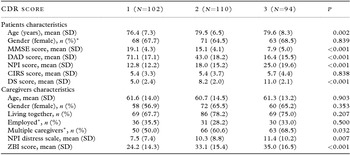
The sample consisted of 306 patients, the mean age was 78.5 years (SD = 7.8), and 66.2% were women. The mean MMSE score was 14.3 points (SD = 6.3), the DAD was 44.2 points (SD = 27.7), the NPI was 18.3 points (SD = 16.4), the CIRS was 5.5 points (SD = 3.9), and the DS was 8.0 points (SD = 3.2). The mean age of caregivers was 61.2 years (SD = 13.9), 62.7% were female, 73.5% lived with the patient, 32.2% were employed, and 59.7% had other support caregivers. The mean ZBI score was 30.7 points (SD = 16.0), and the NPI distress scale was 9.7 points (SD = 8.9). The sociodemographic and clinical characteristics of the study participants according to the severity of AD are shown in Table 1.
Demographic and clinical characteristics of patients and caregivers according to dementia severity

*Data not available in two cases; CDR: Clinical Dementia Rating; MMSE: Mini-Mental State Examination; DAD: Disability Assessment for Dementia; NPI: Neuropsychiatric Inventory; CIRS: Cumulative Illness Rating Scale; ZBI: Zarit Burden Interview; DS: Dependence Scale.
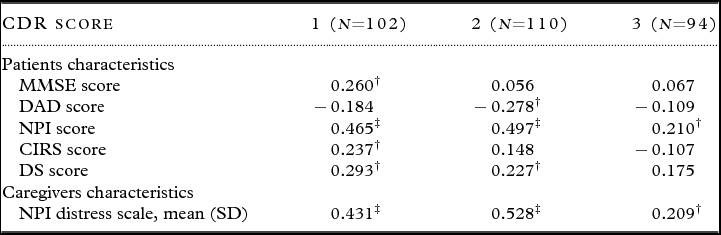
The bivariate analyses showed statistically significant differences in the ZBI score depending on the contextual factors: caregiver gender (male/female: 26.3 points (SD = 15.5) versus 33.3 points (SD = 15.5); p < 0.001), co-residence (live with patient/do not live with patient: 32.3 points (SD = 16.6) versus 26.3 points (SD = 13.3); p = 0.004), and the caregiver's work status (work/no work: 27.5 points (SD = 13.9) versus 32.2 points (SD = 16.7); p = 0.016). There were no statistically significant differences in the ZBI score with respect to the number of caregivers, or caregiver's relationship with the patient (partner or children). The stratified analysis according to the patient's severity did not show statistically significant differences of the ZBI score regarding the contextual factors (data not shown). In Table 2 are shown the Spearman correlation coefficients between patients and caregivers’ characteristics and the ZBI score stratified by dementia severity.
Spearman correlation coefficients between patient and caregiver characteristics and ZBI score stratified by dementia severity

* Data not available in two cases; ZBI: Zarit Burden Interview; CDR: Clinical Dementia Rating; MMSE: Mini-Mental State Examination; DAD: Disability Assessment for Dementia; NPI: Neuropsychiatric Inventory; CIRS: Cumulative Illness Rating Scale; DS: Dependence Scale; †: p < 0.05; ‡: p < 0.001.
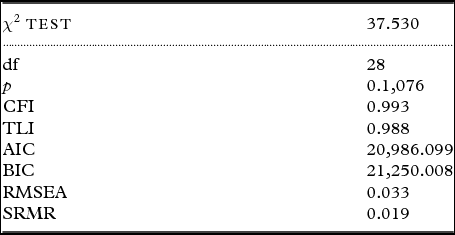
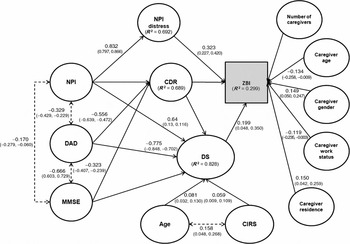
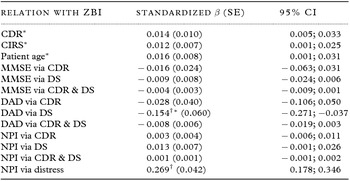
The path model explained 29.9% of the variance in the ZBI score, and the fit indices values indicated that it fit the data well; The χ 2/df value was lower than 2 (1.34), the CFI and TLI values were higher than 0.95, and the model and the data were consistent (χ 2 test of absolute fit was not significant, and SRMR and RMSEA values were lower than 0.05) (Table 3). Figure 1 shows the path diagram and results of the analysis in terms of standardized regression coefficients (β) for each path, wherein caregiver burden results from several determinants. According to this model, the NPI distress scale score, the level of dependence, and the sociodemographic caregiver characteristics were the main direct predictors of the caregiver burden. The NPI, and the DAD had important indirect effects via the NPI distress scale, and the DS scale respectively (Table 3). The model provided a reasonable explanation of the direct and indirect relationships between the clinical variables of the patient and the caregiver sociodemographic characteristics with the caregiver burden. In Table 4 are shown the β coefficients of the indirect relationships of the independent variables with the ZBI score.
Summary of model fit statistics

χ 2 test: Chi-square test; df: degrees of freedom; CFI: comparative fit index; TLI: Tucker-Lewis Index; AIC: Akaike information criterion; BIC: Bayesian information criterion; RMSEA: root mean square error of approximation; SRMR: standardized root mean square residual.
Path model with contextual factors (caregiver gender and age, number of caregivers, caregiver residence), primary stressors (dependence, disease severity, neuropsychiatric symptoms distress), and secondary stressors (caregiver work status) on the Zarit Burden Interview. Numbers on paths represent the estimates for standardized regression coefficients. 95% confidence intervals for paths are in brackets (non-significant path coefficients are not shown). Abbreviations: CDR: Clinical Dementia Rating; MMSE: Mini-Mental State Examination; DAD: Disability Assessment for Dementia; NPI: Neuropsychiatric Inventory; CIRS: Cumulative Illness Rating Scale; DS: Dependence Scale; ZBI: Zarit Burden Interview; R 2: Coefficient of determination.

Standardized β coefficients and 95 confidence intervals (CI) of the indirect relationships between predictors and ZBI score

ZBI: Zarit Burden Interview; SE: Standard error; DS: Dependence Scale; CDR: Clinical Dementia Rating; CIRS: Cumulative Illness Rating Scale; MMSE: Mini-Mental State Examination; DAD: Disability Assessment for Dementia; NPI: Neuropsychiatric Inventory; *: Indirect relationship via DS;†: p < 0.05.
Discussion
The objective of this study was to assess the relationship between the recent concept of dependence for AD patients and the caregiver burden using a path analysis in order to take into consideration the multiple determinants of caregiving process. The findings of our analysis can be summarized as follows. First, our study identified that the major association with the caregiver burden was related to the primary stressors by direct effects (dependence and distress due to the BPSD), and by indirect effects (functional disability via dependence and BPSD via distress). Second, all other stressors, except for the presence of multiple caregivers, were associated with caregiver burden, but the magnitude of these associations was lower than the one exhibited by the primary stressors.
This study adds new evidence to the current research on caregiver burden. We used a complex model because these models are expected to provide more insight into the relative importance of the multiple predictors of caregiver burden. The path analysis allowed us to analyze simultaneously the direct and indirect relationships of the stressors and the contextual factors with the caregiver burden. The specific model of stress for dementia caregiver burden proposes to divide factors by its nature (contextual, primary, secondary, and moderators) (Sörensen and Conwell, Reference Sörensen and Conwell2011). The primary stressors include cognitive impairment, functional disability, and the BPSD, and the current literature has used these variables as independent variables, and has analyzed its effects on the caregiver burden. In previous studies, the most consistent result is the negative effect of BPSD on the caregiver burden (Adelman et al., Reference Adelman, Tmanova, Delgado, Dion and Lachs2014), while regarding the relationship of the cognitive impairment and the functional disability on the caregiver burden is controversial, because some studies have found an association (Miller et al., Reference Miller, Mioshi, Savage, Lah, Hodges and Piquet2013), but others failed to identify these variables as significant predictors of the caregiver burden (Brodaty et al., Reference Brodaty, Woodward, Boundy, Ames and Balshaw2013). In this sense, the use of dependence as a measure of disease progression represents a new approach because, according to the proposed model, the dependence level is a result of the cognitive impairment, the functional disability and the BPSD (McLaughlin et al., Reference McLaughlin2010b). Thus, the path analysis that we adjusted included as primary stressors the level of dependence and the disease severity, while cognitive impairment, functional disability, and frequency and severity of the BPSD were the predictors of these primary stressors. This approach permitted us to decompose the effects of several independent variables in direct and indirect effects.
In concordance with previous studies, our results indicate that the neuropsychiatric symptoms and the related distress were the main variables related to the caregiver burden independently of the remaining stressors (Adelman et al., Reference Adelman, Tmanova, Delgado, Dion and Lachs2014). The frequency and severity of the BPSD had an indirect relationship on the caregiver burden via the distress, but also, the distress itself had an important direct relationship. Regarding the level of dependence, our results indicate that it was, after the distress caused by BPSD, the second primary stressor directly related with the caregiver burden irrespective of the disease severity and the contextual factors. The functional disability contributed indirectly to the caregiver burden mainly due to its effects on the dependence level, and in minor degree due to its relationship with the disease severity. One of the previous studies that analyzed the relationship between the DS and ZBI identified differences depending on the severity of the cognitive impairment (Gallagher et al., Reference Gallagher2011). When all the patients were included in the analysis (backward stepwise multiple regression model), the caregiver burden was predicted by DS and NPI. However, an analysis stratified according to the degree of the cognitive impairment, indicated that the DS score and the MMSE score were good predictors of the caregiver burden, but only in patients with a MMSE over 20 points. Instead, for patients with a MMSE less than 20 points, only the NPI score predicted the caregiver burden, and none of the models accepted the functional impairment as independent variable. Our approach, by using the path analysis strategy, overcomes these problems, because the standardized path coefficients represent partial regression coefficients that measure the effect of one variable on other, controlling for prior variables.
As stated previously, the association between cognitive impairment and caregiver burden has been controversial. In our study, the relationship between cognitive impairment and caregiver burden was moderate and positive in the bivariate analysis, indicating that better cognitive function led to increased caregiver burden, but only for patients with mild severity. This positive bivariate relationship could be interpreted due to the fact that patients with mild severity and better cognitive abilities may be more demanding or reiterative, and consequently producing a burdensome effect on the caregiver. However, in the multivariate analysis, the MMSE was not related to the caregiver burden, nor via disease severity, and nor via dependence. The absence of significant association of the MMSE score with the ZBI in adjusted analysis has been previously described (Bergvall et al., Reference Bergvall, Brinck, Eeek, Gustavsson, Wimo and Jönsson2011).
Regarding the contextual factors, the study results indicate that female gender, decreased age, co-residence, and unemployment, were risk factors for an increased caregiver burden independently of the primary stressors. These results are in concordance with the existing literature. Female caregivers reported higher burden than men, and this difference has been attributed to several factors such as the use of more emotion-focused coping strategies, the reduction in social interactions, or the use of less informal support than men (Springate and Tremont, Reference Springate and Tremont2014). The higher burden in caregivers that live with the patient has been previously reported (Conde-Sala et al., Reference Conde-Sala, Garre-Olmo, Turró-Garriga, Vilalta-Franch and López-Pousa2010), and has been related to the loss of independence, and the increased time the caregiver spends attending to the patient's necessities. Our results also show that caregivers with a job had lower burden, probably because they spent less time performing caregiving activities.
Several limitations of this study should be acknowledged. The first limitation is the absence of moderators such as the caregiver's personality traits, coping skills or socioeconomic level in the path analysis model because these factors have been related to the caregiver burden (Au et al., Reference Au, Lai, Pan, Lam, Thompson and Gallager-Thompson2009). According to the theoretical model of caregiver burden, it is plausible to expect that the relationships detected in the current study could be modified mainly due to the effect of moderator factors. This issue may have produced an overestimation of the stressors analyzed in our study. Second, although the path analysis allowed us to analyze direct and indirect effects simultaneously with multiple independent and dependent variables, the direction of causality between variables was based on the hypothetical relationships expressed within the theoretically based model. In this sense, it is important to emphasize that the path analysis was based on data from a cross-sectional design and cannot test causal directionality on relationships. Third, we have used the caregiver burden as a unitary construct measured by the ZBI. However, there is evidence that the caregiver burden may be composed of several dimensions, and the use of a global measure may mask the true relationships between the independent variables and the existing dimensions. The present paper has also a number of strengths. A recent systematic review of multivariate caregiver burden models identified that the sample sizes in the complex-model studies were not always large, which makes the findings were of low confidence (Van der Lee et al., Reference Van der Lee, Bakker, Duivenvoorden and Dröes2014). In this sense, we used a large sample, which guarantees the confidence in the goodness of fit tests because it doubles the minimum requirement of 10 to 20 individuals for each variable in the model, and ensures the robustness of the statistical analyses in terms of statistical power. Moreover, the model was fitted according to a theoretically based approach, not by using algorithms to adjust the model to the data, conferring to our results a strong external validity.
In conclusion, the results of this study offer evidence that the dependence level is, after the stress related to the BPSD, the most important predictor of caregiver burden. Insight into the multiple determinants of caregiver burden has both theoretical and clinical outcomes. Our results show the multidimensional complexity of the caregiver burden, and may be useful to develop more comprehensive models of this construct, to help clinicians to identify caregivers at risk, as well to develop specific educational programs for caregivers taking into account the large number of determinants and the importance of the patient's dependence level.
Funding
This study was sponsored by Janssen Alzheimer Immunotherapy Research & Development, LLC, and Pfizer Inc. The funder participated in the design of the study. The funder had no part in the analysis and interpretation of the data; the writing of the report; and the decision to submit the paper for publication.
Conflict of interest
Josep Garre-Olmo and Secundino López-Pousa are employees of Institut d'Assistència Sanitària, who were paid contractors to Pfizer Inc and Janssen Alzheimer Immunotherapy Research & Development, LLC in the development of this manuscript and the study design and data analysis. The authors declare that they have no competing interests. None of the authors have interests in any company or institution that might benefit from the publication of this manuscript.
Description of authors’ roles
J. Garre-Olmo, S. López-Pousa and J. Vilalta-Franch contributed to the study concept, design, analysis and interpretation of data, and writing of the paper. L. Calvó-Perxas, O. Turró-Garriga, and L. Conde-Sala contributed to the data interpretation and writing of the paper.
Acknowledgments
The authors want to thanks the associated investigators of the Cost of Dependence Associated to Alzheimer's disease in Spain Study Group (CoDep-EA Study Group). The CoDep-AD Study Group refers to: Miquel Aguilar. Hospital Mútua de Terrassa (Terrassa); Jordi Alom. Hospital General Universitario de Elche (Elche); Guillermo Amer. Hospital Universitari Son Espases (Palma de Mallorca); Carmen Antúnez. Hospital Virgen de la Arrixaca (Murcia); Rafael Arroyo. Clínica Quirón (Barcelona); Miguel Barquero. Hospital La Fe (Valencia); Félix Bermejo. Hospital 12 de Octubre (Madrid); Fernando Castellanos. Hospital Virgen del Puerto (Plasencia); Manuel Franco. Hospital de Zamora (Zamora); Guillermo García. Hospital Ramón y Cajal (Madrid); José María García-Alberca. Instituto Andaluz de Neurociencia y Conducta (Málaga); Domènec Gil. Hospital Universitari Sagrat Cor de Jesús (Barcelona); Pedro Gil. Hospital Clínico San Carlos (Madrid); Albert Lleó. Hospital de Sant Pau (Barcelona); Manuel Martín. Clínica Psiquiátrica Padre Menni (Pamplona); Dolores Martínez. Hospital La Magdalena (Castelló de la Plana); Raimundo Mateos. Hospital de Santiago de Compostela (Santiago); Vicente Medrano. Hospital General Universitario de Elda (Elda); Jordi Peña. Hospital del Mar (Barcelona); Pilar Quílez. Hospital Mútua de Terrassa (Terrassa).We are grateful to all the study participants who have generously given their time and collaborated in the study, and S Monserrat-Vila, for the administrative support, acquisition of data and data handling.