I would like to start with an anecdote. When my daughter was five weeks old, she had a stiff neck, and almost couldn't turn her head at all to her left. So, my wife and I went to see an osteopath. The doctor's practice was a family business: father and son—both of them neurologists and chiropractors—work on scores of bodies day by day, manipulating and treating them. The father is also an osteopath; the son is still learning to become one. We saw the son. He treated our daughter who screamed and turned red and in turn got her back straightened, but not quite as straight as it should have been. So, the son got his father, who showed him another trick or two, explained them to his son and to us, and left again. Our daughter was now really aligned, and the son said: “Well, this is how it goes. I am still learning. While I push and pull and push and pull, my father just needs one grip and the work is done.” Our daughter sneezed. “Do we need to come back?” we asked. “No, one time is sufficient. Good-bye,” he replied and left for his next patient.
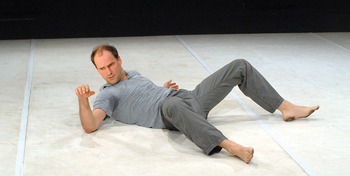
Martin Nachbar in “Remembering” from his Urheben Aufheben. Photo: Gerhard Ludwig.

Our daughter was completely transformed. She had more freedom in all of her movements, and her gaze seemed to go further out into the world. She wouldn't stop looking, which in turn made her very hungry. The period of time for her after the visit at the osteopath's seemed to be one big exchange between visual and food intake. I got very excited. Something had happened here that interests me deeply: Knowledge and skill, that is to say technique, was handed down from one generation to the next. The history of osteopathy and of medicine had contracted into one moment in order to leap from father to son and, even more strikingly, to affect healing through the touch between doctors and our daughter. It was as if this corporeal touch had remembered the whole knowledge of a healing method in a single instant.
Such a moment needs practice and study just like a touching or a moving moment in theater or dance needs practice and study—that is to say technique. But, what kind of technique is needed in dance? What does such a technique do? What does it include? What does it exclude?
In her remarkable book Chaos, Territory, Art: Deleuze and the Framing of the Earth, Elizabeth Grosz (Reference Grosz2008) describes the earth as chaos. It is chaos in the sense that it is the milieu of all milieus and thus contains everything, not in an absence of order, but in a presence of everything at once, a plethora of possibilities. Art's task is to claim something from this plethora, namely heightened perception and sensation. This is achieved through framing parts of the chaos and thus bringing out particular qualities of the base material, forming them and bringing them to the senses. Following Grosz' argument, art's first gesture is therefore an architectural one: the construction of a frame. Through the making of a floor, for example, particular qualities of the earth are framed and brought out, such as gravity and thrust, which let dance emerge. I argue that on the floor that is now a dance floor, the body has so many possibilities that it becomes chaotic itself. On the dance floor, the body needs to be framed as well.
The kinds of framing of the body and of the body on the floor are techniques that can be transmitted, studied, remembered, appropriated, and changed. The first half of the twentieth century showed us, as Steve Paxton has pointed out, that individual choreographers developed dance techniques that comprised the vocabulary of entire choreographic repertories: Martha Graham was the outstanding example of this. But also her former students and dancers Erick Hawkins and Merce Cunningham, who all appropriated and changed Graham's technique, made important points in this argument.Footnote 1 In contrast, I have studied at the end of another era. During the second half of the century, another point was made: Technique was understood no longer as the repetition of situations in order to form bodies within a certain movement repertory (in other words establishing certain movement habits), but as the production of corporeal sensations and perceptions. The body was no longer a style-fulfilling machine to be trained, but an instrument of sensations to be tuned. I am especially thinking of contact improvisation, a movement form instigated by Steve Paxton (who had studied with and danced for Merce Cunningham), and of Trisha Brown's ways of dancing partially shaped by her studies with Anna Halprin and of the Susan Klein technique, whose extreme slowness allows for a rich sensory input while moving. There are many more examples. Since perception is a highly individual affair, the various explorations have led to various, highly eclectic training forms. This has advantages and disadvantages, which would be material for an entire essay of its own. For this one, it is important to remark that it was with this eclectic experience and knowledge, with this framing, that I encountered Dore Hoyer or, to be more exact, the video of a black-and-white film that shows her cycle of dances entitled Affectos Humanos.
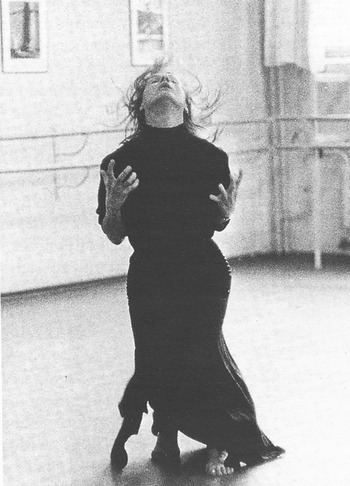
This encounter took place in 1999, in a library in Brussels. My colleagues Thomas Plischke, Alice Chauchat, and I saw a gray and black figure—Hoyer—who, accompanied by percussion and piano by Dimitri Wiatowitsch, danced five dances choreographed by herself: “Vanity,” “Desire,” “Hate,” “Fear,” and finally “Love” (see Photo 2).
Dore Hoyer rehearsing “Hate” from her suite Affectos Humanos. Photo: Jacques Hartz.

With white makeup and a dark cap on her head, dressed in wide clothes draped over her body and flowing around her, Hoyer unfolds her choreographies in a gray-white studio that is lit in such a way that neither corners nor edges are visible: a human being lost in an endless space, solitarily drawing the traces of her affects and emotions. At the same time, we saw an intense physical and sensory presence, and a body that was formed by rigorous training and movement research, a body framed.
Thomas Plischke, Alice Chauchat, and I, with dramaturg Joachim Gerstmeier, decided to work with these dances. After an eight-year absence from Germany, especially Plischke and I took to a search for an artistic home and for what this might mean. Both of us had studied dance at schools that favored American and Belgian over German influences in their training. While I had trained at the SNDO,Footnote 2 Plischke had gone through the training at P.A.R.T.S.Footnote 3 Besides Pina Bausch, we hardly knew anything about German Ausdruckstanz and its influences, and we were curious to find out how choreographers of this tradition had worked, and had approached the body as a tool of expression. We wanted to see if we shared anything with German Ausdruckstanz, and especially the ways its protagonists thought about dance. Hoyer seemed to be an appropriate entry point. Although we didn't find her style particularly interesting, we were fascinated by her intensity and by her apparently thorough movement research. I accepted the role of the guinea pig, and tried to probe and test Hoyer's material on and through my body.
To start this research, I first called the German Dance Archive in Cologne, whose director, Frank-Manuel Peter, referred me to Waltraud Luley, a then eighty-four-year-old dance pedagogue in Frankfurt-am-Main, who died in December 2011. She was a close friend of Hoyer's until her death in 1967, and she acted as a sort of custodian of Affectos Humanos. The first things she wanted to know when I called her in 1999 were my age, my height, my weight, and whether I was a lyrical or a dynamic dancer. Apparently, she wanted to get a picture of me, and although she found me a bit too young for the Affectos Humanos, she said: “Well Mister Nachbar, I suggest you work on one or two of the dances and when you are done, you call me again and we make an appointment to work on the material.” So I did. I worked with the video and learned the steps and gestures from the tape, and tried to transfer them to my body and into space as well as I could. Two months later, Luley and I finally met at her studio. We worked on the beginning of the dance “Hate,” which works with a refined coordination of high tensions running through the arms and shoulders. But I, at the time mostly trained in the above mentioned release techniques and contact improvisation, did it rather softly, almost sloppily. Luley sprang out of her chair and yelled: “Mister Nachbar, this is hate! The whole body is a cramp!” So I put myself into a state of rather unrefined, yet high body tension, only forgetting my little fingers. Waltraud Luley reacted immediately: “The small fingers, Mister Nachbar, the small fingers!”
In the course of the reconstruction, Luley and I met regularly. She had studied and performed dance in the 1930s and 1940s, and had later seen Hoyer perform hundreds of times. Thanks to her, I got to understand the dances of Affectos Humanos. She showed me exercises and explained training methods to me, talked about Hoyer and her approaches to dance and to the stage. She continuously compared the original on tape with the original in front of her in the studio. We often paused the tape, catching Hoyer in her dance and producing the illusion of a position. I would copy this position, and Waltraud Luley would correct me as if I exercised some kind of expressionist dance yoga. She insistently pointed out the differences in posture, dynamics, and movement details between Hoyer and me. There were many—so many that I initially couldn't work through all of them. In the first performances of the reconstruction, I interpreted Hoyer's intensity and her gestural expression as a work of high muscular tension with strong breathing support. Since I already had a strong tension pattern in my shoulders and upper arms, I compensated by also tensing my chest, stomach, and legs. This resulted in a body pattern with a high muscular tonus, which constrained my movement range. I could give impulses only with the help of my breath, and reaching with arms and legs into space became difficult. At the time, dance critic Gerald Siegmund said that I took Hoyer's body onto mine without them really connecting: a little bit too heavily to attain her coordination of, and play with, intensities, but still weighty enough to pass as an important experiment: A contemporary exposes himself to dance history and makes it and its differences with today visible.
Then, I only worked on the dances “Desire,” “Hate,” and “Fear.” My high body tension got in the way of the intricate coordination of reaching and counterreaching in “Desire,” while it helped me to achieve a strong intensity in “Hate.” The dance “Fear” seemed to somehow be in my nature. Its basic movements are shivering and shaking, which both release the greater muscles. I could relate this to my experiences in release techniques. In this way, the performances were always a progression from “Desire,” which stood as most foreign to me, via “Hate,” to “Fear.” Of all three dances, I related to “Fear” most strongly. I showed the dances about 60 times, partially in the frame of affects/rework with Thomas Plischke, Joachim Gerstmeier, and Alice Chauchat, partially as a lecture performance entitled ReConstruct.Footnote 4 The very last performance of this show was in February 2005, at this time already under the title Urheben Aufheben.Footnote 5
Before this, I hadn't danced the dances in a year. Afterwards, I wouldn't dance them for three more years. Instead, I started to study Tai Chi. Then, at the end of 2007, Luley asked me if I didn't want to reconstruct and perform the two remaining dances “Vanity” and “Love.” In 1999, it was she who had not allowed me to dance these dances. She feared a man would look too effeminate in them. But in 2007, she wanted me to inherit her role as the custodian of Affectos Humanos. To be able to do so, I would have to dance all five dances on stage. I accepted with one condition—that the work would be funded. I wanted to reconstruct the last two dances, but only if I could frame and stage the whole thing anew.
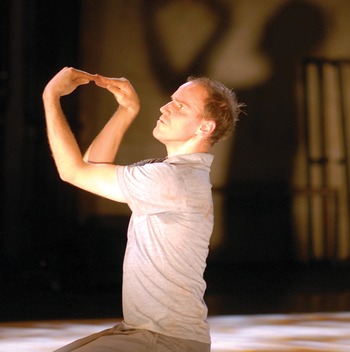
I received the funding, and Luley and I started to work on the dances “Vanity” and “Love”Footnote 6 (see Photo 3). Eight years after the beginning of my exploration of Hoyer's Affectos Humanos, I understood a lot more of these dances. I see now that Hoyer's intensity is not so much caused by a high body tension, but rather with an intricate coordination of the spine itself, and of the relation between the spine and the limbs.
Martin Nachbar performing Hoyer's “Love” in his Urheben Aufheben. Photo: Gerhard Ludwig.

She didn't achieve expression by putting meaningful gestures into space, but rather by coordinating the finely crafted intensities, so that the expression emerged from in between her body and the space around it—a kind of fugitive oscillation rather than a monumental positioning.
Two things were crucial for this understanding. On the one hand, I had started to study Tai Chi a practice that focuses on dropping the weight of the arms and shoulders in order to be able to use them always in relation to the spine, which in turn relates the body's weight to the floor through the hips, legs, and feet. On the other hand, it is exactly the dances “Vanity” and “Love” that accentuate the specifics in Hoyer's technique: the fine and complex coordination of the undulating spine in “Vanity,” and the continuous carving of the hips into space in “Love.” Both spine and hips give impulses to the rest of the body that moves in space. I understood that Hoyer's technique and, apparently, the dance of her era were not so different as I had assumed from the dance I had studied: Steve Paxton, for example, has developed a whole technique evolving around the spine called “Material for the Spine,” which also focuses on the coordination of the spine in relation to the rest of the body. Another example is the “carving” of the coccyx to go from bending over to squatting in the Susan Klein technique. But also choreographically there are parallels, such as when Deborah Hay posits intensities in space with minute attention, or when William Forsythe time and time again searches out the friction between language and dance.
But besides these questions around bodily skill and awareness, what does it mean to reconstruct a dance? From the beginning of my research, I understood it as a form of remembering within a frame that is torn between its quality of being simultaneously actual, and an archived knowledge in movement. The object of dance is always fugitive, and dependent on the dancers' abilities to remember movement in and through the doing of movement. But while, in the beginning, I mostly saw the differences between me (the contemporary with specific training and taste), and a moment in dance history (the Affectos Humanos), I am now rather interested in the similarities between present and past—not necessarily the similarities of styles and habits, but of that which remains over time and is only brought differently to the senses—as the spine in dance or, to come back to the anecdote from the beginning of this article, the hands in medicine.
In dance, as in architecture, a reconstruction is undertaken when the object to be reconstructed has vanished. But unlike architectural objects, the objects of dance have always already vanished. They only survive when practiced continuously, and when passed on from one dancer to the next in repertory sessions or technique classes. This means that a reconstruction in dance takes place when the dance or choreography in question hasn't been danced for a decade or more and when most—if not all—of its protagonists have died. In other words, there is a rather long time span between the remembering dancer and the dance to be remembered. For this, aids such as film, or notation, or eye witnesses are essentially needed, which are not always necessary when a company that has the money cultivates its repertory through specialists or when an established dance technique has enough practitioners that share certain movement patterns, habits, and exercises. But, as Deleuze (Reference Deleuze, Tomlinson and Habberjam1988) points out in a monograph on Henri Bergon's philosophy, once this kind of continuity is interrupted, a leap is needed, namely into a specific zone of the past. From this zone, images are actualized that not only address the visual sense, but also hearing, touch, and proprioception. This is only possible because presence and past are not different in kind. While the present continuously actualizes, its past is made at the same time, and coexists with other pasts in various states of contraction and actualization. When I remember something, I don't bring something back from the past to the present, but I contract and actualize it through myself and my senses (Deleuze Reference Deleuze, Tomlinson and Habberjam1988). The archive cannot exist without the remembering, repeating, and also differentiating body. In dance, this is a repeated experience, when we remember steps in a dance class or whole choreographies while touring a piece, the past of the remembered movement coexists with the present of its performance—and in and through the present bodies.
A central idea for me is that of the experiment on myself, of the bodily text, through which my frames—such as my body, with its movement knowledge and experience—become apparent. In reconstruction, this frame is questioned and trained anew. It can be sensed differently. The beauty of this process is that the gesture of making the (dance) floor as an architectural gesture here meets reconstruction—an activity in dance that borrows its term from architecture to describe an almost osteopathic gesture of restructuring touch.