

Are people who prefer lower immigration levels sensitive to the economic costs of reducing immigration? This question is particularly relevant in Britain in light of ongoing debate over Britainʼs exit from the European Union (EU). Immigration has become increasingly salient since 2013 in many European countries and in the USA and has ranked among the top three issues for voters since 2002 (Duffy and Frere-Smith Reference Duffy and Frere-Smith2014), making it a uniquely persistent topic of political importance. We examine the connection between preferred immigration reductions and their economic costs through a novel constrained preference survey experiment that adds to the scholarly understanding of immigration preferences in several important ways. We find economic considerations may matter more than generally thought as inhibitors of restrictionist policy preferences, and that egocentric economic motives can be as important as sociotropic ones in shaping these preferences.
Previous analyses of immigration attitudes support cultural threat and sociotropic economic explanations – those regarding the economy as a whole – over egocentric material interests such as threats to oneʼs own standing in the labor market (Hainmueller and Hiscox Reference Hainmueller and Hiscox2010). On the cultural side, living near refugee processing centers or inhabiting ethnically changing neighborhoods or countries tends to lead to more negative attitudes to immigrants and a preference for lower levels of immigration (Newman Reference Newman2013; Lubbers Reference Lubbers2006; Enos Reference Enos2014). Brader, Valentino, and Suhay (Reference Brader, Valentino and Suhay2008) show, by manipulating the skin tone and ethnicity of an immigrant, that white Americans prefer European to non-European immigrants.
Sociotropic economic considerations are also seen as important. When asked about the reasons why they oppose immigration, many respondents cite competition for jobs or pressure on public services (Sides and Citrin Reference Sides and Citrin2007). Studies repeatedly find that respondents favor high-skilled over low-skilled immigrants (Bansak, Hainmueller, and Hangartner Reference Bansak, Hainmueller and Hangartner2016). Panel studies, however, find no evidence that the economic cycle affects immigration opinion, but do find that changes in the stock of immigrants predict opposition over time (Hatton Reference Hatton2016).
Deploying an innovative methodology designed to assess implicit cost constraints on immigration attitudes, we test the competing sociotropic or egocentric economic paradigms, as well as the role of noneconomic motivations. We use a novel constrained preference experiment conducted on a national sample of UK adults to investigate the publicʼs preferences over levels of European and non-European immigration. Rather than correlate economic considerations with immigration preferences in the unconstrained manner typical of most existing research, we force respondents to make a trade-off between lowering immigration and foregoing economic benefits. This approach reflects the observation by Kuklinski et al. (Reference Kuklinski, Quirk, Jerit and Rich2001, 414) that “to the extent that citizens can express trade-offs explicitly and realistically, they will give policymakers informative signals about their priorities.” Trade-offs, beyond measures of stated favorability or opposition toward immigration, more accurately reflect what citizens might want in realistic policy terms.
Attitudes toward Immigration
In light of the United Kingdomʼs 2016 vote to leave the European Union, polling finds that British citizens want both reduced immigration and improved economic growth. Opposition to immigration is particularly striking among “Leave” voters (Clarke, Goodwin, and Whiteley Reference Clarke, Goodwin and Whiteley2017) and polling indicates that nearly half (45%) of British citizens would be unsatisfied with a Brexit outcome that continued to allow freedom of movement for EU citizens in order to retain Single Market access. Footnote 2
Despite the prevalence of these restrictionist attitudes, there remain open questions about the degree to which an apparently unconditional opposition to migration may be affected by the economic costs that actually come with attenuating immigration levels. Indeed, it would appear that many British citizens favor reducing immigration and retaining access to the Single Market (43% believe the EU should offer a free trade deal without guaranteeing freedom of movement) Footnote 3 despite this combination of policies being highly unlikely to emerge from the Brexit negotiations. This “cake and eat it” set of preferences highlights a limitation of traditional survey research, which permits citizens to express separate attitudes on what are ultimately inseparable preferences (Lacy Reference Lacy2001).
We ask: are citizens willing to pay a (personal or societal) cost in order to defend a largely symbolic attitude such as opposition to immigration? The LSEʼs Centre for Economic Performance suggests, citing data from Boubtane, Dumont, and Rault (Reference Boubtane, Dumont and Rault2015), that “cutting EU immigrants to 80,000 per year [half of current levels] is likely to shave 0.16% off productivity growth (Wadsworth et al. Reference Wadsworth, Dhingra, Ottaviano and Van Reenen2016). So about a decade after Brexit, UK gross domestic product (GDP) per capita will be about 1.6% lower than it would have otherwise been.” By those numbers, cutting EU immigration entirely would lower GDP per capita by more than 3% by 2030. Opposition to immigration necessarily means an economic cost, even if citizens do not know it. One study suggests that approximately 35% of Leave voters would be willing to pay 5% of their personal income to reduce EU immigration to zero, but 6 in 10 voters are unwilling to sacrifice any income to reduce immigration (Kaufmann Reference Kaufmann2017). This research tested whether egocentric economic considerations affect views on EU immigration but did not ask how respondents might trade off between immigration levels and sociotropic economic costs, nor did it ask about non-EU immigration. We do just this, comparing egocentric and sociotropic economic concerns, as well as preferred EU and non-EU immigration levels.
Theory and Expectations
Our goal is to know what the publicʼs preferred level of net EU and non-EU immigration to the UK is, and what economic costs individuals are willing to pay to achieve that. Our expectations are straightforward. We are interested in two types of economic costs: egocentric (personal costs) and sociotropic (costs to society as a whole) and two types of immigration (EU and non-EU). Thus, we expect:
H1: The imposition of a sociotropic cost in terms of foregone national GDP will make citizens more favorable toward higher levels of immigration (i.e., immigration levels closer to the status quo).
H2: The imposition of an egocentric cost on personal income will make citizens more favorable toward higher levels of immigration (i.e., immigration levels closer to the status quo).
H3: Raising sociotropic (H3a) or egocentric (H3b) costs from a low cost to high cost will further increase favorability toward higher levels of immigration.
Thus, we anticipate that shifting the cost of achieving zero-net immigration from 5% of GDP to 10% of GDP should further increase favorability toward immigration. Given that the literature suggests sociotropic costs matter more for immigration opinion than egocentric costs, we further expect that:
H4: Sociotropic costs in terms of foregone GDP will have a larger effect than the egocentric cost of lost household income in convincing respondents to accept higher levels of immigration.
Design and Methods
To measure preferences toward immigration when constrained by cost, we rely on a survey experiment that presents this trade-off graphically and allows respondents to express their desired reduction in net immigration (between no reduction and 100% reduction), constrained by an associated economic cost. We benchmark these constrained preferences using a within-subjects design that first measures individuals’ unconstrained preferences for levels of EU and non-EU immigration.
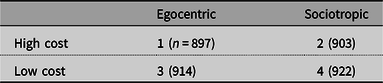
The design then involves two subsequent manipulations. First, we randomly assign individuals to either an egocentric condition where economic costs are expressed in terms of % of personal income or a sociotropic condition where costs are in terms of GDP per capita. This provides within-subjects tests of H1 and H2 (comparing constrained preferences to unconstrained preferences). Second, we test H3 by further randomizing individuals to either a “high cost” or “low cost” trade-off curve, which adjusts the absolute cost associated with various reduced levels of immigration. The high-cost condition imposes a 10% cost (of GDP or personal income) for bringing net immigration to zero; the low-cost condition imposes a 5% cost.
We test H3 and H4 through a 2 × 2 factorial design (four conditions total; see Table 1). We repeat the experiment separately for EU and non-EU immigration, with the order of EU/non-EU immigration questions randomized.
Experimental Design and Sample Sizes

We also ask a manipulation check to assess respondents’ acceptance of the cost trade-off: “Do you believe the economic costs of reducing immigration that you just read are just about right, or do you think reducing immigration will be much more costly or much less costly?” with a five-point scale from “much more costly” to “much less costly,” or “don’t know.”
Finally, we also included a separate two-condition experiment measuring preferences for a relative balance of EU and non-EU immigrants, where the manipulation entailed the inclusion or exclusion of an explicit statement of current relative levels (“Currently 37% of all immigrants to the UK are from the EU and the rest are from Asia, Africa, the Middle East, and the rest of the world.”).
Our main outcome measure is simply respondents’ preferred immigration levels,
 $\sum\nolimits_{i = 1}^n {{{{L_i}}}\over{n}$
, where
 ${L_i}$
is the preferred level of immigration for respondent
 $i$
, among
 $n$
total respondents. Because our design only allows respondents to express preferences for lower levels of net immigration (from 0 fewer immigrants to 165,000 fewer bringing total net immigration to zero), we can also state these preferred levels as preferred reductions, such that
 ${R_i} = 165000 - {L_i}$
for each respondent, separately for EU and non-EU immigration.
The causal effects of interest are the differences in preferred immigration levels across the various cost counterfactuals, such as the high sociotropic cost and low sociotropic cost conditions:
 $${\sum\limits_{i = 1}^{{n_1}} {{{{L_{i,{\rm{High}}\,{\rm{Sociotropic}}}}}}\over{{{n_{{\rm{High}}\,{\rm{Sociotropic}}}}}}} - {\sum\limits_{j = 1}^{{n_0}} \frac{{{{L_{j,{\rm{Low}}\,{\rm{Sociotropic}}}}}}\over{{{n_{{\rm{Low}}\,{\rm{Sociotropic}}}}}}$$
separately for EU and non-EU immigration. We can estimate this effect as difference-in-differences of within-subject changes between unconstrained (
 $t = 0$
) and constrained (
 $t = 1$
) preference measures between experimental conditions:
 $${\sum\limits_{i = 1}^n \frac{{{{L_{i,{\rm{Low}}\,{\rm{Egocentric}},t = 1}} - {L_{i,{\rm{Unconstrained}},t = 0}}}}\over{{{n_{{\rm{Low}}\,{\rm{Egocentric}}}}}}} - {\sum\limits_{j = 1}^n \frac{{{{L_{j,{\rm{Low}}\,{\rm{Sociotropic}},t = 1}} - {L_{j,{\rm{Unconstrained}},t = 0}}}}\over{{{n_{{\rm{Low}}\,{\rm{Sociotropic}}}}}}$$
The within-subject differences provide for tests of
 $H1$
and
 $H2$
, and these differences-in-differences provide for tests of
 $H3$
and
 $H4$
. We estimate effects for the high personal cost, high sociotropic cost, and low personal cost against the low sociotropic cost condition as a baseline, using OLS regression:
 $${\rm{Difference}} = {\beta _0} + {\beta _1}{\rm{Low}}\,{\rm{Egocentric}} + {\beta _2}{\rm{High}}\,{\rm{Sociotropic}} + {\beta _3}{\rm{High}}\,{\rm{Egocentric}}$$
The intercept,
 ${\beta _0}$
, is an estimate of the impact of low sociotropic costs on preferred levels of immigration – a positive value would be consistent with
 $H1$
such that respondents display preferences for higher levels of immigration when reductions are costly.
Footnote 4
 ${\beta _1}$
estimates Equation 2. To the extent that
 ${\beta _1}$
,
 ${\beta _2}$
, and
 ${\beta _3}$
are statistically distinguishable from zero, costs induce preferences for lower (if negative) or higher (if positive) levels of immigration than the low sociotropic cost.
Footnote 5
Most of our analysis focuses on preferred levels of EU and non-EU immigration and overall (summing preferences for both types). We further describe differences in preferences among Leave and Remain voters and voters of different socioeconomic classes. Though not causally intepretable, we expect respondents will accept a higher level of EU than non-EU immigration and, given that Leave voting in the 2016 referendum on EU membership appears more linked to authoritarianism and conservatism than economic concerns (Kaufmann Reference Kaufmann2017), we anticipate Leave voters should be more reluctant than Remain voters to relax their immigration preferences in the face of costs.
Data Collection
Data were gathered by YouGov through two separate waves of their online “Omnibus” panel (26 April and 2 May, 2017, 10 months after the Brexit vote). The Omnibus panel is a non-probability panel of respondents who complete surveys in exchange for reward points. From this panel, respondents are selected using quota methods to reflect the composition of the UK population with respect to age, sex, education, and region. Given the panel, we are able to rely on profile measures of respondents’ characteristics: age, gender, social class, education, region, party identification, and vote history (general election and EU membership referendum). Totally, 3,636 respondents completed the survey and analyses are weighted according to poststratification weights (targetting UK census demographics) provided by YouGov (Hix, Kaufmann, and Leeper Reference Hix, Kaufmann and Leeper2020).
Results
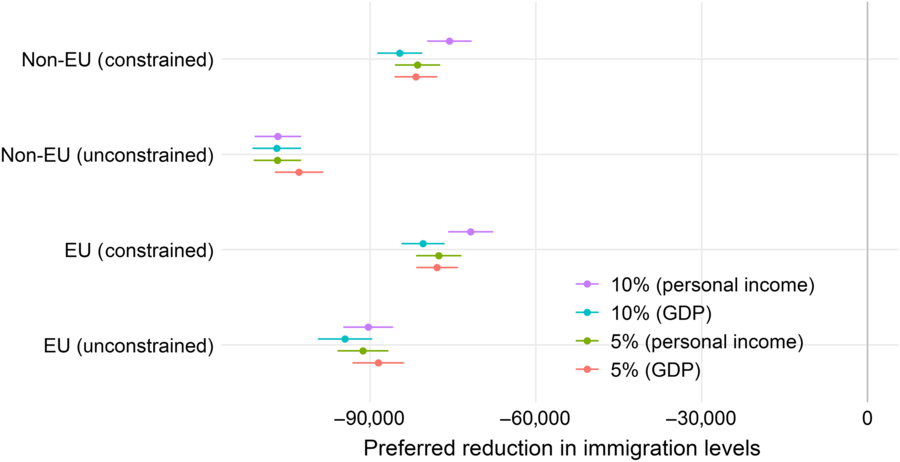
Respondents are in favor of substantial reductions in net immigration. Against the current 330,000 net annual immigrants – 165,000 net migrants from both the EU and outside the EU – the preferred reductions in immigration are substantial. On average, respondents prefer a reduction in EU immigration from 165,000 to 73,775 per year, a drop of 91,325 (SE = 1,201) and a reduction in non-EU immigration from 165,000 to 59,689, a drop of 105,311 (SE = 1,115). This adds up to preferring a level of net annual immigration of around 133,000, equal to about 40% of current levels. Figure 1 reports these reductions in EU and non-EU immigration levels under unconstrained and constrained conditions. The unconstrained conditions show the preference for lower levels of both non-EU and EU immigration. Footnote 6
Preferred Reductions in EU and Non-EU Immigration, Unconstrained or Constrained by Egocentric or Sociotropic Costs.

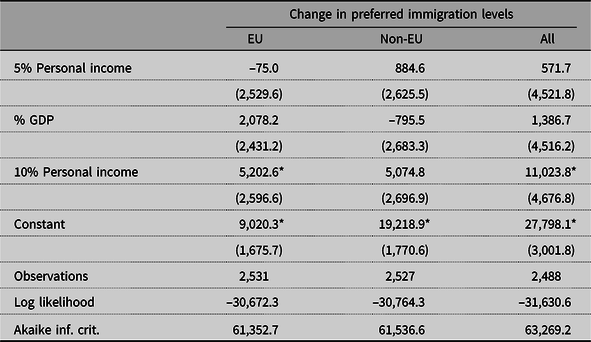
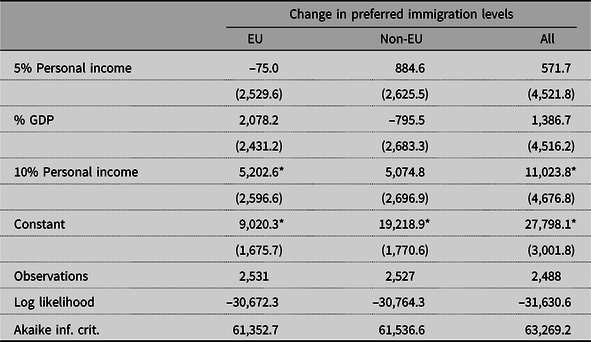
These are estimates of Equation 3, separately for EU (column 1) and non-EU (column 2) immigration, and a pooled estimate (column 3). The outcome is a within-subject shift in preferred immigration levels (cost-constrained preference – unconstrained preference). The positive constant in each case indicates that the imposition of a low sociotropic cost increases preferred immigration levels. The remaining coefficients are differences-in-differences against that baseline condition (as in Equation 2).
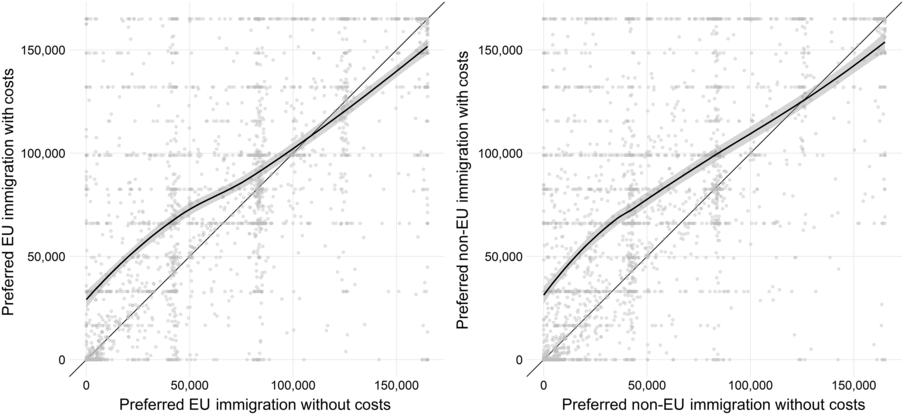
The constrained conditions in Figure 1 show how individuals’ preferences change in the face of low or high personal or sociotropic costs. Table 2 reports estimates of these differences-in-differences. In the low-cost, societal condition (represented by the constant term in these specifications), respondents respond by accepting 9,000 more EU immigrants and 20,000 more non-EU immigrants per year. This result is strongly consistent with our expectation that sociotropic costs will shift preferences in favor of higher immigration levels (
 $H1$
). Keeping in mind that respondents initially preferred higher reductions in non-EU than EU immigration, the larger effect of low societal costs for non-EU than EU immigrants (the constants in columns 1 and 2 of Table 2) mean that costs equalize preferences for levels of EU and non-EU immigration.
Treatment Effects by Full Sample
NOTE: *
 $p < 0.05$
.
Asking respondents to consider a personal rather than sociotropic cost yields similar effects, consistent with
 $H2$
. The difference-in-differences between the low societal cost and low personal cost conditions (the first row of coefficients in Table 2) are not statistically distinguishable from zero, indicating that sociotropic and personal costs have similar effects on preferred immigration levels.
We expected higher costs would magnify these effects (
 $H3$
), yet the differences-in-differences for the high cost conditions do not tell a consistent story. Increasing costs from 5% to 10% of GDP does not lead to significantly larger increases in preferred levels than the sociotropic cost condition (disconfirming
 $H3a$
).
Footnote 7
Yet, higher personal costs do yield a significantly larger shift (consistent with
 $H3b$
) for EU immigration levels.
Footnote 8
One possibility, of course, is that the egocentric cost manipulations were simply more evocative than the sociotropic, rather than an inherently meaningful difference in the influence of these two types of costs. Evaluating these results as a whole in light of the literature, which strongly expects sociotropic costs to be more consequential than egocentric costs in moving immigration preferences, we see no clear evidence for this (disconfirming
 $H4$
). It is also possible respondents were unwilling to believe the cost estimates we provided. On our manipulation check, many respondents indicated they did not know the costs of immigration reductions; among those who provided a substantive answer, there was little variation across conditions in shares of respondents believing the costs were higher or lower than we implied. While respondents were somewhat more skeptical about the 10% personal income cost than the other stimuli, substantial proportions of respondents in every condition thought the costs we reported were “just about right” and majorities thought costs were even higher than we estimated so we are reasonably certain most respondents “took” the treatments at face value.
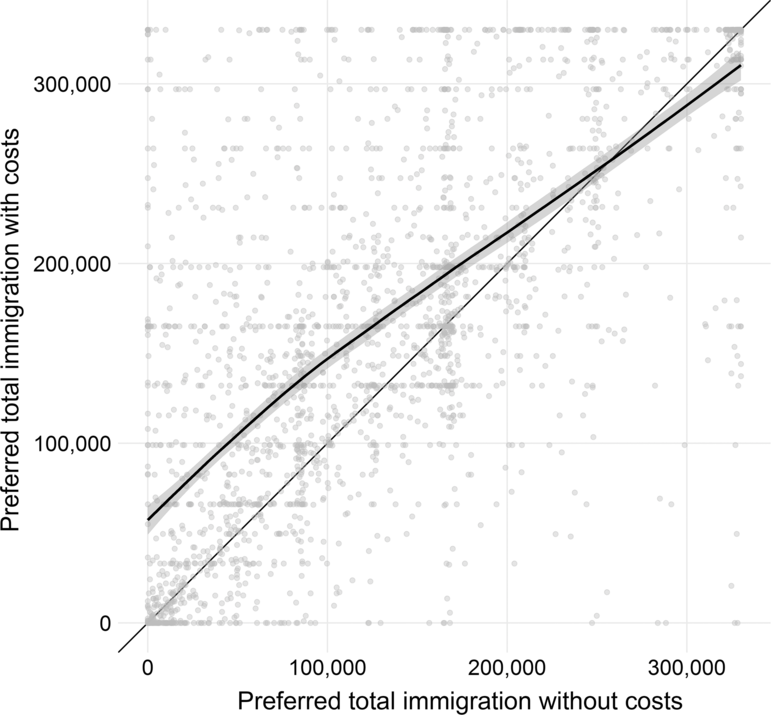
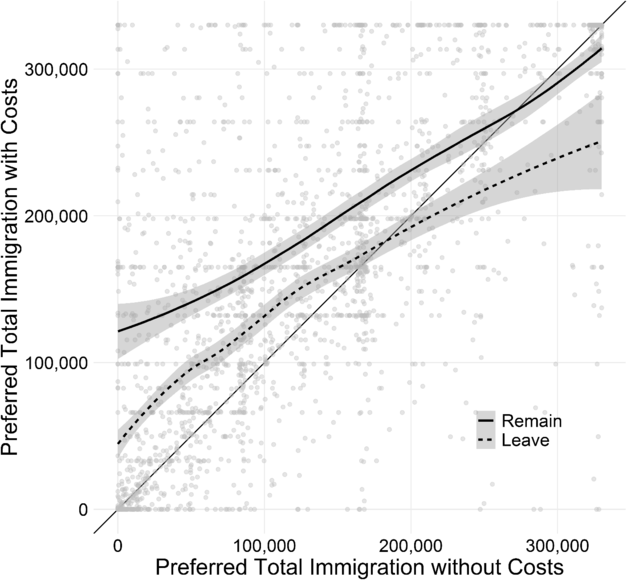
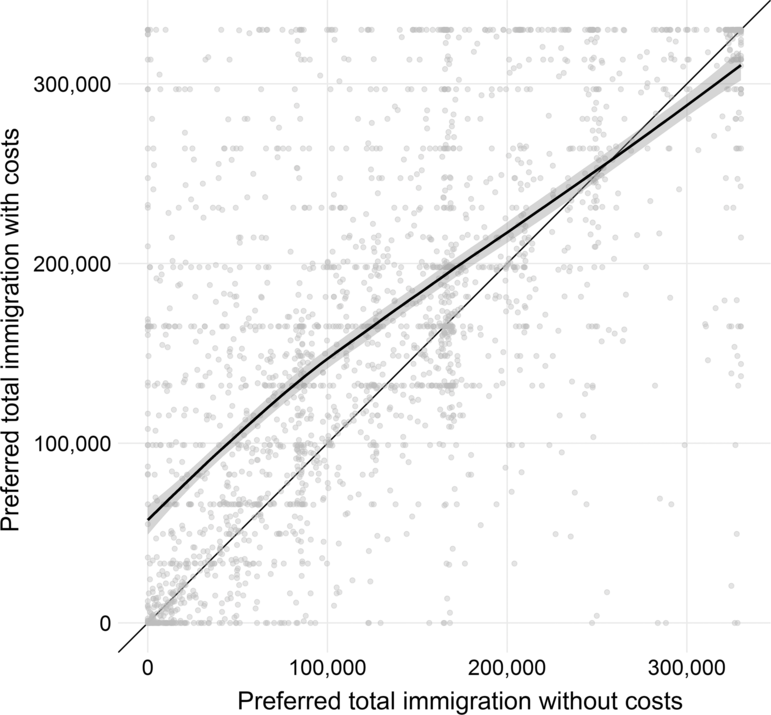
Whose preferences are shifting? Figure 2 provides a visual summary of the individual-level relationship between unconstrained preferences (x-axis) and cost-constrained preferences (y-axis) for total net immigration; the solid black line represents the line
 $y = x$
. The LOESS curve shows how cost constraints shift preferences among those with varying degrees of preferred immigration. Respondents who prefer close to zero-net annual migration (lower left area of figure) substantially shift their preferences once costs are imposed, as evidenced by the vertical shift in the curve in the lower half of the preference distribution.
Footnote 9
This general pattern also holds separately for EU and non-EU immigration (see Figure 3). Reminding citizens of the reality that reducing immigration comes with economic constraints moves the preferences of the most restrictionist individuals rather than those with preferences for more moderate reductions. These individuals appear willing to compromise their preferred immigration level to limit personal or social economic harm, something not obvious from asking them solely for their unconstrained preferences over immigration numbers.
Preferred Constrained and Unconstrained Levels of Immigration, EU and Non-EU Combined.
Preferred Constrained and Unconstrained Levels of Immigration, EU and Non-EU Separated.

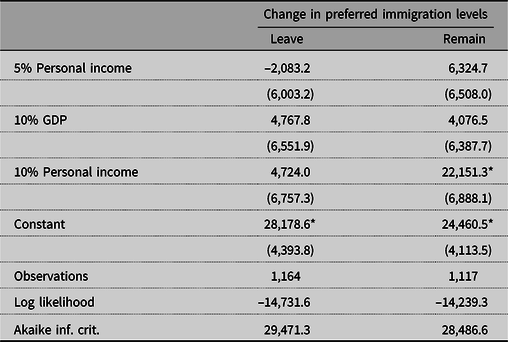
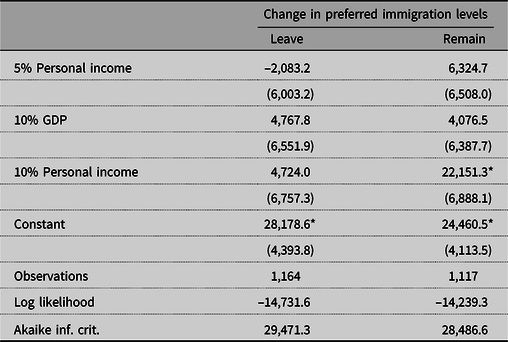
We further consider how preferences vary along salient personal characteristics, namely those who voted Leave and Remain in the 2016 referendum and those of varying socioeconomic status. Leave voters’ unconstrained preferences were for a reduction in total net annual immigration of 249,081 (SE = 2,313) per annum, down to 25% of current levels. Remain voters were more favorable toward immigration but still favored a large reduction of 134,972 (SE = 3,128) in the unconstrained context, down to 59% of current levels. It appears Leave voters are less price elastic than Remainers in some models and similar in others. Table 3 provides a summary of treatment effects by referendum vote and this is illustrated in Figure 4. Both Leave and Remain voters appear sensitive to costs, with Remain voters particularly sensitive to high personal costs.
Preferred Constrained and Unconstrained Levels of Immigration, by Referendum Vote.

Treatment Effects by Referendum Vote
NOTE: *
 $p < 0.05$
.
We might also expect individuals in a lower socioeconomic position to be more sensitive to cost considerations; alternatively those on higher incomes might feel the loss of a percentage of higher income more keenly. Results available in the online Appendix indicate that all class groups are responsive to cost constraints and the effect sizes are generally quite similar. Notable, however, is that the lower middle class is are particularly sensitive to costs – a 10% income cost triggers an average shift in favor of nearly 50,000 additional immigrants per year. By and large, however, it would appear that working class individuals are not particularly sensitive to costs – if anything, the opposite.
Conclusion
We sought to quantify the degree to which citizens’ preferred immigration levels are sensitive to economic costs. We introduced a novel constrained preference measure that ties preferences for levels of immigration to associated costs of obtaining those levels. While we find that Britons prefer a reduction in immigration, the constrained measure leads restrictionist respondents to accept somewhat higher immigration levels. This suggests that economic concerns may be better theorized as inhibitors rather than drivers of immigration restriction. Yet, economic threat cannot be ruled out. Future research using our method might ask whether choice constraints involving various levels of income inequality or pressure on services alter individuals’ preferred migration levels, or the measurement approach we use might be effectively deployed in studying cost constraints of other policy issues. We also find that despite widespread evidence that British citizens oppose EU immigration, unconstrained opposition to EU migration is lower than opposition to non-EU immigration. This hints at the importance of ethnocultural motivations (see also Kaufmann Reference Kaufmann2018), something that merits further research.
Supplementary Material
To view supplementary material for this article, please visit https://doi.org/10.1017/XPS.2020.6.