India reported its first case of coronavirus disease 2019 (COVID-19) on January 30, 2020. Since then, the disease has spread at an alarming rate across the country. As of June 30, 2021, India reported 30,362,848 cases and 398,454 deaths. 1 While the world is working tirelessly to manage COVID-19, the cure is still elusive. The mainstay of management is non-pharmacological, broad public health measures like hand hygiene, cough etiquette, physical distancing, early diagnosis and isolation, contact tracing, and quarantining. Although multiple vaccines are available now, adherence to appropriate behavior remains key in preventing and controlling transmission of severe acute respiratory syndrome coronavirus 2 (SARS-CoV-2; the virus that causes COVID-19), due to the high proportion of non-vaccinated individuals in the community and newer variants. 2
COVID-19 management measures have been promulgated and coordinated by the National Disaster Management Authority in India. India imposed a nationwide lockdown since March 24, 2020, extended multiple times, with relaxations in the subsequent rounds. Health systems in India adopted locally tailored measures to face the challenges in delivering COVID-19 and other health-care services during the lockdown. Reference Chatterjee3 The non-pharmacological and public health measures were widely amplified during the lockdown, and the government’s machinery was mobilized to publicize, enable, and enforce such measures across the country. However, these measures are only as good as they are absorbed and implemented at the community level by the public at large. Although various states have enforced the above measures by means of laws, regulated curfews and statutory fines, their levels of adherence and the impact of such measures on the essential services in the rural communities have not been studied. While much focus has been on the urban areas considering the higher population density, it is a fact that India is predominantly a rural country, with around 68.8% of the population residing in the rural areas. 4
During the early phase of the pandemic, most cases were reported from the cities and towns. Reference Gupta, Biswas and Kabiraj5 A reverse migration triggered by the suspension of industrial activities during the nationwide lockdown has taken the COVID-19 infection to the villages, with cases being reported in increasing numbers from the rural parts. 6 Although the vaccines have been introduced for COVID-19 recently, the emergence of newer variants and their potential resistance against the vaccines poses a credible threat. Reference Baric7,8 In light of the above, the non-pharmacological measures still stand the better protection against the COVID-19. It is essential for us to understand the implementation of such measures in the local settings, to identify the gaps and vulnerabilities for comprehensive management of COVID-19 at the community level. Hence, we assessed the (a) community preparedness and practices for prevention and control of COVID-19; and (b) delivery of health-care services during the lockdown of 2020 in a health block (comprises rural and urban areas) of northern India.
Methods
Study Design and Period
A cross-sectional study based on the transect walk conducted by the investigators during June-July, 2020.
Study Settings
The study was conducted in a rural sub-district administrative block area of Haryana, India. The study area covers a total population of 301,101 spread across 214 villages and 15 wards. It consists of 1 sub-district hospital, 1 community health center (CHC), 4 primary health centers (PHCs), and 31 health sub-centers. The Medical Officer (MO) is the in-charge of the PHC and is the nodal officer for prevention and control of COVID-19 in the coverage area, including surveillance. The MO trains and supervises the COVID-19 activities of the Auxiliary Nurse Midwife (ANMs), Multi-purpose Health Worker (MPHWs), and Accredited Social Health Activist (ASHAs).
ANMs are in-charge of the health sub-center, which is the first point of contact between the rural population and the public health-care system. MPHWs are appointed per sub-center, who share the ANM’s work in delivering the health-care services and disease control activities. As a part of the mobile health team (MHT), the ANMs and MPHWs visited the homes of the COVID-19 cases, traced all the contacts of the cases, advised home quarantine, and shifted the contacts for COVID-19 testing. All persons traveling from other states were also home quarantined for 14 days by the MHTs. 9 The MPHWs of rural areas were posted at the crossing points between Haryana and Himachal Pradesh states, as the study area was at the border. They clinically screened people entering Haryana and tested (the screen positives) them by reverse transcriptase polymerase chain reaction (RT-PCR) of the nasopharyngeal swab. ASHAs are volunteers who are identified from the local community and trained in delivering community-based health-care services. Each ASHA covers approximately 1000 members of the population. They are involved in the house-to-house active surveillance for influenza-like illness (ILI) in their respective villages, sensitizing people on the infection prevention and control (IPC) measures and delivering essential medicines for non-COVID-19 health-care beneficiaries. In urban areas, MPHWs were performing the duties of the ASHAs and MHTs.
Study Population
The assessment was conducted among the selected communities (villages and wards), community health workers, and residents from the study area.
Sample Size & Sampling Technique
Twenty-five villages for rural area and five wards for the urban area were chosen using multistage sampling. Stratified convenience sampling was applied to select the villages. Stratification was done based on the PHCs under the block. After listing the villages under each PHC, 6 villages per PHC from 3 PHCs and 7 villages from the largest PHC were selected by convenience sampling. Of the total 15 wards, five were selected by convenience sampling.
Study Tools
A pretested, semi-structured investigator-administered checklist was used to assess the community preparedness and practices for prevention and control of COVID-19 in the villages and wards. The domains assessed included COVID-19 testing and disease profile; surveillance; IPC measures like use of mask, physical distancing, and maintenance of hand hygiene; receipt of essential health-care services (antenatal care [ANC], immunization, tuberculosis [TB] treatment, non-communicable disease [NCD] care, and others); support systems (maintenance of cleanliness, availability of drinking water, garbage disposal); and essential non-medical services (availability of food and related essentials) for the residents. 10–13
Study Procedure
As a community-based surveillance systems activity during the COVID-19 response, a resident doctor, along with an MPHW, visited the selected villages/wards and conducted a transect walk across the village or ward. During the transect walk, he/she observed the preparedness of the community with regard to COVID-19 with the help of the checklist. He/she interviewed the conveniently selected residents, health system beneficiaries, community health workers, and the elected leaders regarding the existing procedures for COVID-19 quarantine, testing, surveillance, isolation, use and availability of personal protective equipment (PPEs), and other essential medical services. In all selected study areas, efforts were made to interview at least 1 person who is a beneficiary of ANC, immunization (children under 5 y of age), patients with TB and NCD, and the elderly with the questions pertaining to the medical and non-medical services available to them during and after lockdown.
Statistical Analysis and Ethical Considerations
Data were entered in Microsoft Excel, and analysis was done using SPSS 26.0. Frequencies and proportions were calculated for the categorical variables. Ethics approval was obtained from the Institute Ethics Committee of Postgraduate Institute of Medical Education & Research, Chandigarh.
Results
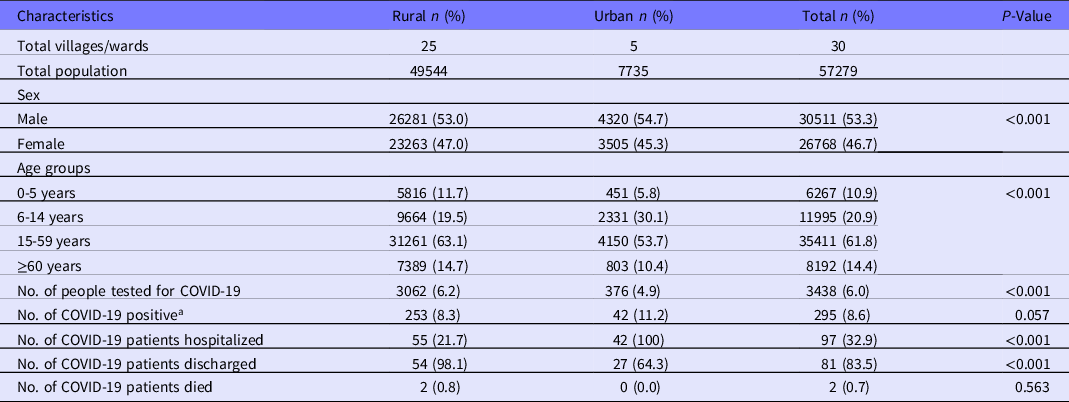
Of the 57,279 total population residing in the study area, 30,511 (53.3%) were males, and 8192 (14.4%) were aged ≥60 y (Table 1). A total of 3438 (6.0%) underwent COVID-19 testing, and 295 (8.6%) were found to be positive for the same. The testing rate was significantly higher (6.2% vs 4.9%) in the rural areas than the urban area (P < 0.001). All villages and wards had at least one COVID-19-positive patient except four villages. Village 14 had a total of 200 (44.4%) COVID-19-positive people of the 450 tested, which was due to a local outbreak (Supplementary Table 1). Only 97 (32.9%) patients with COVID-19 were hospitalized, and the proportion of hospitalization was relatively higher (100% vs 21.7%) among the patients from urban area compared with patients belonging to rural area (P < 0.001). The overall COVID-19 case fatality rate (CFR) was 0.7%, and the two deaths were reported among patients from rural area.
Demography and COVID-19 characteristics of the rural and urban study areas in northern India

a Of the tested.
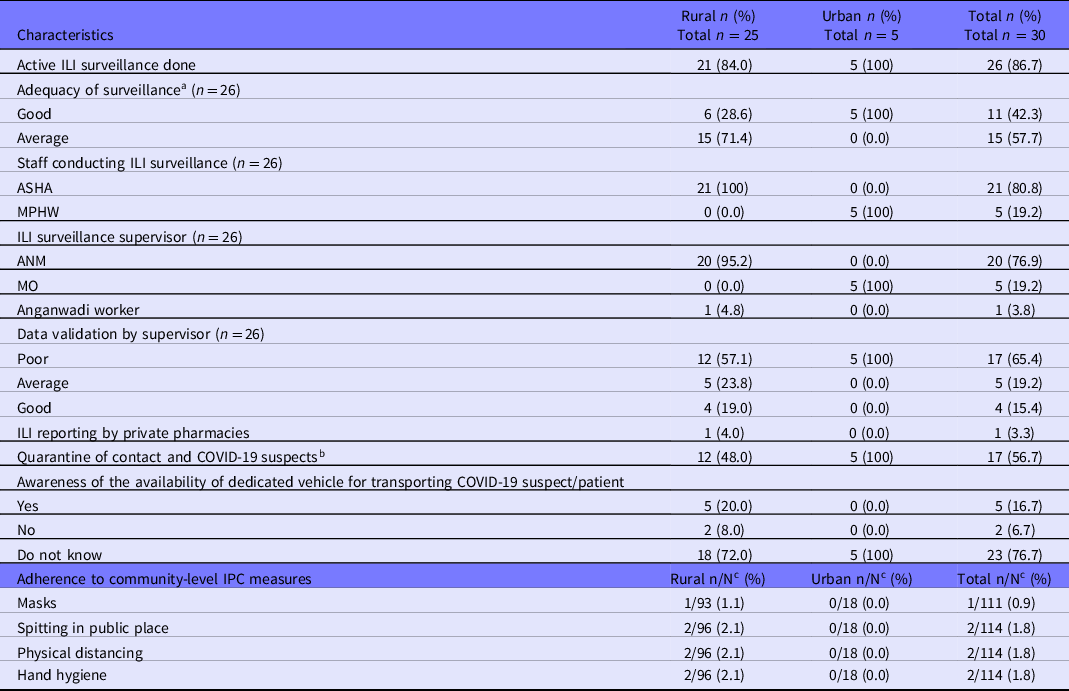
Active surveillance for ILI was being carried out in all five (100%) of the urban wards and 21 (84.0%) villages, with most areas reporting a surveillance frequency of one month. The ASHAs carried out the surveillance in rural areas and MPHWs in the urban areas, which were supervised by the ANMs and MOs in rural and urban areas, respectively. Most (24; 96.0%) of the ASHAs reported that they were unaware of the contact tracing procedures. Similarly, majority (23; 76.7%) did not know whether they had a dedicated vehicle for transporting COVID-19 suspected cases and positive cases. Quarantining of contacts and high-risk suspects were observed only in 12 (48.0%) villages and all five wards, and all were home quarantined. The adherence to COVID-19-specific IPC measures in public places such as wearing masks, no spitting in public, physical distancing, and hand hygiene was completely absent in all study wards and the majority of the villages (Table 2).
COVID-19 community surveillance and public health action system in the study area

a The activity was graded good, average, and poor based on the frequency it was conducted: good, once in 14 days; average, once in a month; poor, more than once a month or not done at all.
b All home quarantined.
c Number of persons followed/number of persons observed.
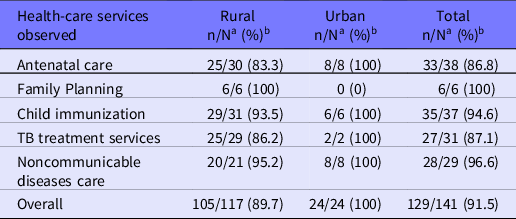
Health-care services related to ANC or reproductive health, immunization among children under five years of age, patients with TB and NCD were available in urban areas during the lockdown. In contrast, few among the ANC women (5; 16.7%), children under five years of age (2; 6.5%), patients with TB (4; 13.8%), and NCD (1; 4.8%) in the rural areas were not able to access the respective services in the same time period (Table 3).
Accessibility to various primary health-care services during the COVID-19 lockdown in the study rural and urban areas

a Number of beneficiaries interviewed/number of beneficiaries availed services.
b Accessibility rate.
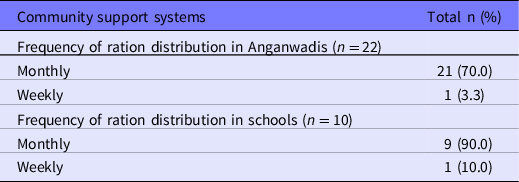
Among the anganwadis (22) and schools (10) visited in the study area, all were providing dry rations (food) to the registered children attending them. The frequency of distribution of rations was monthly except for an anganwadi center and school, which was distributing every week, even during the lockdown period (Table 4).
Community support systems during COVID-19 lockdown in selected villages and wards

The majority of the interviewed households (>85%) in the rural community expressed that they did not face any difficulty accessing essentials like drinking water, milk, vegetables, fruits, meat, fuel, other groceries, and fodder for animals. In comparison, none of the urban households (100%) had difficulty accessing all these services. Cleanliness of public toilets and public places was found not satisfactory in (28-100%) the rural areas. In contrast, all the public places were clean in urban areas (Supplementary Table 2) as per the interviewed beneficiaries.
Discussion
Our study assessed the community preparedness for the prevention and control of COVID-19 in both rural and urban areas. Despite better access for COVID-19 testing, a significantly lower hospitalization rate of patients with COVID-19 from rural areas demonstrates the existing disparities in urban-rural health systems in the study area. Souch and Cossman also reported that such a disparity in combination with the disease that is evasive of surveillance, in general, will amplify the condition. Reference Souch and Cossman14 The overall case fatality rate was 0.7% in the study area, less than that of the national case fatality rate (CFR, 1.8%) during the study period, which was, in turn, lower than that of other countries. Reference Philip, Ray and Subramanian15 The lower CFR might be due to the timely response of the Indian health-care system or the low proportion of severe cases. Another probable reason might be due to the population’s age distribution, skewed towards younger age and, hence, lower CFR. Reference Philip, Ray and Subramanian15,Reference Ray and Subramanian16 Mortality due to COVID-19 did not differ between rural and urban areas of the current study, while Asirvatham et al. reported a higher proportion of mortality among the urban population in India. Reference Asirvatham, Lakshmanan and Sarman17 In contrast, the average mortality rate per 100,000 population in rural counties of South Carolina was significantly higher (89.94) than in urban counties (58.47). Reference Huang, Jackson and Derakhshan18
The findings that the majority of the community health workers (ASHAs) were unaware of the contact tracing procedures poses a significant challenge in tracing and tracking the spread of COVID-19. Capacity building of the workers in this domain and tapping of the digital technologies in a user-friendly manner may be implemented and evaluated to improve contact tracing. Reference Feroz, Khoja and Saleem19 The adherence to the non-pharmacological measures like physical distancing and wearing masks was low in the study area. It might have been due to lack of awareness among people, as we could not find the information, education, and communication materials displayed in prominent places in most of the study areas. It might also be due to complacency on the part of the public in adhering to non-pharmacological measures. The complacency, in turn, might have been due to pandemic fatigue, which must be addressed by adopting the four key strategies and five principles enunciated by the World Health Organization. 20 It may have also been due to the false belief by the people that COVID-19 will not affect the villages or rural areas as they took measures like guarding or preventing external persons from visiting their villages and vice versa.
In their study, Banerjee and Banerjee et al reported higher adherence to IPC measures to combat COVID-19, which is not in line with our observations. Reference Banerjee and Banerjee21 The above-mentioned study was conducted in May 2020, when the lockdown was at its peak, through an online, self-administered questionnaire among the English-speaking population. In contrast, our study was based on the direct observations of community practices and interviews of the people by the professionals. A rural vulnerability index needs to be formulated in line with the urban vulnerability index, Reference Mishra, Gayen and Haque22 to present a summary picture of the breakdown in the COVID-19 prevention measures. It will enable us to have targeted interventions in improving the IPC, ensuring the adherence to other non-pharmacological measures and delivery of essential health-care services during successive waves of the COVID-19 pandemic.
Maintaining essential health-care services during the lockdown is vital to prevent morbidity and mortality due to non-COVID-19 causes. During past and present pandemics, interruption of essential health-care service delivery has been reported worldwide. Reference Blanchet, Alwan and Antoine23,Reference Tullo, Lerea and López24 However, higher accessibility to essential health-care services such as ANC, immunization, TB and NCD management for the target population was reported in the study area. It indicates adherence to standard operating procedures and guidelines issued by the department of health and family welfare for maintaining the above services during COVID-19 pandemic. It is in line with the findings of Ghosh et al., who reported that 91% of the people with diabetes were availing their medicine during the time of lockdown. Reference Ghosh, Arora and Gupta25 Access to food and fuel was not reported as an issue faced by most individuals in the present study. A study from Nagpur City, India, noted that the residents witnessed uncertainties in the food supply chain. There was a decline in market availability, with a simultaneous rise in food prices. Reference Sukhwani, Deshkar and Shaw26 However, the context of the present study area, covering a rural and adjacent urban block, is different from that of Nagpur City. Hence, this might have been a reason for the difference in accessibility to food, as rural areas tend to be relatively self-sufficient with food materials available locally compared with city areas.
Strengths & Limitations
Community-based assessment involving multiple stakeholders like the community health workers, the general public, and the vulnerable groups in the community is an important strength of the present study. Recall bias for the data pertaining to the lockdown period, use of a non-validated checklist for data collection, and non-availability of reasons for the poor or non-compliance of the people in the study area toward the COVID-19-specific IPCs measures were the limitations.
Conclusions
A significant difference exists in the COVID-19 testing and mitigation strategies between the rural and urban areas. The checklist used in the study may be tested in other settings of India for validity and can be evaluated for adoption in community preparedness assessment for COVID-19. Understanding the reasons, facilitators, and barriers for the non-adherence to IPC measures by the study population and formulating behavior change communication strategies for improvement is urgently needed, as illustrated by the findings.
Supplementary material
For supplementary material accompanying this paper visit https://doi.org/10.1017/dmp.2021.255
Author contributions
Drs. Gandhi and Kathirvel contributed equally to this work. Conceptualization and designing: A.G.P., S.K. Data acquisition and analysis: A.G.P., T.R., D.I., S.K. Interpretation of data for the work: A.G.P., S.K., T.R., D.I. Drafting the work: A.G.P., S.K. Revising it critically for important intellectual content: A.G.P., S.K., T.R., D.I. Final approval of the version to be published: A.G.P., S.K., T.R., D.I. Ensuring the accuracy or integrity of any part of the work: A.G.P., S.K., T.R., D.I.
Conflict(s) of interest
None declared.