Children who experience internalizing and externalizing symptoms in early childhood are at an increased risk for psychopathology and impaired functioning across development (Luby, Gaffrey, Tillman, April, & Belden, Reference Luby, Gaffrey, Tillman, April and Belden2014; Mesman, Bongers, & Koot, Reference Mesman, Bongers and Koot2001; Slemming et al., Reference Slemming, Sørensen, Thomsen, Obel, Henriksen and Linnet2010); however, the course of internalizing and externalizing psychopathology can show considerable variability. Some children show homotypic continuity in their symptoms, a pattern typically referred to as stability. In contrast, other children show a pattern of heterotypic continuity, in which their presentations change or become more complex throughout development, resulting in a shift in the expression of their symptoms.
Children who show internalizing problems early in life are more likely than typical peers to exhibit anxiety and depression in adolescence and adulthood, indicating a significant degree of homotypic continuity (Roza, Hofstra, van der Ende, & Verhulst, Reference Roza, Hofstra, van der Ende and Verhulst2003); however, some children with internalizing symptoms develop externalizing symptoms, such as conduct problems and substance abuse, demonstrating heterotypic continuity. Copeland et al. (Reference Copeland, Adair, Smetanin, Stiff, Briante, Colman and Angold2013) investigated diagnostic transitions from childhood to adolescence among more than 3,000 participants drawn from multiple prospective longitudinal studies. They found that emotional disorders (i.e., depression and anxiety) in childhood predicted increased risk of both emotional and behavioral problems (e.g., oppositional defiant disorder, conduct disorder) in adolescence. Thus, they found support for both a homotypic internalizing pathway and a heterotypic pathway linking early internalizing problems to later externalizing problems.
Research has also supported homotypic pathways linking early externalizing behavior to similar problems later in life. In their longitudinal study, Copeland et al. (Reference Copeland, Adair, Smetanin, Stiff, Briante, Colman and Angold2013) found that behavior problems in childhood predicted behavior problems, but not emotional problems, in adolescence. Other longitudinal studies have found support for a heterotypic pathway linking early externalizing problems to later internalizing problems, however; for instance, Mesman et al. (Reference Mesman, Bongers and Koot2001) investigated psychopathology when children were in preschool to when they were 10–11 years old. They found that children with elevated externalizing symptoms in preschool were more likely to exhibit internalizing symptoms later on than those with low externalizing symptoms. Similarly, Kim-Cohen et al. (Reference Kim-Cohen, Caspi, Moffitt, Harrington, Milne and Poulton2003) showed that, among adults with anxiety or depression, 25%–30% of cases were preceded by conduct disorder or oppositional defiant disorder during adolescence. These findings suggest that, as with internalizing problems, externalizing problems can also follow both homotypic and heterotypic trajectories across development.
As these studies demonstrate, psychological symptoms that arise in early childhood can follow a multitude of pathways into adolescence and adulthood. These patterns have been documented in a number of studies, but we know very little about the factors that may moderate the expression of internalizing and externalizing symptoms across development (Patalay, Moulton, Goodman, & Ploubidis, Reference Patalay, Moulton, Goodman and Ploubidis2017). Identifying such factors may allow us to more accurately predict how early childhood psychopathology will manifest over time and help better target intervention efforts to treat children's symptoms before they fully develop.
Hypothalamic-pituitary-adrenal axis functioning and psychopathology
Stress system functioning may contribute to the developmental course of psychopathology in children. The hypothalamic-pituitary-adrenal (HPA) axis is involved in mounting a stress response when an individual is under threat. This system also serves important regulatory functions under nonstressed conditions: it contributes to body temperature regulation, metabolism, and immune system functioning (Tsigos & Chrousos, Reference Tsigos and Chrousos2002). The hormone cortisol is an end product of the HPA axis and can be measured noninvasively via saliva. Cortisol shows a distinct diurnal pattern, with high levels upon waking, a peak approximately 30 min after waking, and a gradual decrease across the day, reaching a nadir in the evening (Bailey & Heitkemper, Reference Bailey and Heitkemper1991; Gunnar & Donzella, Reference Gunnar and Donzella2002). HPA axis functioning can have important effects on the neural networks underlying children's executive functioning and self-regulation (Blair, Reference Blair2010). This system is also highly responsive to a child's environment. Children who experience early adversity often show dysregulated HPA axis functioning. Studies have shown that disrupted caregiving, maltreatment, and poverty contribute to a blunted diurnal cortisol pattern among children, with relatively low morning cortisol levels and relatively high evening cortisol levels (Alink, Cicchetti, Kim, & Rogosch, Reference Alink, Cicchetti, Kim and Rogosch2012; Bernard, Butzin-Dozier, Rittenhouse, & Dozier, Reference Bernard, Butzin-Dozier, Rittenhouse and Dozier2010; Bruce, Fisher, Pears, & Levine, Reference Bruce, Fisher, Pears and Levine2009; Dozier et al., Reference Dozier, Manni, Gordon, Peloso, Gunnar, Stovall-McClough and Levine2006; Fisher, Gunnar, Dozier, Bruce, & Pears, Reference Fisher, Gunnar, Dozier, Bruce and Pears2006; Koss, Hostinar, Donzella, & Gunnar, Reference Koss, Hostinar, Donzella and Gunnar2014; Kuhlman, Geiss, Vargas, & Lopez-Duran, Reference Kuhlman, Geiss, Vargas and Lopez-Duran2015; Zalewski, Lengua, Kiff, & Fisher, Reference Zalewski, Lengua, Kiff and Fisher2012). In some instances, early adversity is also associated with elevated cortisol. For example, children exposed to family instability and maternal depression or anxiety have been shown to have higher diurnal cortisol levels compared with low-risk peers (Goldstein et al., Reference Goldstein, Perlman, Kotov, Broderick, Liu, Ruggero and Klein2017; Koss & Gunnar, Reference Koss and Gunnar2017; Liu et al., Reference Liu, Ruggero, Goldstein, Klein, Perlman, Broderick and Kotov2016). This demonstrates cortisol's relevance to children's self-regulation and its responsiveness to the environmental demands placed on children.
Disruptions in the daily pattern of cortisol are also associated with a range of emotional and behavioral problems in children (Shirtcliff & Essex, Reference Shirtcliff and Essex2008). A blunted cortisol slope, characterized by lower than typical morning levels and higher than typical evening levels, is associated with externalizing psychopathology in children and adolescents (Alink et al., Reference Alink, van IJzendoorn, Bakermans-Kranenburg, Mesman, Juffer and Koot2008; Hawes, Brennan, & Dadds, Reference Hawes, Brennan and Dadds2009). There is also prospective evidence to suggest that a blunted pattern of cortisol may be a risk factor for the later development of externalizing problems (Fairchild, Goozen, Stollery, & Brown, Reference Fairchild, Goozen, Stollery and Brown2008; Kohrt et al., Reference Kohrt, Hruschka, Kohrt, Carrion, Waldman and Worthman2015; McBurnett, Lahey, Rathouz, & Loeber, Reference McBurnett, Lahey, Rathouz and Loeber2000; Popma, Doreleijers, & Jansen, Reference Popma, Doreleijers and Jansen2007; Salis, Bernard, Black, Dougherty, & Klein, Reference Salis, Bernard, Black, Dougherty and Klein2016). For example, Salis et al. (Reference Salis, Bernard, Black, Dougherty and Klein2016) demonstrated that a blunted cortisol slope at age 6 predicted an increase in externalizing problems from age 6 to age 9. There is less evidence investigating cortisol slope in relation to internalizing problems, but research has shown that internalizing symptoms and risk for internalizing psychopathology are generally associated with increased morning cortisol, a greater cortisol awakening response, and a high daily output of cortisol (Ellenbogen, Hodgins, Linnen, & Ostiguy, Reference Ellenbogen, Hodgins, Linnen and Ostiguy2011; LeMoult, Ordaz, Kircanski, Singh, & Gotlib, Reference LeMoult, Ordaz, Kircanski, Singh and Gotlib2015; Lok et al., Reference Lok, Mocking, Ruhé, Visser, Koeter, Assies and Schene2012; Lopez-Duran, Kovacs, & George, Reference Lopez-Duran, Kovacs and George2009). Although there are some findings linking internalizing symptoms with a blunted cortisol slope (Doane, Mineka, Zinbarg, & Craske, Reference Doane, Mineka, Zinbarg and Craske2013; Van Den Bergh & Van Calster, Reference Van Den Bergh and Van Calster2009), much of the research generally indicates a pattern of high morning cortisol as a risk factor for internalizing symptoms (Koss & Gunnar, Reference Koss and Gunnar2017; Lopez-Duran et al., Reference Lopez-Duran, Kovacs and George2009).
Because HPA axis functioning is involved in children's adaptation and self-regulation, it may play a role in how early internalizing and externalizing symptoms are expressed over time (Blair, Reference Blair2010). No studies to date, however, have investigated how cortisol patterns interact with early psychopathology to predict symptoms later in development.
The current study
Longitudinal patterns of psychopathology have been well characterized in the literature, but little work has sought to clarify the factors that contribute to heterotypic or homotypic continuity. Identifying these factors is critical in delineating and understanding the course of psychopathology. Given that diurnal cortisol has been shown to predict later internalizing and externalizing problems, it may modulate the expression of psychopathology over time. In the current study, we tested whether diurnal cortisol patterns moderated the course of internalizing and externalizing symptoms (i.e., patterns of homotypic or heterotypic continuity) from preschool to early adolescence. Given the previous research, we hypothesized that a blunted cortisol slope will be associated with homotypic continuity of externalizing symptoms and heterotypic continuity from early internalizing symptoms to later externalizing symptoms. In addition, we hypothesized that a relatively steep cortisol slope will be associated with homotypic continuity of internalizing symptoms and heterotypic continuity from age 3 externalizing symptoms to age 12 internalizing symptoms.
Method
Participants
Participants included 554 children (54% male) and parents. They were primarily non-Hispanic white (86%) and the majority had at least one parent with a college degree (66%).
Procedure
The current study drew on data from a longitudinal project examining the development of psychopathology in children (Olino, Klein, Dyson, Rose, & Durbin, Reference Olino, Klein, Dyson, Rose and Durbin2010). Families with 3-year-old children (mean [M] = 3.55, standard deviation [SD] = 0.26) were recruited through commercial mailing lists. As described elsewhere (Olino et al., Reference Olino, Klein, Dyson, Rose and Durbin2010), the demographic characteristics of the sample were similar to those of the community from which it was recruited. A total 554 families completed questionnaires assessing child internalizing and externalizing symptoms when children were about 3 years of age. The majority of respondents were mothers (n = 549, 99%), but father report was used when mother report was not available (n = 5, 1%). Of these 554 families, 387 went on to participate in the saliva data collection when children were approximately 9 years of age (M = 9.29, SD = 0.42). Three years later, when children were 12 (M = 12.75, SD = 0.50), 406 parents again reported on their child's psychological functioning. A total of 332 families completed all of the three study components. There were no differences in child sex, race, parental education, age 3 internalizing symptoms, or age 3 externalizing symptoms between those who completed all three study components and those who did not. Full information maximum likelihood was used in analyses to account for missing data; thus, the analytic sample includes 554 participants.
Measures
Cortisol
When children were 9 years old, they collected saliva samples three times per day over 3 consecutive days. Parents were asked to assist their children in taking saliva samples right after they woke up in the morning, 30 min after waking up, and 30 min before going to bed. The waking and bedtime samples were used in this analysis to capture diurnal slope (i.e., the wake-up level to the evening nadir in cortisol). Children were asked to passively drool into a polypropylene tube using a straw and then label each tube with the date and time. Parents instructed children not to eat or drink for 30 min before each sample. After 3 days, samples were either mailed back to the laboratory or retrieved by research assistants. Samples were stored at −20°C before being sent to Trier, Germany, for cortisol assay. Samples were assayed in duplicate using a time-resolved immunoassay with fluorometric detection.
Of the 3 days of waking samples, 91% of participants provided all three samples, 5.2% of participants provided two, and 0.3% of participants provided one. Of 3 days of bedtime samples, 86.0% provided all three samples, 8.8% provided two, and 1.6% provided one. In total, there were 1,097 morning and 1,073 evening samples for 387 participants. We define sample compliance as morning samples taken within 15 min of wake-up time and evening samples taken within 1 h of bedtime. Using these criteria, 85.8% of participants were compliant with all morning samples, 10% were compliant with two morning samples, 2.4% were compliant with one, and 1.8% were not compliant with any. For evening samples, 90.7% of participants were compliant with all samples, 6.1% were compliant with two, 1.6% were compliant with one, and 1.6% were compliant with no samples. Two cortisol samples were removed because they were physiologically improbable. Thirteen samples were excluded because of medication use. In addition, any waking sample that was taken more than 15 min after waking time, as determined by self-report, was excluded. This resulted in a total of 102 waking samples being excluded across the 3 study days. Any evening sample that was taken more than 1 h before self-reported bed time was excluded, resulting in 44 excluded samples. Finally, outlying cortisol values (n = 3) were winsorized to 3 SD above the mean. In the final analysis, 346 children provided at least one saliva sample. Intra-assay coefficients of variation were between 4.0% and 6.7%, and inter-assay coefficients of variation ranged from 7.1% to 9.0%.
Child internalizing and externalizing symptoms
Mothers reported on children's psychological symptoms using the Child Behavior Checklist (CBCL; Achenbach & Rescorla, Reference Achenbach and Rescorla2000). Mothers reported on the CBCL 1.5–5 when children were 3 years of age and the CBCL 6–18 when children were 12 years of age. On each questionnaire, parents evaluate the severity of internalizing and externalizing symptoms using a scale from 0 (never true) to 3 (very true or often true). Coefficient alphas for the internalizing scale were .84 (36 items) and .87 (32 items) at ages 3 and 12, respectively. Coefficient alphas for the externalizing scale were .91 (24 items) and .88 (33 items) at ages 3 and 12, respectively.
Data analysis
Data were analyzed using Mplus, version 7 (Muthén & Muthén, Reference Muthén and Muthén2013). We used a latent change model to estimate cortisol slope, following procedures used in previous studies (Bernard, Peloso, Laurenceau, Zhang, & Dozier, Reference Bernard, Peloso, Laurenceau, Zhang and Dozier2015; Kertes, Gunnar, Madsen, & Long, Reference Kertes, Gunnar, Madsen and Long2008). We created latent factors for wake-up and evening cortisol using the daily values as indicators. Then, cortisol slope was modeled as a latent difference score between evening and morning samples (i.e., bedtime – wake-up). In this model, more negative values indicate a steeper slope across the day, whereas more positive values indicate a blunted slope.
Studies have shown that the latent change models allow for more reliable estimates of change compared with simple difference scores (Burt & Obradovi, Reference Burt and Obradovi2012; King et al., Reference King, King, McArdle, Grimm, Jones and Ollendick2006; McArdle, Reference McArdle2009). By creating latent factors out of individual cortisol indicators, we parse out observed scores from error variance, which allows the change score to account for measurement error and produce less biased estimates (Burt & Obradovi, Reference Burt and Obradovi2012). The model was estimated using full information maximum likelihood estimation with standard errors approximated by first-order derivatives. full information maximum likelihood uses all available information to estimate parameters in models with missing data (Enders & Bandalos, Reference Enders and Bandalos2001). This method has been shown to be a reliable way to account for missing data in latent variable interaction models (Cham, Reshetnyak, Rosenfeld, & Breitbart, Reference Cham, Reshetnyak, Rosenfeld and Breitbart2017).
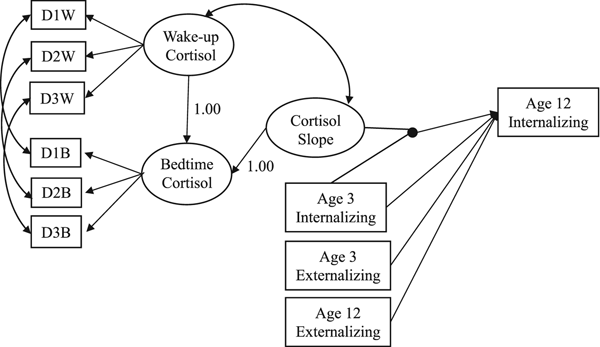
The main question of this project surrounds the continuity of psychopathology over time and whether cortisol alters the strength or direction of the relationship between age 3 and age 12 symptoms. Thus, we ran moderation models testing the interactive effects of cortisol and preschool psychopathology on adolescent psychopathology. We ran a series of multiple regressions with the interaction between preschool psychopathology (using observed variables) and age 9 cortisol slope (using latent change scores) predicting internalizing and externalizing symptoms at age 12. There were four models in total: (a) internalizing homotypic pathway; (b) internalizing heterotypic pathway; (c) externalizing homotypic pathway; and (d) externalizing heterotypic pathway. To account for the co-occurrence of psychological symptoms, all models controlled for concurrent internalizing or externalizing problems at ages 3 and 12 (Figure 1 provides a conceptual diagram of the latent difference model using the internalizing homotypic pathway). Finally, to account for cortisol sample timing, we included the difference between each sample time and wake-up time as statistical covariates in each model. Additional analyses using CBCL subscales are presented in Appendix A.Footnote 1
Conceptual diagram illustrating the latent difference model with the internalizing homotypic model as an example. D1B, day 1 bedtime cortisol; D1W, day 1 wake-up cortisol; D2W, day 2 wake-up cortisol; D3B, day 3 bedtime cortisol; D3B, day 3 bedtime cortisol; D3W, day 3 wake-up cortisol.

Results
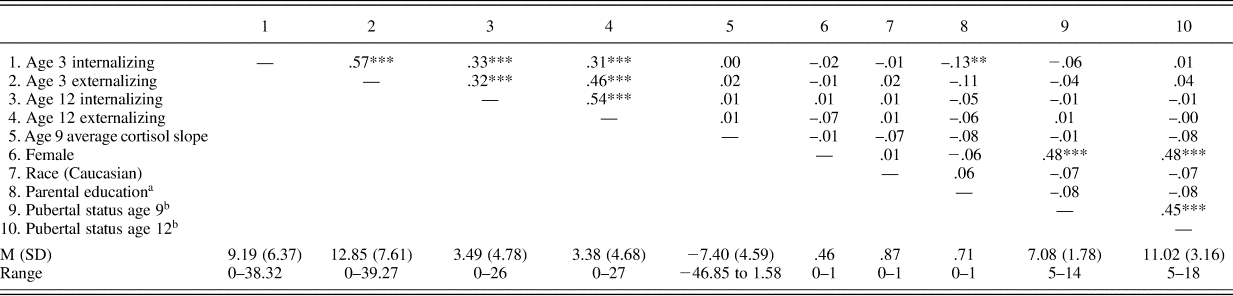
Descriptive statistics and bivariate correlations of the observed study variables are presented in Table 1. Morning cortisol had a mean of 7.86 nmol/l (SD = 3.38) and evening cortisol had a mean of 0.86 nmol/l (SD = 0.92). The majority of children were in the normative range on the CBCL at both ages: 9.9% and 11.4% of children were in the clinical or borderline clinical range for age 3 internalizing and externalizing symptoms, respectively; 10.1% and 9.3% were in the clinical or borderline clinical range for age 12 internalizing and externalizing symptoms, respectively. Ages 3 and 12 internalizing and externalizing symptoms were significantly intercorrelated. Notably, neither age 3 nor age 12 internalizing and externalizing symptoms were correlated with observed age 9 cortisol slope. Associations of demographic characteristics, including child sex, parental education, race, and pubertal status at ages 9 and 12 (Petersen, Crockett, Richards, & Boxer, Reference Petersen, Crockett, Richards and Boxer1988) with study variables were examined to consider the inclusion of additional covariates. Parental education was negatively correlated with age 3 internalizing symptoms, so it was included as a covariate in all models.
Descriptive statistics and bivariate correlations of observed study variables

Note: *p < .05 **p < .01 ***p < .001.
aParental education is a dummy-coded variable representing whether either parent completed college at the time of the age 3 assessment.
bPubertal development is measured using the Pubertal Development Scale (Petersen et al., Reference Petersen, Crockett, Richards and Boxer1988).
Internalizing symptoms at age 3
Homotypic model: Internalizing at age 3 predicting internalizing at age 12
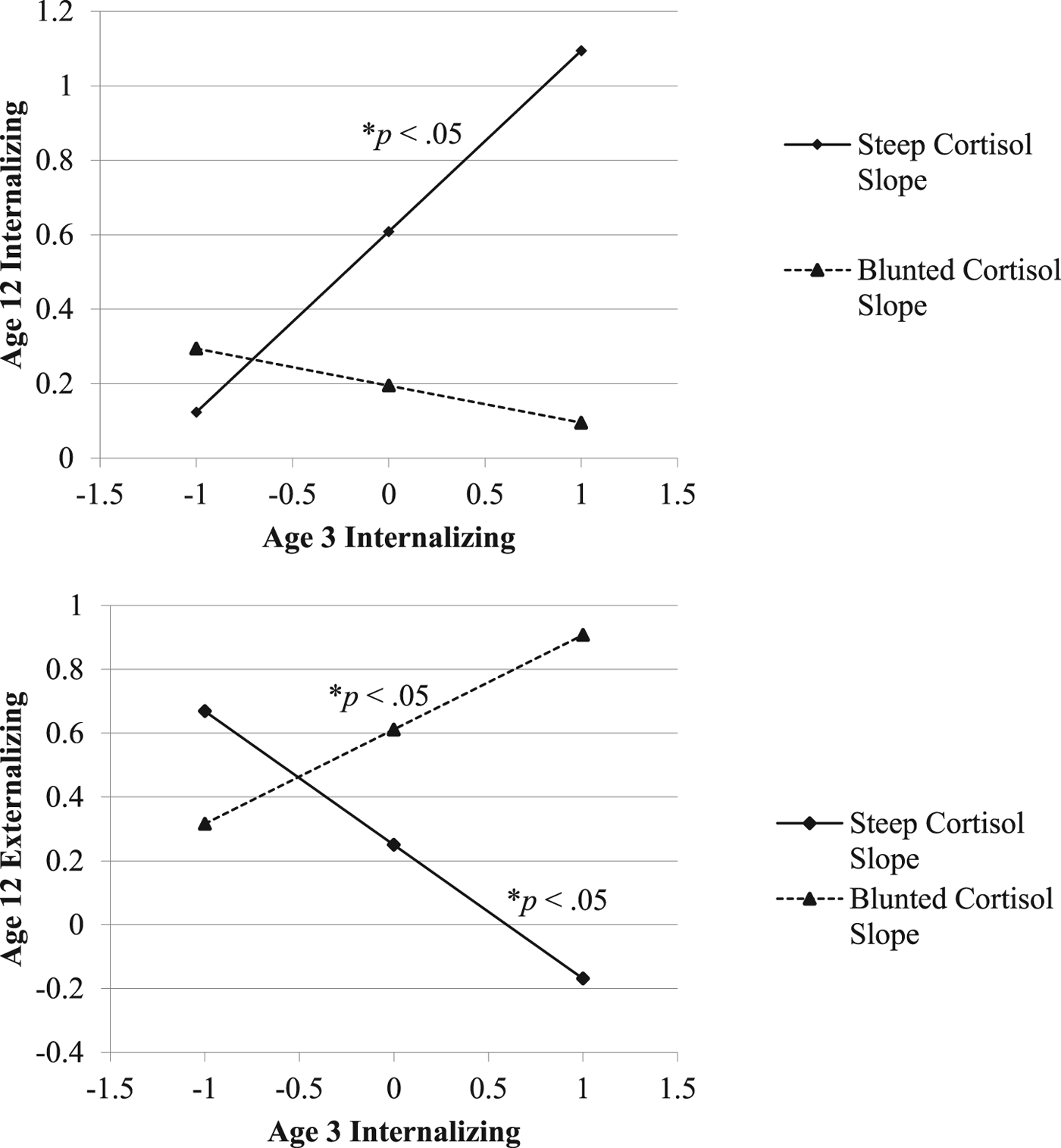
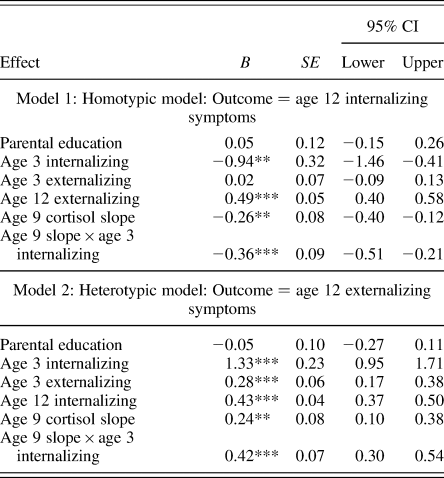
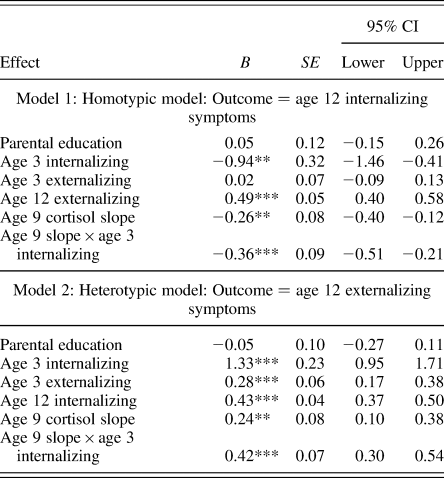
Age 3 internalizing symptoms and age 9 cortisol slope were negatively associated with age 12 internalizing symptoms. These main effects were qualified by a significant interaction between age 3 internalizing symptoms and age 9 cortisol slope in predicting age 12 internalizing symptoms (B = –0.36, p < .001; Table 2), however, suggesting that cortisol slope moderated the continuity of internalizing symptoms over time. This interaction yielded an R 2 value of 0.1029, meaning it explained 10.29% of the variance in age 12 internalizing problems. To probe the interaction, simple slopes were tested. For children with a relatively steep cortisol slope (defined as 1.5 SD below the mean), higher internalizing symptoms at age 3 predicted higher age 12 internalizing symptoms (B = 0.57, p < .001; Figure 2). For children with a blunted slope (defined as 1.5 SD above the mean), however, greater internalizing problems at age 3 did not predict internalizing problems at age 12 (B = –0.39, p > .05). This model supports a pattern of homotypic continuity for early internalizing symptoms in the presence of a steep cortisol slope.
Interactions between age 9 cortisol and age 3 internalizing symptoms in predicting age 12 internalizing (top) and externalizing (bottom) symptoms. Steep slope is defined as 1.5 standard deviations (SD) below the mean and blunted slope is 1.5 SD above the mean.

Multiple regressions with age 3 internalizing symptoms and age 9 cortisol predicting internalizing and externalizing symptoms at age 12
Note: Each model includes the difference between each sample time and wake-up time as statistical covariates; 95% CI = 95% confidence interval; *p < .05, **p < .01, ***p < .001.
Heterotypic model: Internalizing at age 3 predicting externalizing at age 12
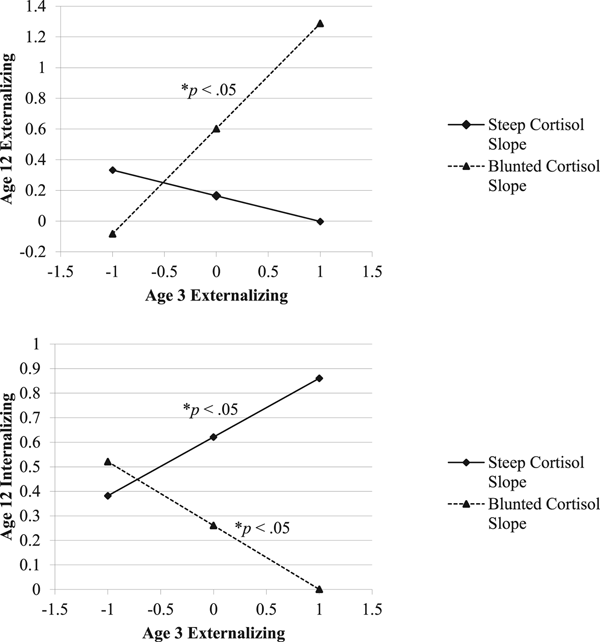
There were main effects of age 3 internalizing symptoms and age 9 cortisol slope on age 12 externalizing symptoms; however, they were qualified by an interaction between cortisol slope and age 3 internalizing symptoms in predicting externalizing symptoms at age 12 (B = .42, p < .001; Table 2). This interaction explained 6.68% of the variance in age 12 externalizing problems. Simple slopes analyses showed that, among children with a blunted cortisol slope, higher internalizing symptoms at age 3 predicted higher externalizing symptoms at age 12 (B = 0.53, p < .01; Figure 2). Among children with a relatively steep cortisol slope, higher internalizing symptoms at age 3 predicted lower externalizing problems at age 12 (B = –.60, p < .01). These results support a pattern of heterotypic continuity for early internalizing symptoms in the presence of a blunted cortisol slope and significantly less heterotypic continuity than expected in the presence of steep cortisol slope.
Externalizing symptoms at age 3
Homotypic model: Externalizing at age 3 predicting externalizing at age 12
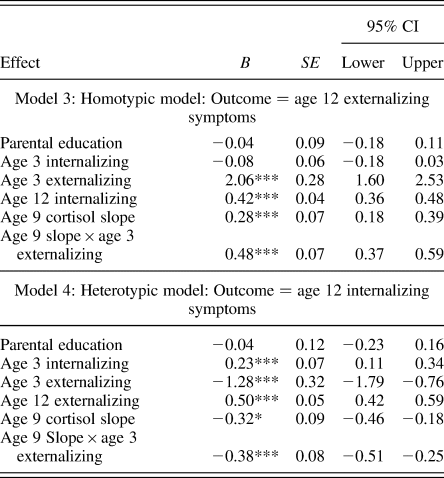
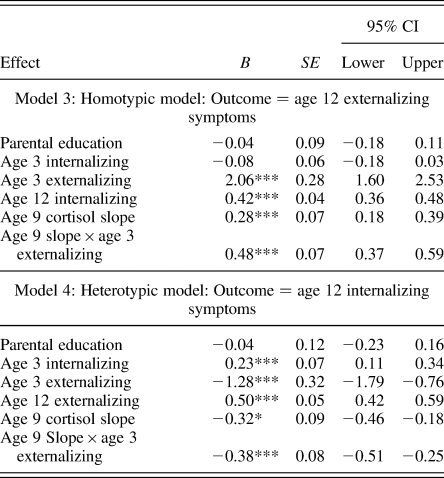
There were main effects of age 3 externalizing symptoms and age 9 cortisol slope on age 12 externalizing symptoms; however, these effects were qualified by a significant interaction between age 3 externalizing symptoms and cortisol slope in predicting externalizing symptoms at age 12 (B = 0.48, p < .001; Table 3). This interaction explained 4.41% of the variance in age 12 externalizing problems. Simple slopes analysis showed that for children with a blunted cortisol slope, higher externalizing problems at age 3 predicted higher externalizing problems at age 12 (B = 0.90, p < .001; Figure 3). For children with a steep cortisol slope, there was no effect of early externalizing problems on age 12 externalizing problems (B = –0.41, p > .05). Overall, these results support a pattern of homotypic continuity for externalizing symptoms in the presence of a blunted cortisol slope.
Interactions between age 9 cortisol and age 3 externalizing symptoms in predicting age 12 externalizing (top) and internalizing (bottom) symptoms. Steep slope is defined as 1.5 standard deviations (SD) below the mean and blunted slope is 1.5 SD above the mean.

Multiple regressions with age 3 externalizing symptoms and age 9 cortisol predicting externalizing and internalizing symptoms at age 12
Note. Each model includes the difference between each sample time and wake-up time as statistical covariates; 95% CI = 95% confidence interval; *p < .05, **p < .01, ***p < .001.
Heterotypic model: Externalizing at age 3 predicting internalizing at age 12
Age 3 externalizing symptoms and age 9 cortisol slope were negatively associated with later internalizing problems. These effects were qualified by a significant interaction between age 3 externalizing symptoms and age 9 cortisol slope in predicting age 12 internalizing problems (B = –0.38, p < .001; Table 3). This interaction explained 5.51% of the variance in age 12 internalizing problems. For children with a relatively steep slope, higher externalizing problems at age 3 predicted higher internalizing problems at age 12 (B = 0.49, p < .05; Figure 3). For children with a blunted slope, higher externalizing symptoms at age 3 predicted lower internalizing problems at age 12 (B = –0.53, p < .05). This model supports a pattern of heterotypic continuity for early externalizing symptoms for children with a steep cortisol slope and a lower chance of heterotypic continuity for children with a blunted cortisol slope.
Discussion
In this study, we examined whether patterns of diurnal cortisol moderated associations between internalizing and externalizing symptoms from early childhood to early adolescence. Despite the frequency of heterotypic continuity between internalizing and externalizing disorders, little research has identified predictors of this kind of heterotypic continuity (Patalay et al., Reference Patalay, Moulton, Goodman and Ploubidis2017). Overall, results suggest that internalizing problems show homotypic continuity in the presence of a steep cortisol slope and heterotypic continuity (i.e., early internalizing problems predicting later externalizing problems) in the context of a blunted cortisol slope. In addition, children who have early internalizing symptoms and a steep cortisol slope show fewer externalizing symptoms at age 12. Externalizing symptoms show homotypic continuity in the presence of a blunted cortisol slope and heterotypic continuity (i.e., early externalizing problems predicting later internalizing problems) in the presence of a steep cortisol slope. Children with high age 3 externalizing symptoms and a blunted cortisol slope also show fewer internalizing problems at age 12.
These results align with some previous work examining cortisol patterns and psychopathology in youth. In particular, research has shown that a blunted cortisol slope prospectively predicts externalizing problems in children (Kohrt et al., Reference Kohrt, Hruschka, Kohrt, Carrion, Waldman and Worthman2015; Salis et al., Reference Salis, Bernard, Black, Dougherty and Klein2016). In the present study, we found that a blunted slope interacted with age 3 internalizing and externalizing symptoms to predict higher externalizing symptoms at age 12. Blunted slope also predicted decreased age 12 internalizing problems in the presence of early externalizing problems. By contrast, children who had a steep cortisol slope or low symptom levels at age 3 did not show increased externalizing problems at age 12.
Many studies have investigated the relationship between various cortisol indices (e.g., morning cortisol, cortisol awakening response, total cortisol output) and internalizing problems, but few have used diurnal slope as a metric for cortisol regulation. The current study demonstrated a link between a relatively steep diurnal slope and internalizing problems in the presence of early internalizing and externalizing symptoms. This study also showed that a relatively steep slope predicted fewer externalizing problems at age 12 when combined with high internalizing problems at age 3. This aligns with previous work showing that high morning cortisol predicts the onset of internalizing psychopathology (Harris et al., Reference Harris, Borsanyi, Messari, Stanford, Brown, Cleary and Herbert2000; Goodyer et al., Reference Goodyer, Herbert, Tamplin and Altham2000); however, this contrasts with some previous work demonstrating a link between blunted cortisol slope and the onset of internalizing problems (Doane et al., Reference Doane, Mineka, Zinbarg and Craske2013; Van Den Bergh & Van Calster, Reference Van Den Bergh and Van Calster2009). This may be because other studies did not account for the interaction between cortisol and early symptoms when predicting the onset of anxiety and depression or control for prior or co-occurring externalizing problems.
Our results suggest that stress system regulation plays a role in moderating homotypic and heterotypic patterns of psychopathology from preschool to early adolescence. Children's physiological regulation may play a role in the development and course of their psychological symptoms over time. Children with a blunted diurnal rhythm may have a general dampening of the HPA axis, or hypocortisolism, which puts them at risk for externalizing psychopathology (Kohrt et al., Reference Kohrt, Hruschka, Kohrt, Carrion, Waldman and Worthman2015; Koss, Mliner, Donzella, & Gunnar, Reference Koss, Mliner, Donzella and Gunnar2016; van Goozen et al., Reference van Goozen, Matthys, Cohen-Kettenis, Gispen-de Wied, Wiegant and van Engeland1998). In contrast, a cortisol slope that is steeper than normal may be reflective of a system that is more primed to react to stressful experiences, which may put children at higher risk for internalizing problems (Koss & Gunnar, Reference Koss and Gunnar2017; Lopez-Duran et al., Reference Lopez-Duran, Kovacs and George2009). Given that this study examined diurnal cortisol regulation and not reactivity, however, we are limited in our ability to draw conclusions about psychopathology and the acute stress responsivity functions of the HPA axis. In general, the mechanisms linking cortisol regulation and psychopathology are not well understood and warrant further research.
Notably, cortisol slope was not correlated with internalizing or externalizing symptoms at either time point, indicating that there are no direct effects in either direction (i.e., early childhood symptoms directly predicting middle childhood cortisol or middle childhood cortisol directly predicting symptoms in early adolescence). Thus, at least in this sample, cortisol was independent of early symptoms, but appeared to shape the patterns of symptoms from early childhood to early adolescence. Interestingly, early internalizing and externalizing symptoms interacted with cortisol in similar ways to predict later psychopathology; that is, steep slope predicted internalizing problems and blunted slope predicted externalizing problems in the presence of early symptoms, regardless of the type of early symptom. In addition, a blunted slope predicted lower internalizing problems and a steep slope predicted lower externalizing problems in the presence of high age 3 externalizing and internalizing problems, respectively. This suggests that much of the variance in early symptomatology may reflect a general vulnerability to psychopathology (Lahey, Krueger, Rathouz, Waldman, & Zald, Reference Lahey, Krueger, Rathouz, Waldman and Zald2017), as opposed to liabilities to specific disorders. Stress system regulation may then serve as a more specific risk factor that modulates the development of internalizing or externalizing symptoms over time (Beauchaine & McNulty, Reference Beauchaine and McNulty2013).
Environmental moderators of cortisol activity may play a role in the effects demonstrated in this study; for instance, factors such as parenting, child maltreatment, socioeconomic status, and maternal depression have been shown to influence diurnal cortisol activity and psychopathology in children (Cicchetti & Rogosch, Reference Cicchetti and Rogosch2001; Dozier et al., Reference Dozier, Manni, Gordon, Peloso, Gunnar, Stovall-McClough and Levine2006; Gunnar & Vazquez, Reference Gunnar and Vazquez2001; LeMoult et al., Reference LeMoult, Ordaz, Kircanski, Singh and Gotlib2015; Zalewski et al., Reference Zalewski, Lengua, Kiff and Fisher2012). It could be that these environmental predictors influence internalizing and externalizing symptoms through their effects on stress system regulation (Bernard, Zwerling, & Dozier, Reference Bernard, Zwerling and Dozier2015; Koss & Gunnar, Reference Koss and Gunnar2017; Koss et al., Reference Koss, Mliner, Donzella and Gunnar2016). Alternatively, cortisol could serve a moderating role in this relationship, such that aberrant stress system activity places youth at higher risk for psychological symptoms in the presence of some forms of adversity (Badanes, Watamura, & Hankin, Reference Badanes, Watamura and Hankin2011; Halligan, Herbert, Goodyer, & Murray, Reference Halligan, Herbert, Goodyer and Murray2007; Rudolph, Troop-Gordon, & Granger, Reference Rudolph, Troop-Gordon and Granger2011). Given the close relationship between HPA axis functioning and environment, cortisol itself may also be an index of environmental stress rather than a moderator or mediator of this relationship. Generally, stress system regulation, environmental factors, and psychopathology demonstrate complex relationships that should be explored in future research on the continuity of emotional and behavioral problems over time.
This study had several strengths, including a fairly large, community-based sample and a longitudinal design; however, there were also some limitations that should be considered when interpreting the results of this study. During cortisol data collection, we relied on parent self-report for the timing of saliva samples. In the future, using electronic monitoring devices (e.g., actigraphy and smart caps) would allow for a more objective measure of participant noncompliance in sample timing. In addition, although a community sample allows for greater generalization, it may not be as readily applicable to children with clinical levels of internalizing or externalizing problems. Indeed, few children in the current sample showed clinical or borderline clinical levels of internalizing or externalizing problems according to the CBCL; thus, future work should attempt to replicate these findings in a clinical sample. Future work should also investigate these effects in a more ethnically and socioeconomically diverse sample, given the research demonstrating the effects of ethnic minority status, poverty, and early adversity on psychopathology and stress system regulation (DeSantis et al., Reference DeSantis, Adam, Doane, Mineka, Zinbarg and Craske2007; Evans & Kim, Reference Evans and Kim2013; Koss et al., Reference Koss, Hostinar, Donzella and Gunnar2014). In this study, we focused on shifts among broad classifications of symptom expression (i.e., internalizing symptoms to externalizing symptoms and vice versa). Future studies should examine factors that influence heterotypic continuity within these broad dimensions. In addition, by covarying externalizing symptoms in analyses of internalizing symptoms, and vice versa, we focused on relatively “pure” expressions of each dimension. Because many youths have concurrent internalizing and externalizing symptoms, it would be useful to extend our work to examine determinants of “uncomplicated” versus comorbid symptom patterns.
This study focused on diurnal cortisol slope as a marker of stress system regulation. There are several systems involved in stress responsivity and daily regulation, including the sympathetic nervous system, which has links with HPA axis functioning and psychological adjustment in children (El-Sheikh, Erath, Buckhalt, Granger, & Mize, Reference El-Sheikh, Erath, Buckhalt, Granger and Mize2008; Hastings et al., Reference Hastings, Shirtcliff, Klimes-Dougan, Allison, Derose, Kendziora and Zahn-Waxler2011; Schumacher, Kirschbaum, Fydrich, & Ströhle, Reference Schumacher, Kirschbaum, Fydrich and Ströhle2013). Sex hormones may also interact with cortisol to predict psychopathology (Tackett et al., Reference Tackett, Reardon, Herzhoff, Page-Gould, Harden and Josephs2015; Turan, Tackett, Lechtrek, & Browning, Reference Turan, Tackett, Lechtreck and Browning2015). To more fully understand the links between physiological stress systems and psychopathology, it is imperative that future researchers account for the role of multiple systems, and their interaction, in children's behavioral and emotional adjustment (Bauer, Quas, & Boyce, Reference Bauer, Quas and Boyce2002; Koss & Gunnar, Reference Koss and Gunnar2017). In addition, because of the design of the larger project, we examined cortisol at a single time point and psychopathology at two time points in this study. Future research should assess both cortisol and psychopathology at more time points to explore these effects across developmental periods and to examine within-person change over time. In addition, because most children were in middle or junior high school at the age 12 assessment and had different teachers for each class, this study does not include teacher report of children's internalizing and externalizing symptoms. This limits our ability to draw conclusions about children's behavior within the school environment. Finally, it is unclear if these relationships will persist into later adolescence and adulthood. Future studies should explore the interactions between cortisol and psychopathology in predicting psychological functioning beyond childhood and early adolescence. Overall, however, the results of this study shed light on the factors that influence homotypic and heterotypic continuity in psychological symptoms from early childhood to early adolescence and point to the utility of examining cortisol to predict trajectories of early childhood psychopathology.
Supplementary Material
To view the supplementary material for this article, please visit https://doi.org/10.1017/S0954579418000573.