As of 2012, nearly 1.4 million people in the United States were living in 15,700 nursing homes.Reference Harris-Kojetin, Sengupta, Park-Lee and Valverde 1 The burden of infection in nursing homes is high, with an estimated 1.6–3.8 million infections occurring in nursing home residents in the United States per year.Reference Strausbaugh and Joseph 2 , 3 A cross-sectional survey in US nursing homes found that 12% of nursing home residents had an infection, most commonly a urinary tract infection, pneumonia, or cellulitis.Reference Rhee and Stone 4 , Reference Dwyer, Harris-Kojetin and Valverde 5 Asymptomatic bacteriuria (ASB) is pervasive, and treatment of ASB is a leading cause of unnecessary antibiotic use.Reference Peron, Hirsch, July, Jump and Donskey 6 Thus, preventing and controlling the spread of infections in nursing homes is an important public health issue.
The high priority placed on infection prevention and optimizing antimicrobial use in nursing homes is reflected in recent policy updates. The Centers for Medicare and Medicaid Services proposed several major reforms as conditions of participation for nursing homes, one of which is that each facility must include an antimicrobial stewardship component in the mandatory infection prevention and control program. 7
To inform the design of a program to improve infection prevention in nursing homes, we assessed healthcare personnel knowledge of catheter-associated urinary tract infection (CAUTI), ASB, antimicrobial stewardship, and selected infection prevention topics. Because we were particularly interested in understanding differences in knowledge between licensed and unlicensed personnel,Reference Travers, Herzig and Pogorzelska-Maziarz 8 one assessment for licensed personnel and another for unlicensed personnel were administered to the first 2 cohorts of nursing home facilities that joined the Agency for Healthcare Research and Quality (AHRQ) Safety Program for Long-Term Care: Healthcare-Associated Infections/CAUTI.Reference Mody, Meddings and Edson 9 The key objective was to help facilities identify knowledge gaps to inform educational needs of frontline healthcare personnel within the collaborative.
METHODS
Program Overview
The “AHRQ Safety Program in Long-Term Care: Healthcare-Associated Infections/CAUTI” was designed to engage more than 500 nursing homes in all 50 states in CAUTI prevention, through 5 different cohorts. The program provided professional development for frontline personnel (nurses and clinical nursing assistants) regarding technical interventions (eg, catheter care and maintenance), and socio-adaptive interventions (eg, team building) aimed at preventing CAUTI. To determine the educational needs of the nursing home personnel participating in this program, a knowledge assessment was administered at the start of each cohort. Facility demographic characteristics were also provided by the program lead at each nursing home. We report here the knowledge assessment results from cohorts 1 and 2. The institutional review board of the University of Michigan determined the study was not regulated as human subjects research. The Health Research & Educational Trust likewise received exempt status for this project.
Knowledge Assessment Development
The infection prevention knowledge assessment was developed with input from physicians, infection preventionists, nurses, patient safety and quality advisors, and a representative from the Centers for Disease Control and Prevention. Several questions were based on a published survey of infection prevention practices in nursing homes.Reference Mody, Krein and Saint 10 , Reference Koo, McNamara and Lansing 11 In general, the instrument was designed to assess knowledge in the following domains: team building, CAUTI definitions, CAUTI infection surveillance and reporting, safety culture, hand hygiene, standard precautions, and antimicrobial stewardship. These domains were aligned with the collaborative onboarding webinars and training modules. Two versions of the knowledge assessment were developed, tailoring questions for licensed and unlicensed personnel (Online Supplemental Material). Licensed personnel included physicians (MD), registered nurses (RN), advanced practice registered nurses (APRN), and licensed practical nurses (LPN). Unlicensed personnel were mainly certified nursing assistants.
Knowledge Assessment Administration
Baseline knowledge assessments were administered at 236 facilities in the first 2 cohorts of the program between March 28 and November 24, 2014. Organizational leads asked each facility to submit responses from at least 10 employees, 5 licensed and 5 unlicensed personnel.
Statistical Analysis
Descriptive statistics were generated to examine respondent and facility characteristics. We assessed the percentage of correct responses to questions within the CAUTI, ASB, antimicrobial stewardship, and general infection prevention domains. Pooled results across cohorts 1 and 2 are presented for licensed and unlicensed personnel.
RESULTS
Characteristics of Respondents and Facilities
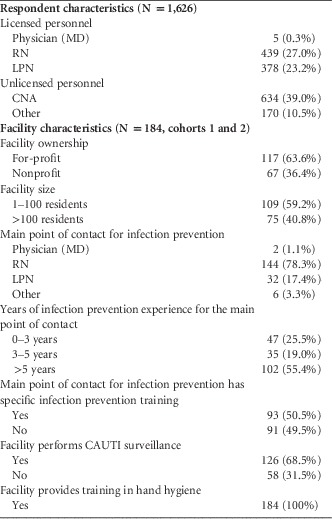
The overall response rate was 184 (78%) of 236 facilities, representing 14 states (Table 1). Of the 68 facilities in cohort 1, we received responses from 49 (72%); for the 168 facilities in cohort 2, we received responses from 135 (80%). The average number of respondents per facility was 8.8 (median [range], 10 [1–32]). A total of 822 respondents (50.6%) were licensed personnel (439 RNs, 378 LPNs, and 5 physicians).
Characteristics of Respondents and Participating Facilities in Study of Infection Prevention and Antimicrobial Stewardship Knowledge for Selected Infections Among Nursing Home Personnel

NOTE. CAUTI, catheter-associated urinary tract infection; CNA, certified nursing assistant; LPN, licensed practical nurse; RN, registered nurse.
Among the facilities, 117 (63.6%) were for-profit. The average number of residents per facility was 98 (median [range], 82 [12–389]). Large facilities, defined as having more than 100 residents, constituted 40.8% of our sample. A total of 102 (55.4%) of the 184 facilities reported that the main point of contact for infection prevention issues was a practitioner with more than 5 years of infection prevention experience. Additionally, only 93 facilities (50.5%) reported that the main point of contact for infection prevention issues had specific training in infection prevention. In 94 facilities (51.1%), the main point of contact for infection prevention issues conducted personnel education and development activities. Specific training for personnel, either by the facility or by an external organization, was provided on appropriate antibiotic use, catheter insertion, and hand hygiene in 142 (77.2%), 170 (92.4%), and 184 (100%) of the facilities, respectively.
Licensed Personnel
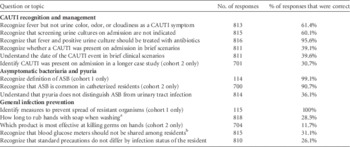
The percentages of correct responses from licensed personnel across several knowledge domains are presented in Table 2. Licensed personnel knew that ASB is very common in persons with indwelling urinary catheters (90.7%). However, only 36.1% understood that pyuria does not distinguish between UTI and ASB; and only 60.1% of respondents knew that screening urine cultures on admission was not appropriate. Clinically based questions about the National Healthcare Safety Network surveillance definitions used in this program elicited many incorrect answers. For example, only 39.6% of respondents correctly identified the date of the CAUTI event when presented with 4 clinical options. Understanding how to determine whether a CAUTI was present on admission was limited, both when presented with brief clinical scenarios (39.1% correct) and when provided a longer case study and asked to determine whether a CAUTI had been present on admission (30.7% correct). Only 61.4% of respondents correctly identified fever as an evidence-based symptom of CAUTI when given a choice between fever, cloudy urine, foul-smelling urine, and a change in urine color. Less than one-third of licensed personnel knew to rub hands for 15 seconds when washing, and less than 20% of licensed personnel chose alcohol-based hand rub as the most effective agent. Other questions that elicited incorrect responses were whether blood-glucose meters should be shared between residents (31.1% correct) and whether personal protective equipment for standard precautions should vary based on the infection status of the resident (26.1%).
Licensed Personnel Responses to Infection-Prevention Knowledge Assessment Questions

NOTE. A total of 822 licensed personnel were respondents. ASB, asymptomatic bacteriuria; CAUTI, catheter-associated urinary tract infection.
a Choices were at least 5 seconds, at least 15 seconds, at least 30 seconds, and at least 60 seconds.
b The long-term care guide developed for this program recommends that blood glucose meters not be shared, whenever possible.
Unlicensed Personnel
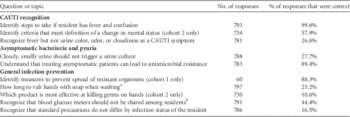
The percentages of correct responses from unlicensed personnel are presented in Table 3. Nearly all respondents (99.6%) were aware that fever and new-onset confusion should be reported to a nurse. Likewise, most knew that treating bacteria in the urine of a resident without symptoms of UTI can lead to a multidrug-resistant organism (89.4%) and that measures to prevent the spread of resistant organisms include limiting antibiotic overuse and performing hand hygiene (88.3%). Questions related to the CAUTI surveillance criteria elicited many incorrect answers. Only 57.9% recognized the appropriate criteria for a change in mental status as new or as worse than usual. Likewise, less than one-third (26.6%) were correctly able to identify that fever but not urine color, odor, or cloudiness is a sign of CAUTI that merits urine culture. Only 25.2% of unlicensed personnel correctly identified how long to rub hands while washing, and even fewer (10.6%) knew which cleansing agent was most effective at killing germs. Knowledge was also limited as to whether blood-glucose meters should be shared (44.4% correct) and application of standard precautions (16.5% correct).
Unlicensed Personnel Responses to Infection-Prevention Knowledge Assessment Questions

NOTE. A total of 804 unlicensed personnel were respondents. CAUTI, catheter-associated urinary tract infection.
a Choices were at least 5 seconds, at least 15 seconds, at least 30 seconds, and at least 60 seconds.
b The long-term care guide developed for this program recommends that blood glucose meters not be shared, whenever possible.
DISCUSSION
Knowledge assessments of licensed and unlicensed personnel in nursing homes were conducted to assess their knowledge of CAUTI, ASB, antimicrobial stewardship, and other infection prevention topics. This information served as the basis for identifying the educational needs of participants in a national AHRQ Safety Program. Our most important findings are gaps in knowledge about the clinical symptoms of CAUTI, distinguishing CAUTI from ASB, and ways to apply the surveillance definitions of CAUTI to clinical scenarios. We also found limited knowledge of selected general infection prevention topics, including the specific procedures to follow for hand hygiene. These identified gaps were common among both licensed and unlicensed personnel and thus represent important targets for personnel education about infection prevention.
The questions requiring application of knowledge of CAUTI and ASB definitions to clinical scenarios elicited mostly incorrect responses. Possible explanations include a lack of familiarity with how to perform CAUTI surveillance, as most participating nursing home facilities were not performing National Healthcare Safety Network–based surveillance for CAUTI at the time of entry into the program cohorts. Other contributing factors may include limited training in infection prevention among nursing home personnel,Reference Herzig, Stone, Castle, Pogorzelska-Maziarz, Larson and Dick 12 the complexity of the surveillance criteria themselves, and ingrained biases about what signs and symptoms should trigger an assessment for CAUTI.Reference Trautner, Petersen, Hysong, Horwitz, Kelly and Naik 13
The lack of knowledge about hand hygiene protocols was noteworthy, as 100% of facilities reported that specific training in hand hygiene is offered to personnel. Many factors may have led to this discrepancy, including logistical challenges to train part-time personnel, and limited uptake by the personnel being trained.Reference Travers, Herzig and Pogorzelska-Maziarz 8 This difference between personnel having knowledge of facts but having difficulty applying these facts to clinical scenarios inspired us to create case-based teaching modules reinforcing existing knowledge while enabling personnel to apply learned facts to clinical scenarios.Reference Knowles, Holton and Swanson 14 Thus, high priority was placed on teaching how to perform CAUTI surveillance through case examples in the clinical content webinars.
Our findings are in accord with those of several previous studies. A survey of Department of Veterans Affairs (VA) physicians, nurse practitioners, and physician assistants working in long-term care settings likewise reported significant gaps in knowledge about antibiotic stewardship and how to manage infections in older adults.Reference Jump, Heath and Crnich 15 , Reference Jump, Olds and Jury 16 Our knowledge assessment reveals similar knowledge gaps in non-VA facilities and includes clinical nurse assistants, who in nursing homes often generate the first request for urine testing or treatment for a possible UTI.Reference Fleming, Bradley, Cullinan and Bryne 17 The gaps in knowledge that we identified around inappropriate screening for ASB are also similar to those previously reported for acute care.Reference Trautner, Petersen, Hysong, Horwitz, Kelly and Naik 13 , Reference Grein, Kahn and Eells 18 – Reference Drekonja, Abbo, Kuskowski, Gnadt, Shukla and Johnson 20
Our study has several limitations. First, we do not have respondent-level demographic information, other than information about credentials, which limited our ability to examine the influence of respondent-level factors on various infection prevention knowledge domains. This knowledge assessment was exploratory and performed to prepare for a large-scale quality improvement program in nursing homes. Second, the sampling was not randomized, as facility leads were at liberty to select respondents at their facility. The knowledge assessment was not previously validated; but through this work we have created and refined a tool that can be used in other projects to measure baseline personnel knowledge relevant to CAUTI prevention. Although facilities participating in this program were not randomly selected, we have conducted separate analyses suggesting that participating facilities did not differ from nonparticipating facilities across a number of key characteristics.
This program represents the largest collaborative of long-term care facilities focused on infection prevention and CAUTI to date. As such, our findings on long-term care personnel knowledge have important implications for infection prevention policies and practices in nursing homes. First, we identified multiple gaps in knowledge of CAUTI, ASB, antimicrobial stewardship, hand hygiene, and standard precautions. Variable knowledge of diagnosis and prescribing guidelines for CAUTI and ASB is one of the challenges for antimicrobial stewardship in nursing homes.Reference Fleming, Bradley, Cullinan and Bryne 17 Second, we found a lack of knowledge about how to perform CAUTI surveillance. Finally, we found that the biases leading to inappropriate management of ASB previously identified in acute care are likewise present in nursing homes. Lessons learned here and the assessment tool are highly relevant to helping nursing homes meet the new Centers for Medicare and Medicaid Services requirements for having an active antimicrobial stewardship component within a robust infection prevention program. 7 As nursing homes expand and enhance their infection prevention programs, educational efforts can repair the gaps identified.
ACKNOWLEDGMENTS
Financial support. AHRQ, US Department of Health and Human Services (contract HHSA 290201000025I); VA National Center for Patient Safety, Patient Safety Center of Inquiry (to S.S. and S.L.K.); VA Healthcare System Geriatric Research, Education, and Clinical Care Center, National Institute on Aging Pepper Center (grant P30AG024824 to L.M.); National Institute on Aging (grants R01AG041780 and K24AG050685 to L.M.); and the Houston VA Health Services R&D Center for Innovations in Quality, Effectiveness and Safety (CIN13-413 to B.W.T.).
Potential conflicts of interest. All authors report no conflicts of interest relevant to this article.
Disclaimer: The opinions expressed are those of the authors and do not necessarily reflect those of the Agency for Healthcare Research and Quality, the Department of Health and Human Services, the Department of Veterans Affairs, the US government, or Baylor College of Medicine.
SUPPLEMENTARY MATERIAL
To view supplementary material for this article, please visit http://dx.doi.org/doi:10.1017/ice.2016.228