Management Implications
Oplismenus undulatifolius (wavyleaf basketgrass) was first discovered in Maryland in 1996, and now is estimated to cover thousands of hectares of forest in Maryland, Virginia, and Pennsylvania. A weed risk analysis by the USDA classified this species as “high risk” in terms of establishment, spread, and impact potential. This shade-tolerant perennial grass species flourishes in the understory, where low light levels and deep leaf litter prevent the establishment of many ruderal invasive plant species. An observational field study found a negative relationship between O. undulatifolius cover and plot-level species richness. The present greenhouse experiment suggests that, at least under the conditions in this study, O. undulatifolius may be a poor competitor. Nevertheless, this species may be able to establish small patches in species-rich understories and spread over short distances vegetatively via a “sit and wait” strategy, and over long distances via viscously awned fruits dispersed by animals, including humans. Other work has shown that, as a perennial species, O. undulatifolius can emerge through up to 6 cm of leaf litter, giving it access to potentially vast tracts of forest. While our research suggests that O. undulatifolius is, at least initially, a poor competitor, it still poses a serious threat to the species diversity of forest understories. Early detection and rapid response will be critical for preventing the spread of this species.
Introduction
The spread of invasive plant species has multiple impacts on forest communities (Levine et al. Reference Levine, Vilà, Antonio, Dukes, Grigulis and Lavorel2003). Interactions between invasive plant species and native biota are associated with changes to many aspects of forest biodiversity, including decreases in native cover and richness (Adams and Engelhardt Reference Adams and Engelhardt2009), lower tree seedling density (Gorchov and Trisel Reference Gorchov and Trisel2003; Stinson et al. Reference Stinson, Campbell, Powell, Wolfe, Callaway, Thelen, Hallett, Prati and Klironomos2006), lower soil microbial activity and mycorrhial fungal density (Motard et al. Reference Motard, Dusz, Geslin, Akpa-Vinceslas, Hignard, Babiar, Clair-Maczulajtys and Michel-Salzat2015; Stinson et al. Reference Stinson, Campbell, Powell, Wolfe, Callaway, Thelen, Hallett, Prati and Klironomos2006), and altered leaf litter invertebrate communities (Motard et al. Reference Motard, Dusz, Geslin, Akpa-Vinceslas, Hignard, Babiar, Clair-Maczulajtys and Michel-Salzat2015) and food webs (McCary et al. Reference McCary, Mores, Farfan and Wise2016). The mechanisms by which novel species are able to invade new regions are varied (Holzmueller and Jose Reference Holzmueller and Jose2011; Levine et al. Reference Levine, Vilà, Antonio, Dukes, Grigulis and Lavorel2003). Plant species can become established in a novel community if they are superior competitors for acquisition and utilization of resources compared with native plant species (Blossey and Notzold Reference Blossey and Notzold1995; Broadbent et al. Reference Broadbent, Stevens, Peltzer, Ostle and Orwin2018; Levine et al. Reference Levine, Vilà, Antonio, Dukes, Grigulis and Lavorel2003; Vilà and Weiner Reference Vilà and Weiner2004). In other cases, a species may be an inferior competitor but is able to exist in a novel community through soil feedback (Klironomos Reference Klironomos2002; Reinhart and Callaway Reference Reinhart and Callaway2006) or enemy release (Keane and Crawley Reference Keane and Crawley2002). Additionally, invasive species may take advantage of an empty niche that occurs when resources are unused or underutilized by the local species (Kuebbing et al. Reference Kuebbing, Rodriguez-Cabal, Fowler, Breza, Schweitzer and Bailey2012). Understanding the mechanisms by which invasive plant species become established and spread can help managers and policy makers determine the potential threat and impacts of a new invasive taxon and monitor those areas most susceptible to invasion.
Wavyleaf basketgrass [Oplismenus undulatifolius (Ard.) P. Beauv.] is a relatively new invader in eastern North American forests (Beauchamp et al. Reference Beauchamp, Koontz, Suss, Hawkins, Kyde and Schnase2013). This grass was first found in Maryland in 1996 in Patapsco Valley State Park (Peterson et al. Reference Peterson, Terrell, Patterson, Uebel, Davis, Scholz and Soreng1999) and has since spread through central Maryland, with a few incursions into southern and western Maryland, various locations in Virginia, and Pennsylvania. A recent weed risk assessment by the USDA classified this species as “high risk” in terms of establishment, spread, and impact potential (USDA-APHIS 2012). Very little is known about the ecology of O. undulatifolius in its native or introduced ranges and little research has been conducted on its competitive ability. To characterize the niche of O. undulatifolius in Maryland, Beauchamp et al. (Reference Beauchamp, Koontz, Suss, Hawkins, Kyde and Schnase2013) conducted a field study and found that areas with high O. undulatifolius cover were characterized by low species richness. Additionally, Tekiela and Barney (Reference Tekiela and Barney2017) found that under certain conditions, O. undulatifolius was responsible for reductions in forest understory species richness, particularly that of native plant species. These data suggest that O. undulatifolius may be able spread into new areas by outcompeting the existing flora.
A major factor in the ability of an exotic plant species to invade forests is shade tolerance (Martin et al. Reference Martin, Canham and Marks2009). Unlike many invaders with a more ruderal life-history strategy that are expected to decrease in abundance with canopy closure (Meiners et al. Reference Meiners, Pickett and Cadenasso2002), the abundance of shade-tolerant species is expected to increase during forest succession (Martin et al. Reference Martin, Canham and Marks2009), potentially accelerating the reduction of native forest biodiversity (Aronson and Handel Reference Aronson and Handel2011; Hejda et al. Reference Hejda, Pysek and Jarosik2009). Oplismenus undulatifolius is a perennial, shade-tolerant species of temperate, subtropical, and tropical areas (Scholz Reference Scholz1981; USDA-APHIS 2012). In its novel range, O. undulatifolius has joined a group of shade-tolerant forest understory invaders (Martin et al. Reference Martin, Canham and Marks2009) and is capable of growing at light levels as low as 2 to 12 mol m−2 d−1 (Beauchamp et al. Reference Beauchamp, Koontz, Suss, Hawkins, Kyde and Schnase2013). Although shade tolerance may be an important aspect of the invasion success of O. undulatifolius (Martin and Marks Reference Martin and Marks2006), no data exist on the competitive ability of this species at different light levels.
The objective of this study was to assess the ability of O. undulatifolius to establish when competitors are present and to examine the effect of shade on these competitive relationships. To accomplish this, we compared the competitive ability of O. undulatifolius with that of Japanese stiltgrass [Microstegium vimineum (Trin.) A. Camus] and a mix of native perennial grass species. We chose to focus on interspecific competition, as we were interested in dynamics during the initiation of invasion. Density-dependent effects due to intraspecific competition are unlikely to be important factors at this stage.
Microstegium vimineum is an annual, invasive grass species discovered in the United States in 1919 (Fairbrothers and Gray Reference Fairbrothers and Gray1972). Like O. undulatifolius, M. vimineum is somewhat shade tolerant and frequently invades forest understories (Barden Reference Barden1987; Cole and Weltzin Reference Cole and Weltzin2005; Kuebbing et al. Reference Kuebbing, Rodriguez-Cabal, Fowler, Breza, Schweitzer and Bailey2012; Warren et al. Reference Warren, Wright and Bradford2011). The two species are frequently seen growing side by side (Tekiela and Barney Reference Tekiela and Barney2017), with O. undulatifolius dominating in shaded understories and M. vimineum dominating nearby light gaps (Beauchamp et al. Reference Beauchamp, Koontz, Suss, Hawkins, Kyde and Schnase2013). This scenario suggests an opportunity for intense competition between the two species.
Seeding to reestablish native cover after invasive species removal is a common practice. To determine how well O. undulatifolius would compete with locally abundant native species, we used a mix of the perennial grass species Autumn bentgrass [Agrostis perennans (Walter) Tuck.], Virginia wildrye (Elymus virginicus L.), and deertongue [Dichanthelium clandestinum (L.) Gould] that is marketed for restoration of areas invaded by M. vimineum (Ernst Conservation Seeds, personal communication). We wanted to see how this mix of species would perform in competition with both M. vimineum and O. undulatifolius. It is also more realistic that O. undulatifolius invading a new site via seed dispersal would encounter a mix of species rather than a monoculture. Based on our field observations of extensive near-monotypic stands of O. undulatifolius at locations in Maryland and Virginia, we hypothesized that O. undulatifolius would be the superior competitor compared with M. vimineum and the native grass species mix and that this competitive ability would be enhanced in the shade.
Materials and Methods
Oplismenus undulatifolius and M. vimineum seeds (caryopses; hereafter referred to as “seeds”) were collected from multiple locations in Patapsco Valley State Park near Baltimore, MD, in October 2011 and stored at room temperature over the winter. Sticky glumes were removed from the O. undulatifolius seed before seeding to facilitate handling. A native seed mix obtained from Ernst Conservation Seeds (Meadville, PA) included locally derived (MD, PA, and VA) ecotypes of the perennial grasses A. perennans, E. virginicus, and D. clandestinum.
In March 2012, 60 plastic greenhouse flats (28 by 55 by 6 cm) were filled with 2 L of topsoil from local (Baltimore area) sources and 1 L of potting soil to increase drainage. The topsoil was screened before purchase to remove large debris, including roots and rocks. Seeds were added to the flats at a rate of 0.5 g each for O. undulatifolius, M. vimineum, and the native seed mix, which we considered a single competitor for this experiment. Based on weighing and counting small batches of seed, 0.5 g equates to approximately 400 O. undulatifolius seeds; 500 M. vimineum seeds; and 80 D. clandestinum, 450 E. virginicus, and 1,800 A. perennans seeds in 0.5 g of the native mix. Seeds were dispersed across the flats by mixing the seed with 500 ml of tap water and pouring this evenly over the flats. Seeds were added to flats in six combinations of 10 flats each: O. undulatifolius alone; M. vimineum alone; native mix alone; O. undulatifolius + M. vimineum; O. undulatifolius + native mix; and M. vimineum + native mix. In this additive design, competition flats received twice the seed (0.5 g of each of the two competitors) of the monoculture flats (0.5 g of one species). This design allowed us to assess the magnitude of interspecific effects among O. undulatifolius, M. vimineum, and the mix of native grasses.
All flats were placed on greenhouse benches, with half of the flats under frames covered with tan 70% shade cloth. The outside of the greenhouse had been previously whitewashed to help control temperature. Light levels measured as photosynthetically active radiation with a Sunfleck Ceptometer (Decagon Devices, Pullman, WA) were 310.8 µmol m−2 s−1 ± 51.9 SD (n = 10) over the unshaded flats and 113.4 ± 17.5 µmol m−2 s−1 SD (n = 10) over the shaded flats, a 36% reduction in light. These levels represent 23.2% and 8.5%, respectively, of full sunlight, and are equivalent to a daily light integral of 26.9 mol m−2 day−1 for the unshaded flats and 9.9 mol m−2 day−1 for the shaded flats (Torres and Lopez Reference Torres and Lopez2010). Shaded and unshaded flats were placed on opposite sides of the greenhouse bay separated by a 1-m lane to ensure that the unshaded flats were not affected by the shadows cast by the shade structures. The final experimental design consisted of six species treatments (three monoculture and three competition) and two shade treatments (shaded and unshaded) all replicated five times. A block design was created with one replicate of each treatment in each of five blocks. Due to space limitations, the five blocks were spread over two adjoining greenhouse bays with temperature and watering regimes kept as similar as possible between the two bays. Flats were watered as needed via an automatic irrigation system to keep the soil moist. All flats were fertilized in June and September with 0.5 L of 200 ppm N fertilizer per flat. All aboveground biomass was harvested in October 2012, dried to a constant weight, and weighed. Seeds of O. undulatifolius were then separated from the vegetative biomass and weighed. We did not harvest seed from any of the other grass species.
Before analysis, data were checked for normality and homogeneity of variance with the Shapiro-Wilk and Levene’s tests. All data met the required assumptions for parametric statistics. Because seed was added to the flats by weight (0.5 g per species) we used an ANOVA to compare the per-flat monoculture biomass among the three species within each block to determine whether our seeding rates resulted in a similar amount of biomass for each species. The effect of shade on each species was analyzed with a paired-samples t-test comparing the growth of each species in monoculture within each block, between the shaded and unshaded treatments. For this purpose, we treated the native mix as a single “species.” The effect of competition among O. undulatifolius, M. vimineum, and the native species mix was measured by dividing the biomass of the same species when grown with a competitor (BMcompetition) by the biomass achieved by each species in monoculture (BMmonoculture) within each shade treatment to obtain a response ratio (RR) for each species. This equation provides a measure of competition intensity between species (Hedges et al. Reference Hedges, Gurevitch and Curtis1999):
 $${\rm{ln \ RR = ln }}\ \left( {{\rm{B}}{{\rm{M}}_{{\rm{competition}}}}{\rm{/B}}{{\rm{M}}_{{\rm{monoculture}}}}} \right)$$
Negative values indicate competition, while positive values indicate facilitation. The combined effect of shade and competitor on the growth of each species was analyzed with a two-way ANOVA on the RRs. Post hoc analysis of competitor effect was conducted using Fisher’s LSD test with a Bonferroni correction. Effect of shade and competitor on O. undulatifolius seed production was analyzed in a similar manner.
Results and Discussion
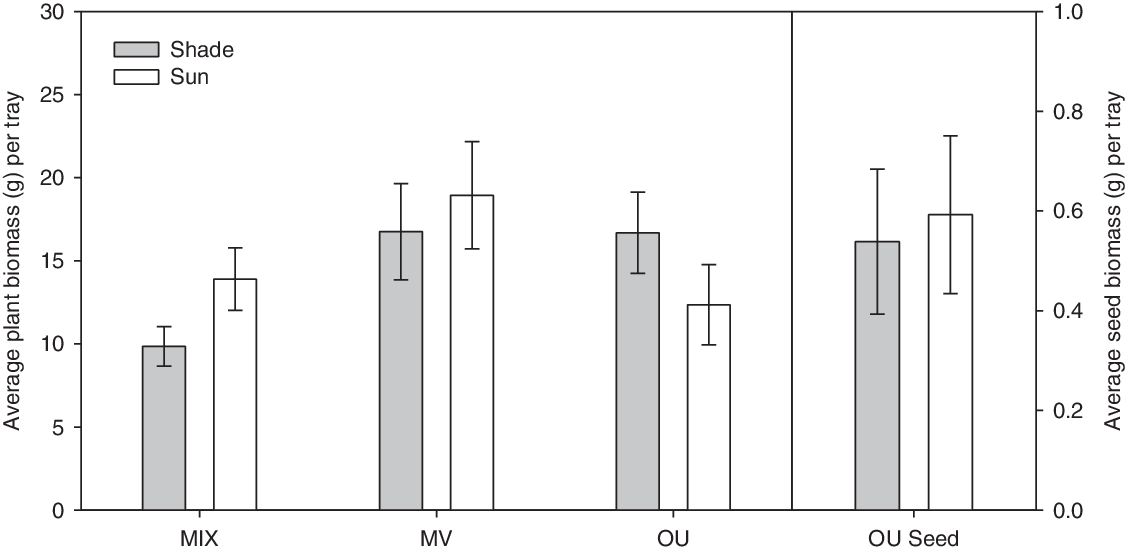
Based on field observations of local populations of O. undulatifolius and the habitat descriptions included in taxonomic treatments of the genus Oplismenus (Scholz Reference Scholz1981), we hypothesized that O. undulatifolius would attain higher biomass in shaded environments. This was not supported by our data. Although O. undulatifolius showed a trend of higher biomass in the shaded treatments, and M. vimineum and the native grass mix showed the same trend in the unshaded treatments, there was no significant effect of light level on the growth of any of the species (Mix: t = 1.662, df = 4, P = 0.172; MV: t = 0.481, df = 4, P = 0.655; OU: t = −1.031, df = 4, P = 0.361). Nor was there any effect of light level on seed production. (OU seed: t = 0.197, df = 4, P = 0.854; Figure 1).
Average per-flat biomass (g) produced in the greenhouse experiment by the native mix (MIX), Microstegium vimineum (MV), and Oplismenus undulatifolius (OU) when grown in monoculture (n = 10 for each species). There was no significant difference in biomass between the sun and shade treatments for any species.

Microstegium vimineum is reported to be somewhat shade tolerant (Cole and Weltzin Reference Cole and Weltzin2004; Horton and Neufeld Reference Horton and Neufeld1998), while optimal growing conditions for D. clandestinum, A. perennans, and E. virginicus span a range from full sun to full shade (Slattery et al. Reference Slattery, Reshetiloff and Zwicker2003). Other greenhouse studies that have demonstrated an effect of shade on M. vimineum growth had a larger difference in light levels between shaded and unshaded treatments and had overall brighter unshaded treatments (Cheplick and Fox Reference Cheplick and Fox2011; Leicht et al. Reference Leicht, Silander and Greenwood2005) than we were able to achieve given the unremovable whitewash on our greenhouses. Although there was not a significant effect of shade on O. undulatifolius biomass, we did observe signs of leaf bleaching in the unshaded treatment, a response symptomatic of light stress and a common occurrence in shade-adapted plant leaves exposed to high light conditions (Demmig-Adams and Adams Reference Demmig-Adams and Adams1992). These observations suggest full sunlight may cause physiological damage to O. undulatifolius, but further study across a broader range of light levels is needed.
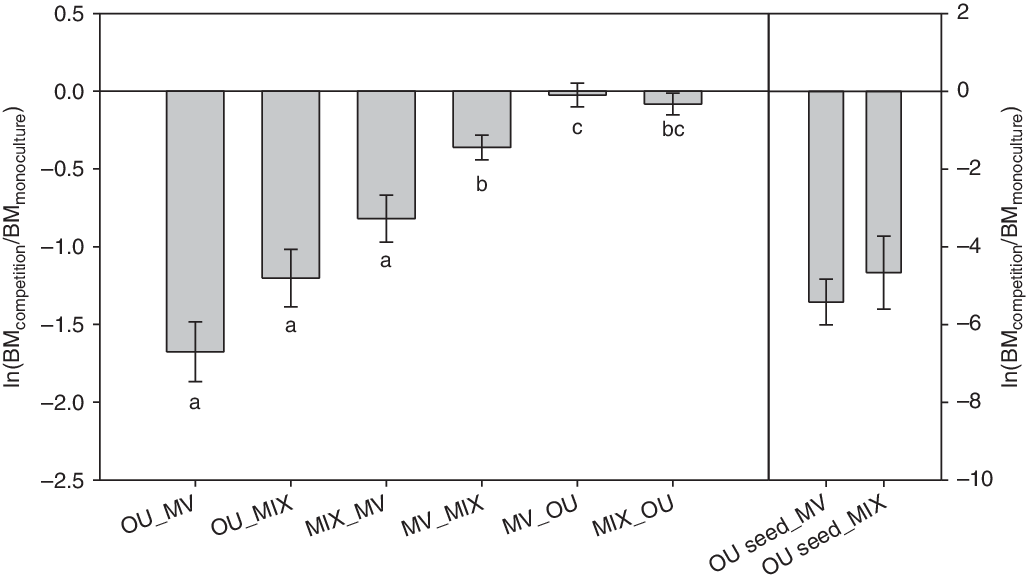
We also hypothesized that O. undulatifolius would be a superior competitor to M. vimineum or a mix of native grass species, but this was not supported by the results of our greenhouse experiment. The presence of a competitor, measured by comparison of a species’ biomass between the competition and monoculture treatments, had a negative effect on growth in all species combinations, irrespective of the shade treatment (Table 1). Oplismenus undulatifolius was affected to a much greater degree by competition than either M. vimineum or the native grass mix (Figure 2). Biomass of O. undulatifolius grown with either M. vimineum or the native mix was reduced by 72% to 85% compared with biomass of O. undulatifolius grown in monoculture. Similarly, competition decreased seed biomass by 95% to 98% (Figure 2; Table 2). Additionally, nearly half the O. undulatifolius samples grown in competition (9 of 20) failed to produce any seed. When grown alone, only 10% (1 in 10) did not fruit. When monoculture per-flat biomass was compared among species within each block and shade treatment, there was no significant difference in final biomass amounts. This indicates that seeding rates of 0.5 g of seed per species resulted in similar per-flat biomass production when each of the species was grown alone and that competitive outcomes were not affected by the differing numbers of seed of each species applied to the flats.
Effects of shade (two treatments) and competitor (six competition combinations) on response ratio (ln RR).

Response ratios from competition pairings. The pairings indicate the competition scenario when grown in the same flat. For example, OU_MV describes the response of Oplismenus undulatifolius to competition with Microstegium vimineum. MIX, native mix; BM, biomass. Negative values indicate competition, and positive values indicate facilitation. Significant effects of competition on growth or seed production are indicated by confidence intervals that do not overlap zero. Different letters indicate significantly different responses among competitive pairs. Effect of competition on O. undulatifolius seed production was analyzed separately. Competition negatively affected O. undulatifolius seed production, but this effect did not differ between M. vimineum or the native mix.

Per-flat biomass (g) of grass species when grown in monoculture and competition.a

a Values are mean ± SE, and n = 10 except where indicated.
b OU, Oplismenus undulatifolius; MV, Microstegium vimineum; MIX, Agrostis perennans + Elymus virginicus + Dichanthelium clandestinum.
Oplismenus undulatifolius had the weakest competitive effect of the three species. Biomass of M. vimineum was reduced by less than 2% and biomass of the native mix was reduced by 4% when grown with O. undulatifolius (Figure 2; Table 2). These biomass reductions were so small that the 95% confidence intervals of the response ratios include zero (MV: −0.187 to 0.236; MIX: −0.111 to 0.277), indicating that in this experiment, O. undulatifolius had a statistically insignificant effect on the growth of its competitors (Figure 2). The native mix and M. vimineum had reciprocal effects on growth of a similar magnitude, with biomass of each decreasing by 31% to 48% in the presence of the competitor (Figure 2; Table 2).
This greenhouse experiment took place under admittedly artificial conditions. Many aspects of the experimental design could have affected our results. While we did not find a significant effect of shade on growth in monoculture or in competition, our shade treatment may have been affected by the confounding factor of soil moisture. We did not measure soil moisture levels in the flats, but soil moisture in the shaded treatments may have been higher if shading limited evapotranspiration substantially. If this was the case, increased growth due to higher soil moisture may have partially compensated for any negative effects of shade on growth. We feel this is unlikely, as we watered frequently enough to keep the flats visibly moist throughout the experiment.
The depths of the flats used in this experiment may have had some effect on the outcome of the competition trials. We used shallow (6-cm) flats to accommodate the sprawling growth habit of both O. undulatifolius and M. vimineum. Both of these species are very shallowly rooted, but rooting depths >6 cm have been recorded for M. vimineum (Touchette and Romanello Reference Touchette and Romanello2010). Agrostis perennans and E. virginicus are capable of rooting much more deeply; however, Brown et al. (Reference Brown, Percivalle, Narkiewicz and DeCuollo2010) found that 80% and 54% of root biomass was found in the top 7.6 cm of soil for A. perennans and E. virginicus, respectively. The shallow containers may have provided an advantage to M. vimineum if the other species were not able to develop a full root system; however, this advantage should have also extended to O. undulatifolius, which also has a shallow root system. Conversely, the concentration of the entire root systems of the native mix into 6 cm of soil may have caused higher levels of root competition than what would be seen in the field. Even if the shallow flats resulted in greater root competition from the native mix, O. undulatifolius still appears to be a weaker competitor than M. vimineum, as it was more affected by interspecific competition with the native mix and was the weaker competitor when paired with M. vimineum.
We applied seed to the treatments in the study by weight rather than number. Based on weighing and counting small batches of seed, this resulted in a sown seed density that was less for O. undulatifolius than for the other species. This could explain the poor performance of O. undulatifolius in competition with M. vimineum and the mix of native grass species; however, when grown in monoculture, all species attained a similar level of per-flat biomass, suggesting that they were evenly matched in the competition treatments. Additionally, most new populations of O. undulatifolius are likely initiated by a few seeds that have to compete with the resident seedbank, so this scenario of initial unbalanced competition would more closely mimic field conditions.
Our results indicate that at least in the first year of growth in shallow flats in a greenhouse setting, O. undulatifolius is an inferior competitor to M. vimineum and a mix of native grass species. While this is certainly an artificial environment, other field studies also suggest that despite O. undulatifolius forming near-monotypic stands in the understory of large tracts of mid-Atlantic forest, it is strongly affected by interspecific competition. Previous work by Beauchamp et al. (Reference Beauchamp, Koontz, Suss, Hawkins, Kyde and Schnase2013) found a negative relationship between O. undulatifolius cover and forest understory species richness, but they were unable to determine whether O. undulatifolius was in the process of outcompeting neighboring vegetation, or whether it was capable of creating a dense carpet only in areas with already low species richness. In the present study, we found that O. undulatifolius presence had little effect on the growth of M. vimineum or the native grass mix, but both of these had significant effects on the growth of O. undulatifolius. An earlier manipulative field experiment showed similar results. Tekiela and Barney (Reference Tekiela and Barney2017) found that O. undulatifolius cover increased by 21% after M. vimineum removal, but that M. vimineum increased by only 4.2% after O. undulatifolius removal. They also found that, at similar densities, M. vimineum had a more negative effect on richness and diversity than O. undulatifolius.
One possible explanation for the discrepancy between the seeming success of O. undulatifolius in the field—its extensive cover—and its lack of competitiveness shown in the greenhouse experiment is that the long history of agriculture in the mid-Atlantic region (Flinn and Vellend Reference Flinn and Vellend2005), in addition to the effects of intense browse pressure from overabundant white-tailed deer (Odocoileus virginianus Zimm.) (Augustine and DeCalesta Reference Augustine and DeCalesta2003), may be creating an empty niche that O. undulatifolius can readily exploit. Empty niches occur in environments where resources are not being fully or efficiently utilized due to low species diversity (Shea and Chesson Reference Shea and Chesson2002). Work done by Vellend et al. (Reference Vellend, Verheyen, Flinn, Jacquemyn, Kolb, Van Calster, Peterken, Graae, Bellemare, Honnay, Brunet, Wulf, Gerhardt and Hermy2007) showed that the agricultural legacy of many secondary-growth forests has had a direct effect on species diversity across North America and Europe. Agricultural practices such as tilling and fertilization have degraded soil microbial communities and eliminated native seedbanks, making it more difficult for native species to recolonize. Decades, even centuries, after agricultural abandonment, this legacy has left many forest understories undersaturated. In eastern North America, recolonization of postagricultural land by native plant species has also been hindered greatly by overabundant native white-tailed deer populations (Tanentzap et al. Reference Tanentzap, Bazely, Koh, Timciska, Haggith, Carleton and Coomes2011). Overbrowsing limits recruitment and survival of both woody and non-woody species (Aronson and Handel Reference Aronson and Handel2011; Augustine and DeCalesta Reference Augustine and DeCalesta2003; Côté et al. Reference Côté, Rooney, Tremblay, Dussault and Waller2004; Rooney and Waller Reference Rooney and Waller2003), leaving forests undersaturated in terms of available space and resource use and giving invasive species an opportunity to take root (Kuebbing et al. Reference Kuebbing, Rodriguez-Cabal, Fowler, Breza, Schweitzer and Bailey2012). Other mechanisms, such as soil feedbacks and enemy release (Keane and Crawley Reference Keane and Crawley2002; Levine et al. Reference Levine, Vilà, Antonio, Dukes, Grigulis and Lavorel2003; Reinhart and Callaway Reference Reinhart and Callaway2006), may also play a role in the invasion of O. undulatifolius into mid-Atlantic forest ecosystems, but these have yet to be investigated for this species.
Although O. undulatifolius appears to be a weak competitor in the year of establishment, it is important to note that it was not entirely outcompeted. A “sit and wait” or “slow and steady” strategy may be another mechanism for O. undulatifolius spread and persistence, even in areas with high species richness. Many gap-colonizing species, such as tree of heaven [Ailanthus altissima (Mill.) Swingle] (Kowarik Reference Kowarik1995), Oriental bittersweet (Celastrus orbiculatus Thunb.) (Greenberg et al. Reference Greenberg, Smith and Levey2001), and ruderal Rubus species (Caplan and Yeakley Reference Caplan and Yeakley2013) are capable of maintaining populations of seedlings or ramets in suboptimal conditions until a disturbance produces conditions conducive to local population explosions. Persistence at low density in species-rich understories may afford O. undulatifolius the opportunity to spread quickly when disturbance reduces the presence of competitors (Martin et al. Reference Martin, Canham and Marks2009). Alternatively, these low-density populations may act as a staging area for long-distance dispersal to more suitable habitats.
Oplismenus undulatifolius seed production decreased with competition from both M. vimineum and the native mix, but it was not completely eliminated. Work with M. vimineum, which has gravity-dispersed seeds and a slow natural dispersal rate (Rauschert et al. Reference Rauschert, Mortensen, Bjornstad, Nord and Peskin2010), has shown that long-distance dispersal is accomplished via periodic water-dispersal events, inadvertent human dispersal, and soil disturbances along roadsides and hiking trails (Cheplick Reference Cheplick2010; Rauschert et al. Reference Rauschert, Mortensen, Bjornstad, Nord and Peskin2010). Preliminary work with O. undulatifolius shows that gravity and water dispersal are both potential seed-dispersal pathways after the plants have senesced, but epizoochory is a major dispersal pathway from August through November (VBB, unpublished data). Unlike most grasses that attach via barbs or hooks on fruiting structures, O. undulatifolius produces fruits with viscid awns (Scholz Reference Scholz1981; Sorensen Reference Sorensen1986) that adhere easily to fur, skin, and clothes. If undisturbed, these fruits are capable of remaining attached to a potential disperser for days or weeks (VBB, unpublished data).
Results from our study and that of Tekiela and Barney (Reference Tekiela and Barney2017) suggest that O. undulatifolius may be a poor interspecific competitor, at least in some circumstances. This by no means decreases the potential threat of this species to forest ecosystems (USDA-APHIS 2012). Even low-density populations in species-rich areas can serve as a source of propagules. Since its initial North American discovery in 1919 in a single Tennessee location, M. vimineum has spread into 25 states from western Texas to upstate New York. This species typically occupies early successional habitats, forest edges, and canopy gaps (Cole and Weltzin Reference Cole and Weltzin2004) and, as an annual, is most successful at colonizing areas with shallow leaf litter (Cheplick Reference Cheplick2010; Gibson et al. Reference Gibson, Spyreas and Benedict2002; Schramm and Ehrenfeld Reference Schramm and Ehrenfeld2010). The perennial nature of O. undulatifolius allows it to thrive in areas with litter depths in excess of 6 cm, giving it access to vast tracts of forest that are inhospitable to M. vimineum (Beauchamp et al. Reference Beauchamp, Koontz, Suss, Hawkins, Kyde and Schnase2013). A recent USDA report estimates that about 30% of the United States is suitable habitat for O. undulatifolius (USDA-APHIS 2012). It will be important to monitor areas that are more at risk to O. undulatifolius invasion and to understand more about how this species affects other aspects of forest ecology, such as soil microbiomes or food webs.
Acknowledgments
We thank Ernst Conservation Seeds for the donation of native seed used in this study. This project was supported by funding from the Towson University Undergraduate Research Committee, the Fisher College of Science and Mathematics, and the National Biological Honors Society. Adele LeBrun, Matthew Moreland, Greg Lande, Emily Martin, and Kim Russell assisted with greenhouse work and sample processing. Kerrie Kyde, Laura Gough, and several anonymous reviewers provided helpful comments on an earlier draft of this article. No conflicts of interest have been declared.