Several studies have highlighted that the quality of early care has a significant impact on later gene expression, brain maturation, and cognitive, emotional, and on the development of relational systems (e.g., Panksepp, Reference Panksepp2010). Particularly, literature has reported the association between early emotional experiences, with parents and family members, and the adjustment of emotional regulation strategies (Gilbert & Perris, Reference Gilbert and Perris2000). It has been well documented that early interactions with attachment figures, which behave in a responsive, sensitive and available fashion, play a significant role in the promotion of an optimal development of the attachment system (Gerhardt, Reference Gerhardt2004; Irons, Gilbert, Baldwin, Baccus, & Palmer, Reference Irons, Gilbert, Baldwin, Baccus and Palmer2006). Embed in the affiliative-soothing system, feelings of security and connectedness are reported as fosterers of the ability to deal with challenging contexts and adversity (e.g., Gilbert, Reference Gilbert2009). More specifically, early experiences involving warmth, reassuring, care, and affection responses have been related to subsequent well-being and resilience towards psychopathology (e.g., Gilbert, Baldwin, Irons, Baccus, & Palmer, Reference Gilbert, Baldwin, Irons, Baccus and Palmer2006). In contrast, when primary attachment figures are experienced as not being reliable, secure, or available, a sense of security cannot be attained, and thus defensive strategies may be activated (Brewin, Andrews, & Gotlib, Reference Brewin, Andrews and Gotlib1993; Cunha, Xavier, Martinho, & Matos, Reference Cunha, Xavier, Martinho and Matos2014; Gilbert, Reference Gilbert and Baldwin2005). Indeed, early negative experiences (i.e., characterized by rejection, over protection/control, or a lack of care) within the family have been linked with subsequent psychosocial difficulties and with several psychopathological indicators (e.g., Gilbert & Perris, Reference Gilbert and Perris2000).
Moreover, several accounts pointed out that rearing experiences can act as conditioned emotional memories (Gilbert & Irons, Reference Gilbert, Irons and Allen2009), which seem to have a crucial impact on emotional regulation (e.g., Matos & Pinto-Gouveia, Reference Matos and Pinto-Gouveia2010). In fact, literature suggested that early negative relational experiences may operate as threat-activating memories and function like highly available emotional “hot spots” (Cheng & Furnham, Reference Cheng and Furnham2004). On the other hand, the evocation of rearing experiences seems to promote positive emotional states, and adaptive emotional resources such as self-compassion (e.g., Gilbert & Irons, Reference Gilbert, Irons and Allen2009; Richter, Gilbert, & McEwan, Reference Richter, Gilbert and McEwan2009).
Self-compassion is a construct, rooted in the Buddhist philosophy, which can be defined as a set of three distinct abilities that mutually interact and enhance one another: (1) self-kindness – the ability to adopt an understanding and caring attitude towards the self, rather than being over-judgmental, in times of suffering; (2) common humanity – the recognition of one’s experiences (such as personal setbacks or failures) as being part of the larger human experience, which promotes a sense of social connectedness, rather than of isolation; and (3) mindfulness – that implies a balanced awareness of the present moment experience, rather than avoidance or over-identification with such experiences, which permits a greater perspective towards unwanted or painful experiences (Neff, Reference Neff2003a; Reference Neffb). Regarding the benefits of cultivating a compassionate attitude towards oneself, self-compassion has been seen as valuable when in one faces personal shortcomings and difficulties, and as being positively associated with positive affect, social connectedness, and adaptive coping (e.g., Gilbert, Reference Gilbert and Baldwin2005; Neff, Reference Neff2003a; Neff, Reference Neff, Leary and Hoyle2009). Additionally, extensive data demonstrated that self-compassion can have an effective impact against negative affect and psychopathology (e.g., Ferreira, Matos, Duarte, & Pinto-Gouveia, Reference Ferreira, Matos, Duarte and Pinto-Gouveia2014; Neff, Reference Neff, Germer and Siegel2012; Raes, Reference Raes2011).
Other relevant studies in the field of body image have documented the importance of nurturing a self-compassionate attitude by reporting its significant association with lower body dissatisfaction, body shame and body surveillance, as well as with higher body image flexibility and body appreciation (Daye, Webb, & Jafari, Reference Daye, Webb and Jafari2014; Ferreira, Pinto-Gouveia, & Duarte, Reference Ferreira, Pinto-Gouveia and Duarte2013; Ferreira et al., Reference Ferreira, Matos, Duarte and Pinto-Gouveia2014; Kelly, Vimalakanthan, & Miller, Reference Kelly, Vimalakanthan and Miller2014; Wasylkiw, MacKinnon, & MacLellan, Reference Wasylkiw, MacKinnon and MacLellan2012). Particularly, the significant association between self-compassion and body appreciation has been corroborated by recent research (Homan & Tylka, Reference Homan and Tylka2015; Kelly & Stephen, Reference Kelly and Stephen2016; Marta-Simões, Ferreira, & Mendes, Reference Marta-Simões, Ferreira and Mendes2016).
Body appreciation is conceptualized as the ability to accept, respect and to be kind towards perceived defects in appearance and, at the same time, to recognize perceived body flaws as part of the common human experience (Avalos, Tylka, & Wood-Barcalow, Reference Avalos, Tylka and Wood-Barcalow2005; Tylka & Wood-Barcalow, Reference Tylka and Wood-Barcalow2015). Thus, body appreciation can be seen as the ability to adopt a compassionate and understanding attitude towards one’s own body features and characteristics (Homan & Tylka, Reference Homan and Tylka2015; Tylka & Wood-Barcalow, Reference Tylka and Wood-Barcalow2015). Furthermore, body appreciation was found to be positively related to several adaptive emotional regulation and wellbeing indicators, such as optimism, proactive coping, positive affect, life satisfaction (Avalos et al., Reference Avalos, Tylka and Wood-Barcalow2005; Tylka & Kroon Vandiest, Reference Tylka and Kroon Van Diest2013; Wasylkiw et al., Reference Wasylkiw, MacKinnon and MacLellan2012), and favorable appearance evaluations, body esteem, and intuitive eating (Avalos et al., Reference Avalos, Tylka and Wood-Barcalow2005; Tykla & Kroon Van Diest, Reference Tylka and Kroon Van Diest2013). In contrast, body appreciation is negatively linked with body dissatisfaction, maladaptive body-related behaviors (such as body surveillance and body checking behaviors; Avalos et al., Reference Avalos, Tylka and Wood-Barcalow2005; Tylka, Reference Tylka2013), and eating psychopathology (Tylka & Kroon Van Diest, Reference Tylka and Kroon Van Diest2013).
Notwithstanding the fact that current approaches recommend a greater investment on adaptive and healthy emotional regulation processes, literature exploring the impact of relating positively with one’s self and body image on eating psychopathology is still scarce (Smolak & Cash, Reference Smolak, Cash, Cash and Smolak2011). The current study aimed therefore to contribute to the clarification of the meaning of positive emotional regulation processes on disordered eating, by testing an integrative model that explores the impact of early memories of warmth and safeness on eating psychopathology, and whether self-compassion and body appreciation play a significant role on this association. It was hypothesized that of early positive affiliative experiences (with family figures) may be associated with lower severity of eating psychopathology’s symptoms, when in the presence of higher levels of self-compassion and body appreciation.
Method
Participants
Four hundred and ninety women were collected from the Portuguese general population, with ages ranging from 18 to 54 years old (M = 24.76; SD = 7.66). Participants presented a Body Mass Index (BMI) mean of 22.29 (SD = 3.87), which corresponds to normal weight values (WHO, 1995). Fifty-three (10.82%) were underweight (BMI < 18.5), 349 (71.22%) presented normal weight values (18.5 ≥ BMI ≤ 25.0), and 88 (17.96%) were overweight (BMI > 25), which reflects the BMI distribution of the female Portuguese population (Poínhos et al., Reference Poínhos, Franchini, Afonso, Correia, Durão, Pinho and de Almeida2009).
Measures
Body Mass Index (BMI)
BMI was calculated by computing the Quetelet Index, using information reported by the participants, namely self-reported height and weight (Kg/m2).
Early Memories of Warmth and Safeness Scale (EMWSS; Richter et al., Reference Richter, Gilbert and McEwan2009; Portuguese version by Matos, Pinto-Gouveia, & Duarte, Reference Matos, Pinto-Gouveia and Duarte2015)
EMWSS is a self-report instrument, composed by 21 items, designed to measure early positive affiliate experiences. Participants are asked to indicate the frequency of warm, safe and affectionate emotional experiences which occurred in close relationships (e.g., “I felt that I was a cherished member of my family”) during childhood. The response options are rated in a 5-point scale (0 = “No, never” to 4 = “Yes, Most of the time”). This measure presented good psychometric properties, with a high level of internal consistency (α = .97), both for the original and the Portuguese versions.
Self-Compassion Scale (SCS; Neff, Reference Neff2003a; Portuguese version by Costa, Marôco, Pinto-Gouveia, Ferreira, & Castilho, Reference Costa, Marôco, Pinto-Gouveia, Ferreira and Castilho2016)
This 26-item self-report measure assesses self-compassion through two main components: a positive, which includes the dimensions self-kindness (e.g., “I’m tolerant of my own flaws and inadequacies”), common humanity (e.g., “I try to see my failings as part of the human condition”) and mindfulness (e.g., “When I fail at something important to me I try to keep things in perspective”); and a negative one, comprising self-judgment, isolation and over-identification dimensions. The response options are rated on a Likert-type scale ranging from 1 (“almost never”) to 5 (“almost always”). SCS presented good internal consistency in the original version (α = .92) and in the Portuguese version (α = .89). In the current study, the three positive dimensions were computed into one, and as a global measure of self-compassion.
Body Appreciation Scale (BAS-2; Tylka & Wood-Barcalow, Reference Tylka and Wood-Barcalow2015; Portuguese version by Marta-Simões, Mendes, Oliveira, Trindade, & Ferreira, Reference Marta-Simões, Ferreira and Mendes2016)
BAS-2 is a self-report instrument composed by 10 items that assesses the presence of respectful and accepting attitudes towards one’s own body’s features, regardless of its appearance (e.g., “I take a positive attitude towards my body”). The response options are rated on a 5-point Likert-type scale (1 = “never” to 5 = “always”). This instrument revealed a good internal consistency in the original version (with αvalues ranging from .93 to .97 in different samples; Tylka & Wood-Barcalow, Reference Tylka and Wood-Barcalow2015) as well as in Portuguese version (α = .95).
Eating Disorder Examination Questionnaire (EDE-Q; Fairburn & Beglin, Reference Fairburn and Beglin1994; Portuguese version by Machado et al., Reference Machado, Martins, Vaz, Conceição, Bastos and Gonçalves2014)
EDE-Q is a 36-item self-report measure, adapted from the Eating Disorder Examination Interview, which assesses the presence and severity of typical symptoms of eating psychopathology. It comprises four subscales: (1) restraint (e.g., “Have you tried to exclude from your diet any foods that you like in order to influence your shape or weight?”), (2) weight concern (e.g., “Have you felt fat?”), (3) shape concern (e.g., “How dissatisfied have you been with your shape?”) and (4) eating concern (e.g., “Have you had a strong desire to lose weight?”). The items are rated for frequency of occurrence and for severity of key disordered eating attitudes and behaviors. The EDE-Q has been considered a gold standard measure of eating psychopathology in clinical and non-clinical populations. Furthermore, the EDE-Q has demonstrated the capacity to differentiate cases from non-cases of eating disorders, through the use of cut scores ≥ 4. The EDE-Q showed high values of internal consistency, in both the original and the Portuguese versions (α = .94; Machado et al., Reference Machado, Martins, Vaz, Conceição, Bastos and Gonçalves2014), with proved discriminant and concurrent validity, and test–retest reliability (for a review see Fairburn, Reference Fairburn2008).
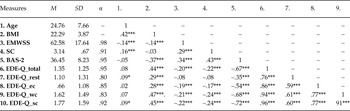
Cronbach’s alphas of these measures for the present study are reported in Table 1.
Means (M), standard deviations (SD), Cronbach alphas and Intercorrelation scores on self-report measures (N = 490)

Note: BMI = Body Mass Index; EMWSS = Early Memories of Warmth and Safeness Scale; SC = Self-Compassion dimension of SCS; BAS-2 = Body Appreciation Scale; EDE-Q_total= Global score of Eating Disorder Examination Questionnaire; EDE-Q_rest = Restraint subscale of EDE-Q; EDE-Q_ec = Eating concern subscale of EDE-Q; EDE-Q_wc = Weight concern subscale of EDE-Q; EDE-Q_sc = Shape concern subscale of EDE-Q; ***p < .001.
Procedures
The present study is part of a wider Portuguese project about the impact of different emotional regulation processes in psychological functioning and mental health. The sample was collected through online advertisements on social networks and all ethical requirements inherent to scientific research were respected. All participants were fully informed about the purpose and objectives of the study, the voluntary nature of their participation and the confidentiality of the data. Participants provided their written informed consent, before the completion of the battery of self-report questionnaires.
Initially self-report measures were completed by 514 participants of both genders (494 women and 20 men), with ages ranging from 17 to 57 years old. However, according to the purposes of this study, data was cleaned in order to exclude (i) male participants, and (ii) female participants who were younger than 18 years old and older than 54 years old.
Data analyses
Data analyses were executed using the software IBM SPSS Statistics 22.0 (SPSS IBM; Chicago, IL) and path analyses with the software AMOS.
Descriptive statistics (means and standard deviations) were performed in order to examine the characteristics of the final sample. Furthermore, product-moment Pearson correlations analyses were used to explore the associations between BMI, age, early memories of warmth and safeness (EMWSS), self-compassion (SC), body appreciation (BAS-2) and eating psychopathology (EDE-Q). The magnitudes of these relationships were discussed taking into account Cohen’s guidelines, in which correlations ranging between .1 and .3 are considered weak, moderate above .3, and strong when equal to or superior than .5, while considering a significance level of .05 (Cohen, Cohen, West, & Aiken, Reference Cohen, Cohen, West and Aiken2003).
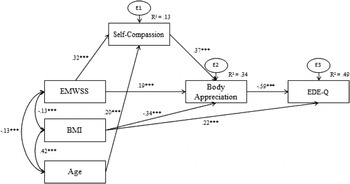
Finally, path analyses were conducted to estimate the presumed relations within the proposed model (Figure 1), specifically the mediator effects of self-compassion (SC) and body appreciation (BAS-2), in the relationship between early memories of warmth and safeness (EMWSS) and the engagement in disordered eating attitudes and behaviors (EDE-Q). Therefore, early memories of warmth and safeness was considered as an exogenous variable, self-compassion and body appreciation were hypothesized as endogenous mediator variables, and eating psychopathology as an endogenous variable (Kline, Reference Kline2005). The variables BMI and age were included in the path analysis model in order to control its effect. The Maximum Likelihood estimation method was used to test regression coefficients and to compute fit statistics. Additionally, a series of goodness-of-fit indices were selected to examine the adequacy of the overall model: the Normed Chi-square (CMIN/DF) which indicates a good fit when values are equal or below 3 (Kline, Reference Kline2005); the Tucker Lewis Index (TLI) and the Comparative Fit Index (CFI), which both indicate the presence of an adequate model of which when within the range of .90 to .95, and a very good fit with values above .95 (Brown, Reference Brown2006). Additionally, the Root-Mean Square Error of Approximation (RMSEA) was examined, while considering that values between .05 and .08 indicate a good fit, and that when values bellow .05 indicate that a model presents a very good fit (p ≤ .05; Arbuckle, Reference Arbuckle2008). The significance of direct, indirect and total effects was assessed by Chi-square tests, and the significance of mediational paths was further examined through the Bootstrap resampling method, with 5000 Bootstrap samples and 95% bias-corrected confidence intervals (CI). A significant mediation effect is denoted when zero is not included in the interval between the lower and the upper limits of the CI (Kline, Reference Kline2005). Effects with p < .050 were considered statistically significant.
Final path model.
Note: ***p < .001; EMWSS = Early Memories of Warmth and Safeness Scale; BMI = Body Mass Index; EDE-Q = Eating Disorder Examination Questionnaire.

Results
Preliminary data analyses
The suitability of the current data for correlation analyses was examined. The analyses of Skewness and Kurtosis values seemed to confirm the assumption of normality of the distribution of the variables in study (Kline, Reference Kline2005).
Preliminary analyses indicated that data followed the assumptions of homoscedasticity, normality, linearity, independence of errors, and multicollinearity and singularity among the variables (Field, Reference Field2004).
Descriptive and correlation analyses
The descriptive statistics for the study variables are presented on Table 1.
Correlations analysis’ results showed that early memories of warmth and safeness were positively associated to self-compassion and body appreciation, with weak and moderate magnitudes, respectively. Furthermore, a negative and weak association was found between early memories of warmth and safeness and EDE-Q. Results, also, indicated that self-compassion and body appreciation were positively associated with each other, and negatively correlated with EDE-Q.
Moreover, results showed that age revealed non-significant associations with body appreciation and with EDE-Q. Nonetheless, age presented positive correlations with BMI and self-compassion (SC), with moderate and weak magnitudes respectively. In contrast, a negative and weak relationship between age and early memories of warmth and safeness (EMWSS) was found. Finally, BMI presented negative associations with early memories of warmth and safeness and body appreciation, and a positive link to EDE-Q, with a moderate magnitude.
Path analysis
The main goal of path analysis was to test whether the effects of early memories of warmth and safeness on eating psychopathology severity are carried through the mechanisms of self-compassion and body appreciation, while controlling the effects of BMI and age.
The path model was initially tested through a fully saturated model (i.e., with zero degrees of freedom), consisting of 27 parameters. However, analyses suggested the pertinence of the progressive removal of the following nonsignificant paths: the direct effect of early memories of warmth and safeness with family figures on EDE-Q (bEMWSS = .001; SE b = .002; Z = .599; p =.549) and the direct effect of BMI on self-compassion (bBMI= –0.16; SE b = .008; Z = –1.947; p = .052). These paths were eliminated and the model was readjusted (Figure 1). The final model revealed that all path coefficients were statistically significant (p < .050), and presented an excellent model fit [χ2 (5) = 13.012, p = .023, CMIN/DF = 2.602; TLI = .967; CFI = .989; RMSEA = .057, p = .323; 95% CI = .019 to .096].
More specifically, early memories of warmth and safeness had a direct effect of .32 (bEMWSS = .012; SEb = .002; Z = 7.459; p < .001) on self-compassion and of .19 (bEMWSS = .089; SEb = .018; Z = 4.981; p < .001) on body appreciation. It was also verified that self-compassion directly predicted body appreciation (β = .37; bSC = 4.528; SEb = .468; Z = 9.683; p < .001). Finally, body appreciation presented a direct effect of –.59 (bBAS-2 = –.090; SEb = .005; Z = –17.119; p < .001) on EDE-Q.
The analysis of indirect effects showed that early memories of warmth and safeness presented an indirect effect on EDE-Q, of –.18 (95% CI = –.243 to –.128), which was totally carried by the effects of self-compassion and body appreciation. Also, results revealed that early positive memories with family figures had an indirect effect of .12 (95% CI = .076 to .164) on body appreciation, which was partially mediated by self-compassion. In turn, self-compassion revealed an indirect effect of –.22 (95% CI = –.275 to –.168) on EDE-Q, which was totally explained by the effects of body appreciation.
Overall, the model accounted for 13% of self-compassion, 34% of body appreciation, and 49% of EDE-Q’ variance, respectively. Furthermore, results revealed that the impact of early affiliative memories on disordered eating attitudes and behaviors is partially mediated by the effects of self-compassion and body appreciation. The tested model, with the standardized path coefficients and R 2 values, is presented in Figure 1.
Discussion
Literature has emphasized the association between early memories of warmth and safeness and adaptive emotional regulation processes and mental health (Richter et al., Reference Richter, Gilbert and McEwan2009). Also, several accounts have documented the crucial role of self-compassion against psychopathology (Neff, Reference Neff, Leary and Hoyle2009; Raes, Reference Raes2011), namely on body and eating-related psychopathology (Daye et al., Reference Daye, Webb and Jafari2014; Ferreira et al., Reference Ferreira, Matos, Duarte and Pinto-Gouveia2014; Homan & Tylka, Reference Homan and Tylka2015). Recently, Homan and Tylka (Reference Homan and Tylka2015) highlighted self-compassion as a possible enhancer of body appreciation, by revealing its buffering effect on the negative effect of body image-related threats on body appreciation. Furthermore, empirical evidence has demonstrated that body appreciation is inversely associated with maladaptive eating, and positively linked to adaptive eating behaviors (Tylka & Wood-Barcalow, Reference Tylka and Wood-Barcalow2015).
However, to the extent of our knowledge, this is the first study that examined the relationship between early positive memories, compassionate attitudes towards the self and one´s body image, and disordered eating. More specifically, the current study presents an integrative model that explored the effect of early memories of warmth and safeness on eating psychopathology’s severity, and the mediator role of self-compassion and body appreciation in this link.
According with the proposed hypotheses and with prior research (Richter et al., Reference Richter, Gilbert and McEwan2009), results of the correlation analysis demonstrated that early positive experiences were positively associated with adaptive emotion regulation processes (such as self-compassion towards the self), and negatively correlated with eating psychopathology’s severity. These results are in line with theoretical and empirical evidences since they reveal that early positive emotional memories play a key role on the promotion of psychological adjustment (e.g., Gilbert & Irons, Reference Gilbert, Irons and Allen2009). Also, the present study adds to literature by revealing that these supportive early emotional experiences are positively linked with a compassionate attitude towards one’s own body, regardless of its characteristics, and negatively associated with disordered eating behaviours and attitudes.
Path analysis’s findings showed that the tested model revealed an excellent fit to the empirical data, accounting 49% of the variance of eating psychopathology severity. Also, this model demonstrated that 13% of self-compassion’s variance was explained by positive early emotional experiences. Furthermore, results suggested that early positive memories had a positive direct effect on body appreciation, and an indirect effect, mediated by increased self-compassion, explaining 34% of the variance of body appreciation. Additionally, results revealed that positive rearing experiences explained lower levels of disordered eating via higher levels of self-compassion and body appreciation, while controlling the effects of age and BMI. These findings seem to suggest that the relationship between early warmth and safeness memories and eating psychopathology’s severity is complex, and influenced by different mechanisms. Indeed, path analysis’ results indicated that, when controlling the effect of age and BMI, the impact of the evocation of positive early emotional memories on disordered eating is fully mediated by self-compassionate attitudes, and caring relationship with one’s body.
Our results seem to support the conclusion that early positive experiences may promote an internal relationship based on an attitude of kindness, accepting and understanding. In turn, these positive emotional experiences and current self-compassionate attitudes seem be linked to a more adaptive and positive relation with one´s own body, regardless of its characteristics, which may explain a lower tendency to adopt disordered eating attitudes and behaviors.
These novel findings cannot be considered without taking into account some limitations. Its cross-sectional design does not permit to infer conclusions regarding causality. Thus, upcoming studies should test the relationships between the study’s variables in longitudinal or experimental design studies. Furthermore, our data may be constrained by limitations associated to the use self-report measures. However, some studies have shown that memories of early parenting are generally accurate, reliable, and stable over time, even in the face of considerable changes in mood and emotional states (Brewin et al., Reference Brewin, Andrews and Gotlib1993; Cunha et al., Reference Cunha, Xavier, Martinho and Matos2014). Nevertheless, future studies should seek to replicate the present findings using other assessment methodologies, such as face-to-face interviews or observational instruments. Additionally, given that the sample of this study only comprised female participants, the generalization of results should be avoided. Although eating psychopathology is more prevalent in women, men also experience weight and body image-related difficulties and this study sample does not allow the generalization of obtained results. Therefore, upcoming research should investigate this model in male samples and explore gender differences. Besides, the use of a nonclinical sample impairs the generalization of the findings to clinical populations. Thus, in the future, studies should also investigate these in clinical samples. Finally, although the aim of the present study was to specifically address the mediator role of self-compassion and body appreciation, the complex nature of disordered eating presupposes the existence of different relevant variables in the association between emotional experiences of warmth and safeness and eating psychopathology’s severity. In this line, future research should then expand on this model by testing different emotion regulation processes.
In conclusion, our findings seem to support that women who present more early positive emotional experiences tend to cultivate a more kind and understanding relationship towards the self and one´s own body, which seem to decrease the women engagement in disordered eating behaviors. In this line, our results seem to indicate that the impact of these early positive emotional experiences on eating disordered attitudes and behaviors may be highly dependent to the existence of the ability to develop self-compassionate attitudes.
The present study appears to offer a significant contribution to literature and clinical practice, by providing preliminary evidence for the relevance of targeting self-compassionate abilities within intervention programs for body image and eating-related difficulties.