Introduction
Separation anxiety (SEPAD) was for a long time considered a childhood disorder. However, in the last 2 decades, several authors have reported high prevalence estimates of SEPAD among adult outpatients.Reference Manicavasagar, Silove and Curtis 1 – Reference Manicavasagar, Marnane and Pini 5 Recently, the newly published Diagnostic and Statistical Manual of Mental Disorders, Fifth Edition (DSM-5) 6 has removed the age restriction on the diagnosis of SEPAD and has reassigned the category to the general section of anxiety disorders, effectively making the disorder one that spans the entire life course.
As described in DSM-5, individuals with SEPAD experience excessive distress when separation from home or major attachment figures is anticipated or occurs; they worry about the well-being or potential death of attachment figures, particularly when separated from them; and they are preoccupied with knowing the whereabouts of their attachment figures, and feel compelled to remain in touch with them.
Recent epidemiological data from the National Comorbidity Survey (NCS-R) have indicated that SEPAD has a lifetime prevalence (as reported by adults) in the general population of 6.6%.Reference Shear, Jin and Ruscio 7 However, clinical samples have varied, with prevalence estimates ranging from 23% to 65% depending on the nature of the sample and the threshold for diagnosing the disorder.Reference Manicavasagar, Silove and Curtis 8 , Reference Manicavasagar, Silove and Marnane 9 Both epidemiological and clinical data indicate that SEPAD is highly comorbid with other mental disorders, and is associated with significant functional impairment.
Although evidence is not conclusive, a specific association between SEPAD and panic disorder (PD) has been hypothesized in different clinical studies.Reference Pini, Abelli and Shear 10 – Reference Kossowsky, Pfaltz and Schneider 12 Moreover, some investigations have identified a relationship between bipolar disorder (BD), PD, and SEPAD. Pini et al Reference Pini, Abelli and Mauri 13 found that both juvenile and adult SEPAD are significantly more prevalent in patients with BD I and PD than in those with major depressive disorder (MDD). Moreover, Toni et al Reference Toni, Perugi and Frare 14 showed that juvenile SEPAD is reported more frequently among patients with both PD and BD II than among those with PD alone.
Data are scant concerning the relationship between SEPAD and mood spectrum symptoms. In a recent study, a strong correlation between SEPAD symptoms and lifetime mood symptoms of both polarities was found among patients with complicated grief and healthy control subjects.Reference Dell'Osso, Carmassi and Musetti 3 Earlier data by Silove et al Reference Silove, Marnane and Wagner 11 showed that in comparison to non-SEPAD anxiety patients, those with SEPAD have higher levels of depression without showing higher comorbidity with a full diagnosis of MDD. We recently investigated SEPAD in a large cohort of patients with mood and anxiety disorders.Reference Pini, Abelli and Shear 10 In keeping with the findings of Silove et al, we showed that SEPAD is associated with greater depressive symptoms but not with a full diagnosis of MDD.
The aim of the present article is to investigate the prevalence and correlates of SEPAD among patients with PD and to assess further whether there is a distinctive pattern of comorbidity in which SEPAD is associated primarily with mood spectrum symptoms rather than full diagnoses of BD or MDD.
Methods
Sample
Subjects were recruited between January 2007 and February 2008 in the adult psychiatric outpatient clinic of the University Department of Psychiatry of Pisa, a tertiary care academic center that specializes in the treatment of mood and anxiety disorders. The sample included 235 consecutive adult psychiatric outpatients with a Diagnostic and Statistical Manual of Mental Disorders, Fourth Edition, Text Revision (DSM-IV TR) 15 diagnosis of PD. To prevent a patient’s current mood state from influencing retrospective reports of lifetime mood symptoms, subjects with current major depressive or manic/hypomanic episodes were excluded. In addition, patients with a past or current diagnosis of psychotic disorders or substance use disorder were excluded from the study sample. All subjects were assessed with the Structured Clinical Interview for DSM-IV Axis I Disorders (SCID-I)Reference Cyranowski, Shear and Rucci 16 to establish the diagnosis of PD and other Axis I disorders. In relation to lifetime Axis I comorbidity, 180 subjects (76.6%) of the whole sample recorded a history of mood disorder (78 MDD, 27 BD I, and 75 BD II); 157 subjects (66.8%) reported another anxiety disorders (39 obsessive-compulsive disorder, 39 social phobia, and 79 simple phobia); and 123 subjects (52.3%) had both a mood disorder and an anxiety disorder other than PD.
The study was carried out in accordance with the Declaration of Helsinki, and the study design was reviewed by the University of Pisa Ethical Committee. All subjects were informed of the nature of study procedures and provided written informed consent prior to participation. Interviews were performed by experienced residents in psychiatry.
Assessment of panic disorder and separation anxiety disorder
Participants were evaluated with the PDSS to assess the severity of PD symptoms. The presence of SEPAD was evaluated with the Structured Clinical Interview for Separation Anxiety Symptoms (SCI-SAS).Reference Cassano, Dell’Osso and Frank 17 This semistructured interview evaluates each of the 8 DSM-IV criteria symptoms of separation anxiety, separately for Childhood (SCI-SAS-C) and Adult (SCI-SAS-A) symptoms. Each question was scored as 0 (not at all), 1 (sometimes), 2 (often), or? (do not recall). Endorsement of 3 or more of the 8 criterion symptoms [symptoms rated as 2 (often)] was used as a threshold to determine categorical (yes/no) diagnosis of SEPAD. In addition, in keeping with DSM-IV guidelines, diagnostic assignment of SEPAD required endorsement of criterion B (duration of at least 4 weeks), C (the disturbance causes clinically significant distress or impairment in social, academic and occupational, or other important areas of functioning), and D (the disturbance is not better explained by another mental disorder).
Assessment of mood spectrum symptoms
Mood spectrum symptoms were assessed with the Mood Spectrum Self-Report Instrument (MOODS-SR) lifetime version,Reference First, Spitzer and Gibbon 18 , Reference Dell'Osso, Armani and Rucci 19 which was developed and validated by an international collaborative group of researchers (Spectrum Project). MOODS-SR assesses lifetime mood spectrum symptoms, including prodromic, residual, atypical, and subclinical characteristics.Reference Dell'Osso, Armani and Rucci 19 , Reference Frank, Cassano and Shear 20 MOODS-SR provides a rating for major affective symptoms, but also identifies and rates atypical and mild symptomatic manifestations as expressions of subclinical conditions. It includes 161 items organized into 3 manic/hypomanic and 3 depressive domains (exploring, in each case, the areas of mood, energy, and cognition). A further domain explores disturbances in rhythmicity (eg, changes in mood, energy, and physical well-being according to the weather, the season, and the phase of menstrual cycle) and vegetative functions (including sleep, appetite, and sexual behavior). The sum of the scores on the 3 manic domains (mood, energy, cognition) constitutes the “manic component” (62 items), and that of the 3 depressive domains constitutes the “depressive component” (63 items).
Statistical analyses
The mean values (±SD) of continuous variables were compared between subject groups using t-tests. Comparisons of categorical variables between groups were conducted using the χ2 test. Covariance analysis was used to compare PDSS and MOODS-SR scores between subjects with and without SEPAD. All tests were 2-tailed and set at a p value <0.05. Analyses were conducted using SPSS, version 16.0. 21
Results
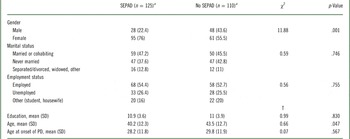
Of the total sample of 235 patients with PD, 125 (53.2%) were categorized as having SEPAD and 110 (46.8%) as not. Table 1 displays the demographic characteristics of the 2 groups.
Demographic characteristics of study patients with PD with or without SEPAD

a Data are reported as no. (%) unless otherwise indicated.
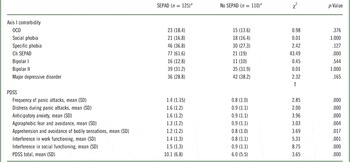
SEPAD patients were more likely to be female (p=.001) and younger (p=.047) than patients without SEPAD. Subjects with or without SEPAD did not differ with respect to marital status, years of education, employment status, or age of onset of PD. Patients with SEPAD reported higher single-item scores and total scores on the PDSS scale with respect to patients without SEPAD, controlling for age and gender (Table 2).
Axis I comorbidity, PDSS scores, and MOODS-SR scores of patients with PD with or without SEPAD

a Data are reported as no. (%) unless otherwise indicated.
Abbreviations: OCD, obsessive compulsive disorder; Ch SEPAD, childhood separation anxiety disorder; PDSS, Panic Disorder Severity Scale; MOODS-SR, Mood Spectrum Self-Report Instrument lifetime version.
Subjects with SEPAD did not differ from those without the disorder with respect to lifetime prevalence of obsessive compulsive disorder (OCD), social phobia, simple phobia, or mood disorders (BD I and II or MDD). However, patients with adult SEPAD were more likely to report a history of childhood SEPAD (p<.001).
A multivariate analysis of covariance (MANCOVA) was conducted to determine significant mean differences in MOODS-SR scores (total, depressive component, and manic component score) between subjects with and without SEPAD, including age, gender, PDSS total score, and the diagnosis of BD and MD as covariates.
As shown in Table 3, SEPAD subjects showed higher MOODS-SR total (p=.005) and manic component (p=.002) scores than PD subjects without SEPAD. No significant differences were found with respect to MOODS-SR depressive component score (p=.066).
Comparison of MOODS-SR scores between PD subjects with or without SEPAD

p-Value of covariance analysis for data.
Abbreviation: MOODS-SR, Mood Spectrum Self-Report Instrument lifetime version.
Discussion
The finding of a 53.2% prevalence of SEPAD among clinic patients with PD is consistent with previous clinical data. Manicavasagar et al Reference Manicavasagar, Silove and Marnane 9 reported a very high prevalence of SEPAD (65%) among patients with PD. The same research group found a prevalence estimate of 46% in a sample of patients with PD/agoraphobia or generalized anxiety disorderReference Manicavasagar, Silove and Curtis 8 and a prevalence of 23% among subjects with mixed anxiety disorders.Reference Silove, Marnane and Wagner 11 Taken together, the available data suggest that SEPAD is highly comorbid with PD and to a lesser extent with other anxiety disorders, at least in clinical samples. In addition, our study shows that patients with SEPAD have greater severity of PD symptoms than patients without SEPAD.
Previous data by our research group found quite a high prevalence of SEPAD (42.3%) among subjects with anxiety and/or mood disorders,Reference Pini, Abelli and Shear 10 which might suggest, in keeping with epidemiological data,Reference Shear, Jin and Ruscio 7 that SEPAD is strongly comorbid with mood disorders as well.
Among the few studies that have investigated the relationship between SEPAD and mood disorders, some have suggested a specific link between SEPAD and bipolar disorders. In particular, a previous investigation by our research group showed higher SEPAD symptoms in patients with both BD I and PD than in those with PD or MDD alone.Reference Pini, Abelli and Mauri 13 In addition, Toni et al Reference Toni, Perugi and Frare 14 showed that juvenile SEPAD is more frequent among patients with comorbid BD II and PD than in those with PD alone.
Our present data show that SEPAD is not associated with higher rates of lifetime mood disorders. Nevertheless, patients with both PD and SEPAD show higher levels of lifetime mood spectrum symptoms compared to PD patients without SEPAD. Specifically, SEPAD subjects show higher total and manic/hypomanic component scores on the MOODS-SR than patients without SEPAD, even taking into account the effect of age, gender, the presence of lifetime comorbidity with frank BD and MD, and the severity of PD symptoms.
These findings are in line with previous data from the literature showing a strong correlation between SEPAD symptoms and lifetime mood symptoms of both polarities among patients with complicated grief.Reference Dell'Osso, Carmassi and Musetti 3 The findings also are consistent with 2 previous studies which indicated that subjects with SEPAD do not report higher rates of lifetime mood diagnoses than subjects without SEPAD.Reference Pini, Abelli and Shear 10 , Reference Silove, Marnane and Wagner 11 However in the latter studies, the presence of SEPAD was associated with greater depressive symptoms, whereas in the present study, that association did not reach significance.
It is possible that PD patients who also show features of SEPAD are more vulnerable to experiencing mood symptoms. The important distinction may be that in spite of not reporting a higher rate of lifetime frank mood diagnoses, SEPAD is correlated to greater lifetime mood spectrum symptoms, particularly of the manic/hypomanic polarity.
Since a great proportion of subjects in our sample had a concomitant mood diagnosis, we could hypothesize that SEPAD is associated with greater severity of comorbid mood disorders. However, given the fact that some subjects did not show any comorbid mood disorder, our data might be also consistent with previous postulates that constellations of early phobic anxiety, including SEPAD, could be linked to subthreshold bipolar spectrum features such as mood lability and cyclothymic temperamental disposition.Reference Perugi and Akiskal 22 A further possibility is that SEPAD is a marker for PD severity. This hypothesis is consistent with the greater severity of PD that we found in the SEPAD group. That finding, together with the higher scores reported by SEPAD subjects on the MOODS-SR, might be interpreted as indicating that these patients experience a greater level of emotional lability of a generic type as a lifelong tendency, including a tendency to more severe panic and mood symptoms. However, our results also show that SEPAD subjects score higher on the MOODS-SR, even controlling for PD symptoms severity (as evaluated with the PDSS), suggesting a specific vulnerability to affective spectrum symptoms. Further studies that take into account other possible confounding factors (including, for example, the presence of agoraphobia) will help to disentangle the pattern of vulnerability to panic and anxiety as opposed to mood spectrum symptoms among patients with comorbid PD and SEPAD.
Interestingly, SEPAD has been shown to predict poor response to both psychological and psychopharmacological treatment for PD.Reference Miniati, Calugi and Rucci 23 , Reference Aaronson, Shear and Goetz 24 In light of our findings, future investigations could profit from exploring whether this differential treatment response could be at least partly due to the presence of greater mood spectrum symptoms in persons with SEPAD.
The limitations of this study need to be acknowledged. First, exclusion of subjects with current mood episodes meant that the sample represented a selective subpopulation of consecutive clinic attenders. However, this strategy was applied to prevent the well-known bias of current mood state influencing retrospective reports of lifetime mood symptoms. Second, the sample represents a population of patients with PD who were referred to a tertiary care center. We do not know if these results can be generalized to those adults treated in primary or secondary care services or to untreated subjects. Third, the study was conducted before DSM-5 was published. In keeping with DSM-IV childhood criteria, 15 a duration of 4 weeks was required to make a diagnosis of adult SEPAD, as opposed to 6 months, a change that was introduced by DSM-5. This could have led to a SEPAD “overdiagnosis” in our sample if considered according to DSM-5 criteria. 6 Nevertheless, DSM-5 specifies that “the duration criterion for adults should be used as a general guide, with allowance for some degree of flexibility.” In addition, in our study, any acute life crisis that might have caused transient separation anxiety was ruled out, allowing the diagnosis of SEPAD only for primary, persistent symptoms. Further, the lack of measures of temperamental characteristics and Axis II disorders did not allow us to investigate whether associations between SEPAD and mood spectrum symptoms might be mediated by underlying characterological disturbances. Last, although we found some important associations between SEPAD and mood symptoms, we could not determine the direction of causality. Further longitudinal studies are necessary to elucidate this relationship.
Despite these limitations, our results suggest that, in a clinic sample where those with current comorbidity with frank mood disorders are removed, subjects with both PD and SEPAD have a distinctive profile, which is characterized by greater lifetime mood spectrum symptoms, greater severity of panic symptoms, and history of early SEPAD compared with subjects with PD alone or PD with other comorbidities. This profile of comorbid SEPAD and PD may explain to some degree the high levels of functional impairment and resistance to conventional treatments found among these patients.
Conclusion
SEPAD is highly comorbid with PD. Compared to patients with PD only, patients with both PD and SEPAD show greater severity of PD, history of childhood SEPAD, and higher levels of lifetime mood symptoms, particularly of the manic/hypomanic polarity. Our data corroborate a strong relationship between mood disorders and SEPAD. However, further studies are warranted to investigate in more detail the possible mediating factors in this relationship.
Disclosures
The authors do not have an affiliation with or financial interest in any organization that might pose a conflict of interest.