Introduction
The control of pest insects through joint use of synthetic insecticides and natural enemies (integrated pest management (IPM) schemes) is impossible and/or impractical in most agroecosystems (e.g. Tabashink & Johnson, Reference Tabashink and Johnson1999; Torres, Reference Torres2012). However, by exploiting the general ability of insect populations to evolve resistance to insecticides, insect natural enemies might survive applications of certain insecticide at rates capable of killing the target insect pest. Such resistance has been detected in populations of predatory mites, hymenopteran parasitoids, chrysopids (Neuroptera) and predatory ladybird beetles (Head et al., Reference Head, Neel, Sartor and Chambers1977; Croft, Reference Croft1990; Kumral et al., Reference Kumral, Gencer, Susurluk and Yalcin2011; Whalon et al., Reference Whalon, Mota–Sanchez, Hollingworth and Duynslager2011; Rodrigues, Reference Rodrigues2012).
Resistance can take many forms because, in addition to being toxic to the target insect pest, insecticides can have other effects on natural enemies of one form and another. For example, in the case of insect natural control agents, such animals can survive insecticide applications by metabolic detoxification, as well as by behavioural mechanisms including repellency and irritability that reduce their exposure to the poisons (Gould, Reference Gould1984; Hoy et al., Reference Hoy, Head and Hall1998; Jallow & Hoy, Reference Jallow and Hoy2005). Repellency is generally associated with sensory perceptions that allow an insect to recognize and to avoid insecticide-treated areas, whereas irritability is associated with the insect's neurotoxic response to direct exposure to the insecticide (Haynes, Reference Haynes1988; Soderlund & Bloomquist, Reference Soderlund and Bloomquist1989). Nevertheless, the associated behaviours differ primarily as to whether they appear before or after insecticide contact, and thus irritability could be considered as repellency in a broader sense (Georghiou, Reference Georghiou1972).
An insecticide of particular concern is the synthetic pyrethroid lambda-cyhalothrin (LCT), a product largely recommended for use to control Lepidopteran and Coleopteran pests in several crops, including cotton, and with field application rates ranging from 5 to 20 g a.i. ha−1 to control cotton pests such as staining bugs, cotton leafworms, bollworms, pink bollworms, and specifically in terms of the present study, the boll weevil, Anthonomus grandis Boheman (Coleoptera: Curculionidae) (MAPA, 2012). Sprayed on the plant canopy, LCT may well also reach non-target insect pests such as insect predators and parasitoids. Several studies have demonstrated that this compound has low selectivity to insect natural enemies, often causing lethal and sublethal effects (Tillman & Mulrooney, Reference Tillman and Mulrooney2000; Torres et al., Reference Torres, Silva-Torres, Silva and Ferreira2002; Wang et al., Reference Wang, Shen, Xu and Lu2003; Liu & Stansly, Reference Liu and Stansly2004; Rocha et al., Reference Rocha, Carvalho, Moura, Moscardini, Rezende and Santos2010). In addition, since LCT is a pyrethroid, it is known that this class of insecticides have repellent properties to phytophagous and predatory mites (Penman & Chapman, Reference Penman and Chapman1983; Riedl & Hoying, Reference Riedl and Hoying1983), Coleoptera (Moore, Reference Moore1980; Riedl & Hoying, Reference Riedl and Hoying1983), Lepidoptera (Ruscoe, Reference Ruscoe1977; Gist & Pless, Reference Gist and Pless1985) and irritability effects to various arthropods (Soderlund & Bloomquist, Reference Soderlund and Bloomquist1989; Alzogaray et al., Reference Alzogaray, Fontán and Zerba2005).
A natural enemy of particular interest is the ladybird beetle, Eriopis connexa (Germar) (Coleoptera: Coccinellidae). Globally, it plays an important role in the natural control of aphids and mites, characterized by its polyphagy, voracity and natural occurrence in various crops of economic importance, including cotton (Torres et al., Reference Torres, Schetino and Pratissoli2009).
The potential of E. connexa as an aphid predator resulted in its introduction into the USA in order to control the Russian wheat aphid, Diuraphis noxia (Mordvilko) (Reed & Pike, Reference Reed and Pike1991). In contrast one of the most important obstacles to increased use of predatory ladybird beetles as biological control agents is the constant need for insecticide sprays to control many pests that are not controlled by the ladybird beetles themselves, such as several lepidopteran pest species, and especially the boll weevil in cotton. Worldwide, the latter is the most important cotton pest where it occurs, and alone it is responsible for about 50% of all insecticide sprays used during the cropping season in Brazil (Richetti et al., Reference Richetti, Melo Filho, Lamas, Staut and Fabrício2004; Haney et al., Reference Haney, Lewis and Lambert2009). Such an elevated number of sprays can directly compromise the survival of predatory ladybird beetles in cotton fields and could also result in secondary pest resurgence, especially of aphids (Kidd & Rummel, Reference Kidd and Rummel1997; Longley, Reference Longley1999), including escalating aphid numbers in LCT treated areas (Hardin et al., Reference Hardin, Benrey, Coll, Lamp, Roderick and Barbosa1995; Deguine et al., Reference Deguine, Gozé and Leclant2000; Obrycki et al., Reference Obrycki, Harwood, Kring and O'neil2009), as well as having indirect effects on E. connexa through changes in its behaviour.
Recently, studies have found and characterized resistance to LCT in some populations of E. connexa (Rodrigues, Reference Rodrigues2012), and have documented the occurrence of a fitness cost along with the predatory potential of resistant beetles after exposure to this insecticide (Ferreira et al., Reference Ferreira, Rodrigues, Silva-Torres and Torres2012). This is of considerable interest because the presence of LCT resistant predatory ladybirds in cotton fields might allow growers to maintain the beetles for aphid control, while at the same time maintaining insecticide action against other target pests such as boll weevils. In order to build on these discoveries, it is important to obtain information about possible direct and indirect effects of LCT on E. connexa adult survival and behaviour, respectively.
Since natural enemies could be exposed to insecticides, both during spraying and afterwards through residual effects on the plant (Croft, Reference Croft1990), two hypotheses were tested, namely that: (i) insecticide resistance allows the survival of E. connexa adults after LCT sprays on cotton plants at concentrations that effectively control the target pest, the boll weevil, A. grandis; and (ii) the resistance of E. connexa adults to LCT includes behavioural responses that favour their survival after insecticide exposure. To investigate these possibilities, we evaluated the effects of LCT on the survival of two populations of E. connexa (resistant, Res, and susceptible, Sus, to the insecticide) in comparison with that of the boll weevil pest population. By using a computer behaviour tracking system, we also studied the behavioural patterns, particularly repellency and irritability, of these two E. connexa populations when exposed to the insecticide.
Materials and methods
Experiments were performed at the Laboratory of Biological Control and Insect Ecology of the Universidade Federal Rural de Pernambuco (UFRPE), Recife-PE, Brazil, behavioural in the Laboratory of Insect Behaviour of the same institute.
Collection and rearing of the boll weevil
Cotton squares and bolls showing some signs of insect attack (feeding and oviposition) were collected from a conventional cotton field located in Frei Miguelinho County, Pernambuco State (07°55′90.1″S and 35°51′45.6″W). The collected material was placed in plastic trays and kept in Plexiglas cages (45 cm wide×45 cm length×30 cm height) in the laboratory at 25±1.5 °C and 12 h daylight until adult emergence. After emergence, adults were transferred to plastic containers (500 ml) and fed cotton flower buds and cotyledon leaves until the start of experiments.
Collection and rearing of E. connexa populations
One population of E. connexa was collected in the same cotton field location as the boll weevil population. Initially, this E. connexa population was reared in the laboratory, and its response to the commercial insecticide Karate Zeon 50 CS (LCT 5% w/v – 50 g l−1, Syngenta) determined. Individuals of the F2 generation exhibited LD50=0.038 g of a.i. l−1. These were designated as the susceptible reference population (Sus).
The second E. connexa population was collected in a conventional cabbage field in Viçosa County, Minas Gerais State (20°45′S and 42°51′W). This population exhibited LD50=1.45 g a.i. l−1 as determined through the dose–mortality curve in F1 generation. Therefore, these two populations showed an initial resistance ratio of 38.1 times (ratio between the LD50s). This second E. connexa population was kept under constant selection with increasing doses of the commercial insecticide, Karate Zeon 50 CS. By F9 generation, its LD50 was 2.16 g a.i. l−1. This group was designated as the resistant population (Res).
Colonies of the two ladybird populations were kept separated in the laboratory, at a temperature of 25 °C and 12 h light phase. Eggs of Anagasta kuehniella (Zeller) (Lepidoptera: Pyralidae), obtained as described in Torres et al. (Reference Torres, Freitas and Pratissoli1995), were provided as food, with ladybird rearing procedures conducted according to Rodrigues (Reference Rodrigues2012).
Survival of E. connexa and boll weevil to LCT
Cotton plants (cv. BRS Rubi) were grown in microplots (1 m diameter) up to ∼70 days old, whereupon they were sprayed with two different concentrations of LCT, 15 and 75 g a.i. ha−1, corresponding to the lower recommended field rate to control boll weevils and five times that field rate, respectively (MAPA, 2012). The LCT used corresponded to the commercial product Karate Zeon 50 CS (5% w/v – 50 g l−1 SC (soluble concentrated); Syngenta, Brazil). The plants of the control group were sprayed only with water. Insecticide applications were made by using a coastal-manual sprayer Jacto PJH 20L (Jacto, Pompéia, SP) with a hollow cone nozzle obtaining complete plant coverage.
Two hours after insecticide application, a food diet for the adult ladybirds, comprising honey and yeast (50:50%), was applied on the top four leaves of the cotton plants. Next, the upper plant stratum (5–6 nodes) was enclosed within a sleeve cage made of voile fabric (60 cm length×40 cm width). The lower end of each cage was fastened by a string around the plant's main stem, while the upper end was closed with a zipper. This allowed access to the plant top for insect release and later evaluation.
Adult males and females, 8–10 days old, of the boll weevil and of E. connexa Sus and Res populations were introduced separately into each caged plant top. These three insect groups represented the treatments in a 3×3 randomized design that encompassed three LCT concentrations (0, 15 and 75 g a.i. ha−1). The experiment was set up with different numbers of individuals owing to the different numbers of insects available (180 E. connexa Sus, 138 R, and 281 boll weevils). These insect numbers allowed for 3, 4 and 5 replications for E. connexa Sus; 4, 4 and 4 replications for Res; and 4, 5 and 5 replications for boll weevil, for the 0, 15 and 75 g a.i. ha−1 concentrations, respectively.
A day after the insects had been released onto plants, the cages were collected and brought to the laboratory to evaluate insect survival by counting the number of dead and alive in each cage. The data for percentage survival of ladybirds and boll weevils were tested by Kolmogorov–Smirnov and Bartlett tests for normality and homogeneity, respectively, (with subsequent arcsine transformation of square roots (x/100) after correction for natural mortality observed in the controls (Abbott, Reference Abbott1925). These data were submitted to analysis of variance through the PROC GLM of SAS (SAS Institute, 2001).
Behavioural response of E. connexa to LCT treated plants
The behavioural responses of ladybird beetles in relation to their position on treated plants were studied using cotton plants cultivated in 5 L-plastic pots and with four to five expanded leaves. The plants used were infested with cotton aphids. Infestation was achieved by allowing the aphids contact over 24 h with old, previously aphid-infested cotton plants. These plants naturally infested with aphids were randomly assigned for each treatment. We did not estimate the number of aphids per plant, but the plants were equally exposed to the possibility of aphid invasion (by walking) and infestation and randomly assigned to different treatments.
The test cotton plants were either treated via a 1-L hand sprayer until full coverage with Karate Zeon 50 CS at the field rate 15 g a.i. ha−1, recommended to control boll weevil and lepidopteran larvae or treated with distilled water only. Before spraying, plastic pots holding the plants were completely covered with aluminium foil, including the soil surface, leaving only the plant canopy exposed to the chemical application. Plants were treated and kept in a greenhouse about 2–3 h after insecticide spray for drying. After spraying, aphids were still present and alive on the plants. Next, the plants were taken to the laboratory under a temperature regime of 25 °C, and were placed on benches for the beginning of observations.
Adult ladybird beetles, 8–10 days old, from the E. connexa Sus and Res populations earlier reared in the laboratory were used in these experiments. They were fed as described for the previous experiments until 24 h before tests; at this point they were deprived of food and the distal 1/3 of their membranous wings was cut-off with scissors to prevent beetles escaping during the observations. Previous tests indicated that this procedure did not impair any behaviour except flight.
Ladybirds were released on untreated plants (controls – sprayed with distilled water) and those treated with LCT (sprayed with 15 g a.i. ha−1), in one of two different releasing sites: onto the soil next to the plant's main stem or in the canopy on the top leaf of the plant. This experiment was conducted in a complete randomized 2×2×2 factorial design, with two plant treatments (untreated and insecticide treated plants), two ladybird populations (Res and Sus) and two release sites (soil and canopy). Twenty-five adult beetles were observed individually per treatment level with each individual representing one replicate, with a total of 200 observed ladybirds from each of the two populations.
The behaviour and position of each released beetle was tracked continuously for 30 min. The following parameters were measured for beetles released on the soil: elapsed time to reach and start climbing on a test plant's main stem (i.e. time on soil surface); time walking on the plant stem; time on plant leaves; and time to suffer insecticide knockdown, which was only measured for beetles released on treated plants. The parameters measured for beetles released on the plant canopy were: time on plant leaves; time walking on the stem; time spent out of the plant (i.e. on the soil surface); and time to suffer knockdown. Ladybirds that had suffered knockdown were collected and kept individually in Petri dishes (9 cm diameter), to evaluate recovery rate after 24 h of insecticide exposure on treated plants.
Based on a null hypothesis of similarity between populations (E. connexa Sus and Res) and both releasing sites (soil and canopy), recovery rates were examined through the PROC FREQ of SAS (SAS Institute, 2001), and statistically significant differences were tested using a chi-square test at 5% probability.
Time to suffer knockdown was submitted to analysis of variance through the PROC ANOVA of SAS (SAS Institute, 2001), in a complete randomized factorial design, comparing populations Sus and Res as treatments with releasing sites (soil and canopy) as main factors only for insecticide-treated plants. Elapsed time to reach and start climbing on the plant's main stem was considered only for beetles released on the soil surface, but the analysis included insecticide-treated and untreated plants and populations Sus and Res.
Behavioural responses of E. connexa to an LCT treated area
The effects of insecticide repellency and irritability were investigated using a dry residue of the insecticide and three groups of adult beetles: E. connexa Sus (n=60), E. connexa Res (n=60) and E. connexa Res recovered (n=60). The E. connexa resistant-recovered (R-rec) subgroup was represented by those adults of the resistant population that recovered from knockdown after being in contact with the dry residue of the insecticide, and hence that had previously experienced direct contact with it. Filter papers (9 cm diameter, Whatman No. 1) were treated with 1 ml of the formulated product Karate Zeon 50 SC in the concentration 435 mg a.i. l−1 (ca. LD90 for the susceptible population). This concentration resulted in a knockdown effect for resistant individuals when exposed to the insecticide residue for a period ≫10 min, and it allowed for a high rate of recovery. Residual contamination consisted of releasing resistant adults inside the Petri dishes with treated filter paper lined in the bottom for a period of 30 min. After contact with the insecticide treated paper, all insects were collected and transferred to another Petri dish lined with clean filter paper. At one day following insecticide contact, the recovering adults were placed in individual containers and fed for 72 h, at which time they were used as a resistant-recovered (R-rec) subgroup for behavioural tests.
Insecticide repellency and irritability were evaluated as residual effects of LCT on a filter paper by using an arena made of a glass Petri dish (9 cm diam.) as described in Cordeiro et al. (Reference Cordeiro, Corrêa, Venzon and Guedes2010). Test conditions consisted of (i) non-choice on treated area; (ii) choice between treated and untreated areas; and (iii) non-choice on untreated area.
The first of these conditions, non-choice on treated area, used arenas that received a filter paper (9 cm diameter) previously treated with 1 ml of LCT at a concentration of 435 mg a.i. l−1 (LD90 for S population). Prior to insect exposure, the insecticide was evenly applied on paper by using a 1000 μl automated pipette (HTL Labmate®). Treated papers were allowed to dry for 60 min at 25 °C before introduction into the arenas. To avoid ladybirds escaping from the arenas, the Petri dish inner walls were coated with Teflon® (polytetrafluoroethylene – PTFE) solution and allowed to dry for 30 min prior to experiments.
The second condition, allowing the beetles to choose between insecticide treated and untreated areas, used arenas partially treated with the insecticide. Filter papers (9 cm diameter) were treated either with insecticide in the same concentration of 435 mg a.i. ha−1 or with distilled water, then dried and cut into two symmetrical halves. Pairs of treated and untreated half-discs were joined with adhesive tape on the underside of the paper. Therefore, these connected paper halves (one treated, the other untreated) were introduced into Petri dish arenas that had been previously marked on the bottom to indicate treated and untreated sides. For the third variation, non-choice on a non-treated arena, beetles were introduced to arenas that had received filter paper evenly treated only with distilled water.
These experiments included nine treatments (3×3) in total corresponding to three ladybird groups (Res, Sus and R-rec) observed under three different conditions (i.e. arenas): full insecticide coverage (‘full’), partially treated (‘partially’), and devoid of insecticide (‘empty’). Twenty individual adult replicates were observed for each treatment and all replicates were observed under the same laboratory conditions (25–27 °C), during the light period of the day from 10.00 to 17.00 h. Arenas were replaced after each four consecutive observations, but filter papers were substituted after each trial to avoid any traces of tested ladybirds.
After the arenas were established, adult ladybirds, regardless of gender, were singly introduced in the arena. Observations were conducted for 10 min with the help of the computer software ViewPoint™ (ViewPoint Life Sciences Inc., Montreal, Canada). This system consisted of a video camera attached to a vertical support and positioned above the arena, which captured the insect behaviour, and which was directed and saved as a computer file. Before each 10-min observation, the insect was allowed to acclimatize inside the arena for 60 s. Behaviour parameters observed for full and empty arenas included walking distance, walking time, walking speed, and number of stops. Meanwhile, for partially treated arenas, the proportion of time spent on each half of the arena was also measured. Insecticide repellency was evident when the insect did not enter the treated half of the arena, whereas insecticide irritability when the insect stayed in the treated half of the arena for ≪50% of the total 10-min observation period (Cordeiro et al., Reference Cordeiro, Corrêa, Venzon and Guedes2010).
For the E. connexa Res, Sus and R-rec groups in fully, empty, and partially treated arenas, observational data of walking distance, walking time, walking speed and number of stops were analyzed by MANOVA using PROC GLM of SAS (SAS Institute, 2001). In addition, to determine the occurrence of insecticide repellency or irritability on ladybirds in partially treated arenas, data were analyzed through the Wilcoxon rank sum test using PROC NPAR1WAY of SAS (SAS Institute, 2001). Meanwhile, comparison among all three groups regarding insecticide irritability and repellency was analyzed using a Kruskal–Wallis test using PROC NPAR1WAY of SAS (SAS Institute, 2001).
Results
Survival of E. connexa and boll weevils to LCT
For Res and Sus ladybirds and boll weevils confined on untreated cotton plants (controls), survival rates were 90.2, 95.5 and 100%, respectively. Considering the insecticide concentrations used of 15 and 75 g of a.i. ha−1, respectively, the results revealed that there was a significant variation on insect survival of the two E. connexa populations, Sus and Res, and of boll weevil (P<0.0001), but between the two tested insecticide concentrations, these populations exhibited the same survival pattern (F 1,24=0.31, P=0.5846). Furthermore, there was no interaction across insect populations and insecticide concentrations tested (P=0.6474).
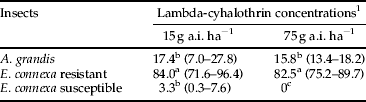
Comparing the lower LCT concentration used (15 g a.i. ha−1) and a concentration 5×higher (75 g a.i. ha−1), there was no difference between insecticide concentrations within insect populations (table 1). In contrast, there was a significant difference in survival of the insects within the same insecticide concentration. Overall, resistant ladybirds had the highest survival rates, at 84 and 82.5% at the lowest and highest LCT concentrations applied, respectively (table 1). Susceptible ladybirds and boll weevils shown at the lowest and highest LCT dose applied 3.3% and 17.4%, and 0% and 15.8% survival rates, respectively.
Average survival (95% confidence interval) for boll weevil adults, A. grandis, and for ladybird beetles, E. connexa, from resistant and susceptible populations, caged on cotton plants in the field treated with lower and 5×higher LCT recommended field rate for cotton pest control.
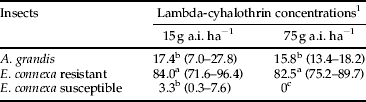
1 Means followed by the same letter within column do not differ statistically (One-way ANOVA; Tukey HSD test; P>0.05).
Behavioural response of E. connexa to LCT treated plants
Regarding the elapsed time to reach and start climbing on the plant's main stem, resistant and susceptible ladybirds released on the soil showed variable responses to LCT treated plants (P=0.012) (table 2). Resistant beetles spent approximately twice as much time on the soil surface (15.95 min) before accessing the stem of treated plants than untreated plants (8.81 min), whereas the susceptible beetles spent a statistically similar amount of time on the soil surface before they all climbed onto the stems of insecticide-treated (9.41 min) and untreated plants (14.70 min) (P=0.172) (table 2). Therefore, owing to this difference between populations of E. connexa Res and Sus functions the type of plant (treated and untreated), there was a significant interaction between these treatments (P=0.005).
Average time in minutes (±SE, standard error) for E. connexa from resistant and susceptible populations spent on cotton plants when released on soil surface or in the canopy of plants treated and untreated with LCT (15 g a.i. ha−1), and time to suffer knockdown.

1 Means followed by the same letter within row do not differ between the canopy and the main stem of the plant when comparing treated or untreated cotton plants for each release site and population (χ2-test; P>0.05).
2 Means followed by the same letter within column for knockdown effect are not statistically significant upon comparing release sites within the same population (χ2-test; P>0.05).
With regard to the time spent on plants and walking on the stem, when insects were on the plant canopy they were easily found on leaves or walking between leaves, and on the plant main stem. Upon comparing individuals released on the plant canopy with those released on the soil and which later climbed onto the plant, there were statistically significant differences in the time spent on the plant (P<0.0001), and whether the plants were insecticide-treated or untreated (P<0.0001). However, these differences were not related to whether the E. connexa populations were Res or Sus (P=0.174).
The time spent on plants when beetles were released on the soil was 65.8% compared with 83.5% when released on the plant canopy. In addition, irrespective of their population type, beetles stayed two to three times longer on the canopy of untreated plants (94%) compared with treated plants (58.7%) (table 2). When ladybird beetles were not on the plant canopy of treated plants, they were found on the soil surface (before or after suffering knockdown) or on the inner border of the plastic pots. Moreover, the time that E. connexa Res and Sus populations spent on the plant canopy was similar (P=0.1181), at 76.7 and 72.6%, respectively.
After insecticide contact on treated plants, significant differences in the time to knockdown (P<0.0001) were evident between the two populations and between beetles at the two release sites (P=0.0166). Resistant ladybirds were seen to show a delayed response to knockdown when released either on soil (average difference of 4.6 min longer) or on plant canopy (7.0 min longer) compared with susceptible ladybird beetles (table 2). In contrast, there was no interaction between insect populations and release site (P=0.2584).
Disregarding the releasing sites, the time to suffer knockdown was higher for resistant ladybird beetles (19.94 min) than for susceptible ladybird beetles (13.87 min). Seven E. connexa Res individuals completely avoided treated plants, not even climbing on them. Therefore, these were not considered in the analyses of knockdown.
Regarding the releasing site, only individuals from the resistant population showed a significant variation in the time to knockdown (P=0.0003). Beetles from the resistant population took longer time to suffer knockdown when released on the plant canopy (21.35 min) compared with beetles released on the soil (17.9 min). In contrast, for susceptible ladybird beetles, the time to suffer knockdown was similar whether they were released on the canopy (14.35 min) or on the soil (13.39 min) (table 2).
After suffering knockdown, ladybirds were kept singly and their recovery/survival rate after 24 h measured. There was a significant difference in the survival rate of both Res and Sus E. connexa, irrespective of releasing site (soil, P<0.0001; canopy, P<0.0001). For resistant beetles that had accessed the treated plants from the soil, 85.7% of individuals that suffered knockdown recovered after 24 h, in comparison with only 14.3% of susceptibles. Among those individuals released on the plant canopy, 100% of resistant beetles recovered after 24 h, whereas no susceptibles survived after knockdown.
Behavioural response of E. connexa to an LCT treated area
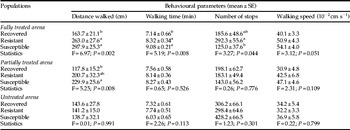
For all behavioural parameters measured, the three E. connexa groups exposed to LCT in a full-insecticide arena showed statistically significant differences in their responses: walking distance (P=0.002); walking time (P=0.008); and number of stops (P=0.044) and a tendency for differences in walking speed (P=0.051) (table 3).
Behaviour parameters evaluated for E. connexa from susceptible (Sus) and resistant (Res) populations and a resistant-recovered (R-rec) subgroup during 10 min of continuous observation in fully and partially treated, and untreated arenas.

1 Means followed by different letters within the column differ in a statistically significant manner among populations (Waller–Duncan test; P<0.05).
Resistant and susceptible E. connexa showed the longest walking distances and walking time in comparison with resistant-recovered (R-rec) individuals (table 3). Beetles from the Sus population made the fewest stops, those from the Res population the most; R-rec group individuals showed intermediate values (table 3). The opposite trend was found for walking speed. E. connexa Sus individuals showed the greatest speed, members of the R-rec group the slowest; E. connexa Res individuals again intermediate values (table 3). Meanwhile, when beetles were in untreated arenas, no behavioural differences among groups/populations were observed (table 3).
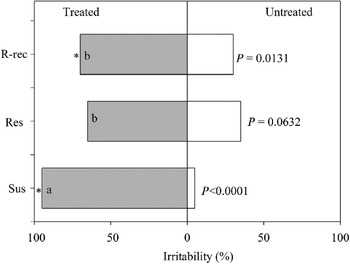
For those behavioural parameters measured for beetles in partially treated arenas, a significant difference was found only in terms of the total walking distance. It was significantly lower for E. connexa R-rec and higher for E. connexa Sus individuals (P=0.0081) (table 3). Beetles of all three groups were not behaviourally repelled by LCT (Kruskal–Wallis, χ2=0.6705, P=0.7152). In contrast, regarding insecticide irritability, variation in responses was more evident across groups (Kruskal–Wallis, χ2=5.68, P=0.0584; fig. 1). Susceptibles exhibited the highest irritability rate (Wilcoxon, Z=5.60, P<0.0001), followed by resistant recovered individuals (Wilcoxon, Z=2.48, P=0.0131); E. connexa Res individuals exhibited only a partial and statistical non-significant difference (Wilcoxon, Z=1.85, P=0.0632).
Irritability of E. connexa from susceptible (Sus) and resistant (Res) populations and a resistant-recovered (R-rec) subgroup in partially treated arenas with dried LCT residues. Bars with an asterisk indicate a statistically significant difference between treated and untreated halves of the arena (Wilcoxon rank sum test; P<0.05), whereas bars with different letters indicate statistically significant differences among the groups tested (Kruskal–Wallis test; Sus× Res: P=0.0192; Sus×R-rec: P=0.0399; Res×R-rec: P=7389).

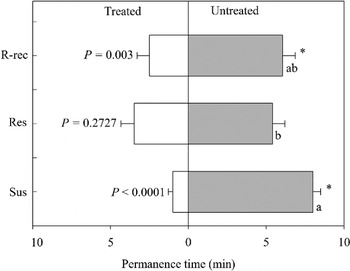
Given a choice, susceptible E. connexa and R-rec subgroup individuals spent more time in the untreated area of the partially treated arena than resistant individuals (Kruskal–Wallis, χ2=6.88, P=0.0321; fig. 2). Between treated and untreated areas of the partially treated arena, within the same group, a significant difference was recorded in the time spent on the untreated area of the arena only for resistant recovered individuals (Wilcoxon, Z=−2.96, P=0.003) and susceptibles (Wilcoxon, Z=−5.29, P<0.0001) (fig. 2).
Average time (+SE) spent on treated and untreated halves of the partially treated arena by E. connexa from susceptible (Sus) and resistant (Res) populations and a resistant-recovered (R-rec) subgroup. Bars with an asterisk indicate statistically significant differences between times in the treated and untreated halves of the arena (Wilcoxon rank sum test; P<0.05), whereas bars with different letters indicate statistically significant differences among the groups tested (Kruskal–Wallis test; P<0.05).

Discussion
In this study, we evaluated the survival of two E. connexa ladybird populations (Res and Sus) with that of the boll weevil, A. grandis, and observed the behavioural responses of the two E. connexa populations towards LCT insecticide treatment. The E. connexa resistant population showed the highest survival rates at the two insecticide concentrations used in laboratory and field cage experiments. Previous results by Rodrigues (Reference Rodrigues2012) had shown that four out of seven E. connexa populations collected in different crop fields and localities, and submitted to topical LCT application, had resistance ratios (ratio between LD50s) varying from 10.5- to 37.5-fold, including the resistant population as studied here.
Our results support the expected response of E. connexa Res and Sus populations to lambda-cyahlothrin; the variation in response found for both populations is compatible with the mortality estimates through dose-mortality curves determined by Rodrigues (Reference Rodrigues2012). Based on the estimated LDs determined by Rodrigues (Reference Rodrigues2012), we expected susceptibles to show an approximately 85% mortality rate for the highest LCT concentration here tested (75 g a.i. ha−1) and resistant individuals mortality rates varying from 10 to 20%. Instead, our results of field exposure of ladybirds to LCT on cotton plants revealed that Res E. connexa individuals had an even higher survival rate than expected from topically treated individuals in the laboratory. In fact in the field, other factors such as humidity on leaves from dew and the abundance of hiding places can lower insect contamination by insecticide. In contrast, the knockdown effect shown by ladybirds caged on treated cotton plants confirmed the insect's response to residual contact with the insecticide, but with substantial recovery after 24 h. Therefore, these results suggest the ability of resistant individuals to detoxify the insecticide, resulting in physiological selectivity in favour of resistant E. connexa, since such individuals had an elevated resistance ratio compared with susceptibles.
For ladybirds, over 210 laboratory-based bioassays for lethal acute toxicity at different developmental stages and for adult reproductive and survival output have been published for several insecticides, including 20 papers based on field-recommended rates or sub-lethal doses of pyrethroids (Web of Science®, research topic ‘Coccinellidae and insecticide’ from 1970 to May 2012). Such tests are important in defining the impact of insecticides on ladybird beetles in terms of designing IPM programmes. With the exception of a possible resistance to the pyrethroid bifenthrin mentioned by Kumral et al. (Reference Kumral, Gencer, Susurluk and Yalcin2011) in the coccinelid Stethorus gilvifrons (Mulsant), all other reports show incompatibility of the studied ladybird species with pyrethroid insecticides. In fact, there are very few examples of organic synthetic insecticides being compatible with ladybirds that can be safely recommended within an IPM approach; these include chemicals such as pymetrozine, pirimicarb, and some growth regulators for ladybird adults (Torres et al., Reference Torres, Silva-Torres and Oliveira2003; Cabral et al., Reference Cabral, Garcia and Soares2008).
Previous studies have detected pesticide resistance in populations of many arthropod pests, while only a few have shown resistance in their arthropod natural enemies (Tabashink & Johnson, Reference Tabashink and Johnson1999). Among the hypotheses to explain such a discrepancy, one states that phytophagous arthropods have biochemical mechanisms with a higher capacity to detoxify toxic compounds, because they are frequently challenged by plant secondary compounds (Plapp & Bull, Reference Plapp and Bull1978; Croft & Morse, Reference Croft and Morse1979). Alternatively, according to Roush & Daly (Reference Roush, Daly, Roush and Tabashink1990), despite the ecological differences between pests and predators, the latter could develop resistance to insecticides through selection pressure caused by repetitive applications of insecticides to control arthropod pests in the field.
Studies related to the survival of lacewings such as Chrysoperla externa (Hagen) and Ceraeochrysa cubana (Hagen) (both Neuroptera: Chrysopidae) following exposure to the pyrethroid permethrin, indicate that these insects have a high level of detoxification, in addition to the low repellency rate of C. externa to permethrin-treated areas (Cordeiro et al., Reference Cordeiro, Corrêa, Venzon and Guedes2010). In addition, research conducted in Pakistan with different populations of Chrysoperla carnea (Stephens) has shown resistance to both organophosphates and pyrethroids (Pathan et al., Reference Pathan, Sayyed, Aslam, Razaq, Jilani and Saleem2008), involving a biochemical resistance mechanism (Sayyed et al., Reference Sayyed, Pathan and Faheem2010).
When searching for potential natural enemies to use in IPM schemes, behavioural responses after exposure to insecticides are important aspects to be investigated. In light of this, the present results may have a major and important influence upon decisions related to pest control. For example, insecticide repellency on a predator's part may favour the avoidance of treated areas, but at the same time the biological control agent would spend less time on treated infested areas. Behavioural alterations could be detected by changes in time spent on the treated areas, walking pattern and speed, irritability and even repellency (Chareonviriyaphap et al., Reference Chareonviriyaphap, Roberts, Andre, Harlan and Bangs1997; Pothikasikorn et al., Reference Pothikasikorn, Overgard, Ketavan, Visetson, Bangs and Chareonviriyaphap2007).
As previously expected, when ladybirds of the two different populations were placed in a confined environment, but were not exposed to the insecticide, there were no differences in behaviour, since no toxic compound was present to elicit escape or avoidance. In contrast, when insects from the Sus, Res and R-rec groups were exposed to insecticide in fully treated arenas or partially treated arenas, behavioural differences were noted even though in most cases they were subtle. Probably these responses are directly linked to insecticide metabolism in E. connexa Res individuals.
The E. connexa Res and Sus populations exhibited overall similar trends among the behaviour responses to treated and untreated areas (table 3). Even so, susceptible E. connexa showed numerically greater walking speed, slightly greater walking distance, and a lower number of stops when exposed to treated areas. Hence, direct contact with insecticide residue in treated areas induced a more pronounced response in susceptibles than in resistant insects. In both fully treated and partially treated arenas, E. connexa R-rec insects showed a slightly reduced walking distance and walking speed than resistant individuals, suggesting that the experience of recovering from knockdown had some lingering behavioural effects on them. They could also have some learning ability to avoid contact with the toxic compound, but this possibility needs further investigation.
A highest avoidance rate to insecticide-treated areas could be related to behavioural and physiological traits in the insects because of continuous selection pressure, generation after generation. However, this was not clear with E. connexa Res or R-rec populations caused by insecticide exposure as expected by our hypothesis. Chareonviriyaphap et al. (Reference Chareonviriyaphap, Roberts, Andre, Harlan and Bangs1997) found that permethrin-resistant mosquitoes, Anopheles albimanus Wiedemann (Diptera: Culicidae) tended to avoid treated areas more than susceptible individuals. Similarly, in our study, some behavioural changes were found in the ladybirds of the three groups, leading us to investigate whether or not the resistant insects would show a higher avoidance rate in a more confined and insecticide-treated environment, as well as differences in repellency and irritability. Nevertheless, all three groups exhibited similar trends for permanence and irritability when exposed to treated areas, differing only in the degree of response.
A combination of insecticide irritability and repellency as an escape mechanism driven by behaviour stimulation was previously described by Chareonviriyaphap et al. (Reference Chareonviriyaphap, Roberts, Andre, Harlan and Bangs1997). Irritability is a result of direct contact with insecticide treated areas, causing a physiological hypersensitivity in individuals to the toxic compound, such that they avoid further contact with the treated area. On the other hand, repellency prevents direct contact with the toxic compound because of various physiological (Klowden, Reference Klowden2007) and sensorial (Haynes, Reference Haynes1988; Soderlund & Bloomquist, Reference Soderlund and Bloomquist1989) mechanisms related to detection of the insecticide, such that the insect avoids entering the treated area. Regardless of their susceptibility status, the ladybird beetles in our study were not repelled by LCT, because none of them avoided direct contact with treated areas. In contrast, LCT caused irritability, as shown by a significant reduction in the amount of time spent on treated areas of the arena, with insects spending more time on untreated areas, although this was less pronounced. Susceptibles exhibited the highest irritability response, with the shortest amount of time spent on treated areas in comparison with the other two populations, an outcome that supports an irritability hypothesis predicting greater speed for such individuals. Susceptible individuals do not have the same detoxifying ability as resistant ones, and could try to find a refuge area comparatively faster in order to avoid the negative effects of the toxic compound. This was observed in full or partially treated arenas.
Studies investigating the behavioural response of natural enemies to insecticides are very few. Recently, Campos et al. (Reference Campos, Picanço, Martins, Tomaz and Guedes2011) found that the earwig, Doru luteipes (Scudder) (Dermaptera: Forficulidae) showed changes in motility and other behaviours, after contacting a surface treated with LCT. Escape behaviour from treated areas was also found for the green lacewings C. externa and C. cubana when exposed to permethrin (Cordeiro et al., Reference Cordeiro, Corrêa, Venzon and Guedes2010). Regarding ladybirds, our study demonstrated that E. connexa showed variations in the elapsed time required to respond to the insecticide, both in its walking behaviour and in the time spent on treated plants.
More detailed information about insecticide repellency and irritability in populations of natural enemies would help inform decisions regarding the potential of these predators as biological control agents in IPM scenarios that involve the concurrent use of pesticides. In addition, behavioural studies of natural enemies would help in the design of appropriate insecticide application methods that would not compromise the survival of the natural enemies in the crop. For example, localized or systemic application might be necessary to favour the survival of natural enemies by ecological selectivity in situations in which they cannot be repelled or irritated by the toxic compound.
Based on our results, resistant E. connexa do not depend on their behaviour in terms of resistance to LCT, but instead rely upon some major physiological resistance mechanism. According to Rodrigues (Reference Rodrigues2012), when the synergist piperonyl butoxide (PBO) was added to LCT, the mortality of resistant E. connexa tested increased over 1400-fold, and attained levels similar to that of susceptibles. Bioassays performed in vitro showed a differentiated action of esterases between the E. connexa populations studied, indicating carboxylesterase type B resistance, a phenomenon associated with the metabolism of LCT.
The fact that resistant E. connexa had a higher survival rate than even the boll weevil populations (these results) has practical implications to the use of LCT in the cotton pest management programme, as well as in other agroecosystems where E. connexa appears as an important predator of aphids. Generally, the use of broad spectrum insecticides such as LCT to control pests such as coleopteran and lepidopteran larvae and adults that are non-targets of ladybird beetles could result in negative effects for these beetles as biological control agents (Tillman & Mulrooney, Reference Tillman and Mulrooney2000; Torres et al., Reference Torres, Silva-Torres, Silva and Ferreira2002).
Owing to seasonal growth patterns in cotton plants and their pest populations, mid- to late-season sprays of LCT are generally recommended to control lepidopteran larvae and boll weevils. However, outbreaks of cotton aphids commonly occur after LCT application (Hardin et al., Reference Hardin, Benrey, Coll, Lamp, Roderick and Barbosa1995; Deguine et al., Reference Deguine, Gozé and Leclant2000; Obrycki et al., Reference Obrycki, Harwood, Kring and O'neil2009), and significant crop loss can take place as a result of sooty mould that grows on opening bolls in response to aphid honeydew excreta. Even with a low population density, resistant E. connexa that survive such pesticide application would be expected to help minimize aphid numbers and thus reduce these losses.
Cotton aphids may also infest cotton plants at an earlier stage. To manage these early-season infestations using insecticides, two practices could be usefully adopted: (i) applying systemic insecticide seed treatments, especially at sites that have a history of aphid infestation; (ii) spraying plants with more selective insecticides, such as pymetrozine (Torres et al., Reference Torres, Silva-Torres and Oliveira2003). As an additional biological control measure, we recommend inoculative releases of resistant E. connexa at this stage, when the cotton plants have a relatively small leaf area for the ladybird beetles to search, and aphid infestations are low, allowing the predator population to increase as the plants grow. Such an approach would seem both promising and feasible. Although little information has been published on mass production of ladybirds, we have found that large numbers of resistant E. connexa can be reliably raised in the laboratory, using A. kuehniella eggs to rear the larvae and providing a honey–yeast mixture plus A. kuehniella eggs as diet for the ladybird beetle adults, as we have done here (see section ‘Collection and rearing of E. connexa populations’).
Lastly, the fact that E. connexa was not repelled by LCT but instead showed irritability is another plus for IPM, because resistant ladybirds do not avoid and presumably would still search for prey in areas treated with LCT. Using resistant ladybirds in conjunction with recommended rates of LCT in pest control also might be expected to reduce some of the negative effects of insecticide sprays. For example, the potential for pest resurgence as a result of reduction in natural enemy populations (Kidd & Rummel, Reference Kidd and Rummel1997; Longley, Reference Longley1999) such as escalating aphid populations in LCT treated areas (Hardin et al., Reference Hardin, Benrey, Coll, Lamp, Roderick and Barbosa1995; Deguine et al., Reference Deguine, Gozé and Leclant2000; Obrycki et al., Reference Obrycki, Harwood, Kring and O'neil2009). Aphid outbreaks after LCT sprays strongly suggest mortality of ladybird beetles and its inefficacy against aphids. Therefore, the combined use of resistant populations of ladybird beetles and rational use of LCT might reduce the number of insecticide sprays in an area, saving costs for the grower, as well as at the same time reducing environmental pollution, thereby improving environmental protection.
Acknowledgments
This research was supported in part by ‘Conselho Nacional de Desenvolvimento Científico e Tecnológico (CNPq) Edital Universal’ and by Fundação de Amparo à Ciência e Tecnologia do Estado de Pernambuco (FACEPE) through BFT, BCT and IBPG grants to the authors and financial aid (APQ). We further thank the two anonymous reviewers for their valuable comments and suggestions on the manuscript, and Professor Hugh D. Loxdale for his helpful editorial comments on the manuscript.