Peer victimization, the experience of being repeatedly the target of agemates’ aggression, harassment, and social isolation, has been implicated in the development of numerous mental health and behavioral problems (Reijntjes et al., Reference Reijntjes, Kamphuis, Prinzie, Boelen, Van der Schoot and Telch2011; Reijntjes, Kamphuis, Prinzie, & Telch, Reference Reijntjes, Kamphuis, Prinzie and Telch2010), not the least of which are externalizing difficulties and aggression (Hanish & Guerra, Reference Hanish and Guerra2002; Ladd & Troop-Gordon, Reference Ladd and Troop-Gordon2003; Reijntjes et al., Reference Reijntjes, Kamphuis, Prinzie, Boelen, Van der Schoot and Telch2011). Affecting approximately 10%–30% of children and adolescents (Leadbeater, & Hoglund, Reference Leadbeater and Hoglund2009), peer victimization is a substantial health risk, warranting systemic efforts to curb bullying and increase peer support for victims (Hertz, Donato, & Wright, Reference Hertz, Donato and Wright2013; Yaeger, Fong, Lee, & Espelage, Reference Yeager, Fong, Lee and Espelage2015). However, the nature and extent of maladjustment subsequent to peer victimization varies substantially across children. To maximize efforts to curb psychopathology resulting from victimization, it is necessary, therefore, to identify those factors that curb or exacerbate victimization–adjustment linkages. Selective attention to social cues may be one such factor. Effective deployment of attention has been identified as a critical component of emotion regulation (Ayduk, Mendoza-Denton, Mischel, & Downey, Reference Ayduk, Mendoza-Denton, Mischel and Downey2000; Todd, Cunningham, Anderson, & Thompson, Reference Todd, Cunningham, Anderson and Thompson2012), and maladaptive deployment of attention is theorized to be a transdiagnostic risk factor for the development of psychopathology (Racer & Dishion, Reference Racer and Dishion2012). Accordingly, the current study examines whether attentional biases to cues of threat or support moderate associations between peer victimization and aggression.
Peer Victimization and Aggression
Although the majority of victimized children are generally passive and submissive, peer victimization has been linked to high levels of aggressive behavior. Researchers have found that approximately 0.4% to 28.6% of victimized children are aggressive to peers (Schwartz, Proctor, & Chien, Reference Schwartz, Proctor, Chien, Juvonen and Graham2001). Victims who are aggressive have a hard time regulating their emotions, resulting in greater emotional responses to stressful peer conflicts, including hostile and retaliatory behaviors. Furthermore, the co-occurrence of peer victimization and aggression likely reflects a series of reciprocal associations that emerge over the course of development (Hodges & Perry, Reference Hodges and Perry1999; Leadbeater & Hoglund, Reference Leadbeater and Hoglund2009; Reijntjes et al., Reference Reijntjes, Kamphuis, Prinzie, Boelen, Van der Schoot and Telch2011). That is, while it is the case that aggressive behavior can elicit harassment from peers (Reijntjes et al., Reference Reijntjes, Kamphuis, Prinzie, Boelen, Van der Schoot and Telch2011), repeated exposure to peer victimization is a risk factor for the development of aggressive behavior and other externalizing difficulties (Hanish & Guerra, Reference Hanish and Guerra2002).
Longitudinal associations between victimization and aggression have been demonstrated in a number of studies (Goldbaum, Craig, Pepler, & Connolly, Reference Goldbaum, Craig, Pepler, Connolly, Zins, Elias and Maher2007; Hanish & Guerra, Reference Hanish and Guerra2002; Ladd & Troop-Gordon, Reference Ladd and Troop-Gordon2003; Leadbeater & Hoglund, Reference Leadbeater and Hoglund2009; Reijntjes et al., Reference Reijntjes, Kamphuis, Prinzie, Boelen, Van der Schoot and Telch2011; Rudolph, Troop-Gordon, Hessel, & Schmidt, Reference Rudolph, Troop-Gordon, Hessel and Schmidt2011; Snyder et al., Reference Snyder, Mulcahy, Taylor, Mitchell, Sachdev and Gandevia2003; Troop-Gordon & Ladd, Reference Troop-Gordon and Ladd2005; van Lier et al., Reference van Lier, Barker, Tremblay, Vitaro, Brendgen and Boivin2012). For example, Hanish and Guerra (Reference Hanish and Guerra2002) found that being victimized at first, second, and fourth grade is predictive of externalizing behaviors 2 years later. Similar findings were reported by Rudolph, Troop-Gordon, et al. (Reference Troop-Gordon and Gerardy2011) who found that victimization in the second grade and increasing victimization between second and fifth grade predicts heightened overt and relational aggression in fifth grade. Moreover, a meta-analysis of 14 longitudinal studies revealed a significant predictive link between peer victimization and later externalizing behaviors (Reijntjes et al., Reference Reijntjes, Kamphuis, Prinzie, Boelen, Van der Schoot and Telch2011).
Although the association between peer victimization and later aggression is consistently found in the literature, the magnitude of this association is moderate. These correlational findings, along with evidence that only a subset of victims are aggressive (Schwartz et al., Reference Schwartz, Proctor, Chien, Juvonen and Graham2001), have motivated investigators to identify those factors that moderate the link between peer victimization and aggression, including interpersonal factors (e.g., friends’ aggressive behavior; Hodges, Boivin, Vitaro, & Bukowski, Reference Hodges, Boivin, Vitaro and Bukowski1999; Lemarche et al., Reference Lemarche, Brendgen, Boivin, Vitaro and Ginette2007) and differences in physiological responses to stress (e.g., cortisol reactivity to stress; Rudolph, Troop-Gordon, & Granger, Reference Rudolph, Troop-Gordon and Granger2010). The current study adds to this literature by examining the moderating effect of attentional biases to social cues.
Aggression and Attention to Social Cues
Social cognitive theories of aggression and psychopathology point to biases in attention to interpersonal cues as integral to the development of externalizing disorders (Crick & Dodge, Reference Crick and Dodge1994; Olson, Sameroff, Kerr, Lopez, & Wellman, Reference Olson, Sameroff, Kerr, Lopez and Wellman2005; Racer & Dishion, Reference Racer and Dishion2012). In complex social interactions with multiple, dynamic cues, attention allocation is crucial to event interpretation (Crick & Dodge, Reference Crick and Dodge1994), emotion regulation (Thayer & Lane, Reference Thayer and Lane2000), and behavioral reactivity (Racer & Dishion, Reference Racer and Dishion2012). Within potentially threatening social interactions, flexible and adaptive attention allocation allows for the identification of cues that elicit a benign interpretation of the situation and for retained focus on cues that aid emotion regulation and inhibit aggressive reactions (see work by Horsley, de Castro, & Van der Schoot, Reference Horsley, de Castro and Van der Schoot2010; Troop-Gordon, Gordon, Vogel-Ciernia, Ewing Lee, & Visconti, in press, regarding related research on attention to scenes of ambiguous provocation). In contrast, attention problems and biases may result in excesssive orientation to aggressogenic cues and, in turn, a heightend sense of threat, dysregulated anger, and aggressive responding. Thus, for children repeatedly exposed to interpersonal threat, attentional biases may play a salient determining factor as to the likelihood and nature of co-occurring psychopathology.
Links between aggressive behavior and clinical diagnoses of attentional disorders (King & Waschbush, Reference King and Waschbush2010), and teacher reports of attentional difficulties (Bjørnebekk & Howard, Reference Bjørnebekk and Howard2012; Dodge, Lochman, Harnish, Bates, & Pettit, Reference Dodge, Lochman, Harnish, Bates and Pettit1997; Wilson, Petaja, Mancil, Reference Wilson, Petaja and Mancil2011) are well documented. Furthermore, accumulating evidence indicates that aggression is associated with heightened attention to unambiguous cues communicating hostility. For example, Gouze (Reference Gouze1987) found that preschool boys who were rated as physically and verbally aggressive were more easily distracted by aggressive cartoons and less likely to orient their attention away from aggressive scenes than nonaggressive boys. Using an emotional Stroop task, Van Honk, Tuiten, de Haan, van den Hout, and Stam (Reference Van Honk, Tuiten, de Haan, van de Hout and Stam2001) found that, among college-age students, those who are high in trait anger have more difficulty inhibiting attention to angry faces than those low in trait anger. In a study of children and adolescents, Lonigan and Vasey (Reference Lonigan and Vasey2009) found that those low in effortful control and high in negative affectivity show greater attention to words indicating threat (e.g., “murder”) than those high in effortful control, low in negative affectivity, or both.
In contrast, attention to cues signaling distress may work to minimize aggressive behavior (Perry & Perry, Reference Perry and Perry1974; Van Baardewijk, Stegge, Bushman, & Vermeiren, Reference Van Baardewijk, Stegge, Bushman and Vermeiren2009). When given the opportunity to behave aggressively against a peer, college students engage in less aggression when victims display pain cues (Baron, Reference Baron1971, Reference Baron1974). Similarly, Nathanson and Cantor (Reference Nathanson and Cantor2000) found that children evidence elevated aggressiveness immediately after viewing violent cartoons, but that this elevation is mitigated if children are coached to attend to the cartoon victim and the cartoon victim's emotions. In a related line of research, aggression has been associated with low attention to distress cues among those high in psychopathic traits (Kimonis, Frick, Fazekas, & Loney, Reference Kimonis, Frick, Fazekas and Loney2006). Thus, heightened attention to hostility and depressed attention to others’ distress may be risk factors for the development of aggressive behaviors.
Children vary, however, as to their exposure to aggression and other forms of interpersonal stress. Attentional biases, therefore, may not serve as a risk factor in isolation, but rather may exacerbate, or minimize, psychopathology resulting from repeated exposure to stressful environments (e.g., victimization from peers). Consistent with this premise, Racer and Dishion (Reference Racer and Dishion2012) propose that poor attentional deployment is a transdiagnostic risk factor that interacts with interpersonal stress in the development of psychopathology. Supporting this theory, deficits in attention have been found to moderate the relation between associating with deviant peers and adolescents’ antisocial behavior (Dishion & Connell, Reference Dishion and Connell2006; Gardner, Dishion, & Connell, Reference Gardner, Dishion and Connell2008). We similarly posit that the extent to which peer victimization is associated with aggression may depend on allocation of attention to social cues. Of particular importance is likely to be attention to cues present in bullying contexts, due to the perceived threat such situations pose for peer victimized youth. Specifically, we anticipate that the link between peer victimization and aggression is heightened when children attend to cues signaling hostility and is dampened when children attend to cues signaling distress or protection from harm.
Social Cues Within Bullying Contexts
For victimized children, situations of bullying may represent a highly relevant and salient context that threatens one's safety and emotional well-being. Within the bullying context, the bully is likely the most salient social cue due, in part, to the threat the bully represents to others. However, bullying rarely happens in isolation of the larger peer group (O‘Connell, Pepler, & Craig, Reference O'Connell, Pepler and Craig1999; Salmivalli, Kaukiainen, Kaistaniemi, & Lagerspetz, Reference Salmivalli, Kaukiainen, Kaistaniemi and Lagerspetz1999). Rather, there are often onlookers who take on a variety of observable roles (Salmivalli, Lagerspetz, Björkqvist, Österman, & Kaukiainen, Reference Salmivalli, Lagerspetz, Bjorkqvist, Osterman and Kaukiainen1996) and, therefore, provide varying social cues. In addition to the bully and the victim, there are often reinforcers, peers who encourage the bully by laughing at the aggressive behavior or otherwise indicating that the bully's behavior is acceptable. Often present as well are defenders who show support and empathy for the victim, and who potentially explicitly stand up to the bully on the victim's behalf.
Differential attention to these actors may have substantial implications for how bullying situations are interpreted and which facets of the peer context are salient to the observer. Attention to bullies and reinforcers would likely lead to the conclusion that the observed peer context is highly hostile and threatening, extenuating the co-occurrence of peer victimization and aggression. Attention to the victim should make salient the distress caused by the bullying, diminishing the link between victimization and aggression. Less clear is how observers would interpret the actions of defenders in a bullying situation. However, because defenders signal support for the victim, attention to defenders is expected to minimize interpretations that the witnessed peer context is highly threatening, diminishing risk for aggression.
The Current Study
Based on Racer and Dishion's (Reference Racer and Dishion2012) conceptualization of attentional processes as moderators of the risk interpersonal stress has on adjustment, the current study examined whether attentional biases to social cues present in scenes of bullying moderate victimization–aggression linkages. Early adolescents (i.e., fifth and sixth graders) were eye tracked while watching child actors depict scenes of aggression. In each scene, a bully aggressed against a victim while two peers were present, a reinforcer who encouraged and laughed with the bully during the hostile encounter and a defender who looked sympathetically at the victim and disapprovingly at the bully. Early adolescents were chosen to participate in this study, as bullying has been found to increase during this period (Nansel et al., Reference Nansel, Overpeck, Pilla, Ruan, Simon-Morton and Scheidt2001; Pellegrini & Long, Reference Pellegrini and Long2002).
The available data allowed us to test the robustness of our findings across multiple informants and across overt and relational aggression. Specifically, we included in our analyses three different measures of aggression, including peer reports of overt (e.g., physical and verbal) and relational (e.g., spreading rumors and excluding others) aggression and teacher reports of aggression, and measures of peer victimization from three informants: peers, teachers, and parents. Thus, analyses were first conducted to determine whether attention to bullying roles moderates the association between peer victimization and the three measures of aggression. Follow-up analyses tested whether the findings held when the three peer victimization scores were used separately to predict a composite aggression score.
We also examined sex differences in the proposed relations. Although the research is mixed as to whether victimization is more predictive of aggression and externalizing problems for boys than for girls (Rudolph, Troop-Gordon, Monti, & Miernicki, Reference Rudolph, Troop-Gordon, Monti and Miernicki2014), boys are overrepresented when aggressive subgroups of victims are identified (Hanish & Guerra, Reference Hanish and Guerra2004; Schwartz, Reference Schwartz2000; Veenstra et al., Reference Veenstra, Lindenberg, Oldehinkel, De Winter, Verhulst and Ormel2005). Thus, it is possible that boys are more sensitive than girls to attentional cues that support or inhibit aggressive responding. Differences may also arise due to gender-specific patterns of aggression: boys tend to use both overt and relational aggression; girls engage primarily in relational aggression (Card, Stucky, Sawalani, & Little, Reference Card, Stucky, Sawalani and Little2008). Thus, it is possible that moderation of the victimization–overt aggression association will be specific to boys. Accordingly, moderation by gender was also taken into account. Furthermore, as biases in attention to social cues may reflect broader attentional difficulties, we controlled for attention problems in each analysis.
Method
Participants
Data for this study came from 72 children residing in the upper Midwest of the United States (34 boys; 38 girls; M age = 11.67, SD age = 8.14 months; 94.4% Caucasian) and their parents (63 mothers; 9 fathers). Children came from primarily middle-class families with 5 (7.0%) reporting annual household incomes between $0 and $40,000, 19 (26.4%) between $41,000 and $60,000, 21 (29.2%) between $61,000 and $80,000, and 24 (33.3%) reporting incomes greater than $80,000. Three parents did not provide income data.
Children were recruited from a sample who had recently completed a longitudinal study examining links between peer relationships and children's emotional, behavioral, and school adjustment. The participation rate for the initial study was 73.9%. Although the larger study consisted of 464 children, recruitment for this study focused on the 187 children living within a 20-min drive to the university. Of these children, 69 (36.9%) had parents willing and able to bring them to the lab. The majority of parents declining to participate stated lack of time as their reason for not participating. A number of parents were not home or did not answer their phone when called. An additional attempt was made to recruit students living approximately 45 min away, although fewer attempts were made to reach these parents due to the unlikelihood that they would be willing to travel such a far distance. Three children were recruited from this subsample. For the families in this community, long distance was the primary reason for not participating in the lab portion of the study. The children who participated in the eye-tracking portion of the study did not differ from those children who either could not be reached or whose parents declined participation on teacher-reported peer victimization, teacher-reported aggression, or teacher-reported attention problems. The recruited sample was less overtly and relationally aggressive (M = 1.52 and 1.49, SD = 0.40 and 0.31, for overt and relational aggression, respectively) than the nonrecruited sample (M = 1.70 and 1.59, SD = 0.47 and 0.36, for overt and relational aggression, respectively), t (208) = 2.78 and 1.99, p = .006 and .048, for overt and relational aggression, respectively. There was also a marginally significant difference in peer-reported victimization, t (208) = 1.89, p = .06, such that the recruited sample had lower peer-reported victimization scores (M = 1.49, SD = 0.22) than the nonrecruited sample (M = 1.57, SD = 0.33).
Apparatus and stimuli
Video clips
Stimuli for the eye-tracking task included short video clips depicting 6 scenes of ambiguous provocation, 18 scenes of bullying, and 6 scenes of prosocial behavior (i.e., 30 scenes total). Each scene was acted out twice, once by four boy actors and once by four girl actors. Thus, 60 video clips were created. Approximately 80 scenes were initially written. The final scripts used for this study were chosen based on piloting with four older elementary-school age children (two boys and two girls) who indicated which scenes were the most realistic and plausible. The video clips lasted approximately 13 s (M = 13.47 s; duration ranged from 8.00 to 21.00 s). See [blinded for peer review] for previous analysis of the ambiguous video clips.
Each scene showed four children engaged in an interaction. Of the 18 bullying scenes, 6 included physical bullying (throwing paper, poking repeatedly, hitting in the back of the head, pushing down, knocking books out of hand, and holding lunch out of reach), 6 included verbal bullying (calling “stupid,” mocking glasses, taunting about affection toward peer, making fun of smell, ordering to do homework, and accusing of passing gas), and 6 included relational bullying (not inviting to party, whispering about someone, not including in game, teasing someone for not being invited to a party, gossiping about someone, and refusing an offer of candy). These scenes were based on items widely used to assess bullying and peer victimization (e.g., Coyne, Archer, & Eslea, Reference Coyne, Archer and Eslea2006; Crick & Grotpeter, Reference Crick and Grotpeter1996; Rudolph, Abaied, Flynn, Sugimura, & Agoston, Reference Rudolph, Abaied, Flynn, Sugimura and Agoston2011), as well as discussions with elementary and middle school children about the types of bullying they witness at school. Each bullying scene followed the same format. An actor playing the bully would aggress against the actor playing the victim. The victim responded in a manner that was ineffectual and communicated being in either physical or emotional pain (e.g., responding in a whiny voice, “stop it”). The bully then made a second aggressive act against the victim, and the victim once again responded ineffectually. During the scene, the actor playing the reinforcer laughed at the bully's aggressive behavior, and the actor playing the defender looked sympathetically at the victim and disapprovingly at the bully.
Eight child actors between the ages of 10 and 13 were recruited from local theater groups. All actors looked very similar in age and had extensive training and experience in local theater productions. For each scene, actors were randomly assigned to a role; therefore, no actor could be associated with a particular role in the scenes. The actors wore jeans and plain, identical colored shirts provided to them by the investigators to insure that clothing did not influence visual attention.
In order to assess whether the actors were displaying the desired behaviors and emotions in the scenes, two undergraduate assistants independently coded on a 5-point scale each actor in each video clip on three dimensions: (a) how mean the actor was behaving (1 = very mean to 5 = very nice), (b) how amused the actor seemed by what was happening (1 = very amused to 5 = not at all amused), and (c) how upset the actor seemed by what was happening (1 = very badly to 5 = very good). The coders’ scores for a role often ranged only 2 or 3 points for a particular item (e.g., ratings of amused for the bully ranged from 1 to 2 for both coders), resulting in constrained variance and low interrater reliability estimates even when the coders’ ratings were highly similar. Therefore, ratings were averaged across the two coders.
A series of one-way repeated measures analyses of variance was conducted in which role (bully, victim, reinforcer, or defender) served as the within-subjects factor and the behavior/affect dimensions (acts mean, amused, and feels badly) served as the dependent variables. Significant differences were found on all three dimensions, F (3, 105) = 165.69, 320.32, 436.31, all ps < .001, for acts mean, amused, and feels badly, respectively. As would be expected, bullies (M = 1.18, SD = 0.05) and reinforcers (M = 2.01, SD = 0.08) were viewed as acting more mean than victims (M = 3.10, SD = 0.09) or defenders (M = 3.22; SD = 0.08). Bullies were also seen as acting more mean than reinforcers. However, no difference in acting mean was found between victims and defenders. Bullies (M = 1.44, SD = 0.11) and reinforcers (M = 1.5, SD = 0.08) were seen as more amused than victims (M = 4.83, SD = 0.06) and defenders (M = 4.08, SD = 0.10). Victims were seen as less amused than defenders. There was no difference in being amused between bullies and reinforcers. Victims (M = 1.14, SD = 0.04) and defenders (M = 2.10, SD = 0.08) were seen as feeling worse than bullies (M = 4.68, SD = 0.10) and reinforcers (M = 4.22, SD = 0.08). Victims were also seen as feeling worse than defenders, and reinforcers were seen as feeling worse than bullies. These differences provide strong evidence that the actors were portraying the desired behaviors and affect in the video clips.
Eye tracking
The 60 video clips were displayed to children on a NEC MultiSync FP2141SB monitor at a resolution of 1024 × 768 pixels and a refresh rate of 75 Hz. Children watched the video clips from a distance of 57 cm. A tower-mounted Eyelink 1000 Eye Tracker (SR Research Ltd., Mississauga, Ontario, Canada) was used to record participants’ eye movements at a rate of 1000 Hz. Only data collected while the children watched the 36 video clips portraying bullying are analyzed for this study. The entire set of 60 video clips was presented in one of two randomly assigned orders. Children were informed that their eye location was going to be monitored as they watched the video clips. No other instructions were given, and participants were asked no questions regarding the individual video clips. There were a total of 2,592 trials (i.e., 72 participants × 36 video clips). Inspection of the raw data files showed that there was a loss of tracking for 1 trial for one participant. This child's attention scores were computed using the remaining trials. For all other trials, eye tracking was uninterrupted with the exception of blinks.
Measures
Visual attention to social cues
For each participant, and for each of the 36 bullying video clips, the location and duration of each fixation were recorded by trained research assistants. Fixations shorter than 100 ms were eliminated (3.28%). Attention was coded as being on one of the four actors if a fixation occurred on any part of the actor's body to account for physically aggressive acts that involved body parts other than the face (e.g., a hand slapping down books or the back of a victim being poked with a pencil). Coders did not record the location of fixations not on one of the four actors (e.g., a chair or a wall).
The total number of seconds attending to each of the four bullying roles was averaged for each video type (e.g., boys physical aggression and girls relational aggression). Cronbach αs were calculated to determine if these six scores for each bullying role could create an internally reliable scale. All Cronbach αs were acceptable (0.91, 0.84, 0.71, and 0.78, for attention to the bully, victim, reinforcer, and defender, respectively). Therefore, attention to each of the four bullying roles was calculated as the average time fixating on that role across all 36 video clips. Children also varied as to whether they attended to the actors while watching the video clips or other parts of the video or screen (e.g., a chair or the wall; the margin of the screen outside the videoclip dispay). As differences in time spent looking at the actors may reflect attention problems, we calculated, and controlled for, the average time spent looking at one of the four actors for each video clip (i.e., total attention to actors).
Victimization
Peer victimization was measured using a combination of peer-report, teacher-report, and parent-report measures. Peer reports and teacher reports of victimization were obtained from ratings children received the previous spring as part of the larger study. Peer-reported victimization was obtained using four items from Ladd and Kochenderfer-Ladd's (Reference Ladd and Kochenderfer-Ladd2002) Multi-informant Peer Victimization Scale (MPVS). For each item, children rated their participating classmates on a scale from 1 (never) to 4 (a lot). The items tapped physical (“hit or pushed by others”), verbal (“called names”), general (“picked on”), and relational (“told by other kids they cannot play with them or be friends with them”) victimization. The children in this study received peer ratings from an average of 15.49 classmates (min = 10; max = 24). Peer ratings received from classmates were averaged to create item-level scores, and these four items were averaged to create a composite peer victimization score (α = 0.89).
Teacher reports of victimization were obtained using four items from the MPVS and four additional items that were written to provide a more comprehensive assessment of peer victimization experiences. The additional items included “is excluded from other kids’ activities,” “is ignored by peers,” “is talked about in negative ways by other kids,” and “seems to allow other kid to tease or bully him/her.” Ratings received from teachers were averaged to create a composite victimization score (α = 0.91).
Parent reports of victimization were obtained during the eye-tracking lab visit. Parents responded to eight items, four derived from the MPVS and four additional items tapping social exclusion (e.g., is excluded from other kids’ activities). All items were scored on a scale from 1 (not true) to 3 (very true or often true). Item ratings were averaged to create a composite peer victimization score (α = 0.85).
Significant correspondence was found between the three reports of peer victimization (r = .44, p < .001, between peer-reported and teacher-reported victimization; r = .40, p < .001, between peer-reported and parent-reported victimization; r = .67, p < .001, between teacher-reported and parent-reported victimization). As multi-informant measures of peer victimization have been shown to provide more valid assessments of children's peer victimization experiences (Ladd & Kochenderfer-Ladd, Reference Ladd and Kochenderfer-Ladd2002), peer-, teacher-, and parent-report measures of peer victimization were averaged to create a composite peer victimization score.
Aggression
Peer ratings of aggression were obtained at the same time and from the same classmates as the peer ratings of victimization. Peer-reported overt aggression was measured using three items derived from the MPVS. They included “hit or push other kids at school,” “pick on others,” and “call other kids bad names or say mean things to them.” Peer-reported relational aggression was measured with one item, “tell other kids that they cannot play with them or that they will not be friends with them.” For each item, children rated their participating classmates on a scale from 1 (never) to 4 (a lot). Peer ratings received from classmates were averaged to create item-level scores, and scores on the three overt aggression items were averaged to create a composite peer-reported overt aggression score (α = 0.95). A final peer-reported relational aggression score was calculated by averaging all ratings received on the relational aggression item.
Teacher reports of aggressive behavior were obtained using six items. Teachers rated each participating child on a scale from 1 (never) to 4 (a lot of the time). Items included “threatens or bullies,” “spreads rumors or lies about other kids,” “acts aggressively toward peers,” “gets kids to gang up on a peer he/she does not like,” “likes to boss other kids around,” and “tries to get other kids in trouble.” These items are consistent with other teacher reports of aggressive behavior (e.g., Achenbach, Reference Achenbach1991; Dodge & Coie, Reference Dodge and Coie1987), have shown good concurrent validity in previous research (Troop-Gordon & Gerardy, Reference Troop-Gordon and Gerardy2012), and demonstrated good concurrent validity with the peer-report and parent-report measures of aggressive behavior used in this study. Ratings were averaged to create a composite aggression score (α = 0.93).
Attention problems
Children's attention problems were assessed using teacher and parent reports. Teachers rated children on three items, “is inattentive,” “has poor concentration or short attention span,” and “is restless and runs about or jumps up and down,” on a scale from 1 (never) to 4 (a lot of the time). These items were taken from the four-item hyperactive–distractible subscale of the Child Behavior Scale, a well-validated measure of children's social and behavioral risk (Ladd & Profilet, Reference Ladd and Profilet1996; α = 0.83 for the current sample). Parents reported on their child's attention problems using nine items from the attention problems subscale of the Child Behavior Checklist (Achenbach, Reference Achenbach1991). Ratings were made on a scale from 1 (not true) to 3 (very true or often true). The items showed good internal reliability (α = 0.74). Teacher and parent reports of attention problems were significantly correlated (r = .56, p < .001) and, therefore, averaged to create a composite attention problem score.
Procedures
Children and one accompanying parent came individually to the lab. Upon arrival, the study was explained to the parent and child, and parental consent and child assent forms were signed. The study consisted of two parts: an eye-tracking task and the completion of parent- and child-report questionnaires. Participants were randomly assigned to either complete the eye tracking or the questionnaires first. The parent and child completed the questionnaires in the same room with a research assistant present to ensure that they did not discuss or share their answers. The questionnaires took approximately 10 min to complete.
For the eye-tracking task, children were escorted to a sound-proofed room. Children were seated at a laboratory table and placed their head in the eye-tracker headrest, which was adjusted to make the child comfortable. The eye tracker was then calibrated and validated to ensure gaze position accuracy of 0.50 degrees or better. Children then performed a demonstration task in which they moved a picture across the computer screen with their eyes. This task allowed children to become more comfortable with the laboratory setup and insure that the height of the chair was comfortable for the children before proceeding. Children watched all 60 video clips (i.e., all children watched the boy and girl video clips). Between video clips, children fixated a cross located at the center of the computer screen. No other tasks were performed other than the viewing of the video clips. After completing the eye-tracking task and the questionnaires, parents and children were thanked for their participation, and parents were given a $25 honorarium.
Results
Missing data, descriptive statistics, and bivariate correlations
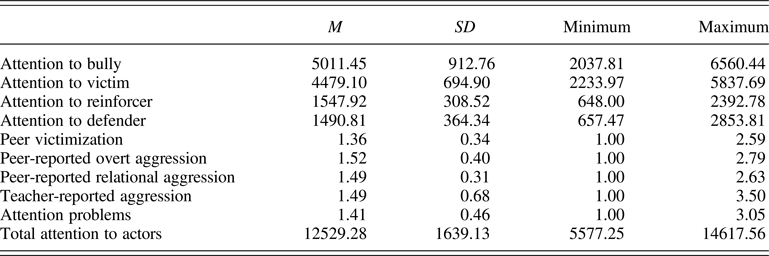
Seven children had some missing data due to not having peer-report or teacher-report data. Only one difference emerged between these seven children and those with complete data. Children with missing data attended to the reinforcer less (M = 1,320.89; SD = 383.02) than those with complete data (M = 1,572.37; SD = 292.57), t (70) = –2.10, p = .04. Descriptive statistics are presented in Table 1. On average, children fixated longest on the bully and victim, with the greatest time being spent on the bully. Consistent with previous literature (e.g., Coyne et al., Reference Coyne, Archer and Eslea2006; Troop-Gordon & Ladd, Reference Troop-Gordon and Ladd2005), aggression and peer victimization scores were moderately low, as were scores for attention problems. On average, children attended to one of the four actors for approximately 12.5 s while watching each video clip, suggesting that children primarily attended to the actors. However, there was notable variance in the amount of time children attended to the actors, a factor that was controlled for in the analyses. T tests were conducted to identify gender differences in the study variables. There were no gender differences in attention to the bully, reinforcer, or defender. A marginal gender difference emerged for attention to the victim, t (71) = 1.86, p =.06. Boys spent less time attending to the victim (M = 4323.23 ms; SD = 553.00 ms) than girls (M = 4618.56 ms; SD = 776.44 ms). Boys received higher overt aggression ratings than girls, t (71) = –2.60, p = .009, (M = 1.64 and 1.41; SD = 0.42 and 0.32, for boys and girls, respectively) and higher scores on attention problems, t (71) = –2.48, p = .01 (M = 3.13 and 2.57; SD = 1.04 and 0.76, for boys and girls, respectively).
Descriptive statistics

Note: Attention to the bully, victim, reinforcer, defender, and total attention to the actors reflect raw duration scores calculated in milliseconds.
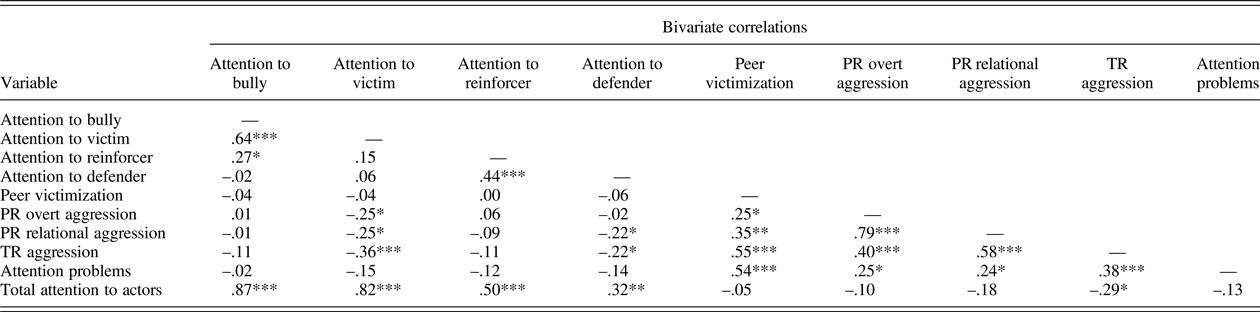
Bivariate correlations are presented in Table 2. Attention to the bully and to the victim were positively correlated, as were attention to the reinforcer and the defender. There was a modest, but significant, negative correlation between attention to the victim and the reinforcer. Although peer victimization was unrelated to attention to any of the bullying roles, two patterns emerged for the aggression variables. All three measures of aggression were negatively correlated with attention to the victim, and peer-reported relational aggression and teacher-reported aggression were negatively correlated with attention to the defender. The measures of peer victimization, aggression, and attention problems were all positively correlated. Of note, there were no significant correlations between attention to any of the bullying roles and attention problems. Total attention to the actors was negatively correlated with teacher-reported aggression, but was not significantly correlated with attention problems.
Bivariate correlations
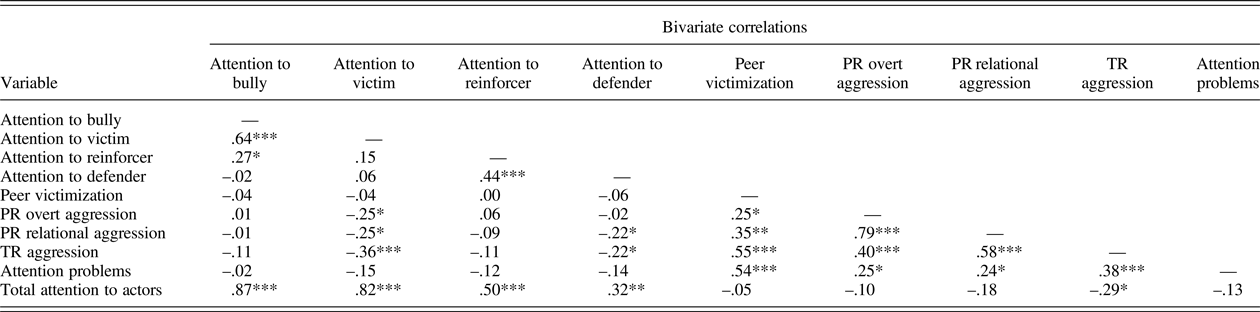
Note: PR = peer report. TR = teacher report. *p < .05. **p < .01. ***p < .001.
Regressions predicting aggression from victimization attention to the bullying roles and gender
In order to determine whether the associations between peer victimization and aggression were moderated by attention to each of the bullying roles and gender, four sets of regressions were conducted, one for each of the bullying roles. In each set of analyses, regressions were estimated simultaneously for peer-reported overt aggression, peer-reported relational aggression, and teacher-reported aggression using MPLUS (Muthén & Muthén, Reference Muthén and Muthén1998–2007). As the primary objective of this study was to determine whether attention to the bullying roles moderates the link between victimization and aggression, all regressions included attention on one of the bullying roles, peer victimization, and their interaction. We also controlled for attention problems, total attention to the actors, and gender (0 = boys; 1 = girls) in each analysis. Two-way interactions between gender and victimization and gender and attention to the bullying role, as well as the three-way interaction between gender, peer victimization, and attention to the bullying role were tested. For parsimony, interactions with gender were removed from the final analysis if statistically nonsignificant; inclusion or exclusion of these interactions did not affect the study findings. All analyses were conducted using full information maximum likelihood (Enders & Bandalos, Reference Enders and Bandalos2001). Therefore, data from all 72 participants were included in these analyses. The maximum likelihood with robust standard errors estimator was used due to nonnormality of some of the variables. Significant interactions were decomposed by testing and plotting simple slopes at –1, 0, and +1 SD (i.e., low, average, and high levels) of attention to the bullying role (Preacher, Curran, & Bauer, Reference Preacher, Curran and Bauer2006).
Attention to the bully
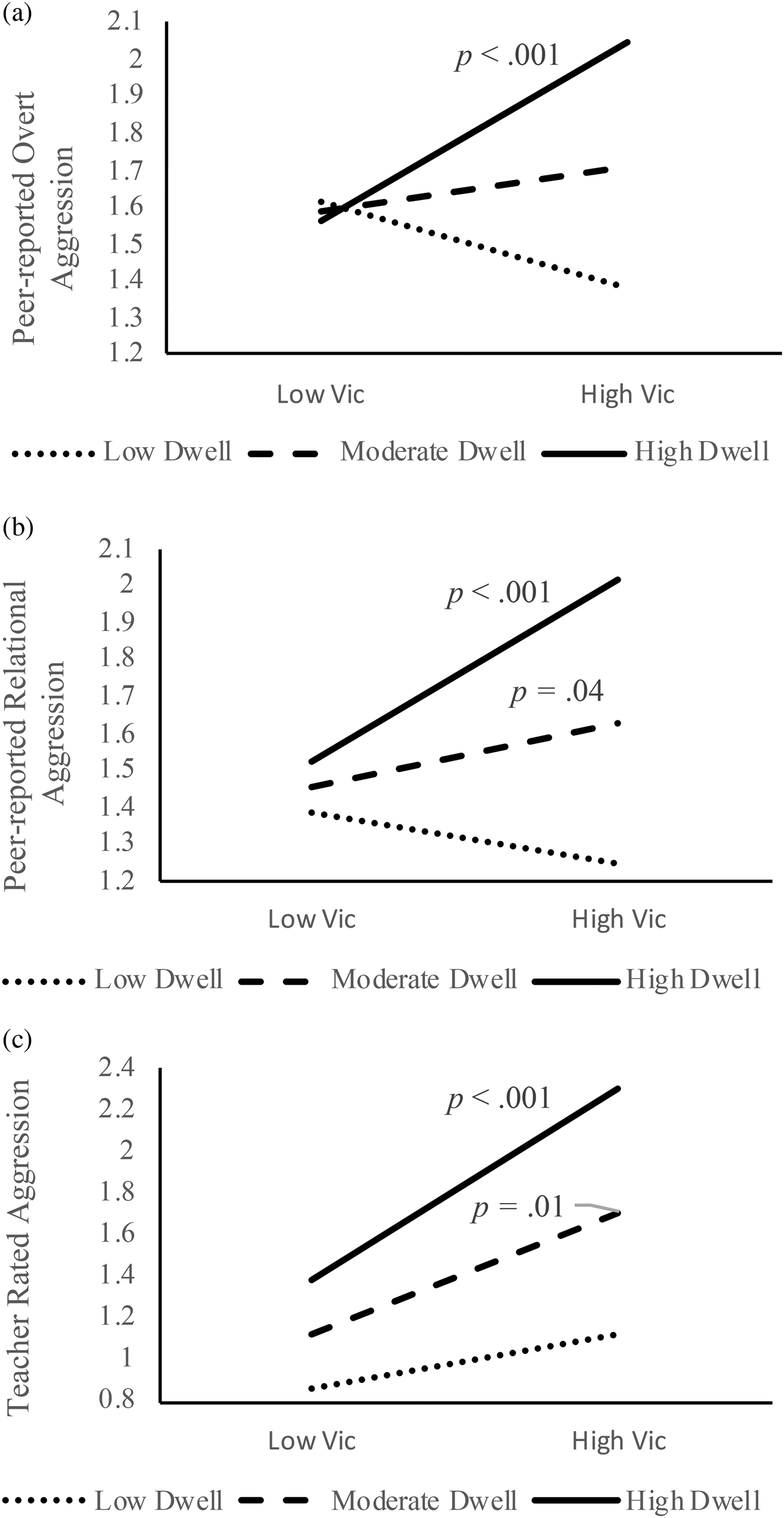
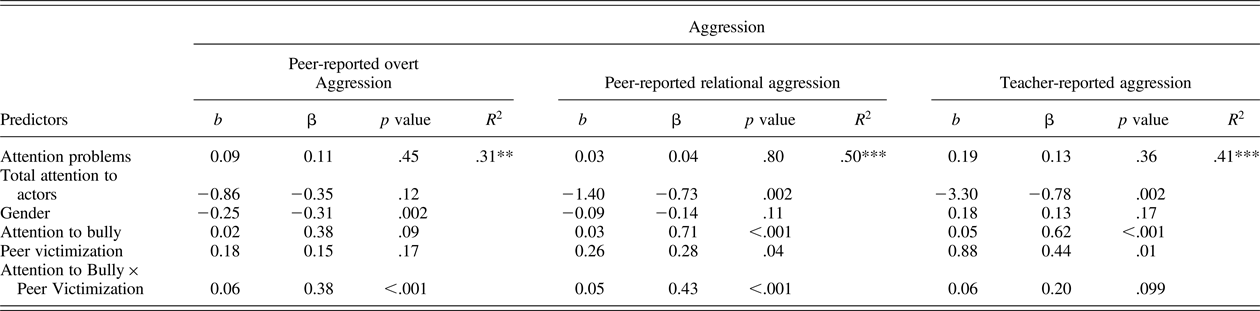
Table 3 shows the regressions predicting aggression from attention to the bully. A main effect of gender emerged for peer-reported overt aggression such that girls evidenced less overt aggression than boys. In addition, a main positive effect of peer victimization emerged for peer-reported relational aggression and teacher-reported aggression. The two-way interaction between gender and peer victimization, the two-way interaction between gender and attention to the bully, and the three-way interaction were nonsignificant. Attention to the bully was marginally positively associated with peer-reported overt aggression, and was significantly positively associated with peer-reported relational aggression and teacher-reported aggression. Moreover, the two-way interaction between attention to the bully and peer victimization was significant for peer-reported overt aggression and peer-reported relational aggression. The two-way interaction only approached significance (p = .099) for teacher-reported aggression. Plots of these interactions are presented in Figure 1. Although the interaction only approached significance for teacher-reported aggression, plots of this interaction are included for comparison purposes.
Plots of regressions predicting (a) peer-reported overt aggression, (b) peer-reported relational aggression, and (c) teacher-reported aggression from attention to the bully and peer victimization. P values for significant simple slopes are labeled.

Regressions predicting aggression from attention to the bully, peer victimization, gender, and their interaction
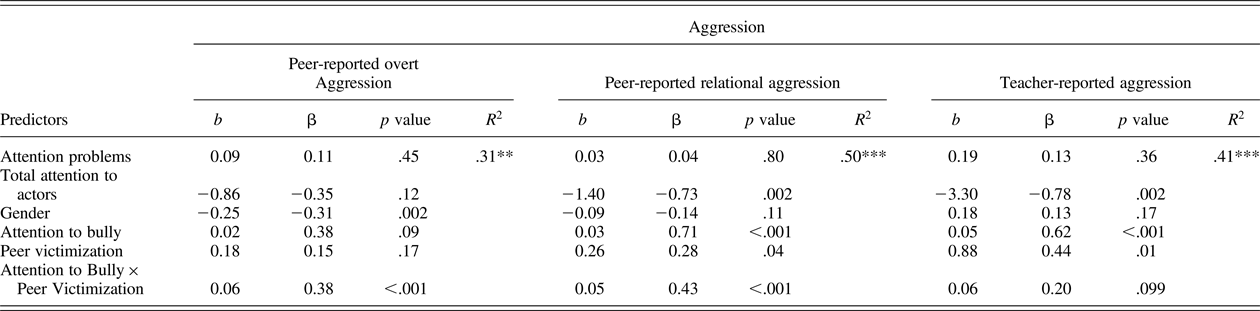
Note: Gender was coded 0 = boys and 1 = girls. **p < .01. ***p < .001.
Across all three forms of aggression, peer victimization was associated with aggressive behavior at high levels of attention to the bully, b = 0.71, t (65) = 4.29, p < .001, for overt aggression; b = 0.73, t (65) = 6.85, p < .001, for relational aggression; and b = 1.38, t (65) = 5.98, p < .001, for teacher-reported aggression. At moderate levels of attention to the bully, peer victimization was not related to peer-reported overt aggression, b = 0.18, t (65) = 1.38, p = .17, but was related to peer-reported relational aggression, b = 0.26, t (65) = 2.06, p = .04, and teacher-reported aggression, b = 0.88, t (65) = 2.58, p = .01. At low levels of attention to the bully, peer victimization was not related to peer-reported overt aggression, b = –0.35, t (65) = –1.69, p = .10, relational aggression, b = –0.21, t (65) = –0.93, p = .36, or teacher-reported aggression, b = –0.38, t (65) = 0.64, p = .53. As can be seen in Figure 1, a combination of high levels of peer victimization and high levels of attention to the bully was associated with elevated levels of aggressive behavior. Aggression scores were relatively low at low levels of victimization regardless of time spent attending to the bully.
Attention to the victim
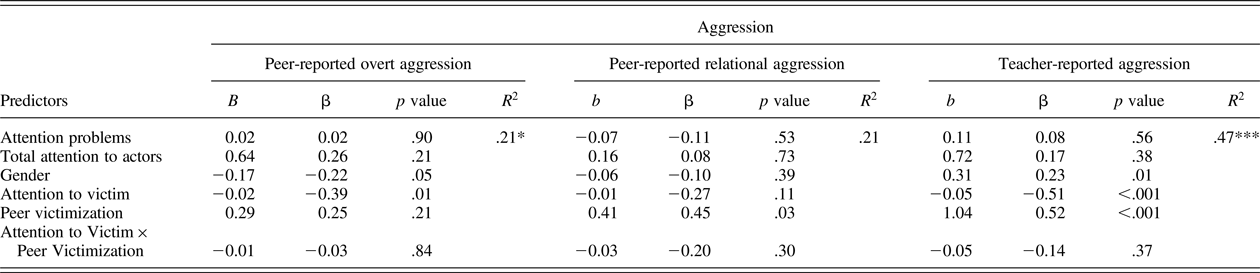
Table 4 shows the regressions predicting aggression from attention to the victim. Main effects of gender emerged, indicating that boys evidenced greater peer-reported overt aggression than girls, but less teacher-reported aggression. There were also significant positive main effects of peer victimization on peer-reported relational aggression and teacher-reported aggression. Although attention to the victim did not moderate the effect of victimization on aggression, a significant main effect of attention to the victim emerged for peer-reported overt aggression, β = –0.39, p = .01, and teacher-reported aggression, β = –0.51, p < .001. Children evidenced lower levels of peer-reported overt aggression and lower levels of teacher-reported victimization at higher levels of attention to the victim.
Regressions predicting aggression from attention to the victim, peer victimization, gender, and their interaction
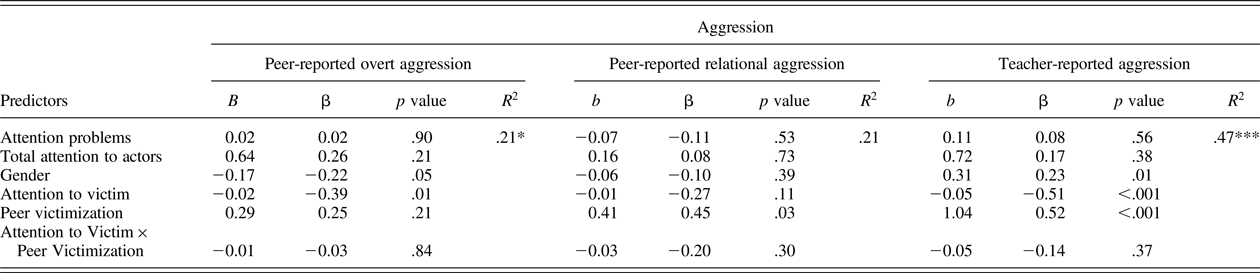
Note: Gender was coded 0 = boys and 1 = girls. *p = .05. ***p < .001.
Attention to the reinforcer
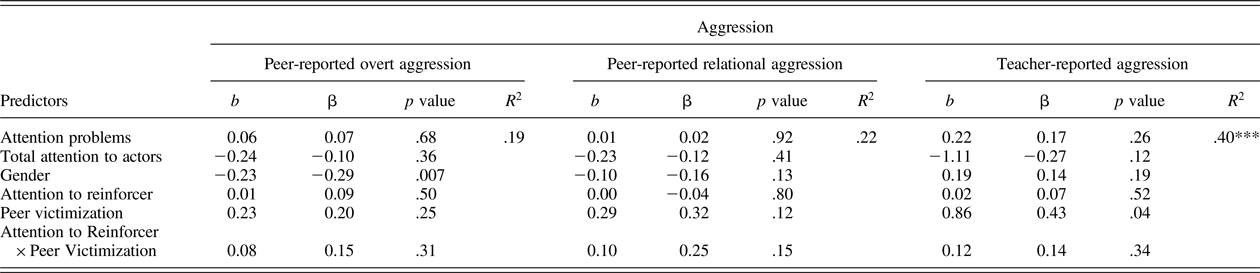
Table 5 shows the regressions predicting aggression from attention to the reinforcer. Main effects of gender emerged, indicating that boys evidenced greater peer-reported overt aggression than girls, but less teacher-reported aggression. There were no main effects of attention to the reinforcer on aggression and no significant interactions between attention on the reinforcer and peer victimization.
Regressions predicting aggression from attention to the reinforcer, peer victimization, gender, and their interaction
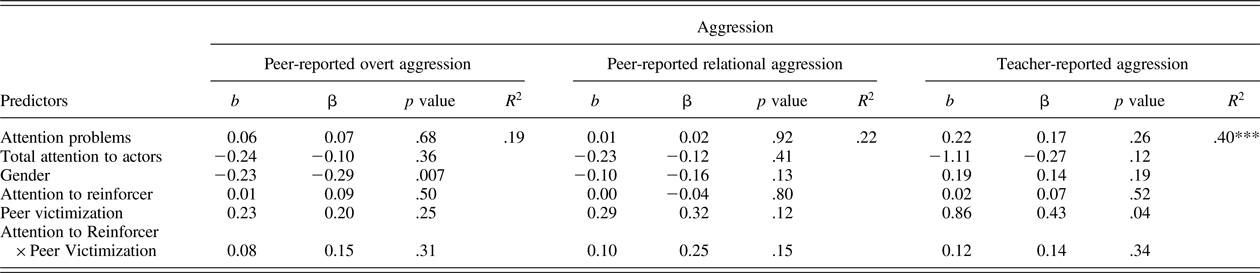
Note: Gender was coded 0 = boys and 1 = girls. ***p < .001.
Attention to the defender
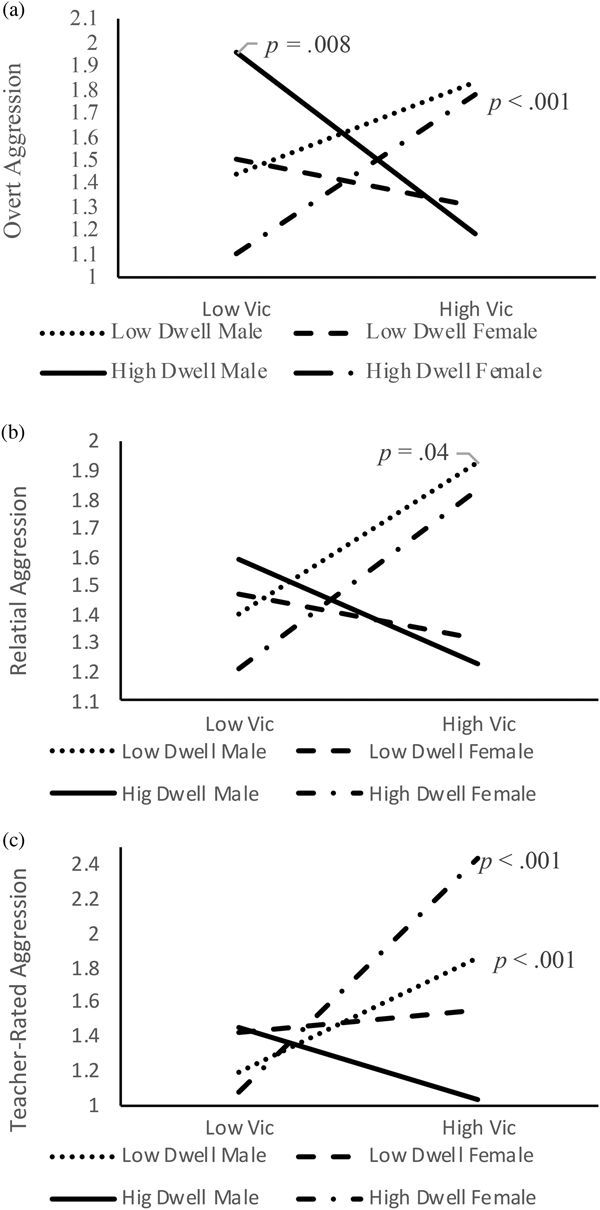
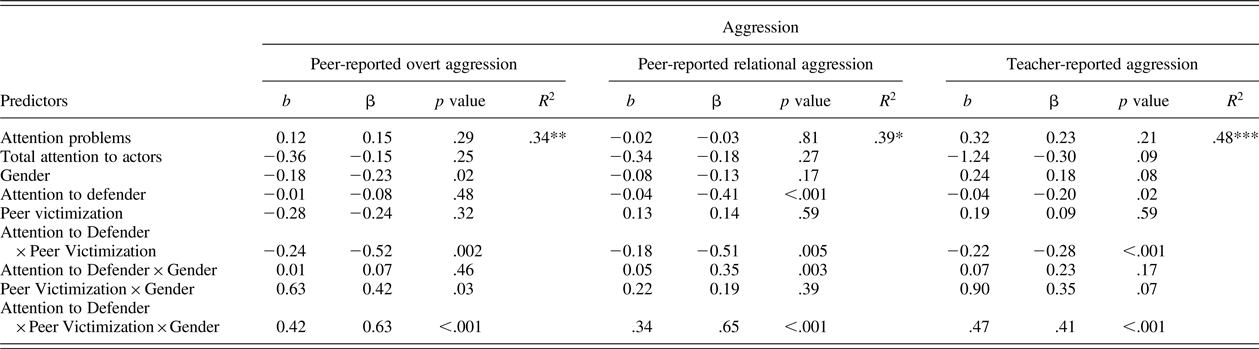
Table 6 shows the regressions predicting aggression from attention to the defender. A negative main effect of gender emerged, indicating that boys evidenced greater peer-reported overt aggression than girls. There was a negative main effect of attention to the defender on peer-reported relational aggression and teacher-reported aggression. Moreover, the three-way interaction between peer victimization, attention to the defender, and gender was significant for peer-reported overt aggression, peer-reported relational aggression, and teacher-reported aggression. Plots of these interactions are presented in Figure 2.
Plots of regressions predicting (a) peer-reported overt aggression, (b) peer-reported relational aggression, and (c) teacher-reported aggression from attention to the defender, peer victimization, and gender.

Regressions predicting aggression from attention to the defender, peer victimization, gender, and their interaction

Note: Gender was coded 0 = boys and 1 = girls. *p < .05. **p < .01. ***p < .001.
For boys, peer victimization was negatively associate with peer-reported overt aggression at high levels of attention to the defender, b = –1.14, t (62) = –2.74, p = .008. However, peer victimization was not associated with peer-reported relational aggression, b = –0.53, t (62) = –1.20, p = .23, or teacher-reported aggression, b = –0.61, t (62) = –1.60, p = .11, at high levels of attention to the defender. For boys, at low levels of attention to the defender, peer victimization was positively associated with aggression. This association was significant for peer-reported relational aggression, b = 0.78, t (62) = 2.09, p = .04, and teacher-reported aggression, b = 0.99, t (62) = 3.76, p < .001. The positive association between peer victimization and peer-reported overt aggression was not significant at 1 SD below the mean on attention to the defender, b = 0.58, t (62) = 1.53, p = .13. As can be seen in Figure 2, high levels of aggression were estimated when boys evidenced high levels of victimization and low levels of attention to the defender. However, high levels of overt aggression were also estimated when boys evidenced low levels of peer victimization and high levels of attention to the defender.
A different pattern emerged for girls. Peer victimization was positively associated with aggressive behavior at hgh levels of attention to the defender. This association was significant for peer-reported overt aggression, b = 0.99, t (62) = 4.99, p < .001, and teacher-reported aggression, b = 1.98, t (62) = 15.06, p < .001, but not for relational aggression, b = 0.92, t (62) = 1.62, p = .11. Peer victimization was not related to any of the measures of aggression for girls at low levels of attention to the defender, b = –0.29, t (62) = –1.03, p = .31, for overt aggression; b = –0.24, t (62) = –0.22, p = .82, for relational aggression; b = 0.19, t (62) = 0.62, p = .53, for teacher-reported aggression. As can be seen in Figure 2, for girls, aggression scores were highest when girls evidenced high levels of peer victimization and high attention to the defender.
Robustness of the findings across victimization informant
A final set of analyses were conducted in which each of the three peer victimization scores (i.e., peer report, teacher report, and parent report) were analyzed separately. A composite score for aggression was computed by averaging the peer-reported overt aggression, peer-reported relational aggression, and teacher-reported aggression scores. This score served as the dependent variable. The findings replicated our initial results. Specifically, across all three measures of victimization there was (a) a positive Victimization × Attention to the Bully interaction (all ps < .02), (b) a negative main effect of attention to the victim (all ps < .008), (c) no significant main or interactive effects for attention to the reinforcer, and (d) a positive Victimization × Attention to the Defender × Gender interaction (all ps < .03).
Discussion
An extensive literature has been accrued documenting the roles children take within the bullying context (Salmivalli, Reference Salmivalli2010). This study is novel in its examination of those roles as important cues with which children interpret and respond to their social environment. By studying how children differentially attend to these social cues, we gain insights into the heterogeneity present among peer-victimized youth. As anticipated, attention to the most threatening cue, the bully, was associated with a heightened relation between victimization and aggression. Although attention to the defender, a proposed protective factor, mitigated the extent to which victimization was associated with aggression, this effect held for boys only. For girls, attending to the defender heightened the link between victimization and aggression, suggesting that boys and girls may have very different interpretations of, and reactions to, defenders’ responses. Furthermore, attending to victims, regardless of one's own victimization from peers, was associated with being less aggressive. Thus, by drawing upon Racer and Dishion's (Reference Racer and Dishion2012) proposition that attentional problems exacerbate risk–psychopathology linkages, we were able to demonstrate that biased attentional processing of cues within socially threatening contexts may be a key factor in the co-occurrence of victimization and aggression.
Attention to bullies and reinforcers
Perhaps the strongest pattern of findings to emerge in this study was that showing that attention to the bully moderates the association between peer victimization and aggression. Specifically, victimization was associated with aggression only at moderate or high levels of attention to the bully. Moreover, this pattern held across all three measures of aggression (i.e., peer-reported overt and relational aggression and teacher-reported aggression). In addition to being consistent with previous research linking aggression or externalizing problems to hypervigilance to threatening cues (e.g., Gouze, Reference Gouze1987; Van Honk et al., Reference Van Honk, Tuiten, de Haan, van de Hout and Stam2001), the current study implicates a propensity to attend to interpersonal threat as a moderating factor augmenting the risk posed by peer victimization.
This finding helps explicate other known factors that differentiate aggressive from nonaggressive victims. Aggressive victims evidence greater emotional dysregulation (Georgiou & Stavrinides, Reference Georgiou and Stavrinides2008; Toblin, Schwartz, Gorman, & Abou-ezzeddine, Reference Toblin, Schwartz, Gorman and Abou-ezzeddine2005), physiological reactivity to social stress (Rudolph et al., Reference Rudolph, Troop-Gordon and Granger2010), and hostile attribution biases (Pouwels, Scholte, van Noorden, & Cillessen, Reference Pouwels, Scholte, van Noorden and Cillessen2016) when compared to nonaggressive victims. Excessive attention to threat, specifically those who aggress against them, may underlie these differences by incurring heightened emotional and physical reactivity when faced with peers’ aggression and greater interpretations of potential harm. Attending to bullies may also bias children's expectations regarding peers’ behavior. For example, antisocial peer beliefs (i.e., viewing peers as hostile and untrustworthy) have been shown to mediate the association between peer victimization and later externalizing problems (Ladd & Troop-Gordon, Reference Ladd and Troop-Gordon2003; Troop-Gordon & Ladd, Reference Troop-Gordon and Ladd2005). Visually attending to the aggressor when witnessing scenes of bullying may contribute to the development of such beliefs among children who are peer victimized.
This explanation presumes that victimized youth were taking the perspective of the victim when watching the video clips. However, it is also possible that after repeated exposure to peer victimization, children begin to identify with the bullies when watching peer aggression. Rather than observing a bully as a threat, victimized children may begin to imagine themselves in the bully's position, observing and learning the peers’ aggressive behavior. Whereas threat cues have often been operationalized as facial expressions or words of anger (e.g., Lonigan & Vasey, Reference Lonigan and Vasey2009; Mogg, Philippot, & Bradley, Reference Mogg, Philippot and Bradley2004; Van Honk et al., Reference Van Honk, Tuiten, de Haan, van de Hout and Stam2001), when asked to portray the role of the bully, the child actors in this study often expressed happiness and amusement. This was verified by the undergraduate assistants who coded the actors’ portrayals. On a scale from 1 (very amused) to 5 (not at all amused), the average rating the coders gave the actors portraying the bullies was 1.44. Thus, victimized chidren may learn from watching bullies that aggression against peers is enjoyable and mimic this behavior when given the opportunity.
Reinforcers also signal threat, and like bullies, communicate enjoyment at the peer aggression. However, the anticipated interaction between peer victimization and attention to the reinforcer did not emerge. Amusement by the reinforcer may be interpreted differently by children. Although some may see the reinforcer's behavior as communicating pleasure at the expense of the victim and indicating that the peer group is hostile, others may view this behavior as a sign that the bullying is “just for fun,” minimizing threat to the victim. Alternatively, for some, attention to reinforcers may be part of a larger coping strategy of diverting attention from the bully to potentially more benign social cues. Subsequent studies that not only assess visual attention to the scenes but also elicit participants’ interpretations of the bullying roles will help clarify how attention to reinforcers is processed by victimized children.
Attention to defenders
Whereas most studies of attentional biases and aggression focus on hypervigilance to cues hypothesized to amplify risk, the current study is unique in examining attention to potentially protective cues. Defenders were conceived as signaling reduced threat through available social support. Thus, it was proposed that attention to defenders may reduce the positive association between peer victimization and aggression. Findings for boys were consistent with this proposition. Specifically, victimization was associated with heightened peer-reported overt and relational aggression, and with teacher-reported aggression, only when they evidenced low levels of attention to defenders. Defenders may be important to boys, who socialize predominantly in larger groups than girls (Ladd, Reference Ladd1983; Lever, Reference Lever1978). Consequently, attention to defenders may reduce emotional reactivity and retaliatory responding by communicating that the bullying is not threatening the target's standing or inclusion within the larger peer group.
Unexpectedly, and for overt aggression only, low victimization was associated with greater aggression at high attention to the defenders. It is possible that overtly aggressive boys who are themselves not the targets of bullying may be highly socially adept, including being aware of peers who may disapprove of their aggression (i.e., defenders) and cautious not to let their overtly aggressive behaviors be seen by adults. We would expect that such boys would be socially central (Rodkin, Farmer, Pearl, & Van Acker, Reference Rodkin, Farmer, Pearl and Van Acker2000) and popular (Cillessen & Rose, Reference Cillessen and Rose2005). This proposition will need to be tested in future research, particularly in light of the fact that this pattern did not replicate with relational or teacher-reported aggression.
Another issue requiring further study is the unexpected positive relation between all three forms of aggression and victimization for girls only at high levels of attention to the defender. Girls may interpret the defender somewhat differently than boys. Rather than perceiving an ally, they may view the defender's behavior as confirmation that a hurtful experience is occurring. Looking to peers for sympathy and confirmation of distress would be consistent with girls’ greater tendency to coruminate (Rose, Reference Rose2002). Visual confirmation that the bullying behavior is harmful may result in greater aggression toward peers. Alternatively, girls who are victimized may translate the presence of defenders into implicit support for any retaliatory aggression they may engage in.
Attention to victims
Correlational analyses confirmed that attention to victims was associated with lower levels of overt, relational, and teacher-reported aggression, although these associations were somewhat attenuated when controlling for other study variables (e.g., peer victimization and attention problems). This is consistent with previous, lab-based studies, in which attention to victims has been shown to mitigate aggression (e.g., Baron, Reference Baron1971, Reference Baron1974; Kimonis et al., Reference Kimonis, Frick, Fazekas and Loney2006; Nathanson & Cantor, Reference Nathanson and Cantor2000). This study is the first to show that attention to victims operates similarly when the victim's distress is caused by bullying. Similar to Nathanson and Cantor (Reference Nathanson and Cantor2000), it is possible that training children to attend to victims within bullying situations may help to minimize aggressive behaviors. Moreover, the relation between attention to victims and aggression did not interact with peer victimization. Thus, the benefits of attention to victims is not disrupted by a history of being the target of peers’ aggression. However, a gender difference in attention to victims did emerge. Boys spent less time looking at victims than girls did. Inattention to victims by boys may partially explain boys’ greater tendency to aggress directly against their victims (Card et al., Reference Card, Stucky, Sawalani and Little2008). Thus, programs that increase attention to victims may have their greatest impact on aggressive boys.
Limitations and future directions
By using eye tracking to study attention to naturally occurring social cues within bullying situations, this study revealed novel findings regarding how attentional biases may amplify or mitigate the relation between victimization and aggression. This study also had a number of additional strengths including the ability to test the robustness of findings across multiple informants of aggression and vicitmizaiton. However, a number of limitations of this study warrant mentioning and should be rectified in future research. We focused on early adolescence, an age during which bullying often peaks (Pepler et al., Reference Pepler, Craig, Connolly, Yuile, McMaster and Jiang2006; Solberg & Olweus, Reference Solberg and Olweus2003) and peers become increasingly important in youth's lives (Steinberg & Morris, Reference Steinberg and Morris2001). We cannot assume that the findings generated here would generalize to younger children, who may have a very different interpretation of the social cues, or to older adolescents whose behavior in relation to victimization may be less affected by attentional processes. In addition to expanding the age range studied, research is also needed in which attentional patterns are assessed along with participants’ interpretations of, and identification with, the bullying roles. Many of the explanations presented here were premised on differential interpretations of the bullying roles. Only through direct assessment of those interpretations can these explanations be supported or refuted. An additional methodology to be employed is directing children and adolescents’ attention to particular social roles (e.g., the defender) to see if such manipulations affect cognitive and affective responses to the bullying scenes.
It should further be noted that although naturalistic scenes of bullying were portrayed, the participants were third-party observers, not directly involved in the bullying situation. Cognitive responses to hypothetical situations vary depending on whether participants are the direct target of that experience or are asked to take a third-party perspective (Kupersmidt, Stelter, & Dodge, Reference Kupersmidt, Stelter and Dodge2011). The effects of attentional biases may be stronger, or qualitatively different, when children are experiencing being bullied. Developing an in vivo task that allows for simultaneously tracking participants’ attention would overcome this limitation. Such methodologies would also remove ambiguiuty as to whom participants are identifying when watching bullying. However, such paradigms would pose substantial ethical challenges.
Other methodological limitations should be addressed in follow-up research. The information regarding relational aggression was available from only one informant, and no measures were included designed to assess reactive and proactive aggression. It is very possible that some of the associations found here would hold up for reactive aggression (e.g., attention to the bully may increase anger and reactive aggression among victimized children) and others may be specific to proactive aggression (e.g., lack of attention to the victim may reflect psychopathic traits or callousness characteristic of those who engage in proactive aggression; Raine et al., Reference Raine, Dodge, Loeber, Gatzke-Kopp, Lynam, Regynolds and Liu2006). In addition, although we have no reason to believe that awareness of the eye-tracking procedure biased the results, it is possible that simply knowing they were being eye tracked influenced children's allocation of attention to the scenes. Properties of the sample should also be considered. The sample size was suffiicent to detect medium effects (e.g., power = .80 for f 2 of .11), but did not allow for reliably detecting small effects that, nonetheless, may have been meaningful. The sample was also highly homogeneous. Whether these findings replicate with a more racially/ethnically and econonomically diverse sample will need to be explored. Finally, only concurrent associations could be tested with this data set. To what extent victimization predicts future aggression as a function of attentional biases, or attentional biases moderate the link between aggression and future victimization, is unknown. It is even possible that a combination of victimization and aggression precedes the development of attention to particular social cues. Only through longitudinal research will these prospective associations be elucidated.
Conclusion
Although attentional biases are known to be foundational in the development of psychopathology and behavioral problems (Dodge, Reference Dodge1993; Racer & Dishion, Reference Racer and Dishion2012), their role in adjustment problems evidenced by peer victimized youth have yet to be examined. This study addressed this gap in the literature by showing that victimization is associated with aggressive behavior only when children have a bias to threat (i.e., bullies) when viewing scenes of bullying. Moreover, this study showed that attention to defenders may serve a protective factor for boys, but heighten the risk victimization poses for girls. Supported as well was the proposition that attention to victims is negatively associated with aggressive behavior. While these findings underscore the importance of attentional biases in victimization–adjustment linkages, we will only understand the developmental processes underlying these associations through studies that test these associations longitudinally and explore the how attentional biases are associated cognitive and affective responses to peer aggression.