Introduction
Accurate determination of field output factors (
 ${\rm{\Omega }}_{{Q_{{\rm{clin}}}},{Q_{{\rm{msr}}}}}^{{f_{{\rm{clin}}}},{f_{{\rm{msr}}}}}$
) in external beam radiotherapy is critical to transfer the absorbed dose in water from reference field size to other clinical field sizes. It is necessary for the commissioning of treatment planning systems that use these fields. The field output factors are defined as the ratio of absorbed dose in water in any clinical field size
 $\left( {D_{w,{Q_{{\rm{clin}}}}}^{{f_{{\rm{clin}}}}}} \right)$
to absorbed dose in water for machine-specific reference field size
 $\left( {D_{w,{Q_{{\rm{msr}}}}}^{{f_{{\rm{msr}}}}}} \right)$
, used for clinical reference dosimetry.
For large fields, the field output factors can be estimated by the ratio of the detector reading in the clinical field (
 $M_{{Q_{{\rm{clin}}}}}^{{f_{{\rm{clin}}}}}$
) to that of machine-specific reference field (
 $M_{{Q_{{\rm{msr}}}}}^{{f_{{\rm{msr}}}}}$
). However, the
 $M_{{Q_{{\rm{clin}}}}}^{{f_{{\rm{clin}}}}}/M_{{Q_{{\rm{msr}}}}}^{{f_{{\rm{msr}}}}}$
is not an accurate determination of field output factors in a small field because of many factors. The most significant factors are small field detector perturbations and volume averaging over the detector’s sensitive volume and the difference in density between detector sensitive material and water. In addition, the effective atomic number of surrounding detector construction materials can affect the perturbation factors.
Reference Palmans, Andreo, Huq, Seuntjens and Christaki1–Reference Bouchard, Kamio, Palmans, Seuntjens and Duane4
Numerous studies have shown a significant variation in the ratio of reading when using different types of small field detectors, especially in very small field sizes.
Reference Cheng, Ning, Arora, Zhuge and Miller5–Reference Mamesa, Oonsiri, Sanghangthum, Yabsantia and Suriyapee8
Moreover, the discrepancies in the ratio of reading increased when the field sizes turned smaller. The previous lesson of an accidental overdosage for beams defined by the Brainlab m3 micro-multileaf collimator (MLC) was published due to the use of unsuitable detectors for measuring field output factors without additional corrections.
Reference Derreumaux, Etard and Huet9
To address this problem, the ratio of reading of appropriate detector should be corrected by the field output correction factors
 $\left(k_{{Q_{{\rm{clin}}}},{Q_{{\rm{msr}}}}}^{{f_{{\rm{clin}}}},{f_{{\rm{msr}}}}}\right)$
introduced in the formalism by Alfonso et al.
Reference Alfonso, Andreo and Capote10
 $$\Omega _{{Q_{{\rm{clin}}}},{Q_{{\rm{msr}}}}}^{{f_{{\rm{clin}}}},\,{f_{{\rm{msr}}}}} = {{M_{{Q_{{\rm{clin}}}}}^{{f_{{\rm{clin}}}}}} \over {M_{{Q_{{\rm{msr}}}}}^{{f_{{\rm{msr}}}}}}}\;k_{{Q_{{\rm{clin}}}},{Q_{{\rm{msr}}}}}^{{f_{{\rm{clin}}}},\,{f_{{\rm{msr}}}}}$$
Field output correction factors (
 $k_{{Q_{{\rm{clin}}}},{Q_{{\rm{msr}}}}}^{{f_{{\rm{clin}}}},{f_{{\rm{msr}}}}}$
) for many active detectors were published in the IAEA-AAPM TRS-483 code of practice. This publication is the guideline for dosimetry procedures of small static fields in external beam radiotherapy.
Reference Palmans, Andreo, Huq, Seuntjens and Christaki1
A dosimetric evaluation of the IAEA-AAPM TRS-483 code of practice for small static fields was conducted by Huq et al. Reference Huq, Hwang, Teo, Jang, Heron and Lalonde11 The same year, an evaluation of the IAEA-AAPM TRS-483 protocol of dosimetry in stereotactic cones using several detectors was conducted. Reference Smith, Montesari, Oliver and Butler12 Both studies suggested that the application of the protocol improved consistency in determining small field output factors. A recent clinical implementation of IAEA-AAPM TRS-483 was performed by Mamesa et al. Reference Mamesa, Oonsiri, Sanghangthum, Yabsantia and Suriyapee8 Their study was performed for commissioning stereotactic radiosurgery. They reported that the corrected field output factors based on IAEA-AAPM TRS-483 reduced the discrepancies of monitor units (MUs) among the difference detector commissioning data for the treatment planning system.
Aside from direct measurement, Monte Carlo (MC) simulation has been regarded as an alternative tool for determining field output factors Reference Cheng, Ning, Arora, Zhuge and Miller5,Reference Haryanto, Fippel, Laub, Dohm and Nüsslin13,Reference Francescon, Cora and Cavedon14 and field output correction factors Reference Francescon, Cora and Satariano2,Reference Puxeu-Vaqué, Duch, Nailon, Lizuain and Ginjaume15–Reference Benmakhlouf, Sempau and Andreo19 in small field dosimetry. The performance of MC calculated output factors hinges on the commissioning of a beam model based on measurements. This study aims to compare measured field output factor data directly to MC simulations of field output factors using a tuned MC beam model.
Materials and Methods
Determination of measured field output factors
The measurements were performed on the Varian TrueBeam linear accelerator (Varian Medical System, Palo Alto, CA, USA) with 6 MV WFF (with flattening filter). The TPR20,10 as the 6 MV beam quality of this machine was 0·667. All measurements were conducted in Blue Phantom (IBA Dosimetry, Nuremberg, Germany) at 10 cm depth of measurement and 100 cm source to axis distance (SAD). The geometric field sizes ranging from 1 × 1 to 10 × 10 cm2 were defined by jaws because the output factors used for commissioning in Eclipse treatment planning (Varian Medical System, Palo Alto, CA, USA) were measured from this configuration. Therefore, it is more convenient to use jaw field sizes in this study. Moreover, there was no difference in output factors between field sizes defined by the jaws and MLC (field sizes were defined by a square MLC aperture while the jaws were slightly retracted with 0·5 cm open larger than the leaves). Reference Mamesa, Oonsiri, Sanghangthum, Yabsantia and Suriyapee8 The machine-specific reference field size was 10 × 10 cm2.
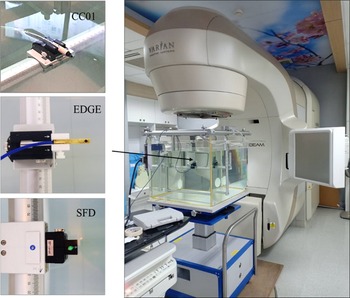
Three small active detectors examined in this work were CC01 ionisation chamber (IBA Dosimetry, Nuremberg, Germany), EDGE detector (Sun Nuclear, Melbourne, FL, USA) and SFD unshielded diode (IBA Dosimetry, Nuremberg, Germany). Table 1 shows the dimension and physical properties of each detector. All detectors were attached to the holder of a water phantom scanning system. Detector orientation with respect to the central axis of the beam was set following the guidelines in the IAEA-AAPM TRS-483 code of practice. The sensitive volume of CC01 and EDGE were positioned in a perpendicular direction towards the beam direction, while SFD was orientated in the parallel direction, as shown in Figure 1.
Lists of detectors were used in this study.

a Dry air at 20 °C and 101.3 kPa.
The measurement set-up of the small detector in blue water phantom with perpendicular orientation for CC01 and EDGE and parallel orientation for SFD.

The beam profile scanning was performed to determine the position of the sensitive volume of the detector at the centre of the beam axis. The scanning for each detector was conducted in 2 × 2 cm2 field size. Before measurement, the centre area of the active detector was aligned with the beam centre. Then, each field size was repeatedly measured three times.
The equivalent square field sizes (S
clin) were also determined in this study. They were utilised for selecting of the
 $k_{{Q_{{\rm{clin}}}},{Q_{{\rm{msr}}}}}^{{f_{{\rm{clin}}}},{f_{{\rm{msr}}}}}$
. Equivalent square field size is given by
 $\sqrt {X.Y} $
, where X and Y are cross-plane and in-plane full width at half maximum (FWHM), respectively, under measured conditions of 100 cm SAD and 10 cm depth. The FWHM in both cross-plane and in-plane were acquired by scanning the beam profile using the EDGE diode detector, a small detector suitable for beam scanning.
The ratio of the readings (uncorrected field output factors) of CC01, EDGE and SFD in the small field relative to the reference field was determined by
 $M_{{Q_{{\rm{clin}}}}}^{{f_{{\rm{clin}}}}}/M_{{Q_{{\rm{msr}}}}}^{{f_{{\rm{msr}}}}}$
for all field sizes.
The ratio of readings was directly corrected by
 $k_{{Q_{{\rm{clin}}}},{Q_{{\rm{msr}}}}}^{{f_{{\rm{clin}}}},{f_{{\rm{msr}}}}}$
based on Equation 1. The
 $k_{{Q_{{\rm{clin}}}},{Q_{{\rm{msr}}}}}^{{f_{{\rm{clin}}}},{f_{{\rm{msr}}}}}$
as a function of S
clin was obtained from Table 26 in IAEA-AAPM TRS-483 code of practice.
Reference Palmans, Andreo, Huq, Seuntjens and Christaki1
The dosimeter reading uncertainty at machine-specific reference field and clinical fields, the uncertainty of
 $k_{{Q_{{\rm{clin}}}},{Q_{{\rm{msr}}}}}^{{f_{{\rm{clin}}}},{f_{{\rm{msr}}}}}$
Reference Palmans, Andreo, Huq, Seuntjens and Christaki1
and the effect of the set-up and jaw positioning uncertainties of 1·3%
Reference Papaconstadopoulos, Archambault and Seuntjens20
were quadratically summed to determine the total uncertainty of the field output factors.
Determination of calculated field output factors (MC simulation)
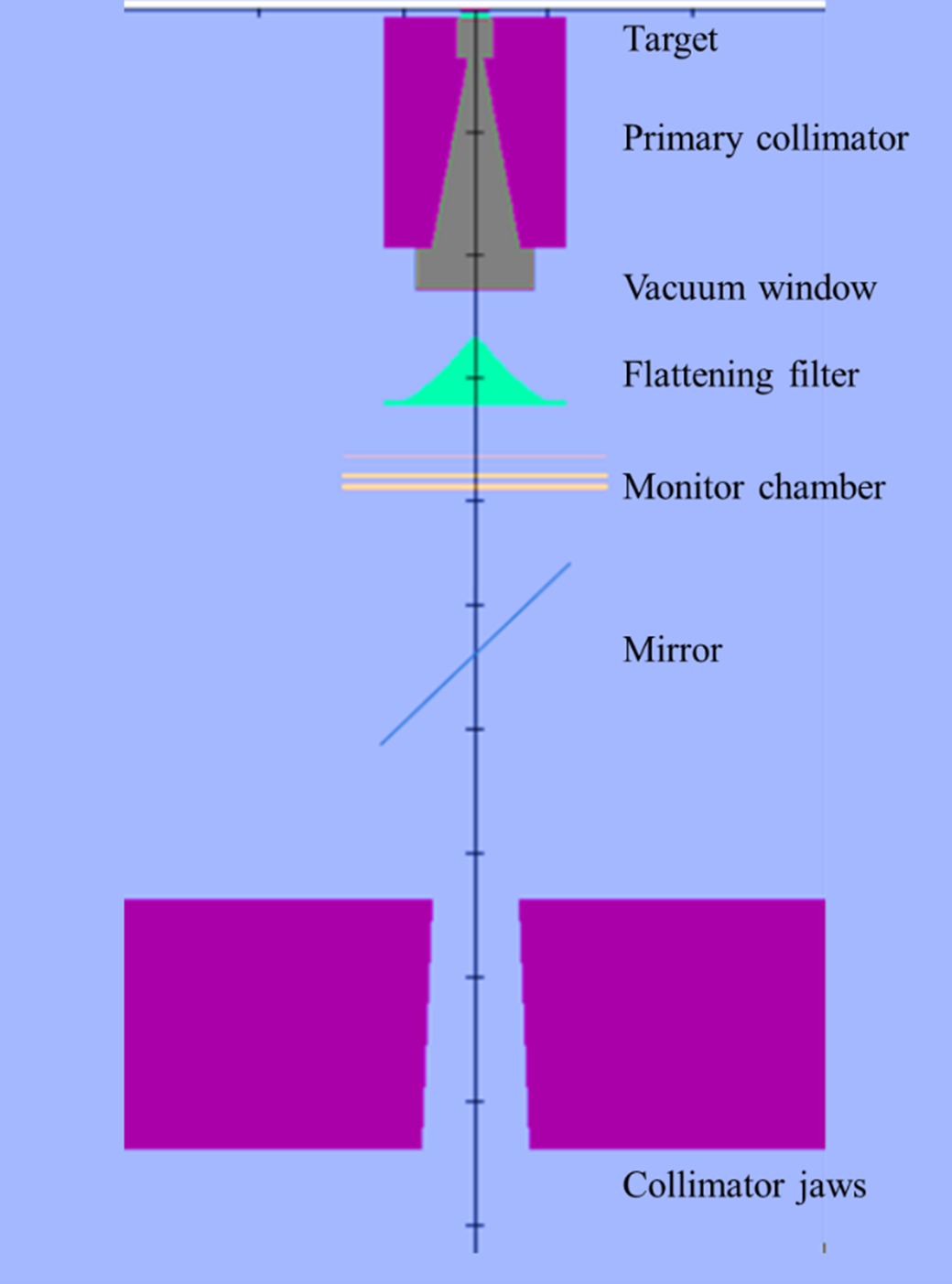
The EGSnrc code Reference Kawrakow21 was used in this study. BEAMnrc was employed for modelling the TrueBeam linear accelerator with 6 MV flattened photon beams. The treatment head geometry of TrueBeam is not available. The previous study claimed a considerable similarity of head assembly geometries between the Clinac 2100 CD and the TrueBeam linacs. Reference Rodriguez, Sempau, Fogliata, Cozzi, Sauerwein and Brualla22 Therefore, this study utilised the treatment head geometry from Clinac 2100 CD, geometry data provided by the manufacturer. Figure 2 shows the schematic of the accelerator model that consists of a target, primary collimator, vacuum window, flattening filter, monitor chamber, mirror and jaws. The beam model used in this study has been previously validated for 6 MV flattened beams by comparing the calculated beam profile and depth dose (DD) with the measurements. Reference Yabsantia, Suriyapee and Phaisangittisakul23 The source parameters used for modelling were 5·9 MeV initial electron energy and 0·11 cm FWHM. For a field size ranging from 0·5 × 0·5 to 10 × 10 cm2, the average difference between measured and calculated DD was 0·94%. The average difference between measured and calculated beam profiles at 10 cm depth was 0·57%. For beam source setting in egs_chamber user code, the BEAM accelerator code was compiled as a shared library and provided with its input file and pegs file.
Schematics of treatment head geometry for a linear accelerator.

The absorbed dose in the small volume of water was determined by the egs_chamber user code. A water phantom with a dimension of 30 × 30 × 30 cm3 was created. The dose scoring volume was generated in a cylindrical shape. The scoring volume dimension was diversified following the field size to reduce the simulation time in larger field sizes. The dimension of 0·015, 0·03 and 0·1 cm radius was set for field size up to 2 × 2, 3 × 3 to 4 × 4 and 6 × 6 to 10 × 10 cm2, respectively. The length of the scoring volume was set to 0·05 cm for all field sizes. The cylindrical volume was placed parallel to the central beam axis at 100 cm SAD (10 cm depth and 90 cm source to surface distance).
The parameters for particle transport are ECUT = 512 keV and PCUT = 10 keV. Variance reduction techniques such as Russian roulette range rejection and photon cross-section enhancement were implemented. The number of particles in a scoring volume of water was calculated to reach the statistical uncertainty of 0·05–0·08% based on field sizes. The doses in small water volume (cGy/particle) were determined for field sizes ranging from 1 × 1 to 10 × 10 cm2. Later, the field output factors were calculated with the 10 × 10 cm2 as the reference field.
Data analysis
The percentage standard deviation (%SD) for each field size was determined to evaluate the variation of output factors among different detectors. It is calculated as the standard deviation (SD) ratio to the mean, expressed as a percentage. The percentage differences between measured and calculated field output factors were investigated for an individual detector to assess improvement in consistency of field output factors after implementing the
 $k_{{Q_{{\rm{clin}}}},{Q_{{\rm{msr}}}}}^{{f_{{\rm{clin}}}},{f_{{\rm{msr}}}}}$
.
Results
The measured field output factors
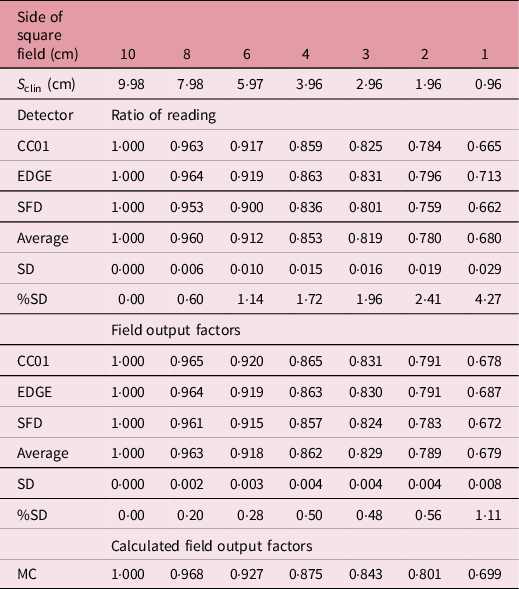
The ratio of readings among the three detectors is tabulated in Table 2. For intermediate field size (4 × 4 to 8 × 8 cm2), the ratio of readings between CC01 and EDGE was comparable. On the other side, SFD exhibited the lowest value and deviated from other detectors. For 3 × 3 cm2 field size or less, the highest ratio of reading was shown by EDGE shielded diode detector. The lowest ratio of reading was observed in the SFD. Comparing the data among the three detectors, the %SD increased when field sizes became smaller. The highest %SD of 4·3% was obtained in 1 × 1 cm2 field size.
The ratios of reading, and measured and calculated field output factors as a function of equivalent square field size, S clin.

As presented in Table 2, the corrected field output factors
 $\left({\rm{\Omega }}_{{Q_{{\rm{clin}}}},{Q_{{\rm{msr}}}}}^{{f_{{\rm{clin}}}},{f_{{\rm{msr}}}}}\right)$
showed much better consistency among three detectors with %SD of 1·1% in the 1 × 1 cm2 field size (S
clin = 9·6 mm). After correction, the
 ${\rm{\Omega }}_{{Q_{{\rm{clin}}}},{Q_{{\rm{msr}}}}}^{{f_{{\rm{clin}}}},{f_{{\rm{msr}}}}}$
of EDGE agreed well with CC01 in small fields to within 1·3%. However, the
 ${\rm{\Omega }}_{{Q_{{\rm{clin}}}},{Q_{{\rm{msr}}}}}^{{f_{{\rm{clin}}}},{f_{{\rm{msr}}}}}$
of SFD was still lower compared to the other detectors.
The dosimeter reading uncertainties at a machine-specific reference field and clinical fields were within 0·2% for all detectors and all field sizes. The uncertainties of
 $k_{{Q_{{\rm{clin}}}},{Q_{{\rm{msr}}}}}^{{f_{{\rm{clin}}}},{f_{{\rm{msr}}}}}$
of CC01, EDGE and SFD were 1·1, 0·7 and 0·5%, respectively. After combining all uncertainties with the effect of the set-up and jaw positioning uncertainties of 1·3%
Reference Papaconstadopoulos, Archambault and Seuntjens20
, the total uncertainties of field output factors determination with expansion were within 3% (k = 2) for all detectors and all field sizes, except the CC01 in 1 × 1 cm2 field size.
Comparison between measured and calculated field output factors
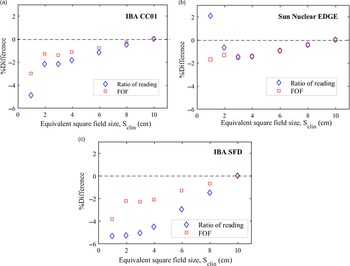
The calculated field output factors from the MC simulation are shown in Table 2, and they were compared with that of measurement. The percentage difference between measurement and calculation by MC simulation in particular methods for three detectors is reported in Figure 3. A discrepancy is expected for uncorrected output factors because the MC calculations report dose to water ratios. In contrast, the measured detector reading ratios include detector response perturbations in the small field.
The percentage difference between the measured field output factors and calculated field output factors for CC01, EDGE and SFD detectors (FOF stands for field output factors).

A decrease in percentage difference to a calculation by MC simulation was found after applying the
 $k_{{Q_{{\rm{clin}}}},{Q_{{\rm{msr}}}}}^{{f_{{\rm{clin}}}},{f_{{\rm{msr}}}}}$
for all detectors, as shown in Figure 3. For field size larger than 1 × 1 cm2, the percentage differences were within 1·5% for EDGE and CC01 detectors and 2·5% for SFD. For 1 × 1 cm2, a difference of 1·7 and 3·0% was observed in EDGE and CC01 detectors, respectively. Meanwhile, a percentage difference of 3·8% was detected in the SFD detector.
Discussion
For the small field size, the highest ratio of reading was exhibited by EDGE shielded diode detector due to the high density of sensitive volume material in conjunction with the embedded brass material as its shielding. The presence of brass shielding material increases the fluence of secondary electrons in silicon diode due to the higher mass-energy absorption coefficient of brass. Thus, an over-response was observed for the EDGE detector in the small field, which agrees with previous publications. Reference Azangwe, Grochowska and Georg24–Reference Tanny, Sperling and Parsai26
For intermediate and large field sizes, the ratio of readings of CC01 and EDGE was comparable, while the results of SFD were lower and showed deviation from other detectors. The unshielded diode exhibited an over-response of output in large fields due to low energy scattered photons in the beam. Hence, an underestimation result was observed when the readings were normalised to a large field of 10 × 10 cm2. This over-response, however, did not occur in the EDGE shielded diode detector since shielding material is present that minimises the effect on the detector response from low energy scattered photons. This explains the agreement in the ratio of readings between CC01 and EDGE for intermediate and large field sizes.
The uncertainty of CC01 was higher than 3% (k = 2) in 1 × 1 cm2. The significant uncertainty was affected by the field output correction factor of CC01 (1·1%). However, these outcomes agreed with the results presented in Tolabin et al. study. Reference Tolabin, Laguardia and Bianchini27
In Table 2, there was a significant variation of the ratio of readings among different types of detectors for smaller field sizes. Therefore, the implementation of field output correction factors is recommended. Preferably, the IAEA-AAPM TRS-483 code of practice stated that averaging the field output factors from at least two different types of suitable small detectors is advised according to the French Society of Medical Physics (SFPM). Reference Palmans, Andreo, Huq, Seuntjens and Christaki1
The larger difference between MC calculated field output factors and measured values following the IAEA-AAPM TRS-483 code of practice recommendations for the smallest field size (10 mm) might be due to a combination of reasons. These include sensitivity of the tuned MC model to exact source and collimator parameters, which affects the prediction of accelerator output in very small fields (10 mm). In addition, experimentally, detector positioning during the measurements in the smallest field size and alignment of the detector sensitive volume with the actual beam axis is a challenge. For this reason, the IAEA-AAPM TRS-483 report recommends the use of multiple detectors corrected using field output correction factors to establish the field output factor for small fields.
In practice, accurate field output factors are needed to implement in the computerised treatment planning system. When a small radiation field is used, the accurate determination of field output factors is challenging. This study provided the data to consider some suitable detectors for small field output factor determination. The result also confirms that the small detectors with appropriate field output correction factors are necessary to achieve the accurate field output factors, as shown in the results compared with MC simulation. The study of Mamesa et al. supports our results. They illustrated that the accuracy of the field output factors is one of the parameters influencing the dose calculation in the treatment planning system in terms of MU calculation for clinical cases of Intensity modulated radiotherapy and Volumetric modulated radiotherapy. Reference Mamesa, Oonsiri, Sanghangthum, Yabsantia and Suriyapee8 Therefore, selecting the appropriate detectors with the recommended field output correction factors is essential for beam commissioning.
In addition, the CC01 and EDGE diode detectors with applying the field output correction factors are recommended for determining the field output factors for field size down to 1 × 1 cm2. The SFD unshielded diode detector showed higher field size dependence and over-response of output in large field sizes. Therefore, the intermediate field method to link the difference of response for small and large fields for unshielded diode detectors should be applied for SFD as suggested in IAEA-AAPM TRS-483· Reference Palmans, Andreo, Huq, Seuntjens and Christaki1
Conclusion
The determination of field output factors in small fields using the field output correction factors based on the IAEA-AAPM TRS-483 code of practice presents a lower %SD (better consistency of three different detectors). The measured field output factors agree well with the calculated field output factors using a tuned MC beam model (less than 3% difference), except the smallest field size of SFD unshielded diode detector. For further recommendation, CC01 and EDGE diode detector are suitable for determining field output factors, while the SFD may need more implementation of the intermediate field method as the suggestion in IAEA-AAPM TRS-483.
Acknowledgements
This research is a part of Testing the IAEA-AAPM Code of Practice on small field dosimetry (IAEA CRP E 2.40.21). The permission to use the computer cluster from the Medical Physics Unit, McGill University, was essential. Without permission from the Varian Medical System to use information from the drawing in the Monte Carlo simulations, this work would have been impossible.
Conflict of Interest
No conflict of interest to declare.