I
One of the defining features of nineteenth-century musical thought concerns the ever-increasing separation of the activities of the composer and the performer, and the emergence of a new conception of the nature and aesthetic status of musical performance. Many of our contemporary ways of thinking about music and musical experiences, including our tripartite classification of involvement in music as either listeners, composers or performers that we regard as self-evident, are in fact rooted in this conceptual shift that took place during the course of the nineteenth century. Our standard understanding of the performer's musical activity in the Western classical tradition as categorically distinct from the processes of composing music is largely the result of the waning during the nineteenth century of a long aesthetic tradition that based its foundations on the art of rhetoric. Indeed, prior to the nineteenth century ‘analogies between rhetoric and music permeated every level of musical thought, whether involving definitions of styles, forms, expression and compositional methods, or various questions of performing practice.’Footnote 2 Accordingly, performance was regarded as the final stage in the musical art of oratory, or the pronuntiatio constituting the delivery of the musical oration. Thus subsumed under one and the same model, compositional practice and performance were conceptualized as merely the different stages of a unified activity, and in that sense composing and performing music were not regarded as clearly differentiated pursuits.
With the nineteenth century came various changes in musical practices that weakened and ultimately put an end to the rhetorical understanding of the performer's role. First, the emerging awareness of a historical repertoire gave performers a more specialized role in the transmission and dissemination of pieces of music. As Lewis Rowell writes, ‘the new demands for technical accomplishment meant that many composers could no longer play their music acceptably, and the rigorous process of acquiring such a virtuoso technique made it difficult for a performer to maintain a total commitment to composition.’Footnote 3 While the eighteenth-century composer was often the performer of his own music, during the course of the nineteenth century the identity of the performer came to be defined as one playing the music of those who specialize in composing. Second, improvisation, which was once a standard part of a concert by Dussek, Hummel, Czerny and Mozart, gradually started to decline, moving the performer one more step away from compositional practice. The skills shaping the musicianship of a performer would no longer be defined in reference to composing.
Arguably the most significant change concerned the transformation that took place in the status of the musical score, which set in motion (ongoing) debates concerning its relationship with the performing musician, paving the way towards the conception of the performer as an ‘interpreter’. As the score began to represent the composer's authoritative text, the continuum that existed between the score and performances in earlier eras started to break down such that the notated music could now be understood to embody an autonomous musical artwork. In contrast to the rhetorically based and homogeneous eighteenth-century conception, nineteenth-century discussions about the role of the performer vis-à-vis the score, and thereby about the interpretative process, would for the first time yield multiple aesthetic models of performance. For instance, while Liszt promoted the view that the performer ‘is not a mason who, chisel in hand, faithfully and conscientiously whittles stone after the design of an architect … He creates as the composer himself created’Footnote 4, E.T.A. Hoffmann believed that the true performer ‘disdains to let his own personality intervene in any way’Footnote 5 in delivering the composer's work. Anton Rubinstein's remarks in this connection render the conflict between these two notions regarding the performer's role – either as a transparent medium transmitting the composer's message or as a creative artist on a par with the composer – even more complex:
I hear so much about the subjective and objective in interpretation; which is the better? I am wholly at a loss to understand what is meant by the objective in interpretation. Every interpretation, if it is made by a person and not by a machine, is eo ipso, subjective. To do justice to the object (i.e. the composition) is the law and duty of every interpreter, but of course each one in his own way, i.e. subjectively.Footnote 6
Within such diversity of views about the performer's interpretative activity, and the attendant conceptual conflicts, the need to explicitly theorize about and provide explanations for the nature of musical performance and of the performer's relationship with the composer, the score and the rising concept of ‘the work’ became urgent. The emergence of the musical performer as an autonomous category deserving of full attention during the nineteenth century motivated the first philosophical debates as well as the first psychological explanations regarding what it is that performers do.
My aim in this essay is to present a thread running through nineteenth-century musical thought and leading to the emergence of a profound conceptual transformation in the way the fundamentals of performance making were understood and explained during the nineteenth century. This thread, which moves along the junctures of nineteenth-century aesthetics, music theory and performance pedagogy has been entirely neglected in recent accounts concerning the changing roles of the composer and the performer, the transformations in the status of the musical score, and the consequent rise of the concept of ‘the musical work’ during this period. The most widely accepted contemporary account in this connection – namely Lydia Goehr's narrative in relation to the appearance of the regulative concept of the musical work at the end of the eighteenth century and the performer's stance regarding the workFootnote 7 – is based on the assumption that during the nineteenth century the score was regarded as the locus of the musical work; the implication is that for the performer knowing, interpreting, and being faithful to the work was identical to knowing, interpreting, and being faithful to the score. In the words of Goehr
The ideal of Werktreue emerged to capture the new relation between work and performance as well as that between performer and composer. Performances and their performers were respectively subservient to works and their composers. The relation was mediated by the presence of complete and adequate notation … Thus, the effective synonymity in the musical world of Werktreue and Texttreue: to be true to a work is to be true to its score.Footnote 8
In her detailed elaboration of this central thesis in her writings, Goehr frequently uses the notion of ‘the music’ interchangeably with that of ‘the work’, treating the two as synonyms. For instance, when discussing the model of performance which she coins as ‘the perfect performance of music’ and which came about as a direct consequence of the work concept to embody the ideal of ‘faithfulness to the work’, she writes that ‘the perfect performance of music is the perfect performance of a work.’Footnote 9 By implication, music – and not only the work – is assumed to reside, ontologically and epistemologically, in the score. This unquestioning sleight of hand reducing ‘music’ to ‘work’ is in fact contrary to the essence of the performance-oriented discourses of the nineteenth century, and obscures the existence of two separate histories that developed in parallel during this period: while one of these histories evolved to indeed equate the score with the work, leading to well-known pronouncements during the twentieth century by the likes of Hindemith, Stravinsky and Schoenberg to the effect that the performer is essentially unnecessary for the art of music and that the work can be experienced and known independently of its performances via score-reading,Footnote 10 a parallel history was shaped by the belief that ‘the music’ is strictly not in the notated score, coming into being only in the act of performance, which is essential for the emergence and communication of any musical meaning. More significantly, the discourse of this parallel history identifies the performer's primary, defining relationship to be with the music rather than with the score or the work.Footnote 11 The explicit introduction of the notion of ‘the music’ into the network of relationships between the composer, the performer, the score and the work during this period further complexifies the history of nineteenth-century performance theory.
The tensions between these co-existing lines of thought partly derive from a visual versus an aural grasp of the musical score, with the former approach representing the ideology of the score-as-work where the seeing and reading of the notation on the tangible, visual object individuates the work, and the latter that of the music-behind-the-score where the same visual object is construed or imagined aurally as a sounding phenomenon, with additional expressive details that the score does not or cannot specify, i.e. as ‘the music’ specifically to guide performance. The possible historical roots of this rift are to be found, according to Bujić, in Beethoven's diminishing ability to continue reliably the tradition of seamlessly binding the score and performance practice. He writes that as Beethoven gets
progressively more isolated from the physical datum of sound, he has to rely more and more on the verbal and graphic additions to the score instead of providing through his own performance the model of how music is to sound. It is instructive to compare the relatively sparse expressive markings in the earlier sonatas with the profusion that can be observed in the late works … The notation becomes more and more invested with details which are designed to ensure that the image of the notation, its visual appearance, contains within itself the determinants of ‘the Work’.Footnote 12
According to Goehr, it is this kind of ‘finished’ or ‘finalized’ visual representations of pieces of music that ultimately led to ‘a kind of untouchability which, translated into concrete terms, meant that persons could no longer tamper with composers’ works’;Footnote 13 and ‘if a work was untouchable, then barring obvious extenuating circumstances so was its representation by the composer in notational form.’Footnote 14 Even if such was the wish of (some) composers during the nineteenth century, the score was clearly not untouchable for performers and performance theorists: few pianists from the mid-nineteenth century, for example, would have regarded Chopin's scores as untouchable as they freely added octaves and ornaments, or left out sections of the music written in the score.Footnote 15 Furthermore, there is evidence that composers did not mind the interpretative liberties performer took in playing their works.Footnote 16 More significant, however, is the fact that performers and performance theorists from the second half of the nineteenth century regarded themselves licensed not only to change but also to correct the notated score in cases where they believed the visual representation did not properly guide them in an intelligible and expressive delivery that would reflect the musical meaning they believed the composer intended. The implications of this wide-spread practice, exemplified in the works of such theorists and pedagogues as Mathis Lussy (1828–1910), Hugo Riemann (1849–1919), Tobias Matthay (1858–1945) and Steward Macpherson (1865–1941),Footnote 17 are profound as far as the performerly conception of the score is concerned. Accordingly, the fact that the composer is the creator of the music does not guarantee that the way he notates it actually reflects his intended musical meaning, and consequently it is up to the performer to discover the music behind the notes and correct, if necessary, the notation to guide him in a performance that is musically meaningful. Within this thread of nineteenth-century musical thought, the score is to be understood only as a guide for revealing in performance the music the composer created rather than as the representation of his final, authoritative work.
The basis of this approach towards the score lies partly in the growing dynamic conception of the constituents of music during the nineteenth century, rendering the complete non-congruity between the spatial-static visual mode of the score and the temporal-dynamic aural nature of music increasingly more evident. The uneasiness in the face of this obvious conflict between the visual score and the audible music is most acutely felt and expressed in the context of discussions concerning a newly emerging concept, which would come to refer by the end of the century to one of the most basic skills exercised by a performer in conveying ‘the true meaning of the music’Footnote 18: this is the concept of phrasing. Proper phrasing in performance requires the performer to first and foremost mentally hear the music behind the notation rather than merely to translate into sound the symbols written on the score. In other words, phrasing is ‘the result of musical perception’.Footnote 19 As a visual representation, the score cannot capture the joint phenomenal qualities of the sounds making up the coherent structure we perceive as music, and in that sense phrasing depends on a musical comprehension and interpretation of the total aural phenomenal effect of the individual visual signs on the notated page.
II
The emergence and development of phrasing as a new concept during the nineteenth century is inextricably bound up with the changes that are reflected in the discourses of music theory, aesthetics and performance pedagogy of the period. In this section, I first discuss what the new concept of phrasing involves, consider the factors that contributed to its establishment and explore the nature of discourses on musical phrasing. I also introduce the first psychological theory of musical performance proposed during the second half of the nineteenth century, directly connected to the practice of phrasing.
The first theorist to use the term phrasing (phrasé) in the context of musical performance is Jérôme-Joseph de Momigny (1762–1842).Footnote 20 Although compositional treatises from the eighteenth century do include the term ‘phraseology’, which refers to the way the musical phrase is to be treated in the creation of large-scale forms, to my knowledge the term ‘phrasing’ does not appear in reference to musical performance prior to Momigny. Distinguishing for the first time phrasing in composing and in performing music, he states in reference to the latter that it concerns not only the articulation of group beginnings and endings, commonly explained by reference to the rhetorical notion of punctuation (ponctuation), but also the subordination of the phrases to one another.Footnote 21 Eighteenth-century performance discourse employs the term ‘punctuation’ in the context of clarity of performance, an idea discussed in great detail by each and every writer, invariably through analogies to rhetoric, as the first requirement for a ‘good execution’. In this connection, much emphasis is given to the correct communication of phrase (and sub-phrase) divisions through proper punctuation. To cite but one example, eighteenth-century composer and critic Johann Schultz wrote that ‘it is incredible how greatly the melody becomes disfigured and unclear if the phrase divisions are incorrectly marked or indeed not marked at all.’Footnote 22 In essence, the practice of musical punctuation concerns the grouping of notes into musical units mainly by the introduction of more or less noticeable breaks: it concerns marking and making known the beginning and ending of each musical phrase by means of pauses and proper accentuation, and sometimes a diminuendo.
Contemporary musicologists writing about eighteenth-century performance practices frequently refer to the criteria for correct ‘phrasing’ specified in the pedagogical texts of the period: for instance, in his Classical and Romantic Performing Practices 1750–1900, Clive Brown discussesFootnote 23 how Daniel Gottlob Türk explained ‘phrasing’ in relation to structural accentuation in his Klavierschule Footnote 24 of 1789. Margery Halford, in her introduction to the English translation of François Couperin's L'art de toucher de clavecin of 1716 includes a section titled ‘Couperin's definition of phrasing’ where she quotes Couperin's remarks that the sign resembling an apostrophe
is to indicate an end of the melody or our harmonic phrases and to make it clear that it is necessary to separate the end of the melody a little before passing on to what follows. In general, this is nearly imperceptible, but when one does not observe this little silence, persons of taste and feeling will feel that something is lacking in the execution.Footnote 25
Similarly, Stephanie D. Vial's book titled The Art of Musical Phrasing in the Eighteenth Century is concerned with the theory of punctuation espoused during this period. What these and other contemporary writersFootnote 26 identify anachronistically as discussions of musical ‘phrasing’ in eighteenth-century sources are in fact discussions about the communication of phrase divisions in performance. As I shall argue, the term ‘phrasing’ refers to a different concept that comprises more than the articulation of phrase divisions and, more importantly, is the offspring of nineteenth-century musical thought. Performance discourses prior to the last decade of the eighteenth century do not include the term, and therefore the concept of phrasing: they rather talk about ‘the separation of groups of notes’, about ‘accentuation’, about ‘punctuation’ for an intelligible delivery of the music. The term does not appear, for example, in Brossard's Dictionnaire de musique of 1703, Rousseau's Dictionnaire de musique of 1768, or Koch's Musikalisches Lexicon of 1802.Footnote 27 From its first appearance in Encyclopédie méthodique of 1791, the concept of phrasing became an important part of performance pedagogical discourse, and by the time Riemann published his Musikalische Dynamik und Agogik: Lehrbuch der musikalischen Phrasierung in 1884, it was part of the standard themes in theoretical and critical writings on performance. While the nonexistence of the term itself does not necessarily indicate a lack of awareness about phrasing in earlier periods, the explicit introduction of the term and concept into performance discourses is a clear sign of the influence of compelling changes taking place in musical thought during the nineteenth century.
One of the most significant of these changes motivating the emergence of phrasing as a concept distinct from punctuation or the grouping of notes concerns a changing attitude towards two parameters that have been considered indispensible for the act of music making since the earliest treatises on performance pedagogy: these are clarity, or intelligibility, and expression. Accordingly, the performer needs to make music intelligible and expressive in performance so that the listener understands it and is affected by it. While clarity is routinely associated with proper musical punctuation within the abundant eighteenth-century literature on performance pedagogy, the same sources discuss expression invariably as an issue separate from clarity: it is always explained in the context of the ‘the passions’ identified in a composition. While various means of achieving expression – such as use of dynamic and tempo variations – are stipulated, these being identified as the same means available to the orator, no theories are put forward regarding the source and cause of expression in performance. The general consensus is that this is ultimately a matter of innate talent and sensitivity. C.P.E Bach, for example, wrote in relation to the use of tempo changes for expressive purposes that its proper execution
demands great critical faculties and a high order of sensibility. He who possesses these will not find it difficult to fashion a performance whose complete freedom will show no trace of coercion, and he will be able to manipulate any kind of passage. However, practice alone will be of no help here, for without a fitting sensitivity, no amount of pains will succeed in contriving the correct rubato.Footnote 28
Eighteenth-century sources on performance typically advise instrumentalists to take every opportunity to hear artistic singing in order to learn and understand the essence of expression in performance, since they share the belief that ‘certain subtleties of expression cannot really be described; they must be heard.’Footnote 29 One assumes that the impossibility of description mentioned in this quotation covers not only contexts of verbal instruction and critical commentary, but also of directions written for performers on the score. Here, we already have the seeds of the conflict between the sounding music and its representations in different modalities that would come to characterize much of the performance discourse during the nineteenth century.
One of the most remarkable conceptual transformations that took place during the course of the nineteenth century is that the means for achieving the fundamental requirements of intelligibility and expression in an artistic musical performance converged in the concept and practice of musical phrasing. As a concept, phrasing evolved to refer to the shaping of the musical phrase and its sub-units in accordance with their internal dynamic structures in a goal-oriented manner so as to make it simultaneously intelligible and expressive: a clear and expressive delivery of the music could be achieved through the same means, namely phrasing. Today this concept continues to be the very basis of performance pedagogy. Even though performance styles have changed rather dramatically between the early nineteenth- and early-twenty-first centuries, conceptually the practice of performance still relies on the unity of the means for achieving clarity and expression: we take it for granted that when the performer is able to make the structure or form of a musical phrase intelligible, he simultaneously renders it expressive.
The factors that contributed to this momentous change in the history of performance theory, merging intelligibility and expression into one theoretical and practical parameter, are numerous, and include the aesthetics of formalism as well as the rise of a dynamic understanding of tonal material as the basis of music, which would become a pervasive theme in music theory. I take up each of these factors in turn to illustrate their contribution to the emergence of the concept of phrasing, and also to highlight their role in this neglected history shaped by the idea of ‘the music’ existing firmly beyond the notated score.
The most fervent advocate of musical formalism during the nineteenth century, namely Eduard Hanslick, put forward the thesis in his influential book On the Musically Beautiful first published in 1854Footnote 30 that there is no semantic content to music beyond its structural, formal properties. Form in music comes into being with its content, and therefore content is inseparable from form: ‘Musical champagne’, wrote Hanslick, ‘has the property of growing with the bottle.’Footnote 31 Such an assertion starkly contrasts with the idea in eighteenth-century musical aesthetics that the puzzling reality of music's intelligibility without recourse to conceptual cognition can be comprehended by reference to ‘the passions of the soul’.Footnote 32 Eighteenth-century writers believed that since the passions always came with their natural expressive manifestations in tone, gesture, etc. immediately and universally recognizable by all people, music's capacity to portray these manifestations would secure its intelligibility. The listener's comprehension of and affective responses to music was thus explained by reference to his first-hand knowledge of the passions of the soul. In contrast to this view, formalist aesthetics no longer required the input of non-musical experiences and knowledge to explain the intelligibility and expressive powers of music. Music as an art could stand on its own feet, as it were, and make sense by itself through its musical qualities. Thus removing the need to refer, as music's content, to a common emotional life expressible in instantly recognizable forms, musical formalism was able to hold that the expressive content listeners hear in music arise from the ways musical materials are organized. Hence, Hanslick wrote that
the passionate effect of a theme does not arise from any extravagant grief that we are to imagine in the composer, but from the extravagant intervals in his music, not from the trembling of his soul but the rolls of the timpani, not from his nostalgic yearnings but from the chromatic nature of his harmony.’Footnote 33
It is important to remember that the move towards formalism in music aesthetics was greatly supported by the sweeping influence of Kant's analysis of the cognitive functions of the human mind: indeed, the beginnings of the notion that there is a mental faculty specifically devoted to musical cognition and providing a synthesizing form to incoming acoustical stimuli,Footnote 34 is rooted in Kant's theory of the synthetic acts of the mind in understanding phenomena.Footnote 35 This is the beginning of the idea that music can indeed be understood and judged in musical terms, without reference to non-musical concepts. By the end of the nineteenth century, the hypothesis that meaning can be communicated through non-conceptual means, music being the prime example of such non-conceptual cognition, was firmly recognized.Footnote 36 We find an early expression of the idea that the evaluation of music should be based on musical criteria in Christian Friedrich Michaelis, who was ‘one of the first to investigate the application of Kant's aesthetic theories to music.’Footnote 37 In his articles published in the Leipzig Allgemeine musikalische Zeitung in 1806 and 1807, Michaelis argued that
Since the sounds communicate no tangible or visible material objects, and since they make us conscious of spatial substance other than ourselves (our immediate awareness of music being in no way dependent on extraneous factors) the sounds themselves constitute influences on our personality … If the intellect is the source of that cognitive clarity which thinks, differentiates between, integrates and coordinates the multiplicity of our sense-impressions, it is natural that an art that does not express itself through words, which makes use of no code of concepts, and which does not appeal directly to the intellect, will lack a certain clarity if one judges it by purely cognitive standards.’Footnote 38
Foreshadowing the formalist thesis that would later become central to Hanslick's work, Michaelis also put forward the idea in relation to music's form and content that
Music's extension is thus movement in time alone; its essence is origin, growth, change, decline and end … Should then the interest, the charm and the magic of music necessarily originate in what the melodies mean rather than in the manner in which they are shaped? I think it is a matter more of musical form rather than of what the music expresses … what delights and enchants us is how the composer uses sound to create melody and harmony, thereby evoking a specific reaction: in other words, it is the form of the music.’Footnote 39
It is indeed a short step from the aesthetic perspective put forward by Michaelis here to the two fundamental assertions in Hanslick's theory, portraying music – through a memorable image – as tonally moving forms and declaring that it ‘must in fact be grasped as music and can only be understood in its own terms and only enjoyed in its own way … There is sense and coherence in music, but it is musical sense and musical coherence.’Footnote 40
It is not difficult to see how the application of the formalist musical aesthetics to the domain of musical performance during the nineteenth century provided the edifice for the concept of phrasing as a theoretical and practical tool: accordingly, since form and (expressive) content are identical in music, the communication of one of these dimensions in performance would guarantee the communication of the other as well. Consequently, when the performer shapes the musical phrase so as to render its form comprehensible to listeners, he or she at the same time and through the same means makes it expressive. Phrasing reveals both the form and the content of music. Furthermore, formalism openly pointed to the source where the performer should seek solutions to issues of expression in performance: the musical elements and structures, constituting the music itself.
In reference to formalist aesthetics, Goehr argued that it has a tendency ‘to neglect the role of human action, a neglect stemming from an age-old preference in Western thought for knowing over doing.’Footnote 41 However, Hanslick's overlooked, rarely quoted, yet all-important statement that
Anyone who wishes to specify the ‘content’ of a musical phrase has no choice but to play the phrase itself. In fact, the ‘content’ of a musical composition can never be grasped objectively [gegenständlich] but only musically, i.e. as the concrete sounds of which the work is composedFootnote 42,
reveals his commitment to the ‘doing’ in the generation of musical meaning as opposed to mere ‘knowing’. Having put forward one of the most influential music aesthetic theories in his time, there would have been nothing to stop him from stating instead, had he wished, that one has no choice but to ‘look at the score’, or ‘read the score’ in order to specify the content of a musical phrase. Yet, this is not what he claimed: from his formalist stance, he clearly assumed that firstly, ‘the music’ is not in the signs written on the score, and that secondly, it comes into being in the act of performance, in the sounding phenomenon brought about by human agents. It is the performer who animates the tones to make music, or the tonally moving forms. Furthermore, he believed, along with Michaelis and other nineteenth-century writers, that at work in our relationship with music is a specifically musical faculty, functioning in accordance with its own principles to ensure our comprehension of and affective responses to music.
While formalism thus provided one of the theoretical pillars upon which the concept of phrasing was built, the other pillar was supplied by the growing dynamic understanding of the tonal material in nineteenth-century music theory, which changed the way the musical phrase itself was conceived and studied. Prior to the nineteenth century, the study of the musical phrase was part of the study of form, which belonged firmly in compositional pedagogy. Theoretical interest in the musical phrase was limited to its capacity to create large-scale forms, and compositional treatises from the eighteenth century abound in various techniques to be employed by the composer for this purpose.Footnote 43 From the end of the eighteenth century onwards, we see a shift in theoretical focus: the phrase is no longer scrutinized merely as the relationally defined building block of musical form, but is approached as a self-sufficient entity. Discussions about the musical phrase are increasingly concerned with its internal dynamic shape and its conditions of unity. Among the most influential factors motivating such a shift is the growing interest in dynamic phenomena, an interest directly inspired by the underlying tendency of nineteenth-century thought to prioritize becoming as opposed to being.
In the history of Western thought, the nineteenth century is recognized by the great emphasis given to such concepts as change, movement, process and temporality. This emphasis was largely motivated by the scientific developments of the era. ‘In spite of the cliché which is often applied to descriptions of nineteenth-century music’, writes Bujić, ‘emphasizing its emotionalism, reliance on fantasy, the cult of the virtuoso and a certain transcendental tendency, the century was also the period of immense advances in the sciences.’Footnote 44 The important advances made in physiology, for instance, brought about a focus on process rather than on immobile, static structures within biology that earlier had focused on anatomy. Application of dynamic conceptions to phenomena that would now fall within the domain of social sciences, and to the arts via organicist aesthetics became the hallmark of nineteenth-century thought. The nineteenth-century French philosopher and critic Ernest Renan (1823–1892) wrote that
the great progress of criticism has been to substitute the category of becoming for the category of being … Formerly, everything was considered as being, one spoke of philosophy, law, politics, art, poetry in an absolute manner; now everything is considered as in the process of becoming (en voie de se faire).Footnote 45
Although we already find in Génération harmonique (1737) by Jean-Philippe Rameau (1683–1764) an explanation of harmonic progression in dynamic terms, particularly in his account of the musical cadence in terms of the gravitational pull of the dominant chord towards the tonic,Footnote 46 it is during the nineteenth century that a dynamic approach to the melodic dimension of music is for the first time firmly articulated. François-Joseph Fétis (1784–1871) is usually credited for having popularized the notion of ‘tonality’ in the 1830s as the sum total of the relationships between the pitches of the scale regulated by the attractive forces between them.Footnote 47 It is, however, in the writings of Jérôme-Joseph de Momigny that we have the very first expression of not only a dynamic and directional but also a hierarchical conception of the relationships between the pitches of the scale. Momigny is the first to systematize the idea of ‘attractional forces’ to explain this relationship.Footnote 48 His theory attributes the tonal system an autonomy in that the principles of movement, development and evolution of tonal forms are now seen to arise from the relationships between the tones themselves. In other words, musical form is not the result of a mechanical, additive process juxtaposing blocks of tonal material, but an organic one arising from forces intrinsic to tonal relationships.Footnote 49 According to this view, the attractional forces render the relationship between the tones inherently expressive of such qualities as movement, tension and relaxation, growth and decay, ebb and flow.
The most significant implication of Momigny's theory of tonal attractions for the history of nineteenth-century performance theory is the idea that musical form is primarily a manifestation of a force exercising its authority inexorably even beyond the will of the composer. The inference that music has its own laws, subsuming both the composer and the performer, introduces a new dimension to the debate concerning the relationship between the performer, the composer and the work. According to such a dynamic, organic understanding, ‘music is understood primarily as motion and as an expression of a force or will beyond the composer. Within this model, compositions can no longer be interpreted through reference to the composer's psychology or biography’.Footnote 50 The ‘musical work’ the composer creates is like a living organism with a life of its own, and is in this sense beyond his or her absolute control and authority. Momigny further substantiates the implications of his theory of tonal attractions, which posits the functioning of forces in the creative process beyond the total control of both composers and performers alike, by claiming in his arguably most momentous departure from his predecessors that music is subject to laws of understanding innate with man, and that the hierarchy we hear in the tonal material is purely a psychological phenomenon and cannot be derived from the physical nature of sounds. In this regard, his theories display the decisive influence of Kant, who proposed that the forms in which the acts of understanding, namely reasoning and judgment, are carried out are within us and not received from outside.Footnote 51 According to Kant, logic, as the science of the laws under which the mind operates, would thus be conceived as inherently psychological. It is precisely in this sense that Momigny calls his theory ‘the doctrine of musical logic’. He writes that ‘there is a logic of sounds as there is one of ideas or of the words that present them’ and that the laws of this logic are written in ‘our soul, in the way we perceive.’Footnote 52 It is no surprise that the most influential music aesthetics of the period displays total congruity with this dynamic theory of music and music perception in arguing for the existence of a specifically musical logic: hence Hanslick would state that the composer in creating music is subject to an ‘intrinsic rationality … inherent in the tonal system.’Footnote 53 Indeed, both the composer and the performer are subject to the laws of musical logic in that they both experience the tonal relationships within the Western tonal system necessarily as hierarchical and directional; they both have to work with tonal material already always in the process of becoming through the action of tonal forces. This is indeed the basis for announcing the performer's primary alliance and loyalty as being to ‘the music’ rather than to the work or the composer; it is only as a by-product of his or her loyalty to the music that the performer's loyalty to the composer's work can be articulated.
The concept of phrasing emerging as part of a theory of performance during the nineteenth century is intimately related to this prevailing theory of musical logic: accordingly, proper phrasing in performance is based on the performer's response to the incitement of the active tonal material, to his recognition of the attractional forces shaping the course of the phrase. Crucially, it is not sufficient to set off the boundaries of musical phrases through accentuation and punctuation in phrasing, since the performer also has to direct each phrase towards its point of repose, thus shaping its inner structure in accordance with musical logic and sustaining the dynamic impulse till the point of repose. Indeed, this is how one of the most influential performance theorists of the second half of the nineteenth century, Mathis Lussy, explained this basic principle of musical performance.Footnote 54 He argued that the performer ‘should not think that it is sufficient to introduce longer notes and rests regularly and fortuitously into a series of sounds to give them meaning. In addition, the sounds must be subject to the laws of attraction, of appeal that govern our tonal system.’Footnote 55
Lussy's theory of expressive performance is the first explicitly psychological theory regarding the role of the performer. Indeed, his conception of expression in performance constitutes the origins of contemporary research in music psychology, which is based on the assumption that performance expression and musical structure are somehow related.Footnote 56 Lussy's hypothesis that there is a causal link between musical structures and performance expression is a conceptual turning point in the history of performance theory. To be sure, the grounds for Lussy's theory had already been prepared by Hanslick's formalist aesthetics, which hypothesized that every musical work must have spiritual content but this content ‘cannot be traced to any source other than the musical structures themselves.’Footnote 57 If the expressive content of music thus originates strictly in the musical structures, then the performer's interpretative activity aimed at delivering this expressive content intelligibly to listeners must take its cue from these structures. Departing from his eighteenth-century predecessors, Lussy claimed that the generating causes of expression in performance are to be found in the musical structures themselves rather than in the innately talented, inspired soul of the performing artist. Through his theory, put forward in Traité de l’expression musicale (1874), Le rythme musical (1883) and L'anacrouse dans la musique moderne (1903),Footnote 58 Lussy attempted to establish a ‘grammar of musical execution’, specifying the relationship between particular kinds of rhythmic-tonal structures and the expressive profiles they generate in terms of timing and dynamics in performance.Footnote 59 In Lussy's theory the performer plays an active role in bringing about this inherent, implied expression, by going beyond the visual score and hearing ‘the music’: ‘Certain artists’, he writes, ‘perceive the impregnations and incitements behind the notes. They possess the means to release the musical idea [from the notes] in order to animate and spiritualize the work they interpret.’Footnote 60 In other words, performance interpretation is the result of the performer's response to ‘the music’, to its constituent structures. As the music creates certain impressions on the performer, he actively externalizes these impressions by translating them into subtle changes and adjustments in timing and dynamics as the music unfolds. In Lussy's words, ‘musicians hasten, slow down, display energy and passion, or restrain their ardor and prefer delicacy, not because of caprice, but under the irresistible impulsion of certain tones.’Footnote 61 In explaining this mechanism, Lussy writes that
The musical faculty, in its relationship with the notes that generate expression, is similar to a kind of photographic plate. According to its degree of sensitivity, this plate is more or less susceptible to receiving impressions and [in turn] to reflecting them in a more or less powerful and faithful manner. If it is dull, the exceptions, the subtle irregularities will glide by without leaving a trace. If, on the contrary, it happens to be alert, sensitized, the least perceptible irregularities, the most elusive facts will make a clear impression, excite its activity and will be reflected with energy and force.Footnote 62
Lussy is also insistent that that the notes need to be comprehended in accordance with musical logic, that is mentally heard, imagined and interpreted as music before any performance expression could arise:
The performer, who does not feel either the attractions of the tonic, or the need for the regularity of accented notes and symmetry of rhythmic groups, is not affected in any special way by the irregular notes; [he] accepts passively, without resistance, not only the notes most destructive of the key, of the mode and of the measure, but even the most incongruous rhythmic irregularities. Thus he renders them without passion, without energy, without life, without poetry: [for] he cannot express what has not affected him.Footnote 63
One of the examples Lussy gives to illustrate how the tonal-rhythmic structures imply expressive timing profiles to be employed in phrasing them in a clear and expressive delivery is the beginning of the third movement of Beethoven's Piano Sonata op. 13, which involves an anacrusis (Example 1). According to Lussy, the three pitches preceding the initial downbeat provoke a slight acceleration not only because they descend, but also because they start on the weak part of a weak beat. They are deprived of the support only the strong part of a beat can provide: ‘as a result, a certain anxiety, a certain nervous agitation resembling the experience of a bather who loses his balance manifests itself by an accelerando.’Footnote 64 Furthermore, the attraction of the notes of the anacrusis to the mediant pitch on the initial downbeat, inherent in the diminishing size of the intervallic steps, is augmented by the acceleration.
Beethoven, Piano Sonata in C minor op. 13, mvt. iii, bars 1–3

Another example demonstrating the necessity of relying first and foremost on one's musical sense rather than on the notation in the practice of phrasing concerns Chopin's Nocturne op. 48 no. 2, which starts with a phrase that appears anacrustic on paper (Example 2). However, this beginning lacks the quality of moving towards the initial downbeat, which is an essential feature of anacrustic beginnings. Because of the absence of a determinate initiation, this phrase is experienced neither as ‘moving away’ not as ‘moving towards’ giving it a unique expressive quality; in Lussy's words this is an example of a ‘decapitated’ [décapité] phrase and as such it proceeds ‘in a heavy, hesitant, anxious manner’ since it lacks the ‘assurance’ an initial downbeat provides.Footnote 65 Accordingly, the absence of an initiating impulse temporarily ‘paralyzes’ the attractions between the notes.
Chopin, Nocturne op. 48, no. 2, bars 1–3

Lussy's theory furnishes the rising idea of the performer-as-interpreter during the nineteenth century with a clear, specific meaning: accordingly, the performer is an interpreter of music in accordance with musical logic and the laws of musical perception. In this sense, the performer's first and foremost loyalty would be to the music. Lussy is explicit in articulating the necessity of following the laws of musical perception in the interpretative process. He writes that the artist has no freedom other than observing these psychological laws. If he strays from them and violates these principles
he produces [something] false [and] ugly. All artistic education, all teaching has no other purpose than making these laws known [to the student]. Leading him to cultivate, strengthen [and] rectify his innate dispositions, so as to set him to carry out by himself what he glimpses, in conformity with these laws.Footnote 66
One of the most fundamental skills of the performer is thus inferring the dynamic shape of the music from the signs on the notated page, and realizing it in sound. Lussy refers to the performer as a ‘psychological barometer par excellence’Footnote 67 who responds in this way to the dynamic profile of musical structures and expresses them in performance. A similar idea forms the basis of the teachings of Tobias Matthay, one of the most influential performance theorists and pedagogues in the English-speaking world during the late nineteenth and early twentieth centuries. According to Matthay, the performer needs always to work from an aural image derived from the score. He advises the performer always to ‘pre-listen all the time as to what should be … let Music tell you what to do’,Footnote 68 and ‘give the closest and most intimate attention to Music itself – to musical Feeling and Shape.’Footnote 69 By ‘pre-hearing’, Matthay means ‘the ability to keenly visualize or auralise things apart from their actual physical happening outside of us.’Footnote 70 The crucial role of the performer in mediating between the visual notation and the sounding music is highlighted when one recalls the representational limitations of the musical score. Tracing the articulation of these limitations in nineteenth-century musical thought once again takes us back to Momigny. In a remarkable early account of the discrepancy between notation and performance, Momigny makes a distinction between ‘music for the eye’ and ‘music for the ear’. Differentiating between artificial and natural beats,Footnote 71 Momigny argues that notation represents the artificial beats by diving the piece into equal spans, whereas in reality the natural beats in a piece of music are qualitatively different in representing, through the function of the tones that occupy them, either beats of repose or beats of action, indicating differences in duration. In other words, Momigny argues that even though the beats of the natural measure appear equal to the eye in notation, in a good execution they are not equal at all. The score, when perceived visually, represents none of the qualitative and hence durational differences between the beats, none of the musical action or repose. Momigny's stance towards the score is at the root of the idea, which would become pervasive in the performance discourses of the second half of the nineteenth century, that the score – already inadequate in its visual spatial mode in representing the music – becomes, in effect, misleading when the truth of the musical idea behind the notes is distorted by incorrect notation. The implication, once again, is that the performer has to be led by his own musical sense and not just the score, and always remain faithful to the laws of music ruling over the music the composer created and committed to notation.
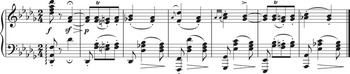
An example of incorrect notation, given by Lussy, concerns Brahms's Hungarian Dance No. 6 in D-Flat major. While Brahms notated it in  , as seen in Example 3, Lussy states that both Hans von Bülow and Anton Rubinstein – and indeed the French pianist Francis Planté as well – performed this piece in
 time, as shown in Example 4.Footnote 72 According to Lussy, the perceived measure, which is determined by the length of the rhythmic units in this example, includes four and not two beats. In a remarkable passage, Lussy writes:
It is truly astonishing that Brahms, so rich in his rhythmic conceptions, has written this phrase in  . Quibblers say: ‘If Brahms wished so!’ Can Brahms or any other genius wish for the impossible, the absurd, that which is against nature? Brahms, like Beethoven, etc. could have had moments of distraction. It's up to us to resist their incorrect incitements. It is highly probable that Brahms played this piece differently than he wrote it. In any case, Bülow, who studied with Brahms, played it as we have shown.Footnote 73
Brahms, Hungarian Dance No. 6, bars 1–7, as notated by the composer

Brahms, Hungarian Dance No. 6, as notated by Lussy

Lussy adds that if we try to sing the melody in  , it is ‘mechanical, lifeless, without poetry: a [mere] pendulum.’ In
 , the melody regains ‘all its grace, all its lightness; its weight and mechanical appearance disappear.’Footnote 74 Intelligibility of the phrase requires
 time signature, which also brings out its proper dynamic shape and thereby expressive content. What is most significant for the nineteenth-century history of the ideology of the-music-behind-the-score is that Lussy actually assigns performers epistemological primacy through this and other similar examples: by arguing that the anacrustic nature of this phrase was revealed to him during performances by the said performers, Lussy elevates them to the status of the true source of musical knowledge.
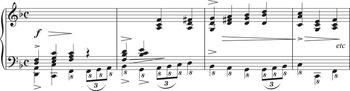
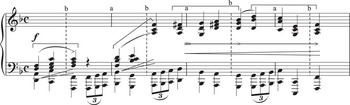
Another example from the pervasive practice of correcting the incorrect notation of composers, this time by Matthay, concerns Schumann's first Novelette. Example 5 shows Schumann's incorrect notation, and Example 6 is Matthay's re-barring of the same phrase to indicate its true musical meaning. Matthay writes that such careless notation serves only ‘to ensure that unmusical players will perform the piece musically “upside-down.” Even many of the great Masters have sinned sorely in this matter of the true notation of their works.’Footnote 75 In reference to Schumann's first Novelette, he states that ‘from the barring of this [phrase] (totally incorrect as it is) one would imagine, that the piece was meant to sound all upside-down musically … But of course he did not mean this; therefore here, as so often elsewhere, we must totally disregard the written barlines (or written accentuation) and must be led by our own musical sense.’Footnote 76 Clearly, this is not the expression of an attitude that regards the score as the site of a sacred, fixed, immortal text representing the final word of the composer; it is rather the manifestation of a widely-shared stance towards the score in nineteenth-century performance discourse that sees its basic – and possibly only – function to be an accurate guide for the performer in devising an intelligible and expressive performance of the music created by the composer.
Schumann, Novelette op. 21, no. 1, bars 1–4, as notated by the composer

Schumann, Novelette op. 21, no. 1, as notated by Matthay; dotted lines indicated by ‘b’ represent Matthay's re-barring of this passage

Because musical notation is incapable of representing any of the motion, impulse and directionality generated by tonal relationships, comprehension of which is crucial for the performer's interpretative activity, the performance discourses during the second half of the nineteenth century become increasingly preoccupied with exploring other means – including imagery, metaphors and even graphic illustrations – to explain to the aspiring performer how to conceive of the dynamics of the musical phrase. The anxiety felt towards the rising of the score into prominence as the composer's authoritative text in certain parallel musical discourses of the century manifests itself in attempts to articulate through different means that which is essential for the art of musical performance yet cannot be represented by the score: the dynamic qualities of music. For example, performance discourses frequently urge the performer to conceive of the internal structure of the musical phrase as an organic unity in order to facilitate correct phrasing. The unity of the rhythmic-tonal movement that individuates a musical phrase and its inherent directionality are much emphasized. In phrasing, the impulse that initiates the phrase and its sub-units needs to be sustained until the arrival point, shaping the inside of the phrase as in a single, unified movement, a continuous dynamic flow. This is achieved only when ‘all the efforts that the artist makes converge towards the final note of the rhythmic units, period, and phrases.’Footnote 77 In a little-known passage, which one scholar describes as giving a ‘rather strange explanation’Footnote 78 although it is in fact entirely in keeping with the new concept of phrasing, Riemann argues that the successive melodic progressions within the unit of music to be phrased are perceived ‘as an actual covering of the intervals between the notes’, whereas the interval between the last note of the phrased unit and the first note of the following unit to be phrased are not perceived in this way ‘and may thus be called “dead” intervals.’Footnote 79 According to Riemann, the living organic quality of music thus resides in and originates from inside the musical phrase. This kind of organicist imagery is a defining characteristic of Matthay's theory of musical interpretation as well. Matthay describes a phrase in performance as ‘a growth, or progression of notes towards a cadence, shown by means of Tone and Rubato inflections.’Footnote 80 He further notes that ‘this idea of Movement is the vitalizing spark which turns mere notes into living music, this sense of Purpose – this sense of progressing somewhere’,Footnote 81 and he contrasts this organic approach to earlier pedagogical approaches (presumably in eighteenth-century sources, although Matthay does not refer to specific names or texts)Footnote 82 by writing that the latter presented music as ‘consisting of chunks or solid segments of accented and of unaccented bars, thus giving the mis-impression to the learner that Music consists of dead, disconnected bits of sound-stone or brick, instead of a living mass, a continuous swing and swirl of Growth.’Footnote 83
In performance discourses of the nineteenth century, the most common model used for representing the unity of the organic movement encompassing the phrase is breathing or respiration. Although eighteenth-century discourses regularly advised instrumentalists to make every effort to listen to good singers in order to learn the secrets of expression in performance, presumably by hearing how they use their breath in delivering the music, it is during the nineteenth century that this is made an explicit model in performance pedagogy. It is well known that Chopin, for example, frequently ‘advised his pupils not to fragment the musical idea, but rather carry it to the listener in one long breath.’Footnote 84 Lussy's theory of expressive performance also identifies respiration as the ideal model to represent the alternating pattern of action–relaxation that defines the basis of the musical phrase: Lussy finds in breathing the origin of directed rhythmic motion, since inhalation or action is always experienced as leading to exhalation or relaxation.Footnote 85 Good phrasing in performance always unfolds in this directed manner, sustaining the originating impulse through the phase of action till the point of repose in an unbroken, uninterrupted manner. During the last decade of the nineteenth and first decades of the twentieth century, much research was carried out within the newly rising science of music psychology on the bodily basis of musical rhythm, and one of these researchers, R.H. Stetson, writing in 1905, asserted in a statement corroborating the teachings of nineteenth-century performance theorists that ‘the dynamic form of the phrase is the form of a movement; there is a rise to a central point of effort and then a decline at the end … In reciting verse, or in singing, a phrase becomes a single act of expiration; indeed, just this movement of breathing is probably the origins of musical phrasing.’Footnote 86 Aside from providing a physical model for musical phrasing, breath and breathing, which since the earliest times have been associated with ‘life’ and ‘giving life’, also appear as metaphors in the performance discourses of the nineteenth century to allude to the power of the performer to bring the notes that remain inert and dead on paper to life: perhaps the best known quotation in this connection comes from Liszt who said that the performer ‘changes the earthy form into a living being, penetrating it with the spark which Prometheus snatched from Jupiter's flesh. He must send the form he has created soaring into transparent ether: he must arm it with a thousand winged weapons; he must call upon scent and blossom, and breathe the breath of life.’Footnote 87
The history of nineteenth-century performance theory I narrated in this article not only opens up new debate about Goehr's widely discussed representation of the multiple ideologies behind the performance practices of this period, but it also highlights the unbroken continuity between nineteenth-century performance pedagogical practices and those of the twentieth and twenty-first centuries, where the driving imperative continues to emphasize loyalty to ‘the music’ before anything else. In my view, contemporary music performance studies has not been sufficiently aware of the seamless continuation of the theoretical concepts and discourses that support performance pedagogy across the two centuries. When a performer and pedagogue writes in 2000 that phrasing ‘should be regarded as the soul of an expressive musical performance’,Footnote 88 or that ‘The musical score is Sleeping Beauty, the performer is the Prince releasing her from the spell’,Footnote 89 researchers often fail to read such discourse as the manifestation of a tradition deeply rooted in nineteenth-century performance thought. Similarly, the striking correspondences between contemporary journalistic performance criticism and nineteenth-century performance discourse with regard to the imagery and metaphors employed are often not recognized and articulated.Footnote 90 Arguably the most significant import of the historical narrative I have presented in this article, however, is the awareness it brings regarding the major role the performer's discourse played in shaping nineteenth-century musical thought: acknowledging this fact is vital not only for any research that attempts to explain the history of the relationship between the composer, the performer, the score and the musical work in the Western tradition, but also for the future direction of contemporary music performance studies, where the issue of integrating the performer's discourse within the discipline – and recognizing the epistemological equality of the act of music-making in the generation of disciplinary knowledge – remains a challenge and an ongoing quest.Footnote 91 Should we need an example to draw inspiration from in closing the rift that musicology introduced between ‘doers’ and ‘knowers’ in musicFootnote 92 during the latter part of the twentieth century, we only need to take a closer look at the history of nineteenth-century musical thought to note the integral part the performer's activity and discourse played in shaping it.