NOMENCLATURE
- A, B & C
engine specific constants derived by fitting a quadratic to data in the ICAO EEDB
- AQMA
air quality management area
- BFFM2
Boeing Fuel Flow Method 2
- CDF
cumulative distribution function
- CO
carbon monoxide
- CO2
carbon dioxide
- EEDB
Exhaust Emission Databank
- EI
emission index
- EI(X)
emission index of pollutant X
- EU
European Union
- F
thrust
- F 00
maximum rated thrust
- FC
fuel consumption
- FDR
flight data record
- HC
hydrocarbon
- ICAO
International Civil Aviation Organisation
- KS
Kolmogorov–Smirnov
- LTO
landing and takeoff
-
 $\dot{m}_{{\rm f}} $
mass fuel flow rate
- MLE
maximum-likelihood estimation
- n
number of engines
- NOX
oxides of nitrogen
probability distribution function
- SESAR
Single European Sky Air Traffic Management Research
- SET
single-engine taxi
- TET
total engine taxi
- t T
taxi duration
- t TET
total engine taxi duration

1.0 INTRODUCTION
1.1 Context
Global air traffic movements have increased at an average annual rate of 5% in recent years and this is expected to continue( Reference Masiol and Harrison 1 ). Many components of the air traffic system are currently operating at capacity, or are forecast to reach capacity in the near future( Reference Berster, Gelhausen and Wilken 2 ). In particular, airports have been described as an aviation capacity bottleneck( Reference Gelhausen, Berster and Wilken 3 ). The adverse impacts of airports on the local environment, specifically pollutant emissions and noise, have a detrimental impact on human health( Reference Wolfe, Yim, Lee, Ashok, Barrett and Waitz 4 ). In the UK, some airports are located near to Air Quality Management Areas (AQMAs), where policy interventions are required to reduce pollution concentrations to below the EU air quality limit values( Reference Masiol and Harrison 5 ).
In the wider European context, the Single European Sky Air Traffic Management Research (SESAR) targets aim to increase air traffic capacity while simultaneously increasing operational efficiency with regard to safety, economic and environmental factors( 6 ). The SESAR environmental targets include a 2.8% reduction in fuel burn and carbon dioxide (CO2) emissions per flight, alongside reductions in local pollutants emissions (e.g. nitrogen oxides (NO X ), carbon monoxide (CO2 emissions), unburned hydrocarbons (HC) and particular matter (PM))( 7 ).
At airports, aircraft landing and takeoff (LTO) operations are a major source of pollutant emissions contributing to human health impacts( Reference Penn, Arunachalam, Tripodis, Heiger-Bernays and Levy 8 , Reference Yim, Stettler and Barrett 9 ). Consequently, mitigation measures such as reduced thrust takeoff( Reference Koudis, Hu, Majumdar, Jones and Stettler 10 ) and single engine taxiing (SET) have been proposed( Reference Guo, Zhang and Wang 11 ). Aircraft taxiing accounts for between 10 to 30% of total flight time in Europe( Reference Deonandan and Balakrishnan 12 ). For a typical LTO cycle in the UK, Stettler et al.( Reference Stettler, Eastham and Barrett 13 ) estimated that, on an average, 36% of fuel is consumed during the taxi phase. Furthermore, they estimated that the taxi phase accounts for 12% of NO X , 89% of CO and 91% of HC emissions. It is forecasted that taxi times will increase due to the growing number of air traffic movements and resultant airport congestion( Reference Goldberg and Chesser 14 ). This would increase the contribution of the taxi phase to LTO cycle and total flight fuel consumption and pollutant emissions.
Historically, standard operating procedures state that all engines operate at an ‘idle’ thrust setting during aircraft taxiing, typically assumed as 7% of the maximum rated engine thrust( Reference Guo, Zhang and Wang 11 ). The ‘idle’ test point in certification emissions testing is also taken to be 7% of maximum rated thrust( 15 ). However, in recent years, certain airlines have adopted SET, which allows pilots to switch off one (for a two-engine aircraft) or two (for a four-engine aircraft) engines during taxiing( Reference Kumar, Sherry and Thompson 16 ). Heathrow Airport have estimated that taxi-related fuel consumption could be reduced by up to 40% and NO X emissions by up to 30% as a direct result of using SET( 17 ).
1.2 Review of taxi emissions modelling studies
Guo et al.( Reference Guo, Zhang and Wang 11 ) calculated reductions of up to 50% in both fuel consumption and NO X emissions due to SET operations using schedule data for 10 of the busiest US airports. The authors estimated fuel consumption and pollutant emissions using the International Civil Aviation Organisation (ICAO) Engine Emission Databank (EEDB)( 15 ), assumed a 7% taxi thrust setting, adopted taxi times specific to the particular airports, and assumed that the secondary engine(s) were switched off for the full taxi duration. Kumar et al.( Reference Kumar, Sherry and Thompson 16 ) identified that through the adoption of SET, there was the potential to reduce NO X emissions by 26% and 45% at Orlando International Airport and New York LaGuardia Airport, respectively. NO X emissions were estimated using activity schedule data and assumptions regarding aircraft trajectory, such as constant fuel flow rates and taxi emission indices per unique aircraft type. During SET, the thrust in the secondary engine was set to 0% for the full taxi duration. Deonandan and Balakrishnan( Reference Deonandan and Balakrishnan 12 ) highlighted the general trend between increasing taxi times and increasing pollutant emissions for 20 US airports. The authors estimated that fuel consumption, HC and CO2 emissions are each reduced by 25–40%, depending on the airport. However, as with Kumar et al.( Reference Kumar, Sherry and Thompson 16 ) and Guo et al.( Reference Guo, Zhang and Wang 11 ), this was based on the assumption of 7% taxi thrust setting, with the secondary engine thrust setting set to 0% for SET operations. Yim et al.( Reference Yim, Stettler and Barrett 9 ), using previous research by Stettler et al.( Reference Stettler, Eastham and Barrett 13 ), estimated that SET could avert 12 early deaths per year if it were implemented at the 20 busiest airports in the UK. During SET, it was assumed that half of the installed engines were operational at 10% thrust setting, compared to a range of 4–7% when not using SET. Each of the above studies lacked high-resolution aircraft trajectory data encompassing SET activities. Therefore, they relied on assumptions regarding taxi thrust settings and durations during SET to analyse its impacts on fuel consumption and pollutant emissions. Consequently, these studies are unlikely to fully capture the observed impacts of SET on taxi duration, the time spent using SET and the thrust settings for both engines( Reference Masiol and Harrison 1 , Reference Nikoleris, Gupta and Kistler 18 ). Any errors or uncertainties would propagate to estimated fuel flow and pollutant emission rates, which, in turn, leads to uncertainty in the estimated benefits of SET( Reference Kurniawan and Khardi 19 , Reference Hao, Kang, Hansen and Ryerson 20 ).
An alternative approach for estimating aircraft taxi emissions was demonstrated by Nikoleris et al.( Reference Nikoleris, Gupta and Kistler 18 ), using varying thrust setting values to calculate fuel consumption and NO X emissions for components of taxiing, such as accelerating, turning and braking. Their results showed that the commonly adopted assumption of 7% thrust during taxi overestimates fuel consumption by 16% at Dallas Fort Worth Airport compared to their more detailed methodology. Ravizza et al.( Reference Ravizza, Chen, Atkin, Burke and Stewart 21 ) adopted the same methodology and estimated that fuel consumption is reduced by 1.2% at Zurich Airport, when optimising aircraft taxi activities for taxi time or fuel consumption efficiency. However, the detailed methodology used in these studies still requires assumptions in order to estimate the taxi duration and average thrust setting. Furthermore, specific analysis of SET was not conducted. Khadilkar and Balakrishnan( Reference Khadilkar and Balakrishnan 22 ) demonstrated that SET modelling limitations could be avoided by using high-resolution aircraft trajectory data. Using over 2,300 flight data records (FDRs) from several airports globally, taxiing trajectory parameters such as the taxi time, braking, turning and acceleration events were estimated and used to calculate fuel consumption to a greater degree of accuracy compared to previous methods. Of all estimated parameters, taxi time was found to be the most significant contributor to taxi fuel consumption (assuming an accurate fuel flow rate estimation), and other parameters mainly influenced fuel consumption in terms of increasing taxi time. Again, the impact of SET operations on pollutant emissions was not evaluated and the optimisation of taxi operations was not investigated. Koudis et al.( Reference Koudis, Hu, Majumdar, Jones and Stettler 10 ) demonstrated the use of FDRs at London Heathrow Airport to evaluate the potential to optimise aircraft takeoff operations to minimise fuel consumption and pollutant emissions.
1.3 Research objectives
Given the research context, the primary aim of this paper is to define SET empirically and to develop a model in order to quantify its impacts on fuel consumption and pollutant emissions, using taxi operations at London Heathrow Airport as a case study.
This paper comprises four further sections. Section 2 describes the data and methodology. Section 3 demonstrates a method for defining SET operations empirically. Section 4 presents the results and discussion of the analyses for the following three objectives: (i) to compare the difference between observed fuel consumption and pollutant emissions to scenarios based on simplified assumptions of engine idle thrust setting and no SET; (ii) to develop a model for estimating the fuel consumption and the pollutant emissions associated with SET operations, which is validated against the observed emission inventory; and finally (iii) to quantify the potential for further reductions in fuel consumption and pollutant emissions. Specifically, the model will be used to investigate the effects of reducing the time prior to initiating SET after landing, reducing the thrust setting during taxiing and a combination of both. Finally, Section 5 provides concluding remarks and describes the implications of the findings.
2.0 DATA AND METHODS
The analyses presented in this paper focus on a case study of a single airline operating at London Heathrow Airport, which provides an opportunity to analyse SET empirically due to its adoption as a fuel consumption and pollutant emission reduction strategy. However, the methodology is transferable and, therefore, may be repeated for other airports and airlines should the data requirements be met.
Any details omitted from the main text of this paper have been included in the Supporting Information (SI) and referenced where appropriate.
2.1 Aircraft flight data
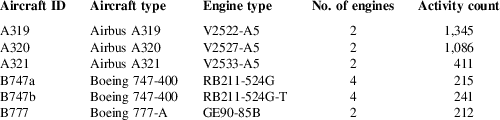
This study presents the analysis of a recorded dataset of high-resolution (1 Hz) aircraft FDRs for taxi activity during November 2012. During the analysis period, SET was not used for taxi-out operations; therefore, the data considered are limited to taxi-in operations (i.e. from touchdown to arrival at the stand). Ultimately, 3510 taxi-in activities covering six distinct aircraft-engine combinations, shown in Table 1, were analysed.
Aircraft-engine combinations and number of associated FDR observations

2.2 Thrust setting and pollutant emission modelling
Each FDR contains 1 Hz resolution data detailing the 4D trajectory (latitude, longitude, altitude and time), ground speed, and fuel flow for each engine during each taxi-in activity. Thrust setting, NO X , CO and HC emissions time series are modelled for each engine using the Boeing Fuel Flow Method II (BFFM2)( 23 , Reference Kim and Rachami 24 ). This method has been widely used( Reference Stettler, Eastham and Barrett 13 , Reference Simone, Stettler and Barrett 25 , Reference Wasiuk, Lowenberg and Shallcross 26 ) to calculate the thrust setting of aircraft engines, as a percentage of rated thrust (maximum thrust generated by an aircraft engine at International Standard Atmosphere sea level static conditions), based on the engine-specific data contained in the ICAO EEDB( 15 ). The thrust setting is calculated for each second using recorded fuel flow rates for each engine, given by,
 $$F\,/\,F_{{00}} {\equals}A \cdot \dot{m}_{{\rm f}} ^{2} {\plus}B \cdot \dot{m}_{{\rm f}} {\plus}C ,$$
where F/F
00 is the thrust setting as a ratio relative to rated thrust,
 $\dot{m}_{{\rm f}} $
is the fuel flow rate, and A, B, C are engine specific constants derived by fitting a quadratic to data in the ICAO EEDB. This thrust setting is subsequently used to calculate engine-specific emission indices (EIs). The EI(NO
X
), EI(CO) and EI(HC) are derived by fitting log–log curves to interpolate data for F/F
00 values between the 7%, 30%, 85% and 100% as specified in the ICAO EEDB following the method described by Kim and Rachami(
Reference Kim and Rachami
24
). The 1 Hz emissions rates (
 $\dot{m}_{{\rm f}} {\times}{\rm EI}$
) are summed for the duration of the takeoff roll phase, resulting in total masses of NO
X
, CO and HC emissions. Insufficient EI(HC) data were available in the ICAO EEDB for the engines RB211-524G and RB211-524G-T, and, therefore, HC emissions for these engine types have not been calculated.
3.0 SET MODEL DEVELOPMENT
3.1 Definition of SET operations
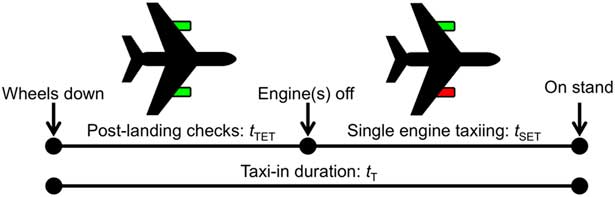
For taxi-in, SET is initiated (the engine(s) are turned off) after the post-landing checks are completed. All taxi-in operations are formed of two components: first, after wheels-down, the engines are set to a suitable thrust setting for aircraft taxiing as chosen by the pilots. This is maintained while the mandatory post-landing checks are completed and the pilots establish if the use of SET is appropriate. During the period before SET is initiated (associated with post-landing checks), the FDRs show that aircraft use all engines operating at an active taxi-in thrust setting. Generally, this thrust setting remains constant, as stated by Khadilkar and Balakrishnan( Reference Khadilkar and Balakrishnan 22 ), who observed that pilots prefer to control aircraft ground speed with the brakes, rather than reducing the engine thrust setting each time the aircraft is required to stop.
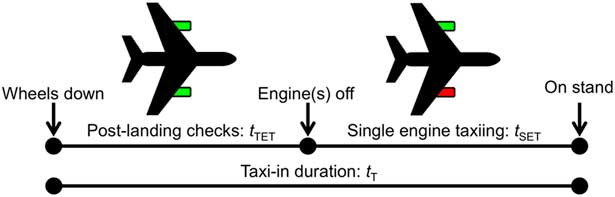
Once the post-landing checks are complete, and if operations allow, SET may begin by switching off the secondary engine(s) until arrival at the stand. The FDRs shows that for two-engine aircraft, this involves switching off one engine, while for four-engine aircraft, this involves turning off two engines (as also found by Guo et al.( Reference Guo, Zhang and Wang 11 )). Both cases are referred to as SET to ensure consistency in discussion, while taxiing with all engines active is referred to as total engine taxi (TET). This is shown diagrammatically in Fig. 1. To calculate the duration of SET taxiing activity, the number of seconds each taxi-in activity operated with half of the engines inactive, i.e. with a thrust setting less than 1%, was counted.
Diagrammatic representation of the taxi-in process.
SET may only be used if all safety factors are met; operational constraints including crew workload, implications on aircraft systems and breakaway thrust levels must all be considered( 17 ). There are many conditions under which SET is not possible, or utilised to a reduced extent, including aircraft operational and technical limitations; airport restrictions such as taxiway/ramp gradients; weather conditions; and taxiway/ramp contamination( 27 ).
While this paper is limited to the empirical observation of SET during taxi-in, it is expected that similar trends would be identified during taxi-out. However, an additional time for engine warm-up is required. Typically, for SET during taxi-out, engines remain switched off after pushback from the stand, and these are then subsequently turned on a minimum of 2 min before takeoff (5 min if the engine had previously been off for more than 2 h)( Reference Guo, Zhang and Wang 11 , Reference Kumar, Sherry and Thompson 16 , Reference Khadilkar and Balakrishnan 22 ).
3.2 FDR analysis for SET model specification
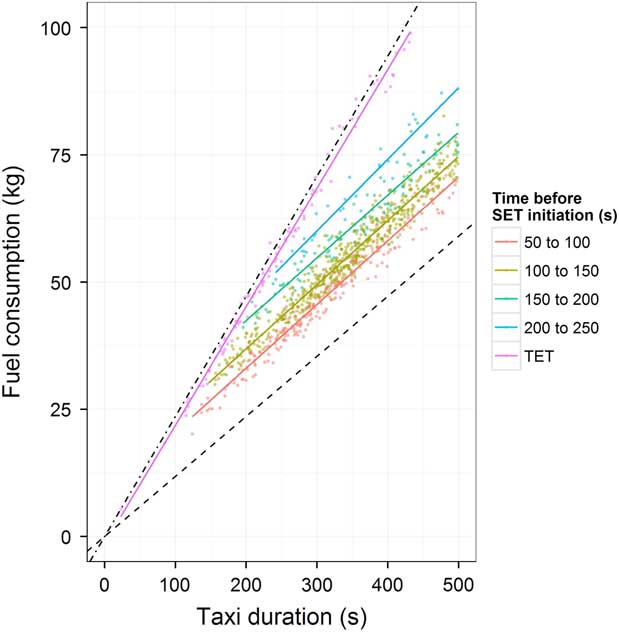
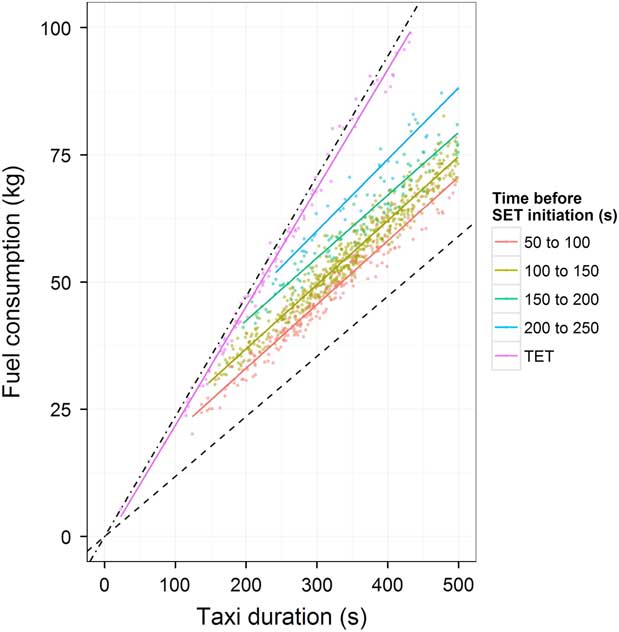
The use of SET during taxi-in is observed in the FDRs as illustrated in Fig. 2, which shows the relationship between fuel consumption and taxi duration for Airbus A319 activities. The TET line represents the fuel consumption versus taxi duration when taxiing with all the engines active. The gradient of the line corresponds to the fuel flow rate of both engines being used (dot-dash line), which is dependent on the engine thrust setting. The remaining four lines correspond to SET activities with varying times before SET is initiated. The fuel flow rate (equal to the gradients of the plotted lines) is similar across all four categories of SET and comparable to the fuel flow rate of a single engine (dashed line). Consequently, it can be concluded that total fuel consumption is a function of the fuel flow rate, the taxi durations and the time spent operating with TET before SET initiation.
Observed fuel consumption versus taxi duration for individual TET and SET operations for A319 aircraft. Also shown is the two-engine idle (dot-dash line) and one-engine-idle fuel consumption (dash line) versus taxi duration.
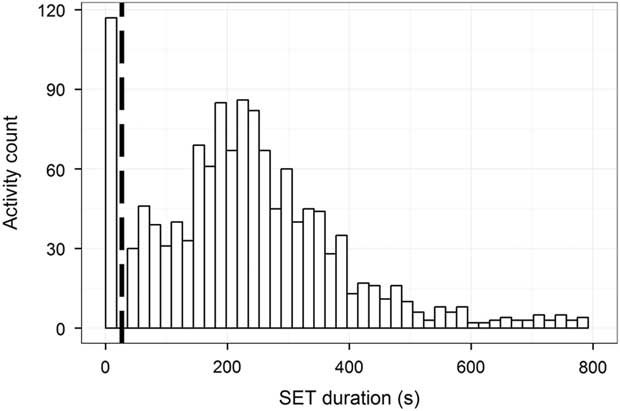
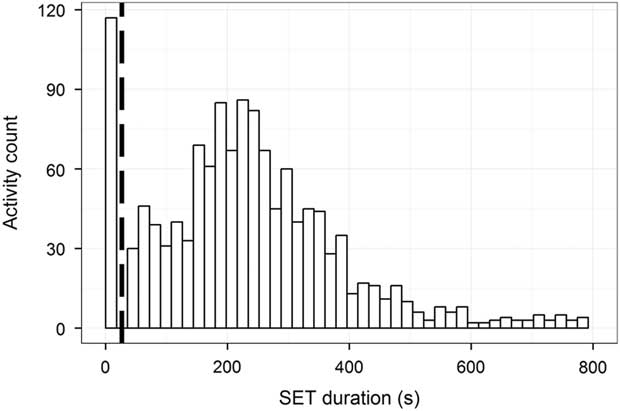
Two distinct categories of taxi-in activities were identified: (i) SET operating for less than 20 s (A319 shown in Fig. 2, A320 and A321) or for 50 s (B747 and B777); and, (ii) those with a higher SET duration. For the first group of events with 20 or 50 s of one-engine off, this time corresponds to the engine shutdown procedures on the stand and these events are, therefore, classified as TET. The remaining activities are categorised as SET; however, the SET duration is highly variable, as shown in Fig. 3.
Distribution of SET durations for Airbus A319 activities. Dashed line indicates 20 s, where activities with less than 20 s of SET are classed as TET operations.
3.3 General model for SET fuel consumption and pollutant emission estimation
Given the above operational definition, the following model has been derived empirically in order to estimate fuel consumption for SET operations:
 $${\rm FC}{\equals} \dot{m}_{{\rm f}} \cdot n \cdot \left( {t_{{{\rm TET}}} {\plus}{1 \over 2}\left( {t_{{\rm T}} {\minus}t_{{{\rm TET}}} } \right)} \right),$$
where FC is the estimated fuel consumption from a taxi-in event in kg,
 $\dot{m}_{{\rm f}} $
is the fuel flow rate corresponding to the average engine thrust setting (F/F
00) for the active engines during taxiing for a specific engine type in kg/s, n in the number of engines installed on the aircraft, t
TET is the time before SET is initiated and t
T is the total taxi-in duration in seconds. To calculate emissions, the fuel flow rate is multiplied by the pollutant-specific EI, which is estimated using the engine thrust setting for the active engines and engine type as described in Section 2.2. The model in Equation (2) is derived to preserve generality, and can subsequently be transferred to other airports.
The application of the model, to calculate fuel consumption and pollutant emissions, involves estimating the following input variables: taxi-in duration (t
T), time before SET initiation (or the time spent in TET) (t
TET) and the average thrust setting (F/F
00) in the active engine(s) for all activities, which determines the fuel flow rate (
 ${\dot{m}}_{{\rm f}} $
). In this paper, input variables are estimated using probability distribution functions (PDFs). These PDFs are calculated using the FDR dataset and the maximum-likelihood estimation (MLE) method(
Reference Stephens
28
) giving the mean and standard deviation corresponding to each input variable and aircraft–engine combination, as shown in Section S.1 in the SI. These distributions are then sampled to estimate the values of the thrust setting, taxi-in duration and time before SET initiation for each activity. For the application to other case studies, the use of constant values for each input variable may be a suitable assumption, otherwise the PDFs calculated here may be used directly or modified on the basis of the expected taxi thrust settings and activity durations for each specific case.
We tested several continuous PDFs for each variable with the goodness-of-fit of each distribution quantified using the one-sample Kolmogorov–Smirnov (KS) test, as demonstrated by Corlu et al.( Reference Corlu, Meterelliyoz and Tiniç 29 ), and Efron’s pseudo-R 2 correlation coefficients, as described by Laitila( Reference Laitila 30 ). The KS test is a non-parametric test that enables the quantification of the likelihood that the observed data are from a different distribution to the one specified. For this purpose, the KS ‘P’ statistic gives the probability that the maximum difference between a recorded, continuous cumulative distribution function (CDF) is not explained by the assumed PDF. The KS test is supported by pseudo-R 2 values, which are calculated based on the residuals between the MLE-fitted distribution and the histograms of each variable (evaluated at the midpoints of each histogram bin), as shown in SI Section S.2.
Our analyses show that lognormal distributions provide the best representation of taxi-in duration and the time before SET initiation. The KS P values lie in the range of 0.05–0.16 for taxi-in duration and 0.05–0.20 for the time before SET initiation, depending on aircraft–engine combination. This is supported by pseudo-R 2 values in the range of 0.80–0.98 for taxi-in duration and 0.84–0.98 for time before SET initiation. For any event where the estimated time before SET initiation is greater than the estimated taxi-in duration, it is assumed that the activity has no SET component for the entire estimated taxi-in duration (i.e. if t TET>t T, then t TET=t T).
We find that the average thrust setting of the active engine is best represented by a normal distribution, given that the KS P statistics in the range of 0.05–0.14 and pseudo-R 2 values in the range of 0.76–0.98, depending on aircraft–engine combination. To ensure no unfeasibly high or low thrust setting values are sampled from the normal distribution (as normal distributions form an asymptote with the x-axis), the maximum and the minimum observed thrust settings for each aircraft–engine combination are used as upper and lower limits, respectively. The fuel flow rate and pollutant-specific EIs are calculated for each estimated thrust setting using the BFFM2 method, as described in Section 2.2.
The estimated KS P values give low probabilities (<20%) that the differences between the CDFs for taxi-in duration, time before SET initiation and the average thrust setting are not explained by the assumed PDFs. This is supported by relatively high pseudo-R 2 values (>0.76), which indicates a high likelihood that the variation in the observed input variables can be predicted using the associated PDFs.
The values for the mean, standard deviation, maximum and minimum extents corresponding to the distributions fitted to each of the variables described above are shown in Table S.1 in the SI for each aircraft–engine combination in order to enable the adoption of these values for other case studies where appropriate. The value of adopting PDFs for the three input variables of the model in Equation (4.1) lies in accurately representing the thrust setting and the durations for a schedule of taxi activities, while maintaining relatively low data requirements.
4.0 RESULTS AND DISCUSSION
4.1 Comparison between observed and estimated taxi-in fuel consumption and pollutant emissions
In this section, the observed fuel consumption and pollutant emissions from the FDR dataset, including SET activities, are compared to two scenarios that have been widely used to estimate fuel consumption and pollutant emissions from TET taxi operations. These are
A. The 7% thrust scenario: all engines are assumed to operate at a constant thrust setting of 7% for the entire taxi-in duration, as previously used by Deonandan and Balakrishnan( Reference Deonandan and Balakrishnan 12 ) and Guo et al.( Reference Guo, Zhang and Wang 11 ).
B. The TET scenario: all the engines are assumed to operate at the TET thrust setting for the entire taxi-in duration (i.e. the thrust setting of the active engine), as conducted by Kumar et al.( Reference Kumar, Sherry and Thompson 16 ) and Stettler et al.( Reference Stettler, Eastham and Barrett 13 ).
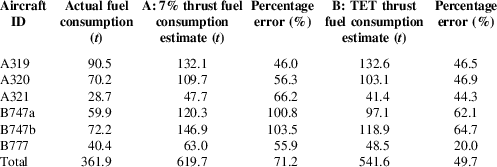
For both scenarios, the taxi-in duration is taken from the observed FDRs. Results for fuel consumption are shown in Table 2, where the final row refers to the sum from the total number of taxi events across all aircraft-engine combinations.
Quantification of observed taxi-in fuel consumption, and estimated fuel consumption using two methods that assume: (A) 7% thrust or (B) TET thrust for the total taxi-in duration. Percentage errors in estimated fuel consumption relative to observed are presented.

When considering all taxi-in activities, we find that Scenarios A and B overestimate the total observed fuel consumption by 71.2% and 49.7%, respectively. The main factor in overestimating the fuel consumption is the lack of accounting for the time spent with one engine inactive. Scenario A provides a poorer estimate of the observed fuel consumption than Scenario B, based on the assumption of constant 7% thrust setting across all aircraft-engine combinations. The only aircraft–engine combination for which this is not the case is the A319, which recorded a mean average thrust setting of approximately 7% across all events.
For NO X , CO and HC, Scenario A overestimates the observed emissions by 43.7–125.9%, −1.6 to 48.0% and 18.8–46.1%, respectively, depending on the aircraft–engine combination. Across all taxi-in activities, this scenario overestimates NO X , CO and HC emissions by 79.4%, 18.8% and 36.5%, respectively. The NO X emissions overestimate is higher than that for fuel consumption, due to the assumption of a higher thrust setting, which increases EI(NO X ) non-linearly. Conversely, the overestimation of CO and HC emissions is lower than that identified for the fuel consumption, as the assumption of a higher thrust setting decreases both EI(CO) and EI(HC). For Scenario B applied to different aircraft types, NO X , CO and HC emissions are overestimated by 21.0–66.4%, 19.3–54.9% and 18.8–46.1%, respectively. For all taxi-in activities, Scenario B overestimates NO X , HC and CO emissions by 49.3%, 46.2% and 22.1%, respectively. Using the same results, the implementation of SET at London Heathrow Airport reduces taxi-in fuel consumption, NO X , CO and HC emissions by 33.2%, 33.0%, 31.6% and 18.1%, respectively, if Scenario B is taken as the baseline. For NO X , this is similar to the 30% reduction expected by London Heathrow Airport( 17 ).
When adapting these scenarios to represent SET with one engine off for the taxi-in duration, as assumed by Guo et al.( Reference Guo, Zhang and Wang 11 ), Deonandan and Balakrishnan( Reference Deonandan and Balakrishnan 12 ) and Kumar et al.( Reference Kumar, Sherry and Thompson 16 ), the estimated fuel consumption for all activities would be half the mass of fuel consumption shown in Table 2. This would lead to underestimates of the observed fuel consumption by 14.4% when using Scenario A and 25.2% when using Scenario B. Likewise, NO X , CO and HC emissions would be underestimated by 25.3%, 26.9% and 38.9%, respectively when assuming Scenario B and by 10.3%, 40.6% and 31.7% when assuming Scenario A. From this, it is clear that a novel approach to estimating SET fuel consumption and pollutant emissions is required to yield more accurate results.
4.2 Validation of SET taxi-in fuel and emission estimation model
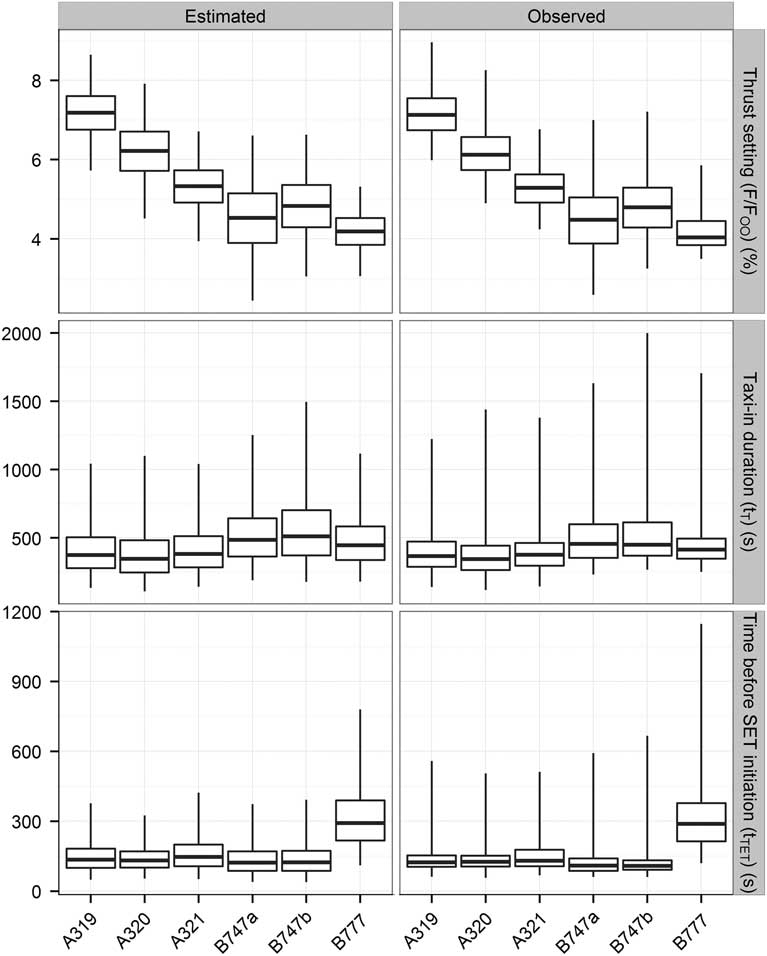
In order to validate the model in Equation (2), this section presents an analysis of the suitability of the fitted PDFs (described in Section 3.3) to estimate the observed input variables. Values for taxi-in duration, time before SET initiation and the thrust setting are estimated from the associated PDFs (as defined for each aircraft–engine combination) for each observed taxi-in activity. This process was repeated 1000 times (Monte Carlo 1000-member ensembles as used by Stettler et al.( Reference Stettler, Eastham and Barrett 13 )) to give average estimated values for the median, 1st, 25th, 75th and 99th percentiles of taxi-in duration, time before SET initiation and the thrust setting. Using the boxplots presented in Fig. 4, the distributions estimated from the PDFs are compared to the observed distributions for each of the input variables and each aircraft–engine combination, respectively.
Observed and estimated distributions of taxi-in duration, thrust setting and time before SET initiation. Boxplots show the median, lower and upper quartiles, and minimum and maximum (1st and 99th percentile) of observed values, respectively.
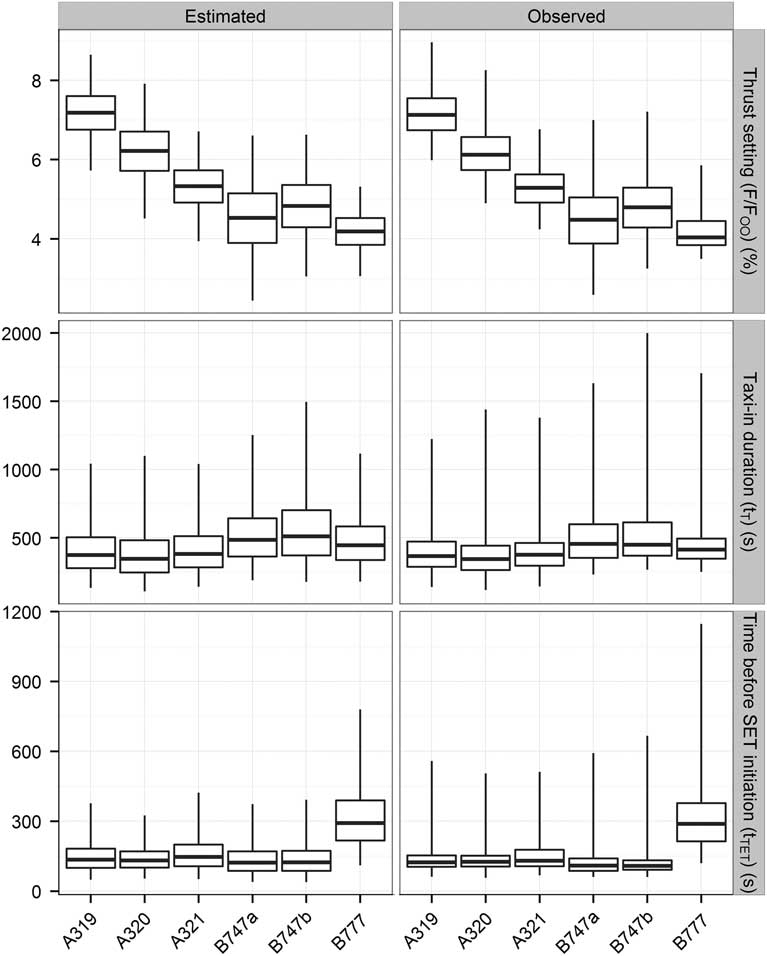
Figure 4 shows that the estimated PDFs represent the observed distributions for each of the three input variables closely. Errors between median observed and estimated values fall in the range of 0–14% for the taxi-in duration, 1–4% for the thrust setting and 1–14% for the time before SET initiation, depending on the aircraft–engine combination. However, for both the taxi-in duration and the time before SET initiation, the estimated distribution captures very high-duration activities relatively poorly, with percentage errors in the range of −35 to −15% and −41 to −17% respectively, relative to the 99th percentile of the observed values. Furthermore, the 1st percentile of the observed values across all aircraft–engine combinations are underestimated, with percentage errors in the range of −34 to −1% for taxi-in duration, −13 to −1% for thrust setting and −35 to −7% for time before SET initiation. The impact of this is expected to be small, given the low rate of occurrence of these events.
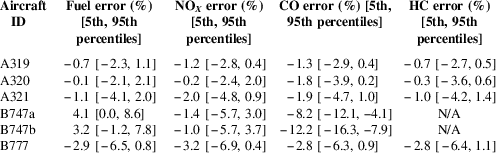
To further ensure that these distributions are appropriate, we estimate the fuel consumption and pollutant emissions for all 3510 taxi-in activities in the emission inventory. This process was repeated 1000 times (Monte Carlo 1000-member ensembles as used by Stettler et al.( Reference Stettler, Eastham and Barrett 13 )) to calculate the mean, 5th and 95th percentiles of percentage errors between estimated and observed fuel consumption and pollutant emissions for each aircraft–engine combination. Percentage errors for the estimated fuel consumption, NO X , CO and HC emissions, relative to the total observed values, are shown in Table 3 and are discussed below.
Errors associated with application of the model to estimate observed aircraft–engine specific taxi-in fuel consumption, NO X , CO and HC emissions.

The mean error in total taxi-in fuel consumption falls between −2.9% and +4.1%, depending on the aircraft–engine type. These errors are due to differences between the observed and estimated distributions for the taxi-in duration, thrust setting and time before SET initiation, as shown in Fig. 4. However, the associated mean and range of the percentage errors shown in Table 3 are considerably less than those calculated in previous studies, which differ from the total observed fuel consumption by an overestimate of 49.6% when no SET operations are used, and an underestimate of 25.2% when SET is implemented (assuming the use of aircraft–engine-specific taxi thrust settings, as discussed in Section 4.1). Consequently, the derived model is an improvement on previous SET fuel consumption estimation methods.
With regard to the pollutant emissions, mean errors are calculated as −3.2 to −0.2% for NO X , −12.1 to −1.1% for CO and −2.8 to −0.3% for HC emissions. These percentage errors are lower than those calculated in previous studies of −25.3%, −26.9% and −38.9% for NO X , CO and HC, respectively (assuming SET and using aircraft–engine-specific taxi thrust settings, as calculated in Section 3). The differences between these errors and those calculated for fuel consumption are due to the non-linear relationship between each EI and thrust setting. The percentage errors between estimated and observed pollutant emissions depend on the aircraft–engine combination. In particular, a relatively high percentage error is identified when estimating CO emissions from B747 aircraft. This is caused by the failure of the distributions to capture high duration events and the relatively low average thrust settings that are regularly adopted during B747 activities.
4.3 Application of SET model to scenarios
To quantify the potential emissions reductions achievable under different taxiing strategies, we investigated the following three scenarios:
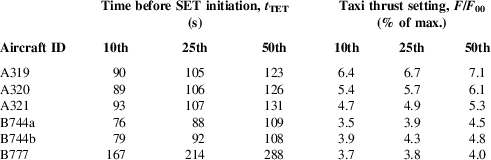
1. SET activities where time before SET initiation (t TET) is minimised (set equal to the 25th percentile of recorded durations shown in Table 4) and thrust setting (F/F 00) is as observed.
2. Thrust setting (F/F 00) is minimised (set equal to the 25th percentile of observed active engine thrust settings) and both engines are active for the full taxi duration (t T).
3. SET activities where the time before SET initiation (t TET) and active engine thrust setting (F/F 00) are minimised (both operating at the 25th percentile).
10th, 25th and 50th percentiles of time before SET initiation and thrust setting for each aircraft–engine combination.

These scenarios were simulated using the model in Equation (2) with fixed values for the time before SET initiation (Scenarios 1 and 3) and thrust setting (Scenarios 2 and 3), calculated as the 25th percentile from the corresponding aircraft–engine-specific distributions, as shown in Table 4. In the first instance, all scenarios are evaluated using the 25th percentile of observed operations. This is taken to be a feasible target for the aircraft operators, given that it is currently achieved during 25% of taxi-in events. However, to investigate the proposed optimisation of taxi activities, other input values can be selected for differing applications of the model, such as the 10th and 50th percentiles. To demonstrate this, the sensitivity of Scenario 1 to the 10th and 50th percentiles of the time before SET initiation is discussed at the end of this section.
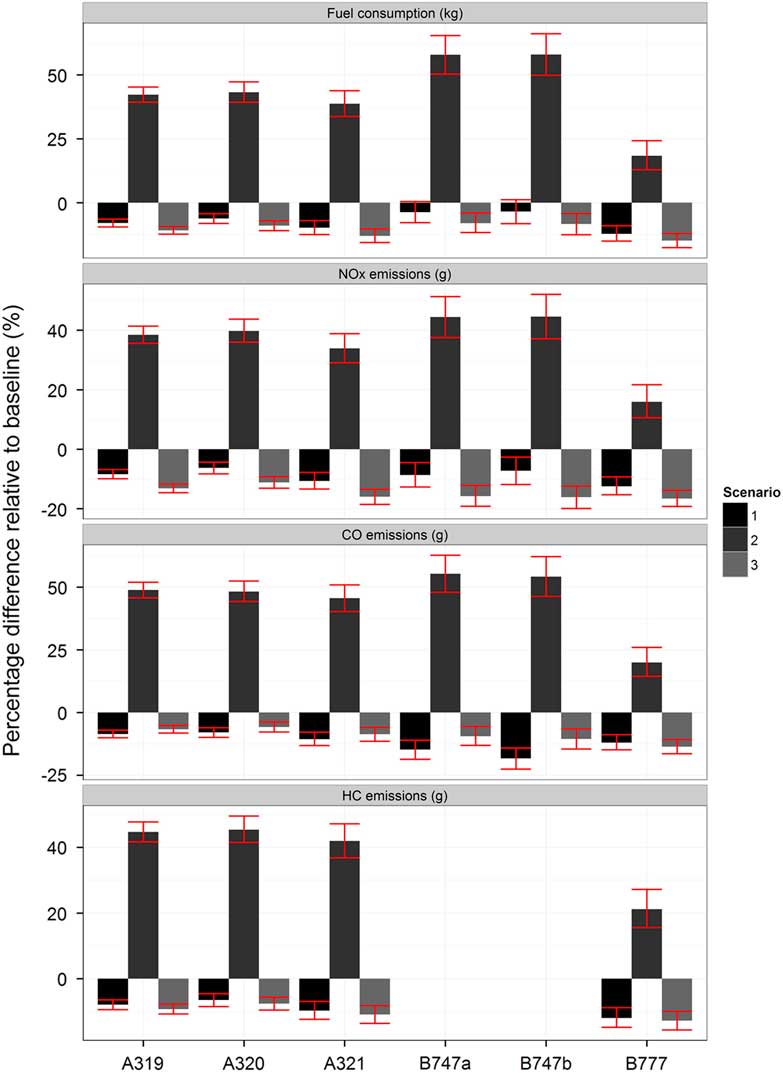
Fuel consumption, NO X , CO and HC emissions are estimated for all activities using Scenarios 1, 2 and 3. Each scenario was repeated 1000 times (Monte Carlo 1000-member ensemble) to identify the mean, and 5th and 95th percentiles. The mean percentage difference (relative to observed fuel consumption, NO X , CO and HC emissions, with error bars representing the 5th and 95th percentiles of the percentage difference) is shown in Fig. 5 for each aircraft–engine combination. The absolute and percentage differences between the scenarios and the observed values are shown in Tables S.1 and S.2 in the SI, respectively.
The percentage difference between estimated fuel consumption, NO X , CO and HC emissions for Scenarios 1 (minimise t TET ), 2 (minimise F / F 00) and 3 (minimise t TET and F / F 00) relative to actual values. Bars represent the mean percentage difference and error bars show the 5th and 95th percentiles of percentage difference.
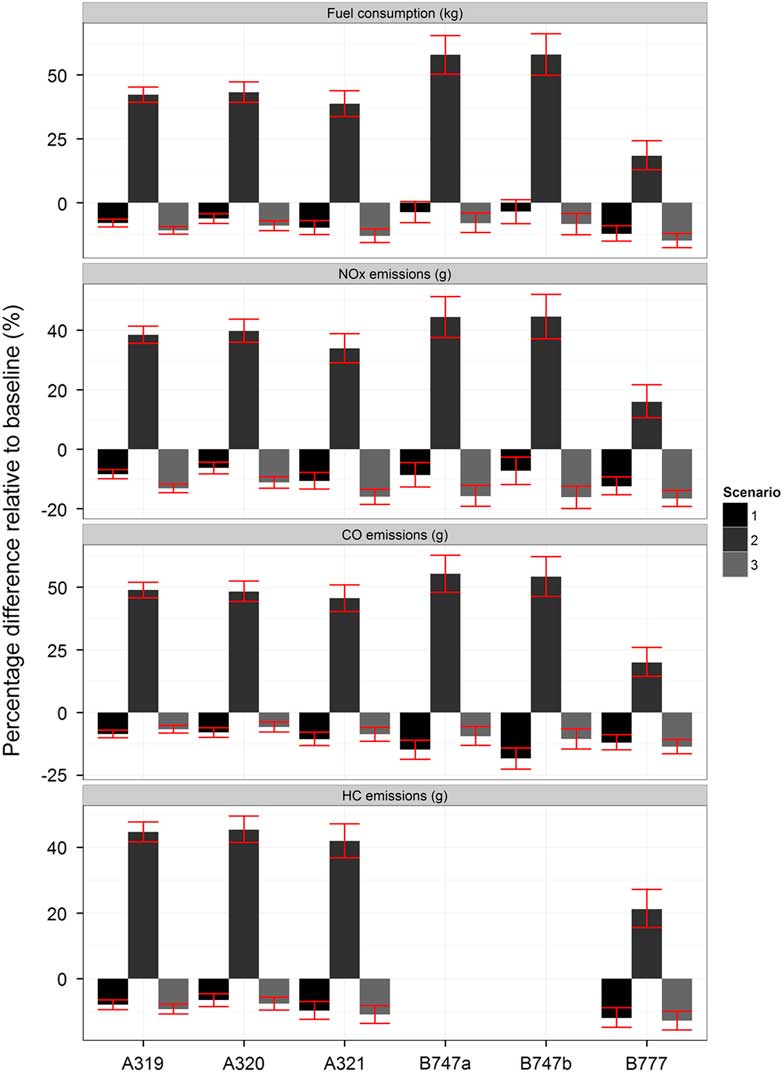
Scenario 1 evaluates the impact of reducing the time before SET initiation. Fixing the time before SET initiation to the 25th percentile of those observed reduces total fuel consumption and pollutant emissions during taxi-in activities at London Heathrow Airport, relative to the observed values. Depending on aircraft–engine type, the reductions are 3–12% for fuel consumption, 6–13% for NO X emissions, 8–18% for CO emissions and 6–12% for HC emissions. Across all activities, total reductions of 6.7% (24.2 tons) in fuel consumption, 8.7% (139.0 kg) in NO X emissions, 14.2% (1419.1 kg) in CO emissions and 11.5% (18.7 kg) in HC emissions would be achieved.
Scenario 2 evaluates the impact of all taxi-in events using the 25th percentile of the observed active-engine thrust settings, without the use of SET. In this scenario, increases ranging from 18 to 58% for fuel consumption, 16 to 45% for NO X emissions, 20 to 55% for CO emissions and 21 to 45% for HC emissions are calculated relative to the observed fuel consumption and pollutant emissions. Across all activities, these results equate to total increases of 45.2% (163.8 tons) in fuel consumption, 37.3% (598.7 kg) in NO X emissions, 47.3% (4716.2 kg) in CO emissions and 24.0% (39.1 kg) in HC emissions, compared to observed values.
Scenario 3 evaluates the combined impact of using the 25th percentile of time before SET initiation and the 25th percentile of the recorded active engine thrust settings simultaneously during taxi-in operations. This scenario provides further reductions for fuel consumption, NO X emissions and HC emissions of 8–15%, 11–17% and 9–13%, respectively, based on the aircraft–engine combinations analysed, relative to Scenario 1. However, CO emissions increase by between 6% and 14% compared to Scenario 1 due to the non-linear increase in EI(CO) with decreasing engine thrust setting.
Consequently, where possible, we find that efforts should be made to reduce the time before SET is initiated during the taxi-in process. Reducing this time by 16–74 s, depending on aircraft–engine combination, results in considerable reductions in both the fuel consumption and the pollutant emissions, even without changes to the overall taxi time. Conversely, we find that reducing the thrust setting by 0.2–0.6% without using SET, considerably increases fuel consumption and pollutant emissions. The combined use of reduced thrust settings and the time before SET initiation at the 25th percentile of observed activities results in further reductions in fuel consumption (3.4%), NO X (5.7%) and HC (0.9%), but increases CO emissions (4.3%). Consequently, the optimisation of taxi-in activities should be selected based on the specific airport air quality targets. For the London Heathrow Airport case study, the chosen optimisations aim to facilitate compliance with EU Air Quality Standards for NO2.
To demonstrate the value of this novel model in analysing the impact of reducing the time before SET initiation, at a varying range of achievable levels, we evaluated the effect of using the 10th and 50th percentiles on fuel consumption and pollutant emissions for Scenario 1. Across the different aircraft types, the 10th percentile is on average ~20 s (between 12 and 47 s) less than the 25th percentile, while the 50th percentile is ~29 s (between 16 and 74 s) greater than the 25th percentile (as shown in Table 4).
Using the 10th percentile of time before SET initiation equates to total reductions of 9.5% (34.3 tons) in fuel consumption, 11.5% (184.9 kg) in NO X emissions, 16.8% (1679.7 kg) in CO emissions and 16.9% (27.6 kg) in HC emissions, compared to the observed activities. These reductions are greater than those calculated using the 25th percentile by 2.8% for fuel consumption, 2.8% for NO X , 2.6% for CO and 5.4% for HC emissions. Using the 50th percentile of time before SET initiation equates to total reductions of 2.8% (10.3 tons) in fuel consumption, 4.7% (75.3 kg) in NO X emissions, 10.7% (1063.0 kg) in CO emissions and 3.5% (5.7 kg) in HC emissions, compared to the observed activities. These reductions are less than those calculated using the 25th percentile by 3.9% for fuel consumption, 4.0% for NO X , 3.5% for CO and 8.0% for HC emissions. Reductions in the fuel consumption and pollutant emissions are still achieved at the 50th percentile due to the lognormal distributions for taxi duration and time before SET initiation as using a median value for these variables does not capture events with high duration (represented by the right-hand tail of the lognormal distributions).
Reducing the time before SET initiation by a further ~20 s (on average) relative to the 25th percentile (equating to a 13–22% relative reduction) would achieve a relatively small (<3%) additional reduction in fuel consumption and NO X emissions. This serves as an example of how aircraft operators could evaluate the benefits of changes to taxiing procedures for fuel consumption and pollutant emissions using the model proposed in this paper.
4.4 Wider impacts of SET model application
Of total ground level emissions at London Heathrow airport, the taxi-in phase contributes approximately 4% of NO X , 30% of CO and 31% of HC emissions( Reference Stettler, Eastham and Barrett 13 ). Consequently, at the 25th percentile of time before SET initiation, the potential savings identified in this paper equate to a 0.3% reduction in the total ground level NO X , a 4.3% reduction in total ground level CO and a 3.6% reduction in total ground level HC emissions. These reductions are relatively small compared to those currently achieved through the adoption of SET during taxi-in at London Heathrow airport of 33.0%, 31.6% and 18.1% for total ground level NO X , CO and HC emissions, respectively. However, the results presented in this paper are expected to offer benefits if applied at other airports.
More significant reductions in fuel consumption and NO X emissions may be achieved if the analysis presented in this paper is extended to include taxi-out operations. Therefore, we suggest that further research should seek to apply a similar methodology to an empirical definition of taxi-out operations. Although similarities are expected, an additional component of engine warm up (3–5 min) is required before the takeoff roll is initiated, dissimilar to the situation in SET. Given the current results, this is likely to further reduce the fuel consumption and pollutant emissions of aircraft activities at airports.
The high volume of data used in this paper facilitates the empirical analysis of variations in the thrust setting and duration of taxi operations. However, the analyses were limited to a case study of taxi-in operations, covering six aircraft–engine combinations of a single airline at London Heathrow airport. Consequently, further analysis should seek to ensure the transferability of these results and the associated model in Equation (2). To achieve this, the methodology should be adopted to estimate fuel consumption and pollutant emissions for taxi-out and taxi-in activities, using additional aircraft–engine combinations, operating for other airlines and at additional airports. Furthermore, future research should investigate the practicalities of implementing SET and operational challenges that may limit reductions in the time before SET initiation, including aircraft operational and technical limitations, airport restrictions such as taxiway/ramp gradients; weather conditions; and taxiway/ramp contamination.
5.0 CONCLUSIONS
This paper presents the evaluation of SET operations using recorded FDRs, which enables the identification of the impacts of taxi duration, thrust setting and time before SET initiation on both the fuel consumption and pollutant emissions. SET and TET operations are defined through the empirical analysis of FDRs using a case study of taxi-in operations at London Heathrow Airport. This enables the development of a model to estimate fuel consumption, NO X , CO and HC emissions. The model is validated against the observed fuel consumption and pollutant emissions, leading to low percentage errors relative to previous methods. The application of the model requires data regarding three input variables (which are commonly measured by airlines and airports): the distributions of taxi duration; thrust setting; and time before SET initiation. Consequently, the model is expected to be transferable to other airports, subject to validation against observed fuel consumption and pollutant emissions at these locations.
With regard to the London Heathrow airport case study, reducing the time before SET is initiated to the 25th percentile of observed values reduces the fuel consumption, NO X , CO and HC emissions by 6.7%, 8.7%, 14.2% and 11.5%, respectively, relative to observed levels. However, reducing thrust setting without using SET causes a relative increase in fuel consumption and pollutant emissions. While these conclusions are specific to the London Heathrow case study, the results are expected to reflect taxi operations at other major international hub airports (with similar numbers of aircraft movements). Consequently, efforts should be made by all airport operators to adopt SET operations and minimise the time before deactivating the secondary engine(s) of aircraft after landing. The mandatory use of SET should be considered for introduction into airport operations policy.
We estimate that further reductions of 0.3% in total ground level NO X , 4.3% in total ground level CO and a 3.6% in total ground level HC emissions are achievable by reducing the time before SET initiation by ~20 s, based on the current case study. This will contribute towards achieving targets of whole flight reductions in fuel consumption and pollutant emissions, to facilitate increased airport compliance with EU Air Quality Standards. Indirect benefits can also be expected, in addition to the direct benefits of reduced fuel expenses and reduced CO2 emissions already observed. Fuel loading is a major contributor of aircraft weight, and, therefore, carrying less fuel for taxi phases will reduce aircraft weight. It is expected that a 1% reduction in aircraft weight leads to a 0.75% reduction in fuel consumption across the whole flight( Reference Capehart 31 ). These results demonstrate the potential for reduced fuel loadings and consequently for lower aircraft weight, which in turn will lead to a decrease in fuel consumption across the whole flight, due to lower thrust requirements during the takeoff, climb and en-route phases.
ACKNOWLEDGEMENTS
The Sensor Network for Air Quality (SNAQ) at London Heathrow consortium, funded by the UK Natural Environment Research Council (project reference: NE/I007172/1), provided the data that support this research. Prof John W. Polak (PI) and Dr Robin J. North (Co-PI) assisted in securing the data used in this study. Dr George Koudis received funding from The Lloyds Register Foundation. Ms Jacintha Mack-Smith provided assistance with data management.