Introduction
Population ageing is a global phenomenon. Between 2015 and 2050, the proportion of the older adult population in the world is projected to increase from 12 to 22 per cent (World Health Organization 2016a). Further, population ageing is occurring especially rapidly in developing countries. In Mexico, the population aged 60 and older is expected to triple to over 20 per cent of the total population by 2050 (Angel, Vega and López-Ortega Reference Angel, Vega and López-Ortega2017). Importantly, population ageing in Mexico is taking place with limited public health and social security systems for older adults (Wong and Palloni Reference Wong, Palloni and P2009) and demographic changes limiting family size. Given these changes, studies of mental health in Mexico and at a global level are becoming increasingly important. Globally, depression is expected to become the leading cause of loss of disability-adjusted life years as soon as 2030 (World Health Organization 2004). Depression can negatively impact social functioning (Lewinsohn et al. Reference Lewinsohn, Rohde, Seeley and Fischer1991), increase suicide risk and overall mortality, and can worsen the progression of many medical conditions (Alexopoulos Reference Alexopoulos2005). Depression among older adults is often under-diagnosed and is less likely to be treated (Lebowitz et al. Reference Lebowitz, Pearson, Schneider, Reynolds, Alexopoulos, Bruce, Conwell, Katz, Meyers, Morrison, Mossey, Niederehe and Parmelee1997). In Mexico, approximately one out of every eight older adults has major depressive symptoms (García-Peña et al. Reference García-Peña, Wagner, Sánchez-Garcia, Juárez-Cedillo, Espinel-Bermúdez, García-Gonzalez, Gallegos-Carrillo, Franco-Marina and Gallo2008). As in other countries, depression rates in Mexico are higher for women and are closely linked to family structure and dynamics, including marital status (Medina-Mora et al. Reference Medina-Mora, Borges, Lara, Benjet, Blanco, Fleiz, Villatoro, Rojas and Zambrano2005).
One major area of research on depression focuses on the role of marital status. While married adults tend to report lower levels of depression than the unmarried (Gore and Mangione Reference Gore and Mangione1983; Gove, Hughes and Style Reference Gove, Hughes and Style1983; Kessler and Essex Reference Kessler and Essex1982; Ross, Mirowsky and Goldsteen Reference Ross, Mirowsky and Goldsteen1990), the relationship between marriage and health is also highly dependent on marital quality (Robles Reference Robles2014). Individuals in high-quality marriages, characterised by reciprocity and support, tend to benefit in terms of both health and psychological wellbeing. However, marriages characterised by distress are associated with depression (Beach Reference Beach2014). The effects of marital functioning on health may also vary for men and women. Marital functioning may be more strongly related to mental health for men than women (Kiecolt-Glaser and Newton Reference Kiecolt-Glaser and Newton2001), which can be attributed to gendered perceptions on the importance of social relationships (Kiecolt-Glaser and Newton Reference Kiecolt-Glaser and Newton2001), gender roles in domestic work and child care, and gender inequality which results in power differentials within marriages (Wanic and Kulik Reference Wanic and Kulik2011).
In the present study, we seek to understand how the distribution of marital power in couples influences depression in gendered ways. We focus on Mexico as several societal-level characteristics make the context of marital power in Mexico unique. First, Mexico is a developing country and research on marriage and depression has tended to focus on developed countries. Second, Mexico has a strong history of traditional general roles that place much of the social and economic power in the hands of men (Stern Reference Stern1997), which is especially pronounced among older cohorts of the population (Seedat et al. Reference Seedat, Scott, Angermeyer, Berglund, Bromet, Brugha, Demyttenaere, Girolamo, Haro, Jin, Karam, Kovess-Masfety, Levinson, Mor, Ono, Ormel, Pennell, Posada-Villa, Sampson, Williams and Kessler2009). Based on the gender inequality index, Mexico ranks in the top half of countries in terms of gender inequality, but ranks lower than other Latin American and Caribbean countries (United Nations 2014). Third, Mexico is undergoing demographic changes that may influence family structure and function. There have been declines in the percentage of married individuals, rises in divorce (Organisation for Economic Co-operation and Development 2016), more women entering the paid labour force (Organisation for Economic Co-operation and Development 2004) and declines in adherence to traditional notions of gender roles (Seedat et al. Reference Seedat, Scott, Angermeyer, Berglund, Bromet, Brugha, Demyttenaere, Girolamo, Haro, Jin, Karam, Kovess-Masfety, Levinson, Mor, Ono, Ormel, Pennell, Posada-Villa, Sampson, Williams and Kessler2009), which may shift gendered expectations of power within marriage. Finally, the strong reliance on spouses and family members for support and care in old age in Mexico (Villegas, Zavala and Guillén Reference Villegas, Zavala and Guillén2014) can ultimately influence gendered power dynamics and the resulting relationship to mental health.
Our theoretical framework for understanding the gendered influence of marital power on depressive symptoms is rooted in equity theory. In general, equity theory argues that human relationships characterised by unequal exchange are distressing (Adams Reference Adams and Berkowitz1965). Hence, negative emotions may result from either under-benefiting or over-benefiting from imbalanced relationships (DeMaris, Mahoney and Pargament Reference DeMaris, Mahoney and Pargament2010). This is because under-benefiting may create feelings of unfairness while over-benefiting may create feelings of guilt. Applied to the context of marriage, previous research in the United States of America (USA) has found that women report lower marital power than men (Bulanda Reference Bulanda2011; Kaufman and Taniguchi Reference Kaufman and Taniguchi2006), and that both husbands and wives tend to report lower levels of depression when household power is shared between spouses (Mirowsky Reference Mirowsky1985). While there is evidence that over-benefiting is associated with higher depressive symptoms (Longmore and Demaris Reference Longmore and Demaris1997; Mirowsky Reference Mirowsky1985), under-benefiting may be more distressing than over-benefiting (Adams Reference Adams and Berkowitz1965; Longmore and Demaris Reference Longmore and Demaris1997; Mirowsky Reference Mirowsky1985). Additionally, perceptions of marital inequality may be more relevant for women than men (DeMaris Reference DeMaris2010).
Many previous investigations of equity theory have relied on younger samples that are more likely to be free of chronic conditions, functionally able, participating in the labour force and raising children. While men may have more marital power in mid-life due to greater earnings and participation in the formal labour sector, by late life, many men may have retired, developed health problems and may rely on their wife for care (Bulanda Reference Bulanda2011). In late life then, having less power in a marriage may be indicative of either ‘under-benefiting’ from the marriage by having less power, or that one may rely on their spouse due to cognitive and physical pathologies/limitations. Therefore, power dynamics may shift and be more influenced by health status and reflect level of support or care provided by one spouse to aid the other in living independently. Previous research on older Mexican adults has found higher education to be related to greater marital power (particularly for women) while poor health was related to having less marital power (particularly for men) (Lührmann and Maurer Reference Lührmann and Maurer2008).
The current study
We investigate the association between marital power and depression in the context of a developing country, explicitly examining the simultaneous influences of one's own characteristics and the characteristics of one's spouse including background and physical health factors, and health dependency. We control for many important factors related to depression, including cognitive and physical health, socio-economic position, and social factors including living arrangements and number of children (Cui et al. Reference Cui, Lyness, Tang, Tu and Conwell2008). We seek to understand, using a dyadic approach, the ways in which the balance of marital power affects the depressive symptomatology of both the husband and the wife in the context of Mexico. The aims of this analysis are, first, to describe the distribution of marital power among older married adults in Mexico. Given the presence of traditional gender roles in Mexico, we hypothesise that husbands will report greater marital power than their wives. Second, we determine how distributions of marital power are associated with depressive symptoms among married adults in Mexico. Based on previous studies of equity theory, we hypothesise that depressive symptoms will be elevated in marriages with an imbalanced distribution of power. That is, we hypothesise a U-shaped relationship between marital power and depressive symptoms.
Data and methods
Data are drawn from the 2015 Wave of the Mexican Health and Aging Study (MHAS Mexican Health and Aging Study 2012). The MHAS is a large, household-based, longitudinal, nationally representative study of older Mexican adults (age 50+) and their spouses (regardless of age) living in Mexico. The first wave of data collection began in 2001 (original cohort age 50+ in 2001). The sample was re-interviewed in 2003, 2012 and most recently in 2015. The MHAS added an additional cohort of respondents born 1952–1962 in 2012 to refresh the sample and regain representation of the population age 50 + . The survey protocols of the MHAS are highly comparable with the US Health and Retirement Study. The MHAS is partly sponsored by the National Institutes of Health/National Institute on Aging (grant number NIH R01AG018016). Data files and documentation are public use and available at www.MHASweb.org. The 2015 wave of the MHAS includes 4,245 married couples, however, after excluding households with missing information on independent or dependent variables, our analytic sample consists of 3,621 dyads.
Marital power
Marital power has been conceptualised in previous work as a spouse's ability to influence the other, and to influence decisions that affect both members of the couple (Blood and Wolfe Reference Blood and Wolfe1960; Mirowsky Reference Mirowsky1985). For this reason, we measure marital power using household decision-making dynamics. This is ascertained in the survey by asking both spouses, individually, whether he/she feels that (a) his/her opinion on important family decisions is given more weight, (b) both his/her and his/her spouse's opinions are given equal weight, or (c) his/her spouse's opinion is given more weight.
Covariates
Demographic covariates in the analysis include rural/urban residence, age, sex, educational attainment and economic wellbeing. Respondents are classified as urban if they live in a community with 100,000+ residents while those who reside in a community with fewer than 100,000 residents are classified as rural. Educational attainment is classified based on elementary education in Mexico. Respondents with zero years of education are classified as no education, those with one to five years of education are classified as incomplete elementary education, those with six years of education are classified as elementary education, while those with seven or more years of education are classified as beyond elementary education. We also include the difference in years of education between the spouses as the husband's years of education minus the wife's years of education to account for differences in levels of education which may influence household power distributions. We account for the relative age of the spouses by calculating the age difference of the couple as the husband's age minus the wife's age.
We measure economic wellbeing at the couple and individual level. First, we include a couple-level count of owned consumer durables (including a radio, television, refrigerator, washing machine, telephone, water heater, internet and computer) as income in late-life among older Mexicans is often quite low and previous studies have used consumer durables in dwellings as a proxy for socio-economic status (Bollen, Glanville and Stecklov Reference Bollen, Glanville and Stecklov2001). We also include individual-level self-assessed financial situation. Respondents are asked: ‘Would you say your financial situation is… (1) excellent, (2) very good, (3) good, (4) fair, or (5) poor.’ Because few respondents report excellent or very good financial situations, we combine the excellent, very good and good categories into one to create a three-level variable (good or better, fair, or poor financial situation). Self-assessed financial measures have been shown to be stronger predictors of health than income in prior work (Balabanova and McKee Reference Balabanova and McKee2002; Gilmore, McKee and Rose Reference Gilmore, McKee and Rose2002), particularly in countries with large informal economies where income may not fully capture financial wellbeing (Gilmore, McKee and Rose Reference Gilmore, McKee and Rose2002) such as Mexico (Instituto Nacional de Estadística y Geografía 2017). We also include a categorical variable indicating whether each spouse is either retired, currently working or has never worked for pay, as previous work has shown that labour force participation, primarily for women, may influence the distribution of power within marriages (Lührmann and Maurer Reference Lührmann and Maurer2008),
Previous research has suggested that household living arrangements and number of children may be associated with depression among older Mexican adults (Díaz-Venegas, Sáenz and Wong Reference Díaz-Venegas, Sáenz and Wong2017). Following this study, we calculate the total number of children ever born for each spouse and create a categorical variable indicating whether each spouse had zero to two children, three to four children, or five or more children. To capture living arrangements, we create binary variables indicating whether the couple had a child living in the household, and whether the couple had any other relatives besides children living in the household at the time of the survey. In sensitivity analyses (not shown), we also controlled for the number of persons in the household (as well as squared and cubic terms), but none of these measures were associated with the husband's or wife's depressive symptoms and, thus, were not included in our final regression results.
We also include a count of chronic conditions as a measure of health status based on self-reported hypertension, cancer, diabetes, stroke, heart attack and respiratory conditions. To capture the physical functionality of respondents, we include the presence of any activities of daily living (ADL) (Katz et al. Reference Katz, Ford, Moskowitz, Jackson and Jaffe1963) and instrumental activities of daily living (IADL) limitations. ADLs are assessed by reporting trouble dressing, bathing, eating, getting out of bed or using the toilet. Following the example of previous research, respondents who report problems performing the activity, not being able to perform the activity or receiving help performing the activity are classified as having a limitation, while those who report no problems performing the activity are considered disability-free (Díaz-Venegas, De La Vega and Wong Reference Díaz-Venegas, De La Vega and Wong2015). IADLs are assessed by difficulty preparing meals, shopping, taking medications or managing money. We also include two measures of cognitive function including verbal learning (respondents immediately recall a list of eight words three times, the average number of words recalled correctly across trials is calculated) and verbal recall (the respondent recalls the eight-word list after a delay).
Depressive symptoms
Our outcome variable, depressive symptoms, is measured using a nine-item version of the Center for Epidemiologic Studies – Depression Scale (CES-D) (Radloff Reference Radloff1977). Study participants were asked whether they experienced the following symptoms of depression in the previous week: (a) felt depressed, (b) felt that everything he/she did was an effort, (c) felt his/her sleep was restless, (d) felt happy, (e) felt lonely, (f) felt that he/she enjoyed life, (g) felt sad, (h) felt tired, and (i) felt that he/she had a lot of energy. Positive items are reverse coded such that the sum of depressive symptoms ranges from zero to nine with higher values representing a greater level of depressive symptomatology. The validity of the nine-item CES-D scale among older Mexican adults has been established in previous work (Aguilar-Navarro et al. Reference Aguilar-Navarro, Fuentes-Cantú, Ávila-Funes and García-Mayo2007).
Statistical analysis
Because we analyse couples which produces two outcome variables (depressive symptoms for husbands and wives), we use Seemingly Unrelated Regression (SUR) (Zellner Reference Zellner1962). SUR allows the error terms of models to correlate to improve estimation efficiency as knowledge about the error term of one equation should reduce the predicted value of the error term in the other equation if error terms are correlated. This method takes into account unobserved factors which are shared by husbands and wives at the household level which may affect depressive symptoms for both spouses (Siegel et al. Reference Siegel, Bradley, Gallo and Kasl2004).
In Model 1, we regress the husband's and wife's depressive symptoms as a function of each spouse's own perception of marital power, own age, own education, own employment history, own number of children ever born and own self-assessed financial situation. We also include couple-level controls including whether the couple lives in an urban or rural area, household count of consumer durables, age difference of couple, difference in years of education between spouses, whether the couple has children living at home and whether the couple has other relatives living at home. In Model 2, we add one's own chronic condition count, ADL limitations, IADL limitations, verbal learning and verbal recall scores to assess whether differences in depressive symptoms across levels of marital power can be attributed to differences in health status, physical functioning, and cognitive function. In Model 3, we allow depressive symptoms to vary as a function of the spouse's chronic conditions, ADL, IADL, verbal learning and verbal recall. While we tested the use of negative-binomial and Poisson models of depressive symptoms, we report the results from Seemingly Unrelated Linear Regressions to facilitate interpretability as results were similar across estimation methods. In sensitivity analyses (not shown), we also dichotomised depressive symptoms using cut-points established in previous work (Aguilar-Navarro et al. Reference Aguilar-Navarro, Fuentes-Cantú, Ávila-Funes and García-Mayo2007) and obtained similar results. To determine whether our results were robust to missing data, we also estimated our models using full information maximum likelihood, allowing us to include all 4,245 married couples, and obtained similar results.
Results
Descriptive results
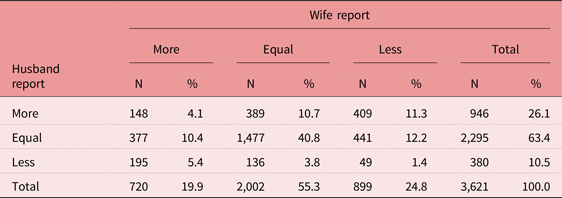
We begin by presenting the cross-tabulation of the husband's report of marital power versus the wife's report of marital power in Table 1. The most common type of household was one in which both the husband and the wife reported that both spouses shared decision-making power equally (40.8%). However, there was evidence of a more patriarchal power structure among the households. Of the husbands, 26.1 per cent reported having more marital power than the wife while only 10.5 per cent reported having less power than the wife. For wives, on the other hand, only 19.9 per cent reported more marital power than the husband while 24.8 per cent reported less power than the husband. While 55.3 per cent of wives reported an equal distribution of power, 63.4 per cent of husbands reported equal power between spouses. Approximately 57.5 per cent of households were in perfect agreement about the distribution of power (both report equality or both spouses agree on which spouse has more power), 5.4 per cent were in perfect disagreement (both spouses report having more power or both spouses report having less power), while the remaining 37.1 per cent were in between (one spouse reports an equal distribution of power while the other reports either themself or their spouse to have either more or less power). On average, the husbands in our sample were 4.3 years older and had 0.7 more years of education than their wives. The mean number of depressive symptoms among husbands was 2.6 (inter-quartile range (IQR) = 1–4), while the mean number of depressive symptoms for wives was 3.5 (IQR = 1–6).
Prevalence of household types based on husbands’ and wives’ reports of which spouse has more marital power

Note: N = 3,621 dyads.
Source: Authors’ own calculations using data from the 2015 Mexican Health and Aging Study.
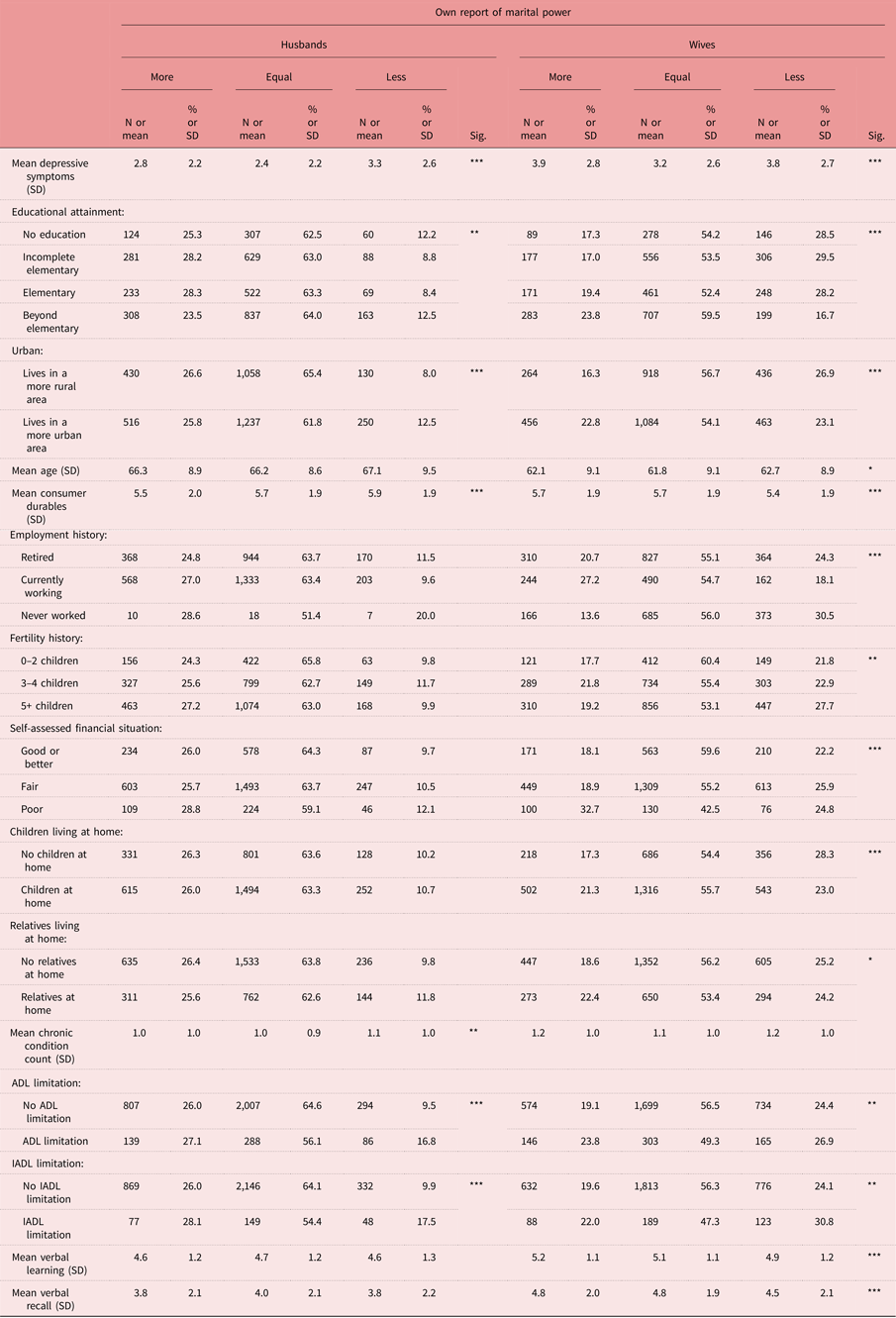
We then present the socio-demographic, psychological and health characteristics of husbands and wives by their report of which spouse has more power in Table 2. Results for the husbands are shown on the left-hand side of Table 2. Husbands who reported less (mean = 3.3) or more (mean = 2.8) power than the wife reported more depressive symptoms than those who reported an equal distribution of power (mean = 2.4). Husbands were most likely to report an equal distribution of power across all levels of education. Husbands who reported either an ADL or an IADL limitation were less likely to report an equal distribution of power compared to their disability-free counterparts. Among husbands with no ADL limitation, 26.0 and 9.5 per cent reported more and less power, respectively. However, these percentages increase to 27.1 and 16.8 per cent among husbands reporting an ADL limitation. A similar trend was observed for IADL limitations. Husbands who reported an equal distribution of power reported slightly fewer chronic conditions.
Socio-demographic, psycho-social and health characteristics of husbands and wives by own report of who has more marital power

Notes: N = 3,621 dyads. All percentages are row percentages calculated for husbands and wives, separately. SD: standard deviation. ADL: activity of daily living. IADL: instrumental activity of daily living.
Source: Authors’ own calculations using data from the 2015 Mexican Health and Aging Study.
Significance levels: Sig. represents whether differences in independent and dependent variables by own report of marital power were significant at * p < 0.05, ** p < 0.01, *** p < 0.001.
We then present the socio-demographic, psychological and health characteristics of the wives by their report of which spouse has more power on the right-hand side of Table 2. Wives who reported either less (mean = 3.8) or more power (mean = 3.9) than the husband reported more depressive symptoms than those who reported an equal distribution of power (mean = 3.2). While wives were most likely to report an equal distribution of power across all levels of education, the percentage reporting more power than the husband generally increased with increasing level of education. While 17.3 per cent of wives with no education reported more power than the husband, this increased to 23.8 per cent among those with beyond an elementary education. Wives who reported an ADL or an IADL limitation were also less likely to report an equal distribution of power. Among wives with no ADL limitation, 19.1 and 24.4 per cent reported more and less power than the husband, respectively. However, these percentages increase to 23.8 and 26.9 per cent among wives reporting an ADL limitation. Among wives with no IADL limitation, 19.6 and 24.1 per cent reported more and less power than the husband, respectively. However, these percentages increase to 22.0 and 30.8 per cent among wives reporting an IADL limitation. Wives who reported an equal distribution of power were slightly younger. For wives, less marital power was associated with reports of no employment history and having more children. Further, marital power was associated with worse self-assessed for financial situation, having children or relatives living in the home, and cognitive function.
Regression results: depressive symptoms of husbands
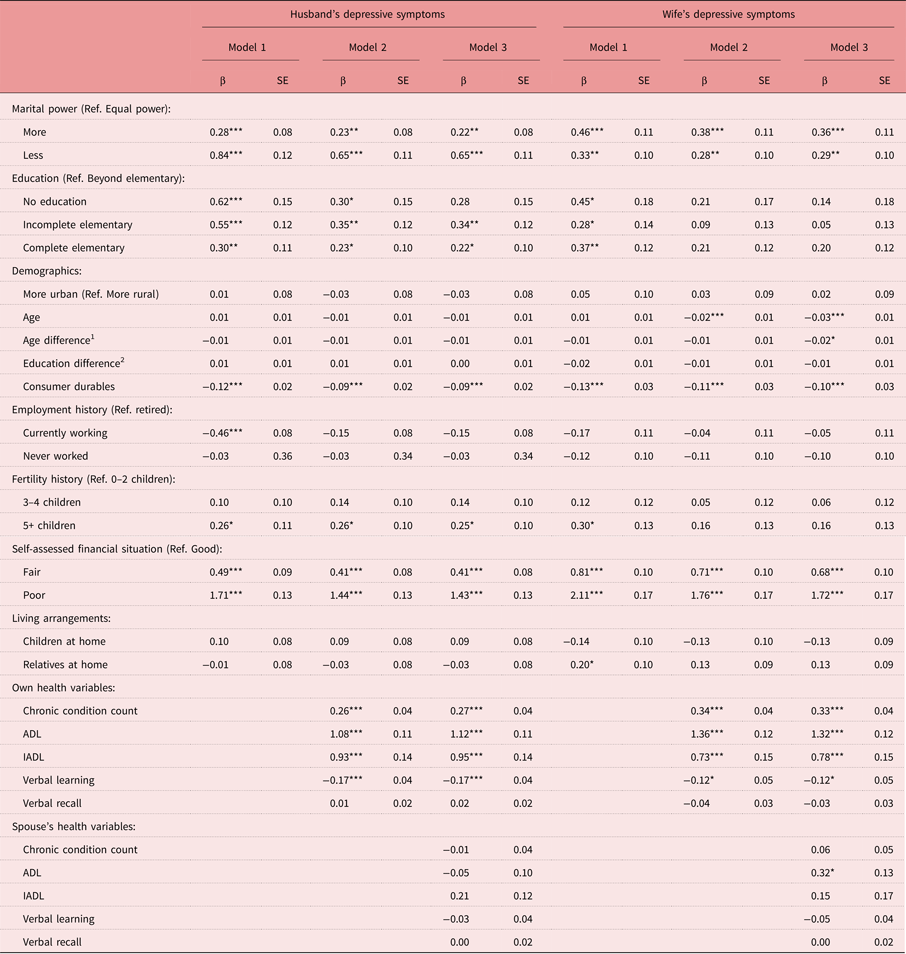
We then present the results of our SUR models in Table 3. Estimates for the husband's and wife's depressive symptoms are shown on the left and right sides of the table, respectively. It should be noted that Models 1–3 for husbands and wives are estimated simultaneously. Focusing first on the husbands, those who reported having either less or more power than the wife reported more depressive symptoms than those who reported an equal distribution of marital power in Model 1. Husbands who reported having less power than the wife reported the highest level of depressive symptomatology. Having fewer consumer durables, having less education, having five or more (compared to zero to two) children and reporting a fair or poor (compared to good or better) financial situation were associated with higher depressive symptomatology.
Seemingly unrelated regression of depressive symptoms for married adults

Notes: N = 3,621 dyads. 1. Age difference = husband's age minus wife's age. 2. Education difference = husband's years of education minus wife's years of education. β: parameter estimate. SE: standard error. Ref.: reference category. ADL: activity of daily living. IADL: instrumental activity of daily living.
Source: Authors’ own calculations using data from the 2015 Mexican Health and Aging Study.
Significance levels: * p < 0.05, ** p < 0.01, *** p < 0.001.
We added own health characteristics (chronic condition count, ADL limitation, IADL limitation, verbal learning and verbal recall) in Model 2 to determine whether differences in the husband's depressive symptoms across the marital power distribution were explained by his health characteristics. For husbands, reporting more chronic conditions, an ADL or IADL limitation, and scoring lower on the verbal learning task were associated with elevated depressive symptomatology. Reporting either more or less power remained statistically significant predictors of elevated depressive symptomatology, although both parameter estimates decreased after accounting for the health variables. In the full model (Model 3), we add cross-spouse effects by adding the wife's health conditions to the model. The inclusion of the cross-spouse effects did not affect the size or statistical significance of the marital power parameters and none of the wife's health characteristics were associated with the husband's depressive symptomatology. In sensitivity analyses (results not shown), we changed the reference group for marital power to reporting more power than the wife. Across models, having less (compared to more) marital power than the wife was associated with elevated depressive symptomatology for husbands.
Regression results: depressive symptoms of wives
We then shift our focus to the models of the wife's depressive symptoms which are shown on the right-hand side of Table 3. Similar to the husbands, reporting either more or less power than the husband (compared to equal) was associated with elevated depressive symptomatology for wives. In contrast to the husbands, wives who reported more power than the husband tended to report the highest levels of depression. Similar to husbands, having fewer consumer durables, lower education, having five or more (compared to zero to two) children, and reporting a fair or poor (compared to good or better) financial situation were associated with elevated depressive symptomatology.
We then added own health conditions in Model 2. Having more chronic conditions, having an ADL or IADL limitation, and poorer performance on the verbal learning task were associated with elevated depressive symptomatology. While in Model 1, having relatives living in the household and having five or more (compared to zero to two children) were associated with higher depressive symptomatology, these parameters lost statistical significance when we added own health conditions in Model 2. Further, the negative association between education and depression for wives lost statistical significance after accounting for own health conditions. Regarding marital power, reporting either more or less power than the husband remained statistically significant predictors of depression for wives, even after accounting for own health conditions in Model 2. The marital power–depression association remained statistically significant even in Model 3 when spousal health conditions were added to the model. Interestingly, while none of the wife's health conditions were significant predictors of depression for husbands, having a husband with an ADL limitation was associated with the wife's depression. In sensitivity analyses, we changed the reference group for marital power to having less power than the husband. Across models, having more (compared to less) marital power was not associated with elevated depression.
Discussion
In this analysis, we explored the association between marital power, measured through household decision-making power, and depressive symptoms using a dyadic approach. We find that about 41 per cent of married couples in Mexico report an equitable distribution of marital power (both spouses reported equal power). Consistent with equity theory (Longmore and Demaris Reference Longmore and Demaris1997; Mirowsky Reference Mirowsky1985), both husbands and wives who reported that their marriage involved an equal distribution of power reported the fewest depressive symptoms. Therefore, depressive symptomatology was significantly higher among married adults who reported having either more or less power than their spouse. This supports prior studies outside Mexico that find that egalitarian marriages tend to be associated with better mental health (Longmore and Demaris Reference Longmore and Demaris1997; Mirowsky Reference Mirowsky1985). In terms of concordance, we find that over half of the couples in the MHAS agreed upon the power dynamics of their relationship.
We also note other important differences by gender. Married men were more likely than married women to report an equal balance of marital power. However, married women (25%) were much more likely than married men (11%) to report having less power in the marriage. We also found gender differences in the influence of marital power on individual mental health. Primarily, for men, having less marital power than the wife was significantly more distressing than having more marital power. Contrastingly, for women, having less marital power was not significantly more distressing than having more marital power than the husband. In fact, for wives, having more marital power seemed to be most distressing (although the difference between having more versus less marital power for wives was not statistically significant).
It is not surprising that depression was higher among those reporting either more or less power than their spouse. Previous work using younger samples suggests that under-benefiting in relationships creates feelings of unfairness while over-benefiting may lead to feelings of guilt. This perspective may be applicable for our current analysis. Spouses who feel that their opinion on important family decisions is not given weight may perceive the situation as unjust, which may ultimately affect depression (Longmore and Demaris Reference Longmore and Demaris1997). On the other hand, spouses who report more power may have higher levels of depression because they feel guilty about the relative lack of power of their spouse. Treating a spouse unfairly also contradicts social norms and may elicit negative reactions from the under-benefited spouse and their loved ones (Mirowsky Reference Mirowsky1985). Having more decision-making power is also not necessarily positive. Certain decision-making activities such as financial decisions may elicit stress (Starcke and Brand Reference Starcke and Brand2012) which is associated with depression (Hammen Reference Hammen2005). Consequently, depression may be higher for both spouses in marriages with an unequal power distribution.
Among older adults, however, marital power may be more dependent on the abilities and disabilities of partners (Bulanda Reference Bulanda2011; Lührmann and Maurer Reference Lührmann and Maurer2008). Married adults may report that their spouse has more influence on important family decisions because they may rely on their spouse to make decisions due to their own physical or cognitive limitations. Hence, higher levels of depression may stem from the negative psychological effects of loss of autonomy and independence (Bruce Reference Bruce2001; Yang and George Reference Yang and George2005). On the other hand, spouses who report more influence on family decisions may have taken this role due to the physical and cognitive limitations of his or her spouse. If married adults with more power are serving as a care-giver for their spouse, the stress associated with care-giving may influence their depressive symptomatology (Beeson Reference Beeson2003).
Health dependency may also explain the gender differences we note in the influence of marital power on depression. The husbands in our sample were, on average, 4.3 years older than their wives. Life expectancy for males also lags behind females in Mexico, where women can expect to live nearly six years longer than men as of 2015 (World Health Organization 2016b). This suggests that wives are likely to outlive their husbands. Gender differences in both life expectancy and age at marriage, combined with traditional notions of gender divisions in care work, indicate that more wives may then serve as care-givers and provide assistance to their husband in his final years of life. The finding that husbands with less marital power than the wife reported the highest levels of depression may be explained, in part, by his loss of autonomy throughout health deterioration and the resulting changes in marital power. Some evidence for this can be provided by the declining parameter estimate for the husband's report of less marital power after accounting for his own health, including physical and cognitive functioning. Research on care-giving also shows that wives tend to be the sole or primary care-givers for their husbands, while husbands rely on adult children and others for help with care-giving for their spouses (Feld et al. Reference Feld, Dunkle, Schroepfer and Shen2010). For wives, on the other hand, elevated depression among those reporting more marital power may be attributed to the negative effects of care-giving and more care being provided to their husbands as their health fails. Further, previous research has suggested that care-giving may be more detrimental for women's physical and mental health (Kaufman and Taniguchi Reference Kaufman and Taniguchi2006; Miller Reference Miller1990; Pinquart and Sörensen Reference Pinquart and Sörensen2006). For wives’ depressive symptoms, husbands’ ADL disability mattered while none of the wife's health conditions mattered for the husband's depressive symptoms. Wives may then be more likely to serve as a care-giver throughout the course of disability, and may experience greater distress due to this role, contributing to the gender differences we note. Gendered patterns in intensity and type of care-giving may be implicated in our findings and we suggest this area for future research.
Gender differences may also be explained by societal norms and expectations of marital power. Traditional gender roles (Stern Reference Stern1997), as well as social structural factors leading to gender disparities in income and formal labour force participation in Mexico (Hausmann Reference Hausmann2009), may lead to gendered expectations of a patriarchal distribution of marital power (Bernard Reference Bernard1981; Ferree Reference Ferree1990; Halloran Reference Halloran1998; Sussman, Steinmetz and Peterson Reference Sussman, Steinmetz and Peterson1999; Tichenor Reference Tichenor2005). For husbands who carry a more traditional gender role ideology, having less power than the wife may be particularly distressing as this may conflict with his expectations of power within marriages (Hyde Reference Hyde, McHale, King, Van Hook and Booth2016). For wives, on the other hand, having more power than the husband may lead to more depression as this violation of gender roles may elicit negative reactions from friends and relatives who may attempt to ‘correct’ this (Kemper Reference Kemper1977). Although our results provide some evidence of a patriarchal power structure among Mexican couples, it should be noted that both husbands and wives were most likely to report an equal distribution of power. Further, shared decision-making among Mexican couples was common as far back as 1966–1967 (de Leñero Reference de Leñero1969), 1973 (Cromwell et al. Reference Cromwell, Corrales and Torsiello1973) and more recently in 1992 (Oropesa Reference Oropesa1997). Gender roles are also becoming less traditional in more recent cohorts in Mexico, and decreases in society-level gender role traditionality have been associated with shrinking gender gaps in the prevalence of major depressive disorder (Seedat et al. Reference Seedat, Scott, Angermeyer, Berglund, Bromet, Brugha, Demyttenaere, Girolamo, Haro, Jin, Karam, Kovess-Masfety, Levinson, Mor, Ono, Ormel, Pennell, Posada-Villa, Sampson, Williams and Kessler2009). Given these demographic trends, it remains to be seen whether future cohorts of older Mexican adults will demonstrate similar gender differences in the associations between marital power and depressive symptoms.
Our study comes with several limitations. The construct we aim to measure (marital power) is quite broad, and we assess it using a single item (household balance of decision-making power). While respondents are asked to report which spouse's opinion on important family decisions is given more weight, there are many types of decisions including economic, social, health and family planning, among others. It is possible that while one spouse may have greater influence on certain types of decisions, he or she may have less influence on other types and some types may be more consequential than others. Further, the influence of each spouse on individual decision types is distributed in a gendered way, and we cannot explore how domain-specific household power imbalances influence psycho-social health. Additionally, we cannot detect ‘hidden power’ among the couples in our sample. Hidden power is observed when spouses (particularly wives) change their responses to agree with the other spouse as a result of observing the response of the other spouse, which has been observed in previous studies (Komter Reference Komter1989; Zipp and Toth Reference Zipp and Toth2002; Zipp, Prohaska and Bemiller Reference Zipp, Prohaska and Bemiller2004). While MHAS interviews are, ideally, conducted alone (Lührmann and Maurer Reference Lührmann and Maurer2008), there are likely to be many cases in which the respondent's spouse or relatives were present at the time of the interview. The presence of one's spouse or relatives may then influence one's report of the household balance of decision-making power towards a more socially acceptable response.
Notwithstanding these limitations, our study comes with several strengths. First, the MHAS sample is large, nationally representative and contains many dyads for analysis. Second, the household-based nature of the MHAS provides the opportunity to utilise both the husband's and the wife's characteristics in models of depressive symptoms. This also affords us the opportunity to investigate cross-spouse effects to understand better how health and functional limitation influence psycho-social wellbeing at the household level. Third, the collection of data across a variety of domains in the MHAS allows us to test a broad range of covariates including socio-demographic factors, chronic conditions, functional limitations, living arrangements and mental health.
This research has several policy and public health implications. First, our study helps to identify older married adults that are at risk for depression. This is especially important as depression is prevalent among older adults and is likely to be undiagnosed. Second, although we did not directly measure care-giving in our analyses, our results infer the need for more focus on older adults with physical and cognitive limitations, as well as spousal care-givers. Third, although education among women is increasing (Wong and Palloni Reference Wong, Palloni and P2009) and traditional gender roles may be relaxing (Seedat et al. Reference Seedat, Scott, Angermeyer, Berglund, Bromet, Brugha, Demyttenaere, Girolamo, Haro, Jin, Karam, Kovess-Masfety, Levinson, Mor, Ono, Ormel, Pennell, Posada-Villa, Sampson, Williams and Kessler2009) in Mexico, our descriptive results still point to a patriarchal power structure among older married adults in Mexico. Future policy efforts should push for greater education of women and enhancing the influence of women on household decisions. Last, our results suggest that egalitarian marriages are beneficial for the mental health of married adults. Therefore, interventions to promote egalitarian marriages may then aid in reducing the burden of depression among older adults in Mexico.
Understanding the factors that influence depressive symptomatology among older Mexican adults is becoming increasingly important given the rapid ageing of the Mexican population, and the considerable health, social and economic costs associated with depression among aged adults. While many studies report lower levels of depressive symptoms among married adults compared to their non-married counterparts, we explored the heterogeneity among married adults in Mexico. While a large portion of respondents reported being in a marriage with shared decision-making power, depressive symptomatology for both spouses was higher among those residing in households with an unequal distribution of power. Future work should continue to examine the characteristics of marriages that are protective or problematic for the mental health of the older population in developing countries experiencing rapid demographic change.
Acknowledgements
The Mexican Health and Aging Study is partly sponsored by the National Institutes of Health/National Institute on Aging (grant number NIH R01AG018016). Data files and documentation are public use and available at www.MHASweb.org.
Funding
This study was conducted with the support of the Davis School of Gerontology at the University of Southern California, and by the Multidisciplinary Research Training in Gerontology Training Grant (T32AG000037) from the National Institutes of Health/National Institute on Aging. The research reported in this publication was supported by the National Institute on Aging of the National Institutes of Health under Awards Number P30AG043073 and K99AG058799. The content is solely the responsibility of the authors and does not necessarily represent the official views of the National Institutes of Health.
Ethical approval
The Mexican Health and Aging Study was approved by the Institutional Review Boards or Ethics Committees of the University of Texas Medical Branch in the USA, and the Instituto Nacional de Estadistica y Geografia (INEGI) and the Instituto Nacional de Salud Publica (INSP) in Mexico.