Introduction
Cholesteatoma is defined as keratinising squamous epithelium within the middle-ear cleft and mastoid.Reference Ojala and Palva1 The classic clinical presentation of cholesteatoma is a foul-smelling aural discharge with a pearly lesion seen on otoscopic examination. Cholesteatoma may progress to destroy the organs of hearing and balance, damage the facial nerve, and cause intracranial complications such as a brain abscess. Cholesteatoma management is usually surgical and aims to create a safe ear with no residual or recurrent cholesteatoma. Secondary aims of cholesteatoma surgery are optimising the hearing level and creating a non-discharging, self-cleaning ear.Reference Ojala and Palva1 Cholesteatoma surgery falls into two broad categories: closed, referring to canal wall up procedures (i.e. combined approach tympanoplasty) and open, referring to procedures that result in an open mastoid cavity (e.g. after radical or modified radical mastoidectomy). A third type of surgery involves reconstruction or repair of the posterior ear canal wall or obliteration of the mastoid cavity. The various reconstruction and repair methods use cartilage, bone, fascial and muscle grafts or synthetic material.Reference Ojala and Palva1
The debate surrounding the best surgical technique for primary cholesteatoma surgery generally sets evidence against surgical experience. This study therefore assessed the available evidence base to support future surgical decision-making in primary cholesteatoma.
Firstly, a pooled analysis of the literature on open cavity, canal wall up, and reconstruction or repair mastoid surgery for primary cholesteatoma was undertaken to compare the recidivism and post-operative ear discharge rates along with the hearing levels achieved for all three surgical techniques. The term ‘recidivism’ as used here includes recurrence and residual cholesteatoma because it is difficult to determine causality, especially over a follow-up period of years.
Materials and methods
A search for articles on primary surgery for cholesteatoma in the PubMed, Google Scholar and Medline databases and in published conference proceedings was undertaken using the search terms ‘cholesteatoma’, ‘mastoid surgery’, ‘mastoidectomy’, ‘complications’, ‘results’, ‘reconstruction’, ‘recurrence’, ‘intact canal wall’ and ‘canal wall down’. The outcome measures were post-operative recidivism and ear discharge rates and pre- and post-operative hearing levels.
Cochrane methodology was used to classify the published evidence levels for mastoid surgery for cholesteatoma as: level 1a, systematic review or meta-analysis of randomised controlled trials; level 1b, at least one randomised controlled trial; level 2a, at least one well-designed controlled study without randomisation; level 2b, at least one well-designed quasi-experimental study, e.g. a cohort study; level 3, well-designed, non-experimental descriptive studies, such as comparative studies, correlation studies, case–control studies and case series; and level 4, expert committee reports, opinions and/or clinical experience of respected authorities.2 Inclusion criteria for evidence level 2 or 3 were (1) the procedure or technique was performed by more than one surgeon and (2) residual disease and/or recurrence was recorded more than one year after surgery.
Results
No prospective randomised controlled trial (i.e. evidence level 1) comparing primary cholesteatoma surgical techniques was found in the literature search. However, four retrospective studies reporting evidence level 2 were found reporting the use of open, closed and repair or reconstruction mastoid surgical techniques.Reference Lau and Tos3–Reference Godinho, Kamil, Lubianca, Keogh and Eavey6 Cholesteatoma recidivism, pre- and post-operative objective hearing assessment, and post-operative ear discharge could be compared among the different techniques in this group of studies (Table I).
Outcomes of all three surgical techniques in four retrospective studies

n = number of patients; D = post-operative ear discharge rate (in %); R = recidivism rate (in %); pre-HL = pre-operative hearing level (in dB); Post-HL = post-operative hearing level (in dB)
A total of 131 patients underwent the closed surgical technique: in this group, the recidivism rate was 25.7 per cent, the average pre- and post-operative hearing loss was 32 dB and 20 dB, respectively, and the post-operative ear discharge was 3.3 per cent. A total of 130 patients underwent the open technique: in this group, the recidivism rate was 16.9 per cent, the average pre- and post-operative hearing loss was 35.6 dB and 30 dB, respectively, and the post-operative ear discharge rate was 26.6 per cent. A total of 184 patients underwent repair mastoid surgery: in this group, the recidivism rate was 20.1 per cent, the average pre- and post-operative hearing loss was 30.6 dB and 22 dB, respectively, and the post-operative ear discharge rate was 8.8 per cent.
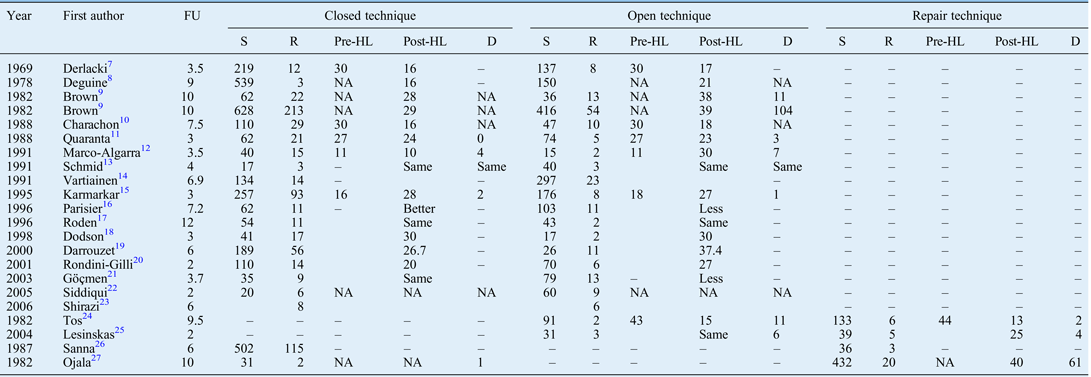
As only four studies comparing all three surgical techniques were found, a second analysis of another group of studies comparing only two of the surgical techniques was performed. Seventeen studies compared open vs closed mastoid surgery,Reference Derlacki, Baron, Beales, Bellucci, Guilford and Plester7–Reference Shirazi, Muzaffar, Leonetti and Marzo23 two studies compared open vs repair mastoid surgeryReference Tos24, Reference Lesinskas and Vainutiene25 and two studies compared closed mastoid surgery with repairing of the cavity.Reference Sanna, Zini, Gamoletti, Delogu, Russo, Scandellari and Taibah26, Reference Ojala and Palva27 All of these studies had evidence level 2 (Table II).
Outcomes of 22 studies comparing two different surgical techniques
FU = follow up (in years); S = sample size (n); R = recidivism rate (in %); pre-HL = pre-operative hearing level (in dB); post-HL = post-operative hearing level (in dB); D = post-operative ear discharge rate (in %); NA = not available
Inclusion of these 21 studies increased the patient sample size by 3112 for the closed surgical technique, 1809 for the open technique and 640 for the repair technique. The second analysis determined cholesteatoma recidivism rates of 29.4 per cent for the closed technique, 16 per cent for the open technique and 5.3 per cent for the repair group. The proportion of patients with discharging ears was 18 per cent in the closed technique group, 17 per cent in the open technique group and 11 per cent in the repair cavities group. The mean hearing levels were 23 dB pre-operatively vs 22 dB post-operatively for the closed technique, 27 dB pre-operatively vs 27 dB post-operatively for the open technique and 44 dB pre-operatively vs 39 dB post-operatively for the repair group.
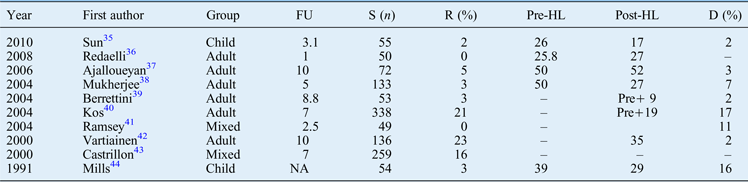
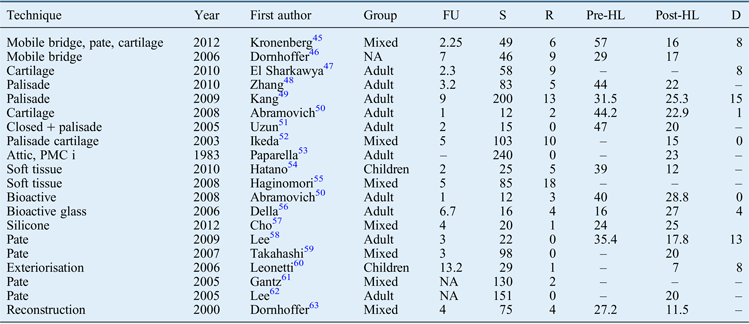
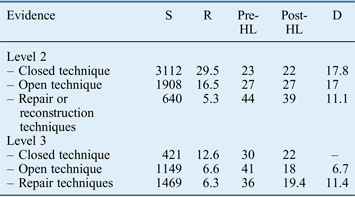
In a third analysis, the cholesteatoma recidivism rate, pre- and post-operative hearing levels, and post-operative ear discharge rate were determined using data from studies which evaluated only a single surgical technique (i.e. evidence level 3; Tables III–V). Table VI provides an overall summary of evidence level 2 and 3 analyses.
Level of evidence 2 for closed mastoid surgery

FU = follow up (in years); S = sample size; R = recidivism rate; pre-HL = pre-operative hearing level (in dB); post-HL = post-operative hearing level (in dB); D = post-operative ear discharge rate
Level of evidence 2 for open mastoid surgery
Examined were recidivism rates, pre-and post-operative hearing levels and ear discharge rates following surgery. FU = follow up (in years); S = sample size; R = recidivism rate; pre-HL = pre-operative hearing level (in dB); post-HL = post-operative hearing level (in dB); D = post-operative ear discharge rate
Level of evidence 2 for repair or reconstruction surgery
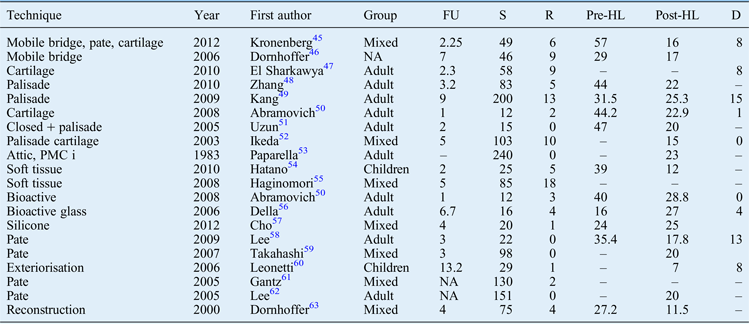
FU = follow up (in years); S = sample size (n); R = recidivism rate (in %); pre-HL = pre-operative hearing level (in dB); post-HL = post-operative hearing level (in dB); D = post-operative ear discharge rate (in %); NA = not available
Outcomes after mastoid surgery
S = sample size (n); R = recidivism rate (in %); pre-HL = pre-operative hearing level (in dB); post-HL = post-operative hearing level (in dB); D = post-operative ear discharge rate (in %).
Discussion
Level 1 evidence for primary cholesteatoma surgery was not found in the literature search. Moreover, no prospective randomised study comparing two or more surgical techniques in mastoid surgery for cholesteatoma was identified. However, studies on primary cholesteatoma surgery with levels of evidence 2 and 3 were found.
This study analysed the published data on outcomes of primary cholesteatoma surgery and highlights an important deficiency in the available level of evidence. In addition, various methods have been used to repair the mastoid cavity, so their combined analysis may not accurately represent the outcomes associated with each method. Further, post-operative hearing assessment was not performed in all cases and various methods were used for hearing assessment: speech discrimination testing along with a pure tone audiogram may provide a standardised functional outcome assessment to enable comparisons. Ear discharge findings should also be quantified in a consistent manner (for example, as the number of days per year with ear discharge), but this was not done. These issues demonstrate the difficulties involved in defining a ‘gold standard’ treatment. Despite this, it is imperative that surgical decision-making is based on the best available evidence.
Evidence level 2 data were analysed in two different ways: the first analysis of a group of four papers compared the outcomes of all three types of surgery (Table I); and the second analysis of a group of 18 papers compared the outcomes of only two types of surgery. These two groups of papers were then pooled to determine the overall evidence level 2 on the different types of mastoid surgery for primary cholesteatoma. The pooled analysis showed that a lower cholesteatoma recidivism rate is associated with open mastoid surgery (16.9 per cent) than with closed (25.7 per cent) or reconstruction and/or repair mastoid surgery (20 per cent). Open mastoid surgery was associated with a much higher ear discharge rate (27 per cent) compared with closed (3.3 per cent) and reconstruction (8.8 per cent) mastoid surgery. Pre- and post-operative hearing levels were similar among the three groups. In the papers reporting evidence level 2 for open and closed mastoid surgery (Table II), open mastoid surgery was associated with a much lower recidivism rate (16 per cent) compared with the closed technique (29.4 per cent). The repair mastoid group had an even lower recidivism rate (5.3 per cent), although only 4 of the 22 studies examined this group. There was no difference in hearing outcome between the open and closed mastoid groups in all 22 studies. Ear discharge rates were not mentioned in many studies, so it was difficult to compare this outcome among groups.
In general, if level l evidence regarding a clinical question is available, then studies with weaker levels of evidence should not be considered: evidence level 2 should alter practice whilst evidence level 3 should inform practice. Thus, clinical practice should follow the highest level of evidence. Analysis of studies with level of evidence 2 demonstrated that open mastoid surgery is associated with a much lower cholesteatoma recidivism rate compared with closed techniques. As this is the highest level of evidence found on this subject, it should be used to inform clinical practice.
The worldwide literature on primary cholesteatoma surgery was analysed in this study. Notably, when only level 3 evidence was analysed, the differences in outcome between techniques were smaller than for level 2 evidence. Although analysis of level 3 evidence demonstrated a higher cholesteatoma recidivism rate for closed mastoid surgery compared with the open surgical technique, the difference was smaller than in the equivalent analysis of level 2 evidence (evidence level 3, 12.6 per cent vs 6.6 per cent; evidence level 2, 29.5 per cent vs 16.5 per cent). These data demonstrate that including data from individual case series or other non-experimental descriptive studies in the analysis can lead to a false view of the benefits of closed surgery. There may be a smaller difference in cholesteatoma recidivism rates between open and closed mastoid surgery in the evidence level 3 analysis because closed mastoid surgery is preferentially performed on cholesteatoma with a less extensive spread within the middle ear and mastoid cavity. Presentations at international meetings often refer to performing canal wall up surgery on patients with simpler disease and open surgery on others with more complex disease. This practice would skew results in favour of closed mastoid surgery when recidivism rates in studies with evidence level 3 are considered. It is also a reminder to avoid basing clinical practice on evidence level 4 when a higher level of evidence is available.
• No level 1 evidence is available for primary cholesteatoma surgery
• There is no difference in hearing change or discharge rate between open and closed cavity mastoid surgery
• The recidivism rate is much lower for open than for closed cavity mastoid surgery
• Low levels of evidence may inform surgical decision-making
• This may explain the continued use of combined approach tympanoplasty for primary cholesteatoma
The smaller difference in cholesteatoma recidivism rates between closed and open mastoid surgery in studies with evidence level 3 may persuade some surgeons that closed mastoid surgery is the best method. Closed mastoid surgery may also be falsely thought to result in a lower risk of post-operative ear discharge. Table VI provides an overall summary of level of evidence 2, showing the same rate of post-operative discharge for both open and closed mastoid surgery. Hence, it may be argued that if recidivism rates between open and closed mastoid surgery are similar and there is a reduced ear discharge rate after the latter technique, then closed mastoid surgery is the best option. However, this finding is found to be false when only studies with evidence level 2 are analysed.
This study aims to provide the highest level of evidence for primary cholesteatoma surgery and highlights the danger of relying on lower evidence levels or surgical experience alone. Whilst this article was being written, a meta-analysis of intact canal wall mastoid surgery vs open cavity surgery for primary cholesteatoma by Tomlin et al. (2013) demonstrated that the recurrence and/or recidivism rate was almost three times greater with closed mastoid surgery than for open surgery, thus supporting our findings.Reference Tomlin, Chang, McCutcheon and Harris64 However the published evidence is analysed, it is difficult to avoid the conclusion that open surgery cures more cholesteatomas compared with the other available techniques, without a significant difference in the dry ear rate or post-operative hearing level.
Conclusion
A comparison of data on 5366 patients from studies with the highest available evidence level (level 2) showed a lower recidivism rate for open cavity surgery (16.0 per cent) than for closed cavity surgery (29.4 per cent), whilst there was no difference in hearing change or discharge rate among all surgical techniques. Analysis of reconstruction and/or repair mastoid surgery using a variety of non-comparable techniques in 640 patients identified a failure rate of between 5.3 per cent and 20 per cent. Combined analysis of all the available evidence suggests that reconstruction of the posterior canal wall and/or obliteration of the mastoid may in fact be the better treatment alternative, certainly in the first instance. These results (although from a much smaller patient group compared with the open or canal wall up surgery groups) suggest that this technique has the lowest recidivism rate combined with a reduced post-operative ear discharge rate.