INTRODUCTION
Winter turnip rape (Brassica rapa L. ssp. oleifera (DC.) Metzg.) is a cruciferous oilseed crop better adapted to the Nordic climate than oilseed rape (Brassica napus L. ssp. oleifera (Moench) Metzg.). Because of its rapid growth, it out-competes weeds and consequently suits organic farming production systems (Mäkelä et al. Reference Mäkelä, Tuulos, Turakainen, Santanen and Stoddard2011). Moreover, winter turnip rape can be harvested before other crops because it reaches maturity earlier than other crops, i.e. in July, and since it is also sown in July, it is in the ground for 12 months of the year. In Finland, winter turnip rape is sown by the end of July because late sowing results in yield reduction (Valle Reference Valle1951). This is a limiting factor for winter turnip rape cultivation since farms usually have no free land at that time because most field crops do not mature before August. A potential solution to this problem would be to sow winter turnip rape in May with a cereal and thereby reduce the costs of establishing the crop while increasing land-use efficiency. The cereal would be harvested, as usual, in autumn and the winter turnip rape would remain in the field to overwinter and produce seed in the following growing season (Valle Reference Valle1951). Mixed crop stands often capture more mineral nutrients than pure stands (Midmore Reference Midmore1993; Morris & Garrity Reference Morris and Garrity1993a ) and are also more water-use efficient (Morris & Garrity Reference Morris and Garrity1993b ). This could also be the case with mixed crops of winter turnip rape and cereals. Mixed crops also tend to reduce pest damage (Trenbath Reference Trenbath1993) and allow fewer weeds to develop due to more intense competition within the canopy (Szumigalski & Van Acker Reference Szumigalski and Van Acker2005).
Owing to interspecific competition, growth and yield of one or both of the component species in a mixed stand usually differ from those in pure stands (Vandermeer Reference Vandermeer1989). However, the most successful mixed crops tend to have component species that differ from each other in length of growing time, and therefore during the period of greatest demand for resources (Fukai & Trenbath Reference Fukai and Trenbath1993). Such is the case when one of the components remains in the vegetative stage whereas the other reaches the reproductive stage. However, most research in temperate and boreal areas has focused on mixtures of spring crops (Bellostas et al. Reference Bellostas, Hauggaard-Nielsen, Andersen and Jensen2003; Andersen et al. Reference Andersen, Hauggaard-Nielsen, Weiner and Jensen2007). Under-sowing winter oilseed rape with barley (Hordeum vulgare L.) is considered impractical since the yield and quality of winter oilseed rape is inferior when compared with its production as a monocrop. Under-sowing in such a situation also results in damage to the apical meristems of winter oilseed rape during barley harvest (Nordestgaard Reference Nordestgaard1982). The hypocotyls of winter oilseed rape tend to lengthen when the temperature exceeds 10 °C during the early growth stages (Rapacz Reference Rapacz1998) and thus can become four times as long as hypocotyls exposed to lower temperatures. Winter turnip rape meristems are less likely to be damaged during cereal harvest as the apical meristem remains near the soil surface during the vegetative phase (Torssell Reference Torssell1958). For this reason, winter turnip rape could be double-cropped, as with oilseed rape (Kirkegaard et al. Reference Kirkegaard, Sprague, Dove, Kelman, Marcroft, Lieschke, Howe and Graham2008) and cereals (Dann et al. Reference Dann, Axelsen, Dear, Williams and Edwards1983; Bonachela et al. Reference Bonachela, Orgaz and Fereres1995).
Double-cropping of winter turnip rape could improve the profitability of the crop through forage production. In double-cropping, the vegetative mass of the cultivated crop is harvested for forage before the generative phase begins. Successful double-cropping requires incorporation of crops for which reproductive capacity is not negatively affected by harvesting vegetative plant parts. This is possible when an adequate period exists between leaf removal and reproductive development (Dann et al. Reference Dann, Axelsen, Dear, Williams and Edwards1983). Thus, winter cultivars are generally more suitable for double-cropping than spring cultivars. Winter cultivars also allow sowing several months earlier than usual, which results in increased herbage yield in late summer or autumn (Dann et al. Reference Dann, Axelsen, Dear, Williams and Edwards1983).
The aim of the present work was to evaluate the performance of winter turnip rape in mixed stands with different spring cereals at various plant stand densities. Another objective was to investigate whether autumn harvest of aerial biomass for forage has a negative effect on overwintering and yield formation of winter turnip rape.
MATERIALS AND METHODS
Plant material and experimental design
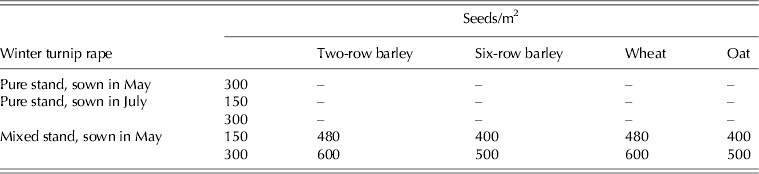
Two field experiments were conducted during 2009–11 at the Viikki Experimental Farm (60°13′N, 25°02′E, 8 m asl), University of Helsinki, Finland. The soil was silty clay loam (silt 30–40%, clay 50–60%, sand 10–20%) with organic matter content of 6–12%. According to the WRB system (IUSS Working Group WRB 2006) the fields were typically Luvic Gleysols or Luvic Stagnosols. In both experiments, the preceding crop was a grass-ley and the soil was ploughed in the previous autumn. Plant material consisted of oat (Avena sativa L., cvar Marika), wheat (Triticum aestivum L., cvar Zebra), two-row barley (cvar Xanadu), six-row barley (cvar Vilde) and winter turnip rape (cvar Largo). Cereal seeds were dressed with 1·5 g Baytan l/kg seed (triadimenol 150 g/kg and imazalil 25 g/kg, Bayer CropScience) and turnip rape seeds with 10·75 ml Elado FS480/kg seed (chlothianidin 400 g/l and betacyfluthrin 80 g/l, Bayer CropScience). Seed densities of cereals were according to recommended commercial practices (six-row barley, 500 seeds/m2 and two-row barley 600 seeds/m2; oat, 500 seeds/m2; wheat, 600 seeds/m2) and 20% lower than normal densities (Table 1). Seeding densities of turnip rape were the recommended commercial density of 150 seeds/m2 and 100% higher density, i.e. 300 seeds/m2 (Table 1). Cereals and turnip rape in mixed stands, as well as early-sown winter turnip rape monocrops were sown on 5 May 2009 and 15 May 2010. Turnip rape monocrops were sown on 30 July 2009 and 31 July 2010. Fertilizer (80 N kg/ha) was applied to the seed-bed at the time of sowing (N–P–K: 20–2–12, Pellon Y4, Yara Finland) and broadcast (80 N kg/ha) on to the soil surface after winter turnip rape overwintering (N–P–K: 15.5–0–0, Peltokalkkisalpietari, Yara Finland). Row spacing was 125 mm and rows of different species in mixed stands were sown in alternate rows. Cereals were sown first with a plot drill (Wintersteiger TC2700, Wintersteiger AG, Ried, Austria) in all plots at 50 mm below the soil surface and winter turnip rape on a second pass with the plot drill to a depth of 20 mm, after which the plots were rolled.
Seeding densities of winter turnip rape and cereals used in experiments in 2009–11. Normal commercial seeding rate is 150 seeds/m2 for winter turnip rape, c. 500 seeds/m2 for oat and six-row barley, and c. 600 seeds/m2 for two-row barley and wheat

Insect pests were controlled in 2009 with 0·6 litres/ha Bioruiskute S (pyrethrin 100 g/l, Yara) and 0·5 litres/ha Roxion (dimethoate 400 g/l, BASF) at cereal growth stage (GS) 51 (Zadoks et al. Reference Zadoks, Chang and Konzak1974). Fungal pathogens of cereals were controlled with 0·5 litres/ha Tilt 250 EC (propiconazole 250 g/l, Makhteshim Agan) at GS 65. Weeds were controlled after winter turnip rape overwintering with 0·3 litres/ha Galera (clopyralid 267 g/l and picloram 67 g/l, Dow Agro) and 1·5 litres/ha Fusilade Max (fluazifop-P-butyl 125 g/l, Syngenta) in both years at winter turnip rape GS 30 (BBCH 1997). Insect pests of winter turnip rape were controlled with 0·3 litres/ha Biscaya OD (thiacloprid 240 g/l, Bayer CropScience) and fungal pathogens with 0·5 litres/ha Juventus 90 (metconazole 90 g/l, BASF) at winter turnip rape GS 60.
The experiments were conducted in a split-plot design of four replicates with the mixtures and densities of plants as main plots and cutting the stands for forage as sub-plots. The combinations (Table 1) of different cereals and seeding densities with winter turnip rape and two different seeding densities were randomly assigned to the 10 m2 (8×1·25 m) plots.
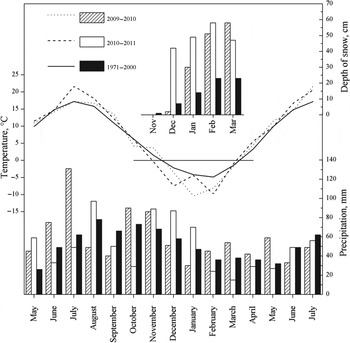
The weather during the vegetative growth phase and overwintering of winter turnip rape varied greatly between seasons (Fig. 1). The beginning of the 2009 growing season was more humid than the long-term (1971–2000) average, with June and July having twice the precipitation of June and July of 2010. Unlike in 2009, in the late autumn of 2010 the soil did not freeze before there was permanent snow cover. This maintained soil temperatures above 0 °C during the winter months. However, both winter periods were slightly colder and the snow cover was deeper than the long-term average.
Monthly mean temperatures, precipitation and depth of snow during the experimental period in 2009–11 and the long-term means from 1971 to 2000 at Kaisaniemi (60°10′N, 24°56′E, 4 m asl), Helsinki, Finland (FMI 2013).

Sampling and growth parameters
Plant stand densities were determined from three randomly selected places in each plot by counting the plants from a 0·3 m section within a single row. Density measurements were repeated three times during the first growing season and also after winter turnip rape overwintering. Cereals were harvested with a plot combine harvester (Hege Maschinen GmbH, Waldenburg, Germany) at maturity leaving >0·3 m stubble. Oat and barley were harvested on 20 August and wheat on the 2 September in 2009. In 2010, all cereals were harvested on 20 August. As the harvester was not equipped with a shredder, the straw was removed. One-third of each winter turnip rape stand was cut to 50 mm stubble to simulate forage harvest at GS 19 (BBCH 1997) on 21 October 2009 and 29 September 2010. Simultaneously, winter turnip rape leaf forage samples were collected for quality analysis from three stand types (double density monocrop sown in May; double density mixed crop with oat sown in May, including oat stubble in the sample; normal density monocrop sown in July). Winter turnip rape samples (five plants/plot) were collected randomly at winter turnip rape GS 19, including the tap root, before snowfall in 2009 and 2010. The tap root was removed from the soil using a notch-headed chisel. Each plant sample was divided into leaves, hypocotyl and root fractions. After fractioning, all samples were dried in an oven at 80 °C for 48 h and weighed. Another set of samples was collected prior to harvest, at the end of July 2009 and 2010. Ten plants/plot in 2010 and 15 plants/plot in 2011 were collected randomly from ground level throughout the plot, excluding the two outermost rows on each side of a plot, and used for analysis of yield components (number of branches/plant, weight of seeds/plant and dry weight/plant) and harvest index. At maturity (29 July 2010 and 2 August 2011) winter turnip rape was harvested and the yield was determined.
Oil and protein content of the seeds were determined with a near infra-red analyser (Perten DA 7200, Perten Instruments AB, Segeltorp, Sweden) and thousand seed weight was determined as the mean of two samples, each consisting of 200 seeds, counted with a Pfeuffer Contador semi-automated counter (Pfeuffer GmbH, Kitzingen, Germany). The nutritive values of winter turnip rape leaf forage were determined. Primary dry matter was determined by drying the samples for 48 h at 80 °C. Ash content was determined by incinerating the samples in a furnace at 600 °C for 18 h. Carbon and nitrogen content were determined with an automated dry-combustion analyser (Elementar VarioMAX CN, Elementar Analysensysteme GmbH, Hanau, Germany). Crude protein content of the leaf forage was calculated by multiplying the nitrogen content by a factor of 6·25 (Jones Reference Jones1941). The measurement of in vitro organic matter digestibility was based on pepsin–cellulase solubility and was performed as reported previously by Jaakkola et al. (Reference Jaakkola, Saarisalo and Heikkilä2009). Neutral detergent fibre (NDF) was determined using the method described by Van Soest et al. (Reference Van Soest, Robertson and Lewis1991).
Statistics
Analysis of variance was conducted using PASW 18 (IBM, Armonk, New York, USA) and multiple comparisons of means were done with Tukey's test.
RESULTS
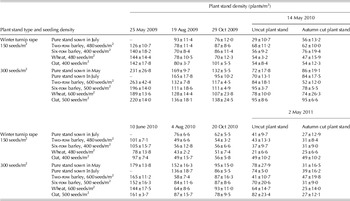
There were significantly lower germination percentages in double density stands than in normal density stands (2009, P<0·01; 2010, P<0·05). Winter turnip rape plant establishment was low, especially in 2009 (2009, 63–88%; 2010, 48–60% of sowing density). In the plots sown at normal density, the winter turnip rape densities were 84–95% of seeds sown in 2009, but fell to only 52–70% in 2010. All winter turnip rape stands self-thinned during the summer months (Table 2). After summer 2009 the densities were 37–62%, and in 2010 19–51% of the seeds sown. Thinning was less evident in the autumn after cereal harvest, and in both years, in some stand types, an increase in winter turnip rape density occurred during the autumn months. Further thinning occurred during winter (as a result of winter kill): in the following spring the winter turnip rape densities were 19–45 and 14–32% of the sown seeds in 2009 and 2010, respectively. In the spring, the densities in most plant stands were well above 30 plants/m2, and the plants were evenly distributed. Stands sown at high density remained denser than stands sown at normal density in the following spring, even though significant differences were recorded only between some stand types (Table 2). In 2009, stands sown at double density as a mixed crop with six-row barley or oat retained a significantly (P<0·001) higher winter turnip rape population than the normal density pure stand of winter turnip rape sown in July. In 2010, the stand sown at double density as a mixed crop with oat was significantly (P<0·01) denser than the normal density stand sown with wheat at reduced density (Table 2).
Density of winter turnip rape plant stands when established as a pure stand or as mixed crop with cereals in experiments conducted in 2009–10 and 2010–11. Mixed stands were sown in May. Data shown are means±s.e., n=4

Double density stands that were cut for forage in October tended to be sparser in the following spring than normal density stands cut for forage, even though the differences between various plant stand types were not significantly different (Table 2). In 2010/11, however, the cut stands of winter turnip rape sown at double density as a monocrop, either in May or July, were significantly (P<0·001) sparser than similar stands that were not cut in the previous autumn (Table 2).
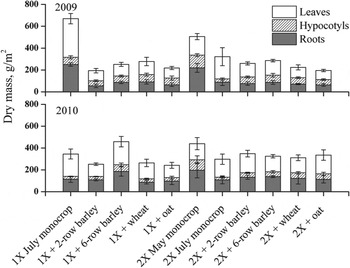
Winter turnip rape sown as a monocrop at normal density in July 2009 had significantly (P<0·001) higher leaf biomass per m2 in comparison with other winter turnip rape stands, excluding the high density monocrop, before the onset of winter (Fig. 2). Also, winter turnip rape sown as a monocrop at high density in May and at normal density in July had significantly (P<0·001) higher root biomass per m2 in comparison with other treatments. In 2010, no differences in dry mass of leaves and roots were recorded, and barring a few exceptions, the plants in different treatments had accumulated more biomass before winter than during the previous year. In 2010, the highest biomass per m2 was produced by winter turnip rape sown at normal density (150 seeds/m2) with six-row barley (Fig. 2).
Dry mass of different plant parts of single winter turnip rape plants when established as monocrops or mixed crops with cereals in 2009 and 2010. 1X=150 seeds/m2 (at normal cereal density) 2X=300 seeds/m2 (at −20% reduced cereal density). Data shown are means±s.e., n=4.

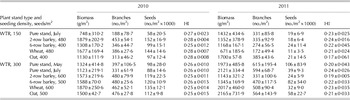
The above-ground biomass and the number of seeds of winter turnip rape in 2010 differed according to plant stand types (Table 3). The above-ground biomass of normal density winter turnip rape grown with reduced density two-row barley, and high density winter turnip rape grown with wheat, was significantly higher (P<0·05) than that of a normal density pure stand. Multiple comparisons of number of branches in 2010 did not reveal differences, even though there was a significant (P<0·05) effect of treatments. In both years, there was very little difference in harvest index among stand types irrespective of the method used for establishment. In 2011, there were no differences in the above-ground biomasses produced, and number of branches and seeds among plant stand types (Table 3).
Above-ground biomass, number of branches, number of seeds and harvest index (HI) in differently established winter turnip rape (WTR) stands in experiments conducted in 2009–10 and 2010–11. Pure stands were sown either in May or July and mixed stands were sown in May. Data shown are means±s.e., n=4

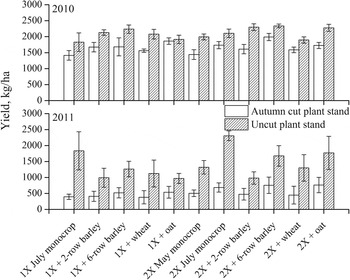
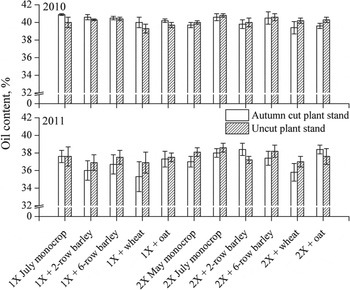
Winter turnip rape seed yield (Fig. 3) and its quality (Figs 4 and 5) did not differ among different plant stand types (pure or mixed stands with cereals) in 2010. The late-sown, double density pure stand of winter turnip rape outperformed the other stand types in quantity of yield in 2011 and produced the second highest yield in 2010. Also the late-sown, normal density winter turnip rape stand yielded similarly in both years (Fig. 3). In 2011, however, the winter turnip rape pure stand sown in July at high density performed significantly better (P<0·05) in yield formation compared with when intercropped with two-row barley (at both winter turnip rape sowing densities) or oat (at low winter turnip rape sowing density) (Fig. 3). Also, an effect on seed quality was noted in the treatments where forage cuts were taken, as winter turnip rape sown at high density with oat produced significantly higher (P<0·01) oil content than winter turnip rape sown at normal density with wheat (Fig. 4). Seed protein content did not differ between treatments in either year (23·9–25·2% in 2010 and 24·2–25·9% in 2011). However, protein and oil content of winter turnip rape seed correlated negatively in both years (2010, R 2=−0·928, P<0·001, n=88; 2011, R 2=−0·850, P<0·001, n=88).
Seed yield of winter turnip rape in 2010 and 2011, when established as monocrops or mixed crops with cereals. 1X=150 seeds/m2 (at normal cereal density) 2X=300 seeds/m2 (at −20% reduced cereal density). Data shown are means±s.e., n=4.

Oil content of winter turnip rape seeds in 2010 and 2011, when established as monocrops or mixed crops with cereals. 1X=150 seeds/m2 (at normal cereal density) 2X=300 seeds/m2 (at −20% reduced cereal density). Data shown are means±s.e., n=4.

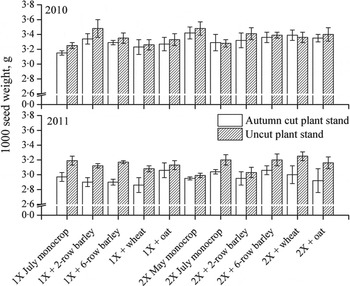
Thousand seed weight of winter turnip rape in 2010 and 2011, when established as monocrops or mixed crops with cereals. 1X=150 seeds/m2 (at normal cereal density) 2X=300 seeds/m2 (at −20% reduced cereal density). Data shown are means±s.e., n=4.

The seed yield of winter turnip rape was negatively affected by cutting the leaves in autumn in both years (Fig. 3). The only plant stand type that was not affected in either year was winter turnip rape sown at normal density with oat. The average yield reduction due to harvesting of leaf material in autumn was 20% in 2010 and 62% in 2011. Cutting the leaves before overwintering also reduced the thousand seed weight significantly (P<0·001) in several plant stands (Fig. 5).
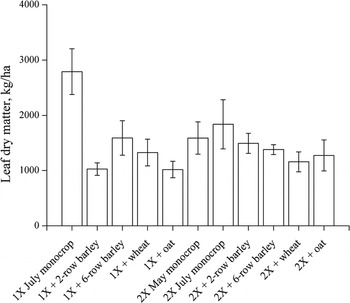
The average leaf dry matter yield of winter turnip rape ranged from c. 1000 kg/ha up to 3000 kg/ha in 2009 and 2010 (Fig. 6). The normal density pure stand of winter turnip rape sown in July produced significantly higher (P<0·001) leaf dry matter yield than winter turnip rape sown in a mixed crop. The only exception was with reduced density six-row barley, which yielded leaf dry matter of almost 1600 kg/ha. Total leaf dry matter yield did not differ between the winter turnip rape monocrops, yielding 1600–2800 kg/ha (Fig. 6).
Leaf dry matter of winter turnip rape harvested before cessation of growth in 2009 and 2010. 1X=150 seeds/m2 (at normal cereal density) 2X=300 seeds/m2 (at −20% reduced cereal density). Data shown are means±s.e., n=4, over two years.

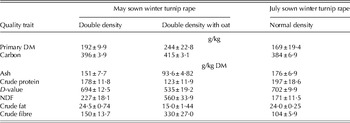
Even though there was little difference in the forage quality of the two monocrop stands of winter turnip rape, it did differ significantly from that of the mixed crop stand with oat. The forage from monocrop stands had a higher D-value (P<0·001), ash (P<0·001), crude fat (P<0·001) and crude protein (P<0·01) content than forage from mixed crop stands (Table 4). However, the mixed crop stand forage had higher dry matter content (P<0·05), NDF-value (P<0·001) and crude fibre content (P<0·001) than that of the two monocrop stands (Table 4).
Forage quality of winter turnip rape leaves harvested before cessation of growth in 2009 and 2010. Winter turnip rape sowing density was 150 seeds/m2 at normal density and 300 seeds/m2 at double density with 500 (2009) and 400 (2010) seeds/m2 of oat. Glucosinolate content of leaf matter was 3–20 μmol/g DM. Data shown are means±s.e., n=6 (data combined over 2 years), except for crude fat and crude fibre where n=3

DM, dry matter; D-value, digestible organic matter; NDF, neutral detergent fibre.
DISCUSSION
Sowing early in May 2009 resulted in even germination of winter turnip rape seedlings in stands at normal sowing density. The reason for high sowing density stands being sparser than expected is not clear, but since the low density was not a result of seedling death, and the plants of both species were in their early growth stages, excluding interspecies above-ground competition, reasons other than the usual self-thinning mechanisms are likely. Yasumoto et al. (Reference Yasumoto, Suzuki, Matsuzaki, Hiradate, Oose, Hirokane and Okada2011) reported autotoxicity or allelopathy in winter oilseed rape, and suggested that it inhibited germination of the same species via volatile and non-volatile compounds, such as glucosinolates, found most abundantly in seeds and roots. As ploughing took place in the current experiments in the previous autumn, the preceding ley had decomposed for over 6 months. That would have reduced the possibility that germination-inhibiting substances originated from the decomposing ley because most such substances denature within days or weeks (Lynch & Audus Reference Lynch and Audus1976). Winter turnip rape densities lower than the original sowing density observed during the first measurement in 2010 may partly be a result of drought because they were sown in mid-May, when most of the spring moisture in the soil had evaporated. Densities in 2010 were, however, more affected in stands sown at double density. As seedling death was again ruled out, results suggest a self-inhibitory effect on winter turnip rape germination. Similarly, in an oilseed rape stand at high seeding density (270 seeds/m2) the establishment was 24% lower than with low seeding density (90 seeds/m2) as a result of intra-species competition (Moore & Guy Reference Moore and Guy1997). Nevertheless, the lower than expected densities after germination in 2010 in normal density stands could have affected the yield in the following year.
The thinning of different types of winter turnip rape stands is a result of environmental factors, which may alter the proportions of the component species in a mixed stand by favouring one species over another, as well as intra- and inter-species competition (Silvertown Reference Silvertown1982). More pronounced thinning of the double density stands compared with normal density stands in the early growth stages in both years shows evidence of self-thinning under intra-species competition that is more intense at a high seed rate (White & Harper Reference White and Harper1970). However, the inter-species competition in mixed stands of cereal sown at normal density and winter turnip rape sown at double density is more intense than in the stands with reduced cereal density and normal winter turnip rape density. High densities in the canopy may also have contributed to the more pronounced thinning (Silvertown Reference Silvertown1982) that was observed in the early growth stages in the high-density stands. The increase in densities observed during the autumn months in both years suggests that some of the seeds originally sown in May germinated at later stage.
In 2009, the higher leaf and root biomass before overwintering of the July-sown monocrop did not predict better overwintering or higher seed yield of the stand compared with other treatments. In 2010, even though the leaf and root biomasses were similar in all stands, and the plants had accumulated more biomass before winter, overwintering in 2010/11 was not as successful as in 2009/10. It seems that plant size has a smaller effect on overwintering than the climatic conditions experienced during the winter period.
The highest winter turnip rape densities after overwintering were recorded in stands sown at high density, which indicates that higher than normal sowing density is suitable when winter turnip rape is under-sown with a cereal. Nevertheless, almost all stands in both years had densities above the threshold (30 plants/m2) suggested for failure in a winter oilseed crop to overwinter successfully (Mendham et al. Reference Mendham, Shipway and Scott1981). Higher seeding density ensures an even distribution of plants after overwintering, even if it might not generate a yield advantage over sparser stands. Doubled sowing density might be too high, as evidence of self-inhibition of winter turnip rape following germination was noted in densely sown stands. Cutting the leaves for forage in the autumn might promote thinning of winter turnip rape sown at higher than normal densities, but stands sown originally as mixed crops are less likely to be affected than pure stands.
Low-density crucifer oilseed crops can produce yields comparable with high-density crops because low-density crop canopies are able to benefit from yield component compensation to a greater extent than high-density canopies (Mendham et al. Reference Mendham, Shipway and Scott1981). As different stand types yielded similarly in 2010, but densities and number of seeds differed between some plant stands, it is suggested that low-density crops compensated for seed yield by producing more seeds per plant, similarly as reported for oilseed rape (Mendham et al. Reference Mendham, Shipway and Scott1981; Leach et al. Reference Leach, Stevenson, Rainbow and Mullen1999).
The seed yield obtained in 2010 suggests that establishing winter turnip rape as a mixed crop with cereals does not affect the seed yield or its quality when weather conditions are conducive to overwintering. No distinguishable differences in the suitability of different cereals as companion crops to winter turnip rape were evident in 2010 after successful overwintering of the crop. In 2011, both mixed stand types that were established with two-row barley produced the smallest yield. However, winter turnip rape stands established with six-row barley performed well when compared with other mixed stands, possibly indicating that six-row barley is an appropriate companion crop for winter turnip rape, if less favourable overwintering conditions follow the first growing period. Generally, lower yields in 2011 can be attributed to less favourable climatic conditions during the winter of 2010/11. As the soil did not freeze before or during winter 2010/11, unlike in 2009/10, it is possible that the winter turnip rape did not reach full cold acclimation, which would have prevented freezing injuries during overwintering in the second experiment. Chilling of the root system of oilseed rape is known to have a major role in the development of frost resistance as plants that have only either a chilled shoot or root system have lower leaf phospholipid and protein content and reach only half of the water potential of the plants with both systems chilled, resulting in reduced ability to withstand sub-zero temperatures (Kacperska & Szaniawski Reference Kacperska and Szaniawski1993). Additionally, soil remaining unfrozen under the snow cover might have promoted respiration of the plants and the degradation of storage carbohydrates in 2010/11, as shown with winter cereals (Jamalainen Reference Jamalainen1978). Correspondingly, Waalen (Reference Waalen2013) reported for winter rapeseed, that depletion of carbohydrates under long-lasting snow cover affects negatively freezing tolerance and spring re-growth. However, in 2011 the pure stands sown in July produced a larger yield than other stand types, which suggests that the ability to produce yield decreased with stands that were sown in May. It seems that the climatic conditions during winter 2010/11 promoted the differences between plant stands sown in May and July.
The amount of seed yielded in 2010 and 2011 by both winter turnip rape pure stands sown at the normal time in July implies that winter turnip rape monocrops sown late in the growing season produce consistent yield and seem to be less affected by the differences in conditions during the growing seasons or the overwintering period than stands established as mixed crops. Winter turnip rape stands established in spring as a monocrop or a mixed crop with cereals can, however, be affected by different overwintering conditions as indicated.
The negative correlation of seed oil and protein content is consistent with earlier findings on oilseed rape (Zhao et al. Reference Zhao, Evans, Bilsborrow and Syers1993; Rathke et al. Reference Rathke, Christen and Diepenbrock2005), but the reason for the differences in oil content between plant stand types being more pronounced following forage cuts in the second experiment is not clear. However, the autumn-cut stands were sparser than uncut stands after overwintering. Low-stand density increases the proportion of yield produced by the lower branches in oilseed rape (Mendham et al. Reference Mendham, Shipway and Scott1981). The lower branches in autumn-cut stands probably had low oil content in the seeds, which therefore resulted in generally lower oil content of sparse stands, as reported for oilseed rape by Zhang et al. (Reference Zhang, Liao, Zhang and Xu2012).
Cutting winter turnip rape leaves for forage before overwintering seems to increase the risk of a yield penalty or even yield failure in the following year. This is consistent with reports on using autumn sown seed crops as forage, including oilseed rape (Kirkegaard et al. Reference Kirkegaard, Sprague, Dove, Kelman, Marcroft, Lieschke, Howe and Graham2008) and cereals (Bonachela et al. Reference Bonachela, Orgaz and Fereres1995; Francia et al. Reference Francia, Pecchoni, Li Destri Nicosia, Paoletta, Taibi, Franco, Odoardi, Stanca and Delogu2006). It is likely that not only leaf cutting but also removal of the leaves contributed to the poor performance of the autumn cut stands. Oilseed rape is known to take up c. 40% of the N released from leaves that died during winter in the following spring (Dejoux et al. Reference Dejoux, Recous, Meynard, Trinsoutrot and Leterme2000). If the same uptake rate is assumed for winter turnip rape, the fertilizing effect of winter turnip rape leaves could be 36 kg N/ha, as winter turnip rape can hold up to 90 kg of N/ha in its leaves in the autumn (A. Tuulos, unpublished). This might also have affected the oil content of the seeds (Grant & Bailey Reference Grant and Bailey1993). The severe yield reductions recorded in 2011 may be partly associated with climatic conditions during winter 2010/11, which also contributed to the thinning and relatively low yields in the uncut stands. In both seasons, the winter turnip rape forage was collected in mid-October, which is the latest that harvesting can take place in Finland. An earlier harvest might improve the re-growth before overwintering (Kirkegaard et al. Reference Kirkegaard, Sprague, Dove, Kelman, Marcroft, Lieschke, Howe and Graham2008) and the weather conditions might be more suitable for harvest, but the forage yield would be lower.
The leaf dry matter yield of winter turnip rape seems to depend more on plant stand density than on sowing time. A normal density monocrop sown in July was the most productive stand, possibly due to lower competition within the stand. None of the high-density stands reached similar dry matter yields as the normal density monocrop sown in July, even though some of the high-density stands were sown in May. This is consistent with previous work with oilseed rape monocrops by Harper & Compton (Reference Harper and Compton1980), who concluded that early sowing is not advantageous for forage yield.
The high crude protein content combined with low crude fibre content of forages can result in low utilization of forage nitrogen (Thomas et al. Reference Thomas, Chamberlain, Kelly and Wait1980; Bowman et al. Reference Bowman, Hunt, Kerley and Paterson1991). If such forages are used as the only roughage in ruminant nutrition, the excess nitrogen is secreted in the urine (Rinne et al. Reference Rinne, Jaakkola and Huhtanen1997). Thus, the high crude protein and low crude fibre forage harvested from winter turnip rape monocrops is more suitable as supplementary feed. Grazing or feeding winter turnip rape monocrop forage should be done with caution as the high crude protein and low crude fibre content suggest that excessive intake can induce acute frothy bloat in ruminants (Cole et al. Reference Cole, Huffman, Kleiber, Olson and Schalk1945; Wang et al. Reference Wang, Majak and McAllister2012). Since species belonging to the Brassica genus contain glucosinolates, it is possible that some winter turnip rape cultivars contain these compounds, even though nearly all cultivars available in Europe since the late 1980s have very low concentrations of glucosinolates in their seeds. The cultivar Largo contains glucosinolates at 3–20 μmol/g DM in leaves, of which glucobrassicanapin, gluconapin and gluconasturtin are the most abundant. Older cultivars can have two to three times more glucosinolates in their leaves (A. Tuulos, unpublished), but the total amounts of glucosinolates in cultivar Largo leaves are comparable with those in commonly used forage brassicas (Barry Reference Barry2013). Nevertheless, the breakdown products of glucosinolates are considered to be detrimental to ruminant health (Tripathi & Mishra Reference Tripathi and Mishra2007), in particular cattle (Fales et al. Reference Fales, Gustine, Bosworth and Hoover1987). The concentration of these compounds can be, however, significantly reduced by ensiling the forage (Fales et al. Reference Fales, Gustine, Bosworth and Hoover1987) and thus forage quality is improved for ruminant nutrition. The sowing time of the plant stands does not affect digestibility of the monocrop forages, as suggested earlier by Kalmbacher et al. (Reference Kalmbacher, Everett, Martin and Jung1982). As the other nutritive qualities in monocrop forages, such as NDF and crude fat, do not differ between the early and normal sowing dates, very flexible timing of crop establishment can be practised if the crop is intended for forage use. Winter turnip rape forage from stands that were established in May tended to have slightly higher dry matter content at harvest, which would make it more suitable for forage harvesting.
The cereal stubble that was included in the sample increased the crude fibre content of the forage harvested from mixed stands with oat. High fibre content is essential for normal rumen function (Allen Reference Allen1997). Thus, the mixed crop forage might be suitable for more extensive use than sole winter turnip rape forage.
CONCLUSIONS
Winter turnip rape can be under-sown in spring cereals without yield penalty providing that overwintering conditions are favourable. After exceptional overwintering conditions, such as those of 2010/11, crop failure can occur, leading to decreased stand density and reduced seed yield. When establishing winter turnip rape as a mixed crop, it is necessary to use a higher than normal seed rate and a barley variety with low tillering ability as a companion crop. Leaf material can be used as forage in autumn, even though it can increase the risk of crop failure. Winter turnip rape monocrop forage could represent a high-protein supplement for ruminants, but the high-crude protein and low-crude fibre content might require intake to be regulated. A winter turnip rape forage monocrop stand can be established either in May or in July without affecting forage quality, although the highest yields are from monocrops established in July.
This work was partly funded by the University of Helsinki Research Grants, Science and Research Foundation of The Finnish Association of Academic Agronomists, Jenny and Antti Wihuri Foundation, August Johannes and Aino Tiura Agricultural Research Foundation, Olvi-foundation and The Finnish Cultural Foundation. The authors thank Markku Tykkyläinen and Axel Baarman for technical assistance and Dr Jarkko Isotalo for statistical advice.