Introduction
Mealybugs are one of the most serious pests attacking cultivated orchids. The larvae and adult individuals of the family Pseudococcidae are mobile and can crawl between plants. Furthermore, they hide in the roots and rhizomes in the potting media as well as in the joints of benches or under the lips of pots and trays. Mealybugs, like other scale insects, have piercing–sucking mouthparts that drain the resources available within the host. They feed on leaves, stem axils, inflorescence shoots and flowers causing loss of vigor and weakening of orchids, resulting in the dieback of leaves, buds and flowers (Johnson, Reference Johnson2009). The damage caused by phloem-feeding insects, such as scale insects or aphids, is not limited to specific tissues near the feeding sites but affects the entire plant. They deplete photosynthates and introduce chemical and/or protein effectors that alter defense signaling and the development of plant. In addition, mealybugs secrete honeydew, which makes plant sticky and serves as a substrate for sooty mold. The extent to which the function of plant is disrupted depends on the density of scale insect infestation (Vranjic, Reference Vranjic, Ben-Dov and Hodgson1997; Walling, Reference Walling2008; Samsone et al., Reference Samsone, Andersone and Ievinsh2012; Golan, Reference Golan2013).
Defenses of the plants against herbivorous insects are a complex issue, because the plants have developed various defense mechanisms and responses to infestation also vary between the plant species (Gatehouse, Reference Gatehouse2002). Their reaction to biotic and abiotic stress factors have been often associated with reactive oxygen species (ROS), including hydroxyl radicals (OH•), hydrogen peroxide (H2O2) and superoxide anion radical (O2 −). The production of ROS is a very early response to biotic stress, and has been suggested as providing a signal in plant–insect interaction. The increased accumulation of ROS in response to herbivory begins by the activation of plasma membrane-located NADPH oxidases, which catalases the production of O2 −, by one-electron reduction of oxygen using NADPH as the electron donor (Maffei et al., Reference Maffei, Mithofer and Boland2007). Superoxide serves as a starting material for the production of other ROS, such as H2O2 and others (Apel & Hirt, Reference Apel and Hirt2004). ROS such as H2O2, can also activate lipoxygenases to initiate the biosynthesis of oxylipins such as jasmonic acid (Porta & Rocha–Sosa, Reference Porta and Rocha-Sosa2002), indeed, jasmonic acid treatment alone produces a H2O2 burst (Ozawa et al., Reference Ozawa, Bertea, Foti, Narayana, Arimura, Muroi, Horiuchi, Nishioka, Maffei and Takabayashi2009). Excessive production of ROS acts as a necessary factor controlling stress perception that can be associated with the induction of plant defense responses against insects feeding (Ali et al., Reference Ali, Hahn and Paek2005; Golan et al., Reference Golan, Rubinowska and Górska-Drabik2013; Mai et al., Reference Mai, Bednarski, Borowiak-Sobkowiak, Wilkaniec, Samardakiewicz and Morkunas2013). Additionally, ROS have not only deleterious effects in cell metabolism but also play a key role in intracellular communication triggers the acclimation ability of plants to unfavorable conditions (Rejeb et al., Reference Rejeb, Abdelly and Savouré2014). However, enhanced ROS production in plants leads to a disturbance in the cellular redox balance, which causes oxidative damage to cellular components such as proteins, lipids, sugars and nucleic acids (Mittler, Reference Mittler2002; Mai et al., Reference Mai, Bednarski, Borowiak-Sobkowiak, Wilkaniec, Samardakiewicz and Morkunas2013). When the levels of ROS exceed the threshold, peroxidation of lipids (LPO) occurs in both cellular and organelle membranes. The overall effects of LPO are decreased membrane fluidity, increased leakiness of the membrane and membrane proteins damage (Gill & Tuteja, Reference Gill and Tuteja2010).
Plants have developed a number of enzymatic (e.g., peroxidases, catalase) and non-enzymatic (e.g., glutathione, carotenoids and flavonoids) antioxidant defense mechanisms to protect themselves against ROS (Hung et al., Reference Hung, Yu and Lin2005; Gill & Tuteja, Reference Gill and Tuteja2010). Peroxidases and catalase contribute to the reduced accumulation of ROS and detoxification of oxidation products, thereby allowing ROS to play crucial functions in signal transduction. Elevated activities of these enzymes may increase the ability of plants to tolerate insect feeding (Gulsen et al., Reference Gulsen, Eickhoff, Heng-Moss, Shearman, Baxendale, Sarath and Lee2010; Mai et al., Reference Mai, Bednarski, Borowiak-Sobkowiak, Wilkaniec, Samardakiewicz and Morkunas2013). Proline appears to have multiple functions in stress adaptation and signaling. It can be viewed as a non-enzymatic antioxidant that plants require to mitigate the adverse effects of ROS. Free proline is believed to act as an osmoprotectant, a protein stabilizer and an inhibitor of LPO. Increased accumulation of proline has been correlated with improved tolerance to various abiotic stresses (Szabados & Savouré, Reference Szabados and Savouré2009; Gill & Tuteja, Reference Gill and Tuteja2010). Carotenoids play a number of functions in plant metabolism, including the tolerance to oxidative stress. These pigments scavenge ROS and suppress LPO in photosynthetic organisms (Gill & Tuteja, Reference Gill and Tuteja2010). Chlorophyll content is one of the parameters that can be modified during insect infestations of the plants, e.g., the feeding of aphids can reduce the level of chlorophyll (Ni et al., Reference Ni, Quisenberry, Heng-Moss, Markwell, Higley, Baxendale, Sarath and Klucas2002; Goławska et al., Reference Goławska, Krzyżanowski and Łukasik2010).
Although, oxidative responses of plants to aphids (Hemiptera: Sternorrhyncha) have been reported in number of studies (e.g., Gomez et al., Reference Gomez, Oosterhuis, Rajguru and Johnson2004; Kehr, Reference Kehr2006; Łukasik et al., Reference Łukasik, Goławska, Wójcicka and Pogonowska2008; Sytykiewicz et al., Reference Sytykiewicz, Goławska and Chrzanowski2011; Mai et al., Reference Mai, Bednarski, Borowiak-Sobkowiak, Wilkaniec, Samardakiewicz and Morkunas2013), plant–mealybug interactions are poorly described (Retuerto et al., Reference Retuerto, Lema, Roiloa and Obeso2004; Calatayud & Le Rü, Reference Calatayud and Le Rü2006; Golan, Reference Golan2013; Golan et al., Reference Golan, Rubinowska and Górska-Drabik2013). Little is known about the response of orchids induced by insect feeding, especially mealybugs (Kmieć et al., Reference Kmieć, Kot, Rubinowska, Łagowska, Golan and Górska-Drabik2014; Sempruch et al., Reference Sempruch, Golan, Górska-Drabik, Kmieć, Kot and Łagowska2014).
A better understanding of the physiological basis of plant–scale insect interactions is important for generation of effective and sustainable strategies controlling mealybugs. The present study will use Phalaenopsis and Pseudococcus longispinus as a model.
Our working hypothesis was that the higher infestation of Phalaenopsis by P. longispinus was associated with a stronger response of antioxidative plant systems. The aim of this work was to determine what the number of feeding insects that required control was. This study documents the influence of different number of feeding scale insects on the degree of cell damage, estimated by electrolyte leakage measurement and the level of thiobarbituric acid reactive substances (TBARS), the content of pigments as well as the activity of antioxidative enzymes and proline level, as measurements of stress and stress compensation in moth orchid.
Material and methods
Insects and plants
The longtailed mealybugs were originally obtained from stock cultures kept at the Department of Entomology, University of Life Sciences in Lublin (Poland). The insects were reared on Phalaenopsis × hybridum ‘Innocence’ plants in an environmental chamber (temperature 27 ± 1°C; relative humidity 50 ± 5%, photoperiod L:D = 16:8). The plants used for analysis (without inflorescence shoots) were purchased from JMP Flowers Gardening Enterprise in Stężyca (Poland). The orchids were grown in plastic transparent pots of a diameter of 12 cm, filled with coarse pine bark bedding. Plants were situated in a cultivation chamber on textile sub-irrigation mats (Polprotex) covered with black agrofabric for a 4-week adaptation period before the start of the experiment. Care practices included only once a week plants flooding with tap water.
Colonization of orchids by longtailed mealybug
The orchids (four groups of five plants) in a phase of seven fully developed leaves, without inflorescence shoots, were colonized with various numbers of P. longispinus young females or third instar larvae. Plants with no insects were used as a control. For plants colonized by mealybugs three thresholds were set: 5 individuals/plant (series I), 20 individuals/plant (series II), 50 individuals/plant (series III). The plants were placed in an environmental chamber (conditions described above). Mealybugs fed on plants for 10 days, after then samples were taken for the analysis. The number of insects on plants did not change due to their long pre-reproduction period.
Physiological analysis
Assays of the state of cell membranes
The physiological state of the plants was analyzed in the laboratory of the Department of Plant Physiology of the University of Life Sciences in Lublin.
The state of leaf cell membranes in plants of each series was checked by determining electrolyte leakage (E L) from leaves according to the method described by Kościelniak (Reference Kościelniak1993), using an Elmetron CC-317 microcomputer conductometer (Elmetron, Poland). Ten rings (0.9 cm diam.) were cut with a cork borer from leaves of each series, then covered with 20 cm3 redistilled water and shaken at room temperature for 24 h, after which the first electroconductivity measurement was made (K 1). The plant material was then boiled at 100°C (15 min). After next 24 h of shaking, electroconductivity was measured again to determine total electrolyte content (K 2). Electrolyte leakage is expressed as a percentage of its total content in the tissue, according to the formula: E L = (K 1/K 2) 100%.
Assays of level of membrane lipid peroxidation
The level of membrane lipid peroxidation was assessed by determining TBARS content according to Heath & Packer (Reference Heath and Packer1968). Crushed plant material (0.2 g) was homogenized in 0.1 M potassium phosphate buffer, pH 7.0, and then centrifuged at 12,000 g for 20 min. Next, 0.5 cm3 of the homogenate was added to 2 cm3 20% trichloroacetic acid (TCA) containing 0.5% thiobarbituric acid (TBA) and incubated for 30 min in a water bath at 95°C. After incubation the samples were quickly cooled and centrifuged again at 10,000 g for 10 min. Absorbance was measured at 532 and 600 nm with a Cecil CE 9500 spectrophotometer (Cecil Instruments, UK). The TBARS concentration in a sample was calculated using the molar absorbance coefficient, which for TBARS is 155 nM−1 cm−1, and expressed as nanomoles per 1 g fresh weight.
Preparation of enzymatic extract
Assays of the activity of examined enzymes
Leaves (0.2 g) were homogenized in a mortar in 0.05 mol dm−3 phosphorus buffer pH 7.0, at 4°C. The homogenate was then centrifuged at 10,000 g for 10 min at 4°C. The supernatant thus obtained was used for further procedures.
Activity of peroxidase toward guaiacol was measured following the method given by Małolepsza et al. (Reference Małolepsza, Urbanek and Polit1994). The reaction mixture contained 0.5 cm3 0.05 mol dm−3 phosphorus buffer pH 5.6, 0.5 cm3 0.02 mol dm−3 guaiacol, 0.5 cm3 0.06 mol dm−3 H2O2 and 0.5 cm3 enzymatic extract. Absorbance was measured at 1 min intervals for 4 min with a Cecil CE 9500 spectrophotometer at 480 nm. Peroxidase activity toward guaiacol was determined using the absorbance coefficient for this enzyme, which is 26.6 mM cm−1. The result was converted to peroxidase activity per fresh weight, expressed as U mg−1 fresh weight (FW).
Catalase activity was determined as described by Chance & Meahly (Reference Chance and Meahly1955) and modified by Wiloch et al. (Reference Wiloch, Mioduszewska and Banaś1999). The reaction mixture contained 2 cm3 50 mM K-phosphorus buffer pH 7.0 0.2 cm3 H2O2 and 0.1 cm3 enzymatic extract. Extinction was measured for 3 min using a Cecil CE 9500 spectrophotometer reading the initial and final results at 240 nm. Catalase activity was determined using the absorbance coefficient, which for catalase is 0.036 mM cm−1. The result was converted to catalase activity per fresh weight, expressed as U mg−1 fresh weight.
To determine free proline level, 0.5 g of leaf samples from each group were homogenized in 3% (w/v) sulphosalicylic acid and then homogenate filtered through filtered paper (Bates et al., Reference Bates, Waldren and Teare1973). Mixture was heated at 100°C for 1 h in water bath after addition of ninhydrin and glacial acetic acid. Reaction was then stopped by ice bath. The mixture was extracted with toluene and the absorbance of fraction with toluene aspired from liquid phase was read at 520 nm using a Cecil CE 9500 spectrophotometer. Proline concentration was determined using calibration curve expressed as μg proline g−1FW.
Assays of the content of photosynthetic pigments
The content of pigments: chlorophyll a, chlorophyll b and carotenoids in plant tissues was performed according to the method described by Lichtenthaler & Wellburn (Reference Lichtenthaler and Wellburn1983) after taking 0.5 g of the leaf fresh weight and extraction in 80% acetone. The measurement of absorbance was performed with three wave lengths (λ): 470 nm (carotenoids), 646 nm (chlorophyll b) and 663 nm (chlorophyll a), using a Cecil spectrophotometer CE 9500. The concentration of particular pigments was calculated according to the following formulas:
 $${C_{{\rm chl}.{\rm a}}} = {\rm 12}.{\rm 21}\cdot {A_{{\rm 663}}} - {\rm 2}.{\rm 81}\cdot {A_{{\rm 646}}},$$
 $${C_{{\rm chl}.{\rm b}}} = {\rm 2}0.{\rm 13}\cdot {A_{{\rm 646}}} - {\rm 5}.0{\rm 3}\cdot {A_{{\rm 663}}},$$
 $${C_{{\rm kar}.}} = \left( {{\rm 1}000\cdot {A_{{\rm 47}0}} - {\rm 3}.{\rm 27}\cdot {C_{{\rm chl}.{\rm a}}} - {\rm 1}0{\rm 4}\cdot {C_{{\rm chl}.{\rm b}}}} \right)/{\rm 227},$$
where A λ is the absorbance value for wave length λ.
Next, the concentrations of pigments were converted into their content in the leaf fresh weight.
Statistical analysis
All data are presented as means ± SE, n = 5, where each replication represents one independent plant. Comparisons of particular parameters between infested and control orchids were subjected to Mann–Whitney U-test. The non-parametric Kruskal–Wallis test was applied after the rejection of the normality assumption of the data for catalase, peroxidase and pigments, followed by the post-hoc multiple comparison of mean-ranks for four insects density groups. One-way ANOVA was used for normally distributed data (E L, TBARS, proline). The strength of relationship between the number of individuals per plant and the values of physiological parameters was estimated using Spearman's rank correlation coefficient (r S) for catalase, peroxidase and pigments, while Pearson's correlation coefficient (r) was applied for E L, TBARS and proline. The experimental data were verified with Statistica for Windows v. 8.0 (StatSoft); P = 0.05 was used as the threshold of significance.
Results
Although the analyzed parameters of the plant physiological responses varied, certain changes seemed to be positively correlated with the number of scale insects feeding on orchid plants.
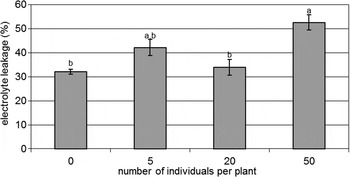
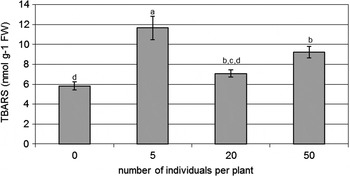
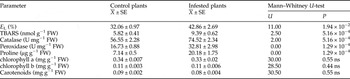
The degree of Phalaenopsis × hybridum ‘Innocence’ cell membrane damage after mealybugs infestation was estimated based on the measurements of electrolyte leakage and lipid peroxidation. Mean values of TBARS and E L parameters were significantly higher in plants colonized by P. longispinus than in non-infested plants (table 1). Electrolyte leakage was increased in all the leaves infested by P. longispinus, regardless of their number (fig. 1). The highest E L value (52.62%) among samples from colonized plants was found in the orchids from series III, whereas the lowest (33.85%) in the plants from series II. Significant differences were observed between the control and series III plants. A considerable difference in E L was also found between series II and III. A statistically significant positive correlation was demonstrated between the number of feeding mealybugs and the value of E L parameter (r = 0.6525; P = 0.002). The TBARS content reached the highest level at the lowest number of feeding insects (series I) (fig. 2). The increase in the number of mealybugs on the leaves in series II and III resulted in 12 and 46% increase in TBARS levels, respectively, compared with the control. Statistically significant differences were recorded between control and series I and III plants.
The effect of P. longispinus infestation of different density on electrolyte leakage of Phalaenopsis × hybridum ‘Innocence’ leaves. Values with the same letter do not differ significantly at P = 0.05.

Changes in TBARS content in leaves of Phalaenopsis × hybridum ‘Innocence’ depending on the infestation density of P. longispinus. Values with the same letter do not differ significantly at P = 0.05.

The effect of P. longispinus feeding on level/activity of studied parameters in leaves of orchid Phalaenopsis × hybridum ‘Innocence’.

ns, not significant.
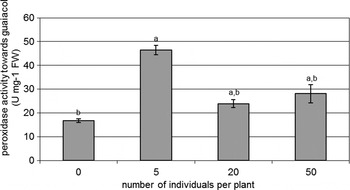
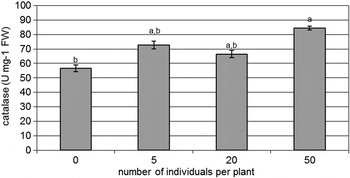
The presence of P. longispinus resulted in a significant increase in both peroxidase and catalase activity in orchid leaves (table 1). Peroxidase activity toward guaiacol was significantly increased in series I (5 individuals/plant) (fig. 3). However, at 20 and 50 individuals/plant, the activity of this enzyme showed only a minor tendency to increase. The highest catalase activity was recorded in plants colonized by the highest number of scale insects (fig. 4). The degree of infestation with longtailed mealybug was positively correlated only with the catalase activity in leaf tissues (r S = 0.783617; P = 0.000044).
Peroxidase activity toward guaiacol in Phalaenopsis × hybridum ‘Innocence’ leaves in response to P. longispinus infestation of different density. Values with the same letter do not differ significantly at P = 0.05.

Catalase activity in Phalaenopsis × hybridum ‘Innocence’ leaves exposed to P. longispinus infestation of different density. Values with the same letter do not differ significantly at P = 0.05.

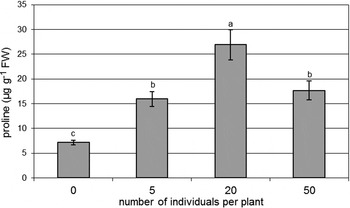
Figure 5 presents proline content in plants with various degree of infestation, indicating that the highest value of this amino acid was in series II. Low number of feeding insects (5 individuals/plant) caused a significant increase in the proline content when compared with the plants without mealybugs. The successive increase in the number of soft scale insects on the leaves in series II resulted in a 3.5-fold increase in proline content. Proline content was lower in the leaves of plants colonized with 50 individuals of P. longispinus compared to series II, but it was still over 2-fold higher in comparison with the control.
The effect of P. longispinus infestation of different density on free proline content in Phalaenopsis × hybridum ‘Innocence’ leaves. Values with the same letter do not differ significantly at P = 0.05.

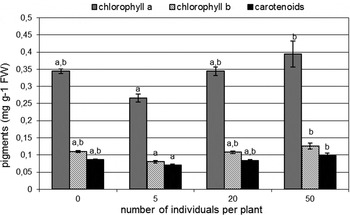
The content of individual photosynthetic pigments (chlorophyll a, chlorophyll b and carotenoids) in plant tissues did not vary significantly between control and colonized orchids (table 1). The content of all pigments decreased in series I, whereas it was slightly higher in series II and III compared with the control plants (fig. 6).
Changes in chlorophyll and carotenoid contents in leaves of Phalaenopsis × hybridum ‘Innocence’ depending on the infestation density of P. longispinus. Values with the same letter do not differ significantly at P = 0.05.

Discussion
Biotic stress factors such as herbivores induce the production of ROS and can activate signaling and defense mechanisms in plants (Apel & Hirt, Reference Apel and Hirt2004; Mai et al., Reference Mai, Bednarski, Borowiak-Sobkowiak, Wilkaniec, Samardakiewicz and Morkunas2013). Plant tissues are sufficiently sensitive to wounding so that multiple punctures with insect's stylet can cause a transient increases in cytoplasmic streaming and cell permeability. Damage to the cell membrane leads to leakage of the cellular content and lipid peroxidation (Walling, Reference Walling2008; Gomathi & Rakkiyapan, Reference Gomathi and Rakkiyapan2011). Reports concerning feeding of aphid indicate that the increase in the percentage of cell membrane damage (based on electrolyte leakage) and lipid peroxidation were directly linked to the phloem-sucking insects: Brevicoryne brassicae (L.) (Khattab, Reference Khattab2007), Aphis medicaginis Koch (Wei et al., Reference Wei, Zhikuan and Qingfang2007), Acyrthosiphon pisum Harr. (Mai et al., Reference Mai, Bednarski, Borowiak-Sobkowiak, Wilkaniec, Samardakiewicz and Morkunas2013). We have found significant changes in the parameters of orchid leaves reflecting the state of cell membranes under mealybugs feeding. The injury percentage to Phalaenopsis leaves was increasing with the size of P. longispinus population. However, significantly higher E L was measured only in plants with the largest mealybugs infestation (series III). Our results are consistent with previous studies on Coccus hesperidum L. feeding on Nephrolepis biserrata (Sw.) Schott. (Golan et al., Reference Golan, Rubinowska and Górska-Drabik2013), Citrus limon (L.) var. Ponderosa and Ficus benjamina L. (Golan, Reference Golan2013). Furthermore, our previous work (Kmieć et al., Reference Kmieć, Kot, Rubinowska, Łagowska, Golan and Górska-Drabik2014) revealed that the parameters determining cytoplasmic membrane condition reached high values during the initial (24 h) period of P. longispinus feeding on the orchid leaves. The injury percentage in Phalaenopsis leaves after P. longispinus infestation in each series increased by about 6–64% compared with the control leaves. Therefore, it can be assumed that mealybugs have not developed sufficient physical/chemical measures to limit the electrolyte leakage in the plant response to stylet penetration, e.g., as opposed to aphids. The components of the sheath and watery saliva play a key role in counteracting plant defense reactions against aphid feeding (Miles, Reference Miles1999; Will & van Bel, Reference Will and van Bel2008; Will et al., Reference Will, Tjallingii, Thönnessen and van Bel2007, Reference Will, Steckbauer, Hardt and van Bel2012). Calatayud et al. (Reference Calatayud, Rahbe, Tjallingii, Tertuliano and Le Rü1994) observed that the duration of cell puncture and the minimal time to reach the phloem was even 8-fold higher in mealybugs than in aphids. Moreover, Pseudococcus manihoti Matile-Ferrero during the probing on cassava plants secreted pectinolytic enzymes involved in the degradation of cassava cell wall, thereby facilitating penetration of the stylets into the host tissues (Calatayud & Le Rü, Reference Calatayud and Le Rü2006).
Regulation of the level of ROS is one of the important factors controlling plant physiology (Łukasik et al., Reference Łukasik, Goławska and Wójcicka2012; Suzuki & Mittler, Reference Suzuki and Mittler2012). Plants enhance the resistance mechanisms enabling ROS scavenging and cell defense under stress conditions to maintain cell balance (Ferry et al., Reference Ferry, Stavroulakis, Guan, Davison, Bell, Weaver, Down, Gatehouse and Gatehouse2011). The main task of oxidative enzymes (e.g., superoxide dismutase (SOD), ascorbate peroxidase (APX), guaiacol peroxidase (GPX), glutathione S-transferase (GST) and catalase (CAT)) is to catalyze and reduce toxic intermediate products of oxygen metabolism, which prevents plant cell damage (Mittler, Reference Mittler2002; Gill & Tuteja, Reference Gill and Tuteja2010). The present study also included the analysis of the activity of catalase and peroxidase toward guaiacol. The activity of both enzymes in Phalaenopsis leaves was enhanced by P. longispinus infestation. Peroxidases are involved in ethylene metabolism, redox reactions in plasma membranes, cell wall modifications as well as developmental and defense processes, i.e., biosynthesis of phytoalexins and metabolism of ROS (Mika et al., Reference Mika, Boenisch, Hopff and Lüthje2010). Elevated level of peroxidase may strengthen the plant ability to tolerate insect feeding. Peroxidase (POD) oxidizes phenolic compounds in the expense of H2O2 and is considered to be a key enzyme in lignin biosynthesis (Mika et al., Reference Mika, Boenisch, Hopff and Lüthje2010). The highest activity of peroxidase toward guaiacol in orchid leaves was recorded at the lowest mealybugs infestation. The up-regulation of this enzyme in series I (5 individuals/plant) was almost 3-fold compared with the control, whereas only a slight increase in peroxidase activity toward guaiacol in orchid leaves was caused by P. longispinus feeding in other density classes. An increase in peroxidase activity due to aphids feeding was previously reported by Mohase & van der Westhuizen (Reference Mohase and van der Westhuizen2002), Moloi & van der Westhuizen (Reference Moloi and van der Westhuizen2006), He et al. (Reference He, Chen, Chen, Lv, Deng, Fang, Liu, Guan and He2011), Mai et al. (Reference Mai, Bednarski, Borowiak-Sobkowiak, Wilkaniec, Samardakiewicz and Morkunas2013). Kaur et al. (Reference Kaur, Gupta and Taggar2014) suggest that the strength in induction in enzymatic activities varied among genotypes. This might be due to differences in sensitive up-regulation response of genotypes against pest insects (War et al., Reference War, Pauljar, War and Ignacimuthu2012). POD participates in defense responses through the cell wall toughening as it is considered to be a key enzyme in the biosynthesis of lignin (Gaspar et al., Reference Gaspar, Penel, Hagege, Greppin, Łobarzewski, Greppin, Penel and Gaspar1991). In addition, the increase in phenolics could lead to the substrate-induced higher activity of POD. Taggar et al. (Reference Taggar, Gill, Gupta and Sandhu2012) and Kaur et al. (Reference Kaur, Gupta and Taggar2014) observed significant and positive correlation between POD and total phenols during insect–plant interactions. Our results are in agreement with the study of Golan et al. (Reference Golan, Rubinowska and Górska-Drabik2013). They demonstrated that the activity of peroxidase was many times higher in fern leaves sparsely colonized by C. hesperidum, when compared to the plants abundantly colonized by this insect, where the activity of the enzyme was similar to that in the control plants. In the present study, the peroxidase activity toward guaiacol and the TBARS content in orchid leaves was similar in all mealybugs density classes.
Catalase is indispensable for ROS detoxification during stress. This enzyme scavenges H2O2 generated during mitochondrial electron transport and beta-oxidation of the fatty acids (Mittler, Reference Mittler2002; Gill & Tuteja, Reference Gill and Tuteja2010). The relationship between changes in CAT activity of the plant and abundance of piercing-sucking insects is variable. The study of Ferry et al. (Reference Ferry, Stavroulakis, Guan, Davison, Bell, Weaver, Down, Gatehouse and Gatehouse2011) reported that the catalase was strongly up-regulated in wheat by Sitobion avenae (F.) infestation, whereas Mohase & van der Westhuizen (Reference Moloi and van der Westhuizen2002) demonstrated that the feeding of Russian wheat aphids reduced the activity of CAT in wheat. In addition, Kaur et al. (Reference Kaur, Gupta and Taggar2014) observed significant decline in CAT activity in Cajanus cajan (L.) Millsp. leaves, seeds and pod wall during Helicoverpa armigera (Hbn.) infestation. In other cases, feeding of soft scale insets did not elicit any changes in CAT activity (Golan et al., Reference Golan, Rubinowska and Górska-Drabik2013). Additionally Mai et al. (Reference Mai, Bednarski, Borowiak-Sobkowiak, Wilkaniec, Samardakiewicz and Morkunas2013) observed enhanced CAT activity in pea seedlings infested by A. pisum after 48 h of infestation. Then between 48 and 72 h authors revealed a decrease in CAT activity. Although in our study the activity of catalase was up-regulated by the longtailed mealybugs infestation, the increase was significant only at the highest number of insects (series III) compared to the control plants.
Proline has certain regulatory functions, it controls plant development and acts as a signal molecule. It plays a role in cellular homeostasis, including redox balance and energy status. Proline is considered as a potent antioxidant and potential inhibitor of programmed cell death. The accumulation of this amino acid in response to stress is widely reported, and may play a role in stress tolerance (Szabados & Savouré, Reference Szabados and Savouré2009; Gill & Tuteja, Reference Gill and Tuteja2010). Infestation of P. longispinus increased proline content in orchid leaves. Proline was characterized by the strongest reaction to P. longispinus infestation among all antioxidants analyzed. The capacity of certain plant species for proline hyperaccumulation contributes to their stress tolerance (Szabados & Savouré, Reference Szabados and Savouré2009). Stress-inducible proline accumulation might act as a component of an antioxidative defense system to counteract the deleterious effects of oxidative stress, by directly scavenging free radicals or by activating antioxidant system (Rejeb et al., Reference Rejeb, Abdelly and Savouré2014). The role of proline in plant responses to oxidative stress has been demonstrated extensively in experiments in which exogenous proline was applied (Hoque et al., Reference Hoque, Banu, Nakamura, Shimoishi and Murata2007; Ozden et al., Reference Ozden, Demirel and Kahraman2009) or in which proline synthesis or degradation was genetically engineered (Kocsy et al., Reference Kocsy, Laurie, Szalai, Szilágyi, Simon-Sarkadi, Galiba and de Ronde2005; Molinari et al., Reference Molinari, Marur, Daros, de Campos and de Carvalho2007).
Chlorophyll content can change in response to a wide variety of stresses. Goławska et al. (Reference Goławska, Krzyżanowski and Łukasik2010) found a decrease in chlorophyll a + b concentrations in Fabaceae tissues in response to aphid A. pisum feeding. Huang et al. (Reference Huang, Zhang, Zhang, Lu, Huang and Li2013) also observed significantly decrease in chlorophyll contents after mealybug infestation on tomato leaves. This trend continued to 23 days of infestation, measurement after 30 and 38 days indicated an increase in relative chlorophyll content. On the other hand, the study of Ni et al. (Reference Ni, Quisenberry, Heng-Moss, Markwell, Higley, Baxendale, Sarath and Klucas2002) revealed that wheat leaves infested with Diuraphis noxia (Mordvilko) (without visible damage) had a higher level of chlorophyll a, b and carotenoids in comparison with uninfested plants. This suggested that the attacked leaves might compensate for insects feeding by increasing the chlorophyll concentration in undamaged cells in the leaf. In our work, longtailed mealybug infestation did not exert significant changes in the levels of pigments compared with the control plants. However, we observed a slight decrease in series I (5 individuals/plant) and an increase in series III (50 individuals/plant). No visible signs of P. longispinus feeding were observed on Phalaenopsis leaves. Possible reason for those differences could include the length of infestation time, the effects of the environmental conditions on herbivore activity, the herbivore densities or the type of herbivore feeding.
As this work has shown, insects–host plants interactions offer a number of interesting problems, some of which were addressed here. The proposal of further research in this scope can be extended to examine the ROS (e.g., O2•−, H2O2. 1O2 and OH•), other antioxidant enzymes (e.g., APX, GR, SOD and GST) and substances with antioxidant activity (e.g., ascorbic acid, α-tocopherol and glutathione). They can better clarify the defense mechanisms of plants against feeding of mealybugs.
Conclusions
The defense response in the leaves of Phalaenopsis × hybridum ‘Innocence’ to P. longispinus infestation revealed some novel aspects of the regulatory mechanisms in the plant–mealybugs interaction. Increased percentage of cell membrane damage (based on electrolyte leakage), lipid peroxidation, activity of antioxidant enzymes and proline content, examined in this study, suggested that the occurrence of P. longispinus induced oxidative stress in Phalaenopsis × hybridum ‘Innocence’. Our results have not confirmed hypothesis that the increasing number of mealybugs occurring on plant enhanced plant physiological response. The degree of longtailed mealybug infestation on plants was positively correlated only with electrolyte leakage and catalase activity in leaf tissues. The strong reaction of certain parameters was already observed with a small number of herbivorous insects (only 5 individuals/plant). This indicates the complexity of the processes responsible for plant tolerance.
Funding
The study was financed by University of Life Sciences in Lublin (Project no. OKE/DS/2 in 2013-2017).