INTRODUCTION
In Western Europe in the eighteenth and nineteenth centuries, industrialization structurally changed the labour market. Machines replaced manual labour, and new occupations related to working with and maintaining machinery emerged. As a result, sons could not follow in their fathers' footsteps as much as before and thus needed to take up occupations different from those of their fathers.
It is argued that these changes went beyond the labour market and also affected the status positions related to occupations. Before industrialization, many sons attained the same social position as their father, since they would end up in the same occupation. According to the logic of industrialism thesis, the decreasing likelihood of occupational ‘inheritance’ caused the occupational status positions of sons to become decreasingly associated with that of their father.Footnote 1 Status maintenance theory, however, argues that, despite industrialization and the changes in the labour market it brought about, fathers were still able to pass on their status positions to their sons by investing in more years of education and at more prestigious schools.Footnote 2 The question then arises whether industrialization indeed changed the status attainment process and, if so, whether the association between a father's occupational status and that of his son declined.
This question has been addressed in many sociological and historical studies on intergenerational social mobility. Contemporary sociological studies of intergenerational social mobility find either no pattern in relative social mobilityFootnote 3 or only a small increase in relative mobility after the postwar period.Footnote 4 To discover whether such a trend is linked to industrialization, contemporary research compares social mobility patterns from countries with different levels of industrialization. However, the outcomes of these studies are not conclusive since today's industrializing countries industrialize in a manner different from countries in the nineteenth century. More explicit tests of the impact of industrialization are rare. As a result, there is no conclusive evidence in contemporary research on the impact of industrialization on patterns of social mobility.Footnote 5
Historical studies on the influence of industrialization on status attainment also raise a number of issues. Due to the enormous amount of work involved in gathering historical occupational data, many of these studies are confined to a small number of cities, a specific period, or a specific part of the population. Furthermore, studies trying to provide a more general view based on these splintered studies are hindered by the many different occupational classifications and class schemes used.
However, several developments in the field of historical social mobility provide opportunities to combine the scale advantages of contemporary sociological research with the authenticity of historical data. While digitalization projects unveil enormous quantitites of occupational information, regional, temporal, and language differences in occupational titles have to a large extent been overcome by the development of the Historical International Standard Classification of Occupations (HISCO). Based upon occupational titles derived from 2.4 million personal records originating from eight countries between 1692 and 1950, HISCO provides a specific code for occupations in which equivalent tasks are performed.Footnote 6 Furthermore, specific historical class schemes (including HISCLASSFootnote 7 and SOCPOFootnote 8) and occupational stratification scales (such as HIS-CAMFootnote 9) linked to HISCO have recently been developed. This enables researchers to systematically assign class categories and scale scores to occupations. Taken together, these developments increase the comparability of studies, and therefore the understanding of status attainment in the past.
The present study greatly benefits from these developments and uses digitalized data from all marriage records from the Dutch province of Zeeland between 1811 and 1915 to answer the following questions.Footnote 10 First, to what extent did the influence of a father's occupational status on his son's status differ between regions and over time? Second, how can regional and temporal differences in the influence of a father's occupational status on his son's status be explained?
By answering these questions, this article contributes to the existing research on (historical) social mobility in four ways. First, it provides a large-scale test of the influence of industrialization on the status attainment process. This study encompasses all strata, in over 100 municipalities, over a period of more than a century. By deriving data from all marriage records in the Dutch province of Zeeland between 1811 and 1915, the results of this study are easier to generalize than results from contemporary studies on industrialization or more confined historical studies. Second, the regional variation in industrialization in the province of Zeeland allows for a comparison of the status attainment process in more agricultural and industrialized regions. Third, since the data cover a time period of more than a century, even small changes over time, as found thus far in the historical and contemporary literature,Footnote 11 can be detected. Finally, this article studies the influence of contextual differences on intergenerational mobility, beyond a static dichotomization of rural (traditional) and urban (modern) areas, which usually goes under the heading of modernization.
This last contribution deserves elaboration. The term ‘modernization’ implies that there is a single mechanism at hand which causes a number of macro-level developments. Modernization theory describes this mechanism, but given the diversity of macro-level developments it does so in a general manner. By labelling a region or period as either ‘traditional’ or ‘modern’, the fact that these concepts are not mutually exclusive is neglected.Footnote 12 In ‘modern’ societies, traditional values and institutions can still persist. Furthermore, the term ‘modernization’ implies that, once it has started, it will expand within every aspect of society. However, there is neither theoretical argumentation nor empirical support for such a ‘domino’ effect between macro-level developments. Several authors even emphasize the autonomous nature of different aspects of ‘modernization’.Footnote 13
Both issues – dichotomizing areas as either traditional or modern and treating several macro-level processes as one – have had a substantive impact on the empirical tests of modernization theory. The theory is often tested at the national level and with just one indicator of modernization. However, the criticisms above show that, within societies, there can be variation in the development of different aspects of modernization and, furthermore, that these developments may occur independently of others, or at a different pace. It is therefore questionable whether tests of modernization theory at the national level that include only a single indicator of modernization are valid. This article, therefore, concentrates on the level of the municipality and focuses on the processes distinguished by TreimanFootnote 14: industrialization, educational expansion, mass communication, urbanization, geographical mobility, and furthermore mass transport. Hypotheses on how each of these processes influences the status attainment process are derived and tested using hierarchical linear regression models.
THEORY
The basic version of the status attainment process modelled by Blau and Duncan describes a direct and an indirect relationship between the occupational statuses of a father and a son.Footnote 15 The direct relationship represents a direct transfer of status between father and son. A father passing his occupation on to his son or a father using resources to find his son a job are illustrations of this direct kind of relationship.Footnote 16
A son's occupational status is also indirectly influenced by his father's status. While a son's educational attainment influences his occupational status, his educational attainment itself is influenced by his father's status. Before educational expansion, a son attained education through being taught occupational skills, often within the family. It is argued that, afterwards, the father's status influenced his son's educational attainment through investment in formal schooling and in the circumstances under which that education was obtained (housing, for example, and the need for a part-time job). The skills and/or the diploma then determine a son's status.
Having described the essence of the status attainment process, I will now explain how industrialization, educational expansion, mass communication, mass transportation, urbanization, and geographical mobility influence relationships in the status attainment model. I start with hypotheses derived from the logic of industrialism thesis.
Industrialization affects all three relationships in the status attainment model. I use Davis's definition to define industrialization as ‘the use of mechanical contrivances and inanimate energy (fossil fuels and water power) to replace or augment human power in the extraction, processing, and distribution of natural resources or products derived therefrom’.Footnote 17 First, industrialization decreases the direct association between the occupational status of the father and that of the son. The mechanization of labour decreased the need for manual labour in the agricultural sector,Footnote 18 making some of the more traditional occupations superfluous, obstructing some sons from following in their father's footsteps. At the same time, a demand for non-manual occupations arose due to the shift from the production of goods to the production of servicesFootnote 19 and to a growing demand for administrative and clerical workers in public bureaucracies.Footnote 20 This newly created demand offered sons the possibility of taking up occupations different from that of their father.
Second, industrialization diminished the influence of a father's status on his son's educational attainment. The reason is that the occupational skills passed on within the family became of less use with the changes in the occupational structure described above.
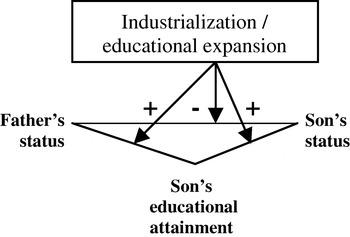
Third, industrialization increased the association between a son's educational attainment and his occupational status. With industrialization, the production process shifted from a craft system, in which a single individual creates a given article, to an assembly-line system, and the production process was split into ‘a set of discrete operations, each of which can be carried out in a routine manner by a semiskilled workman or machine attendant’.Footnote 21 This specialization of occupations, together with the increasing scale of economic activity, adds to the complexity of the production process and increases the need for the synchronization of its components. It can be assumed that such synchronization demands a labour force with increased communication and numerical skills in order to align the production process in an efficient way. Furthermore, more supervisors and managers are needed to guide the production process. Unlike fathers, schools are able to provide the skills for these non-manual occupations and, by increasing demand, industrialization increases the value of education. Thus the influence of a father's occupational status on the son's status as well as his educational attainment is expected to be less in more industrialized regions, while the influence of the son's educational attainment on his occupational status is greater (see (a) in Figure 1).
The influence of contextual processes on the status attainment model according to the logic of industrialism thesis.

Educational expansion influences a single relationship in the status attainment model: it decreases the influence of a father's occupational status on his son's educational attainment (see (b) in Figure 1). The reason is that, due to educational expansion, the cost of education decreased and education became available to a more diverse audience, diverse that is with regard to socioeconomic background. Before educational expansion, education was provided by private teachers or in small schools and universities with a small number of students. The increasing demand for a semiskilled workforce expanded education and decreased the cost of education per student. Furthermore, central and local governments started subsidizing education for those from lower-class backgrounds, thereby decreasing the cost of education even further.Footnote 22 Thus, the more educational expansion there is in a region, the less the influence of a father's occupational status on his son's educational attainment.
Before the rise of mass communication, information was disseminated mostly from person to person. This means that information on job opportunities, for instance, would have depended heavily on the social circles in which one mixed. With the rise of mass communication, such ‘private’ knowledge became more widespread, through, inter alia, newspapers. Information on national events, technological developments, and fashion trends, for instance, were shared through newspapers among individuals from different regions and social standings. This decreased the exclusivity of information based on background to a certain extent. In the case of job opportunities, many more individuals learned of a particular job opening, most likely decreasing the value of information attained through the father's social network. This thus decreased the influence of a father's occupational status on that of his son.
Mass communication is also argued to have diminished the association between a father's occupational status and his son's educational attainment. Through mass communication, people were able to learn about how people outside their local region lived. The latest fashion trends were no longer exclusive to ‘haute couture’ traders, but appeared in local newspapers. Treiman even posits that mass communication led to ‘a common culture and the diminution of regional, ethnic, and class differences in attitudes and behavior’.Footnote 23 In such cases, differentiation in social skills and behaviour between people from various social standings decreased and diminished the influence of background. In schools, too, pupils would then become more alike in the way they dressed and behaved. Pupils would therefore stand out less in terms of their social background. I would therefore expect the direct influence of a father's occupational status on his son's status and educational attainment to be less, the greater the means of mass communication (see (c) in Figure 1).
Urbanization and geographical mobility are yet other developments that would have reduced the influence of ascribed characteristics in the status attainment process.Footnote 24 First, lower-class children in urbanized areas would be under less pressure to leave school at an early age, or to leave school temporarily to help generate family income. Second, due to the size of urbanized municipalities and partially as a result of migration, individuals in more urbanized areas were less hampered or advantaged by their background status.Footnote 25 Thus the direct influence of a father's occupational status on his son's status will be less in more urbanized regions and in regions with more geographical mobility (see (c) and (d) in Figure 1). Furthermore, in more urbanized regions the influence of a father's status on his son's educational attainment will be smaller (see (c) in Figure 1).
Another macro-level development during industrialization was the mechanization of mass transport. While means of mass communication provided information from outside the local region, means of mass transport enhanced the opportunities to act on this information. The decreasing cost of transportation made it possible for people from different backgrounds to pursue jobs outside the local region and outside the social network of their father. Mass transportation also influences the association between a son's educational attainment and his occupational status. In cities with mechanized mass transportation, many people appear from outside the local region. To assess these people, family background is no longer of use as a reputation mechanism, since the family history is unknown beyond the local region. Therefore, another indicator of skills and behaviour is required. Diplomas serve this purpose. In sum, the influence of a father's occupational status on the son's status will be less in regions with greater means of mass transportation, while the influence of a son's educational attainment on his occupational status will be greater (see (e) in Figure 1).
Alternative hypotheses on the influence of industrialization and other macro-level developments on intergenerational status attainment can be derived from the status maintenance theory.Footnote 26 This theory contends that if a father's direct influence on his son's occupation diminishes, elites are still able to pass on their status positions through education. First, those with higher status positions often have greater economic resources and are able to invest in higher-quality education and more years of education for their children.Footnote 27 Contemporary research also shows that individuals from higher strata improve the conditions under which their children study by supporting them in their daily expenses and improving their housing conditions. Second, students from higher strata would have an advantage over students from lower strata in the educational system, since higher strata students have more cultural capital on which part of the curriculum is based. For example, by partaking in cultural activities with their parents, such as reading and visiting museums and theatres, higher-strata students acquire knowledge and skills that are valued in schools. Both these arguments advocate that, with industrialization and educational expansion, the influence of a father's status on his son's educational attainment will increase.
Another way for those from the higher strata to pass on their status positions to their sons is through selection on educational attainment.Footnote 28 Status maintenance theory argues that, even if schools provide students with the same quality and type of skills, they differ with regard to the cultural skills they provide to their students. For example, these skills teach them how to interact with others, to have an opinion on certain topics, to behave, and how to dress and to talk according to a desired manner of speech. The type and length of one's education would influence the development of these cultural skills. Hence, even if students from higher backgrounds can no longer be distinguished by their knowledge, they can be distinguished by their cultural skills and are thus selected by those. These cultural skills are also beneficial to people who attain diplomas providing access to occupations at the lower and middle level: ‘Educational requirements for employment can serve both to select new members for elite positions who share the elite culture and, at a lower level of education, to hire lower and middle employees who have acquired a general respect for these elite values.’Footnote 29
In sum, from status maintenance theory it follows that a loss in the direct influence of the father's occupational status on his son's status due to industrialization and educational expansion can be compensated for through education (see Figure 2).
The influence of contextual processes on the status attainment model according to the status maintenance thesis.

For each of the macro-level processes mentioned by Treiman and for mass transport, I have now derived hypotheses on how these processes influence the three relations in the status attainment model. The data that I use, however, allow for a test only of the overall association between a father's occupational status and the son's status. Since the son's educational attainment is not registered in the marriage records, changes in the indirect influence of the father's status on his son's status cannot be distinguished from the direct effect of a father's status (with these data). Therefore, I need to derive hypotheses on the overall association between the father's occupational status and his son's status. This can be done efficiently with (a) to (e) in Figure 1 for the hypotheses derived from the logic of industrialism thesis and with Figure 2 for the status maintenance theory.
Except for industrialization and mass transport, each of the diagrams in Figure 1 shows either one or two decreasing associations in the status attainment model and no increasing associations. In these instances, the total influence of a father's status on his son's status is expected to decrease, since all relations are either stable or decreasing. Thus, the logic of industrialism thesis expects the influence of a father's status to diminish with educational expansion, mass communication, urbanization, and geographical mobility. In the case of industrialization and mass transport, there are both decreasing and increasing associations. This means that the decreasing associations caused by industrialization and mass transport could be countered and the overall association between father and son would remain stable. This is least likely in the case of industrialization, since the increasing association between the son's educational attainment and his occupation would then have to compensate for the decreasing influence of a father's status on both his son's educational attainment and his status. Thus, according to the logic of industrialism thesis, the overall association between a father's status and that of his son is likely to diminish with industrialization.Footnote 30 It is not clear how mass transport changes the overall association between a father's occupational status and that of his son. Mass transportation is hypothesized to decrease the direct influence of a father's status on that of his son; it is expected to increase the association between a son's educational attainment and his occupational status. Since there are no theoretical arguments on the size of the two effects, an increase or decrease in the overall association is an empirical matter.
Finally, from Figure 2 it becomes clear that even if the influence of a father's occupational status on his son's status were to diminish with industrialization or educational expansion, status maintenance theory expects this loss to be compensated for. The increasing influence of a father's status on his son's educational attainment and the increasing influence of the son's educational attainment on his occupational status will undo the diminishing direct influence of the father. The total association between the occupational statuses of the father and the son is therefore expected to remain stable with industrialization and/or educational expansion.
SETTING
The focus of this study is on the Dutch province of Zeeland in the southwest of the Netherlands bordering the North Sea in the west and Belgium in the south. Zeeland consisted of two strips of mainland and about five inhabited islands, the number of which has changed over time. Through dykes and water management, some of the islands have merged. Between 1817 and 1910, the span of cultivated land increased more than 17 per cent, from 311,833 to 366,259 acres.Footnote 31
Although Zeeland was once mainly agricultural, by the end of the nineteenth century mechanization had found its way into agriculture, the industrial sector, and the means of transport. The main crop grown in the first half of the nineteenth century was wheat.Footnote 32 Wheat exhausted the clay soil and farmers would sometimes grow other crops that were less exhausting, such as rapeseed (Brassica napus), common flax (Linum usitatissimum), rose madder (Rubia tinctorum), and sugar beet (Beta vulgaris).Footnote 33 Although at first mainly intended for trading purposes, by the end of the nineteenth century sugar beet and common flax were grown on an increasingly large scale for the production of sugar and textiles, respectively, in factories in Zeeland.Footnote 34 The demand from Zeeland's factories for these crops grew and their contracts with farmers improved. This development is argued to have stimulated the use of machinery in agriculture,Footnote 35 since the cost of purchasing a steam plough was very high: about four times the yearly wage of an agricultural labourer.Footnote 36 Some farmers joined up to buy machinery together and helped each other out with sowing and harvesting. Others bought a machine and employed personnel to hire it out.Footnote 37
In addition to the flax and sugar industries, various other types of industry were present in Zeeland, such as shipbuilding, brewing beer, shoemaking, textiles, concrete production, and the sawing of wood.Footnote 38 These factories were to be found not just in Middelburg and Flushing, the largest two cities in Zeeland, but in various smaller municipalities as well.Footnote 39
Furthermore, transport became mechanized. Between 1868 and 1872, three railway lines were constructed. The first two connected the southern part of Zeeland, Zeeuws-Vlaanderen, with Belgium. The third line connected the peninsula of Walcheren with the Dutch mainland. In total, the three lines linked up 15 municipalities and some smaller settlements.Footnote 40 The steam tram appears to have been a beneficial means of mass transport as well. The first such tram appeared in 1882, and by 1915 over 40 municipalities and settlements could be reached by tram.Footnote 41 By 1915, 49 municipalities had either a train or tram station, or both.
Various historical accounts of Zeeland draw attention to the regional differences with regard to land use, religion, and social differentiation.Footnote 42 Perhaps the most striking example is the attempts of the Dutch government to introduce a standard national time. After an initial request in 1858 that proved in vain, 8 out of 109 municipalities in Zeeland complied, 51 stated they were inclined to do so, while 50 chose an alternative local time.Footnote 43
All in all, Zeeland was mainly an agricultural province, but with distinct regional differences. While developments in the mechanization of agriculture, industrial production, and transport were embraced in some regions, more traditional ways of life were still preferred in others. It is exactly this variation that makes Zeeland a suitable test case for our hypotheses.
METHOD
To test the hypotheses, I used hierarchical linear regression analysis. This regression technique is especially suited to testing hypotheses that distinguish between different levels of analysis. In this article, all the hypotheses state that a process at the contextual level (industrialization for instance) influenced the intergenerational transfer of occupational status at the individual level. Unlike ‘regular’ ordinal least squares regression analysis, hierarchical linear regression analysis also deals with the fact that observations within a specific context may be more alike than observations across contexts. The characteristics of grooms, as observed from the marriage records of a single municipality and/or year, may be more alike than the observed characteristics of grooms across municipalities and/or years. Ignoring this dependence between observations leads to estimates of standard errors that are too small, producing spurious ‘significant’ results.Footnote 44
To apply hierarchical linear regression models, a specification of the clustering or grouping of the observations is needed. Space (municipalities) and time (years) are the dimensions on which the individual-level observations can be grouped. However, the theoretical interest of this article lies specifically in the combination of the two dimensions. Therefore, I define the group structure, or context, as space×time. In other words, all observations at the individual level are grouped at the contextual level: the municipality and year of marriage (for example, Middelburg 1811, Middelburg 1880, Flushing 1880).
Another characteristic of hierarchical linear models is that they distinguish between fixed effects and random effects. Fixed effects are the same for all research units, while random effects may be different between groups of observations. In the analyses below, all explanatory variables have a fixed effect. In addition, I will estimate a random effect for the intercept and the effect of the father's occupational status, that is the intercept or average value of the son's status and the effect of his father's status are allowed to differ between municipalities in the same year, and between years within the same municipality. By relating (interacting) a father's occupational status with contextual variables that vary between municipalities and over time, the ‘randomness’ of the effect of the father's status can be explained.
DATA AND MEASUREMENT
Characteristics at the individual level, such as the father's occupation and that of his son, are derived from all marriage records registered in Zeeland in the period 1811 to 1915. The database containing these records is located at the Zeeuws Archief in Middelburg.Footnote 45 To ensure that the sons were at a comparable stage in their careers I take into account only the marriage records of couples marrying for the first time. Sons marrying for a second or third time, or sons marrying a widow (or divorcée), were likely to be older and more advanced in their careers. The fact that fathers were at a stage in their careers different from that of their sons is of no concern. Since all fathers are at a later stage in their careers, the association between the occupational status of fathers and sons is comparable between pairs of fathers and sons. In total there are 88,401 records of first marriages in Zeeland between 1811 and 1915. Unfortunately, only 58,261 marriage records (65.9 per cent) provide an occupational title for both father and son.
The large number of missing occupational titles is an unfortunate, but common, characteristic of marriage records.Footnote 46 While the occupation of a son is missing only occasionally, that of the father is often missing. These missing occupational titles are often caused by the early deaths of fathers. Delger and Kok reason that this could bias the data if early deaths of fathers are related to lower occupational status, since people from lower strata are then underrepresented in the marriage data. However, in a study of the Netherlands based on the marriage records of students in secondary education (all from mediocre or high social backgrounds) during the period 1880–1920 a large proportion (54.8 per cent) of the occupations of fathers was also found to be missing.Footnote 47 Furthermore, specifically addressing the relationship between social position and mortality, van Poppel and van Gaalen find that for Dutch adult men born between 1850 and 1920 there is no relationship between social position and mortality.Footnote 48
To measure the occupational status of fathers and sons for which an occupational title was available, occupations were first coded using HISCO,Footnote 49 and next using a historical occupational stratification scale: HIS-CAM v0.1.Footnote 50 In coding occupations into HISCO, all occupations that are alike in terms of occupational activities are given one and the same code. This procedure standardizes the occupations, but does not yet provide a ranking score for the occupations to indicate which occupations have low status and which occupations have high status. The occupations were therefore coded using HIS-CAM, which provides a ranking score for all HISCO codes.
HIS-CAM is a historical version of the contemporary CAMSIS scales. CAMSIS scales are based on the assumption that patterns of social interaction between people from different occupational strata are representative of the overall occupational stratification structure.Footnote 51 The HIS-CAM scale is an estimation of the stratification structure, based on 1.5 million marriage records from six different countries (Britain, Canada, France, Germany, the Netherlands, and Sweden) covering the period 1800–1938. To estimate the association scores, Goodman's RCII models were applied.Footnote 52 The association scores were then transformed onto an occupational stratification scale, theoretically ranging from 1 (low) up to and including 99 (high). Some examples of occupations and their corresponding HIS-CAM scores are: domestic servant (10.6), farm labourer (general) (37.2), field crop farmer (50.7), primary school teacher (70.4), and public health physician (99.0).Footnote 53
The dependent variable in the analyses is son's occupational status. This is the HIS-CAM score associated with the son's occupation as registered on his marriage record. HIS-CAM scores range from 1 to 99.
The individual-level explanatory variable is derived from the marriage record of the son.
Father's status. The occupational status of the groom's father is created by assigning a HIS-CAM score associated with his occupation as registered on his son's marriage record. The father's status is centred on the grand mean for the period 1811–1915, thereby setting the average for the occupational status for all fathers to zero and so enhancing the interpretability of our results.
The explanatory variables at the contextual level are derived from various sources. In this article, contexts are operationalized at the level of the municipality and the year of marriage. Next, follows a description of contextual characteristics and how they are operationalized.
Industrialization. To account for the influence of industrialization I used an indicator that is closely related to Davis's definition of industrialization as the use of mechanical contrivances and inanimate energy.Footnote 54 I used the number of steam engines ever purchased in a municipality in a given year. Since more labour could potentially be mechanized in larger municipalities, the number of steam engines purchased is divided by the population size of the municipality in the year of marriage. This information is derived from the Registers of the Dutch Department for Steam Engineering, which are accounts of the safety and reliability of steam engines.Footnote 55 These registers are one of the few sources (if not the only one) that provide information on steam engines at the level of the municipality over a long period (up to 1890). The amount of horsepower or the unit of measurement of power is not given for all steam engines. Therefore, I could not use a more refined measure than the number of steam engines. Even so, the number of steam engines provides a direct measure of industrialization in terms of the replacement of manpower by mechanical contrivances. Another important characteristic of this indicator is that it measures changes in industrialization in both rural and urban regions. Finally, this indicator of industrialization is available at a refined contextual level (the municipality) over a long period.
Educational expansion. In order to measure educational expansion, I used the number of students enrolled in secondary education in the municipality and the year of marriage relative to the size of the population. In each municipality, and for every five years, I recorded the number of students registered as full-time students for all types of secondary education provided in the annual reviews on Dutch education between 1860 and 1915.Footnote 56 Students from gymnasia are also included. Although they are registered in the reviews of ‘higher’ education, they were in fact at secondary schools, preparing for higher education.Footnote 57 For the years in which no information on student enrolment was retrieved, estimates were used in order to utilize the marriage data from these years as well. The estimates are the weighted means of the years for which information on student enrolment was retrieved. The weight was determined by the proximity to years for which information on educational expansion was available.Footnote 58
Mass communication. Mass communication developed only towards the end of the nineteenth century in the Netherlands. However, letters, telegrams, fashion brochures, and newspapers also informed people about cultures and regions other than their own. Further, advertisements kept people in touch with new technological developments, while newspapers were also used to place contact ads.Footnote 59 Unfortunately, information about these means of communication at the level of the municipality is available only for a small number of municipalities over a short period in the nineteenth century. However, the delivery of these items was directed through post offices. Lacking other information, I therefore used the presence of a post office in a municipality in the year of the marriage as an indicator for mass communication. Information on the existence of post offices is derived from the annual reports of the Dutch postal services, which can be found in the archive of the Museum of Communication, The Hague.Footnote 60
Urbanization. Urbanization is measured by the population size, divided by a thousand inhabitants, in the municipality and year of marriage. I combined data from the Historical Ecological Database (HED) and the Historical Database of Dutch Municipalities (HDNG) and retrieved the population size for every tenth year.Footnote 61 For the years in between, estimates were derived in the same way as with educational expansion.
Geographical mobility. The argument for the hypothesis on geographical mobility is largely based on an increasing diversity of the population in the municipalities. Therefore, I used the proportion of in-migrants relative to the population as an indicator for geographical mobility: those who moved into the municipality of marriage in the year of marriage.
Mass transport. As an indicator of mechanized transport I used a dummy variable that indicates the presence of a steam train or steam tram station in the year and municipality of marriage.Footnote 62 On the whole the first stations to appear were train stations, but the tram stations were geographically more widespread. It is important to note that in Zeeland in the nineteenth century trams were, above all, a means of transport between cities, rather than within cities, as is the case today. Data on steam trams are available for the entire period, but the first steam tram station in Zeeland was opened in the city of Middelburg in 1882. Before the end of the period under study (1915), no steam tram stations had been closed in Zeeland.Footnote 63
More detailed information, such as timetables indicating the frequencies of trains and trams travelling between municipalities, could not be derived from the archives. Cars are another form of mechanized transport, but the archives report either only national aggregates of the number of motor vehicles or regional accounts for shorter periods.Footnote 64
The models also contain control variables at the individual as well as the contextual level. Since the father's occupational status and that of his son changed over the life course, the age of the groom centred on the grand mean is controlled for. The age of the father is not recorded in the data. Since occupational status may be different for those living in a municipality their entire life and for those who migrated to a municipality later in their life, I controlled for migrant/non-migrant sons. This measure is derived by comparing the name of the municipality at birth and the name of the municipality where a son married. No other information on places of residence is available. Finally, at the individual level I controlled for whether a son's mother was still alive at his marriage. Miles reports that in nineteenth- and early twentieth-century England fathers were the most dominant facilitators of a ‘boy's transition into regular work’. Furthermore, Miles indicates that mothers and other family members were important for both the transition into regular work and later job transitions.Footnote 65 Since the occupation of a deceased father was not registered on the marriage record, I could not use observations from these sons in the analyses. As a consequence I was unable to control for whether a father was alive at the time his son married: all deceased fathers are omitted from my analyses.
At the contextual level, I controlled for time and religious composition. Time is measured in decades and is equal to the number of years since 1800, divided by ten. I also controlled for religious composition. As a measure of religious composition, I used the proportion of Protestants in the year and the municipality of marriage. I do not distinguish between the many different types of Protestantism. Since almost all of those individuals who were not affiliated to a Protestant religion belonged to the Catholic Church, I assumed that those who were not Protestant were Catholic. In some cases, the proportion of Protestants turned out to be somewhat larger than one. This may be the result of discrepancies within the census data. Proportions above one were rounded down to one.
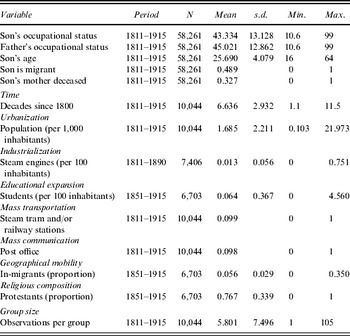
Descriptive statistics for all variables are provided in Table 1. This table also includes information on the number of observations per context (municipality and year of marriage).
The descriptives: mean, standard deviation, minimum and maximum value – Zeeland, The Netherlands, 1811/1851–1915

Sources: Marriage records and municipality-level data (see the section ‘Data and measurement’).
RESULTS
Regional and temporal variation in intergenerational status transfer
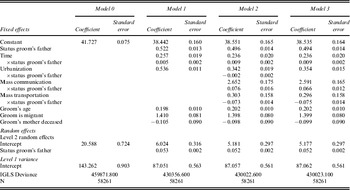
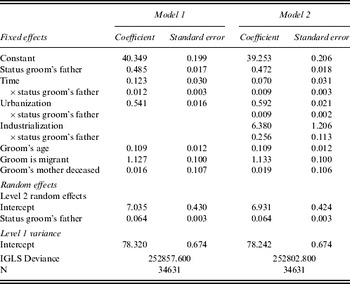
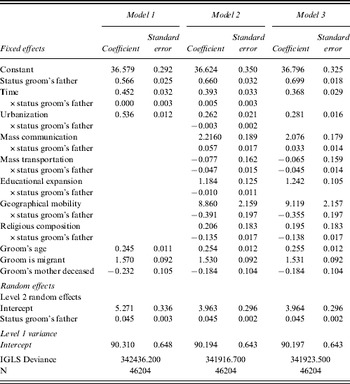
Since not all contextual indicators are available for the entire period (1811–1915), I divided the analyses over three time slots, presented in Tables 2 to 4. Table 2 covers the whole period (1811–1915), but contains few contextual indicators. Table 3 is on the period 1811–1890 and focuses on the influence of industrialization. The analyses in Table 4 cover the period 1851–1915 and include all but one contextual indicator (industrialization).
Hierarchical linear regression on son's occupational status, Zeeland, The Netherlands, 1811–1915

Sources: As in Table 1.
Hierarchical linear regression on son's occupational status, Zeeland, The Netherlands, 1811–1890Footnote a

a Model 1 shows results after 125 iterations, since the model did not fully converge. This means that effects and standard errors should be considered approximations. Models similar to Model 1 with additional contextual variables do converge and provide similar results. I provide Model 1 to maintain consistency between the models of the different time periods, while I use the results from Model 2 to test the hypotheses.
Sources: As in Table 1.
Hierarchical linear regression on son's occupational status, Zeeland, The Netherlands, 1851–1915

Sources: As in Table 1.
Table 2 shows the effects of the father's occupational status on that of his son between 1811 and 1915. Before I elaborate on the results, I will first consider my assumptions that (a) the occupational status of sons differed between groups (year and municipality of marriage) and (b) the influence of a father's occupational status on that of his son differed between groups.
Model 0 in Table 2 is a so-called ‘empty model’ and contains no effects other than the fixed and random effects of the intercept. From this model we can deduce whether the occupational status of sons did indeed differ between contexts. The variance in a son's status at the contextual level is 20.588 (with a standard error of 0.724) and accounts for 12.565 per cent of the total variation (20.588/(20.588+143.262)). Thus the status of sons did indeed differ between contexts, although most variation existed within contexts. The constant shows that the status of sons is on average 41.727. To assess the size of the difference between contexts Snijders and Bosker suggest comparing the scores of groups (here: contexts) two standard deviations below and two standard deviations above the mean.Footnote 66 In contexts two standard deviations below the mean the ‘average’ son had an occupational status of 32.652 (41.727−2√20.588), while in contexts two standard deviations above the mean the ‘average’ son had an occupational status of 50.802.
Model 1 in Table 2 shows that a father's occupational status influenced that of his son and that this influence differed between contexts. The fixed effect of a father's status (0.522) is positive and significant. On average for every ten points of the father's occupational status, a son's status increased by somewhat more than five points.
Model 1 in Table 2 depicts a linear increase over time in the effect of a father's occupational status on that of his son. For every decade, the influence of a father's status increases by nearly 1 per cent (0.522+0.005×1/0.522). An increasing linear change over time in the influence of a father's status of about 2 per cent (0.472+0.009×1/0.472) is also found in Model 2 of Table 3 over the period 1811–1890, but not in the models of Table 4 over the period 1851–1915. This suggests that the increase in the influence of a father's status during the nineteenth century levelled off around the turn of the nineteenth and twentieth centuries.
The significant random effect of a father's occupational status implies that the influence differed between contexts. The random coefficient may seem small (0.053), but it actually indicates substantial differences in the influence of a father's status on that of the son between some groups. In some contexts the influence of a father's status was as low as 0.062 (0.522−2√0.053, two standard deviations below the mean), while in other contexts that influence was as high as 0.982 (two standard deviations above the mean). In contexts where the influence of a father's status was strong, a son gained nearly ten status points for every ten status points of his father, while in contexts with a weak influence of a father's occupational status a son gained less than a single status point for every ten points of his father's occupational status.
The next section discusses the results for the influence of macro-level processes on the association between the occupational statuses of father and son. This section ends with a brief description of the results for the control variables. The individual control variables show that older sons had, on average, a higher occupational status. Model 3, in Table 2, shows that on average, for the period 1811–1915, for every five years of age a son's occupational status increases by one point (5×0.202). This model shows furthermore that sons who migrated had, on average, 1.399 status points more than sons who did not. Whether a son was a maternal orphan prior to his marrying does not seem to have influenced the son's occupational status. At the contextual level, Table 4 controls for the religious composition of municipalities, measured by the proportion of Protestants in a municipality. Model 3 in Table 4 suggests that the influence of a father's occupational status was nearly 20 per cent less in municipalities that were entirely Protestant than in municipalities all of whose inhabitants were Catholic ((0.699−0.138×1)/0.699).
Intergenerational status transfer and macro-level processes
Industrialization, measured by the number of steam engines ever purchased per hundred inhabitants of a municipality in a given year, increased the influence of a father's occupational status on that of his son. This result rejects the logic of industrialism thesis and concurs with status maintenance theory. In about one-sixth of the municipalities in Zeeland, before 1890 there was an industrialization ratio of at least 0.135, that is one steam engine for every 740 inhabitants. Model 2 in Table 3 (1811–1890) shows that in these municipalities the influence of a father's occupational status was 7.3 per cent greater than in municipalities with no steam engines ((0.472+0.256×0.135)/0.472). In five municipalities (Breskens, Hulst, Kerkwerve, Nieuwerkerk, and Sas van Gent), from 1872 onwards there was even an industrialization ratio of at least one steam engine purchase for every 250 inhabitants. In these municipalities the influence of a father's occupational status was 1.2 times as great as in municipalities without any steam engines ((0.472+0.256×0.4)/0.472). In Middelburg and Flushing, Zeeland's two largest municipalities by far, the maximum ratio of steam engines ever purchased per hundred inhabitants was 1:5.35 and 1:4.71 (in other words one steam engine for every 535 inhabitants and one for every 471 inhabitants) respectively.
Educational expansion, measured by the number of students relative to the population, did not decrease the association between a father's occupational status and that of his son between 1851 and 1915 (see Table 4, Model 2). The non-significant interaction between a father's occupational status and educational expansion again compromises the logic of industrialism thesis. Although educational expansion did not change the influence of a father's status on that of his son, from the bivariate relation between a father's and a son's status alone it cannot be concluded that the influence of a father's occupational status on the son's educational attainment increased. Therefore, I can only conclude that this finding provides indirect support for the status maintenance theory.
The influence of mass communication is tested in Table 2 (for 1811–1915) and Table 4 (for 1851–1915). According to Models 2 and 3 in Table 2 (1811–1915), the influence of a father's occupational status on that of his son is more than 10 per cent greater in municipalities with a post office than in municipalities without a post office (Model 3: (0.494+0.066×1)/0.066). Models 2 and 3 in Table 4 for the period 1851–1915 also show a positive influence of mass communication on the association between a father's and a son's status, albeit somewhat less: 8.6 and 4.7 per cent respectively. Mass communication thus enhanced the association between a father's and a son's status, rejecting the logic of industrialism thesis.
All the tables encompass the effect of urbanization on the association between a father's and a son's occupational status. Only Table 3, for the period 1811–1890, shows a significant interaction between urbanization and a father's occupational status. The effect is quite small. In 1890 the average population of municipalities in Zeeland was 2,000. In that same year in only six municipalities were there more than 5,000 inhabitants (Goes, Hontenisse, Middelburg, Terneuzen, Flushing, and Zierikzee). In a hypothetical municipality with 5,000 inhabitants the influence of a father's occupational status would be somewhat more than 5 per cent greater than in a municipality where the average number of inhabitants in 1890 was 2,000 ((0.472+5×0.009)/(0.472+2×0.009)). Of the aforementioned six municipalities, in 1890 only Middelburg and Flushing had far more than 5,000 inhabitants, at 17,362 and 13,634 respectively. Compared to municipalities with an average of 2,000 inhabitants, in Middelburg and Flushing the influence of a father's occupational status was nearly 1.3 times as great. In sum, where the logic of industrialism thesis would expect the influence of a father's occupational status to decrease, in the nineteenth century urbanization increased the influence of a father's occupational status, while the models also covering the early twentieth century provide no support for a change in the influence of a father's occupational status due to urbanization.
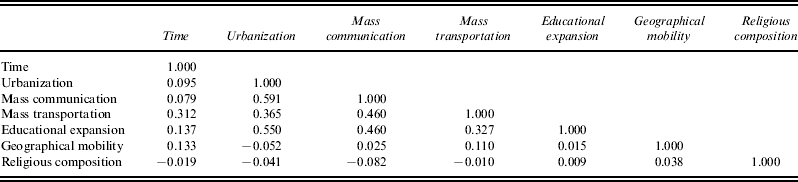
Table 4 provides a mixed picture of the influence of greater geographical mobility, as measured by the proportion of in-migrants, in the second half of the nineteenth and in the early twentieth century. In Model 2 a borderline significant effect indicates that the association between a father's occupational status and that of his son decreased in municipalities with a larger number of in-migrants. In Model 3, however, the negative influence of geographical mobility is no longer significant. Subsequent analyses not shown reveal that this effect is significant only in the presence of an interaction effect between a father's occupational status and urbanization, suggesting the presence of multicollinearity. Indeed, Table 5 shows moderate to high correlations between the contextual indicators educational expansion, mass communication, urbanization, and modern transport for the period 1851–1915. In the conclusions and discussion section below I will elaborate on the significance of these findings for the logic of industrialism thesis.
Correlation matrix of several indicators at the contextual level over the period 1851–1915 in Zeeland, The Netherlands (N=6,703)

Sources: As in Table 1.
Mass transport, indicated by whether there was a steam train or steam tram station present in the municipality and the year of marriage, decreases the influence of a father's occupational status on that of his son. Models 2 and 3 in Table 2 show that the influence of a father's occupational status is 15.1 per cent less in municipalities in which there is a steam train or steam tram station present than in municipalities without a train or tram station (Model 3: 0.494−0.075×1/0.494). Models 2 and 3 in Table 4 also show a negative influence of mass transportation, albeit somewhat less. Here the influence of a father's occupational status on that of his son is 6.4 per cent less in a municipality with mass transportation. The hypothesis of the logic of industrialism thesis, that enhanced means of transportation would decrease the influence of a father's occupational status, is therefore supported.
CONCLUSIONS AND DISCUSSION
This article takes advantage of major developments in historical social mobility research and is among the first to study the influence of industrialization, educational expansion, and other macro-level processes on intergenerational status attainment before and during industrialization. Researchers tend to refer to these macro-level developments as ‘modernization’, implicitly assuming that there is a single mechanism in operation, which affects the status attainment process. However, my research shows that, according to the arguments available in the literature, industrialization, educational expansion, and other macro-level developments influenced the type and number of relations in the status model differently. By explicating the arguments for each of the relations and deriving separate hypotheses for the macro-level developments, I provide more refined hypotheses on the influence of industrialization and other macro-level processes on the status attainment process.
Another contribution of this study is the extended empirical test of the hypotheses. Having combined a dataset consisting of all marriage records from the more than 100 municipalities in the Dutch province of Zeeland between 1811 and 1915 with contextual data from other datasets and data derived from archives, I used hierarchical linear regression to test my hypotheses over a long period of time at a regionally detailed level, that of the municipality.
The results indicate a linear increase over time in the association of a father's occupational status and that of his son in the first half of the nineteenth century, after which the increase stagnated. However, the results also show that apart from this general trend there were non-linear temporal differences as well as regional differences in the association between a father's occupational status and that of his son. This is in line with contemporary findings on regional variation in the status attainment process.Footnote 67 It suggests that it is difficult to generalize results from studies confined to a single municipality, while studies that focus on the national level fail to take intra-country variation into account.
Macro developments partially explain differences in the association between a father's and a son's occupational status. In the nineteenth century, the influence of a father's occupational status increased with industrialization and urbanization. Like urbanization, during the same period mass communication increased the association between a father's occupational status and that of his son, but the influence of mass communication extended well into the twentieth century. Post offices played an important role in the dissemination of a shared culture by serving as a channel for distributing national newspapers and fashion magazines, but it appears that post offices most of all enhanced the influence of social background. Through letters, and telegrams later on, personal information could be shared within family networks even when family members were far apart. Perhaps this enhanced parents' opportunities to support their children.
Educational expansion did not change the association between a father's occupational status and that of his son, while mass transportation decreased the influence of a father's occupational status. For some sons from lower social backgrounds steam trams and trains may literally have provided a way out. For those who stayed, railways also expanded their geographical horizon, providing opportunities to experience what was outside the local community. Whether increased rates of in-migration influenced the relationship between a father's and a son's occupational status remains inconclusive. Although in one of the models for the late nineteenth and early twentieth century the influence of geographical mobility showed a significant decrease, the absence of that effect in another model covering the same period suggests that the effect should be interpreted cautiously. The moderate to large correlations between some of the contextual indicators might indicate the presence of collinearity.
Another point to consider is the size of the effects of mass communication and mass transportation in the models covering the whole of the period (1811–1915) and the models covering the second half of the nineteenth century and early twentieth century (1851–1915). On the whole, the influence of the contextual indicators on the association between a father's occupational status and his son's is greater in models covering the entire period. Therefore, one might conclude that the influence of the contextual indicators was especially strong in the first half of the nineteenth century. However, this conclusion is ambiguous. In the early nineteenth century there was hardly any mass communication or mass transport. Therefore, in models including the entire nineteenth century there is much more variation, since they basically compare a period with and a period without mass communication and mass transportation.
In the light of these considerations, the results provide hardly any support for the logic of industrialism thesis, which would lead us to expect all macro-level developments other than mass transportation to have decreased the association between a father's and a son's occupational status. There is partial support for the status maintenance theory, since the influence of a father's occupational status on that of his son increased with industrialization, as expected, but not with educational expansion.
To obtain these results I have made compromises, and future studies may improve on them. Marriage data do not allow for a direct test of the separate relationships in the status attainment model due to the absence of information on a son's educational position. Future research may try to gather such specific information at the individual level to allow for a direct test of the hypotheses derived in this article.
A further point for discussion concerns the indicators of macro-level developments that are comparable between regions and over time. An advantage of the indicators used in this article is that they are available over a long period of time and at a regionally detailed level. An often proposed alternative indicator, the proportion of farmers in the labour force, is not. Furthermore, the indicators used are analogous to those used in contemporary research, such as school enrolment as a proportion of population size.Footnote 68 Nevertheless, this study is the first to use these indicators for a long period of time, including the nineteenth century, and future research may address the validity of these indicators in comparison with other possible indicators.
A final consideration for future research is the optimal choice of methods to study the status attainment process. Studies regularly use log-linear models, since they control for structural changes in occupational mobility. However, these models only allow for a limited number of parameters and even the data used in this study would not be rich enough to fill all cells sufficiently. Therefore, I chose to use hierarchical linear analysis, which enabled me to study the status attainment process in regional contexts and over time, and to explain differences in the process between contexts. In addition, it allows for a continuous measurement of occupational status, which takes into account the fact that occupations are not only hierarchically structured between classes but also within classes.Footnote 69 Furthermore, correlations do control for structural changes to some extent, and indicators such as industrialization do, in fact, reflect some of the structural changes in the occupational structure.
A discussion on the optimal research method should not, however, be allowed to deflect attention away from the research questions relating to social mobility, past and present, as it has done in the past.Footnote 70 This study shows that recent developments in historical social mobility now allow for historical studies of the status attainment process in extensive regions and over long periods. As such, they paint a more complete picture of status attainment. The decline in the association between a father's and a son's status as found in the Netherlands after the Second World War did not, in the province of Zeeland, start with the onset of industrialization. On the contrary, it seems that at the onset of industrialization fathers were more able than before to pass on their status positions to their sons. Only in cities with mass transport, and perhaps due to geographical mobility, did the occupational status level of sons become more independent of that of their fathers.
ACKNOWLEDGEMENTS
This article is part of my PhD project. I am grateful to the Netherlands Organization for Scientific Research (NWO) for funding it (grant: MAGW Open Competition 400-05-054). The article has benefited from the comments of the reviewers and of participants in the Social Stratification Research Seminar, Cambridge, 2006; the International Sociological Association Research Committee on Social Stratification and Mobility (RC28), Montreal, 2007; the European Social Science and History Conference, Lisbon, 2008; and the Migration and Social Stratification Seminar (Utrecht University). I would like to thank Vincent Buskens for his comments on the analyses. The comments of the editor and the two anonymous referees enhanced the quality of the article. I am especially grateful to Ineke Maas, Marco van Leeuwen, and Henk Flap, who helped me with the design of the study and who commented on several earlier versions of this article.