


 , where vi and si are the vote shares and subsequent seat shares for party i.


Crossref Citations

This article has been cited by the following publications. This list is generated based on data provided by Crossref.
Schofield, Norman
Jeon, JeeSeon
Muskhelishvili, Marina
Ozdemir, Ugur
and
Tavits, Margit
2011.
Political Economy of Institutions, Democracy and Voting.
p.
259.
Schofield, Norman J.
2011.
Adams, James
2012.
Causes and Electoral Consequences of Party Policy Shifts in Multiparty Elections: Theoretical Results and Empirical Evidence.
Annual Review of Political Science,
Vol. 15,
Issue. 1,
p.
401.
Hug, Simon
and
Martin, Danielle
2012.
How electoral systems affect MPs’ positions.
Electoral Studies,
Vol. 31,
Issue. 1,
p.
192.
Pardos-Prado, Sergi
2012.
Valence beyond consensus: Party competence and policy dispersion from a comparative perspective.
Electoral Studies,
Vol. 31,
Issue. 2,
p.
342.
Singh, Shane P.
and
Roy, Jason
2014.
Political knowledge, the decision calculus, and proximity voting.
Electoral Studies,
Vol. 34,
Issue. ,
p.
89.
Fujimura, Naofumi
2015.
The influence of electoral institutions on legislative representation.
Party Politics,
Vol. 21,
Issue. 2,
p.
209.
Castater, Eric Graig
2015.
Unionization and the partisan effect on income inequality.
Business and Politics,
Vol. 17,
Issue. 1,
p.
1.
Ferland, Benjamin
2018.
Party responsiveness to public opinion and party supporters.
Party Politics,
p.
135406881877788.
So, Florence
2018.
Attract voters or appease activists? Opposition parties’ dilemma and party policy change.
Journal of Theoretical Politics,
Vol. 30,
Issue. 2,
p.
246.
Ferland, Benjamin
2018.
Ideological congruence over government mandates under majoritarian and proportional representation electoral systems.
West European Politics,
Vol. 41,
Issue. 2,
p.
350.
Stadelmann, David
Portmann, Marco
and
Eichenberger, Reiner
2019.
Preference Representation and the Influence of Political Parties in Majoritarian vs. Proportional Systems: An Empirical Test.
British Journal of Political Science,
Vol. 49,
Issue. 1,
p.
181.
Martin, Danielle
and
Hug, Simon
2020.
Constituency preferences and MP preferences: The electoral connection.
Party Politics,
Vol. 26,
Issue. 5,
p.
619.
Ferland, Benjamin
2020.
A Gender Gap in Party Congruence and Responsiveness?.
Politics & Gender,
Vol. 16,
Issue. 1,
p.
174.
Stadelmann, David
Torrens, Gustavo
and
Portmann, Marco
2020.
Mapping the theory of political representation to the empirics: An investigation for proportional and majoritarian rules.
Journal of Comparative Economics,
Vol. 48,
Issue. 3,
p.
548.
Ferland, Benjamin
2021.
Electoral Systems and Policy Congruence.
Political Studies,
Vol. 69,
Issue. 2,
p.
344.
Ferland, Benjamin
2021.
Policy congruence and its impact on satisfaction with democracy.
Electoral Studies,
Vol. 69,
Issue. ,
p.
102204.
Mehlhaff, Isaac D.
2025.
Mass Polarization across Time and Space.
Liao, Yen‐Chieh
2025.
Electoral reform and fragmented polarization: New evidence from Taiwan legislative roll calls.
Legislative Studies Quarterly,
Vol. 50,
Issue. 1,
p.
3.
Trastulli, Federico
2026.
Varieties of Social Democracy in Western Europe.
p.
91.
The proposed relationship between electoral systems and party extremism assumes that electoral systems mediate the relationship between party proximity (to the mean voter position) and vote share. In disproportional systems, parties are expected to gain greater electoral rewards for adopting moderate positions than in proportional systems. Following Jay Dow in this issue, I re-analyse the Comparative Study of Electoral Systems (CSES) data to directly evaluate the hypothesized mediating role of electoral systems in explaining party vote share.Footnote 1 These analyses do not support the finding that electoral systems mediate the relationship between party proximity and vote share. This finding suggests that further exploration is necessary to understand the relationship between electoral systems and party positioning.
To review, in 2001, Jay Dow published spatial mappings of the Dutch, Israeli, Canadian and French party systems and concluded that ‘parties in the majoritarian systems are located significantly closer to the center of the distribution of voters than those in proportional systems’.Footnote 2 Inspired by Dow, I then explored the same relationship between electoral system proportionality and average party extremism in eighteen countries.Footnote 3 Parties competing in proportional electoral systems were expected, on average, to adopt more extreme policy positions than their counterparts competing in disproportional systems. After analysing eighteen democracies, however, I reported that there was no evidence that electoral systems affect parties’ tendencies to propose extreme or moderate policy positions. Jay Dow analyses the same relationship in thirty-one countries using more recent data from the Comparative Study of Electoral Systems (CSES),Footnote 4 and he reconfirms the conclusions he reports in his 2001 article that proportional electoral systems promote party extremism, and disproportional systems are more compact. I do not question the conclusions Dow reports: the empirical findings stand.
If this is the case, the question naturally turns to what accounts for the difference in findings. Earlier in the issue, Dow accurately targets explanations for the differences. These are based on time-period, data and groups of countries. Since I agree that these are the likely candidates, and I do not take issue with Dow’s empirical findings, I wish to push the argument forward by turning the analysis to the central causal mechanism of the expected relationship between electoral systems and party positioning – votes.
The expected relationship between electoral system proportionality and average party extremism is based on vote-seeking incentives for parties. Parties have weaker incentives to maximize votes in proportional systems than they do in disproportional/plurality systems. The logic is persuasive. Disproportional electoral laws tend to punish small parties by awarding them seat shares in parliament that are less than their national vote shares – while correspondingly awarding seat shares to large parties that exceed their vote shares. If maximizing votes means staking out popular positions close to the mean voter position, the expectation is to observe a ‘clustering’ of a small number of competitive parties close to this mean voter position in plurality systems.
By contrast, given that electoral thresholds in proportional systems permit more parties to win seats in the legislature, the competing parties in proportional systems can afford to be less concerned about whether they are occupying moderate, vote-maximizing positions. Thus, parties competing in PR systems are plausibly free to advocate their sincere policy beliefs, even if these preferred policies are distinctly non-centrist.
While theory may be straightforward, the empirical results reported by Dow and by EzrowFootnote 5 (reviewed earlier) are obviously less so. In this issue, Jay Dow uses identical measures to mine and presents empirical results based on a greater number of countries than mine, which confirms the expected relationship between electoral system proportionality and average party extremism. En route, Dow reiterates the vote-seeking explanation by remarking that disproportional systems encourage ‘parties to compete over a relatively small portion of the electoral space due to the “winner takes all” nature of majoritarian politics. Proportional systems, in contrast, support more parties and increase the range of the viable political space by rewarding parties with seats for relatively modest vote shares.’Footnote 6
Does the relationship hinge on vote-seeking incentives for parties? Are moderate parties rewarded with greater shares of the vote in disproportional systems than in proportional systems? We can explore this empirical question directly, by employing the CSES for the same set of countries to evaluate this proposition that the electoral rewards for centrist positioning are enhanced in disproportional systems.Footnote 7 Accomplishing this requires four pieces of information: parties’ policy positions; the mean voter position; parties’ vote shares; and a measure of electoral system proportionality. Thus, we can re-analyse the CSES data (described by Dow earlier) to evaluate whether electoral systems mediate the relationship between party positioning and vote share.
The party’s distance to the mean voter position is measured by squaring the difference between party position and the mean citizen placement:
where Ai is the position of the mean voter on the Left–Right dimension, and Xi is the mean perceived position of party X.Footnote 8 The following regression model specification evaluates the relationship between policy moderation and vote share across all of the countries in the study:
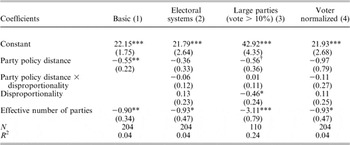
I have reported a negative relationship between party policy distance and party support, i.e. that parties’ vote shares decrease with the distance between the party’s left–right position and the mean voter position (i.e. β 2 is expected to be negative).Footnote 9 Column 1 of Table 1 presents the results from estimating the parameters of the ‘basic’ model specification in Equation 2. The coefficient on the [party policy distance] variable is negative (−0.55) and statistically significant. The negative estimate corroborates the earlier finding, based on the Eurobarometer data, that parties further from the centre of the voter distribution tend to gain fewer votes than parties closer to the middle of the electorate.
Estimating Parties’ Vote Shares
Notes: Parameters are ordinary least squares (OLS) coefficients. Standard errors, clustered by election, are in parentheses. Independent variables are described in the text. Estimates are based on data from countries in the Comparative Study of Electoral Systems (CSES). *p < 0.10, **p < 0.05, ***p < 0.01, two-tailed test; †p = 0.127.
To evaluate the mediating effect of electoral systems on the relationship between policy moderation and vote share, we can rely on the disproportionality measure described earlier by Dow.Footnote 10 Furthermore, to deal with countries with different numbers of competitors, we can similarly rely on the measure of effective number of parties, which is based on the number of parties that are competitive enough to gain seats in the national legislature.Footnote 11 The degree to which centrifugal and centripetal incentives exist across countries featuring different electoral systems can be measured by estimating the parameters of the following regression model specification:
If there are differences in electoral incentives across systems that feature different levels of (dis)proportionality, then we would expect the coefficient, β 3, on the interaction term [Party policy distance × disproportionality] to be statistically significant. If party policy distance matters more in disproportional systems, leading to the expectation of clustering of parties at the centre of the voter distribution, then this coefficient is expected to be negative and statistically significant. A negative sign indicates that parties in disproportional systems would experience additional electoral punishment for adopting policies further from the mean voter position.
With respect to the key expectation formulated in this section that electoral systems mediate the effects of proximity, there is no statistically significant evidence that moderate parties gain more votes in disproportional systems than in proportional systems. If the coefficient on the interaction term was negative and statistically significant, this would suggest that electoral systems mediate party proximity effects. However, the estimates on the interaction term in Table 1, Column 2 for the ‘electoral systems’ model are not statistically significant.
If there are greater electoral penalties for large parties that adopt distinct positions in disproportional systems, then we would expect the coefficient on the interaction [Party policy distance × disproportionality] variable to be negative and statistically significant, and significantly larger in magnitude than that for all parties. The parameter estimates for the model specifications in Column 3 are based on parties that receive more than 10 per cent of the vote. In addition, an important recurring theme raised in the previous discussions is the importance of accounting for the underlying distribution of voters.Footnote 12 In comparing two countries, party policy distance may be regarded as greater where there is a compact distribution of voters’ political preferences; and less where the voter distribution is dispersed. In Column 4, spatial distances are normalized to the underlying voter distribution, which is calculated as the standard deviation of voter Left–Right self-placements in the CSES. The coefficients in Columns 3–4 do not approach conventional levels of statistical significance (indeed, the coefficient is slightly positive in Column 3). Thus, they continue to support the finding that electoral systems do not mediate the effects of party proximity on electoral success. This conclusion holds under a number of additional robustness checks.Footnote 13
Discussion
It seems obvious that plurality systems promote policy centrism. Candidates gravitate towards the centre of political competition in an attempt to win elections in systems like those in the United States and Britain. They lose if they do otherwise. A casual observation of these systems suggests that this proposed relationship is slightly more complex. While there are periods of convergence in these systems, there are also periods of polarization. British party competition in the mid-1990s, with the arrival of Tony Blair and ‘New Labour’, was noticeably centrist. By contrast, Margaret Thatcher initiated a decade of polarized politics in the 1980s. In the United States, the gap between Democrats and Republicans has been growing steadily since the mid-1970s with McCarty, Poole and Rosenthal neatly summarizing it: ‘partisan differences in congressional voting behavior have grown dramatically to levels not seen since the early twentieth century’.Footnote 14
These examples point to difficulties that arise when generalizing about the effects of electoral systems on party positioning. Electoral rules have remained constant, but average party extremism has changed dramatically.
The discussion of Britain and the United States suggests that one clear area for future exploration is within country analysis over time. One may concentrate on democracies where electoral rules have remained constant, but levels of polarization vary (such as Britain and the United States). Why have party strategies changed? Alternatively, one could focus on political systems where electoral rule change has occurred – like New Zealand, Italy and France – and on whether these rule changes have produced changes in polarization.
A second direction follows the most recent and welcomed study by Dow, which reports that disproportional electoral systems encourage centrist positioning (as one would expect). Based on the empirical analyses I present above, however, the proposed vote-seeking explanation for this relationship is doubtful. Identifying the elusive causal mechanism is then a second direction for exploration.