INTRODUCTION
Marine turtles have a long and complex life cycle involving trans-oceanic migrations and marked changes in diet and habitat. Juveniles are believed to spend their first few years drifting passively in ocean current systems or in floating sargassum rafts (Carr, Reference Carr1986; Bolten et al., Reference Bolten, Bjorndal, Martins, Dellinger, Biscoito, Encalada and Bowen1998). Advanced juveniles subsequently shift to coastal feeding habitats (Carr, Reference Carr1987). After reaching sexual maturity, some 20 or 30 years later (Frazer & Ehrhart, Reference Frazer and Ehrhart1985; Klinger & Musick, Reference Klinger and Musick1995), adults undertake reproductive migrations that range from tens to thousands of kilometres (Meylan, Reference Meylan and Bjorndal1982; Meylan et al., Reference Meylan, Bjorndal and Turner1983; Hughes, Reference Hughes, Payne and Crawford1989; Limpus et al., Reference Limpus, Miller, Parmenter, Reimer, McLachland and Webb1992). Nesting usually occurs in spring and summer. Tagging data suggest that sea turtles show maternal phylopatry to their natal site (Bjorndal et al., Reference Bjorndal, Meylan and Turner1983; Bowen et al., Reference Bowen, Nelson and Avise1993). The sexual differentiation of embryos is determined by temperature: cooler incubation temperatures produce males and warmer ones, females (Mrosovsky, Reference Mrosovsky1994).
Five sea turtle species can be found in Brazil: Caretta caretta, Chelonia mydas, Eretmochelys imbricata, and Lepidochelys olivacea from the family Cheloniidae, and Dermochelys coriacea from the family Dermochelyidae (Marcovaldi & Marcovaldi, Reference Marcovaldi and Marcovaldi1999). Caretta caretta, known as loggerhead, is the most common nesting sea turtle found on the continental beaches of Brazil. Its rookeries comprise beaches from the north of Rio de Janeiro to Sergipe States, being concentrated in Bahia State (Marcovaldi & Chaloupka, Reference Marcovaldi and Chaloupka2007). Chelonia mydas, known as green turtle, is the most abundant species on the Brazilian coast. Juveniles can be found all over the coast, but females nest almost exclusively in the oceanic islands of Fernando de Noronha, Atol das Rocas, and Trindade (Marcovaldi & Marcovaldi, Reference Marcovaldi and Marcovaldi1999). Eretmochelys imbricata, known as hawksbill, can be found as juveniles or sub-adults along the north-east Brazilian coast, although their nests are mainly found in northern Bahia and Rio Grande do Norte States (Marcovaldi et al., Reference Marcolvaldi, Lopez, Soares, Santos, Bellini and Barata2007). Lepidochelys olivacea, known as olive ridley, shows great concentration of nests in Sergipe State (da Silva et al., Reference da Silva, Castilhos, Lopez and Barata2007). Finally, D. coriacea, known as leatherback, has a few numbers of nests, mainly concentrated in northern Espírito Santo State (Thomé et al., Reference Thomé, Baptistotte, Moreira, Scalfoni, Almeida, Rieth and Barata2007).
Human exploitation and habitat destruction have caused declines in the abundance of sea turtles (Troëng & Rankin, Reference Tröeng and Rankin2005; Marcovaldi et al., Reference Marcovaldi, Patri and Thomé2005, Reference Marcovaldi, Sales, Thomé, Dias da Silva, Gallo, Lima, Lima and Bellini2006), as well as of other marine megafauna (Roman & Palumbi, Reference Roman and Palumbi2003; Baum & Myers, Reference Baum and Myers2004). Under the World Conservation Union (IUCN) criteria, Caretta caretta, L. olivacea and Chelonia mydas are currently considered endangered, while D. coriacea and E. imbricata are classified as critically endangered (IUCN, 2007). Also, all of them are listed in the Appendix I of the Convention on International Trade in Endangered Species of Fauna and Flora (CITES, 2008). Fishing is the most important source of human-associated mortality to all five protected species of sea turtles occurring off the Brazilian coast (Soto et al., Reference Soto, Serafini, Celini and Seminoff2003; Kotas et al., Reference Kotas, dos Santos, de Azevedo, Gallo and Barata2004; Marcovaldi et al., Reference Marcovaldi, Sales, Thomé, Dias da Silva, Gallo, Lima, Lima and Bellini2006; Bugoni et al., Reference Bugoni, Neves, Leite Jr, Carvalho, Sales, Furness, Stein, Peppes, Giffoni and Monteiro2008; Sales et al., Reference Sales, Giffoni and Barata2008). The presence of stranded sea turtles on beaches may be used as an index of turtle–fisheries interactions (Epperly et al., Reference Epperly, Braun, Chester, Cross, Merriner and Tester1995; Shaver & Teas, Reference Shaver, Teas and Eckert1999).
The aim of the present study is to report sea turtles stranded along the central-north coast of Rio de Janeiro State, Brazil. Due to the scarcity of published information on sea turtles in this area, this kind of study and its continuity are extremely important.
MATERIALS AND METHODS
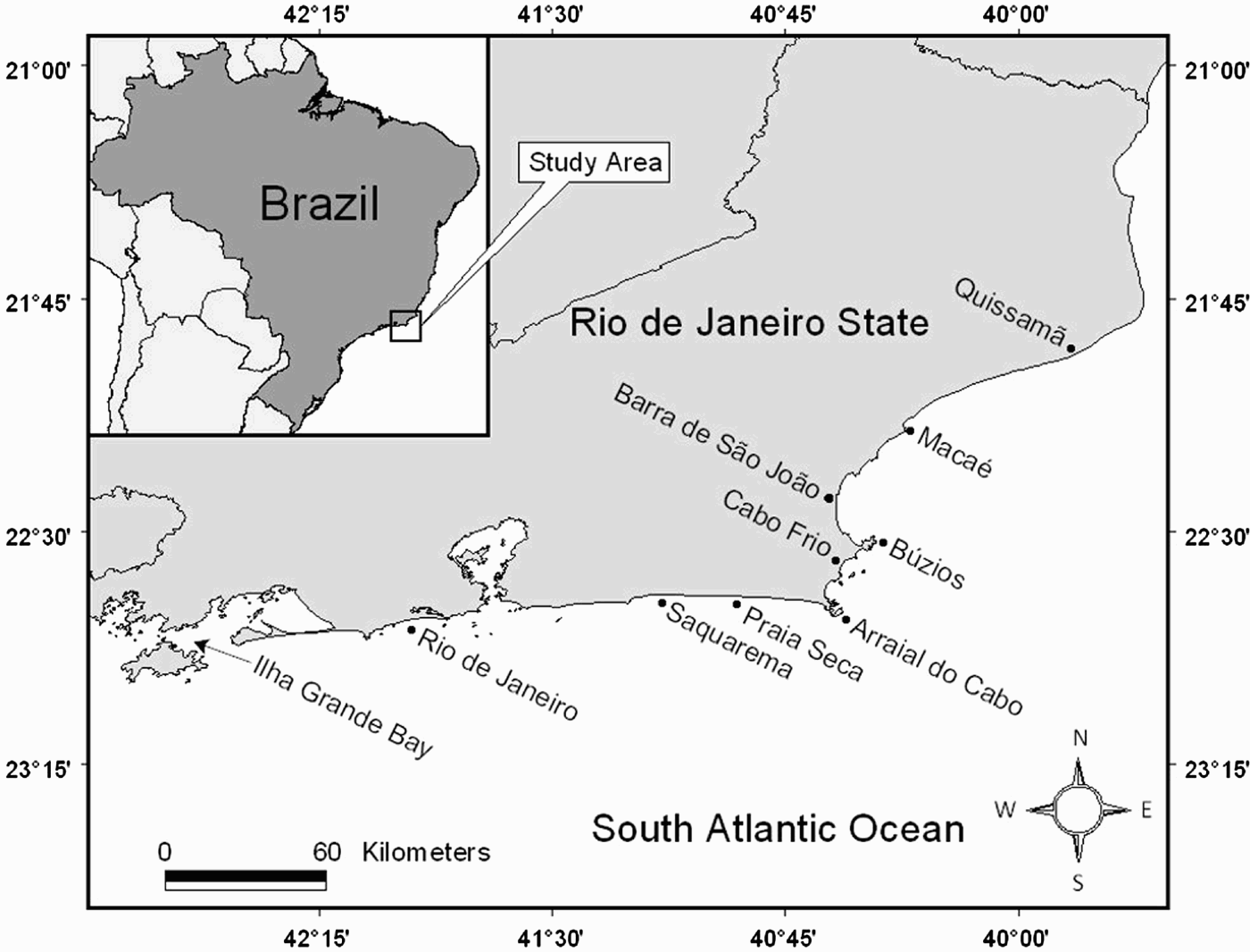
Monitoring was made by GEMM-Lagos staff (Grupo de Estudos de Mamíferos Marinhos da Região dos Lagos) along the central-north coast of Rio de Janeiro State, from Saquarema (22°55′12″S–42°30′37″W) to Quissamã (22°06′24″S–41°28′20″W) (Figure 1). From 1994 to 2004, this area was monitored just once in the summer. Since 2005, it has been regularly patrolled by car driving along the sand beaches (speed of 20 km h−1) at intervals of 90 days. GEMM-Lagos was also alerted by callers (tourists and community members) for stranded sea turtles in southern Rio de Janeiro State. These cases were also reported here (Figure 1).
Collection sites of stranded sea turtles along the coast of Rio de Janeiro State, Brazil (1994–2008).

Sea turtle carcasses were collected and species identified based on morphological characteristics following international standards described in Pritchard & Mortimer (Reference Pritchard, Mortimer and Eckert1999). Curved carapace length (CCL) and width (CCW) were measured for individuals with integral carapace. They were always taken over the curve of the carapace with a non-stretching tape measure. The CCL is measured from the anterior-most point on the midline of the nuchal scute to the posterior-most tip of the last marginal in cheloniids (Wyneken, Reference Wyneken2001). In leatherbacks, it is measured between the middle of the nuchal notch and the terminal tip of the caudal peduncle, without forcing the tape along the ridge (Wyneken, Reference Wyneken2001). The CCW is measured at the widest part of the carapace. In leatherbacks, it is typically on the most lateral ridges (Wyneken, Reference Wyneken2001).
Specimens were classified as juveniles or adults based on these measures (see Márquez, Reference Márquez, Fischer and Scialabba1990 and TAMAR, 2005 for reference values). Flippers were checked for tags, and the presence of tumour-like nodules reported.
RESULTS
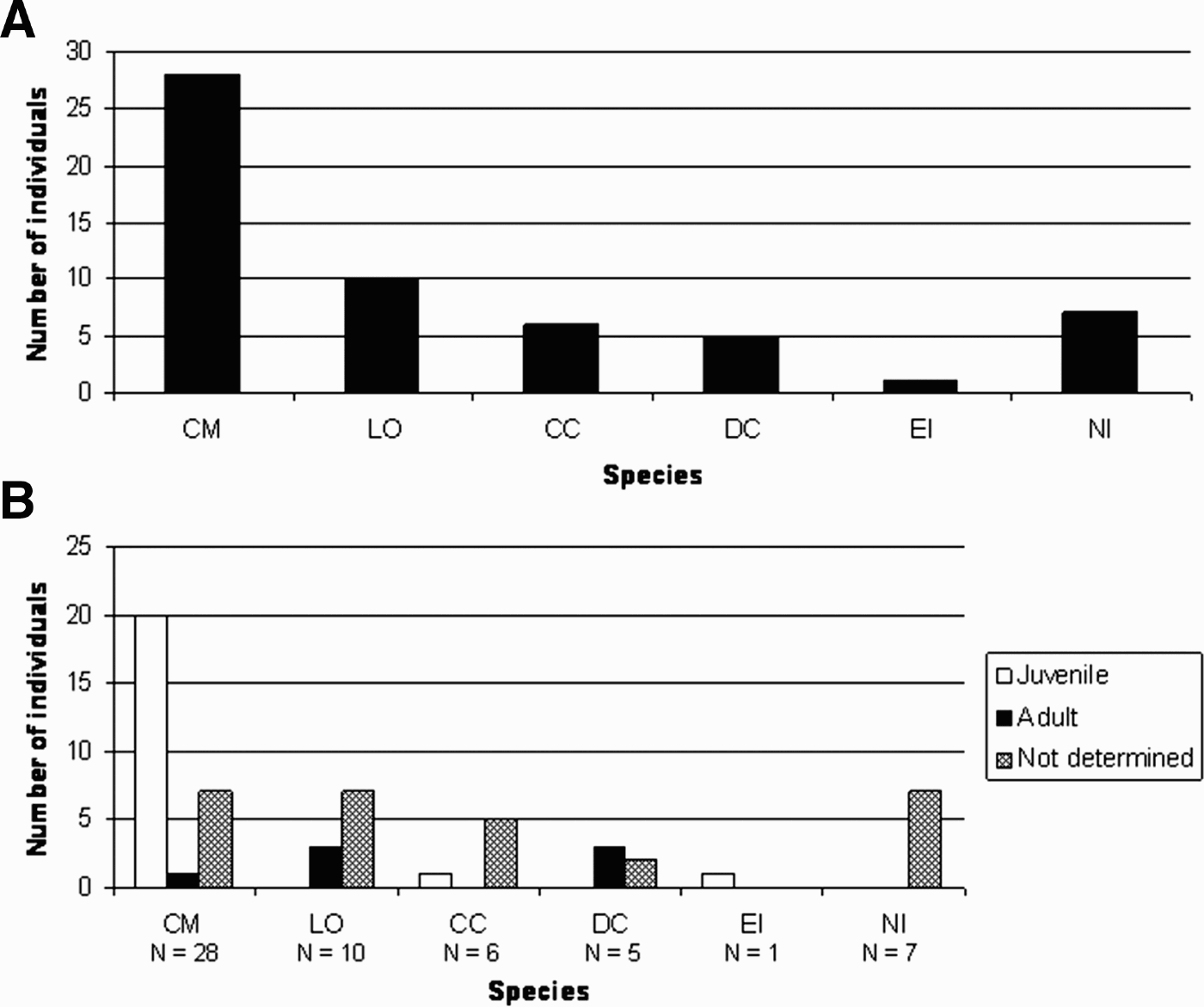
A total of 57 stranded sea turtles was reported since 1994, mostly (N = 45; 79%) from the central-north coast of Rio de Janeiro State (from Saquarema to Quissamã). However, not all dead stranded turtles were reported during this period (particularly between 1994 and 2004) due to the discontinuity of monitoring. Our data indicates a higher proportion of stranded Chelonia mydas (N = 28; 49.1%), followed by Lepidochelys olivacea (N = 10; 17.5%), Caretta caretta (N = 6; 10.5%), Dermochelys coriacea (N = 5; 8.8%), and Eretmochelys imbricata (N = 1; 1.8%). Seven specimens (12.3%) were not morphologically identified (Figure 2A).
(A) Number of individuals of different species of stranded sea turtles recorded for the coast of Rio de Janeiro State, Brazil (1994–2008); (B) number of juveniles and adults for each species. CM, Chelonia mydas; LO, Lepidochelys olivacea; CC, Caretta caretta; DC, Dermochelys coriacea; EI, Eretmochelys imbricate; and NI, species not identified.

A great proportion of the stranded carcasses were of juveniles (N = 22; 75.9%). However, many individuals (N = 28; 49.1%) could not be classified to their life stage due to their advanced state of decomposition (Figure 2B). Only two specimens, both Chelonia mydas, had signs of tumour-like growths, suggesting fibropapillomatosis. No tags or tag scars were noted.
DISCUSSION
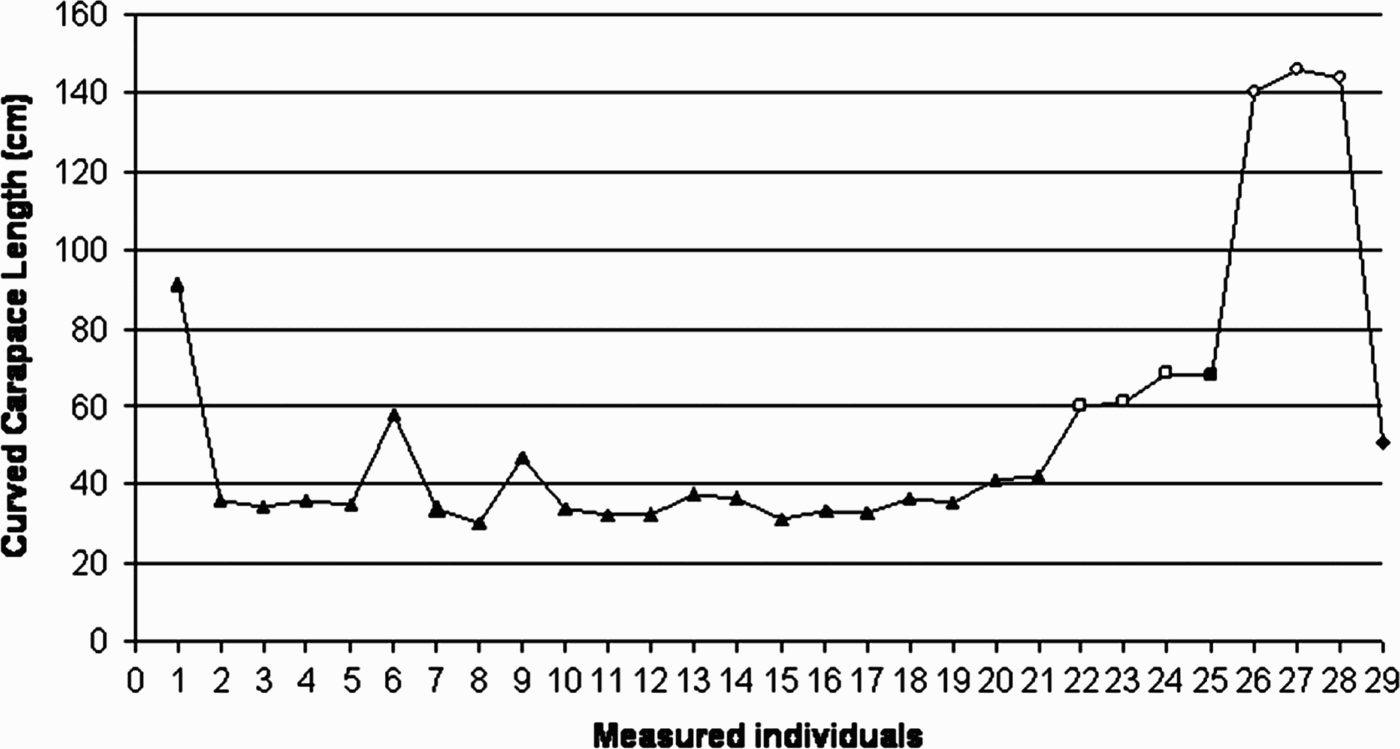
Most of the stranded carcasses collected were of Chelonia mydas (49.1%; Figure 2A). These individuals were mainly juveniles (N = 20; 71.43%; Figure 2B). The CCL ranged from 30 to 91.4 cm with a mean of 39.3 cm (Figure 3). The predominance of juvenile green turtles was expected since individuals from this species can be found feeding along the entire Brazilian coast (Marcovaldi & Marcovaldi, Reference Marcovaldi and Marcovaldi1999). Additionally, the north-eastern coast of Rio de Janeiro State represents a promising feeding ground for sea turtles, since during the summer the prevailing north-easterly winds generate a coastal upwelling (Costa & Fernandes, Reference Costa and Fernandes1993; Valentin, Reference Valentin, Seeliger and Kjerfve2001). The upwelling system brings deep waters rich in nutrients to the surface. These nutrients are utilized by phytoplankton, generating high levels of primary production that propagates up the food chain (Costa & Fernandes, Reference Costa and Fernandes1993; Valentin, Reference Valentin, Seeliger and Kjerfve2001). So, upwelling areas are often important for sea turtle feeding, as food sources can be found in these productive zones (Polovina et al., Reference Polovina, Balazs, Howell, Parker, Seki and Dutton2004; James et al., Reference James, Myers and Ottensmeyer2005; Amorocho & Reina, Reference Amorocho and Reina2007).
Curved carapace length (in centimetres) for 29 measured by-catch turtles. ▴, Chelonia mydas (1–21); □, Lepidochelys olivacea (22–24); ■, Caretta caretta (25); ○, Dermochelys coriacea (26–28); and ♦, Eretmochelys imbricata (29).

On the other hand, the high percentage of Lepidochelys olivacea (17.5%; Figure 2A) was unexpected since this species is less abundant along the Brazilian south-east coast (da Silva et al., Reference da Silva, Castilhos, Lopez and Barata2007). Thirty per cent of L. olivacea reports were of adults (N = 3; Figure 2B). The CCL ranged from 60 to 68.5 cm with a mean of 60 cm. Based on incidental catch by the Brazilian pelagic long-line fishery, Sales et al. (Reference Sales, Giffoni and Barata2008) suggested that the part of the ocean around the northern region of Brazil is a preferential habitat for olive ridley turtles. It is still unknown if this species use the study area for feeding. So their presence in the region must be better investigated. Among Caretta caretta reports (10.5%; Figure 2A), only one individual was able to be measured (68 cm; Figure 3) and diagnosed as a juvenile (16.67%; Figure 2B). However, adults of C. caretta are commonly found in the study area where females usually nest (Marcovaldi & Chaloupka, Reference Marcovaldi and Chaloupka2007).
Eretmochelys imbricata and Dermochelys coriacea are the most threatened sea turtle species in Brazil and worldwide (IUCN, 2007; CITES, 2008; MMA, 2008). So the lower number of E. imbricata reports (1.8%; Figure 2A) could be explained by fewer abundance. Nevertheless, it is also important to consider that the region may not represent a suitable habitat for E. imbricata since this species is more commonly found along reef environments (Marcovaldi et al., 2007). The unique stranded E. imbricata was a juvenile (Figure 2B) with 50.3 cm of CCL (Figure 3). Dermochelys coriacea comparatively showed a higher percentage (8.8%; Figure 2A). Sixty per cent of D. coriacea individuals (N = 3) were diagnosed as adults (Figure 2B). The CCL ranged from 140 to 146 cm with a mean of 143.3 cm (Figure 3). Barata et al. (2004) have already reported 21 stranded D. coriacea in eastern Brazil (18% of all leatherbacks records on the Brazilian coast) between 1969 and 2001.
As sea turtles undertake long migrations to feed, reproduce and nest, they interact with many kinds of fisheries, especially coastal gill-net and pelagic long-line fisheries (Soto et al., Reference Soto, Serafini, Celini and Seminoff2003; Kotas et al., Reference Kotas, dos Santos, de Azevedo, Gallo and Barata2004; Marcovaldi et al., Reference Marcovaldi, Sales, Thomé, Dias da Silva, Gallo, Lima, Lima and Bellini2006; Bugoni et al., Reference Bugoni, Neves, Leite Jr, Carvalho, Sales, Furness, Stein, Peppes, Giffoni and Monteiro2008; Sales et al., Reference Sales, Giffoni and Barata2008), that are probably the major source of their mortality in Rio de Janeiro. However, the carcasses found did not show any obvious incidental by-catch characteristics due to their advanced state of decomposition. Our next aims are to intensify beach monitoring in this area correlating the results with fishery activities, and also identify species and investigate their variability through genetic tools.
ACKNOWLEDGEMENTS
The authors are very grateful to the team involved with GEMM-Lagos (Grupo de Estudos de Mamíferos Marinhos da Região dos Lagos) for their help during field work. A special thanks to Luciano M. Lima for his comments on the manuscript, and to Jailson F. de Moura for helping with map construction. S. Siciliano is supported by CNPq Produtividade em Pesquisa, Processo Nr. CNPq 301544/2008-5.