Much of the scholarship on democracy was produced in a context characterized by Cold War ideologies in which freedom and equality often stood in opposition to each other. Democracy came to be associated with capitalist societies embodying principles of freedom, competition and self-determination. Communist societies, by contrast, were characterized by planned economies and autocratic rule, often justified by the pursuit of equality. It is therefore not surprising that the most widely accepted conceptions of democracy tend to emphasize liberal principles much more than they do principles of egalitarianism. In prominent contemporary measures of democracy, such as Freedom House and Polity IV, democracy has become synonymous with distinctively liberal traits such as constitutional de jure rights and constraints on executive powers.
Yet, the concept of equality occupies a central place in democratic theory. Much early theorizing about democracy was based on the simple idea that individuals are not inherently unequal, as aristocratic systems implied. Contemporary scholarship is increasingly attentive to the gulf that exists between de jure democratic procedures, rights and freedoms, and the extent to which they apply equally across citizens. Equality, moreover, figures prominently in theories of democratic durability, effectiveness and legitimacy. Even Robert Dahl, whom many consider the icon of liberal theories of democracy, explicitly emphasizes the fundamental importance of equality for the realization of pluralistic and liberal forms of democracy (Dahl Reference Dahl1989; Dahl Reference Dahl1996). Nonetheless, empirical research on democracy has remained overwhelmingly focused on liberal conceptions of democracy. Today, accelerating levels of inequality accompanied by growing dissatisfaction with democracy underscores the risks of neglecting the study of the egalitarian underpinnings of democracy.
Varieties of Democracy (V-Dem) seeks to “bring equality back in” by recognizing—and measuring—the egalitarian foundations of democracy.Footnote 1 This paper develops the concept of egalitarian democracy as a type of democracy in which citizens across all social groups are equally capable of exercising their political rights and freedoms, and of influencing political and governing processes.Footnote 2 Underlying this broad principle are three main dimensions: Equal Protection of Rights and Freedoms, Equal Distribution of Resources and Equal Access to Power. In addition to theorizing the concept of egalitarian democracy and justifying its necessity, we develop measures of these three dimensions, aggregate them into an index of egalitarian democracy, and illustrate the validity and potential utility of these measures.
The paper begins with a discussion of the importance of equality in contemporary theories of democracy and an assessment of the extent to which existing measures capture egalitarian concepts. We then present the methods and data used to produce measures of egalitarian democracy. Using a variety of techniques, we conduct a battery of validation tests of these measures. The paper concludes by outlining potential directions for research aimed at developing a more robust body of knowledge about egalitarian forms of democracy and the potential contribution to our broader understanding of democratic polities.
THE CONCEPT OF EGALITARIAN DEMOCRACY
The importance of egalitarianism in democratic theory arises, in part, out of the distinction between democratic forms of government and aristocratic ones. Describing democracy as “an absence of class government [and] the indication of a social condition where a political privilege belongs to no one class as opposed to the whole community,” Bernstein (Reference Bernstein1961, 21) suggests that the defining property of democracy is equality, particularly as it relates to the right or privilege to govern. This negative definition of democracy (the absence of class government) is, likewise, integral to contemporary theories of democracy that emphasize self-rule, pluralism and representation. As Dahl (Reference Dahl1989, 164–75) reminds us, self government is not merely procedural but constitutes substantive power-sharing in itself, thus requiring “intrinsic equality”—the belief that all beings are equally suited to rule.
Liberal theories of democracy tend to emphasize the importance of legal protection of individual freedoms, competitive elections and constraints on rulers. Although the classical liberalists challenged aristocratic views of a privileged ruling class, they did not necessarily see equality as a necessary component of “civil” government. In The Second Treatise, for example, Locke (Reference Locke2016 [1689]) suggests that while all individuals have natural rights to common property, inequalities were justified by the idea that one’s own property was principally the result of unequal values of labor.Footnote 3 Liberal democracy does not, therefore require equality per se, but rather the protection of inequalities that were seen as a “natural” part of society. This perspective has formed the basis of the liberal perspective that inequality, particularly economic inequality, is not fundamentally inimical to democracy.
The classical liberal perspective, however, is challenged by contemporary theoretical and empirical work. Most notable in this regard is Rawls, whose focus on the “original position” implies that existing inequalities—economic or otherwise—are likely to undermine the ability of poorer or marginalized populations to participate meaningfully in self-rule. To address this problem, Rawls develops a set of principles that seek to ensure equal basic liberties and fair equality of opportunity (FEO). The latter, in particular, holds that all individuals with equivalent talent and effort ought to have similar real opportunities to hold positions of influence. The principle of FEO requires that all advantages given by social group, class, status or economic position are offset in the political process, thereby ensuring that people are equally capable of effectively shaping the rules that govern their society (Rawls Reference Rawls2005). The underlying logic of this approach is that material and immaterial inequalities can fundamentally inhibit the actual exercise of formal rights and liberties, and compromise the extent to which a democratic polity achieves “rule by the people.”Footnote 4
As Dahl notes, de jure forms of equality are usually insufficient for citizens to truly “believe that no single member, and no minority of members, is so definitely better qualified to rule that the one or the few should be permitted to rule over the entire association” (Reference Dahl1989, 31). This “strong principle of equality,” Dahl argues, ensures that “when binding decisions are made, no citizens’ claims as to the laws, rules and policies to be adopted are to be counted as superior to the claims of any other citizen” (Reference Dahl1989, 105), thereby lending both legitimacy and a sense of effectiveness to democratic institutions. Whereas the liberal perspective emphasizes legal provisions for political participation such as suffrage, party organization and contested elections, the egalitarian perspective emphasizes the actual provision of rights and freedoms as it relates to the ability for the polity to exercise sovereign discretion to rule over itself.Footnote 5
In addition to the uneven provision of rights and freedoms, economic or distributional inequalities can also impede democracy. Aristotle, for instance, famously argued that only in contexts where “few citizens lived at the level of real poverty could there be a situation in which the mass of the population intelligently participates in politics and develops the self-restraint necessary to avoid succumbing to the appeals of irresponsible demagogues” (Lipset Reference Lipset1981, 31). Dahl (Reference Dahl1989) echoes this concern, noting that large levels of inequality are likely to undermine the strong principle of equality since the wealthy would tend to see the poor as unfit to rule. Pateman’s (Reference Pateman1988) description of inequality surrounding the “sexual contract” is one such example of this type of limitation. By engaging in a contract, tacit or otherwise, that subverts their economic power, women can be limited in their abilities to participate in socio-political contracts.
The relationship between economic and political inequalities is of particular importance when assessing the prospects for achieving the “strong principle.” For Walzer, the key to achieving greater equality in society is by ensuring what he calls “complex equality,” or the idea that inequality does not overlap across political and economic spheres. Where inequalities exist along socioeconomic lines, one way to advance the “strong principle” is to redistribute in such a way that “redraws the line between politics and economics” resulting in a strengthened “sphere of politics” that is capable of mitigating the ill effects of economic inequality (Walzer Reference Walzer1983, 122). In this sense, the egalitarian principle is clearly distinct from the liberal perspective, as it sees the “natural” approach to equality of opportunity as insufficient to produce conditions in which all citizens can properly engage in self-rule.
Regarding legitimacy in particular, equality minimizes the “resentments and frustrations” of some groups in society (Dahl Reference Dahl1971, 82), thereby leading to greater overall acceptance of the system in place. If some groups are, in practice, denied access to political and governing processes, the legitimacy of the system is likely to remain in question (Lipset Reference Lipset1959, 89). Cross-national analysis lends support to the idea that the decision to participate in the political system is itself an expression of legitimacy for that system (Anderson and Barimendi Reference Anderson and Barimendi2008, 290). When Dahl’s “strong principle” is achieved, and individuals recognize their fellow citizens as capable of effectively governing society, a legitimate system of self-rule becomes more feasible.Footnote 6 Related to this point is De Tocqueville’s view that associations based on horizontal (equal) ties support effective democratic rule in a way that less equal, vertical ties do not. To the extent that governments protect and enable such ties, they foster the means necessary to make their polities more responsive and legitimate, no matter what formal democratic institutions might be in place.Footnote 7
Effectiveness and legitimacy, both supported by equality and participation, can be mutually reinforcing in such a way that further strengthens democracy. The principle of egalitarian democracy must therefore address the ways in which equal participation becomes both possible and productive. We identify three dimensions, or “subcomponents,” that relate closely to this perspective.Footnote 8 First, we focus on the provision or deprivation of de facto rights for all citizens, or what we call Equal Protection. Second, we focus on Equal Distribution, or the extent to which the government ensures that the entire population enjoys the basic necessities that enable them to participate in political and governing processes. We also identify a third principle relating to Equal Access emphasizing the de facto distribution of power in society. We describe these three subcomponents in the following sections.
Equal Protection Of Rights And Freedoms
Equal Protection implies that the state grants and actively protects rights and freedoms evenly across the population, such that all citizens are free to engage in the political process.Footnote 9 Whereas the liberal doctrine tends to focus on formally codified political rights and civil liberties, the Equal Protection subcomponent focuses instead on the effective enjoyment of those rights and freedoms across the populace. Equality, as Rousseau declared, is seen as necessary because “liberty cannot subsist without it” (Reference Rousseau1920, 170). Beetham summarizes this principle when he states that “all adult members … should have an equal right to have their voices heard, and be given equal consideration in the formulation of public policy” (Reference Beetham1999, 282). To achieve Equal Protection of Rights And Freedoms, the state must also take action to ensure that rights and freedoms of one social group are not threatened by the actions of others, echoing arguments by Bernstein (Reference Bernstein1961), Beetham (Reference Beetham1999), Pitkin (Reference Pitkin2004) among others, that the liberal emphasis on formal or constitutional provision of rights is not enough.
There are myriad ways that rights and freedoms could be unequally applied across social groups. Historically, political or civil rights have often been extended selectively extended to certain social groups such as property owners, men, religious groups, and so on. It is not uncommon that some groups are denied civil liberties such as the right to contest political office, form political parties or freely express their views. These conditions have occurred quite frequently in the history of democracies, such as in the denial of voting rights to slaves and women. Our measure of Equal Protection thus includes two indicators measuring the extent to which civil liberties and political rights are protected equally across citizens. A third indicator measures the percent of the population whose civil liberties are effectively protected.Footnote 10
Equal Distribution of Resources
The literature on equality and democracy suggests that a more Equal Distribution of Resources across social groups is also necessary to achieve political equality.Footnote 11 Lower poverty rates and guarantees of basic goods and services, such as food, water, housing, education and healthcare, ensure that all individuals are physically capable of participating (Saward Reference Saward1998; Beetham Reference Beetham1999; Sen Reference Sen2001). For example, if citizens are denied healthcare in a way that leads to sickness or even death, they are effectively prohibited from exercising the right to vote or express themselves. Likewise, lack of high-quality basic education impairs an individual’s capability to be a political equal (Dewey Reference Dewey2004 [Reference Dewey1916]).
In addition, high levels of social or economic inequalities can easily translate into political inequalities (Sinclair Reference Sinclair1962; Dahl Reference Dahl2006). Sen, for example, notes that “relative deprivation in terms of incomes can yield absolute deprivation in terms of capabilities,” and “in a generally opulent country, more income is needed to buy enough commodities to achieve the same social functioning” (Reference Sen2001, 89). Thus, Sen not only warns against the potential for overlapping spheres of inequality, but suggests that these particular inequalities are not likely to abate as countries grow or transform their economies.
Where high levels of resource inequality exist, moreover, relationships of dependence, such as patron–client ties, are likely to proliferate. Such relationships hold the potential to inhibit meaningful participation of the poor. Describing agrarian societies in the developing world, for instance, Scott (Reference Scott1977) explains that a certain basic level of resources is necessary to avoid a “profound loss of standing within the community” which can bring about a “permanent situation of dependence” that increases the likelihood of coercion in political decisions (9). As Stokes et al. conclude, the contingent distribution of basic resources in exchange for votes provides an opportunity for powerful patrons to “blunt elections as instruments for holding governments to account and for communicating the distribution of voters’ preferences” (Reference Stokes, Dunning, Nazareno and Brusco2013, 13).
In other words, a system of self-rule requires a certain level of equality in the distribution of resources. An egalitarian democracy must ensure (a) that no individual is so impoverished as to preclude their participation; and (b) that the distribution of resources is not so unequal as to give rise to relationships of dependence or coercion that undermine individual autonomy. The Equal Distribution subcomponent thus comprises both positive and negative conceptions of freedom that are necessary for a working democracy.
Equal Access to Power
The third dimension of egalitarian democracy is based on the idea that neither the protections of rights and freedoms nor the Equal Distribution of Resources is sufficient to ensure adequate representation.Footnote 12 Ideally, all groups should enjoy equal de facto capabilities to participate; to serve in positions of political power; to put issues on the agenda; and to influence policymaking. Arguably, if all groups and individuals are equally capable of participating in these ways, power should be distributed relatively equally in society. We focus in particular on Equal Access to Power by gender, socioeconomic class and social group.Footnote 13
Do Existing Democracy Indices Measure Egalitarianism?
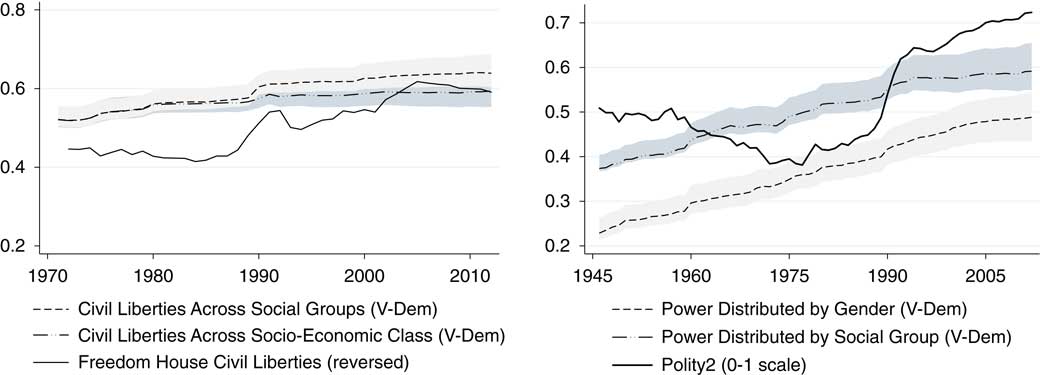
Before moving on to describe the specific data and methods used to measure egalitarian democracy, we briefly explore the extent to which the most commonly used democracy indices—those produced by Freedom House and Polity—capture the egalitarian principles described in this section. In Figure 1(a) we compare Freedom House’s Civil Liberties Index to V-Dem indicators measuring the extent to which civil liberties are protected equally across the population.Footnote 14 It is evident from Figure 1 that the trajectory of the Freedom House index diverges considerably from the indicators measuring the extent to which civil liberties are protected across socioeconomic and social groups, suggesting that the extension of formal rights is not necessarily synonymous with the Equal Protection of those rights.
Egalitarianism in existing democracy measures

In Figure 1 we also look at the relationship between the Polity2 index (Marshall and Jaggers Reference Marshall and Jaggers2015), which measures procedural elements of democracy such as competition and participation, and V-Dem indicators measuring the distribution of power by gender and social groups. Again, movement in the Polity2 measure does not follow the same trajectory as the power distribution indicators. Specifically, the large increase in openness during the Third Wave transitions as measured by Polity are not reflected in the power distribution measures. Together, the two graphs suggest that existing indices do not appear to sufficiently capture egalitarian principles, and that new measures to counter-balance the liberal and electoral perspectives are warranted.
CONSTRUCTING MEASURES OF EGALITARIAN DEMOCRACY
With an emphasis on de facto protections of rights and freedoms, distribution and actual access to power, the availability of data sources to measure egalitarian democracy have, until recently, been somewhat limited. The V-Dem dataset (Coppedge et al. Reference Coppedge, Lindberg, Skaaning and Teorell2016b) includes measures derived from expert survey data of both de jure and de facto aspects of political regimes, thus helping to overcome this problem and develop indices measuring the egalitarian principles outlined above. Specifically, we use ten V-Dem indicators to construct measures of the three subcomponents: Equal Protection of Rights and Freedoms, Equal Distribution of Reources and Equal Access to Power. We then combine these three measure to form an “Egalitarian Component index.” Finally, because the Egalitarian Component alone does not necessarily encompass the basic requirements of democracy, we combine it with V-Dem’s index for Electoral Democracy to form the highest level of measurement: the Egalitaraian Democracy index. This last step follows V-Dem conventions for measuring other “high-level” principles of democracy, such as Liberal, Participatory and Deliberative democracy.Footnote 15
Several goals guide the selection of indicators and construction of indices. First, we select indicators for the Equal Protection, Equal Access and Equal Distribution subcomponents that do not appear in V-Dem’s other main indices of democracy. This ensures that we can, to the extent possible, study relationships between different forms of democracy. Second, we construct each subcomponent to capture the relevant theoretical dimensions of egalitarianism in a way that is both coherent and conceptually distinct from other concepts of interest, while at the same time aspiring toward unidimensionality in each subcomponent.
Starting with the conceptual logic outlined above, we identify individual indicators that relate closely to each subcomponent.Footnote 16 We then employ a Bayesian factor analysis (BFA) to estimate a single latent dimension for each subcomponent. As described in Coppedge et al. (Reference Coppedge, Gerring, Lindberg, Pemstein, Skaaning, Teorell, Andersson, Marquardt, Mechkova, Miri, Pemstein, Stepanova, Tzelgov and Wang2016a), we randomly select 100 draws from each indicator variable’s posterior distribution, and use a unidimensional normal theory BFA to measure the latent concept sequentially for each randomly selected draw in each grouping of variables. We then combine the posterior distributions of the latent factor scores in each variable group to yield the latent factor scores. One distinct advantage of this method is that it produces confidence intervals for each estimate, taking rater accountability and uncertainty into account.
Subcomponent Indices
Equal Protection of Rights and Freedoms
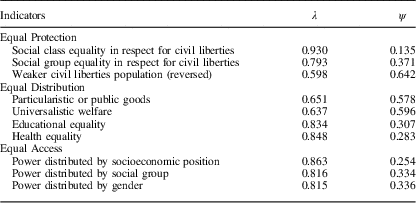
The Equal Protection index utilizes indicators listed in Table 1 aimed at measuring respect for civil liberties across socioeconomic classes and other social groups (including e.g., race, ethnicity, religion), as well as the extent to which such rights are protected equally across the country’s entire population. The two indicators measuring protection of civil liberties use the V-Dem measurement model output which is scaled from approximately −3 to 3. The indicator measuring the percent of population with weaker civil liberties is a continuous measure scaled from 0 to 100 that uses bootstrapping to aggregate multiple coder ratings in a way that maximizes reliability and comparability.
Loadings and Uniqueness Scores of Constituent IndicatorsFootnote a
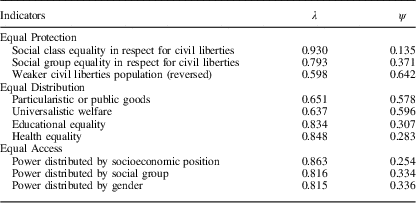
a Note: (λ)’s and (ψ)’s provided by the V-Dem data team.
See footnote no. 23 and Coppedge et al. (2016c, 439) for more detail.
Equal Distribution of key resources
The Equal Distribution subcomponent employs four V-Dem indicators capturing both the extent to which basic resources are provided by the government and the extent to which these resources are distributed equally among the population. First, we include an indicator measuring the extent to which the public programs are designed and administered in a targeted and particularistic way. This measure also relates to clientelism, tapping into unequal relationships of dependence. Second, we use V-Dem’s indicator that measures whether welfare policies are means-tested or applied universally. This measure helps to identify the extent to government programs are making sure all citizens enjoy the basic goods and services necessary to participate in democratic processes. The final two measures we include are measures of the extent to which health and education services are distributed equally among the population. Point estimates for all four indicators are measured using measurement model output that range from approximately −3 to 3.
Equal Access to power
Finally, the Equal Access subcomponent measures power distribution by socioeconomic position, social group and gender. As described above, we include these measures as a way to capture the extent to which typically disadvantaged social groups are capable of influencing their polity’s political and governing processes. The power distribution measures specifically ask experts to rate the extent to which economic wealth, membership in a particular social group or gender are translated into political power. Where these attributes translate strongly into power, opportunities for access and influence will be greater.Footnote 17
The Egalitarian Component and Democracy Indices
We combine the Equal Protection, Equal Distribution and Equal Access subcomponent indices to form the Egalitarian Component. As discussed in Coppedge et al. (Reference Coppedge, Gerring, Lindberg, Skaaning, Teorell, Altman, Andersson, Bernhard, Fish, Glynn, Hicken, Knutsen, Marquardt, McMann, Mechkova, Miri, Paxton, Pernes, Pemstein, Staton, Stepanova, Tzelgov, Wang and Zimmerman2016d), if dimensions of a concept are viewed as necessary conditions, a multiplicative aggregation would be most appropriate. If they are substitutable, an additive approach should be used. Given that all three of our subcomponents are to some extent necessary, but that strength on one dimension is a higher achievement of egalitarianism than none, we aggregate using the mean of the three subcomponents. This approach acknowledges that countries scoring high on one dimension but lower on another should still be considered as more closely embodying the principle of egalitarianism. This approach also puts a premium on countries that are strong on all three dimensions. It should also be emphasized that the Egalitarian Component does not measure egalitarian democracy but measures egalitarianism across different regime types.
Finally, we combine the Egalitarian Component index with the Electoral Democracy index (Teorell et al. Reference Teorell, Coppedge, Skaaning and Lindberg2016) to form the Egalitarian Democracy index.Footnote 18 There can be no democracy without elections, but there is wide recognition that democracy is more than just elections. We therefore combine the score for V-Dem’s Electoral Democracy index (also sometimes called the Polyarchy index) with the score for the Egalitarian Component using the aggregation formula developed by V-Dem’s research group for other democracy indices, described in Appendix A, where we also provide descriptive statistics for the indices. All indices are scaled between 0 and 1.
UNDERSTANDING THE INDICES
Since there are few, if any, extant measures of egalitarian democracy, validation is not necessarily a straightforward matter. To the extent possible, we follow the guidance of Adcock and Collier (Reference Adcock and Collier2001), Seawright and Collier (Reference Seawright and Collier2014) and Gerring (Reference Gerring2011) prescribing content, face and convergent/discriminant validation methods, each of which “provides one kind of evidence to be integrated into an overall process of assessment” (Adcock and Collier Reference Adcock and Collier2001, 543).Footnote 19 Our approach to validation specifically addresses the possibility of systematic measurement error that would weaken confidence not only in the measures themselves, but in their theorized relationships with other concepts of interest (Gerring Reference Gerring2011, 159).Footnote 20
Content Validation
Content validation includes an assessment of whether or not the appropriate conceptual elements are included, as well as the extent to which inappropriate elements are not included (Adcock and Collier Reference Adcock and Collier2001, 538). It is especially important to assess content validation for measures produced using a latent variable approach given the uncertainty involved in assuming the existence of an underlying latent trait within a set of observed indicators. We do so by first examining the loadings and uniqueness scores of constituent indicators with respect to the three subcomponent indices. These basic statistics give us a sense of what is, and is not, most closely related to the latent variables generated by the BFA and in the aggregation of the subcomponent and component indices.
We then examine content validity by decomposing variance in V-Dem’s coder-level data. For the content to be valid, Bollen and Jackman (Reference Bollen and Jackman1989) argues, there must be some level of agreement about the concepts being investigated. We test for agreement by analyzing variance components in coder ratings across the indices and constituent indicators.Footnote 21 Employed by Martinez i Coma and Van Ham (Reference Martinez i Coma and Ham2015) for the Electoral Integrity Project, by Steenbergen and Marks (Reference Steenbergen and Marks2007) for the Chapel Hill Expert Survey and by McMann et al. (Reference McMann, Pemstein, Seim, Teorell and Lindberg2016) and Lindberg et al. (Reference Lindberg, Coppedge, Gerring and Teorell2014) for other V-Dem indices, this method assumes that coder disagreement may signal lack of common understanding about underlying concepts.Footnote 22
Relationships to constituent indicators
We examine the loadings and uniqueness scores resulting from the BFA used to produce the Equal Protection, Equal Distribution and Equal Access subcomponent indices (Table 1). Point estimates of the loadings (λ) are provided for each indicator and subcomponent. The uniqueness scores (ψ) represent the proportion of the variance in the particular indicator that is not explained by the latent subcomponent variable.Footnote 23 Thus, a higher value of uniqueness suggests that the indicator is less strongly related to the latent construct. The latent Equal Protection variable predicts a larger proportion of variance for the indicators measuring social class equality in respect for civil liberties than it does for social group equality. Not surprisingly, the uniqueness score for the variable “percentage of population with weaker civil liberties” is higher, at 0.642, because there is naturally more variance in a variable scaled from 0 to 100 than in the other variables measured on an ordinal four-point scale. In the Equal Distribution subcomponent, ~70 percent of variance in the health and education inequality variables is predicted by the latent variable while the same can be said for 40–43 percent of variance in the other indicators. The Equal Access variable appears slightly more coherent as the resulting latent variable predicts 67–75 percent of variance in all three constituent indicators. Overall, the uniqueness patterns appear to suggest that the subcomponent indices are particularly sensitive to socioeconomic disparities, such as when poorer segments of the population are denied civil liberties, or when there is inequality in the provision of healthcare or education.Footnote 24
Coder agreement
Variance decomposition is an increasingly popular tool to evaluate validity of expert survey data because it assesses coder agreement relative to other sources of variance in the data. Following Steenbergen and Marks (Reference Steenbergen and Marks2007), Martinez i Coma and Van Ham (Reference Martinez i Coma and Ham2015), Lindberg et al. (Reference Lindberg, Coppedge, Gerring and Teorell2014), McMann et al. (Reference McMann, Pemstein, Seim, Teorell and Lindberg2016), we use multi-level models without predictors to generate estimates of the variance that is attributable to coder-level disagreement for each indicator. Specifically, we analyze variance components at the coder and indicator (survey question) level to assess the overall proportion of variance in coder ratings attributable to coder disagreement across country-years.Footnote 25
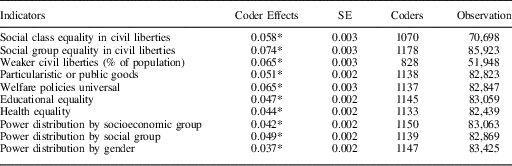
In Table 2 we test if the coder-level variance component is statistically significant and compare its levels across indicators, thus estimating which indicators produce more or less disagreement in ratings. We would expect, for instance, to see relatively larger coder-level variance on indicators that measure more abstract concepts or phenomena that are more complex and thus harder to rate uniformly.Footnote 26
Coder Disagreement by Indicator
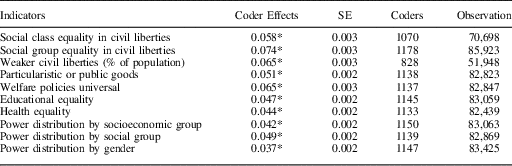
Note: *p<0.01.
For each indicator, Table 1 provides average coder-level deviations from the grand mean of ratings for each country-year. While there is a statistically significant (p<0.001) variance for all indicators, no indicator contains a coder-level variance component of >0.075, indicating a rather minimal coder-level effect. Coder-level variance components are highest in the variables measuring respect for civil liberties across different groups and the extent to which welfare policies are universal. The higher levels of disagreement in these variables are not surprising given the difficulty of observing respect for civil liberties across subgroups, as well as the complex and multi-faceted nature of welfare policy in many countries. Overall, these results are comforting in that the proportion of variance attributable to coder disagreement is not exceedingly large.Footnote 27
While more could be done to analyze coding patterns of specific indicators, the variance components presented here suggest that overall levels of coder disagreement are of small magnitudes given the types of coding tasks asked of V-Dem experts. Moreover, this brief analysis shows that coding patterns vary in ways that might be expected based on both the observability of the phenomenon and coder characteristics.
Face Validity
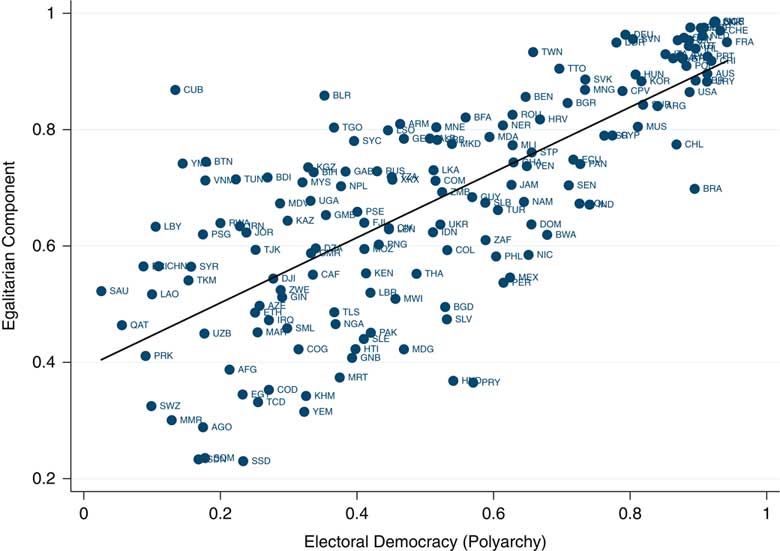
We also examine face validity: the extent to which the indices match our knowledge of particular cases both across countries and over time. First, we examine relationships between country scores on particular indices. Figure 2 shows the relationship between the Egalitarian Component index and V-Dem’s Electoral Democracy index averaged over the period 1990–2012. These two variables comprise the two main ingredients in the Egalitarian Democracy index and thus provide a general picture of how the egalitarian principles outlined above relate to the basic procedural expression of democracy.
Scatter plot: electoral democracy versus egalitarian component 1990–2012

At lower levels of electoral democracy we find countries like Cuba, Bhutan and Vietnam well above the best-fit line reflecting higher-than-average scores on the egalitarian component. Well below the best-fit line are countries like Angola, Yemen and South Sudan. Given the systematic deprivation of both rights and resources in these countries, their placement seems plausible. At high levels of electoral democracy Northern European countries and Taiwan are found above the best-fit line while countries like the United States, Chile and Brazil are, as expected, found below the best-fit line. Given the emphasis on liberal political and economic principles in the Western Hemisphere since the 1980s, these placements also seem to make intuitive sense. That variation is highest at low and medium levels of democracy is also encouraging, as this indicates an underlying relationship between democracy and egalitarianism that is consistent with the theoretical approach described above.Footnote 28
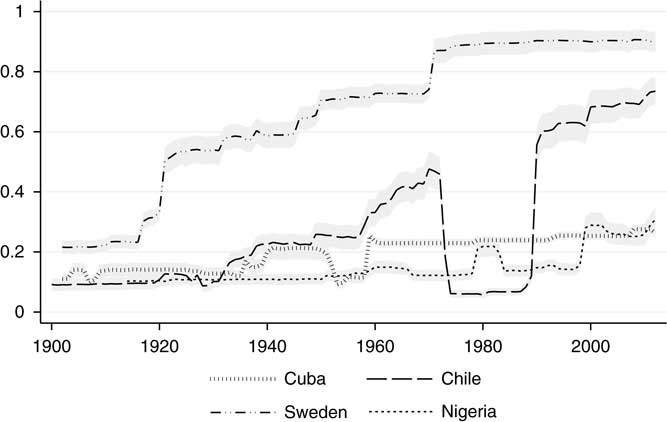
We also examine a few specific country cases in more detail to assess whether or not the variables change over time as we might expect. To do so, we select an array of “extreme” cases whose scores should, for the most part, be predictable and uncontroversial. Figure 3 shows time trends in the Egalitarian Democracy index for four countries that we would expect to vary both cross-nationally and over time. As expected, Sweden shows the highest scores throughout the entire time period, with increases in the 1920s and again in the mid-1970s, the latter reflecting adoption of a new constitution and broad extension of social welfare policies such as free childcare. In Chile we see increasing levels of egalitarian democracy until Pinochet takes power in 1973 when a precipitous drop takes place in all dimensions of the index following the introduction of political repression and neoliberal reforms. Cuba and Nigeria, both under autocratic rule for most of the 20th century show consistently low scores, with Cuba scoring somewhat higher thanks to their relatively Equal Distribution of Resources. Nigeria climbs considerably following elections in 1999, though Equal Access to Power and Equal Distribution of Resources keeps Nigeria relatively low in recent decades. With expected increases in electoral democracy scores resulting from successful elections in 2011–2015, we would expect to see some level of increase in the overall electoral democracy score, though we expect it to remain somewhat low relative to other democracies. Time trends for the United States are provided in in the Online Appendix, Section C.
Egalitarian democracy over time in four countries

Attention to these specific cases demonstrates the potential utility of the four indices in capturing relevant variation—both across countries and over time—in a wide variety of countries. Though the cases of Nigeria and Cuba illustrate the potential difficulty of using the Egalitarian Democracy Index to distinguish between a democracy with unequal distributions of resources and/or access to power and an autocratic country with relatively Equal Distributions of Resources or Access to Power, the lower level indices help researchers to overcome this problem. Additionally, the case of the United States illustrates that the Equal Protection component may not always capture all relevant change in the extension of rights and freedoms, specifically as it relates to voting rights. Overall, however, we believe that the movements across a variety of cases merit a sufficiently high level of confidence that the indices, in general, capture what we know about particular cases.
Convergent/Discriminant Validation
The purpose of convergent/discriminant validation is to assess the extent to which the new measures relate to alternative indicators of the systematized concept of interest (Adcock and Collier Reference Adcock and Collier2001, 540). Given that, to our knowledge, no cross-country time-series measures of egalitarian democracy exist, we assess convergence with related concepts. We also examine relationships with concepts with which egalitarian democracy should not relate, with the expectation that relationships will be of medium strength or negative. Tables 8 and 9 provided in the Online Appendix Section D, summarize these relationships. We find that correlations with other V-Dem indices tend to fall in the 0.6–0.8 range and vary in expected ways. There is also a clear distinction between common measures of rights and freedoms and the egalitarian indices, thereby suggesting that the egalitarian indices achieve meaningful distinction from conventional measures of liberal democracy.
We draw several important lessons from this series of tests including content, case and convergent/discriminant methods of validation. First, we are generally confident that the measures as currently constructed capture the theorized concept of egalitarian democracy and its underlying principles. Second, while Equal Protection and Equal Distribution both measure conditions that may enable participation, it is clear from the tests that Equal Access is, to a greater extent, a measure of whether various groups are actually able to reap the benefits of participation meaningful in the political system.
Additional work may be necessary to build more comprehensive subcomponents, especially to measure the Equal Protection of rights and liberties across various types of groups, such as workers. Moreover, the analysis of coder disagreement suggests that Equal Protection of rights may be more difficult than the other concepts to measure with expert survey data, suggesting the need to further examine the best ways to understand how rights and freedoms are (or are not) protected across various groups in society. This last point also suggests the need to further explore the strengths and weaknesses of expert survey data to measure de facto political phenomena, given that it can be difficult to observe these phenomena directly, and that the ability to produce consistent expert coded data may vary across different topics and units of analysis.Footnote 29
A RESEARCH AGENDA
We conclude the paper by suggesting a number of ways in which the development of these five indices can advance existing research. Naturally, the brevity of the outline makes it incomplete. Yet, two areas may be viewed as particularly conducive to advancement using the measures developed and presented here: the study of global trends in the egalitarian nature of polities and the relationship between equality/inequality and democratic survival.
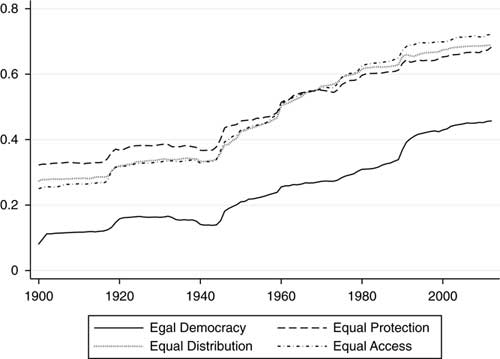
Figure 4 shows global trends in the four egalitarian indices from 1900 to 2012. The convergence among the indices following World War II is particularly striking as Equal Distribution and Equal Access rise to meet and surpass levels of Equal Protection. Additionally, we see a spurt of growth in all indices corresponding to the “Third Wave” of democratization at the end of the 1980s and the early 1990s. While one might assume that the fall of communism during this time would lead to less Equal Distributions of Resources, the Equal Distribution subcomponent appears to move in close tandem with Equal Access. A more complete inquiry into these trajectories would help to deepen our knowledge about the underlying dynamics of egalitarian democracy.
Global trends in egalitarian indices

A second area of potential contribution relates to the expanding body of empirical research on the relationship between inequality and democracy (i.e., Boix Reference Boix2003; Acemoglu and Robinson Reference Acemoglu and Robinson2006; Ansell and Samuels Reference Ansell and Samuels2015) that provides mounting evidence that high levels of inequality threaten both the survival and quality of democracy. Not only would V-Dem’s egalitarian indices enable researchers to better grasp the inequality dynamics that shape the probability of authoritarian reversals, but they could also provide insight into the particular institutional mechanisms that shape the participatory patterns of the poor or otherwise marginalized populations in ways that could potentially undermine democratic stability. The idea here would be to bring closer together literature on the relationship between inequality and participation, for example, by Uslaner and Brown (Reference Uslaner and Brown2005), with research on the relationship between inequality and democratic survival. This area of research is especially important given recent observations of anti-democratic trends (Foa and Mounk Reference Foa and Mounk2016) accompanied by rhetorics of economic and political inequality.
Ultimately, these areas of potential research are just a small fraction of the types of knowledge that could be gained from further advancing our ability to conceptualize and systematically measure the egalitarian underpinnings of democratic regimes. This paper points not only to the effectiveness and utility of developing such indices, but also to the potential benefits from further work to improve these indices and explore their range of capabilities.