Introduction
The United States is home to the world’s largest network of natural gas pipelines, consisting of over 480 000 km of large transmission lines and 3.5 million km of local distribution lines, moving trillions of cubic feet of natural gas each year. 1 Adverse incidents such as pipeline leaks, ruptures, and explosions occur regularly. In the last 20 years, 2810 significant natural gas pipeline adverse incidents (ie, resulting in injury, fatality, or at least US $50 000 in damage) have been reported to the Pipeline and Hazardous Materials Safety Administration – averaging nearly 3 incidents per week. 2 These incidents have resulted in over 250 fatalities, 1150 injuries, and billions of dollars in damages. 2
When pipeline incidents occur, first responders, defined as firefighters, emergency medical services (EMS), law enforcement, and other emergency workers, contain hazards and minimize loss of life and property. 3 Responding to these incidents can involve health risks for first responders because natural gas fires produce intense thermal radiation, may emit fine (≤ 2.5 µm) and ultrafine (≤ 0.1 µm) particles, and may produce irritating and/or toxic gases. 3–Reference Elder and Oberdörster5 Understanding these health effects may help emergency managers and first responders prepare for future pipeline disasters and take measures to mitigate and manage occupational health hazards.
On August 1, 2019, a natural gas transmission pipeline extending from Texas to Pennsylvania exploded in Lincoln County, Kentucky, releasing 66 million cubic feet of natural gas and burning 30 acres of surrounding land and structures. 6 The explosion and subsequent fires (the incident) destroyed 5 homes and damaged 14 others. One resident was killed, 6 were hospitalized, and over 70 were evacuated. Shortly after the incident, evacuated residents notified the Kentucky Department for Public Health (KDPH) about upper respiratory symptoms, ash, and debris deposited on their homes and vehicles, and concerns of ongoing exposure risks from these deposits (Doug Thoroughman, PhD, official letter of request for assistance, September 3, 2019).
KDPH requested assistance from the Centers for Disease Control and Prevention (CDC) and Agency for Toxic Substances and Disease Registry (ATSDR) to assess the health effects of the incident on residents and first responders. This paper describes the results of the epidemiologic investigation into the occupational health effects on first responders. This investigation had 4 objectives: (1) describe self-reported new or worsening post-response physical health symptoms, (2) identify risk factors associated with the development of post-response physical health symptoms, (3) assess self-reported personal protective equipment (PPE) use, and (4) assess self-reported post-response health care use.
Methods
Setting, Study Design, and Participants
On September 5, 2019, a team of CDC/ATSDR investigators deployed to Lincoln County, Kentucky, to assist KDPH with investigating the health effects of the incident. Lincoln County is located approximately 95 km south of the state’s capital, Frankfort, Kentucky, with a population of 24 742 and population density of 29 persons/km2. 7 The pipeline section that ruptured was approximately 76 cm in diameter with 0.95-cm-thick steel walls. The pipeline was over 60 years old at the time of the incident; another section had previously ruptured in 2003, about 100 km northeast of the current incident. 6
A roster of all 173 responders who signed in during the incident response was obtained from the local incident manager. The investigation team attempted to interview all who responded within 83 hours of the initial explosion (from August 1, 1:00 am, to August 4, 12:00 pm) and worked within the evacuation area, which encompassed a half-mile (approximately 0.8 km) radius from the site of the pipeline rupture. The 83-hour time frame was chosen to ensure responders who worked in the evacuation area during the several days following the incident to extinguish smoldering fires were included in the investigation. Responders who worked outside the evacuation area or time frame of interest were excluded. The half-mile radius was chosen because it was the civilian evacuation distance established by the response’s incident command structure and is the recommended distance to minimize harmful exposure to pipeline ruptures and fires. 8 Department chiefs were contacted to obtain permission to interview first responders involved with the response and to arrange for face-to-face interviews at department stations or, when necessary, by phone. Informed consent was obtained from responders before each interview.
This investigation protocol was reviewed by the CDC and determined not to be research, using criteria established by the US Department of Health & Human Services (45 CFR part 46), because it was conducted to inform local public health surveillance and response to the pipeline explosion.
Data Sources/Measurements
ATSDR’s Assessment of Chemical Exposures (ACE) Toolkit questionnaires and materials were used for this study. 9,Reference Duncan and Orr10 Designed to assist local authorities in responding to a broad range of chemical releases and events, the ACE Toolkit contains materials to facilitate the measurement of chemical exposures, exposure-related symptoms or clinical signs, health outcomes, and post-exposure health care use. The ACE Toolkit’s “Adult” survey was modified for use with first responders to capture symptom onset dates, PPE use, and response experience.
Physical Health Symptoms
Responders were asked about new and pre-existing physical symptoms, conditions, and injuries (all referred to as “symptoms”) that developed or worsened during the 1 month after the incident, using a pre-defined list of 23 symptoms listed in the ACE Toolkit survey materials (see supplemental materials for full list). An open text response option was included to allow responders to report symptoms not in the pre-defined list. If a responder reported experiencing a new or worsening symptom, that responder was asked the date of onset during the 1 month after the incident and if she or he was still experiencing the symptom on the day of the interview (approximately 1 month after the incident). If a responder reported pre-existing symptoms that did not worsen, those symptoms were not counted as new or worsening symptoms in this analysis.
For analysis, the 23 symptoms were mapped to 8 symptom categories (see supplemental materials for full symptom-to-category mapping). The symptom categories were headache, eye irritation (eg, burning of eyes), ear or hearing-related (eg, tinnitus, hearing loss), upper respiratory (eg, cough, runny nose), lower respiratory (eg, wheezing, difficulty breathing), skin irritation or injury (eg, skin irritation, laceration), cardiac (eg, elevated heart rate, angina), and other neurologic symptoms (eg, concussion, fainting). Other neurologic symptoms (n = 1) were infrequently reported and not analyzed further; headache was separately categorized from “other neurologic” symptoms, given its relatively high frequency. Symptoms reported in the open response field were mapped to one of these categories, and symptoms that could not be categorized were reported individually.
Physical Exertion
Because higher respiration rates may increase inhalation and exposure to airborne contaminants, responders’ perceived physical exertion during the response was measured as a proxy for respiration. The Borg Rating of Perceived Exertion (RPE), a validated scale ranging from 6 (“no exertion”) to 20 (“very, very hard”), was used to assess each responder’s physical exertion during the response. Reference Borg11 The RPE has been validated and shown to correlate with heart rate and blood lactate. Reference Scherr, Wolfarth and Christle12 Responders were shown the RPE scale with descriptive examples for each rating; for example, an RPE of 15 to 16 was described as “bicycling, swimming or other activities that take vigorous effort and get the heart pounding and make breathing very fast.” Using a map of the incident location, responders were asked to rate their physical exertion during the response at each location within the evacuation area where they worked. If a responder reported working at multiple locations, the RPE was calculated as a time-weighted average:
 $$RP{E_{time - weighted}} = \;{{\sum {\left( {{t_i}{\rm{*}}RP{E_i}} \right)} } \over {\sum {{t_i}} \;}}$$
where
 ${t_i}$
= time in minutes at location
 $i$
and
 $RP{E_i}\;$
= perceived exertion at location
 $i$
.
Two categories for perceived physical exertion were created: light exertion (RPE between 6 and 12) and hard exertion (RPE between > 12 and 20). The cutoff for this variable was chosen a priori based on where the RPE description changes from “light” ratings of exertion to “hard” ratings (see supplemental materials for the RPE showcard).
Use of Personal Protective Equipment
Responders were asked whether PPE was readily available to them and whether they wore PPE at any time while working within the evacuation area. If they said yes, they were asked to identify which PPE ensemble level they wore at each location within the evacuation area. PPE ensemble levels (A, B, C, or D) are based on the Occupational Safety and Health Administration’s guidance on PPE for Emergency Response and Recovery Workers. 13 We also included an option for responders to indicate whether they wore standard firefighter turnout gear with or without respiratory protection. If responders wore a partial ensemble (eg, boots only), they were asked what specific PPE or garments were worn.
For this study, PPE was considered to be equipment designed for protecting the skin, eyes, or respiratory system from environmental and chemical exposures (eg, turnout coat, respirators); PPE for biologic fluids (eg, non-sterile exam gloves) and traffic exposure (eg, visibility vests) were not considered. PPE use was analyzed as a binary variable (did not wear any PPE = 1, wore PPE = 0), and responders were considered as wearing PPE if they indicated wearing any PPE while working at any time within the evacuation area.
Smoke and Ash Exposure
Exposure to smoke and to ash or debris was subjectively measured as separate binary variables (eg, no smoke exposure = 0, smoke exposure = 1). Responders were asked “Did you breathe, inhale, or smell smoke?” and “Did ash or debris fall directly on you?” while working within the evacuation area; responders were considered exposed if they answered affirmatively.
Post-Response Health Care Use
Responders were asked whether they sought medical care or evaluation for their health symptoms since responding to the incident (approximately 1 month before the interview). Symptomatic responders not seeking medical care or evaluation were asked to specify reasons for not doing so, using a pre-defined list of reasons with open-response fields.
Other Variables
Responder type was measured as a categorical variable and based on responder self-identification: firefighter, EMS, law enforcement, or other responder (eg, emergency managers and utility workers). Other variables in this analysis were responder age, response hours worked (ie, number of hours in evacuation area), and career type (paid career responder or unpaid volunteer responder).
Statistical Methods
Descriptive statistics were used to summarize responder demographics, exposures, and outcomes. A series of logistic regression models were used to assess the association between each symptom category and each exposure of interest. Smoke exposure, ash exposure, responder type, PPE use, and physical exertion were assessed. Separate logistic regression models were fit with each symptom category as the outcome (eg, headache = 1 or no headache = 0), and each exposure of interest (eg, exposed to smoke = 1, not exposure to smoke = 0) as the primary independent variable, with responder age (continuous variable) and response hours worked (continuous variable) included as covariates. For models assessing physical exertion, responder type was added as a categorical covariate to control for potential confounding by response role. Adjusted odds ratios (aOR) and 95% confidence intervals (CI) are reported for statistically significant results (P ≤ 0.05). All analyses were done in R, Version 3.6 (R Foundation, Vienna, Austria).
Results
Participants
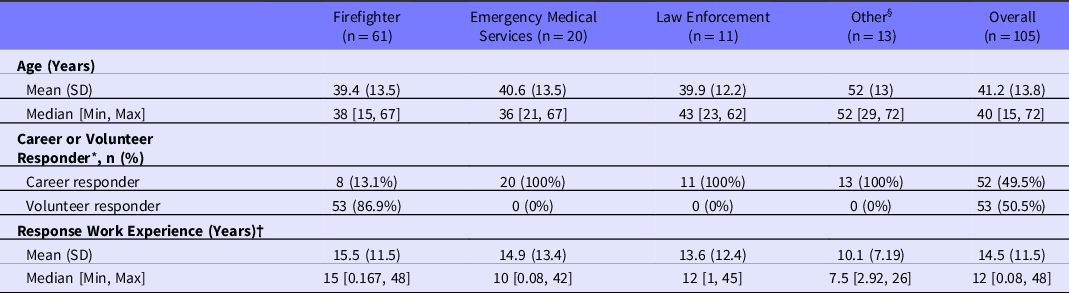
Interviews were completed for 105 of 173 (61%) first responders: 60 (35%) could not be reached, 3 (1%) refused participation, and 5 (3%) did not meet inclusion criteria upon screening (ie, did not work within the evacuation area or time frame of the study). The interviewed responders were firefighters (58%), EMS (19%), other responder types (12% [includes emergency managers and utility workers]), and law enforcement officers (10%) (Table 1). The responders were predominantly male (91%) and white (97%) and had a median of 12 years (range = 0.08–48 years) of emergency response experience. Half of the responders were career responders (ie, full-time, paid responders).
Demographic characteristics of first responders involved in the natural gas pipeline explosion response, August 2019

Notes:
* In general, career responders are paid for their emergency response work, while volunteers are not paid.
† Years of work experience in the specified responder type role.
§ Other responders include emergency managers and utility workers.
Exposures, Personal Protective Equipment Use, and Physical Exertion
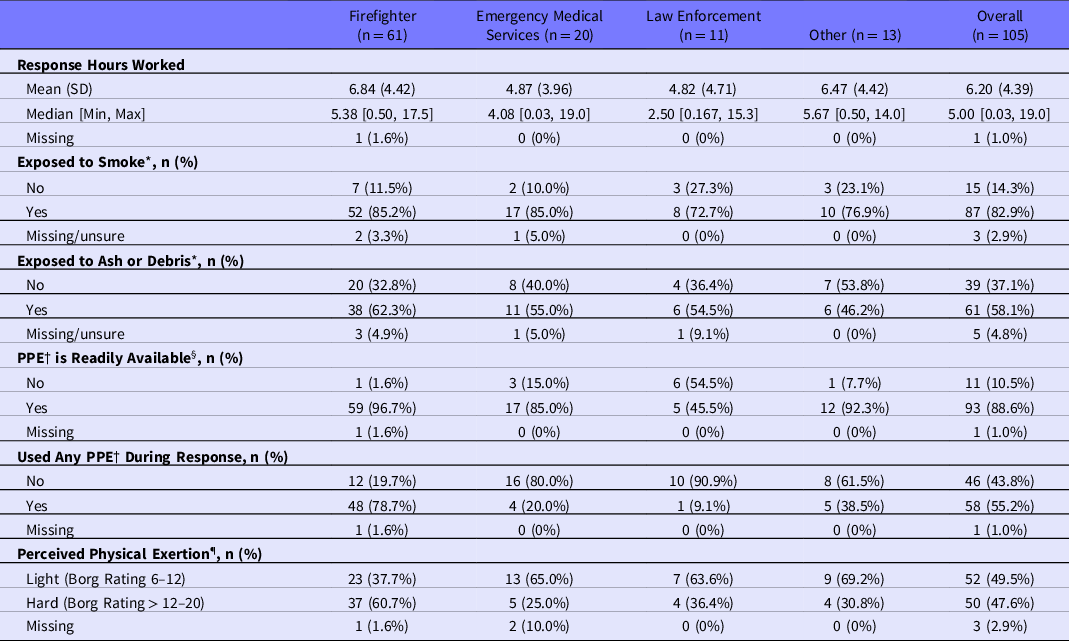
All responders reported working within the evacuation area on the day of the incident, and several returned to work in the evacuation area on subsequent days. The majority of responders reported exposure to smoke (83%) and ash or debris (58%). While almost all responders (89%) reported that PPE was readily available to them, 46 (44%) reported not using any during the response. The majority (74%) of those not using PPE were non-firefighters; overall, 77% of non-firefighter responders did not use any PPE.
Among those who wore PPE, Level “D” ensembles (8%) and firefighter turnout gear (76%) were the most commonly worn (See Table S1a for PPE ensembles worn); among firefighters, the proportion wearing turnout gear was similar, but slightly lower among career (63%) compared with volunteer (74%) firefighters. The proportion using PPE was lowest among EMS and law enforcement officers. Of the 46 responders who did not use any PPE, 43% thought it was unnecessary and 33% said it was unavailable at the time of the incident (See Table S1b for reasons for not wearing PPE). Only nine (9%) responders reported using any respiratory protection in the evacuation area. Notably, about a third (32%) of responders arrived at the incident in personal vehicles. About half (48%) of all responders working within the evacuation area reported an average level of hard physical exertion; the majority (74%) reporting hard physical exertion were firefighters (Table 2).
Summary of exposures among first responders working within the evacuation area and within 83 hours of the natural gas pipeline explosion – August 1, 2019

Notes:
* Responders were considered exposed to smoke if they answered “Yes” to the question of “did you breathe, inhale, or smell smoke” while working within the evacuation area. Responders were considered exposed to ash if they answered “Yes” to the question “did ash or debris fall directly on you” while working within the evacuation area.
† PPE = Personal Protective Equipment; considered as equipment used to protect from environmental or chemical skin, eye and respiratory contact during emergency response. Does not include use of PPE for biologic hazards (e.g., non-sterile exam gloves). Responders were considered wearing any PPE if they indicated wearing a full or partial PPE ensemble at any point while working within the evacuation area.
§ Generally available at duty station for regular response-related tasks and duties; question was not specifically in reference to availability at the time of pipeline incident.
¶ Physical exertion is based on Borg rating of perceived exertion with scale from 6 (“none or no exertion”) to 20 (“very, very hard exertion”).
Health Outcomes
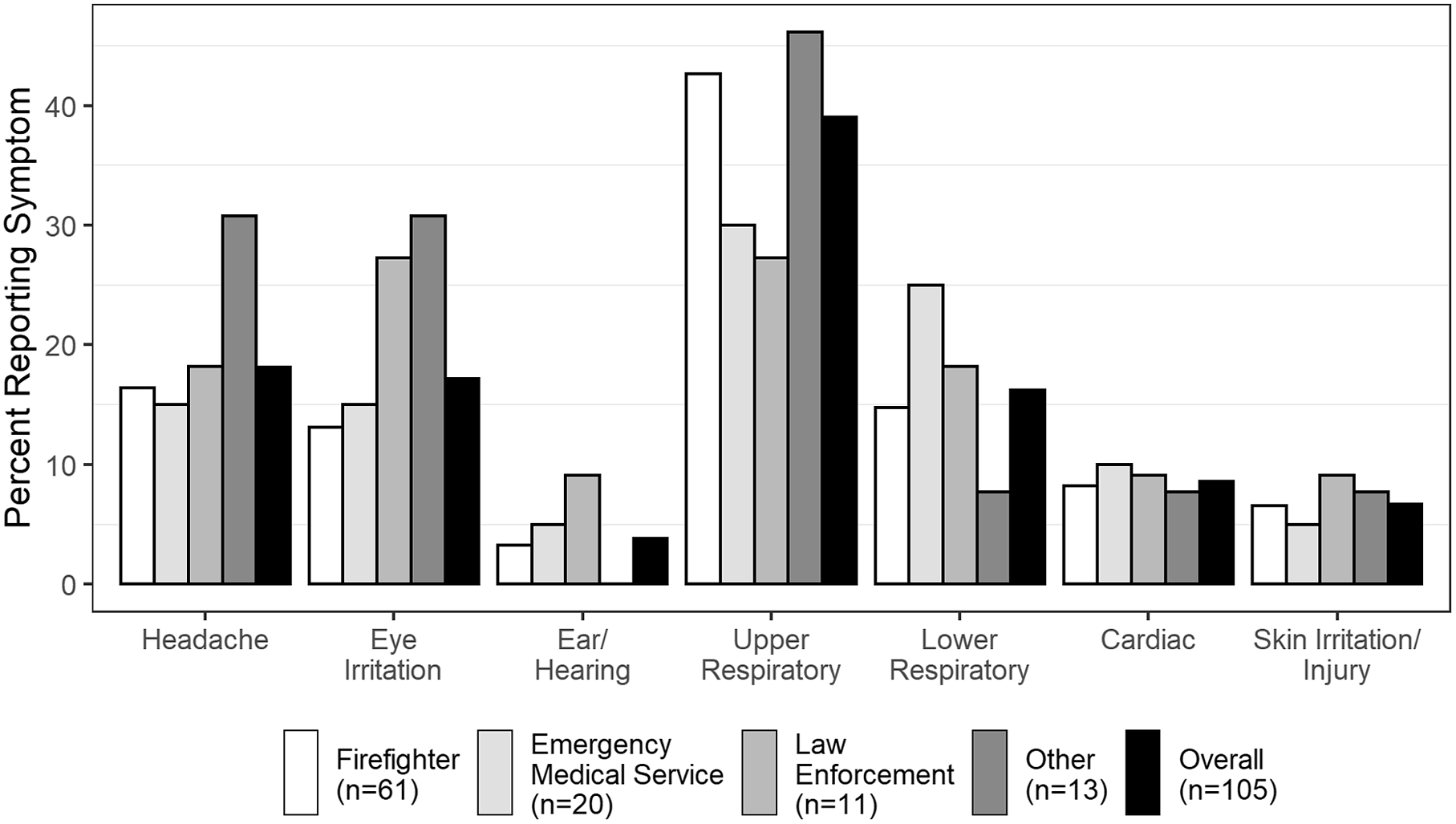
Over half (53%) of the responders reported at least 1 new or worsening symptom within 1 month after the incident; the most frequently reported symptom categories were upper respiratory (39%), headache (18%), eye irritation (17%), lower respiratory (16%), and cardiac (9%) (Figure 1) (see Table S2 for all symptom frequencies). Ear or hearing-related symptoms (4%) were the least frequently reported, followed by skin irritation or injury (7%). Other symptoms reported those that could not be mapped to a symptom category were infrequent: sore gums (n = 1), metallic taste in mouth (n = 1), dehydration (n = 1), low grade fever (n = 2), fatigue (n = 2), and joint pain (n = 2). The majority (61%) of responders reporting new or worsening symptoms were firefighters. Most (78%) of the responders reported that their symptoms developed or worsened within 3 days of the incident (see supplemental, Figure S1).
Symptom categories reported.

Risk Factors for Developing Symptoms
After controlling for responder age and response hours, it was observed that ash or debris exposure was associated with upper respiratory symptoms (OR: 3.74; 95% CI: 1.52–10.04) and lower respiratory symptoms (OR: 6.14; 95% CI: 1.59–40.72). Smoke exposure was associated with increased odds of upper respiratory symptoms (OR: 2.83; 95% CI: 0.81–13.31) and lower respiratory symptoms (OR: 2.98; 95% CI: 0.53–56.36), but these associations were not statistically significant.
The odds of developing headache (OR: 3.62; 95% CI:1.15–13.10), eye irritation (OR: 5.65; 95% CI: 1.61–23.93), and upper respiratory symptoms (OR: 2.99; 95% CI: 1.25–7.50) were greater among hard exertion responders than among light exertion responders, after controlling for responder age, response hours, and responder type. While not statistically significant, responders who did not wear PPE had 3 times the odds of reporting skin irritations or injuries compared to those who did wear PPE (OR: 3.09, 95% CI: 0.57–24.31, controlling for responder age and response hours). We did not find any significant associations between responder type and development of symptoms. Although firefighters were the majority of responders reporting symptoms, they were also the largest group of responders (see Table S3 for all regression results).
Post-Response Health Care
The majority (79%) of responders who reported any new or worsening symptoms did not seek post-response medical care or evaluation (Table 3), and most responders (77%) who did not seek care thought their symptoms were not serious (see Table S4 for all reasons). Among responders reporting any symptoms, EMS (100%) were least likely to seek post-response care or evaluation (see Table 3). Overall, 41% of responders who reported new or worsening symptoms were still experiencing at least 1 reported symptom at the time of interview, approximately 1 month after the incident; among the 23 experiencing ongoing symptoms, the majority (74%) reported not seeking care. Among those with ongoing symptoms, lower respiratory symptoms were the most common (see Table S5 for ongoing symptoms).
Number and percent of first responders who did not seek post-response medical care of evaluation stratified by symptom status and responder type, August 2019

Notes:
* Number not seeking care (numerator) is shown with total number of responders for each symptom status (denominator).
† Responders reporting the development of new or worsening symptoms after responding to the natural gas pipeline explosion.
§ Responders reporting they were still experiencing symptoms that developed or worsened after responding to the natural gas pipeline explosion on the day of the interview, approximately one month after the response.
Discussion
In this study, first responders experienced new health symptoms or worsening pre-existing health symptoms within 1 month after responding to a major natural gas pipeline explosion and fire. Responders with physically demanding response activities (as assessed through the RPE scale) were at greater risk for developing headache, eye irritation, and upper respiratory symptoms. PPE use was low among responders working within the evacuation area of this incident. Finally, the majority of responders experiencing symptoms did not seek medical care or evaluation, despite experiencing both acute (presenting shortly after the incident) and ongoing (persisting a month after the incident) symptoms.
These results support previous studies showing that upper respiratory symptoms are common among first responders after working at fire and chemical incidents. Reference Melnikova, Wu, Yang and Orr14–Reference Brinker, Lumia and Markiewicz16 While post-response respiratory symptoms were commonly reported in this investigation, the exact cause is unknown. When natural gas burns, the primary byproducts are carbon dioxide and water vapor, but other potentially harmful byproducts are also emitted. Reference Xue, Li and Peppers4 Incomplete combustion of natural gas could have released methane, carbon monoxide, and other irritants in sufficient quantities to cause headache and upper respiratory symptoms. Reference Hartzell17 Furthermore, exposure to smoke, ash, disturbed soil, and other chemical emissions from burning or smoldering structures, vehicles, and brush may also have contributed to respiratory irritation among these first responders. Reference Hartzell17–Reference Terrill, Montgomery and Reinhardt24 Given the high proportion of responders reporting acute and ongoing post-response health symptoms and the potential for toxic exposures, responders should be encouraged to seek post-response medical care or evaluation. Barriers to seeking care should be identified and addressed to promote post-response health care.
This study found an association between physical exertion, as measured by the RPE, and an increased risk of headache, eye irritation, and upper respiratory symptoms. The increased odds for headache and upper respiratory symptoms could be related to a greater inhaled dose of airborne contaminants resulting from higher respiration rates during physical exertion. Exposure measurement studies show that adults engaged in moderate intensity activities have respiration rates 6 times higher than when at rest, resulting in greater doses of inhaled air. 25 Studies have shown that strenuous physical activity in polluted air is associated with reduced lung function, increased airway inflammation, and altered cardiovascular function. Reference Qin, Yang and Wang26–Reference Giles and Koehle29 Furthermore, physical exertion and heat stress during wildfire suppression activities have been found to elevate acute inflammatory markers among firefighters. Reference Main, Wolkow and Tait20
Guidelines for responding to pipeline incidents recommend that all first responders wear appropriate PPE to protect from thermal and chemical exposures 3,30 ; however, a large proportion of the responders in the current study did not. Furthermore, almost half of the responders who did not wear any PPE thought it was unnecessary, and a third reported that PPE was unavailable. Notably, a third of the responders arrived on scene with personal vehicles where PPE may not be stored, and it may be possible that responding in personal vehicles may have contributed to PPE unavailability on scene. Use of respiratory PPE at non-structure fires, known to be low among firefighters, Reference Austin, Dussault and Ecobichon31 was similarly low among responders in our study, despite high levels of reported smoke and ash exposure. Even in the absence of smoke or ash, respiratory protection during and after fire incidents is generally recommended to protect responders from potential toxic emissions. Reference Greven, Rooyackers, Kerstjens and Heederik15,Reference Burgess, Nanson and Bolstad-Johnson23,32 The low PPE use rate in this response indicates a need to promote PPE training, PPE availability, and use among all responders involved in pipeline responses, especially if they are working in evacuation zones with possible harmful thermal and chemical exposures. Law enforcement officers in our study had the lowest PPE use rate. A previous analysis of chemical incidents over a 10-year period also showed that law enforcement officers had the lowest reported PPE use among all responder types. Reference Melnikova, Wu, Yang and Orr14 These findings suggest a need to increase PPE availability and ensure PPE use among law enforcement officers responding to chemical hazards.
Limitations
Because interviews were conducted about a month after the incident and relied on participant memories for exposures, information bias could have influenced results. For example, symptomatic responders might be more likely than asymptomatic responders to recall smoke and ash exposure, which would bias the results toward a larger association between smoke and ash exposure and symptom development. Recall bias among persons exposed to toxic events has been shown to be a potentially major issue, particularly when significant time has elapsed after the chemical event. Reference Hopwood and Guidotti33 Although responders were asked about new or worsening health symptoms, comprehensive baseline data or underlying health status prior to the incident was not available for comparison with their post-incident health status. While the goal was to interview a census of responders, a third of the responders could not be interviewed; it is possible that non-participants experienced different exposures or symptoms. As a convenience to responders, most interviews were conducted at responders’ stations, and responders may be less willing to report adverse health symptoms while at their workplace; this factor could have led to underestimates of symptoms. It is possible that the symptoms the responders experienced could be unrelated to the pipeline incident and could have developed from some later and unrelated exposure; however, all responders reported having worked within the evacuation area on the day of the incident, and most reported symptoms had developed within 3 days of the incident.
For simplicity, PPE use was modeled as a binary variable, which cannot fully account for variation in PPE ensembles, PPE ensemble completeness, equipment efficacy and quality, and proper use and consistent wear (ie, worn at all times in the evacuation area); however, since the majority of responders wore level “D” PPE ensembles or equivalent firefighter turnout gear, this representation of PPE use may be sufficient to understand general PPE availability and use during the response. The question about PPE availability was non-specific, such that some responders may have answered about PPE availability in general or availability on scene during the incident. Furthermore, only PPE use within the overall civilian evacuation area was assessed, such that PPE compliance by hot, warm, or cold zones was not assessed. Since it is unlikely that all responders worked within the hot zone where PPE would be required, the low rate of PPE use we observed may not necessarily be inappropriate as a proportion of responders may not have entered hot zones, but this was not verified. The effect of respirator use on symptoms was also not examined because very few responders reported using respirators.
While separate adjusted logistic regression models including age, response hours, and responder type variables were used to assess the association between exposures of interest and the development of symptoms, it is likely that there could still be uncontrolled confounding in the reported odds ratios. While more complex models could be used to control for other confounders, the small sample size and number of observed events for the individual symptoms assessed precluded this. Reference Peduzzi, Concato and Kemper34
Mental health symptoms were assessed during the field investigation but were not included in this study. Mental health conditions, such as posttraumatic stress disorder and depression, are prevalent among first responders, and repeated exposure to traumatic events like this incident can cause short- and long-term mental health conditions, which remain an important aspect of responder health warranting further study. Reference Benedek, Fullerton and Ursano35 Without environmental monitoring data during and after the incident, air quality in the evacuation area while responders were working could not be assessed. Moreover, since hot, warm, and cold zone locations were not assessed, it was not possible to assess how working in hot zones within the evacuation area – where thermal and chemical exposure risk would be greatest – may have influenced or modified results. The civilian evacuation zone was chosen as the area of study because the overall investigation involved assessing the evacuated civilian community.
Conclusions
Upper respiratory symptoms were common among first responders to a natural gas pipeline explosion and fire, especially among responders reporting hard physical exertion, in the immediate period after the incident. It may be necessary to increase PPE availability and training for certain types of responders and ensure PPE use during pipeline incident responses, especially when responders are working within evacuation zones where harmful thermal and chemical exposures may be greatest. Given the reports of ongoing symptoms after this incident and the potential for harmful exposures, symptomatic responders should be encouraged to seek medical care or evaluation for their symptoms after responding to natural gas pipeline explosions and fires. Furthermore, responders should be aware that symptoms may arise over a longer period than revealed in this study.
Supplementary material
To view supplementary material for this article, please visit https://doi.org/10.1017/dmp.2021.266
Acknowledgments
The authors thank the Lincoln County and Boyle County Health Departments, and the Lincoln County and Boyle County Emergency Management Agencies for their assistance in conducting our field investigation. Special thanks to the Kentucky Public Health Assistance and Support Team (K-PHAST), Medical Reserve Corps, and local community volunteers who helped with outreach and logistics for the field investigation. We thank all the local first responders for accommodating our investigation and for their work and service to their communities.
Author Contributions
DPB, EAK, EFB, LKT, MO, RH, DM, JH, TB, RF, and DT conceived of and designed this study. DPB, EAK, EFB, LKT, MO, KLB, CE, RH, DM, and JH were involved in field operations, data collection, data entry, and management. DPB conducted data analyses. All authors contributed to interpretation of results, reviewed the manuscript, and provided critical feedback and revision. All authors approved the final manuscript.
Conflict(s) of Interest
The authors declared no potential conflicts of interest with respect to the research, authorship, and/or publication of this paper.