INTRODUCTION
Since low temperatures restrict germination and seedling growth of oilseed rape (Brassica napus L. subsp. oleifera DC.) (Nykiforuk & Johnson-Flanagan Reference Nykiforuk and Johnson-Flanagan1999) and spring turnip rape (B. rapa L. subsp. oleifera DC.) (Peltonen-Sainio et al. Reference Peltonen-Sainio, Känkänen, Pahkala, Salo, Huusela-Veistola and Peltonen2006), sowing is best carried out when soil temperatures are c. 10°C (Pahkala Reference Pahkala, Sorensen, Sorensen, Sorensen, Muguerza and Bjergegaard2003). Combining an optimal temperature regime with other conditions that favour germination is challenging. Small turnip rape seeds are sown into rapidly drying soil at a depth of c. 20–30 mm. Germinating seeds are therefore frequently exposed to drought, which typically occurs during late spring to early summer in Finland. Unsatisfactory compromises in the timing of and conditions at sowing are often further emphasized by the heavy spring workload on farms, especially as farm size has increased substantially in Finland in the last 15 years (Pahkala et al. Reference Pahkala, Sankari and Ketoja1994).
Winter sowing would lighten the workload and provide moist soils for germination, but winter crop types lack sufficient winter hardiness for Finnish conditions. However, using carrier technology, by sowing polymer-coated seeds during the preceding autumn, winter or very early spring (Kirkland & Johnson Reference Kirkland and Johnson2000; Karamanos et al. Reference Karamanos, Harapiak and Flore2002; Clayton et al. Reference Clayton, Harker, O'Donovan, Blackshaw, Dosdall, Stevenson, Henderson and Hensley2004; Johnson et al. Reference Johnson, Miller, Blackshaw, Gan, Harker, Clayton, Kephart, Wichman, Topinka and Kirkland2004), did not prove successful under Finnish conditions when combined with broadcast sowing (Peltonen-Sainio et al. Reference Peltonen-Sainio, Känkänen, Pahkala, Salo, Huusela-Veistola and Peltonen2006). Therefore, the problems in turnip rape production that are linked with uncertainty about seedling establishment need other solutions.
Water-storing polymers have been developed to facilitate water availability during drought periods. Polymer granules are mixed with soil not only to increase germination, enhance growth and improve soil conditions but also to reduce the volume and frequency of irrigation required in drought- and saline-prone areas. Such highly hydrophilic polymers can store water to c. 1000 times their weight and are sometimes fortified with nutrients and growth-promoting agents. They are used especially in horticulture, landscaping, golf-course construction and hobby gardening (see e.g. http://www.agripol.co.uk), i.e. in areas typically characterized by high rates of investment and input use. In contrast, for agriculture and especially field crop production, low cost, efficient cropping systems are favoured because of relatively low yield prices. Irrigation is not a potential method for preventing drought-induced problems at germination and early seedling establishment, because of, inter alia, the risks of a harmful soil crust developing, compaction of the uppermost soil layers and lack of facilities and farmers’ time in early summer.
Both positive and negative effects of water-absorbing polymers have been reported in horticulture, agriculture and forestry. For example, negative effects on crop emergence were reported by Henderson & Hensley (Reference Henderson and Hensley1987) with Kentucky coffee tree (Gymnocladus dioica L.) and Berdahl & Barker (Reference Berdahl and Barker1980) with Russian wild rye (Elymus junceus Fisch.), but positive effects were reported by Johnson & Leah (Reference Johnson and Leah1990) on various horticultural and agricultural crops. Volkmar & Chang (Reference Volkmar and Chang1995) found that polymer increased vegetative biomass of canola but had no effects on pod yield.
The present study was designed to evaluate the potential of applying granulated, water-storing polymers to sustain turnip rape establishment. However, after the first experiences with granulated polymers, the technology was further developed to result in higher precision with smaller quantities of hydrophilic polymers. This is in accordance with Volkmar & Chang (Reference Volkmar and Chang1995), who mixed powdered crystals of two polymers with soil in pots and concluded the recommended rates to be inappropriate. They also found that water use tended to increase with polymer application rate.
The experiments performed investigated: (1) the effects of granular hydrophilic polymer type and rates in the field, (2) the effects of higher polymer application rates and placement below seed in a glasshouse and (3) the effect of placement of hydrated polymers below the seed in the field. The ultimate objective of the project was to improve the early growth of spring turnip rape, which in general allows for better realization of yield potential (Peltonen-Sainio & Jauhiainen Reference Peltonen-Sainio and Jauhiainen2008).
MATERIALS AND METHODS
In total, six field experiments and one controlled environment experiment were undertaken in 2002–5. All the experiments were conducted at MTT Agrifood Research Finland, Jokioinen (60°81′N) with turnip rape cultivar Valo. In all field experiments, 300 viable seeds/m2 were sown at a depth of 20–30 mm. The proportional germination of seeds was 0·95, 0·91, 0·89 and 0·90, and mean seed weight 2·61, 2·72, 3·14 and 2·21 mg in 2002, 2003, 2004 and 2005, respectively. Seeds were coated with the product Cruiser (containing insecticide thiamethoxam; fungicides metalaxyl-M and fludioxinil, manufactured by Syngenta, USA).
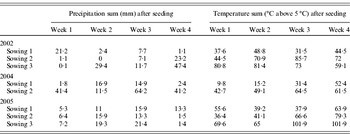
In field experiments, soils were ploughed in the preceding autumn and smoothed in spring before the first sowing. Turnip rape was sown with a row distance of 125 mm and a fertilizer row distance of 250 mm. Precipitation (mm) and temperature (°C) sums (a sum of mean daily temperature above 5°C) were recorded for 4 weeks after seeding in 2002, 2004 and 2005 (Table 1). Dates for different development stages (Harper & Berkenkamp Reference Harper and Berkenkamp1975) were monitored: seed leaf stage (DS 1), early flower bud initiation (DS 3.1), onset of flowering (DS 4.1), full flowering (DS 4.2), end of flowering (DS 4.4) and ripening (DS 5.4). Spring turnip rape was harvested with a combine harvester at maturity. The dried yield (kg/ha) was corrected to moisture content of 0·09 of the total weight.
Precipitation (mm) and temperature (mean daily temperature above 5°C) sums in each 4 weeks after seeding in different sowing times

Granular hydrophilic polymer type and rates at field
In field experiment in 2002 (Expt 1), two different water-storing polymers were used: Broadleaf P4® (Agricultural Polymers International Ltd, Great Britain) and Fennopol K211 (Kemira Chemicals Oy, Finland). Polymer application rates were 0 (control), 0·20, 0·50 and 1·00 of the seed weight, which are 0, 1·7, 4·2 and 8·4 kg/ha. Three sowing dates were used to represent different soil moisture conditions: very moist, favourable and dry.
Broadleaf P4® is a cross-bound co-polymer composed of ⩾0·9995 polyacrylamide (PAM) and ⩽0·0005 acrylamide. The granule size of Broadleaf P4® was comparable to that of turnip rape seed, allowing an even and continuous flow of both mixture components, seeds and polymer granules at sowing. Broadleaf P4® can absorb 100–200 times its weight in water, and it provides >0·95 of that to plants. Fennopol K211 is a cationic co-polymer of acrylamide and methacrylate-based quaternary amine. It is powdery and water soluble. Polymers were sown in mixtures with seeds.
The site for Expt 1 was clay loam. Before each sowing, soil was prepared with a horizontal rotary cultivator. Plots of 10×1·25 m were sown on 29 April (Sowing 1), 20 May (Sowing 2) and 31 May 2002 (Sowing 3). Plots were fertilized with 90 kg N, 22·5 kg P and 18 kg K/ha, with micronutrients, at sowing.
Seedling establishment was monitored by counting seedlings in three 0·5 m sections of row in each plot. Seedling shoot weight (mg dry matter) was measured at DS 3.1 by collecting 20 samples per plot. Soil coverage was analysed by photographing a 500×540 mm area in three fixed places in every plot at DS 1, 5–7 days later and at DS 3.1. All the photographs were prepared in Adobe PhotoShop and analysed with a Scion Image program to measure the proportion of the area under turnip rape, i.e. soil coverage. Leaf area index (LAI) was measured (Sun Scan Canopy Analysis System, Delta-T Devices Ltd, UK) at DS 4.2 at Sowings 1 and 3, but at DS 3.3 for Sowing 2. Plant height (mm) was measured prior to harvest on ten plants sampled per plot.
Soil samples (each originating from four sub-samples) were taken at split-plot level immediately after each sowing of Expt 1 and 2–4 weeks later, at c. DS 3.1, to determine the soil water content at depths of 0–25, 25–50 and 50–75 mm. Each sample was weighed after collection and 2 months later, after drying at room temperature. Water content was measured as a proportion of total soil weight. Soil moisture near the seed was determined by taking soil from around a seed with a spoon, drying overnight at 105°C and weighing after cooling for 2 h in a desiccator. The samples were taken 4, 1 and 3 days after Sowing 1, 2 and 3, respectively.
Higher polymer application and placement below seed in a greenhouse
An additional experiment (Expt 2) was conducted in a glasshouse with higher application rates of water-storing polymer granules compared with those used in field experiment (Expt 1). Four polymer (Broadleaf P4® granules) application rates were used: 0 (control), 1·0, 2·0 and 4·0 times the weight of the seed. Polymer granules of identical weight and size were selected for each group of application rates. Soil was perforated by using a plate with constant number, distance and depth (20 mm) of holes. One polymer granule was sown into each of 30 small holes per pot. Afterwards, one seed was placed immediately on top of each granule, and the hole was filled with soil.
The experiments were carried out on two soils. The coarse soil was loamy sand (4% clay by volume, 10% silt and 86% sand) and contained 11 g organic carbon/kg soil in the plough layer. According to the World Reference Base (WRB) system (FAO 2006), it was classified as a Haplic Arenosol (Dystric). The fine-textured soil was a clay loam (38% clay, 37% silt and 25% sand) with 33 g organic carbon/kg in the plough layer. It was a Vertic Stagnic Cambisol (eutric) inclining to a Vertic Stagnosol (eutric). The particle size distributions stand for the plough layer, with a slightly more fine-textured subsoil. Both soil types were taken from the tillage layer of the field and the clay loam soil was from the same field used for Expt 1.
Two soil moisture conditions were used; either dry or favourable. The loamy sand soil (6·10 kg air dry soil per pot) was watered (700 ml) to provide favourable moisture conditions. For clay loam, the proportions were 5·51 kg soil and 800 ml water. Dry condition pots each contained 6·19 kg soil without any added water.
A transparent plastic film enabling gas exchange was placed on the pots until seed establishment, in order to prevent evaporation. After that, all pots for Expt 2 were watered twice a week with a liquid feed (96, 135 and 54 mg/kg N, P and K, respectively). The solution was given until the original weight of each pot was reached. Mean air day/night temperatures were about 30/14°C.
Seedling establishment was monitored by counting seedling number daily for Expt 2. After full establishment the seedling number was adjusted to 18 seedlings per pot. Seedling shoot weight (mg dry matter) was measured by collecting five plants randomly at DS 2.2 and DS 2.4.
Hydrated polymers below the seed at field
Due to lack of success with Expts 1 and 2 on granulated polymer applications, the method was further developed to increase its accuracy and reduce polymer usage/ha. The slightly acid PAM polymer Fennopol K504 (Kemira Chemicals Oy, Finland) was hydrated with water and a special accessory was constructed for placing the hydrated polymer below the seed in the field. The method was termed gel-sowing.
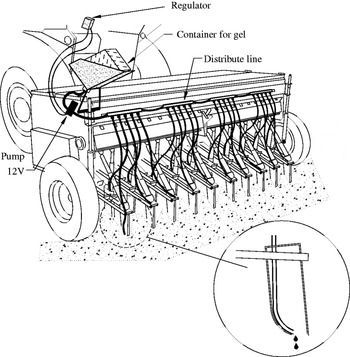
Gel-sowing underwent preliminary testing in 2003 (Expt 3). A conventional combined drill (Tume KL 200, Tume Oy, Finland) was equipped with apparatus for transmission of the gel (Fig. 1). Gel was pumped from a 30-litre container through plastic tubes directly under the seeds. Six seed coulters of the drill were equipped with tubes for gel, and the remaining six rows without gel were considered as controls. In total, six sowings at different soil moisture conditions were carried out to test the first version of the pilot method. Seedling establishment was monitored by counting.
A schematic of an accessory for placing the hydrated polymer straight under the seeds at field. Hydrated polymer (gel) was pumped from a 30-litre container through plastic tubes. The pump, or amount of gel pumped, was regulated from tractor. The gel was distributed to plastic tubes passing through six coulters in Expt 3 and through all twenty coulters in Expts 4 and 5.

In field experiments in 2004 (Expt 4, including Expts 4a and 4b) and 2005 (Expt 5, including Expts 5a and 5b), all seed coulters of the drill were equipped with tubes for gel. Three sowing times, targeting favourable, moderately dry and dry soil conditions, were used, when sowing with or without gel was compared. PAM was used at the rate of 0·005 and 0·007 of total gel in Expts 4 and 5, respectively. The water solution rate was 680 kg/ha (8·5 ml/m, i.e. 3·4 kg PAM/ha) and 140 kg/ha (1·75 ml/m, i.e. 1 kg PAM/ha) in Expts 4 and 5, respectively. The sowing speed was 10 km/h.
Expts 4a and 4b were both on clay loam with moderate organic content, but soil workability differed, being better in Expt 4a (providing better soil-to-seed contact) than in Expt 4b. Experiment 5a was conducted on heavy clay soil (problems with soil-to-seed contact), while Expt 5b was on fine sand (better soil-to-seed contact and higher water conductivity). The seedbed was prepared with a horizontal rotary cultivator in 2004 and with an S-tine harrow in 2005 just prior to sowing at each sowing time.
Early summer was rainy in 2004 and hence no dry conditions for establishment occurred, whereas in 2005 three targeted soil moistures were attained. In 2004, only two sowings occurred; the first (Sowing 1) was on 11 May and the second (Sowing 2) on 10 June. In 2005, Sowings 1, 2 and 3 were on 18 May, 26 May and 20 June. Four soil samples per sown area were taken immediately after each sowing to determine (similarly to Expt 1) the soil moisture content at depths of 0–25, 25–50 and 50–75 mm.
Seedling establishment was monitored by counting seedlings in three separate 1 m lengths of row, in each plot. Counting was carried out twice at the same places, at DS 2.1 and about 1 week later, when seedling emergence was complete. However, seedling number at DS 2.1 in Expt 4b was assessed only for Sowing 1. The seeding rate was tested before sowing in a machinery hall, which does not reach an exact seeding rate in the field. Therefore, seedling number can be even higher than targeted seeding rate. The settings on the machine were identical for each sowing during each year.
Seedling shoot weight (mg dry matter) was measured at DS 3.1 by collecting 42 plants from each plot. At DS 4.2, an additional sample from a 500×500 mm2 area at three places per plot was taken to measure plant biomass (g/plant and g/m). Numbers of plants per sample were recorded. Crop coverage was analysed at DS 2.1 and DS 3.1 by photographing and analysing similarly as in Expt 1. In 2005, Sowing 3 did not produce any seeds because of damage by rape blossom beetles.
Statistical analyses
All statistical analyses were carried out with Statistical Analysis System software (SAS Institute Inc., 2004). For all measured traits, LSMEANS and differences among LSMEANS were estimated employing the PROC MIXED procedure (Littell et al. Reference Littell, Milliken, Stroup and Wolfinger1996). Replication (four in each trial) and main plot were considered as random effects and split-plot and split-split-plot treatments were considered as fixed effect. Sowing date was analysed as a main plot factor in the field trials, and soil moisture in the pot trial. Polymer in Expt 1, soil type in Expt 2 and gel treatment in the rest of the experiments were analysed as subplot factors, and the application rate as a sub-subplot factor in Expts 1 and 2. If significant interaction between sub-subplot or subplot and other treatments were found, the differences of the effect of the subplot factors in different treatment combinations were examined.
RESULTS
Granular hydrophilic polymer type and rates at field
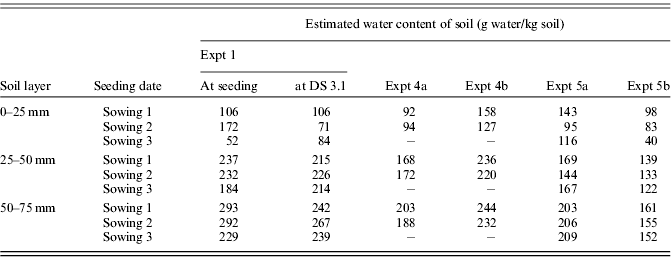
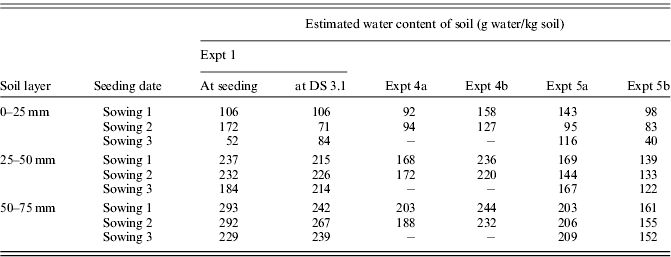
In Expt 1, sowing into different soil moisture conditions succeeded well. Precipitation after sowing varied considerably between the sowing times (Table 1). The water content of the 0–25 mm soil layer was higher at the second than the first sowing because of the rain between the two sowings, but at 25–75 mm the moisture was similar (Table 2). The soil was driest at the time of Sowing 3, but 1 week later a 3-week rainy period began, which led to late seedling establishment in areas where it was otherwise poor. Until the second sampling, soil dried at Sowing 1 (except layer 0–25 mm) and 2, but was wetter at Sowing 3. Soil moisture near the seed was not affected by the treatments.
Estimated water content of soil (g water/kg soil) at seeding date and DS 3.1 in Expt 1, and at seeding date in Expts 4 and 5 when spring turnip rape was sown in three different dates (Sowings 1, 2 and 3). Dry weight is measured after 2 months drying in room temperature
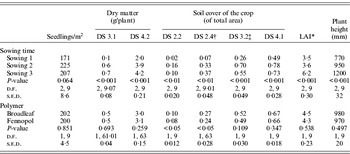
Sowing time had no detectable effect on seedling stand (P=0·064, Table 3), but sowing time greatly affected plant growth. The earlier the sowing time, the smaller the plants at every development stage. The effect of sowing time on plant dry matter, on soil cover and on LAI was significant. LAI differed at Sowing 1 from that at Sowing 3 but not from Sowing 2, because the measurement of the latter was done at an earlier growth stage (Table 3). When measured at the same growth stages, LAI at Sowings 2 and 3 did not normally differ, but the plant dry matter at DS 4.2 was higher for Sowing 3. Also the height of mature plants was greatest at Sowing 3.
Estimated plant density (seedlings/m2), dry matter per plant (g) at DS 3.1 and DS 4.2, soil cover of the crop at four stages similar for each sowing, LAI and height of full-size plants in Expt 1. Statistical significances of F values by analysis of variance (P values), degrees of freedom (d.f.) and standard error of difference (s.e.d.) are shown

* LAI was measured at DS 4.2 in Sowings 1 and 3, but at DS 3.3 in Sowing 2.
† Sowing 1 was measured at DS 2.5.
‡ Sowing 3 was measured at DS 3.1.
No effect of application rate or sowing time×application rate and polymer×application rate interactions on growth variables was established.
The only sowing time×polymer interaction is explained in the text.
Polymer treatments did not affect seedling numbers. According to visual observation, there were no differences in turnip rape growth associated with polymer treatments. In general, polymer effects on the soil cover of the crop or plant height were very small or not significant.
Seed yield was affected by sowing time (P<0·05). Seed yield was lower at Sowing 3 (1580 kg/ha) compared to Sowing 1 (2190 kg/ha) and Sowing 2 (2150 kg/ha). Broadleaf P4® seemed to increase the yield on average by 100 kg/ha, but only the increase to 120 kg/ha associated with the lowest polymer application rate was statistically significant (P<0·05). Fennopol K211 decreased the yield at the two highest application rates by 120–130 kg/ha (P<0·05), although this was not the case at Sowing 2. Furthermore, at Sowing 2 Fennopol K211 at the lowest rate increased the yield by 200 kg/ha (P<0·05).
Higher polymer application and placement below seed in a greenhouse
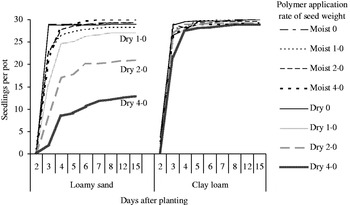
In Expt 2, polymer slightly decreased or had no effect on seedling establishment in clay loam, regardless of soil moisture (Fig. 2). In dry loamy sand, however, the polymer greatly decreased seedling establishment: the higher the application rate of polymer, the lower the seeding establishment. In wet loamy sand all application rates of polymer decreased the seedling number at the second count by c. 7 seedlings, but little or no effect was found later.
Seedlings per pot 2–15 days after seeding in dry and moist loamy sand and clay loam. Polymer (Broadleaf P4® granules) application rates of 0, 1·0, 2·0 and 4·0 of seed weight were used. Seedling establishment decreased at the highest polymer application rates in dry loamy sand (soil type×soil moisture×polymer application rate interaction, P<0·001).

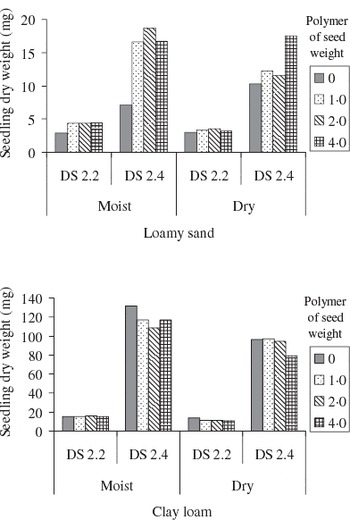
Polymer slightly decreased or had no effect on shoot dry weight in clay loam (Fig. 3). In loamy sand, shoot dry weights were not affected by polymer application rate at DS 2.2. At DS 2.4, all polymer rates increased shoot growth in moist loamy sand, but only rate of 4·0 of seed weight increased shoot growth in dry soil. However, shoot dry weights were very low in all cases in loamy sand.
Seedling weight (mg dry matter) in the pot trial (Expt 2) at DS 2.2 and 2·4 in moist and dry loamy sand and clay loam. Polymer (Broadleaf P4® granules) application rates of 0, 1·0, 2·0 and 4·0 of seed weight were used. The polymer decreased the seedling weight at DS 2.4 in moist clay loam, and in dry soil at the highest polymer application rate (soil type×soil moisture×polymer application rate interaction, P<0·001). Because of poor growth in loamy sand, the relatively higher seedling weights with polymer were not significant. Note the difference in the scale between the soil types.

Hydrated polymers below the seed at field
Preliminary field experiment in 2003
Testing the gel-sowing technology in Expt 3 gave promising observations on the effects of such a system under variable conditions. The gel seemed to sustain seedling growth both in dry and moist soils, and even if heavy rain occurred after sowing. The gel tended to increase the seedling number at three sowing times and soil coverage at all six sowings. The results were not statistically valid, but nevertheless encourage further studies.
Field experiments in 2004 and 2005
Sowing time greatly affected several variables. In Expt 4 seedling stand and seed yield were higher, and proportion of weed seeds in the yield lower at Sowing 1 (P<0·001), the difference between Sowings 1 and 2 being 200 plants/m2, 700 kg/ha and 0·03, respectively. Also, in Expt 5 sowing time affected seedling stand (P<0·01), and the stand at Sowing 2 was 1·35–1·55 times higher than at Sowings 3 and 1. Similarly, soil coverage at DS 3.1 was highest at Sowing 2; 0·728 of total area compared with 0·518 and 0·483 at Sowings 1 and 3, respectively (P<0·01). The effect of sowing time on biomass per plant at DS 4.2 (P<0·05) was contrary to that of seedling stand in Expt 5: the plants at Sowing 2 were 0·52 and 0·28 g lighter than at Sowings 1 and 3, respectively. Plants grew 100 mm taller in Expt 5 at Sowing 1 compared to Sowing 2 (P<0·001, Sowing 3 not measured).
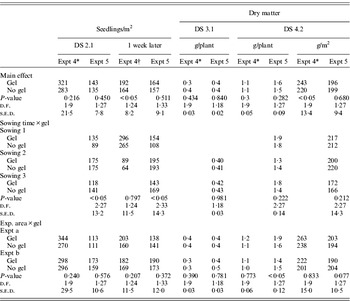
The gel had an effect on the establishment and growth of spring turnip rape, but not on seed yield. In Expt 4, the gel increased the seedling stand at the second count date, irrespective of sowing time. In Expt 5, the effect of gel on the seedling stand was dependent on the sowing time at both counting dates. The gel increased seedling establishment at Sowing 1, had no effect at Sowing 2 and tended to decrease it at Sowing 3 (Table 4).
Estimated stand density (seedlings/m2) at DS 2.1 and about one week later, dry matter per plant (g) at DS 3.1 and DS 4.2, and dry matter yield (g/m2) at DS 4.2 when seeding was done with or without gel in Expts 4 and 5. Statistical significances of F values by analysis of variance (P values), degrees of freedom (d.f.) and standard error of difference (s.e.d.) are shown

* Counting was done and plant samples were taken only in Sowing 1.
† The seedling number is not comparable with DS 2·1, because Sowing 2 is included.
Sowings 1, 2 and 3 are the sowing dates, told in materials and methods.
Expts a and b are similar trials, although randomised separately, in different experimental areas in Expts 4 and 5. Differences between Expts 4 and 5 in PAM and water solution rates are explained in the Materials and Methods.
Seedling shoot weight at DS 3.1 did not differ among treatments. At DS 4.2, gel increased the crop biomass (g/m2) in Expt 4 (Table 4). Moreover, gel increased plant biomass (g/plant) at DS 4.2 in Expt 5a.
Seed yield was very low in Expt 4, on average 1060 kg/ha at Sowing 1 and 360 kg/ha at Sowing 2. In Expt 5, the seed yield was moderate, on average 1620 kg/ha, and there was no difference between Sowing 1 and Sowing 2. Sowing 3 did not produce yield. Gel did not have any detectable effects on seed yield in either year.
DISCUSSION
The present study found no clear effects of granulated hydrophilic polymers, sown dry in mixtures with seeds, on the growth and yield of spring turnip rape when grown under field conditions. The differences in Expt 1 mainly originated from different sowing times. Furthermore, plant growth was mainly affected by conditions after sowing rather than soil moisture at sowing, which could partly explain the very limited effects of polymer granules on seedling growth. However, differences in growing conditions, depending on sowing time, indicated potential for monitoring the effects of the polymer granules on early seedling performance. Such effects were, however, not recorded. Poor effects can also originate from uneven placing of granules near the seed, when a mixture of seeds and polymer granules is used in a common drill.
Due to the lack of positive results with granulated polymers, an additional study was conducted under controlled conditions to monitor the effects of the granule application rate on the success of methods to promote early growth (Expt 2). Polymer granules normally had a negative effect; obviously because the water potential gradient was away from the seeds. In dry loamy sand, the polymer decreased seedling establishment substantially, and in clay loam a decrease in seedling shoot weight was recorded when soil was polymer treated. Because the granules absorb water, they obviously absorbed it from soil next to the seed and thereby hindered germination and seedling growth. This was the case even though the frequent watering to reach the original weight of each pot obviously increased moisture more at the surface than deeper in the soil. Similarly, Volkmar & Chang (Reference Volkmar and Chang1995) found increased consumptive water use when they mixed polymer powder with soil in a pot experiment. Because of the difficulties in placing of granules near the seed in the field and the negative effects of granules in dry soil in pot, it was clear that an alternative solution for using hydrophilic polymer granules was needed to be found to improve seedling establishment and growth.
In order to stop PAM absorbing water from soil around the seeds, it was hydrated with water. The gel was also expected to provide better contact with seeds when sown with a combined drill. The hypothesis was that the gel pumped directly under the seeds would release water to the seeds, rather than absorbing it from the surrounding soil. Furthermore, the gel layer could actually slow capillary movement of water towards the soil surface, saving water for the seed. Suspensions were used previously by Longden et al. (Reference Longden, Johnson, Darby and Salter1979), among others, who mixed sugarbeet (Beta vulgaris L.) seeds with polyethylene glycol in sodium/calcium alginate gel, and reported positive effects on early growth, although it possibly resulted from seed priming. Cook & Nelson (Reference Cook and Nelson1986) reported improved emergence of sweetcorn (Zea mays L. var. rugosa) and alfalfa (Medicago sativa L.) because of decreased soil crusting when PAM suspensions were applied to the soil surface. No similar emergence improvement was found when granular PAM was applied, obviously because the surface of the soil was not stabilized. In earlier studies with suspensions, the rate of application of polymer was much higher (Wallace & Wallace Reference Wallace and Wallace1986) compared to the use of gel in the present study, feeding the PAM directly below the seed.
Summer 2003 was used for testing the gel-sowing technology. Although there were no statistically significant differences, the results encouraged the continuation of examination with randomized field trials. Worthy of mention is the positive effect on establishment in excessively wet soil because of heavy rain after sowing, a situation that occurred also in Expt 4. Possibly the gel mitigated the lack of oxygen in soil by absorbing the extra water near the seeds. A positive effect of gel may arise also from PAM's ability to improve soil physical properties, as reported by Wallace et al. (Reference Wallace, Wallace, Abouzamzam and Cha1986) with polymers in irrigation water. Similarly, Cook & Nelson (Reference Cook and Nelson1986) found liquid PAM kept soil aggregates stable throughout seven irrigation events.
The rate of PAM in gel was not studied in Expts 4 and 5 although it varied, originating from the simultaneous improving of the method. These results are discussed as effects of gel, which quality varies in certain limits, when usability for this sowing method was a decisive factor. The gel increased seedling number in moist soil but tended to decrease it when soil was exceptionally dry in comparison with conditions needed for successful seedling emergence. When higher seedling density occurred, it resulted in greater biomass per unit area at flowering in Expt 4. The effect on biomass per plant was negligible on average; although on clay soil in Expt 5 plants weighed more at flowering when gel was used.
Although differences in growth were found due to the use of the gel, its use did not result in significant effects on seed yield. Obviously this arises partly from the ability of turnip rape to compensate for sparse growth by trade-off between different yield components (Pahkala et al. Reference Pahkala, Sankari and Ketoja1994; Peltonen-Sainio & Jauhiainen Reference Peltonen-Sainio and Jauhiainen2008) and seed yield per plant (Velička et al. Reference Velička, Marcinkevičienė, Rimkevičienė, Trečiokas and Venskutonienė2005).
Several factors affect growth after sowing, particularly precipitation, temperature, soil type and occurrence of flea beetles, making the effect of gel less distinct. The interaction between the seed or seedling and gel varies according to situation. However, the effects recorded were mainly positive when sowing was done at normal time. However, it seems obvious that the use of gel does not compensate for sowings conducted too late in the season or inappropriate seedbed preparation.
It is possible to further improve the gel-sowing technique presented here. Large amounts of gel cannot be used in practice in field crop production, and precise placing directly under the seeds is technically challenging. Lower drilling speed may be required if improvements in coulters do not occur. Drill coulters vibrate strongly when tractor speed is 10 km/h as used in practice and can cut the gel band.
In conclusion, improving the use of PAM by hydrating it improved efficacy of the polymer. However, careful preparation of the seedbed and accurate sowing under favourable soil moisture conditions are essential for successful early growth in small-seeded turnip rape. When these prerequisites are fulfilled, the gel can help improve establishment. It suggests that positive effects of using gel can be expected, especially in the case of normal sowing time. The gel seemed to help when water deficit occurred after sowing, which is a common situation in Finland. Moreover, the gel also tended to help in case of heavy rain immediately after sowing. Weather conditions determine successful plant growth, but gel-sowing with PAM can sustain early establishment and seedling growth, especially if circumstances after sowing are unfavourable. PAM cannot compensate for sub-optimal sowing conditions, however. Improving this technique will likely further enhance its positive effects.
The authors are grateful for Matti Ylösmäki (who constructed the gel-sowing accessory), Ari Lahti, Kauko Kyläsorri, Elina Antinluoma, Sini Vaittinen and Pyry Ukkonen at MTT Agrifood Research Finland for their assistance in developing the polymer sowing technology, organizing the experiments and participating in sampling and measurements. The study was financed by the Ministry of Agriculture and Forestry and MTT Agrifood Research Finland.