Immediate post-mastectomy breast reconstruction (IBR) for women with breast cancer is a procedure offering good clinical, aesthetic and psychological results and is oncologically safe (Reference Al-Ghazal, Fallowfield and Blamey1;Reference Taylor, Horgan and Dodwell25). Nevertheless, the rate of complications seems to be higher than with delayed reconstructions (Reference Chevray6;Reference Sullivan, Fletcher and Isom23) and with nonreconstructed mastectomies (Reference Chevray6;Reference Mortenson, Schneider and Khatri17).
Reported rates of surgical complications vary widely; some series describe rates of less than 10 percent (Reference Cordeiro and McCarthy7), whereas others are almost 50 percent (Reference Alderman, Wilkins and Kim2;Reference Lipa, Youssef and Kuerer13;Reference Pinsolle, Grinfeder and Mathoulin-Pelissier19;Reference Spear, Ducic and Low22). The same inconsistency occurs with respect to reconstruction failures requiring the removal of the prosthesis.
Previous studies on the predictive variables of IBR complications have shown that the latter do not vary significantly according to the type of reconstruction, i.e. tissue expander, prosthesis or autologous tissue flaps (Reference Alderman, Wilkins and Kim2;Reference Anderson, Freedman and Nicolaou3;Reference Chevray6). There also exists considerable unanimity as to the negative influence of radiotherapy, whether pre- or postoperative, and on the possibility that early reconstructions might interfere with the administration of radiotherapy (Reference Alderman, Wilkins and Kim2;Reference Chevray6;Reference Krueger, Wilkins and Strawderman11;Reference Tallet, Salem and Moutardier24). On the other hand, opinions are contradictory concerning the influence of factors such as patient age, obesity, previous surgery, and adjuvant treatments such as chemotherapy or tamoxifen (Reference Taylor, Horgan and Dodwell25).
The aims of this study were as follows: (i) to describe the frequency and nature of IBR complications; (ii) to study the influence of postoperative complications on subsequent reconstruction failure with removal of the prosthesis; (iii) to identify the variables that are explanatory of reconstruction failures; and (iv) to create a predictive statistical model capable of determining the probability of the occurrence of a reconstruction failure, given the information known before the intervention.
PATIENTS AND METHODS
An analysis was made of all the post-mastectomy IBR carried out from April 2002 until June 2009 at the Costa del Sol Hospital, a general hospital attending a population of 380,000, located in Marbella (Spain).
In every case, a modified radical mastectomy was carried out, thirteen of them skin-sparing. Axillary lymph node dissection was performed in patients with invasive tumors. The IBR method used, in 104 cases (90.4 percent) was the insertion of a Becker 35 texturized anatomic expander under the pectoralis muscle, which was instilled with saline serum during the following weeks, through a valve located in the lower axillary region, and which was not subsequently replaced. IBR was performed with a tissue expander and subsequent replaced by a Mentor-type prosthesis in 11 patients (9.6 percent). The protocol included the insertion of one drain at the base of the mastectomy and another in the axillary area, the preoperative administration of 2 grams of Cefazolin and the postoperative administration of Amoxicillin for 1 week. The operations were performed by general surgeons and gynecologists.
The regimen of neoadjuvant chemotherapy used before 2005 was FEC (fluorouracil, epirubicin, and cyclophosphamide) every 3 weeks for six cycles. After 2005 the AC-T schedule was used (four courses of adriamycin plus cyclophosphamide, every 3 weeks followed by four of docetaxel every 3 weeks). Before 2005, adjuvant chemotherapy consisted of four cycles of AC every 3 weeks for node negative patients and six cycles of FEC for node positive patients. After 2005, the AC-T schedule was used. The regimen of tamoxifen therapy was 20 mg/day for 5 years.
Radiotherapy was delivered after mastectomy according to clinico-pathological risk factors (tumor size and the number of axillary nodes involved). The treatment portal included at least the chest wall or reconstructed breast in patients with tumor size >5 cm. Reconstructed breast doses ranged from 45 to 50.4 Gy delivered in 1.8- to 2.0-Gy fractions. The supraclavicular field was irradiated in patients with more than three axillary nodes; the homolateral axilla was irradiated in patients with incomplete axillary lymphadenectomy. Because only one patient received preoperative radiotherapy, this variable was not included in our analysis.
Retrospective information was obtained about the appearance of postoperative complications and possible associated variables, by means of a review of clinical records from October 2009 to March 2010. Complications were classified into three categories: minor (not requiring an intervention, readmission or prolongation of hospital stay), moderate (requiring an intervention, readmission or prolongation of hospital stay), or reconstruction failures (involving the removal of the prosthesis). The date of each complication was recorded, together with the end of follow-up considered as the last contact with the hospital regarding the illness. The minimum follow-up time was 9 months.
The following predictive variables were taken: age of the patient at the moment of the intervention; menopause (women aged over 50 years); tumor size: maximum tumor diameter in millimeters (mm) and weight of the surgical specimen in grams, both measured at the anatomic-pathologic examination; presence of estrogen receptors; maximum volume that could be attained by the tissue expander after instillation, in cubic centimeters; a history of previous conservative surgery of the breast; neoadjuvant and adjuvant chemotherapy; postoperative radiotherapy during the 6 months after the intervention and postoperative tamoxifen.
The significance level assumed to determine statistically significant variables was 0.05. The association between moderate postoperative complications, characteristics of the patients, and the treatments applied and the appearance of reconstruction failures was studied by bivariate logistic regression (LR). Results are presented as Odds Ratios (OR) and the corresponding 95 percent confidence intervals (95 percent CI). In the survival analysis, using Cox's regression with backward stepwise selection, we studied time from surgery to reconstruction failure (events cases) or to the end of follow up without failure (censored cases) and two models were created: an explanatory model including all the study variables, and a predictive model including only the variables known before surgery (age, type of intervention, previous surgery, and neoadjuvant chemotherapy). The hazard ratios (HR) are presented with their respective 95 percent CI. A predictive model was then used to calculate the probability of complications in several theoretical types of patients. The database was created using MS Access, and statistical analysis was performed using MS Excel, SPSS, and EPIDAT.
RESULTS
We analyzed the evolution of 116 IBR interventions performed consecutively on 112 women with breast cancer. Three patients had both breasts removed, in two cases, simultaneously, and in the other, on different dates. The patients' mean age was 49.6 years, with a standard deviation (SD) of 9.8 and a range of 27–74 years. The mean follow-up period was 25.5 months (SD 18.4, range 9–78 months). Only one patient was lost to follow-up, and thus the final sample size was 115. IBR interventions represented 45 percent of the mastectomies carried out at the hospital during the 8 years studied. Most of the interventions were performed by the gynecology department (n = 76; 66.1 percent), with the rest corresponding to general surgery. Four patients died after the minimum follow-up period of 9 months from surgery, none of them had suffered a reconstruction failure at the time of death.
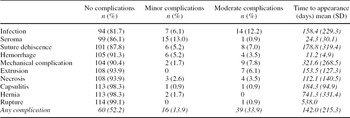
Table 1 shows the frequency of postoperative complications. By the end of the follow-up period, sixty interventions (52.2 percent) presented no complications, while sixteen (13.9 percent) presented a minor complication and 39 (33.9 percent) presented a moderate complication. In 26 cases (22.6 percent), the prosthesis had to be removed. In twenty-four of these, a history of moderate complication had been registered. Moreover, in two cases, the prosthesis was removed due to persistent pain.
Frequency and Delay to Appearance of Complications in 115 Immediate Post-mastectomy Breast Reconstructions

The complications found to occur most frequently were the following: infection (n = 21; 18.3 percent of the interventions); seroma (n = 16; 13.9 percent) and suture dehiscence (n = 14; 12.2 percent). Table 1 shows that hemorrhages and seroma appeared at an early stage (mean delay of 11.2 and 24.3 days, respectively), while infections and suture dehiscence occurred at an intermediate interval (around 5 months), and mechanical complications were long-term events, taking place approximately 2 years after the intervention. Of the twenty-one infections, only seven appeared during the first 2 months after the intervention. Of the twenty-six patients who required removal of the prosthesis, this took place over a highly variable period, with an average of 8.6 months (SD 7.9 months; range 37 days to 34 months).
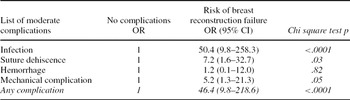
Table 2 shows that the occurrence of moderate complications increased the risk of developing reconstruction failures in the medium-long term: OR 46.4 (95 percent CI 9.8–218.6). This greater risk was not observed in the case of minor complications. The presence of a moderate degree of infection resulted in an OR of 50.4 (95 percent CI 9.8–258.3) while the appearance of a moderately serious degree of suture dehiscence was reflected in an OR of 7.2 (95 percent CI 1.6–32.7).
Relation Between the Appearance of Moderate Complications and Reconstruction Failures (Bivariate Logistic Regression Analysis)

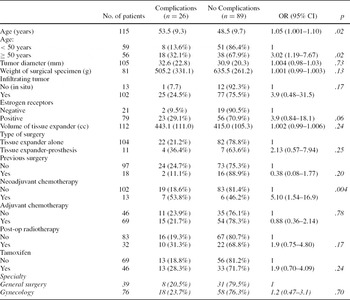
Table 3 shows the bivariate LR analysis, in which only three variables present statistically significant differences: there were more reconstruction failures among the patients who received neoadjuvant chemotherapy (53.8 percent versus 18.6 percent, p = .004) and in older women: mean age 53.5 (SD 9.3) years of the women who suffered a reconstruction failure versus 48.5 (SD 9.7) of those who did not, p = .02. Reconstruction failures were also more frequent among menopausal women (defined as aged over 50 years): 32.1 percent versus 13.6 percent, p = .02.
Patient Characteristics and Treatments Related to the Development of Reconstruction Failures

Note. Quantitative variables expressed as the mean (standard deviation). OR and p values according to bivariate logistic regression.
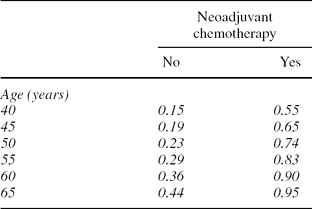
Table 4 shows the probability of developing reconstruction failures, on the basis of the two variables found to be predictive in the Cox's model. We consider two hypothetical cases: a patient 40 years old who did not receive neoadjuvant chemotherapy presents a 15 percent probability of suffering a reconstruction failure, while a patient aged 65 years treated with neoadjuvant chemotherapy presents a corresponding probability of 95 percent.
Probabilities of Developing Reconstruction Failures (Applying Cox's Model for Predictive Purposes)

Supplementary Table 1, which can be viewed online at www.journals.cambridge.org/thc2011021, shows the results of the Cox multivariate regression analysis. The explanatory model with an initial -2 log likelihood (-2LL) of 230.2 and a final one of 209.4 (p = .0001) shows that reconstruction failures were related to the following factors: age of the patient (HR 1.08); the administration of neoadjuvant chemotherapy (HR 6.24); and tamoxifen (HR 3.10). The predictive model, constructed using only the variables known before the intervention, with an initial -2LL of 230.2 and final one of 214.7 (p = .0004) included the variables: neoadjuvant chemotherapy (HR 5.11) and age of the patient (HR 1.05). The area under the ROC curve was 78.8 percent for the predictive model.
DISCUSSION
The results of this study show that the risk of reconstruction failure following post-mastectomy IBR is mainly related to the age of the patient and the administration of neoadjuvant chemotherapy and postoperative tamoxifen. Of the variables identified before the intervention, the ones that best predicted reconstruction failures were neoadjuvant chemotherapy and the age of the patient.
The negative effect of neoadjuvant chemotherapy highlighted in our results has been described previously (Reference Mitchem, Herrmann and Margenthaler16), and is attributed to interference with the wound healing process and to an increased susceptibility to infection (Reference Sullivan, Fletcher and Isom23). There are divided opinions as to the effect of adjuvant chemotherapy; some studies have identified it as a risk factor (Reference Barreau-Pouhaer, Le and Rietjens4;Reference Tallet, Salem and Moutardier24), while others have not (Reference Alderman, Wilkins and Kim2;Reference Anderson, Freedman and Nicolaou3;Reference Cordeiro and McCarthy7;Reference Jhaveri, Rush and Kostroff10;Reference Mortenson, Schneider and Khatri17;Reference Nahabedian, Tsangaris and Momen18), including our own. This could be explained by the fact that chemotherapy was delayed in patients with initial signs of infection, capsulitis, or dehiscence until those problems were solved.
A significant number of studies have identified an association between worse IBR results and the use of pre- and postoperative radiotherapy (Reference Alderman, Wilkins and Kim2;Reference Chevray6;Reference Cordeiro and McCarthy7;Reference Krueger, Wilkins and Strawderman11;Reference Nahabedian, Tsangaris and Momen18;Reference Tallet, Salem and Moutardier24), although one study has reported good outcomes with IBR and post-mastectomy radiation (Reference McCormick, Wright and Cordiero15). Several authors consider that prior radiotherapy is a relative contraindication for reconstructions with tissue expanders or implants, and prefer the use of nonirradiated autologous tissue flaps (Reference Barreau-Pouhaer, Le and Rietjens4;Reference Chevray6;Reference Jhaveri, Rush and Kostroff10). The problem is that it is often not possible to know whether preoperative radiotherapy will be needed until the surgical specimen is available for study (Reference McCormick, Wright and Cordiero15). In the present study, postoperative radiotherapy was examined and it did not show to have an influence on reconstruction failures.
There are two main types of IBR surgical techniques: implants or autologous tissue flaps (or combinations of the two). Most studies have reported that rates of complication do not vary significantly between the two methods of reconstruction (Reference Alderman, Wilkins and Kim2;Reference Anderson, Freedman and Nicolaou3;Reference Chevray6;Reference Sullivan, Fletcher and Isom23), although some studies have reported differences between the two methods (Reference Jhaveri, Rush and Kostroff10;Reference Lipa, Youssef and Kuerer13;Reference Pinsolle, Grinfeder and Mathoulin-Pelissier19). The technique used with our patients was that of the immediate implantation of a Becker-type tissue expander, which was not subsequently replaced in 90.4 percent of cases or was subsequently replaced by a prosthesis in the remaining 9.6 percent.
Our results suggest that reconstruction failures are more likely among older patients. This finding may reflect a relative impairment of the wound-healing capacity in older populations (Reference Lipa, Youssef and Kuerer13). The bibliography, however, contains reports both identifying this risk factor (Reference Barreau-Pouhaer, Le and Rietjens4;Reference McCarthy, Mehrara and Riedel14;Reference Pinsolle, Grinfeder and Mathoulin-Pelissier19;Reference Woerdeman, Hage and Smeulders26) and rejecting it (Reference Alderman, Wilkins and Kim2;Reference Anderson, Freedman and Nicolaou3;Reference Jhaveri, Rush and Kostroff10;Reference Lipa, Youssef and Kuerer13;Reference Nahabedian, Tsangaris and Momen18;Reference Sullivan, Fletcher and Isom23).
Regarding the effect of tamoxifen, our results show there is an association between the administration of this drug and the development of reconstruction failures; this is evident in the multivariate analysis, in which variables related to the aggressiveness of the tumor are also included. We identified only four previous studies that examined this relation. In one of them, the results were similar to our own (Reference Krueger, Wilkins and Strawderman11), while the other studies found no such relation (Reference Anderson, Freedman and Nicolaou3;Reference Jhaveri, Rush and Kostroff10;Reference Tallet, Salem and Moutardier24). Tamoxifen is a known inductor of the expression of the transforming growth factor beta (TGF-β) in breast tissue (Reference Buck and Knabbe5). Raised levels of TGF-β may account for our observations, through two mechanisms: on the one hand, an increase in the activity of fibroblasts of the skin, with the induction of a local profibrotic state (Reference Sonnylal, Denton and Zheng21); and on the other hand, the effect on the regulatory T lymphocytes, inducing a state of local immunologic tolerance (Reference Li and Flavell12), which could favor the appearance of infections.
We found no relation between the risk of reconstruction failure and a series of variables previously described in the bibliography as risk factors, such as previous surgery (Reference Woerdeman, Hage and Smeulders26) or the type of tumor, in situ or infiltrating (Reference Barreau-Pouhaer, Le and Rietjens4).
In our study, the postoperative complication most commonly encountered was infection, which was present in 18.3 percent of the patients. This rate is higher than that reported in the majority of previous studies, ranging from less than 5 percent (Reference Cordeiro and McCarthy7;Reference Handel, Cordray and Gutierrez9;Reference McCarthy, Mehrara and Riedel14;Reference Pinsolle, Grinfeder and Mathoulin-Pelissier19), to 5–10 percent (Reference Spear, Ducic and Low22;Reference Sullivan, Fletcher and Isom23), or 10–20 percent (Reference Lipa, Youssef and Kuerer13;Reference Mortenson, Schneider and Khatri17;Reference Woerdeman, Hage and Smeulders26). Nevertheless, two studies reported a higher infection rate of 23.5 percent (Reference Krueger, Wilkins and Strawderman11;Reference Mitchem, Herrmann and Margenthaler16). As concluded in a prior study that found an OR of 257 in the association between infection and implant loss (Reference Woerdeman, Hage and Smeulders26), our results show that moderate postoperative infection is the complication more strongly associated with the subsequent removal of the prosthesis, with an OR of 50.4.
A total of 33.9 percent of our patients suffered complications of a moderate nature. Other studies, such as that by Alderman et al. (Reference Alderman, Wilkins and Kim2), have described similar rates of complications, with 31.6 percent for the whole set of techniques and 46 percent when considering only IBR with a tissue expander. Other authors have reported diverse rates, from less than 10 percent (Reference Cordeiro and McCarthy7) to around 20 percent (Reference Anderson, Freedman and Nicolaou3;Reference Jhaveri, Rush and Kostroff10;Reference McCarthy, Mehrara and Riedel14;Reference Mortenson, Schneider and Khatri17;Reference Simpson, Ying and Ross20), 30 percent (Reference Woerdeman, Hage and Smeulders26), 40 percent (Reference Krueger, Wilkins and Strawderman11;Reference Tallet, Salem and Moutardier24), and even close to 50 percent (Reference Lipa, Youssef and Kuerer13;Reference Pinsolle, Grinfeder and Mathoulin-Pelissier19;Reference Sullivan, Fletcher and Isom23).
A total of 22.6 percent of the patients in our series suffered reconstruction failures with subsequent removal of the tissue expander; this rate was higher than that given in most published studies, which report rates from less than 5 percent (Reference Anderson, Freedman and Nicolaou3;Reference Cordeiro and McCarthy7;Reference McCarthy, Mehrara and Riedel14;Reference Mortenson, Schneider and Khatri17;Reference Pinsolle, Grinfeder and Mathoulin-Pelissier19), to 5–10 percent (Reference Nahabedian, Tsangaris and Momen18) or 10–20 percent (Reference Barreau-Pouhaer, Le and Rietjens4;Reference Jhaveri, Rush and Kostroff10;Reference Krueger, Wilkins and Strawderman11;Reference Tallet, Salem and Moutardier24;Reference Woerdeman, Hage and Smeulders26). Nevertheless, it was lower than the rates reported in some studies: 38 percent (Reference Mitchem, Herrmann and Margenthaler16), 42 percent (Reference Lipa, Youssef and Kuerer13), 51.5 percent (Reference Spear, Ducic and Low22), and 35.5–50 percent of reoperations (Reference Gouy, Rouzier and Missana8;Reference Handel, Cordray and Gutierrez9).
The wide variability of the rates of complications described in the literature could be partly due to methodological problems, such as the heterogeneity of the severity of the complications recorded by different authors, or the comparison of series studied either prospectively or retrospectively. Another limitation when comparing different studies is the fact that some authors describe the rate of complications with respect to patients, and others with respect to breasts. Moreover, in reconstructions performed in two stages, some authors report the percentages of complications per patient, and others, per intervention. In our study, all the mastectomies were oncologic interventions, while in other studies, an important percentage of the mastectomies performed were prophylactic (Reference Mortenson, Schneider and Khatri17;Reference Nahabedian, Tsangaris and Momen18;Reference Woerdeman, Hage and Smeulders26); in this latter case, the rates of complications were lower (Reference Handel, Cordray and Gutierrez9).
Our study presents some important differences with respect to most published studies. In many of these, a single surgeon was responsible for hundreds of interventions (Reference Cordeiro and McCarthy7;Reference Handel, Cordray and Gutierrez9;Reference McCarthy, Mehrara and Riedel14;Reference Nahabedian, Tsangaris and Momen18;Reference Spear, Ducic and Low22;Reference Sullivan, Fletcher and Isom23), while in our case interventions were carried out by a group of general surgeons or gynecologists. We agree that this type of intervention is probably best performed by a breast-focused surgeon with long experience (Reference McCarthy, Mehrara and Riedel14), but on many occasions it is only possible to obtain good access to IBR by means of general surgeons.
Our study was subject to certain limitations: the rate of reconstruction failures may have been underestimated, as these occurred in the medium term, after an average of 8.6 months, while our minimum follow-up period was 9 months, though the mean period was 25.5 months. In addition, not every patient on whom a mastectomy was performed was offered IBR; in selecting suitable patients, those presenting more severe risk factors or a worse prognosis, may have been excluded, and thus when the influence of such risk factors was studied, it may have been under-represented.
CONCLUSIONS
The present study shows that a significant proportion of patients on whom IBR is performed suffer reconstruction failures. As a practical application, the explanatory model provides medical personnel with information of interest concerning the factors influencing such reconstruction failures while the predictive model may be useful when providing patients with realistic information on the possibilities of developing a reconstruction failure, allowing a better informed decision on the various treatment options. An aspect of particular interest is the fact that patients treated with tamoxifen are exposed to a fourfold increase in the risk of developing reconstruction failures; this situation has only been described in one previous study (Reference Krueger, Wilkins and Strawderman11). We believe that future studies are needed to clarify the role of tamoxifen as a potential risk factor in IBR.
CONTACT INFORMATION
Alberto Jiménez-Puente, MD, PhD (ajpuente@hcs.es), Evaluation Unit, Hospital Costa del Sol, Autovía A7, Km 187, 29603 Marbella, Spain; and CIBER Epidemiología y Salud Pública (CIBERESP), Dr. Aiguader, 88, 1a planta–08003, Barcelona, Spain
Elisa Prieto-Lara, MD (elisa.prieto.lara@gmail.com), Department of Preventive Medicine, Hospital Virgen de la Victoria, Campus de Teatinos, 29010 Málaga, Spain
Antonio Rueda-Domínguez, MD, PhD (arueda@hcs.es), Claudio Maañón-Di Leo, MD (jcm@hcs.es), Multidisciplinary Breast Cancer Unit, Research Support Unit, Hospital Costa del Sol, Marbella, 29603 Spain
Nicolás Benítez-Parejo, B.Math (nparejo@hcs.es), Francisco Rivas-Ruiz, BSc (frivasr@hcs.es), Research Support Unit, Hospital Costa del Sol, Autovía A7, Km 187, 29603 Marbella, Spain; CIBER Epidemiología y Salud Pública (CIBERESP), Dr. Aiguader, 88, 1a planta–08003, Barcelona, Spain
Francisco J. Medina-Cano, MD (fjmecano@hotmail.com), Multidisciplinary Breast Cancer Unit, Hospital Costa del Sol, Autovía A7, Km 187, 29603 Marbella, Spain
Emilio Perea-Milla, MD, PhD (deceased)
CONFLICT OF INTEREST
All authors report they have no potential conflicts of interest.