In many Mediterranean countries, sheep milk is traditionally produced and processed to cheese and yoghurt. In the Middle East, the fat-tailed Awassi sheep is often the breed of choice because of its adaptive capabilities and comparatively high milk production potential (Galal et al. Reference Galal, Gürsoy and Shaat2008). Frequent droughts in this region increase the shortage of feed of sufficient nutritional quality which is the reason for intensively searching for alternative feeds. Certain food industry by-products and forages have already been characterised for their palatability and nutritional value (e.g., Ben Salem & Znaidi, Reference Ben Salem and Znaidi2008; Molina-Alcaide & Yáñez Ruiz, Reference Molina-Alcaide and Yáñez Ruiz2008; Abbeddou et al. Reference Abbeddou, Rihawi, Zaklouta, Hess, Iñiguez and Kreuzer2011a, Reference Abbeddou, Rihawi, Hess, Iñiguez, Mayer and Kreuzerb). However, a common feature of such feeds is that they often contain unusually high concentrations of potentially anti-nutritional constituents. Even when remaining without substantial effect on performance, their particular composition may impair physicochemical properties of milk and dairy products. Nutritional measures are known to affect milk composition and, as a consequence, also its clotting characteristics (Kreuzer et al. Reference Kreuzer, Von Siebenthal, Kaufmann, Rätzer, Jakob and Sutter1996; Leiber et al. Reference Leiber, Nigg, Kunz, Scheeder, Wettstein and Kreuzer2005). Still few experiments have assessed the effect of diet composition on processed dairy products (e.g. Zhang et al. Reference Zhang, Mustafa and Zhao2006; Bodas et al. Reference Bodas, Manso, Mantecón, Juárez, De La Fuente and Gómez-Cortés2010), and none addressed the more common alternative feeds in the dry areas, except Chiofalo et al. (Reference Chiofalo, Liotta, Zumbo and Chiofalo2004) studying the cheese-making properties of milk from ewes fed olive cake.
We hypothesized that feeding certain agro-industrial by-products and forages has side-effects on physicochemical properties of dairy products from sheep which limit their usefulness in complementing the scarce primary feeds. Feeds were tested which were either rich in lipids (tomato pomace, the residue of tomato juice production, and olive cake, the residue of olive oil extraction) or phenolic compounds (olive leaves and lentil straw) or salt (Atriplex halimus leaves; trivial name: saltbush). Effects were determined in unprocessed milk, yoghurt and non-aged cheese (type ‘farmer cheese’ called ‘Jibneh Khadra’ in the Middle East) which are the main fresh dairy products consumed in the area.
Materials and Methods
Animals, experimental design and diets
The experiment was conducted at ICARDA, Aleppo, Syria, and met the ‘International Guiding Principles for Biomedical Research Involving Animals’ (Council for International Organizations of Medical Sciences, 2010). In a completely randomized block design, six groups of ten multiparous Awassi ewes, weighing on average 51 0±6 80 kg, were assigned to six diets by considering days in milk (67 2±9 99), milk yield (1 26±0 340 kg) and composition. The ewes were fed in barn 1 3 kg dry matter (DM) of a traditional concentrate composed of a mixture of barley grain, cottonseed meal and sugar beet pulp (0 5:0 25:0 25) and were grazing a natural pasture before the experiment. After 2 days of gradual exchange of this preliminary diet by the experimental diets, the ewes, kept in groups, received 2 5 kg DM diet/day per head of the experimental diets for 50 days. Water was offered ad libitum.
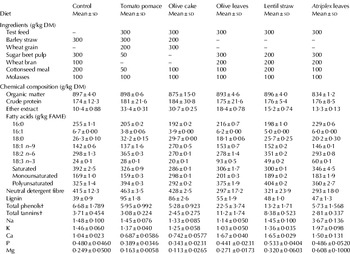
Forage always constituted 300 g and concentrate 700 g of kg total DM offered, except for the olive cake diet, where forage constituted 200 g/kg only (Table 1). All test feeds represented 300 g/kg of the total diet (on DM basis). The ingredient composition of the concentrates was adapted to balance the complete diets for metabolisable energy (target: 9 2 MJ/kg DM) based on experimental data obtained earlier (Abbeddou et al. Reference Abbeddou, Rihawi, Zaklouta, Hess, Iñiguez and Kreuzer2011a, Reference Abbeddou, Rihawi, Hess, Iñiguez, Mayer and Kreuzerb). Urea was added at levels of 8, 16, 19, 12, 0 and 5 g/kg DM for control, tomato pomace, olive cake, olive leaf, lentil straw and Atriplex leaf diets, respectively, to balance all diets for crude protein content (target: 175 g/kg DM). Daily, sheep were supplemented with 20 g/head of a mineral-vitamin mix providing Ca, 2 76 g; P, 2 16 g; Mg, 3 02 mg; Na, 2 47 g; Cu, 2 38 mg; Mn, 15 5 mg; I, 1 52 mg; vitamin A, 250 000 IU; vitamin D3, 6000 IU; vitamin E, 10 mg.
Ingredient and nutrient composition (n=3; means±standard deviation (SD) of laboratory replicates) of the six experimental diets as offered

† Tannic acid equivalents
Feeds were analysed for their proximate composition (AOAC, 1997), including DM and total ash (AOAC index no. 942.05), crude protein (AOAC 977.02) and ether extract (AOAC 963.15). Feeds were additionally analysed for their content of neutral detergent fibre (Van Soest et al. Reference Van Soest, Robertson and Lewis1991), total phenols and tannins (applying the Folin Ciocalteu method; Makkar, Reference Makkar2003) and fatty acids (after accelerated solvent extraction; Khiaosa-ard et al. Reference Khiaosa-ard, Klevenhusen, Soliva, Kreuzer and Leiber2010). Minerals were determined after wet digestion in the presence of nitric and perchloric acids (AOAC 935-13). Calcium and Mg were analysed by atomic absorption spectrophotometry (model AA-630-12, Shimadzu, Tokyo, Japan; AOAC 965-09), Na and K by a digital flame analyser (FGA-350-L, A. Gallenkamp and Co., London, UK; AOAC 969.23) and P by a UV-Vis spectrophotometer (model U-2000, Hitachi, Tokyo, Japan; AOAC 965-17).The diet composition as analysed is reported in Table 1.
Milk sampling and analysis
The ewes were machine milked twice daily before feeding (starting at 6:00 a.m. and 4:00 p.m., respectively). On days 0, 24, 36 and 48, morning and afternoon milk was obtained manually for yield recording and sampling purpose (AOAC 968.12). Morning milk samples were analysed on the same day for protein, fat, lactose and total solids (Milkoscan, model 133 B, Foss Electric, Hillerød, Denmark), casein contents (AOAC 927.03) and fatty acid profile (Abbeddou et al. Reference Abbeddou, Rischkowsky, Richter, Hess and Kreuzer2011c). Electrical conductivity (Microprocessor EC/TDS Meter, HI98360, Hanna Instruments, Padovana, Italy), pH (pH meter, HI113, Hanna Instruments, Padovana, Italy) and density (density meter, DMA35, PAAR, Graz, Austria) were analysed in the same individual milk samples. Minerals were determined after drying and incinerating 1 ml milk at 105°C for 16 h and 525°C for 16 h, respectively. The ash was dissolved in 1 ml nitric acid, diluted with doubly distilled water to 250 ml and analysed for minerals similar to the feeds. Acidity was measured (AOAC 947.05) in samples pooled across animals per treatment in aliquots considering individual milk yield.
Production of yoghurt and cheese
On experimental days 24, 36 and 48, milk from the morning and the afternoon was collected from each experimental ewe and pooled per diet to get sufficiently large batches of 6–10 l required for traditional processing to yoghurt and cheese (total n=18 yoghurts and cheeses, respectively). For yoghurt processing, 1 l of the filtrated milk was heated to 85°C, cooled to 43°C and then inoculated with 30 ml of a mother culture (0 5 g of YC180, Chr-Hansen, Hørsholm, Denmark; in 1 l sterilised milk). The inoculated milk was then distributed to three 50-ml glass beakers for later firmness measurement and to two 500 ml glass beakers for sensory evaluation. Then the samples were incubated (C1245, Sanyo-Gallenkamp, Japan) at 43°C for 4 h, cooled to 4°C and kept in a refrigerator until use. Jibneh Khadra cheese was prepared from 5 l batches of raw milk which had been filtrated through double layers of cheese cloth, heated under continuous manual stirring to 73°C for 10 s in a metal pan and cooled to 38°C. Then 15 mg chymosin suspension/l (CHY-MAX Extra, Chr-Hansen, Hørsholm, Denmark) and 50 mg CaCl2/l were added. The milk was left to coagulate for 1 h, cut into small cubes (1 to 2 cm3) and then poured into cheese cloth for whey separation. Afterwards, curd was formed in squares of 30×20 cm where two were placed in the same rectangular basket. The curd was pressed with 32 N m for 1 h and then with 56 N m overnight at 5°C. The cheeses, then about 3 cm thick, were removed from the cheese cloth, sealed under vacuum in plastic bags and stored at 4°C. Additionally, aliquots of yoghurt and cheese were taken and stored in sealed bags at −20°C for fatty acid analysis.
Analysis of yoghurt and cheese
Yoghurt and cheese were analysed for total solids, protein and fat (Lactoscope FTIR advanced, Delta Instruments, Drachten, The Netherlands). For fatty acid analysis, yoghurt and cheese samples were thawed in a water bath at 37°C. Yoghurt samples (1 g) were extracted directly. For homogeneity reasons, cheese samples (0 25 g) were kneaded and suspended in distilled water (750 μl) and then vortexed before lipid extraction. Fat from yoghurt and cheese suspension was extracted according to Abbeddou et al. (Reference Abbeddou, Rischkowsky, Richter, Hess and Kreuzer2011c), using a methanol:chloroform extraction solvent mixture. Fatty acids were methylated by a method developed by Molkentin & Precht (Reference Molkentin and Precht2000). One microlitre of the fatty acid methyl esters (FAMEs) was manually injected into a gas chromatograph (GC Reference Dhiman, Zanten and Satter2010, Shimadzu, Kyoto, Japan) equipped with a capillary column (105 m×0 25 mm ID, 0.20 μm film, Rtx®-2330, Supelco Inc., Bellefonte, PA), a split-injection port and a flame-ionization detector. The injector and detector temperatures were 250°C using helium as carrier at 1 30 ml/min. Oven temperature started at 50°C for 3 min, increased by 5°C/min to 140°C, stayed isotherm for 2 min, increased by 2°C/min to 170°C, stayed isotherm for 5 min, increased by 10°C/min to 220°C, stayed isotherm for 5 min, increased by 5°C/min to 225°C, and finally stayed isotherm for 20 min. The FAME were identified and quantified with the GCsolution program version 2.3 (Shimadzu, Kyoto, Japan) and by comparison with chromatograms obtained under similar conditions (Collomb & Bühler, Reference Collomb and Bühler2000). The response factor of the FAME standard (Supelco™ 37 Component FAME Mix, Supleco, Bellefonte, PA) was used to correct FAME proportions. Total 18:1 cis was calculated as the sum of 18:1 c9, c11, c12, c13 and c14; total 18:1 trans was the sum of 18:1 t4 to t12; total CLA was the sum of 18:2 c9 t11, c9 c11 and t9 t11.
The firmness of the dairy products was determined after 3 days refrigerated storage by a texture analyser (TA-XT2, Stable Micro Systems Ltd, Surrey, England) calibrated with a 2-kg force, using a 5 kg load cell, and equipped with cylindrical flat-bottomed puncture probes which were inserted into the products. The values recorded represented the maximum force (N) required to penetrate the sample surface for a given distance (Bourne, Reference Bourne1966). In the three 50-ml yoghurt beakers per sampling date and treatment, measurements were carried out at room temperature. In the cheeses, three positions each were analysed, the centre and positions 5 and 10 cm away. The diameters of the probes were 6 and 2 mm for yoghurt and cheese, respectively, the corresponding penetration depth was set to 20 and 10 mm. The probe movement speed was always 1 mm/s.
The sensory evaluation of yoghurts and cheeses was done by a rating scale for product preference. One hour before the start of the tests, the six yoghurt and cheese samples each available per session were removed from the refrigerator. The tests were conducted in an air-conditioned room under a white light source. The samples, labelled by numbers, were offered in a random order to the 11-member sensory panel recruited from local staff and trainees of ICARDA. The panellists had been familiarised with the different terms used to describe texture and taste. They evaluated yoghurt for ‘texture’ (defined as consistency when removing a portion of the sample with a spoon, evaluated on a scale from 1=extremely weak to 5=extremely firm) and ‘odour’ and ‘taste’ (rated on a scale from 1=dislike extremely to 5=like extremely). Cheese ‘texture’ i.e. the force required to compress the test cheese portion with the fingers (Hort & Le Grys, Reference Hort and Le Grys2001), ‘odour’ and ‘taste’ were also evaluated and rated on the same scales. Additionally, ‘chewiness’, i.e. the total amount of work necessary to chew a sample to a state ready for swallowing (Meullenet et al. Reference Meullenet, Carpenter, Lyon and Lyon1997) was ranked from 1=extremely crumbly to 5=extremely cohesive.
Statistical analysis
Analysis of variance was done with the MIXED procedure of SAS (version 9.1, SAS Institute Inc., Cary, NC). The first model applied for milk data included a repeated measurement analysis considering diet, sampling date and their interaction as fixed factors, with the initial records measured at day 0 as covariates. The processed dairy product data were analysed with a second model, also using a repeated measurement analysis as described for milk, but without including covariates. Following Meilgaard et al. (Reference Meilgaard, Civille and Carr1999), the third model used for testing the firmness and the sensory evaluation included additionally the position of measurement and the panellist as fixed factors, respectively. The tables present least square means, standard errors of the means (sem) and P-values. Multiple comparisons among means were always performed by Tukey's procedure.
Results
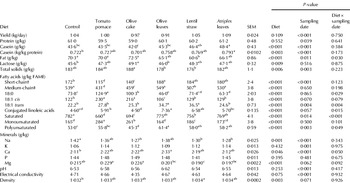
As intended, there were clear numerical differences between diets in lipid content, fatty acid profile, phenolic, sodium and organic matter contents, besides certain differences in fibre and lignin contents (Table 1). This was even more pronounced in the individual feeds (data not shown in table). Ether extract contents of tomato pomace and olive cake were as high as 99 9 and 92 2 g/kg DM. Tomato pomace was particularly rich in linoleic acid and olive cake in oleic acid. Olive leaves were especially rich in total phenols (63 5 g/kg DM), followed by lentil straw with 28 0 g/kg DM. Atriplex leaves contained 310 g ash/kg DM, and its Na and K contents were 93 6 and 39 0 g/kg DM, respectively. At an average of 1 01 kg/day, milk yield was not significantly affected by diet except for the olive leaf diet where yield was lower numerically than with control (Table 2).
Effect of the diet type and experimental week on physicochemical properties of the milk (n=10×3 sampling dates). Values without a common superscript are different at P<0 05

† 4:0–11:0
‡ 12:0–16:1
There were significant diet and week effects on most of the physicochemical properties of the milk, but interactions were rare. Offering the olive cake and the tomato pomace diets appeared to numerically reduce milk protein content compared with the other diets. This grouping was quite similar for casein content (low also with olive cake, P<0 05 against the lentil straw and Atriplex leaf diets). The casein proportion of total protein (casein number) did not differ significantly between treatments, except for the control where it was lower than with the Atriplex leaf diet (P<0 05). Fat and lactose contents were highest with the olive cake (P<0 01) and lowest with the lentil straw and control diets, respectively. Feeding tomato pomace, followed by olive cake, resulted in higher proportions of 18:0, 18:1 cis and monounsaturated fatty acids in milk fat (P<0 001). Feeding olive leaves and lentil straw led to higher proportions of short chain fatty acids, 18:1 trans, conjugated linolenic acid and polyunsaturated fatty acids (P<0 001). Although milk did not differ largely in mineral contents, some differences were significant. For example olive leaves elevated (P<0 05) milk Ca compared with control. Atriplex leaves, though being extremely rich in electrolytes, did not affect either Na or K contents. Milk pH was numerically highest with the olive leaf diet. Electrical conductivity was high in control and olive leaves compared with the olive cake diet (P<0 01). Even though staying within a narrow range, milk density differed (P<0 001) between treatments. Acidity determined across all group members in the 3 sampling weeks required 232, 262, 281, 231, 258 and 276 ml 0 1 m NaOH/kg milk for the diets named control, tomato pomace, olive cake, olive leaves, lentil straw and Atriplex leaf, respectively.
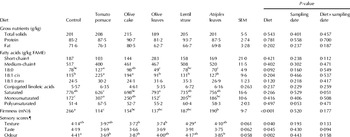
In yoghurt, gross nutrient composition differed only numerically between treatments (Table 3). By contrast, the fatty acid profile in terms of major (groups of) fatty acids clearly depended on diet type. The yoghurt produced from the tomato pomace and olive cake diets was rich in 18:1 cis, 18:0 (especially with tomato pomace) and total monounsaturated fatty acids, whereas it was low in medium-chain and total saturated fatty acids. The yoghurt fatty acid profiles did not differ much otherwise. Compared with control, yoghurt firmness was reduced (P<0 05) by all test diets. Yoghurt was softest when feeding tomato pomace followed by the olive leaf diet. There was a trend (P=0 06) for lower sensory texture scoring with the two olive by-product based diets, followed by the tomato pomace diet. Odour was ranked highest with control and lowest with tomato pomace (P<0 05), whereas taste scores did not differ among diets. There were no notifications about off-flavours.
Effect of the diet type on yield and physicochemical properties of yoghurt (n=3). Values without a common superscript are different at P<0 05

† 4:0–11:0
‡ 12:0–16:1
§ Maximum force required to insert a probe a given distance into a food product
¶ 1=weak/dislike extremely, 5=firm/like extremely
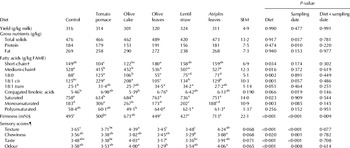
Cheese yield was similar among treatments with about one third of the milk amount being utilised (Table 4). There were also no significant differences in cheese gross nutrient composition. Feeding tomato pomace and olive cake resulted in similar differences from the other diets in cheese fatty acid profile as had been noted in the yoghurt. Additionally, also the proportion of the short-chain fatty acids was reduced in these two groups. Polyunsaturated fatty acids, 18:1 trans fatty acids, and conjugated linoleic acids seemed to be low with control and olive cake. The Atriplex-leaf and olive-cake based cheeses were clearly firmer than the others (P<0 05). This coincided with the sensory texture and chewiness scores. The cheeses produced with the olive cake and Atriplex leaf treatments ranked first in taste and odour (P<0 05 against the olive leaf treatment). Panellists did not register any off-flavours.
Effect of the diet type on yield and physicochemical properties of fresh cheese (n=3). Values without a common superscript are different at P<0 05

† 4:0–11:0
‡ 12:0–16:1
§ Maximum force required to insert a probe a given distance into a food product
¶ 1=weak/crumbly/dislike extremely, 5=firm/cohesive/like extremely
Discussion
This study tested the hypothesis that feeds with specific composition may have severe side-effects on physicochemical properties of milk and dairy products from dairy ewes that might render them useless for alleviating feed scarcity and low animal productivity in dry Mediterranean areas.
Effects of feeds rich in oil
The diets containing tomato pomace and olive cake with their elevated fat content, led to low milk protein and casein contents (significant in case of casein), while milk fat was similar to control. Others have also reported no difference in milk protein with these feeds (Chiofalo et al. Reference Chiofalo, Liotta, Zumbo and Chiofalo2004). A reduction in milk protein can have two different causes, a direct lipid effect on the metabolism of insulin or glucose in the mammary gland (Dhiman et al. Reference Dhiman, Zanten and Satter1995) and a lack of energy limiting the energy-demanding microbial and endogenous protein synthesis (Kreuzer et al. Reference Kreuzer, Von Siebenthal, Kaufmann, Rätzer, Jakob and Sutter1996; Leiber et al. Reference Leiber, Nigg, Kunz, Scheeder, Wettstein and Kreuzer2005). Along with total protein, typically casein and the κ-casein fraction are depressed, while β-casein content remains constant (Leiber et al. Reference Leiber, Nigg, Kunz, Scheeder, Wettstein and Kreuzer2005). It is well established that lower protein (Kreuzer et al. Reference Kreuzer, Von Siebenthal, Kaufmann, Rätzer, Jakob and Sutter1996), casein, and more specifically α-casein (St-Gelais & Haché, Reference St-Gelais and Haché2005) and κ-casein (Leiber et al. Reference Leiber, Nigg, Kunz, Scheeder, Wettstein and Kreuzer2005) fractions in milk result in slower curd formation and softer texture after rennet addition. In the cheese, olive cake actually had a positive effect on both instrumental and sensory firmness, whereas the tomato-pomace derived cheeses resembled that of the control. In yoghurt, however, both diets were inferior to control in physical firmness which was less apparent in sensory impression. The inferiority of the tomato pomace compared with the olive cake treatment could also have resulted from the lower acidity of the corresponding milk, another important factor involved in the curd firmness (Chiofalo et al. Reference Chiofalo, Riolo, Fasciana, Liotta and Chiofalo2010). Finally, it cannot be excluded that the shifts found in FA profile played a certain role as the corresponding cheese and yoghurt lipids were less saturated and therefore maybe softer. As this applies for both treatments, the difference between the tomato pomace and olive cake treatments remains unexplained. Furthermore, also the short- and medium-chain fatty acids were lower in proportion counterbalancing this effect. The latter agrees with previous results where diets rich in 18:1 n–9, 18:2 n–6 and 18:3 n–3 were fed (Zhang et al. Reference Zhang, Mustafa and Zhao2006; Bodas et al. Reference Bodas, Manso, Mantecón, Juárez, De La Fuente and Gómez-Cortés2010). Unsaturated fatty acids may inhibit their de novo synthesis in the mammary gland (Bauman & Griinari, Reference Bauman and Griinari2003) but they may also simply have been diluted by C18 fatty acids (Bodas et al. Reference Bodas, Manso, Mantecón, Juárez, De La Fuente and Gómez-Cortés2010). Both feeds promoted 18:1 n–9 in milk, probably by direct transfer from the olive cake diet and by 18:0 desaturation in the mammary gland in the case of tomato pomace (Chilliard et al. Reference Chilliard, Glasser, Ferlay, Bernard, Rouel and Doreau2007).
Another consequence of a modified milk fat composition could be the development of off-flavours. However, despite their richness in 18:1 n–9, these yoghurts and cheeses could not be distinguished from the other samples by the panellists. The slight inferiority of yoghurt odour from tomato pomace probably had other reasons.
Effects of feeds rich in phenolic compounds
The olive leaves and lentil straw diets were richer in phenols than the others. Both diets did not affect milk protein, but milk fat seemed to decline (significantly with lentil straw). This can be easily explained by the comparably lower fibre content of these diets compared with the control yielding less acetate, one main precursor of milk fat. Another factor could have been the inhibitory effect of the elevated metabolic 18:1 trans fatty acid level (Bauman & Griinari, Reference Bauman and Griinari2003) which was recovered in milk and the two dairy products. This could well have been the action of the phenols since for instance tannins were described to affect ruminal biohydrogenation accordingly (Khiaosa-ard et al. Reference Khiaosa-ard, Bryner, Scheeder, Wettstein, Leiber, Kreuzer and Soliva2009). The phenols might also have helped to maintain or even enhance milk protein and casein formation as they could have promoted ruminal protein bypass through forming complexes with protein (discussed in Abbeddou et al. Reference Abbeddou, Rihawi, Hess, Iñiguez, Mayer and Kreuzer2011b).
A low-fat-high-protein milk would theoretically promote curd structure formation and increase its firmness. Additionally, phenols might increase firmness of dairy products directly by increasing the acidity. This would reduce the hydrophobic interactions in milk protein resulting in less entrapped water remaining in the protein polymeric networks of the cheese curd (Han et al. Reference Han, Britten, St-Gelais, Champagne, Fustier, Salmieri and Lacroix2011). Phenols might also provide a means for bridging para-casein units (Han et al. Reference Han, Britten, St-Gelais, Champagne, Fustier, Salmieri and Lacroix2011). However milk acidity was lowest with the two diets in question, and accordingly cheese texture related properties did not differ from the control and were even inferior in the yoghurt. The lower 18:0 content and higher proportion of short-chain fatty acids found with these treatments provide additional explanations.
Effects of feeds rich in electrolytes
The salty Atriplex leaves had mainly positive effects on the physicochemical properties of raw milk, yoghurt and cheese even though previous work reported no difference in milk composition when feeding an Atriplex supplemented diet (Abu-Zanat & Tabbaa, Reference Abu-Zanat and Tabbaa2006). Although diets had been balanced for energy, it seems that the highly digestible Atriplex leaves (Abbeddou et al. Reference Abbeddou, Rihawi, Hess, Iñiguez, Mayer and Kreuzer2011b) were helpful to promote milk protein and casein formation. This could explain partly why, among all test feeds, the best yoghurt and cheese texture was found with this diet (superior also to control). Other milk components which are potentially reported to affect the curd firmness are salt, and especially calcium (St-Gelais & Haché, Reference St-Gelais and Haché2005). However, feeding the Atriplex leaf diet did not seem to affect milk mineral contents. There were no indications that Atriplex feeding impaired taste and odour.
The low cost and the high availability of local agro-industrial by-products, crop residues or novel rangeland species in the Mediterranean area basically would make their feeding quite attractive to farmers especially in periods of feed shortage. Still their use in milk production systems is at a low level (Vasta et al. Reference Vasta, Nudda, Cannas, Lanza and Priolo2008). Maintaining performance and milk quality is important for a successful introduction of these feeds in the farming system. Some of the test feeds had a poor nutritive value, which may adversely affect performance, and they caused certain changes in milk. Nevertheless, all feeds tested appeared to have only moderate influence on firmness and on important sensory traits of yoghurt and cheese, when prepared in a way that is common in many Mediterranean countries. Therefore, the majority of the feeds investigated would be genuine dry season alternatives. However, further research is required to test their effect on other milk products such as ghee, another very important regional milk product with projected long shelf life.
We thank Dr Safouh Rihawi for his assistance in diet formulation, Monika Zaklouta for coordinating the experiments and all technicians and workers at ICARDA helping in animal experiment, laboratory analyses, and yoghurt and cheese manufacturing. The financial support of the Swiss Development Co-operation, Berne, through the North-South Centre, ETH Zurich, Switzerland is acknowledged.