1. Introduction
Despite the widespread recognition of the global importance of marine conservation, management of marine habitat as protected areas is limited to only 1 per cent of oceans. Such management that does take place is often less effective than needed, due in part to inadequate funding (Balmford et al., Reference Balmford, Gravestock, Hockley, McClean and Roberts2004; Gravestock et al., Reference Gravestock, Callum and Alison2008). This situation is attributable in part to the distribution of the costs and benefits of conservation. Many benefits take the form of non-market values that are important to people far removed from the resource owners and users. For example, people around the world may value the existence of coral reefs, even if they never actually see one. However, the costs of conservation largely fall on coastal communities in the form of lost incomes and foregone consumption of marine resources. Although the global benefits from conservation may outweigh these costs, at the level of resource users, benefits from unsustainable use often exceed those from conservation (Balmford et al., Reference Balmford, Bruner and Cooper2002). These misaligned incentives make sustainable management economically unattractive or unaffordable for local decision makers in many contexts, particularly in the short term.
The challenge of making conservation economically attractive is a critical hurdle for expanding the sustainable management of marine habitats. Effective strategies must construct economic alternatives that make foregoing income from unsustainable resource use a viable and preferred option for decision makers. In other words, resource users need to see tangible rewards from changing their behavior if the sustainable management and conservation of marine biodiversity is to be achieved. This paper, drawing extensively on Niesten and Gjertsen, (Reference Niesten and Gjertsen2010), will explore three approaches that seek to provide such incentives – buyouts, conservation agreements and alternative livelihood investments.
Small island developing states (SIDS) represent a priority for conservation. Although they comprise less than 5 per cent of the Earth's surface, they house a third or more of the world's threatened mammal, bird and reptile species (da Fonseca et al., Reference da Fonseca, Mittermeier and Mittermeier2006). The nature of island biogeography means that these species reflect high degrees of endemism, and are therefore of great biodiversity importance (Conservation International, 2006). The environment and natural resources in SIDS are also extremely important for human wellbeing, as these nations feature a high dependence of people on ecosystem services (Wong et al., Reference Wong, Marone, Lana, Agard, Fortes, Moro, Vicente, Mooney and Cropper2005). This close relationship between ecosystems and the economies of SIDS is emphasized, for instance, in the Barbados Plan of Action and the Mauritius Strategy, and specifically highlighted in Agenda 21 (Fisher, Reference Fisher2004). Thus, conservation strategies in SIDS must necessarily revolve around the sustainable use of natural resources, to meet the needs of local populations while maintaining ecosystem function.
International conventions, policy documents and status assessments like Agenda 21, the Convention on Biological Diversity, the Millennium Ecosystem Assessment and The Economics of Environment and Biodiversity (TEEB) Report highlight the role of incentives in shaping resource use and environmental degradation (UN, 1992a, b; Millennium Ecosystem Assessment, 2005; TEEB, 2010). However, to date there has been limited consideration of incentives for biodiversity conservation and natural resource management in the specific SIDS context. Incentives relating to energy use and waste management have received some attention, but conservation is largely treated as an awareness and capacity-building issue (see, for example, UN, 2011).
Therefore lessons with regard to marine conservation interventions based on economic incentives are of particular interest for SIDS. Given that various activities (e.g., fisheries, tourism) prevalent in SIDS economies depend on healthy marine ecosystems, effective approaches for conservation and sustainable management of these ecosystems are of great importance (Hein, Reference Hein, Beller, d'Ayala and Hein1990; Ellul, Reference Ellul and Briguglio1999). Moreover, high dependence on the marine resource base means that management solutions must pursue conservation in ways that are compatible with economic needs, highlighting the need for appropriate incentives. Finally, compensation-based conservation is increasingly becoming a norm, suggesting that global willingness-to-pay for conservation can be leveraged to make these approaches viable in many SIDS contexts (TEEB, 2010).
2. Three approaches: buyouts, conservation agreements and alternative livelihoods
The three incentive-based approaches considered here form a spectrum with respect to directness of incentives. Directness refers to the link between project benefits as an incentive and the desired change in behavior or conservation outcome, i.e., to what degree benefits are a function of conservation performance. Paying someone to desist from dynamite fishing is a very direct incentive. An example of an indirect incentive is training someone to be a dive guide, with the expectation that they then will be less inclined to overharvest. Indirect incentives do not explicitly reward individuals for pursuing conservation activities or penalize them for destructive activities, but conservation outcomes are anticipated as a collateral impact of the benefits provided. Usually indirect strategies are based on the premise that a short-term investment can become self-sustaining and permanently alter resource-use dynamics, while direct incentives typically require a long-term strategy to secure ongoing external financing.
Buyouts create a direct incentive by offering compensation for a complete transfer of property or user rights. Typically the conservation implementer acquires resource rights or equipment with the intention of retiring them from use, thereby reducing the total level of harvesting effort and pressure on the resource base. A buyout can take several forms:
• purchase and retirement of fishing permits, quotas or licenses to reduce effort;
• purchase of vessels or gear to reduce effort or change harvesting methods;
• purchase of an area and the accompanying resource rights.
Buyouts will only reduce harvest effort if the reduction is not readily replaced by either increased effort on the part of existing resource users or new entrants into the fishery. This means that effective buyouts require effective regulation of total effort or harvest level (Clark et al., Reference Clark, Munro and Sumaila2005, Reference Clark, Munro and Sumaila2007). In a pure buyout, resource owners or users typically receive an up-front, one-time cash payment and, following this transaction, prevention of violations primarily depends on formal law enforcement. Most examples of buyouts are designed to maintain industry profitability or improve commercial stock management, rather than to reduce bycatch or protect biodiversity. However, in recent years buyouts increasingly have been implemented for goals such as the protection of ecosystems and endangered species, bycatch reduction and biodiversity conservation in general (Curtis and Squires, Reference Curtis and Squires2007).
Conservation agreements involve compensation to resource users in exchange for periodically verified adherence to agreed-upon management practices. This approach differs from buyouts and alternative livelihoods in that it explicitly provides ongoing benefits from external sources. Benefits provided under conservation agreements must be conditional on conservation performance, which requires effective monitoring. Components of a conservation agreement include (Gjertsen and Niesten, Reference Gjertsen and Niesten2010):
• Parties and their rights and responsibilities. An agreement typically involves two principal parties – the resource users who agree to collaborate in conservation and forego unsustainable practices, and the conservation investor who agrees to provide compensatory benefits. Additional parties can be involved in the agreement, such as government agencies or other partners who perform monitoring activities.
• Conservation commitments. The agreement must clearly define prohibited and required activities on the part of resource users, designed to respond to threats to ecosystem health and biodiversity and thus advance conservation objectives. Examples include observing no-take zones, ending destructive practices like dynamite fishing and conducting vigilance efforts to deter poachers.
• Benefits. The conservation investor agrees to supply a defined benefit package in return for the commitments undertaken by the resource users. The value of this package should be calibrated to offset opportunity costs – the value of foregone resource use (e.g., reduced yields from eschewing destructive practices) and the cost of conservation actions (e.g., time spent on vigilance efforts). Benefits may include cash payments, but more often take the form of social investments such as scholarships, training programs or funding for community development projects.
• Sanctions for non-compliance. Benefits are provided only when adherence to conservation commitments is verified. Failure to meet commitments leads to adjustments in benefits; a thorough agreement defines the impact of particular infractions on the benefit package. Usually initial sanctions take the form of temporary reductions in benefits to allow an opportunity to improve compliance and restore full benefits; persistent non-compliance will lead to the dissolution of the agreement.
• Performance monitoring protocol. Since benefits depend on conservation performance, agreement compliance must be monitored. Therefore the agreement must be designed such that commitments are readily monitored, and the parties must agree on how monitoring takes place (how often, by whom, etc.) and benchmarks for satisfactory performance.
Finally, of the three approaches considered, the alternative livelihoods approach may be characterized as the least direct, though still predicated on the notion of creating incentives to desist from unsustainable resource use. Alternative livelihood investments try to provide incentives to resource users by developing new income-generating options, but usually this support is not linked directly to conservation performance. Rather, the new options are intended to yield conservation outcomes as people adopt activities that are more profitable than unsustainable resource use. These interventions can take three forms (Niesten and Gjertsen, Reference Niesten and Gjertsen2010):
• Type 1: Transform existing resource extraction to sustainable use. These projects involve working with resource users to adopt management practices such as rationalizing harvest levels or establishing no-take zones to enhance the sustainability of the resource base. The principal incentive is improved prospects for continued extraction.
• Type 2: Encourage new commercial activities that rely on ecosystem quality but do not involve harvesting. An example of this kind of project is shifting from extraction to ecotourism, which requires intact ecosystems and an abundance of species. The conservation incentive lies in the fact that the continued provision of environmental goods or services needed for the new income-generating activity depends in some form on ecosystem health.
• Type 3: Pursue new activities that are not related to or only peripherally related to the ecosystem. These projects seek to reduce dependence on marine resources, for example by encouraging fishermen to become farmers. The conservation incentive in this case is the income to be derived from non-marine activities.
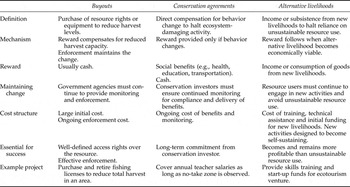
The intuitive appeal of making reduced resource pressure viable by providing new income options is obvious, so this basic logic is seen in many conservation interventions. Indeed, many buyout and conservation agreement initiatives include an alternative livelihoods component in their overall project design. However, a key distinction is that alternative livelihoods interventions do not position the support for new activities as compensation for displacing unsustainable behavior. Table 1 presents a characterization of the three approaches, in terms of how they attempt to change incentives for resource use and how they are generally designed.
Characterization of buyout, conservation agreement and alternative livelihood approaches

Niesten and Gjertsen, (Reference Niesten and Gjertsen2010) examined the design and performance of marine conservation projects with varying types of incentives through an analysis of 27 case studies in 14 countries. The study sample was constructed in collaboration with key informants who helped compile a large set of suggested candidate projects for inclusion in the study. Constrained to a sample size of less than 30 cases (due to the costs of collecting data), random selection from all possible sites would not yield an adequately representative sample. Therefore, to ensure broad geographical representation, we constructed a purposive sample that includes examples of each approach in a variety of settings. The purposive sample also sought to include an effective representation of the best practices of each approach (for more information about the full study sample, see Niesten and Gjertsen, Reference Niesten and Gjertsen2010). The cases thus represent a wide range of designs and contexts and include both successes and failures. Fourteen of the 27 case studies are in SIDS (for summary information on these case studies, please see table A1 in the online appendix, available at http://journals.cambridge.org/EDE).
The following sections present more details of three of the cases to illustrate each type of approach in a SIDS setting. These three cases are not meant to fully represent the three approaches, but rather to offer illustrations of how they can work in practice; the discussion and conclusions draw on the full set of case studies. The buyout example is the Phoenix Islands Protected Area, which is one of two SIDS buyouts in our study. This case is not a conventional buyout in that, rather than relying on a one-time purchase of vessels or licenses, it provides an annual offset for fisheries license revenue foregone by excluding commercial harvesting from a portion of the Phoenix Islands exclusive economic zone (EEZ).This type of buyout, resembling a conservation agreement, is becoming more common. Navini, a long-term conservation agreement success story, was chosen to illustrate an informal but explicit transaction that defines the approach. The alternative livelihood example from Pohnpei was chosen because it is relatively successful compared to other alternative livelihood projects in the set of case studies.
2.1. Phoenix Islands Protected Area fisheries license revenue offset, Kiribati
The Phoenix Islands are in the center of the Republic of Kiribati in the central Pacific Ocean. They are among the least influenced by human activity of the tropical Pacific islands due to their remoteness. The Phoenix Island ecosystem includes eight islands and their fringing reefs, deep sea mounts and open ocean. Human presence is minimal, but the islands are threatened by pressure from foreign commercial fishers and transmission of invasive species and improper waste disposal by occasional visitors. These threats demand a management presence and carefully zoned commercial fishing activity.
The New England Aquarium (NEAq) has been working with the Government of Kiribati to enhance the protection of the Phoenix Islands since 2001, with support from Conservation International (CI). The overarching aim was to establish the Phoenix Islands Protected Area (PIPA). The process of establishing a marine protected area (MPA) has met with no objections, save for voices from the Ministry of Fisheries expressing concern about the impact on fishing license revenue. This concern, recognized early on by all parties, was addressed through the concept of a ‘reverse fishing license’, a phrase coined by the then Minister of Fisheries of Kiribati.
The strategy to protect the Phoenix Islands may be characterized as MPA creation using a fisheries buyout. The Government of Kiribati approved the designation of PIPA on 20 March 2006. In January 2008, the Cabinet finalized the PIPA boundaries to define an MPA of 410,500 km2. A management plan has been developed and includes provisions for maintaining a portion of PIPA as a no-take zone (NTZ). The NTZ portion will be a function of the amount of financing generated to offset foregone fishing license revenue. The non-NTZ portion of PIPA will be subject to intensified vigilance to ensure that commercial fishers are in compliance with regulatory requirements.
The central feature of the initiative is the creation of a financial mechanism to offset fisheries license revenue foregone by excluding commercial harvesting from a portion of the Phoenix Islands EEZ. In essence, international willingness to pay for marine biodiversity conservation is being channeled to Kiribati in return for protecting this important marine site. To guarantee the flow of revenue replacement over time, the partners will establish and capitalize an endowed fund operated by an independent trust body. This trust will enter into a formal agreement with the government specifying that as long as conservation objectives and management prescriptions of PIPA are met, payments to replace fishing license revenues will continue.
This approach was chosen because the extraordinarily pristine condition of the Phoenix Islands warrants full protection from harvesting pressure. The absence of a local community greatly facilitates the process of MPA establishment with strict protection of the islands and their reefs. However, fishing license revenues are critical to the government budget, so the financial burden of foregoing harvests must be shared by the international community.
The size of offset payments depends on fundraising success. This in turn will determine the size of the NTZ within the overall PIPA zoning plan. An initial target of US$175,000 per year justifies closing 25 per cent of PIPA to annual access licenses; an increase to US$750,000 will extend this closure to US vessels that operate under a separate, long-term agreement due to expire in 2013.
The project enjoys several strengths – firm government support, dedicated partners, and a scale and scope that have generated international attention. In addition, the remoteness of the Phoenix Islands has protected this site from a range of pressures that can now be pre-empted by the creation of this MPA. The main challenge, again, will be to raise the financing for the endowment. At the same time, the project must build the human capacity to manage this MPA, and carefully delineate how to deploy a credible and robust monitoring framework to ensure that the fishing activity that does take place meets rigorous sustainability standards. A critical component of future plans is the tracking of trends in catch volumes and access fee revenues to better calibrate the portion of PIPA designated as an NTZ for a given endowment size.
2.2. Navini Island Resort lease, Fiji
Navini is one of 32 small islands in Fiji's Mamanuca group, one of Fiji's major tourism assets featuring island resorts, white sandy beaches, sunshine, calm seas and gentle tropical breezes. This region has been the focus of tourism development from the mid-1960s, and Navini hosts one of the smallest tourism establishments, the Navini Island Resort, established in 1976.
Historically, Navini Island's coral reefs suffered various threats including over-fishing, destructive fishing using explosives and poison, and pollution (mostly from waste from the resort). Although most households in nearby communities now depend heavily on the tourism industry for their livelihoods, originally this was not the case as locals lacked qualifications for tourism jobs and therefore depended heavily on marine resources for income and protein. Uncontrolled fishing in terms of methods and techniques, absence of catch quotas or restricted areas, and fishing without licenses or permits by locals as well as outsiders led to decreases in fish stock and degradation of the ecosystem. Pressure was mainly due to limited livelihood options in the area and increasing cash needs for expenses such as school fees.
The Navini island managed marine area (MMA) is a partnership between the Navini Island Resort and the chiefly clan of the Tui Lawa, the paramount chief of the Malolo region. Situated in Fiji's busiest tourism area and close to several fisheries landing sites, the resort management team is keenly aware of the value of the reef system surrounding the island and the need for conservation to sustain tourism development. In 1988, the resort management team approached the Tui Lawa and members of his clan to ask for protection of the reefs surrounding the island. The team from Navini explained the rationale for establishing the MMA and also discussed the commercial use and value of fish being taken from the area. The resort then offered payment in excess of that value as compensation for establishing the ‘protected area’, which resulted in the agreement to establish what is now Fiji's oldest MMA. The Navini Island MMA is thus a conservation agreement between the Navini Island Resort and the chiefly clan of the Tui Lawa.
The agreement and MPA are not formally recognized under Fijian government legislation or policies. The reefs surrounding the island resort form the MMA and are fully protected under a complete ban on extraction of any marine resources. Some village members who do not belong to the land-owning clan initially opposed the creation of the MMA, but were convinced through the intervention of the Tui Lawa and assistance from the Nadroga Provincial Council Office.
The agreement is annually renewable. Each year the management of the resort holds a meeting with the Tui Lawa's clan and decides on the terms of agreement for the following year. The resort pays approximately US$2,570 annually for the renewal of the agreement. These funds are managed by a special committee within the clan of the Tui Lawa and used for education and development needs of clan members. The resort also provides library books and other school materials for the local primary school and supports community development projects through financial or technical assistance. The total value of these benefits exceeds US$5,150 per year. In addition, the Tui Lawa reports that fishing grounds throughout the Malolo region are benefiting from the Navini MMA, as stock recovery in the Navini reef is having positive spillover effects.
Since the MMA is close to the island resort, surveillance and monitoring of illegal activities falls under the daily duties of Navini resort staff, though there is no formal surveillance plan. When poachers are detected, the staff request that they leave as the area is a no-fishing zone. Once the poachers depart, the staff informs the Tui Lawa who speaks to the chief of the poachers' community. Between 1989 and 1992, after the establishment of the MMA and recovery of marine resources, some poaching took place by village fishermen. The Tui Lawa was alerted to this problem, and poaching diminished soon thereafter. Poaching incidents are now rare, and usually do not involve locals.
The Navini Island Resort management team is committed to the continuation of the MMA program as it is important to the tourism enterprise. However, one concern is the lack of capacity-building programs that could enable the community to operate the MMA if the resort closes or if a new owner does not share the same priorities as current resort management. Establishing links between the Navini MMA and programs of conservation organizations such as the Fiji Locally Managed Marine Areas network could provide an additional safeguard for long-term sustainability. The main strength of the Navini MMA is the dedication shown by the resort in providing compensation to the community, and the community's commitment to the program for the past 22 years, especially the active participation of the Tui Lawa and members of the chiefly clan.
2.3. Pohnpei sponge and coral farming, Federated States of Micronesia
Pohnpei Island is a mountainous volcanic island, located slightly north of the equator in the western Pacific Ocean. It is the largest of the Federated States of Micronesia (FSM) island archipelago. Pohnpei has an extensive barrier reef 2–4 km offshore. Inside the lagoon, a well-developed fringing reef complex with associated seagrass beds and mangrove forest is home to a large number of species (Burgoin and Joseph, Reference Burgoin and Joseph2008). According to recent studies, unsustainable fishing practices such as harvesting and selling species at immature sizes, as observed in Pohnpei markets (Rhodes and Tupper, Reference Rhodes and Tupper2007; Rhodes et al., Reference Rhodes, Tupper and Wichilmel2008), are threatening the local commercial coral reef fisheries and especially the coral reef system. Fishing is mainly nighttime spear fishing, which is difficult to monitor and regulate. It is estimated that there are 756 commercial and 1,408 subsistence farmers and fishers (Rhodes et al., Reference Rhodes, Tupper and Wichilmel2008).
In 2001 the Conservation Society of Pohnpei (CSP) began working with communities to re-establish State-sanctioned MPAs within Pohnpei lagoon. There are eleven MPAs that have been designated by law and CSP currently works with seven of these areas. To provide additional income-generating opportunities, CSP partnered with MERIP to establish sponge farming with MPA communities. In 2005, income-generating activities were expanded to hard coral, soft coral and other marine invertebrate farming.
There are currently 19 sponge farmers in the program. Each sponge farm has 700–1,000 pieces, and the farmer must clean the sponges approximately once a month. MERIP harvests from the farms 3–4 times per year and pays the farmers $1 per piece. Sponges are processed and packaged for sale as bath sponges. In 2008, Pohnpei sponge farmers sold 3,500 grade A sponges and 1,000–1,500 grade B. The market potential has been estimated at 30–40,000 sponges per year.
Coral farming has been more successful than sponge farming as they are faster-growing and there is a good market for corals for home aquaria. MERIP harvests corals from community farmers, and any shortfalls in supply are met through MERIP's central coral farm, which has approximately 15,000 standing stock for this purpose. The Marshall Islands Mariculture Farm (MIMF), the largest commercial producer of farmed giant clams and corals in the Micronesia region, purchases all the corals that MERIP can supply. In 2008, MERIP sold 6,000 corals. The market potential has been estimated at 20,000 corals per year.
Benefits provided by the project are assistance with setting up sponge and coral farms, and US$1 per sponge or coral that MERIP harvests. Coral farmers and productive sponge farmers receive about three to four payments per year, with each payment of the order of US$50–300. MERIP also paid farmers to set aside 25 per cent of their sponges as brood stock in 2008, in an effort to make the farms more environmentally sustainable. Persons residing in a community that has declared an MPA are eligible to receive MERIP assistance for setting up a farm. Sponge and coral farm sites were chosen for their appropriateness for farming and their proximity to MPAs. Recently, MERIP has focused on recruiting farmers in a major fishing community that is situated between two MPAs. Otherwise, there has not been a focus on specific communities or individuals because of their impacts on reefs or MPAs or because they are heavily engaged in fishing. There are currently 18 sponge farms and five coral farms.
The overall goal of the project is to improve the living conditions of the most impoverished coastal communities in Micronesia through sustainable small-scale mariculture ventures. One of the long-term objectives is to decrease stress on natural resources. It is unclear at this point to what extent the MPAs are having a positive impact on marine resources because it is impossible to determine whether the differences in fished versus protected areas are due to initial differences in size or habitat quality, fish dispersal patterns or the effectiveness of the MPA. Similarly, the effect of sponge and coral farming on marine resources is even less clear, as there are no measures of fishing effort or compliance with MPA rules before and after the farming program was established. Although the extent of illegal encroachment has not been quantified, community conservation officers state that fishing activities are occurring within the boundaries of outer reef MPAs. Those participating in sponge and coral farming are likely to be slightly better off than before the project, since they are not required to give anything up (apart from minimal amounts of time), and they receive cash when their sponges and corals are harvested.
The sponge and coral farming project has been successful in several respects. In contrast to many alternative livelihood options that require a great deal of infrastructure and skills, the farming enterprise is quite simple. Production requires relatively few inputs and low labor and technical expertise. Growing the corals and sponges is environmentally benign and mainly requires good water flow and some cleaning. The products have no predators; thus losses are minimal. The sponges have a somewhat local market, eliminating the need for complex arrangements or costly transportation. There is also a good market for sponges and corals outside of Pohnpei. MERIP's involvement has greatly assisted with finding export opportunities and organizing production at a scale that can supply the market. Over the coming years the project will attempt to increase the number of beneficiaries and further diversify alternative livelihoods.
The project has also met with a number of challenges. Sponge farming in particular has been difficult to establish. To be profitable, a certain volume of sales is required, but villagers have been reluctant to take up farming or expand production beyond current low levels. The main issue appears to be the long interval between establishing a farm and receiving payments from the harvest. MERIP is considering offering an alternative system where anyone can work as a day-wage laborer on a central MERIP sponge farm. This will permit more people to benefit from sponge farming and receive immediate payment, without having to invest in their own farm. Overall, it seems that the farming is not expected to replace or even reduce fishing effort; thus it may serve as a complement rather than a substitute for fishing.
These cases have illustrated how the three approaches can be applied in SIDS. We next discuss the strengths and weaknesses of the approaches, the observations and lessons generated from studying a global sample of sites, and the implications for the further application of incentive-based approaches.
3. Discussion
Case studies of all three approaches demonstrate the importance of addressing the opportunity cost of conservation – offsetting potential loss of income and resource access to ensure that local stakeholders do not bear an undue economic burden. Buyouts involve an upfront transaction to achieve this offset. Conservation agreements provide an ongoing stream of periodic benefits to offset opportunity costs. Alternative livelihood projects invest in new economic activities to replace unsustainable resource use. For any approach, extremely high opportunity costs will represent a challenge, as buyouts and conservation agreements will face substantial fundraising requirements and alternative livelihood projects will struggle to become profitable enough to replace foregone resource use; this was seen in Port Honduras, Belize, where local fishermen feel compelled to continue fishing despite the availability of tourism- and conservation-based jobs.
A textbook buyout involves a one-time payment, but half of the case studies in the full sample include continued incentives after the initial transaction. For example, the PIPA case in Kiribati adapts the buyout approach to parallel the national system for annual fishing licenses, such that annual payments from a trust fund will offset foregone license revenues. Thus, the apparent simplicity of a one-time transaction versus a long-term engagement does not necessarily apply in practice when pursuing conservation objectives. A recurring theme is that simply removing fishing capacity through a one-time transaction will often not be enough; local stakeholders typically demand assistance in pursuing new economic activities or continued fishing with improved gear or practices. Therefore buyout projects will often incorporate features of conservation agreements and alternative livelihoods approaches.
Although all conservation agreements involve a direct exchange of benefits for conservation commitments, each agreement is adapted to specific cultural, economic, biological, legal and institutional factors. Consequently, benefit packages, monitoring frameworks, sanctions and the types of conservation actions/non-actions required of resource users vary widely. In most agreements, resource owners commit to establishing a marine management area of some kind. Some of these are legally designated; others simply amount to an agreement covering a defined area without formal protected status, although recognition within traditional contexts can nevertheless generate strong respect and effective enforcement, as seen in the Navini case. Some cases, although designed as quid pro quos, do not feature all the components of a comprehensive agreement. For instance, several lack provisions for performance monitoring or explicitly defined sanctions for non-compliance. Long-term financing tends to be the greatest challenge for conservation agreements. In the Navini case, sustainability is ensured by the presence of a private enterprise with a long-term stake in the success of the agreement. However, most other cases depend on short-term grants, which are detrimental to the reliability of the benefit stream and the ability to execute project management and monitoring.
Some practitioners have raised questions about the conservation agreement approach, often due to incomplete understanding of how agreements can be adapted to different contexts. For example, there are concerns about an influx of cash into a small, remote community, but benefit packages can comprise in-kind benefits or funds for community development, as in the Tetepare and Rendova examples. Another misunderstanding is the impression that local stakeholders lose their resource rights. However, stakeholders typically retain their rights and voluntarily agree to use these rights in specified ways; if the conservation commitments become untenable for resource owners, they can terminate the agreement and use their resources as they choose.
Alternative livelihood projects are usually seen in settings with low opportunity cost, which makes sense since high opportunity cost makes it hard to find competitive alternatives. However, although relatively low benefits in the form of alternative income or resource yields may be needed to overcome the opportunity cost, most of these projects involve substantial costs of continued technical assistance to build the required capacity; thus the approach can involve non-trivial long-term expenses. In the cases studied, projects in Fiji reduced the need for external funding by using tourism revenue, but one-time investments in Baraulu and St. Croix did little to impact livelihoods or reduce pressure on resources. Moreover, social expectations regarding the distribution of benefits can complicate alternative livelihood projects. Successful projects often include prominent roles for skilled individuals. Therefore, the benefits are likely to go to people who are already relatively advantaged (Walpole and Goodwin, Reference Walpole and Goodwin2000; Wunder, Reference Wunder2000; IMM, 2008), who may then face social pressures that can undermine the project. This was seen in the Baraulu sewing project, where disputes and jealousies led to conflicts, poaching and the collapse of the project. Project implementers in the Pohnpei case have avoided these problems by working directly with individuals who wish to set up their own sponge or coral farms, and extending this opportunity to all community members. Thus, anticipating and planning for distributional considerations is an important element in the early project stages, as is a community-level consensus on the project operations.
3.1. Positive and negative incentives: benefits and enforcement
Many project contexts include some kind of formal protected area as well as formal regulations that support conservation outside the protected areas. For example, laws in the Solomon Islands prohibit the harvesting of sea turtles and their eggs, but the remote project sites there are rarely visited by enforcement officers. Thus, weak enforcement raises the need for incentives for local resource users whose activities put pressure on biodiversity or resources – incentives in the form of externally sourced benefits in the case of conservation agreements, and in the form of additional sustenance or income in the case of improved management under alternative livelihoods. In the most remote sites, external pressure such as illegal foreign fishing operations poses the main threat, as in the PIPA and Helen Reef cases. Local communities are limited in their ability to respond to this large-scale threat, so in addition to incentives, interventions must also assist the local resource users with enforcement. In general, local threats can be addressed through incentives but greater external threats require a greater emphasis on enforcement.
In buyout cases, compensation facilitates equitable capacity reductions and the acceptance of strengthened regulation and conservation measures, but government enforcement remains necessary. A limited-access fishery is necessary so that there are clearly defined resource rights that can be purchased, traded or leased; these rights must be enforced to assure conservation investors that by acquiring them harvest pressure will be reduced. In the absence of reliable enforcement, buyout projects must incorporate ongoing incentives, in essence adopting the conservation agreement approach. Meaningful conservation agreements require the monitoring of conservation performance and sanctions in the event of non-compliance. Sanctions may simply involve withholding funds or reducing benefits by some amount, but some cases may require legal action to prevent resource or habitat uses that violate the terms of the agreement. Most conservation agreements seek to address the lack of enforcement resulting from non-existent or inadequately applied laws.
Enforcement may not be an issue in alternative livelihood projects if new activities fully replace unsustainable resource use. More often, though, livelihoods must be one component of a larger intervention strategy that includes enforcement. Without enforcement, people may continue the unsustainable activities in addition to adopting the new livelihood. To address this, strengthening enforcement is one option, but another is to make alternative livelihood investments a function of verified compliance with conservation requirements. The latter essentially comprises the conservation agreements approach.
3.2. Performance monitoring
Most projects in our study sample leave considerable room for improvement in monitoring, with respect to conservation outcomes, socioeconomic impacts and agreement compliance. Conservation agreements depend on monitoring to link benefits to performance, so one would expect these case studies to include better monitoring provisions; however, even among these cases monitoring is often lacking. Given that performance monitoring is critical for the conservation agreement approach, this tool should not be used unless desired behavior change can be monitored.
The direct payments for the protection of sea turtle nests in Rendova is a good example of performance monitoring. Payments are based on formulas of varying complexity linked to numbers of nests, eggs and hatchings. This illustrates how the explicit link between conservation performance and benefits determines monitoring requirements. More complex compensation arrangements require closer monitoring of specific performance metrics, with the added benefit that the project can better demonstrate actual conservation impact.
Alternative livelihood projects do not involve an explicit quid pro quo and therefore do not rely on performance monitoring. Alternative livelihood interventions can benefit from monitoring that demonstrates biological as well as socioeconomic impacts, as can the other two approaches. Tracking of resource trends also contributes to sustainable resource management, to allow for the rationalization of extraction rates.
3.3. Benefits
A wide range of possible benefits can create individual or community incentives, from individual cash payments to funds for community development projects to scholarships. Benefit packages must respond to local needs and priorities, as identified through participatory processes. For instance, if the resource pressure is driven by cash needs related to school fees, scholarship funds may be an appropriate benefit package. As another example, a benefit package can address the problem of credit access by directing funds to a community micro-lending facility.
Among the case studies, cash payments to individuals are rare, even though this is often associated with direct incentive programs due to the literature on conservation payments and payments for environmental services (Ferraro, Reference Ferraro2001; Ferraro and Kiss, Reference Ferraro and Kiss2002; Wunder, Reference Wunder2008). Buyouts have historically involved cash payments to vessel owners or permit holders, but the examples in this study also involve loans or alternative livelihood support. The cases that include individual cash payments usually involve a broader package with other types of benefits such as employment or community development funds. In many cases, arrangements that pool individual payments to support social investments can achieve a greater impact than small individual cash payments, especially when communities face institutional or social challenges to providing public goods.
3.4. Choosing approaches: essential capacities
Buyouts require the least local capacity, as resource users give up ownership or rights in exchange for compensation and are then no longer involved in management or enforcement. However, enforcing the terms of the buyout typically depends on government capacity. A buyout will not succeed if purchased equipment or retired licenses or permits are simply replaced by other fishers.
The key capacity consideration for a conservation agreement is that resource owners must be able to negotiate and enter into the agreement as a coherent agreement counterpart. Often, this requires extensive consultation and investment in creating community decision-making mechanisms. In Tetepare, for example, the Tetepare Descendants Association acts on behalf of thousands of resource owners living throughout several islands.
Alternative livelihoods are the most demanding approach in terms of essential local capacities; however, although high local capacity might be expected at the relevant sites, this is not seen in most cases in this study. Investment in training and skills building may be worthwhile if other conditions favor a livelihoods approach, but often a tool with less demanding local capacity requirements may be more suitable. Initial assessment of the potential for new activities is often less than comprehensive, missing rigorous value chain analyses and market studies for new products or the assessment of capacity to deliver a product or service at a consistent quality and quantity.
Indeed, the focus of many alternative livelihoods projects appears to be limited to a narrow set of considerations, but assistance in several areas is usually necessary for a new livelihood to succeed. For example, the Baraulu project concentrated on providing start-up capital for sewing machines. In St. Croix, fishermen were assisted in obtaining captains' licenses, but not in obtaining employment. Financing initial equipment purchases or training will often not be sufficient, given the necessary support for such activities as business development, technical assistance, credit, transportation and marketing. A global review of livelihood approaches by IMM, (2008) lists 29 elements for consideration in alternative livelihoods projects; most projects appear to address only a small number of these elements.
Ideally, the preceding discussion and quantitative analysis of the case studies would permit the concrete characterization of the conditions under which particular approaches would be most suitable. These conditions would include economic, legal and institutional factors, as well as biophysical aspects and conservation objectives. Economics and statistics provide straightforward tools for conducting such analysis, such as multivariate regression which would relate contextual and design aspects of cases to project outcomes. However, conservation projects have yet to provide usable metrics that permit a meaningful comparison across cases in terms of resource impacts. As the cases include a broad range of conservation objectives – protecting sea turtle nesting sites, increasing fish catch, preserving coral reefs, etc. – quantitative methods of the types alluded to above are not possible. An alternative is to construct an index of project impact, but that would amount to little more than assigning arbitrary values and produce results of questionable statistical meaning.
Therefore we eschew the pretense of definitive answers regarding tool selection, and instead qualitatively identify some general observations drawn from the case studies. First, with respect to buyouts, formal enforcement and the rule of law are critically important. Without a reliable legal and regulatory context, other tools should be considered. Conservation agreements can overcome enforcement challenges relating to buyouts and alternative livelihoods, but require that a community be able to act collectively as an effective counterpart. Acute threats to biodiversity or the resource base require a direct incentive response – a buyout if possible, or else a conservation agreement. However, a conservation agreement should not be pursued if the desired behavior change cannot be monitored, as there will be no way to determine whether a reward is justified. Of the three approaches, alternative livelihoods appear to face the greatest challenges. Market requirements for alternative livelihoods are often demanding; this can be overcome with private sector involvement. External financing should not be needed once the livelihood activity becomes self-supporting, but this end goal is only rarely attained. When unsustainable activities are very profitable, competitive alternatives may not exist, requiring strategies based on enforcement or externally sourced direct incentives. Finally, many alternative livelihood projects face challenges in demonstrating clear links to conservation outcomes; such outcomes must be defined and monitored to measure the project impacts.
4. Conclusion
As noted previously, identifying and pursuing best practices for marine conservation is of particular importance for SIDS, given the high level of dependence on marine resources. The case studies introduced above demonstrate a significant and growing experience with innovative incentive-based approaches within the SIDS community, generating valuable lessons for the design of future projects, programs and policies. In particular, the case studies clearly illustrate the importance of recognizing the opportunity cost of conservation faced by resource owners – whether at the national level as in the case of the Phoenix Islands or at the local level such as in the Navini case – and designing interventions that squarely address this opportunity cost.
The question of funding is a common challenge for any intervention, especially long-term financing for initiatives in developing countries. Although this challenge certainly characterizes most of the case studies discussed above, the case studies also show that various opportunities exist for financing incentive-based efforts in SIDS. Conventional funding sources such as foundations and bilateral development cooperation agencies are increasingly embracing incentive-based approaches as a means to simultaneously achieve conservation and development. Other funding opportunities include partnerships with private sector companies, particularly tourism enterprises such as resorts and dive operators, as seen in the Navini case.
Resource ownership contexts in many SIDS lend themselves particularly well to the conservation agreement approach. For instance, communal and traditional resource tenure as in Fiji, the Solomon Islands and Palau can preclude the establishment of formal protected areas or the extension of government regulatory control; by seeking conservation as a negotiated quid pro quo, conservation agreements can achieve equitable outcomes that respect local resource rights but provide compelling incentives for sustainable resource use. While buyouts will often not be tenable in these contexts, a conservation agreement can achieve the same results by avoiding a formal transfer of rights and structuring compensation as a stream of benefits over time. Finally, conservation agreements will often benefit from the inclusion of an alternative livelihoods component, but enhance the conservation impact of alternative livelihood investments by making these investments contingent on verified compliance with conservation commitments. This is particularly important in many SIDS contexts where livelihood enhancement is likely to feature more prominently among local priorities than conservation per se.
Supplementary materials and methods
The Supplementary material referred to in this paper can be found online at journals.Cambridge.org/EDE.