Introduction
Caregiver burden in dementia is well known to occur at higher levels when compared to other medical illnesses (Schoenmakers et al., Reference Schoenmakers, Buntinx and DeLepeleire2010) and to be associated with high medical comorbidity of caregivers. With the impending worldwide epidemic of dementia, caregiver burden has become one of the main concerns in the dementia clinic, and for researchers and healthcare policy-makers.
There is a range of psychosocial interventions designed to reduce caregiver burden; these include education and training programs, support groups, counseling (Brodaty et al., Reference Brodaty, Green and Koschera2003), and respite care (Acton and Kang, Reference Acton and Kang2001). However, while most of these interventions are effective in reducing psychological distress or depressive mood (Brodaty et al., Reference Brodaty, Green and Koschera2003; Chu et al., Reference Chu2011), they do not reduce global care burden (Acton and Kang, Reference Acton and Kang2001; Schoenmakers et al., Reference Schoenmakers, Buntinx and DeLepeleire2010; Chu et al., Reference Chu2011), thus indicating that the construct of caregiver burden may be multidimensional and that non-psychological burden may require different types of interventions than does psychological burden (Ankri et al., Reference Ankri, Andrieu, Beaufils, Grand and Henrard2005). Therefore, to improve their efficacy, psychosocial interventions should be tailored to the different dimensions of caregiver burden. However, there is little research investigating which component of psychosocial intervention can reduce these different dimensions of caregiver burden in dementia.
In this study, we used the concepts of social supports from the Medical Outcomes Study Social Support Survey (MOS-SSS; Sherbourne and Stewart, Reference Sherbourne and Stewart1991) as components of psychosocial interventions. The MOS-SSS classified overall social support into five types because each type is known to be independent and could lead to different outcomes. The five types of the MOS-SSS are as follows: (1) emotional support (which expresses positive affect, empathic understanding, and encouragement of expressions of feelings); (2) informational support (which offers advice, information, guidance, or feedback); (3) tangible support (which provides material aid or behavioral assistance); (4) positive social interaction (which means availability of other persons to do fun things with you); and (5) affectionate support (which involves expressions of love and affection; Sherbourne and Stewart, Reference Sherbourne and Stewart1991). We investigated the types of social supports that may be helpful for reducing caregiver burden according to two dimensions (psychological vs. non-psychological), and explored the mechanism of how such social supports reduce each type of caregiver burden.
The goal was to provide evidence for the tailoring of psychosocial interventions for caregivers of individuals with dementia and to show how psychosocial interventions can be made more effective.
Method
Sample
This study was part of the National Survey of Dementia Care in South Korea (NaSDeCK; Ministry of Health and Welfare, Republic of Korea, 2011), a nationwide survey on dementia care in elderly Koreans. We analyzed data from 731 pairs (n = 1,462) of community-dwelling dementia patients and their caregivers, sampled from among visitors to 13 dementia clinics between December 2010 and August 2011. All caregivers were living together with the dementia patients or visited them regularly (at least once per week). All participants were fully informed about the study protocol and provided written statements of informed consent signed by themselves or by their legal guardians. The study protocol was approved by The Institutional Review Board of Seoul National University Bundang Hospital, South Korea.
Assessments
Research geropsychiatrists evaluated each patient using the Korean version of the Consortium to Establish a Registry for Alzheimer's Disease Assessment Packet Clinical Assessment Battery (CERAD-K-C; Lee et al., Reference Lee2002). Dementia was diagnosed according to the Diagnostic and Statistical Manual of Mental Disorders, Fourth Edition (DSM-IV) criteria (American Psychiatric Association, 1994); Alzheimer's Disease (AD), according to the National Institute of Neurological and Communicative Disorders and Stroke and the Alzheimer's Disease and Related Disorders Association (NINCDS-ADRDA) criteria (McKhann et al., Reference McKhann, Drachman, Folstein, Katzman, Price and Stadlan1984); and vascular dementia (VD), according to the National Institute of Neurological Disorders and Stroke-Association International pour la Recherche et l’Enseignement en Neurosciences (NINDS-AIREN) criteria (Roman et al., Reference Roman1993).
We evaluated behavioral and psychological symptoms of dementia (BPSD) using the neuropsychiatric inventory (NPI-K; Cummings et al., Reference Cummings, Mega, Gray, Rosenberg-Thompson, Carusi and Gornbein1994); activities of daily living (ADL) using the disability assessment for dementia (DAD; Gelinas et al., Reference Gelinas, Gauthier, McIntyre and Gauthier1999); level of dependence using the Dependence scale (DS; Stern et al., Reference Stern1994); comorbid chronic medical conditions using the Cumulative Illness Rating scale (CIRS; Miller et al., Reference Miller1992); and global severity of dementia using the Clinical Dementia Rating (CDR; Hughes et al., Reference Hughes, Berg, Danziger, Coben and Martin1982).
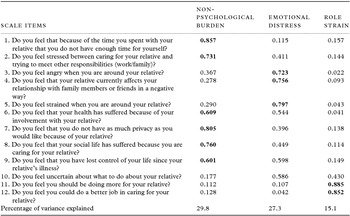
We evaluated the attitude of the caregivers toward dementia using the Dementia Attitude scale (DAS) (O’Connor and McFadden, Reference O’Connor and McFadden2010), dysfunctional coping strategies of the caregivers using the subscale of Brief-COPE (dys-B-COPE; Carver, Reference Carver1997), and daily care activities using the Caregiver Activity Survey (CAS; Davis et al., Reference Davis1997). We evaluated psychological care burden of the caregivers by using the short form Center for Epidemiologic Studies Depression scale (CES-D10; Kohout et al., Reference Kohout, Berkman, Evans and Cornoni-Huntley1993), and non-psychological burden by using the non-psychological burden subscale (np-ZBI-s) extracted from the Zarit Burden Interview – Short Form (ZBI-s) using exploratory factor analysis (Bedard et al., Reference Bedard, Molloy, Squire, Dubois, Lever and O’Donnell2001). Three factors were extracted by principal component analysis with varimax rotation. Bartlett's test of sphericity was significant (x 2 = 5389.9, p < 0.001) and the Kaiser–Meyer–Olkin (KMO) measure of sampling adequacy value was 0.92. The first factor defined as the “non-psychological burden” consisted of six items and explained 29.8% of the variance. The second factor defined as the “emotional distress” consisted of three items and explained 27.3% of the variance. The third factor defined as the “role strain” consisted of two items and explained 15.1% of the variance. Cronbach's α for the total scale was α = 0.913, and α = 0.924, α = 0.811, α = 0.752 for the three factors, respectively (see Table 1).
Factor analysis of the Zarit Burden Inventory – short form (ZBI-S)

Note: Bold values indicate the items of each factor (non-psychological burden, emotional distress, role strain).
We evaluated each caregiver's five types of social supports (emotional support, informational support, tangible support, positive social interaction, affectionate support) using the MOS-SSS (Sherbourne and Stewart, Reference Sherbourne and Stewart1991).
Statistical analysis
We performed a stepwise multiple regression analysis to identify variables that determined the non-psychological and psychological burdens of caregivers. Independent variables were categorized according to one of four factors: Patient (age, gender, education, medical insurance, urban dwelling, type of dementia, CDR, duration of illness, CIRS, DAD, NPI), Caregiver (age, gender, education, relationship with the care recipient, medical insurance, certification of care manager, DAS, dys-B-COPE), Care Situation (duration of care, frequency of visit, daily caring time, number of care tasks), and Social Support (emotional support, informational support, tangible support, positive social interaction, affectionate support). Among these 28 independent variables, the variables in the final regression model advanced to the path analysis.
Path analysis was then performed to examine the mechanisms of specific types of social support that predicted psychological/non-psychological burden in the stepwise multiple regression models.
The significance level was set at p < 0.05. Path analysis was performed using SAS software, version 9.1 (SAS Institute Inc., Cary, NC, USA). The stepwise multiple regression analysis and exploratory factor analysis were performed in PASW Statistics 18, release version 18.0.0 (SPSS, Inc., 2009, Chicago, IL).
Results
The mean age of 731 dementia patients was 77.3 ± 7.69 years old (range 40–99). Female patients were 66.2% of total dementia patients. The mean educational level was 6.28 ± 5.42 years (range 0–21). The distribution of dementia type was 73.1% with AD, 13.0% with VD, 5.6% with Parkinson's disease dementia or diffuse Lewy body dementia, 4.0% with frontotemporal dementia, and 4.3% with other type of dementia. The severity of dementia was 27.6% with very mild (CDR = 0.5, n = 202), 43.4% with mild (CDR = 1, n = 317), 20.7% with moderate (CDR = 2, n = 151), and 8.3% with severe (CDR ≥ 3, n = 61). The mean score of Mini-Mental Status Examination for Dementia Screening (MMSE-DS) was 15.2 ± 6.0 (range 0–29). The mean total scores of NPI-K for BPSD, DAD, and CIRS were 13.85 ± 17.4 (range 0–144), 20.8 ± 12.0 (range 0–40), and 5.87 ± 3.31 (range 0–10), respectively.
The mean age and educational level of 731 caregivers were 57.3 ± 13.6 years (range 21–96) and 12.2 ± 6.51 years (range 0–22), respectively. Female caregivers were 67.2%. The relationship with dementia patients was of spouses, 33.8%; sons/daughters-in-law, 35.7%; daughters/sons-in-law, 27.6%. The 60.5% of the caregivers did not have any occupation, and 11.1% had their own certificates of care managers. Among the caregivers, 78.5% were visiting their patients in six to seven days per week (two to three per week, 12.9%; four to five per week, 6.7%; one or below per week, 1.2%). The mean time for spent care in each caregiver was 5.00 ± 4.96 h per day.
The mean CES-D10 score of the caregivers (indicating level of psychological burden, ranged 0 to 10) was 3.63 (SD = 2.74), and 48.6% of the caregivers had scores of 4 or greater which is optimal cut-off score for major depression (Irwin et al., Reference Irwin, Artin and Oxman1999). In addition, higher caregiver CES-D10 scores were associated with increased severity of dementia (measured by the CDR) in the care recipients (p < 0.001).
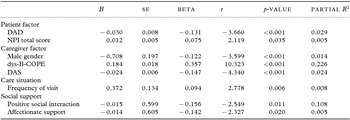
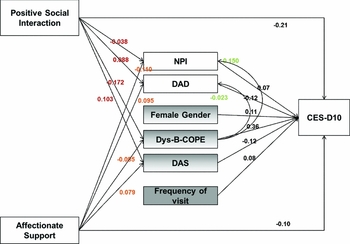
In the stepwise multiple regression analysis (see Table 2), two Patient variables (low DAD and high NPI scores), three Caregiver variables (female, low DAS score, and high dys-B-COPE score), one Care Situation variable (high frequency of visits), and two Social Support variables (low positive social interaction and low affectionate support) were associated with increased CES-D10 scores (R 2 = 0.418, F (1,530) = 47.643, p < 0.001). The overall effect of positive social interaction on the CES-D10 was represented by a path coefficient of −0.27 (direct effect, −0.21; indirect, −0.06; see Figure 1). The path coefficient for the overall effect of affectionate support on CES-D10 was −0.18 (direct effect, −0.10; indirect, −0.08). In both cases, indirect effects appeared to be mediated by lower NPI and dys-B-COPE scores and by increased DAD and DAS scores. The total combined effect of positive social interaction and affectionate support on the CES-D10 was −0.454 (see Table S1, available as supplementary material attached to the electronic version of this paper at www.journals.cambridge.org/jid_IPG). We estimated the maximum effect of positive social interaction and affectionate support on the CES-D10 score according to the following multiple regression model:
Stepwise multiple regression model of variables determining psychological burden of caregivers (CES-D10)

CES-D10 = Center for Epidemiologic Studies Depression scale – 10 items; DAD = disability assessment of dementia; DAS = Dementia Attitude scale; dys-B-COPE = dysfunctional-brief-COPE; NPI = neuropsychiatric inventory.
Path model of the standardized direct and indirect effects of positive social interaction and affectionate support on psychological burden (path coefficient, p < 0.05). Note: Patient factors: NPI, DAD; caregiver factors: gender, dys-B-COPE, DAS; care situation factors: frequency of visit; social support: positive social interaction, affectionate support. CES-D10 = Center for Epidemiologic Studies Depression scale – 10 items; DAD = disability assessment of dementia; DAS = Dementia Attitude scale; dys-B-COPE = dysfunctional-brief-COPE; NPI = neuropsychiatric inventory.

CES-D10 score = 5.33 + 0.01 × NPI-K total score – 0.03 × DAD score + 0.19 × dys-B-COPE score – 0.02 × DAS score + 0.33 × frequency of visit − 0.68 × gender of caregiver − 2.05 × positive social interaction − 1.03 × affectionate support.
Assuming that the minimum (0) to maximum (100) degree of both positive social support and affectionate support was provided, the CES-D10 score could be reduced by 30.8%.
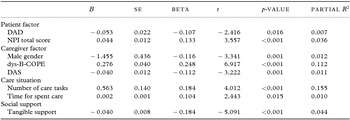
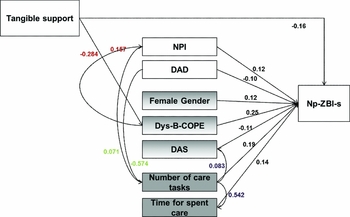
The mean np-ZBI-s score of the caregivers (indicating level of non-psychological burden, ranged 0 to 24) was 11.2 (SD = 6.06). The np-ZBI-s scores of the caregivers increased as the CDR scores of their care recipients increased (p < 0.001). In the stepwise multiple regression analysis, two Patient variables (low DAD score and high NPI score), three Caregiver variables (female, low DAS score, and high dys-B-COPE score), two Care Situation variables (high number of care tasks and long daily caring time), and one type of Social Support (low tangible support) were associated with increased np-ZBI-s (R 2 = 0.387, F (1,530) = 41.877, p < 0.001; see Table 3). The total effect of tangible support on np-ZBI-s was represented by a path coefficient of −0.237 (direct effect, −0.160; indirect effect, −0.077; see Figure 2 and Table S1, available as supplementary material attached to the electronic version of this paper at www.journals.cambridge.org/jid_IPG). Its indirect effect was mediated by lowering of dys-B-COPE, NPI, the number of care tasks, and daily caring time, and by improving DAS. We estimated the maximum effect of tangible support on the np-ZBI-s score according to the following multiple regression model:
Stepwise multiple regression model of variables determining non-psychological burden of caregivers (np-ZBI-s)

DAD = disability assessment of dementia; DAS = Dementia Attitude scale; dys-B-COPE = dysfunctional-brief-COPE; NPI = neuropsychiatric inventory; np-ZBI-s = non-psychological burden scale of Zarit Burden Interview – short form.
Path model of the standardized direct and indirect effects of tangible support on non-psychological burden (path coefficient, p < 0.05). Note: Patient factors: NPI, DAD; caregiver factors: gender, dys-B-cope, DAS; care situation factors: number of care tasks, time for spent care; social support: tangible support. DAD = disability assessment of dementia; DAS = Dementia Attitude scale; dys-B-COPE = dysfunctional-brief-COPE; NPI = neuropsychiatric inventory; np-ZBI-s = non-psychological burden scale of Zarit Burden Interview – short form.

np-ZBI-s = 12.43 + 0.58 × numbers of care tasks + 0.28 × dys-B-COPE score − 3.62 × tangible support + 0.04 × NPI-K total score − 0.04 × DAS score − 0.05 × DAD score − 1.49 × gender of caregiver + 0.003 × time for spent care.
The estimated maximum effect of tangible support on reducing the np-ZBI-s score was 15.1%.
Discussion
We found that psychological and non-psychological caregiver burden in dementia could be reduced by distinguished types of social supports; psychological burden by positive social interaction and affectionate support and non-psychological burden by tangible support. We also found that mechanisms of reducing caregiver burden differed according to type of social support. Positive social interaction and affectionate support could reduce psychological burden via improvements in BPSD (NPI-K) and functional activities of dementia patients (DAD), less use in dysfunctional coping skills of caregivers (dys-B-COPE), and enhancements of positive attitude of caregivers toward dementia (DAS). Tangible support reduced non-psychological burden via less use in dysfunctional coping skills of caregivers (dys-B-COPE) and consecutive indirect pathways. However, other types of social supports (informational support and emotional support) were not helpful in reducing caregiver burden regardless of the type of caregiver burden.
One recent study (Zhang et al., Reference Zhang, Edwards, Yates, Guo and Li2013) also showed that positive social interaction played a positive and crucial role in caregivers’ mental health directly and indirectly. This finding seems to be in line with our results because psychological burden is closely related to mental health. It was surprising that emotional support was not effective in reducing psychological burden and that, in the present study, affectionate support reduced psychological burden much less than did positive social interaction. One systematic review (Selwood et al., Reference Selwood, Johnston, Katona, Lyketsos and Livingston2007) has suggested that support therapies were ineffective and made no immediate improvement in caregiver depression, anxiety or burden because they could not engender change since they instead aim to maintain. In other words, active strategy that could engender change in caregiver burden might be needed. Emotional support might be a somewhat passive strategy for reducing psychological burden of chronically stressed dementia caregivers. The definition of emotional support in MOS-SSS is “caring, love, and empathy” and that of affectionate support is “expressions of love and affection,” defined by behavioral manifestations of love such as hugging someone (Sherbourne and Stewart, Reference Sherbourne and Stewart1991). Although the degree of behavioral manifestation that constitutes “emotional” or “affectionate” support has not yet been established (Sherbourne and Stewart, Reference Sherbourne and Stewart1991), we speculate that dementia caregivers might need to receive more expressions of love and affection as only “affectionate” support appeared to reduce psychological burden. The relatively weak effect of affectionate support (compared to positive social interaction) on psychological burden could be understood as an extension of emotional support. The result that affectionate support was more effective than emotional support seems to be in line with the result that positive social interaction was far more effective than the other two, since affectionate support involves a higher degree of affirmative social interaction than emotional support and positive social interaction involves the highest degree of such interaction among the three kinds of supports.
In previous studies, various psychosocial interventions such as support groups, stress management, education, training programs and counseling were effective in reducing psychological burden of the caregivers of dementia patients (Brodaty et al., Reference Brodaty, Green and Koschera2003). However, counseling that provides information without emotional support cannot reduce caregiver stress (Sutcliffe and Larner, Reference Sutcliffe and Larner1988); further, educational programs that provide only information fail to reduce psychological distress in caregivers (Selwood et al., Reference Selwood, Johnston, Katona, Lyketsos and Livingston2007). The differential efficacy of these interventions according to the type of caregiver burden may possibly be attributed to the type of supports provided by the interventions. In support groups, individuals share personal feelings and concerns, encourage mutuality and validation, and overcome feelings of social isolation (Sorensen et al., Reference Sorensen, Duberstein, Gill and Pinquart2006). Stress management usually consists of assessing the caregiver's current appraisal and response to stressors and then giving adaptive methods for managing personal stress including: self-monitoring, relaxation training, cognitive-behavioral responses, role-playing, and exercises to address caregivers’ feelings of loss concerning changes in patients or alterations to their own quality of life (Marriott et al., Reference Marriott, Donaldson, Tarrier and Burns2000). Counseling usually consists of a combination of emotional support and information-provision (Sutcliffe and Larner, Reference Sutcliffe and Larner1988). These interventions cannot be exactly matched to each type of social support. However, they share common components that represent positive social interaction and active communication about caregiver's feelings in contrast to the considerable social isolation experienced by dementia caregivers (Sorensen et al., Reference Sorensen, Duberstein, Gill and Pinquart2006). Together, these results and the findings of the present study suggest that providing informational support without positive social interaction or affectionate support may not be effective for reducing psychological burden of caregivers.
However, these interventions that were effective in reducing psychological burden of the caregivers of dementia patients were not effective in reducing global care burden (Acton and Kang, Reference Acton and Kang2001; Schoenmakers et al., Reference Schoenmakers, Buntinx and DeLepeleire2010; Chu et al., Reference Chu2011), which may be attributed to lack of efficacy on non-psychological burden. In the present study, non-psychological burden of dementia caregivers was reduced only by the provision of tangible support. Our measures of non-psychological burden identified the practical problems and physical properties of caregiving including loss of privacy, personal/social life and self-control as well as health problems and increased responsibility. In the multiple regression model, two Care Situation variables (number of care tasks, time spent to care) explained 16.5% of variance in non-psychological burden (see Table 3), whereas these variables explained only 0.8% of variance in psychological burden (see Table 2). We found that well-designed interventions that provide tangible supports may reduce non-psychological burden up to 15%. Therefore, long-term care insurance services should develop and provide various types of tangible supports that reduce non-psychological care burdens and improve ease of access and use of those services by dementia caregivers. Also in a previous meta-analysis, global care burden may not be reduced when psychosocial interventions lack tangible supports (Acton and Kang, Reference Acton and Kang2001). Therefore, psychosocial interventions should be designed to combine tangible supports and the two most important psychological supports (positive psychosocial interaction and/or affectionate support) to reduce global care burden (i.e. psychological plus non-psychological burdens) effectively in dementia caregivers. In addition, psychosocial interventions for the caregivers of dementia patients could be tailored according to the relative proportions of psychological to non-psychological burden. This is because the types of social supports required for reducing psychological and non-psychological burden differ from one another.
In our path analysis, the indirect effects of social supports on both psychological and non-psychological burden were largest for dysfunctional coping skills (dys-B-COPE) (see Table S1, available as supplementary material attached to the electronic version of this paper at www.journals.cambridge.org/jid_IPG). Therefore, psychosocial interventions for dementia caregivers may be more effective for those who frequently use dysfunctional coping strategies. We also found that both psychological and non-psychological burdens increased as the severity of dementia increased. As the severity of dementia increases, caregivers are more likely to detach from their own support systems because they need to devote more time to caring for the dementia patient. Therefore, a more active effort should be made to provide social programs to the caregivers as care-recipient symptoms worsen.
On average, 50% of family caregivers of dementia patients report various degrees of depression at any given time (Lavretsky et al., Reference Lavretsky, Siddarth and Irwin2010). One study showed that 10% of family dementia caregivers met the criteria for major depressive disorder and 62% met the criteria for minor depression (Schulz et al., Reference Schulz, Newsom, Mittelmark, Burton, Hirsch and Jackson1997). A recent cohort study reported that spousal caregivers have a four times higher risk of a diagnosis of depression than do controls, and that prescription rates for both antidepressants and anxiolytics were significantly higher for spousal caregivers than for controls (Joling et al., Reference Joling2010). In the current study, positive social interaction and affectionate support were estimated to reduce the prevalence of major depressive disorder in dementia caregivers by up to 20%. Therefore, well-designed psychosocial interventions that provide positive social interactions and affectionate support may be helpful not only to treat clinical depression of dementia caregivers (much like antidepressants) (Lavretsky et al., Reference Lavretsky, Siddarth and Irwin2010) but also to prevent the high incidence of depression among dementia caregivers.
We note some limitations to the present study. First, the CES-D10 is a self-questionnaire for depression as a measure of psychological burden. A diagnostic interview might be more useful to diagnose caregiver psychological burden. Second, the np-ZBI-s is a newly developed measure using factor analysis from ZBI-s. A confirmatory analysis of its validity is warranted in an independent sample. Third, the level of care burden in the present study appears to range from mild to moderate. The mean CES-D10 score in our sample was 3.63 (SD = 2.74), which was below the cut-off score of 4 for depression. Therefore, we should be cautious in extrapolating our observations to the burden in caregivers of severely ill or institutionalized dementia patients. Fourth, we estimated the maximum effects of positive social interaction, affectionate support, and tangible support using a linear regression model. Since the relationship between supports and corresponding burdens may not be linear, these results should be supported by further clinical trials. Finally, this study was a cross-sectional study. In the path models, our hypothesis was that each type of social support might influence the related burden through direct and indirect pathways. It is possible that the relationship between social support and care burden was not unidirectional. Psychological burden may require more positive social interaction or affectionate support, and non-psychological burden may require more tangible support. Thus, our observations should be supported by further longitudinal studies.
In spite of some limitations, current study has several strengths. First, we performed comprehensive assessment of each patient's clinical characteristics such as clinical severity, functional activities, level of dependence, BPSD as well as neuropsychological assessment. Most previous studies about caregiver burden employed only limited assessments on the dementia patients such as brief cognitive function tests. Second, although global care burden or psychological care burden have been studied frequently, non-psychological burden has been investigated more rarely. Third, although many previous studies have identified possible factors related to the care burden, they did not investigate how the factors could influence the care burden. To our knowledge, this is the first study that focused on the type of social support and the mechanisms of their effect on different kinds of care burden.
In conclusion, psychosocial interventions for caregivers of dementia patients should be tailored to target the type of caregiver burden. For psychological burden, positive social interaction and affectionate support should be incorporated into the interventions, and tangible support should be incorporated into them for non-psychological burden. In addition, the effect of these tailored psychosocial interventions could be maximized if they are provided to caregivers who frequently use dysfunctional coping strategies.
Conflict of interest
None.
Description of authors’ roles
K.W. Kim and J.W. Han contributed to the conceptualization, data analysis, and preparation of the paper. K.W. Kim, J.W. Han, H. Jeong, J.Y. Park, and T.H. Kim drafted the report. J.W. Han, H. Jeong, J.Y. Park, T.H. Kim, D.Y. Lee, D.W. Lee, S.H. Ryu, S.-K. Kim, J.C. Yoon, J.H. Jhoo, J.L. Kim, S.B. Lee, J.J. Lee, K.P. Kwak, B.J. Kim, J.H. Park, and K.W. Kim contributed to data collection and analysis. K.W. Kim designed the study and finalized the manuscript and provided overall supervision of study conduct.
Acknowledgments
This study was supported by a grant from the Korean Health Technology R&D Project, Ministry of Health and Welfare, Republic of Korea (Grant No. A092077) and by a research grant from the Ministry of Health and Welfare, Republic of Korea (Grant No. 08-2010-049).