Anyone acquainted with the Masses of the Milanese and Roman rites will be aware that they share a significant number of texts. I have recently written about those of the offerendae-offertoria, the confractoria-communiones and the psalmelli-responsoria gradualia.Footnote 1 The main objective of the present article is to establish that the melodies of similarly corresponding pairs of ingressae and introits descend from a common ancestor.Footnote 2 This is a relatively narrow subject, but it led unexpectedly to important insights into the procedure used to elaborate ecclesiastical chants. And as a further benefit, the musical comparisons presented in what follows offer a basis for an objective estimation of the effectiveness of musical memory in the milieu of ecclesiastical chant prior to the reliance on notation.
The earliest document that provides details of the Ambrosian Mass, the eleventh-century Manuale ambrosianum,Footnote 3 contains the texts of sixty-eight proper Footnote 4 ingressae. These same chants, with their melodies, are included in Ambrosian antiphoners of the twelfth century and (essentially unchanged) in later chant books. The texts of thirty-four of the sixty-eight are used in introits or (in two cases) as communion antiphons in the oldest Franco-Roman Mass books, those published in the Antiphonale missarum sextuplex by René-Jean Hesbert.Footnote 5 Later neumed sources reveal that these thirty-two introit-ingressa pairs and the two ingressa-psalmellus pairs employ Gregorian and Ambrosian versions of the same melodies. The Gregorian and Ambrosian forms of Requiem aeternam dona (not found in the books of the Sextuplex) are virtually identical. Presumably the Milanese adopted the introit for the Mass of the Dead in relatively recent times, so the number of significant pairs remains thirty-four, half the number of the Ambrosian repertory of ingressae in the High Middle Ages.
History
We can do little more than guess at the composition of the Ambrosian Mass prior to the Manuale. It is simply not known whether there had been an ancient Ambrosian counterpart of the Roman entrance antiphon, though in the Gallican and Old Iberian Mass antiphons similar to the introits were sung as the celebrants approached the altar. But if such chants had been employed in Milan before the Roman importations, we would expect the Ambrosian entrance antiphons to have survived in the same way as the indigenous offertory chants and communion antiphons,Footnote 6 which were doubled by the importation of their counterparts but not displaced. That the early Ambrosian Mass had no dedicated chants to accompany the procession of the celebrants to the altar is entirely possible; in point of fact (as will be shown later), that would be no different from the practice of the High Middle Ages.
The most likely time for wholesale, and publicly conspicuous, borrowing of Roman practices in Milan is after the Frankish conquest of the city in 774, for such a development would be in keeping with the intentions of Charlemagne and his father to unify their expanded empire by the imposition of uniform religious practices, and would have been unlikely during the preceding two centuries of rule by the Lombards since they were in constant conflict with the papacy. There is little doubt that sacramental textsFootnote 7 from the Roman Mass were accepted in Milan very early. It is generally agreed that the earliest known Ambrosian canon is a variety of the Roman, and this conformity may very well go back to the time of Ambrose himself, who came from a distinguished Roman family with close ties to the papacy. It is unlikely, however, that any Roman chants were adopted early in Milan, not even the alleluia, whose use at Mass was championed by Pope Gregory I (590–604). Consider that the principal Ambrosian melodies correspond to the Gregorian;Footnote 8 moreover, such a papal initiative, early as it was, came well after the establishment in the north of the Lombard hegemony, and would hardly have been acceptable until that was broken.
From the earliest of the Ordines romani,Footnote 9 and by inference from their name, the introits accompanied the approach of the celebrant and his ministers to the altar at the beginning of Mass. Ordo romanus I, which survives only in copies made north of the Alps, may be assumed to represent the ideal Frankish liturgical usage of about 800. Therefore it may almost be taken for granted that the Ordo's description of the Roman introits applied initially in Milan to the imported counterparts. For however willing the Milanese to accept Romanising changes before the conquest, after it circumstances suggest that an element of coercion was also involved. The Franks, the new rulers, the protectors of Rome and promulgators of its liturgy, maintained a powerful presence in Milan. Archbishop Tommaso Grassi (759–83) stood godfather to Charlemagne's daughter Gisela, who was baptised in Milan in 781;Footnote 10 Charlemagne's son Pippin, crowned king of Italy, died in Milan in 810; and later in the century the Franks installed two of their own as archbishops – Angilbert I and Angilbert II occupied the see of Milan from 822 until 859.
Although the acceptance of the introit may be seen as an instance of Milanese conformity to Franco-Roman customs, the earliest documents already reveal differences. The introits had verses, and kept them; it seems likely, therefore, that the ingressae were sung with verses in the beginning. But none is found in the books of the eleventh century; and in the earliest Ambrosian ordinal,Footnote 11 compiled by Beroldus shortly after 1126 (although certainly incorporating much that was older), we read that the ingressa was sung only after the arrival of the celebrant at the altar:
[In the sacristy] the archbishop puts on the holy vestments … and together with all the cardinal priests, the leader of the decumans, the leader of the lectors, and the hebdomadal Master of the Scholars – all wearing copes – goes forth with them to the altar. Before [they arrive], the deacons cense the altar, and [there] the archbishop makes his confession [Confiteor deo omnipotenti, etc.]. As soon as this is finished the deacons go up to the [right?] side of the altar, and the subdeacons go behind it. This done, the Master of the Scholars intones the ingressa.
[In secretarium] Archiepiscopus induitur sacris vestibus … et cum omnibus presbyteris cardinalibus, et cum primicerio decumanorum, et primicerio lectorum, et magistro scholarum ebdomadario, vestitis pluvialibus, procedit ad altare cum istis. Sed diaconi prius faciunt incensum ante ipsum altare, deinde [ante altareFootnote 12] archiepiscopus facit confessionem [Confiteor deo omnipotenti, etc.], qua finita, levitae statim ascendunt ad cornu altaris [dextrumFootnote 13?], et subdiaconi vadunt post altare. Quo facto, magister scholarum incipit ingressam.Footnote 14
Although the Ambrosians repositioned the ‘entrance antiphon’ (as, in fact, did those who followed the Roman rite), an echo of its earlier function survives. We learn from Beroldus that in the twelfth century the procession of the celebrants from the sacristy to the altar was sometimes accompanied by singing – although not always, and the chants mentioned were intended for another use:
When Terce is finished … the archbishop, whether on Sundays or on important festivals, enters the sacristy with the rest of the officiants to put on the holy vestments … for celebrating Mass. When he is vested, two deacons, one on either side (the senior, on the right, intones the second of the psallenda at Matins), leading the archbishop by the hand, exit the sacristy and go to the altar, preceded by the subdeacons. And immediately [after the chant is finished] the master of the scholars sings the Gloria patri, and together with his boys repeats this psallenda. … But if the archbishop is absent, the priest who is officiating, after vesting, exits the sacristy with the above-mentioned celebrants without procession.
Tertia vero … finita, archiepiscopus, in dominicis diebus vel praecipuis solemnitatibus, vadit in secretarium cum ceteris ordinibus, ut induat se sacris vestibus … ad canendam missam. … Illo vero induto, duo diaconi per manus ducentes archiepiscopum circumdant, ex quibus primus a dextris est, qui incipit psallendam secundam, quae fuit in matutinis, et canendo exeunt de secretario, subdiaconibus praecedentibus usque ad altare … et statim magister scholarum dicit Gloria Patri, reiterando cum pueris suis praedictam psallendam. … Sed si archiepiscopus defuerit, presbyter ebdomadarius exit de secretario indutus sine processione cum supradictis ordinibus.Footnote 15
The ‘second psallenda’ was the antiphon sung in the earlier procession between the two baptistries, where there were additional observances following Matins.Footnote 16 ‘Without procession’ would certainly mean without music, and that would be most of the time, for it cannot be supposed that an archbishop had time to celebrate a public Mass on any but the most important occasions.
The assignments
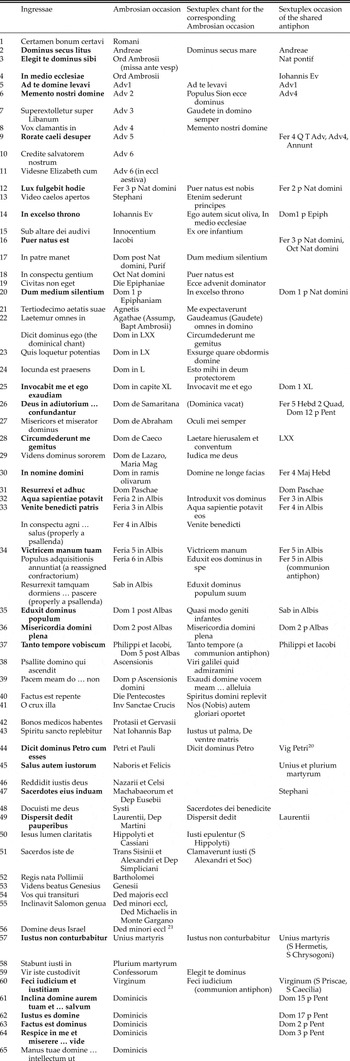
The occasions for which the Roman entrance antiphons were adopted (see Table 1) do not suggest a more precise date for the takeover than the rough guess that it was likely within the last quarter of the eighth century or in the first half of the ninth. The original borrowings were probably sufficient for all the occasions of the year – in earlier centuries the Milanese relied on chants of the commune much more than later; but that the number of corresponding ingressae is not greaterFootnote 17 suggests that they were borrowed somewhat before the compilation of the oldest surviving Franco-Roman Mass books, which date from the first half of the ninth century, and that the adopted chants (later greatly supplemented by the local production of ingressae) reflect an earlier and simpler Roman practice than is found in the Sextuplex. As for the haphazard correspondence in assignments seen in Table 1: at the time the entrance antiphons were taken over in Milan, the allocations to specific occasions were probably not fixed to the same degree as in later books.
Ambrosian ingressae and their assignments in the Sextuplex

Notes: Numbers in the first column give the order of the chants in the Ambrosian antiphoner. Incipits in bold identify chants with counterparts in the Sextuplex whose Gregorian and Ambrosian melodies are similar.
I have elsewhere considered at some length the question why the Milanese would accept some Roman chants and pass over others.Footnote 18 Concerning the introits, I will make only a few indicative suggestions. The Gregorian and Ambrosian chants for Christmas and Easter are the same, but not those of Epiphany and Pentecost. This is perhaps because the texts chosen for these latter occasions in Rome were already assigned in Milan. A psallenda, Ecce adveniet dominator, was sung twice in Milan – once on the fifth Sunday of Advent and again on the sixth; perhaps this was reason enough to rule out the text, which is more obviously appropriate to Advent than to Christmastide or Epiphany. As for Spiritus domini replevit: on Pentecost the text was employed in the Ambrosian antiphon ‘ad crucem’ and also in the alleluia verse of the Mass sung in the Winter Church.Footnote 19
The circumstances of Advent are harder to understand. The Ambrosians adopted only three introits from this season; for the other occasions they made use of locally produced chants. Four or more of the books of the Sextuplex agree on texts that would have been perfectly suitable (it is conceivable that these were taken over, but later replaced by local productions, but Milanese practice suggests that those replaced would have been reassigned). One of those not adopted, Populus Sion ecce dominus veniet, assigned in four of the ancient Mass books (Sextuplex sources RBKS) to the second Sunday of Advent, would probably have been passed over because the same text and melody were sung as the confractorium on the fourth Sunday. But two introits referring to the ‘nearness of the Lord’, Gaudete in domino (Sextuplex RBCKS), which contains the phrase, ‘dominus prope est’, and Prope esto domine (BCKS) were also passed over, as was Veni et ostende nobis faciem Footnote 22 (RBCKS). Perhaps when the introits were brought to Milan these particular Roman chants were not on the list at hand or, conceivably, were not known to any singers present.
The melodies compared
The Ambrosian and Gregorian melodies are not identical, and often look less similar than they really are because they have been notated at different pitch levels. To simplify the comparisons, I have transposed a number of Ambrosian antiphons to agree with the Gregorian tradition. The explanation for the differences between the melodies of the introits and ingressae is that Ambrosian chant had an independent, purely oral transmission until the mid-eleventh century.Footnote 23 As for the Gregorian, although the melodies were undoubtedly stabilised to some extent by the use of cheironomic notation from the beginning of the ninth century, pitch-accurate Gregorian sources are not that much earlier than the Ambrosian, and therefore between the presumed time of the appropriation of the Franco-Roman chants in Milan and the widespread acceptance of diastematic sources for the two repertories both would certainly have undergone the kind of change unavoidable in the circumstances of an oral tradition over a period of two hundred years or more. In any case, it should not be supposed that the shared chants were ever exactly the same: the transference of complex melodies from one location to another so that they were identical in every detail could only have been achieved with the aid of pitch-accurate notation.
I want now to speculate a little about the original neumation of the melodies. In earliest times (simple choral refrains apart), chants may have been recreated ex tempore by the cantor from known melodic types in accordance with widely accepted procedures. That is the classical model (whether it corresponds to reality or not). However, the consistently faithful reproduction in countless Gregorian manuscripts of inessential details (details that could not have belonged to the type-melody) is enough to demonstrate that by the time the chants were neumated they were thought of as idiomela, to be repeated as exactly as memory would allow from one occasion to the next. A cantor, relying entirely on his memory, would probably not sing a chant exactly the same way on two occasions; there is no reason to think this would have been a cause for concern. A schola would, for obvious reasons, be less likely to make spontaneous changes, but over time changes would occur, notwithstanding the cantor's supervision. It was certainly the cantor who decided what was the correct melody to be included in the archetypes of neumed service books (each intended, of course, for a single church or diocese). As for the practicalities of this initial neumation, two possibilities come to mind: the simplest is that the cantor, a competent musical scribe, singing the melody to himself (probably out loud) wrote it down just as he remembered it at that moment – thus casually creating what was henceforth the official version of the region;Footnote 24 a slightly more complicated alternative is that a second person (an expert scribe) entered the neumes while the cantor sang, repeating the chant as often as necessary. This hypothetical ‘expert scribe’ might, in principle, suggest corrections from his own memory, but the official Gregorian version (of St Gall or wherever) and the official Ambrosian version (of Milan and the archdiocese) were first and foremost what the respective cantors remembered on one particular occasion.
The appearance of the comparisons
In the comparisons, and not only for practical reasons, I make use of a very simple musical notation where letters stand for pitches. It should be assumed that all intervals are a fourth or smaller; on the rare occasions when a leap is a fifth or more, the direction of the interval is indicated by a sign (↑ or ↓).Footnote 25 Unless otherwise indicated every melody begins in the tetrachord of the finales; to indicate a beginning in the lower or higher tetrachord, one of these same signs will be prefixed.
Text setting is an important question, and since their text underlay is quite different it would be of interest to compare both the Ambrosian and the Gregorian versions of the entrance antiphons in this respect. In this article, I pass over this matter, but important melodic features explained by the necessities of text underlay are clearly visible in the examples. In both Gregorian and Ambrosian chant, the two usual methods used to stretch the melody to the syllables were (1) the repetition of single notes, and (2) the immediate repetition of brief melodic segments. The comparisons reveal both methods, but it will be obvious from the lack of agreement that the first was largely a casual matter. Much more important is the general agreement about the repetitions of melodic segments, which is a demonstration of concordance over and above the correspondence of pitch series.
In the nineteen comparisons, it is the outlines of the melodies that are juxtaposed, the series of pitches. Repeated single notes, even if they might amount to a transient recitation-tone (a pitch sung three or more times) are represented by a single letter in boldface; the obvious exception is when the last note of a text phrase is the same as the first note of the next. A verticule (|) indicates the end of a text phrase or logical break and marks points in the melody that correspond in both versions. To make it easier to refer to the melodies notated conventionally with their texts in publications and manuscripts, I include the words that occur just prior to these signs. I have used capital letters to show the notes shared by the Gregorian and Ambrosian versions (note that these upper-case letters are not meant to have any significance with respect to identifying octaves). The letter notation used in the comparisons presents the melodies as though compressed, but it is important to emphasise that the representations are only minimally reductive: no pitches are omitted.
The Gregorian versions are from the Graduale romanum Footnote 26 and they are always given first. The Ambrosian counterpart of this edition, the Antiphonale missarum … ecclesiae mediolanensis of 1935, is not nearly as reliable, and I have therefore transcribed the Ambrosian melodies from antiphoners B and D of the church of San Stefano in Vimercate (a suburb of Milan), one pair of the two earliest surviving manuscript sets, i.e., of the same ageFootnote 27 and used in the same church.
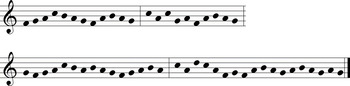
One can conceive that comparisons such as those presented below might be helpful in identifying type melodies, the basic notes of families of chants. But that task – assuming it is even possible – would require the comparison of all the members of each chant family, or at least a very large number. This is far from my present purpose, which is simply to compare pairs of melodies and establish the very interesting fact that they share so much. What they share, barring a certain amount of co-incidence, must have been present in the melodies as they were sung in Rome, and that so much of those melodies has survived the centuries seems, at this distance, nothing less than astonishing. What they do not share reveals the kinds of variation that occurred spontaneously in a repertory transmitted independently by rote. It is tempting to think that the shared portions of these melodies preserve the entire outline of the ‘original’ melody, or something close to its form at the time the Gregorian and Ambrosian traditions began to diverge. Indeed, if all the notes common to both versions are given on a staff (see for instance Example 1) one can easily imagine distributing the text in the usual ways (several syllables on one note, or their accommodation by re-iterations of brief passages), and thus (in some sense) reconstituting the melody – stripping away, as it were, the accretions of the centuries.
The notes shared by the four phrases of the Gregorian and Ambrosian versions of the Christmas chant, Lux fulgebit hodie (see comparison number 9 in Appendix).

But the ‘accretions’ that are thus omitted belong to the local melody, and, moreover, we could never be sure that all the important features of the original Roman version have survived the centuries (for we have no way of recovering its earliest form). I should rather have said ‘all the features we think are important’. Consider the cautionary example of the first four antiphons of the Ambrosian Commune dominicarum. By chance, the corresponding introits (and also Rorate caeli desuper, the Advent chant) begin with or include a melodic progression that most would consider characteristic of the first mode – that is:
 or

This ‘important’ figure appears in none of the corresponding ingressae.
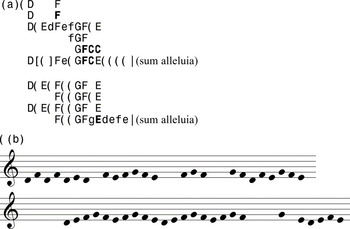
A final comment about the way of presenting the comparisons: it might seem that the relationships between the Ambrosian and Gregorian melodies would be easier to see in conventional notation, but that proves not to be the case. Letter notation is not only more compact but easier to interpret. Consider Example 2 in which the Gregorian and Ambrosian versions of the first phrase of Resurrexi et adhuc, the introit for Easter, are compared.
The first phrase of the Gregorian and Ambrosian Resurrexi et adhuc compared in letter and conventional notations.
Note: In the above example and in what follows, repeated segments of melody are aligned in successive lines; where an important note appears to be lacking I have suggested this by empty brackets.Footnote 28

Even when, as in Example 2(b), the melodic outlines are aligned as much as possible, the similarities are not nearly as easy to recognise in staff notation. I have referred already to incidental insights into the structure of melodies; as an example, note the two-part form of both versions of Resurrexi that is revealed by the arrangement of the letters in Example 2(a).
The large-scale structural repeats are interesting, but a more striking revelation of the musical examples given in this article is the procedure employed by the cantors to elaborate melodies. This mechanism is what my German colleagues would call Fortspinnung. In the arrangements of the letter-notation will be seen many instances of close repetition – sometimes quite extended – where two or three notes will be repeated, and the second iteration will be extended by a note or two, this in turn partly repeated and similarly extended. The following passage, which occurs in comparison 16 (see the second phrase of the ingressa), will illustrate:

I do not wish to suggest that the analyses presented in this article are the only ones possible.Footnote 29 The details will always be to some extent conjectural, for who can be sure how the ancients understood their melodies? But the way of proceeding, revealed again and again in example after example, seems clear and incontrovertible.
Gregorian and Ambrosian compared
To present all thirty-four pairs of antiphons would probably tax the patience and concentration even of the most interested. A neutrally chosen sampling of a few more than half of them will be sufficient for almost all purposes. In some cases, the resemblances are momentarily unclear, but the examples presented contain enough instances of those sorts of difficulties (which I will draw attention to and explain as necessary) that looking at all the rest would not change the general impression. I will begin with the seven shared entrance antiphons the Milanese assigned to the Commune dominicarum. I will also include the shared antiphons assigned to some of the most important occasions of the Ambrosian Temporale (the first Sunday of Advent, Christmas, the Sunday ‘at the beginning of Lent’, Palm Sunday, Easter, the first day of the Easter triduum), and those of saints' festivals where the text of the shared chant was proper to the occasion – that is, not taken from the Commune sanctorum (those of St Andrew, St Ambrose, St John the Evangelist, Sts Peter and Paul, St Lawrence, Sts Philip and James).
It might be expected that important occasions would have called for greater elaboration in the melodies, but that is not generally the case (the Christmas and Easter chants are not out of the ordinary). The ingressa for the Sunday in capite quadragesimae appears to be an exception (see comparison 10), although the elaboration might be a late development. The occasion is the day of the Ambrosian ‘farewell to the alleluia’ (Lent began the next day). Lengthy melismas are featured on this Sunday (which in some respects anticipated Easter), so I should mention that what appears to be an insertion in the last phrase of the ingressa is not a melisma: the extra notes are distributed – appropriately enough – over the phrase ‘glorificabo eum in longitudinem dierum’; in the Gregorian version these words have attracted no special treatment.
What is not shared in the comparisons is easy to see: individual notes or melodic passages belonging to one tradition and not the other are represented by lower-case letters. These departures from the path of the shared melody seldom amount to more than a few notes – often only one – and most can be described as alternate routes or diversions (so to speak) between the fixed points of the shared notes. The following example from comparison 9 will illustrate:

However, some insertions in the shared melody can be quite long, such as the ten notes just prior to the final cadence in the Milanese version of Inclina domine (see comparison 1). The last words of this ingressa (tota die) are not sufficiently charged to explain special treatment. The probable answer, here as in other similar cases, is that the extra notes were to accommodate the alleluia that would be added in Paschal time. This alleluia should not be expected in the Commune dominicarum, where chants were chosen for throughout the year. But alleluias are (for some reason) included in another dominical chant, this time an introit. See Exaudi domine vocem, comparison 3, where they explain the dozen or so extra notes in the first phrase of the introit, and again in the last (these alleluias are not included in the ingressa).
A momentary lapse of memory is one explanation for the dozen notes added at the beginning of the first phrase, and the other dozen added at the beginning of the fourth phrase of the dominical chant Dicit dominus ego (see comparison 7). Although the similarity of the introit and ingressa soon emerges – it is quite unmistakable in the second and third phrases – a relationship between the Gregorian and Ambrosian melodies is completely lacking at the beginning of the first and last phrases, where the Ambrosian version has been significantly developed. The opening words, ‘dicit dominus’ occur in two other Ambrosian chants, in an ingressa (Dicit dominus Petro) and in a psallenda (Dicit dominus simile). The latter opens in the same range and similarly:

It may be that there was some momentary confusion about the melody, but it is conceivable that the Milanese found unacceptable the strange (perhaps singular) openingFootnote 30 of the Gregorian antiphon:

There is nothing to explain the extra notes at the beginning of the Ambrosian last phrase of Dicit dominus. Finally, I should say that melodic elaborations in one version but not the other are never to be explained as word painting. In Ad te (domine) levavi (comparison 8) for instance, the notable forty-two inserted notes in the first phrase of the ingressa are in no way accounted for by the extra word, the ubiquitous ‘domine’.
Appendix: the comparisons
1 (61)Footnote 31. Inclina domine aurum

2 (62). Iustus es domine

3 (63). Exaudi domine vocem … tibi

4 (64). Factus est dominus

5 (65). Respice in meFootnote 32

6 (66). Dominus illuminatio meaFootnote 33

Footnote 7 (68). Dicit dominus egoFootnote 35

8 (5). Ad te (domine) levaviFootnote 36 (Advent 1)

9 (12). Lux fulgebit hodie (Christmas)

Footnote 10 (25). Invocabit me et (the Sunday before the beginning of Lent)

11 (30). In nomine domini (Palm Sunday)

12 (31). Resurrexi et adhuc (Easter)Footnote 38

13 (32). Aquae sapientiae potavit (Feria 2 post Pascha)

14 (2). Dominus secus mare/litus (for St Andrew)

15 (3). In medio ecclesiae (for the Ordination of St Ambrose)

16 (14). In excelso throno (for St John the Evangelist)

17 (37). Tanto tempore vobiscum (for Sts Philip and James)

18 (44). Dicit dominus Petro (for Sts Peter and Paul)

19 (49). Dispersit dedit pauperibus (for St Lawrence, St Martin)