Limited research on social networks among minority populations has found associations between social networks and preventive health service utilization among Hispanic and Black Americans (Kang & Bloom, Reference Kang and Bloom1993; Suarez et al., Reference Suarez, Ramirez, Villarreal, Marti, McAlister and Talavera2000); however, studies examining associations between social networks and health in American Indian/Alaska Native (AI/AN) populations are rare. In this study, a US national sample is used to: (1) compare the strength of AI/ANs social networks with those of non-Hispanic Whites and (2) examine the association between the strength of AI/AN social networks and self-reported health. The National Epidemiologic Survey on Alcohol and Related Conditions (NESARC) is a population-based epidemiological survey of adults in the United States, conducted in two waves between 2001 and 2005 (Grant et al., Reference Grant, Goldstein, Chou, Huang, Stinson, Dawson and Compton2009). Data on social networks as well as various health measures were collected in Wave 2 (2004–2005). Non-Hispanic White (NHW) and non-Hispanic AI/AN participants who provided data on social networks were selected for the sample. The sample was also restricted to those living in an urban or suburban location because rural areas were under-represented. After applying exclusion criteria, 16,447 NHW and 472 AI/AN participants were available for this analysis.
Cohen's Social Network Index (SNI), a 22-item instrument that measures the number of members and diversity of a social network and that has been used in a variety of studies since Reference Cohen and Sokolovsky1979 (Cohen & Sokolovsky), assesses the presence of twelve different types of relationships: spouse, grown children, parents, parents-in-law, close relatives, friends, neighbours, co-workers, fellow students or teachers, religious group members, volunteer group members and other group members (Cohen et al., Reference Cohen, Doyle, Skoner, Rabin and Gwaltney1997). Respondents reporting a certain type of relationship were then asked to give the number of members with whom he or she communicated socially at least once every 2 weeks. The number of members from each type of relationship with whom contact was made at least once every 2 weeks was summed to give the first measure of Cohen's SNI: total number of network members. These were added across the twelve different relationships possible. The second measure of Cohen's SNI (the network diversity score) was the total number of different relationship types that composed the social network, with a maximum of twelve possible.
Self-reported health was measured by the NESARC using the following question: ‘In general, would you say your health is excellent, very good, good, fair, or poor?’ This single-item self-reported health measure has been shown to be consistent with objective health measures (DeSalvo et al., Reference DeSalvo, Bloser, Reynolds, He and Munter2006). For descriptive purposes, participant age was grouped into the following categories: 20–29, 30–39, 40–49, 50–54 and 55 years and older. Age was treated as a continuous variable in regression models. Education level was categorized as less than high school graduate, high school graduate and more than high school graduate. Marital status was dichotomized as married or cohabiting versus not. Approximate quartiles were used to divide household income into categories of US$0–24,999, US$25,000–49,999, US$50,000–79,999 and US$80,000 and over.
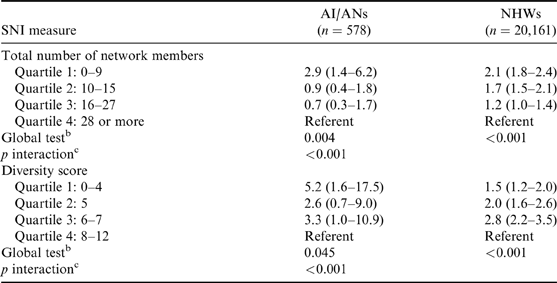
Survey weighted logistic regression was used to model the relationship between SNI and self-reported health (see Table 1). Moderation of these relationships by race was assessed using a test of interaction. Models were adjusted for sex, age, marital status, education and income. Social Network Index diversity and size measures were categorized by quartiles to allow consistent estimation of non-linear trends. Self-reported health was dichotomized as either good (good to excellent) or poor (fair to poor). Survey weights standardized the sample to that of the US adult population. Model coefficients were assessed for statistical significance using the Wald test at the 0.05 level. All statistical analyses were conducted using Stata version 11.2 (StataCorp, College Station, Texas).
Survey weighted logistic regression model estimates for odds of health outcomes by social network index (SNI) quartiles, NESARC 2001–2005a

a Adjusted for age, sex, marital status, education and income.
b Multivariate Wald test for whether the three ORs of poor health between quartiles are simultaneously 1, or equivalently consistent with no relationship.
c Obtained from logistic regression estimation of the interaction parameter in the joint model.
First, the different relationship types available for AI/AN and NHW participants were summarized. The two groups were similar with respect to availability of the five different familial relationships examined. Both AI/AN and NHW participants had an average of 3.1 familial types of relationships (95% CI for difference: −0.0, 0.1). However, for non-familial relationship contacts, the two groups differed. Only 15% of AI/ANs had at least one volunteer contact whereas NHWs had 21% (Fisher's Exact p<0.01). Thirty-three per cent of AI/ANs had at least one religious contact whereas 40% of NHWs had at least one religious contact (p<0.01). The mean number of non-familial types of relationships for AI/AN (2.5) was significantly lower than that of NHW (2.7, 95% CI for difference: −0.4, −0.1).
Next, the extent to which participants not only had available relationships, but also reported frequent contact with persons in those existing relationships, was examined. Again, AI/AN and NHW participants were similar with respect to the different types of familial relationships with which they had frequent contact. For most relationship types, the two racial groups were similar with respect to number of network members. These variables were then summed to calculate the two measures of Cohen's SNI and compare them across the two racial groups. Overall, the total number of social network members was similar among AI/AN (mean=24.3, SE=1.5) and NHW (mean=24.8, SE=0.3, p=0.72). In a regression model adjusting for demographic characteristics, network diversity scores did not differ between the two groups (mean difference comparing AI/AN to NHW: 0.0; 95% CI: −0.2, 0.2).
Forty per cent of AI/ANs in the lowest quartile of social network size reported poor health versus 18% in other quartiles. Only 20% of NHWs in similar social network size reported poor health versus 12.8% in other quartiles. AI/ANs had an associated 3.7 factor difference in odds ratios for poor health comparing small social networks with large ones (95% CI: 2.3–5.8). Similarly, AI/ANs with the least diverse networks had a 34% poor self-reported health versus 18% in other network diversities. Comparatively, NHWs had 23% poor health in lowest diversity networks versus 11% in others. AI/ANs relative to NHWs had an associated 2.6-fold difference in the odds ratio for poor health comparing least network diversity with others (95% CI: 1.7–3.9). The AI/ANs did not show further trends in poor health comparing other network quartiles (comparing 3rd and 2nd quartiles, OR 1.3, 95% CI: 0.5, 3.3) whereas NHWs in the 2nd quartile of social networks continued to show less favourable health conditions relative to those with larger networks (OR=1.5, 95% CI: 1.3–1.7). Similar results were found in comparing network diversity.
The above results indicate two primary findings: SNI measures of total network members and network diversity were strongly associated with self-reported health among AI/ANs. Those in the quartiles with the fewest members/types of relationships had worse self-reported health than those with other network sizes and diversities. Furthermore, this relationship was strongly moderated by race with AI/ANs showing a much greater difference in health outcomes than NHWs. Because this sample is restricted to urban and suburban participants, these results cannot be generalized to rural populations. Additionally, the cross-sectional nature of this study precludes causal conclusions regarding the association between SNI characteristics and self-reported health. Future research might address these areas.