Nosocomial infections are common among patients receiving extracorporeal membrane oxygenation (ECMO), and they are associated with increased mortality. The only known risk factors for infection in patients receiving ECMO are nonmodifiable and include time on the circuit as well as older patient age. Reference Grasselli, Scaravilli and Di Bella1,Reference Bizzarro, Conrad, Kaufman and Rycus2 Although modifiable risk factors in patients receiving ECMO are not known, it is difficult to determine which countermeasures to emphasize to prevent infections.
One time in the patient’s treatment course that may be associated with significant infectious risk is during interhospital transfer. Despite infection control best practices, pathogenic bacterial species are found in surveys of ambulances Reference O’Hara, Reed and Afshinnekoo3,Reference Wepler, Stahl and von Baum4 and uniforms of transporting medical personnel. Reference Mackay, Whitehead and Purdue5 Additionally, transported patients have been associated with nosocomial infections with antibiotic resistant organisms, especially in patients requiring military or international transport. Reference Sutter, Bradshaw and Simkins6–Reference Janvier, Delacour and Tesse8 Finally, the use of portable equipment, such as ventilators, has been historically associated with an increase in number of nosocomial infections and is an additional concern for infectious transmission. Reference Kollef, Von Harz and Prentice9
Over the past decade, the use of ECMO in adult patients has increased and subsequently so has interhospital transfer. Reference McCarthy, McDermott and Kini10 Several single-center studies have described successful transfers of cannulated patients with minimal logistical complications related to transfer. Reference Uribarri, Cruz-Gonzalez, Dalmau, Rubia-Martin, Ochoa and Sanchez11–Reference Mendes, de Albuquerque Gallo and Besen15 The largest multicenter trial in ECMO evaluating transfers showed benefits to both starting ECMO and transferring patients to ECMO centers compared to conventional therapy at a patient’s original hospital. Reference Peek, Mugford and Tiruvoipati16 With evidence of larger centers having better outcomes for patients on ECMO, there may be an increase in transport of patients receiving ECMO. Reference Barbaro, Odetola and Kidwell17 In this study, we aimed to clarify the risk, if any, of nosocomial infection related to transfer because recent studies that have assessed adverse effects of ECMO transfer have not quantified infectious complications. Reference Coppola, Tyree, Larry and DiGeronimo18,Reference Ericsson, Frenckner and Broman19 With the additional handoffs, extra personnel, and the difficulty of maintaining infection control strategies in multiple environments, we hypothesized that interhospital transfer may be associated with more nosocomial infections.
Methods
Patient selection and characteristics
A retrospective chart review was performed on all patients who received ECMO by the ECMO team at Brooke Army Medical Center (BAMC) between May 2012 and May 2020. Patients were enrolled retrospectively before 2017 and then prospectively for the remainder of this study. Patients were excluded from the analysis if they were transported by the ECMO team to another institution or if the patient received <48 hours of care on ECMO. Additionally, burn-injured patients were excluded because no burn-injured patients were transported to our facility and burns are associated with a higher infection rate among patients receiving ECMO. Reference Marcus, Piper and Ainsworth20
Transported patients were cannulated at the originating hospital by our ECMO team and treated by a multidisciplinary team of ECMO specialists, nurses, and physicians during transport as previously described. Reference Read, Nam and Biscotti21 ECMO therapy was performed using the CARDIOHELP system (Maquet, Rastatt, Germany). All patients from <400 km away were transported by ground ambulance, and patients from >400 km away were transported by fixed-wing aircraft followed by ground ambulance. At our institution, there are no protocols for routine use of prophylactic or periprocedural antimicrobials. Cultures are only obtained if there is clinical suspicion for infection. The BAMC Institutional Review Board approved this protocol.
Data collection
Data on gender, age, length of hospital stay, hours on ECMO, cannula configuration, cannulation facility, and patient survival to discharge from hospital were collected. Patients were categorized as having primarily medical, cardiac, or surgical-trauma admissions based on their admission diagnosis. Infections were defined as positive cultures while on ECMO or within 48 hours of decannulation and were deemed to represent true infections by the patient’s ECMO treatment team, as reported in other studies. Reference Grasselli, Scaravilli and Di Bella1,Reference Schmidt, Brechot and Hariri22 Cultures that had growth and were not treated with antimicrobial therapy by the primary team were considered colonizers or contaminants and were excluded from analysis. These infections were divided into bloodstream infections (BSIs), respiratory infections (RIs), skin and soft-tissue infections (SSTIs), and urinary tract infections (UTIs) based on collection site. Information on causative organism, drug susceptibility, and time to infection were collected. Pre-ECMO infections were defined as any positive viral, bacterial, or fungal pathogen during the hospitalization prior to cannulation that was deemed by the treatment team to be pathogenic. Multidrug-resistant organisms (MDROs) were determined for bacterial infections only; multidrug resistance was defined as resistance to 3 or more classes of antibiotics or as defined by the 2019 CDC Antibiotic Resistance Threat Report. 23,Reference Magiorakos, Srinivasan and Carey24
Statistical analysis
Nominal variables were compared using the Pearson χ2 or Fisher exact test as appropriate. Continuous variables were compared using the Mann-Whitney U test and were reported as medians with interquartile range (IQR). Patients that underwent on-site cannulation were compared to those that underwent cannulation at another facility and subsequent interhospital transfer based on demographics, characteristics of ECMO, and clinical infections. To further clarify the risk of infection, patients who underwent interhospital transfer were compared by mode of transportation whether by ambulance or fixed-wing aircraft followed by ambulance. A Kaplan-Meier curve compared time to first infection in both groups and was censored to 30 days to limit the effect of late infections because late infections were unlikely to be related to transfer. Based on the Kaplan-Meier curve, a Cox proportional hazard test was performed using factors that were significant on univariate analysis for risk of infection including admission diagnosis and ECMO modality. Time on ECMO was not included in the model because time was censored. Statistical analyses were conducted using JMP version 13.2 software (SAS Institute, Cary, NC). A P value <.05 was predetermined to indicate significance.
Results
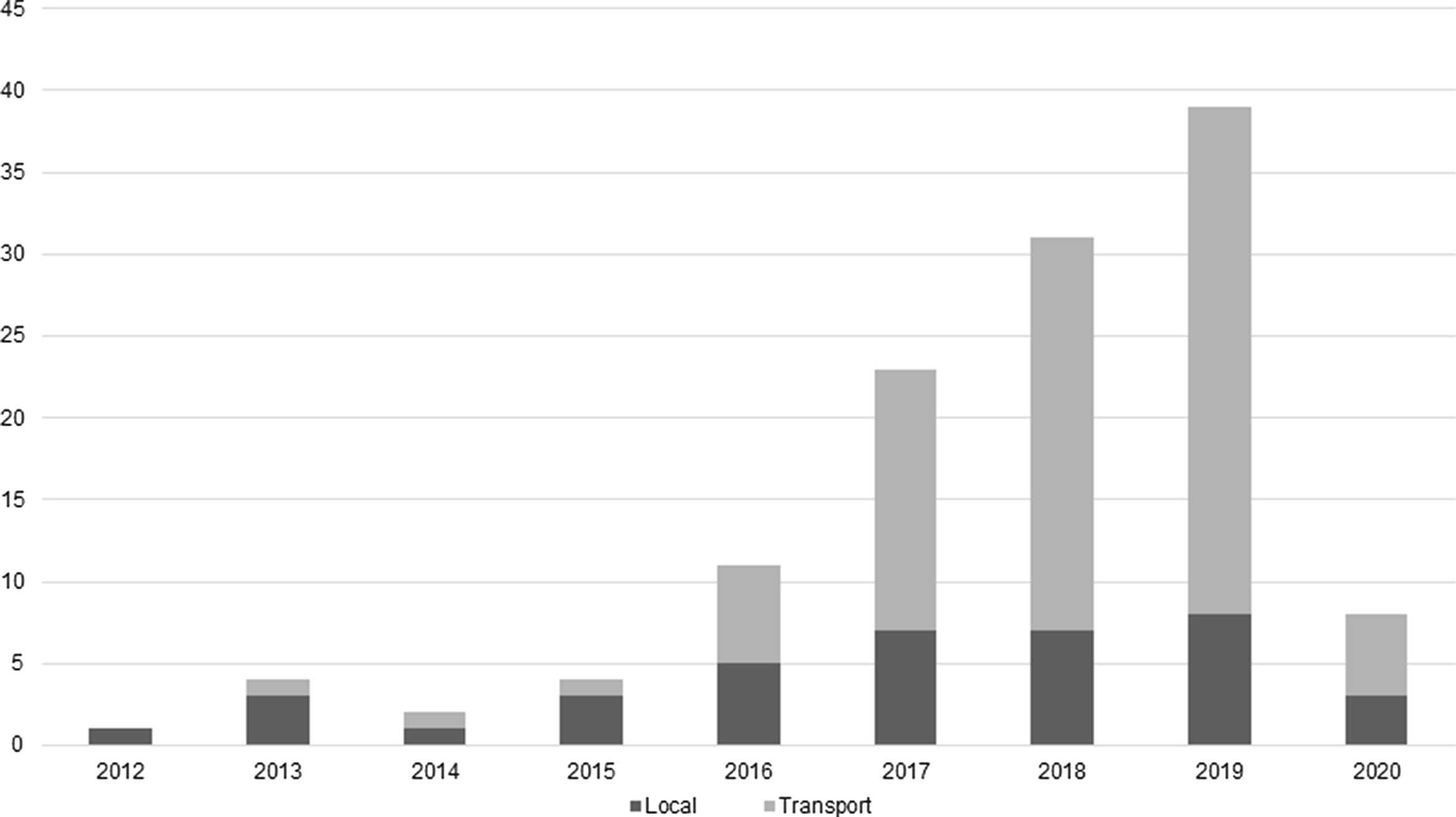
In total, 179 ECMO runs were completed by our institution’s ECMO team in the study period (Fig. 1). Of these patients, 56 (31%) were excluded: 11 were transported by our team to another institution, 19 received an ECMO course <48 hours, and 26 were burn injured. Since its inception in 2012, the BAMC ECMO program has had a steady increase in cases, and this increase was primarily driven by an increase in the number of patients transported from other institutions (Fig. 2). Patients were more commonly male (73%) with a median age of 40 years (Table 1). The median time on ECMO and length of stay was 233 hours and 22 days, respectively. Veno-venous ECMO was used for most cases (85%). Overall, 72% of patients survived to hospital discharge. The most common indications for ECMO by admission diagnoses were influenza for medical admissions (n = 22, 27%), acute respiratory distress syndrome after polytrauma for surgical admissions (n = 14, 58%), and failure to wean from bypass after cardiothoracic surgery for cardiac admissions (n = 5, 32%). Moreover, 38 patients (31%) were cannulated at our institution. Of the 85 (69%) patients who were transferred to our institution, 74 (87%) of these patients were cannulated <400 km away and transported by ground ambulance. The remaining 11 patients were transferred via fixed-wing aircraft, including from the countries of Colombia, Germany, Iraq, Japan, and South Korea.
Development of the study cohort.

Number of patients receiving extracorporeal membrane oxygenation at Brooke Army Medical Center from April 2012 through May 2020. All local patients were cannulated at our facility. Transport patients were cannulated at an outside hospital prior to transfer.

Baseline Demographics of Patients Receiving Extracorporeal Membrane Oxygenation Between May 2012 and May 2020

Note. ECMO, extracorporeal membrane oxygenation.
To evaluate for nosocomial infections associated with interhospital transfer, patients cannulated at our institution (local) were compared against those who were cannulated at other hospitals (transfer). There was no differences in median age among local and transferred patients (43 years vs 39; P = .15), sex (76% male vs 71%; P = .51), or hospital length of stay (27 days vs 20; P = .34). Patients who were transferred had greater median time on ECMO (150 hours vs 257 hours; P = .04). Surgical and trauma admission diagnoses were more common among those cannulated at our institution, whereas patients with medical admission diagnoses were more likely to be accepted from an interhospital transfer. All patients cannulated at our institution and 66 patients (78%) cannulated at other institutions had data on pre-ECMO infection available for review. Finally, 64% of interhospital transfers versus 39% of locally cannulated patients had an infection prior to ECMO initiation (P = .02).
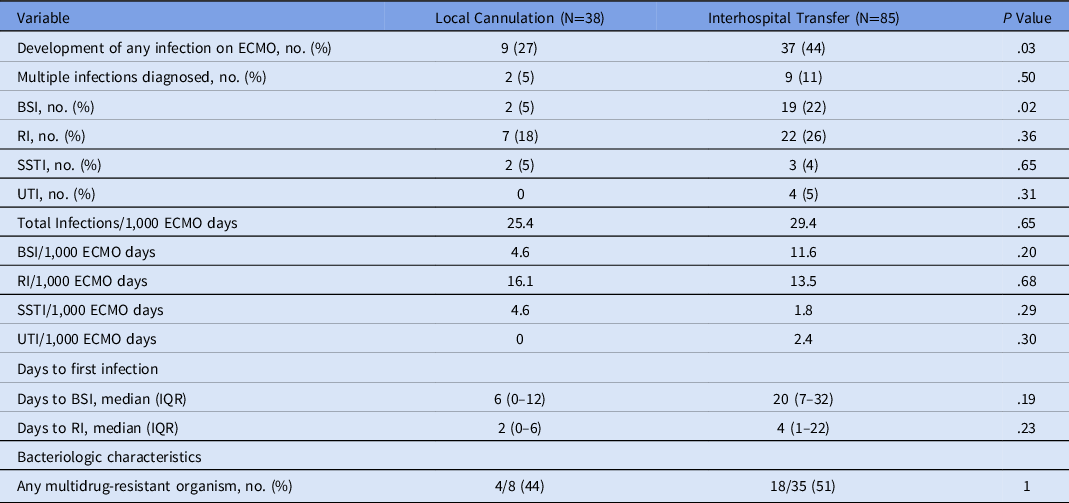
Overall, there were 59 infections in 49,576 hours of ECMO for an infection rate of 28.6 infections per 1,000 patient days (Table 2). Patients who were transferred had significantly more incidents of infections than patients who were cannulated locally (44% vs 27%; P = .03) but there was no difference between the 2 groups when evaluating infections per 1,000 ECMO days (25.4 local vs 29.4; P = .65) by univariate analysis. Although BSI was more common among patients with interhospital transfers (22% vs 5%; P = .02), this difference was no longer significant when controlled for time on ECMO (4.6 vs 11.6 per 1,000 ECMO patient days; P = .10). We detected no difference in other infection types, number of infections in the first 5 days after cannulation, number of patients having multiple infections, or infections due to drug-resistant organisms.
Characteristics of Nosocomial Infections for Patients Receiving Extracorporeal Membrane Oxygenation

Note. ECMO, extracorporeal membrane oxygenation; BSI, bloodstream infection; RI, respiratory infection; SSTI, skin and soft-tissue infection; UTI-urinary tract infection.
The patients who underwent interhospital transfer were further subdivided by travel modality. Compared to patients who were transported by aircraft, patients who were transported by ground showed no difference in the number of patients with infections (36% vs 45%; P = .75), rates of nosocomial infections per 1,000 patient days (32.0 vs 31.1; P = .94), or infections caused by MDROs (75% vs. 48%; P = .60).
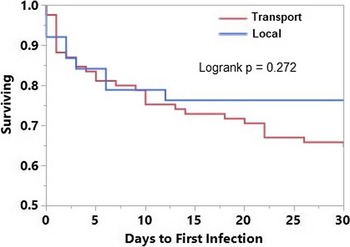
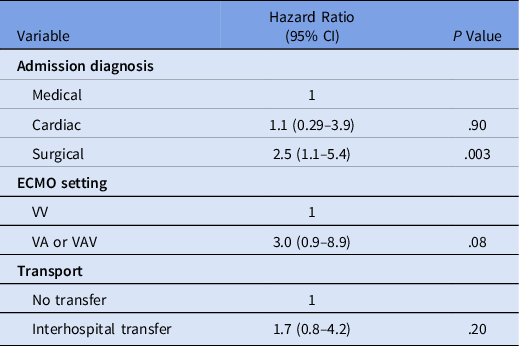
A Kaplan-Meier curve showed that that there was no difference in time to first infection between the 2 groups (log-rank test P = .27) (Fig. 3). The Cox proportional hazard test did not show a significantly increased risk of infection with interhospital transfer (hazard ratio [HR], 1.7; 95% CI, 0.8–4.2; P = .20) (Table 3 ). Surgical patients, compared to medical patients, had more nosocomial infections (HR, 2.5; 95% CI, 1.1–5.4; P = .003). We detected no difference in infectious risk by ECMO modality infections as determined by ECMO modality (HR, 3.0; 95% CI, 0.9–8.9; P = .08). Pre-ECMO infection did not change significance when added to the model (data not shown) and was excluded.
Kaplan-Meier curve showing time to first infection for patients who underwent interhospital transfers versus those cannulated locally. Time censored to 30 days after cannulation.

Cox Proportional Hazards Model for Development of Infection on ECMO

Note. ECMO, extracorporeal membrane oxygenation; VV, veno-venous; VA, veno-arterial; VAV, veno-arterio-venous.
Discussion
In this study, we detected no difference in whether a patient underwent interhospital transfer on ECMO and subsequent rates of nosocomial infections. In conjunction with data showing decreased mortality in patients who were transported, these findings further confirm the safety of transporting patients on ECMO in this critically ill population. Despite the high risk of nosocomial infections in this population, we did not find a possible area for intervention.
Rates of infections in this study of 28.6 infections per 1,000 patient days are similar to the national average in adults reported in a national survey of ECMO centers, 30.6 infections per 1,000 patient days. Reference Bizzarro, Conrad, Kaufman and Rycus2 These data are in line with data from other individual centers, with several slightly higher nosocomial infection rates (reported rates, 50.4–75.5 infections per 1,000 patient days) Reference Grasselli, Scaravilli and Di Bella1,Reference Schmidt, Brechot and Hariri22,Reference Pieri, Agracheva and Fumagalli25 and others with slightly lower nosocomial infection rates (11.9 infections per 1,000 days). Reference Hsu, Chiu, Huang, Kao, Chu and Liao26 These differences are likely due to patients’ underlying pathologies, cannulation practices, type of ECMO configuration used, as well as underlying nosocomial infection rates at different hospitals. The overall survival for this cohort, 72%, is higher than the international average reported by ELSO for patients receiving veno-venous ECMO of 58%. Reference Kon, Bittle and Pasrija27
We detected several demographic differences between the group of patients transported compared to those cannulated at our institution. Notably, admission diagnosis and ECMO modality used were different between these 2 groups of patients. As a level 1 trauma center, surgical patients are more likely to be admitted initially at our facility and less likely to be transferred from other institutions. Without transplant capabilities, there is also likely selection bias for our center to accept patients with reversible causes of respiratory failure, which would favor the veno-venous modality. Secondly, patients who were transferred spent significantly more time on the ECMO circuit, which is a known risk factor for nosocomial infection. Reference Juthani, Macfarlan, Wu and Misselbeck28 The cause of these differences is unclear, but they may be related to adherence to selection criteria, a lower number of emergent cannulations, or earlier cannulations to prevent decompensation during transport. A final difference in demographics is that more patients were started on veno-arterial ECMO at our facility, which has been associated with an increased risk of nosocomial infections in other studies but did not reach statistical significance in this study. Reference Bizzarro, Conrad, Kaufman and Rycus2,Reference Aubron, Cheng and Pilcher29 Larger multicenter studies will be needed to take into account the wide variety of specialties that rely on ECMO to determine the generalizability of these findings. Reference Broman, Holzgraefe, Palmér and Frenckner30
In this study, we found no significant increase in the rates of nosocomial infections by univariate, Kaplan-Meier analysis, or multivariate analysis in groups that underwent interhospital transfer compared to groups that did not. To provide a plausible mechanistic relationship between transport and subsequent infections, first infections were censored to 30 days, which may have excluded differences that were caused by longer time on ECMO in the transported group.
Further data arguing against a mechanistic relationship between transport and nosocomial infections include the long duration (20 days) of onset of BSI in the transported group. Although previous retrospective studies have shown that portable ventilators are associated with increased infection rates, Reference Kollef, Von Harz and Prentice9 we did not detect an increased risk of respiratory infection or a shorter time to onset of respiratory infection in our transferred patients. Ultimately, our study is underpowered to assess these features. Finally, distance traveled and modality of transfer were not risk factors for nosocomial infection for patients transported on ECMO in this study. Because those transported by fixed-wing aircraft had longer transport times, this analysis argues against a longer transit time being a risk factor for nosocomial infection.
We detected no difference in the incidence of MDROs between transported patients and local patients. Additionally, patients transported from other countries were not noted to have an elevated risk of MDROs. This finding contrasts with the known risk of interhospital MDRO spread with patient transfers in previous studies. We suspect that with the high background rate of MDROs our study is not powered to evaluate a smaller increased risk of MDRO acquisition from other facilities or during transport. As shown in other centers, the rates of MDRO are high in patients undergoing ECMO. Reference Grasselli, Scaravilli and Di Bella1 This high overall rate of MDROs across cohorts is concerning because infections caused by MDROs lead to greater patient cost as well as higher mortality. Reference Johnston, Thorpe, Jacob and Murphy31,Reference Neubeiser, Bonsignore and Tafelski32 Robust antibiotic stewardship and infection control practices are needed in all critically ill patients due to the high risk of acquisition of a resistant organism, and increased attention to the care of ECMO patients may be warranted.
As a single-center study, our protocol had several limitations that require further exploration. Our center mostly provides veno-venous ECMO; thus, these data may not be applicable to centers that provide primarily veno-arterial ECMO or transplant candidates. Although the treatment team’s determination of positive cultures being a pathogen or a contaminant is the standard in ECMO papers that allows rates to be compared between studies, it is unclear whether there is a bias present in these infection determinations. The study was likely underpowered to detect small differences that may exist between groups. The lack of outside hospital records also made it impossible to calculate a disease severity score for patients receiving ECMO or the presence of pre-hospital ECMO infection suggesting a potential selection bias. Ideally, this analysis could be repeated as a multicenter study to get a better understanding of the effect of transport on a wider variety of ECMO modalities and underlying disease processes.
In conclusion, we evaluated risk of development of a nosocomial infection while on ECMO, and we demonstrated that there is a significant increase in the rate of nosocomial infections among those who were transferred. Although there was no statistical difference in multidrug-resistant organisms, our findings demonstrate the need for aggressive infectious control practices because these patients are commonly infected with MDROs. Furthermore, our findings are similar to previous studies concluding that transfer on ECMO is not related to increased mortality. Further studies are needed to better elicit the risk factors of nosocomial infections complicating the course of ECMO.
Acknowledgments
The view(s) expressed herein are those of the author(s) and do not reflect the official policy or position of Brooke Army Medical Center, the US Army Medical Department, the US Army Office of the Surgeon General, the Department of the Army, the Department of the Air Force, or the Department of Defense or the US government.
Financial support
This work was funded by the 59th Medical Wing Office of Science and Technology.
Conflicts of interest
All authors report no conflicts of interest relevant to this article.