Introduction
Porphyrins and their derivatives with well-defined size and chemistry are essential building blocks for the synthesis of active nanostructured materials for various applications, including light harvesting, photocatalytic synthesis, and water splitting.Reference Blankenship1–Reference Drain, Varotto and Radivojevic8 It has been shown that efficient electron or energy transport relies not only on intermolecular forces (such as hydrogen bonding, and π–π stacking), but also on ordered intermolecular arrangements, morphology, and dimension control.Reference Drain, Varotto and Radivojevic8–Reference Wagner, Johnson and Lindsey18 For example, the formation of ordered porphyrin nanoparticles with spatial control or axial porphyrin arrangement leads to significantly better photocatalytic activity.Reference Gong, Milic, Xu, Batteas and Drain17,Reference Wang, Zhong, Wang, Zhan, Cao, Bian, Alarid, Haddad, Bai and Fan19–Reference Zhong, Wang, Zhang, Bai, Wu, Haddad and Fan22 Thus, the potential of these materials is directly connected to the ability to control and engineer well-defined material structures, including size, shape, dimension, and spatial or axial intermolecular arrangements, which drives extensive synthetic efforts.
Earlier studies on the formation of porphyrin arraysReference Barlow, Scudiero and Hipps23–Reference Scudiero, Hipps and Barlow25 were limited to two-dimensional arrays with ill-defined material morphology and without long range order. Three-dimensional (3D) porphyrin assemblies have been demonstrated through solid-state synthesis.Reference Goldberg26 However, the resulting materials exhibited uncontrolled external morphology and structure dimensions. Recently, multichromophoric arrays and dendrimers were elegantly synthesized as antennas, and their photophysics were investigated.Reference Wagner, Johnson and Lindsey18,Reference Gensch, Hofkens, Heirmann, Tsuda, Verheijen, Vosch, Christ, Basché, Müllen and De Schryver27,Reference Hofkens, Maus, Gensch, Vosch, Cotlet, Kohn, Herrmann, Mullen and De Schryver28 However, the complex multistep syntheses needed generally make it difficult for reproducibility and the engineering of material structure and properties, which hinders practical applications. More recently, efforts have been made to direct the synthesis of one-dimensional (1D) nanostructures. For example, 1D porphyrin arrays were synthesized through electrostatic interactions and ionic self-assembly (see also the Zhong et al. article in this issue).Reference Wang, Medforth and Shelnutt29–Reference Hu, Guo, Liang, Wan and Jiang32
Despite these recent advances, methods to engineer the assembly of porphyrins into well-defined 1D–3D nanostructures as model materials for the fundamental understanding of chemical and physical properties are still limited. Technologies to leverage the structural advantages of individual porphyrins amenable to energy-storage applications remain a significant challenge. Key factors such as molecular arrangement, types of noncovalent interactions, and shape have been demonstrated to be critical within specific 1D–3D nanostructures for charge and energy transfer. In this article, the cooperative self-assembly method will be discussed as a way to use amphiphilic surfactants and block copolymers to form “micelle-like” nanostructures to confine nucleation and growth of well-defined optical and electrically active nanostructures with precisely controlled size, shape, and spatial or axial molecular arrangement. The method realizes the intrinsic advantages of individual porphyrin and derivatives by engineering them into well-defined 1D–3D nanostructures.
Molecular porphyrin building blocks
The successful synthesis of ordered nanostructured materials with desired structure and function relies on the correct choice of the molecular building blocks. Porphyrins and their derivatives have a well-defined size close to 2 nm × 2 nm × 0.5 nm and controlled chemistry. They have been demonstrated for new optical and electrical applications in the areas of molecular electronics, photosensitized solar cells, and sensors due to their unique aromatic structure and excellent photochemical and photophysical properties.Reference Dolphin3–Reference Drain, Varotto and Radivojevic8 In addition to single molecules, extensive studies has been devoted to creating highly ordered arrays of porphyrins by assembling them in a well-defined manner aimed at constructing devices that can efficiently capture light and utilize the excitation energy to realize long-range transfer to a designated acceptor.
Similar to chlorophyll chromophores in natural light-harvesting systems, the key driving forces for porphyrin assembly are (1) π–π interactions (or stacking) between the porphyrin macrocycles; (2) coordination of the central ion. The core porphyrin ring is stable under a wide range of temperatures, pH, and other environmental conditions. The oxidation and reduction potentials, and, therefore, the chemical and physical activities, can be tuned by appropriate choice of the metal ions chelated in the center of the porphyrins. Axial ligation of the chelated compounds affords an additional means for assembly or organization;Reference Drain, Varotto and Radivojevic8 and (3) Hydrogen bonding of hydroxyl groups (–OH) or carboxylic acid groups (–COOH). The rigid, planar macrocycles are amenable to appending a variety of auxiliary moieties, such as H-bonding motifs and ligands that are situated outside of the porphyrin ring, at predefined geometries for the synthesis of designed supramolecular systems.Reference Drain, Smeureanua, Patela, Gong, Garnod and Arijeloyea4 The self-assembly of porphyrins by these noncovalent interactions offers several advantages, including formation of desired structures with precise arrangement of porphyrin building blocks, relatively easy synthesis and purification, and generation of the most thermodynamically stable structures.
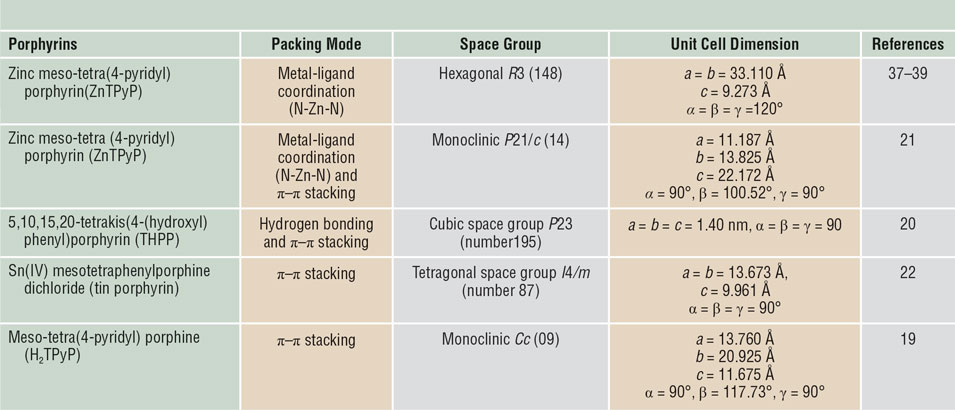
Porphyrins self-assemble into bulk crystalline materials through intermolecular noncovalent interactions. These materials usually have undefined morphology.Reference Goldberg26 In bulk synthetic environments, rational control of structure (e.g., dimension, shape) has not been accomplished. Understanding porphyrin self-assembly and aggregation allows for the synthesis of ideal well-defined nanostructures for efficient light harvesting and optimized charge or energy transfer for the fabrication of new solar cells. Table I shows some of the porphyrins that have been used for recent syntheses of ordered porphyrin arrays, including the types of interactions, crystalline structure, and dimensional parameters.
Porphyrins and their packing structures through noncovalent interactions.
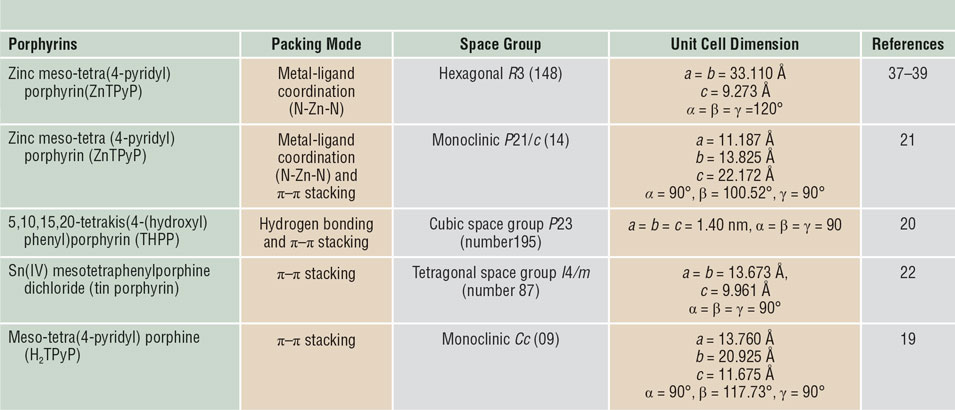
Note: a, b, c, unit cell dimensions; α, β, γ, unit-cell angles.
Confined nucleation and growth of well-defined porphyrin nanostructures
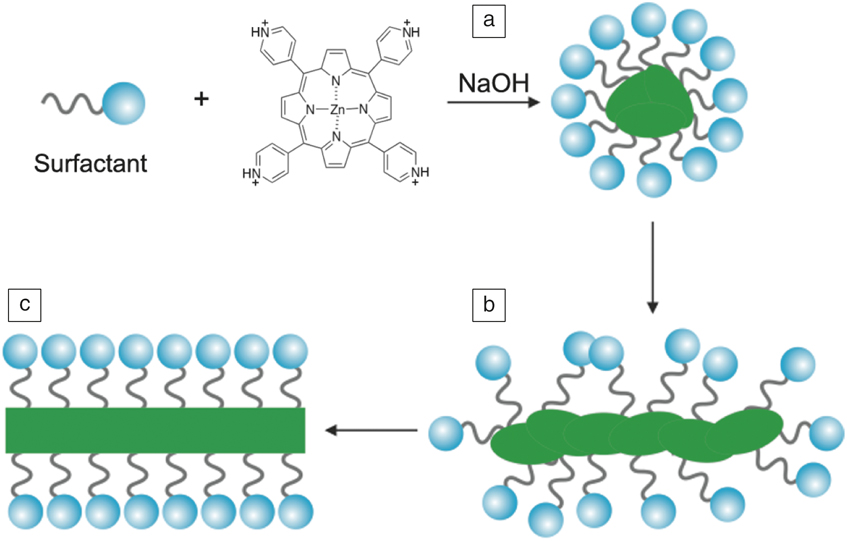
Cooperative self-assembly uses “micelle-like” nanostructures to confine nucleation and growth to form well-defined porphyrin nanostructures (Figure 1). In an interfacially driven microemulsion process, the concept was originally developed through formation of nanoparticle micelles by encapsulation of nanoparticles into the interior of surfactant micelle structures and thereby forming stable monodisperse nanoparticle micelles.Reference Fan33–Reference Fan, Yang, Boye, Sigmon, Malloy, Xu, Lopez and Brinker35 Chen et al. demonstrated the synthesis of 1D FePt nanorods through micelle-confined nucleation and growth.Reference Chen, Pica, Jiang, Li, Yano, Liu, Datye and Fan36 Their results indicate that nucleation and growth confined in micelle structures such as cylindrical or lemallar micelles often result in the formation of 1D nanostructures. Otherwise, nanostructures with spherical shape dominate.
Schematic illustration of surfactant-assisted cooperative self-assembly through confinement of nucleation and growth of porphyrin to form 1D porphyrin nanostructures. (a) Encapsulation of porphyrin (green) inside the surfactant micelle. (b) Nucleation of porphyrin aggregation within the micelle. (c) Growth of 1D porphyrin nanostructure.Reference Zhang, Wang, Wang, Cao, Wang, Bai and Fan20

Recently, this method was extended to incorporate porphyrin building blocks (see Table I) within the micelle interiors to confine molecular self-assembly.Reference Wang, Zhong, Wang, Zhan, Cao, Bian, Alarid, Haddad, Bai and Fan19–Reference Zhong, Wang, Zhang, Bai, Wu, Haddad and Fan22,Reference Bai, Sun, Wu, Haddad, Coker, Huang, Rodriguez and Fan37–Reference Wang, Niu, Qiao, Cheng, Wang, Zhong, Bai, Wang and Fan40 Once positioned inside the micelle-like structures, self-assembly of these molecular building blocks is confined and directed by the varied shapes of the micelle structures. Different from bulk synthesis in which diverse material morphologies and shapes may be randomly formed with no control, the micelle-like structures confine and direct the formation of nanostructures, which leads to controlled structures and shapes with reproducibility. Through careful design and engineering, well-defined 1D–3D nanostructures with different shapes have been fabricated through the utilization of various surface micelles, emulsions, and mesophases.Reference Wang, Zhong, Wang, Zhan, Cao, Bian, Alarid, Haddad, Bai and Fan19–Reference Zhong, Wang, Zhang, Bai, Wu, Haddad and Fan22,Reference Bai, Sun, Wu, Haddad, Coker, Huang, Rodriguez and Fan37–Reference Sun, Bai, Wu, Schmitt, Boye, Zhang, Wang and Fan42
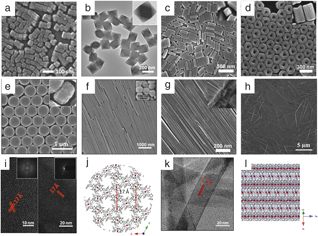
Figure 2 shows a gallery of nanostructured porphyrin arrays that have been synthesized through the surfactant-assisted cooperative self-assembly method. Relying on noncovalent interactions, porphyrins self-assemble into hierarchical nanostructures with controlled size and shape. At the molecular level, porphyrins provide unique surface chemistry for noncovalent interactions and unique optical and electrical properties. On the nanoscale, controlled noncovalent assembly of porphyrins confined within micelles enables the formation of ordered crystalline nanostructures with precisely defined size, shape, and intermolecular arrangement of the individual porphyrins.
Scanning electron microscope (SEM) and transmission electron microscope (TEM) images of porphyrin nanomaterials with different shapes and sizes synthesized through the surfactant-assisted cooperative self-assembly method. (a) Nanoparticles.Reference Wang, Niu, Qiao, Cheng, Wang, Zhong, Bai, Wang and Fan40 (b) Nano-octahedra; (inset) TEM image of the octahedron porphyrin particle.Reference Wang, Zhong, Wang, Zhan, Cao, Bian, Alarid, Haddad, Bai and Fan19 (c) Tetragonal nanorods; (inset) cross-sectional SEM image of the porphyrin nanorods.Reference Zhong, Wang, Zhang, Wei, Wang, Lu, Bai, Wu, Haddad and Fan21 (d) Hexagonal nanorods; inset: cross-sectional SEM image of the porphyrin nanorods.Reference Bai, Sun, Wu, Haddad, Coker, Huang, Rodriguez and Fan37 (e) Nanodisks; (inset) cross-sectional SEM image of the porphyrin nanodiscs.Reference Bai, Wu, Haddad, Sun, Schmitt, Skocypec and Fan38 (f) Hexagonal nanowires; (inset) cross-sectional SEM image of the porphyrin nanowires.Reference Wang, Zhong, Wang, Zhan, Cao, Bian, Alarid, Haddad, Bai and Fan19 (g) Short nanowires; (inset) SEM image of the bundles of the porphyrin nanowires.Reference Bai, Sun, Wu, Haddad, Coker, Huang, Rodriguez and Fan37 (h) Long nanowires.Reference Zhang, Wang, Wang, Cao, Wang, Bai and Fan20 (i–l) TEM images and the corresponding crystalline structures of self-assembled ZnTPyP. (i) (Left): Side view along the nanorod; inset shows the selected-area electron diffraction. (Right): Top view of the nanorod; inset shows the fast Fourier transform pattern. (j) Simulated crystal structure of hexagonal nanorods in (i); Zn (red) and C (gray). (k) TEM image of the nanowires. (l) Simulated crystal structure of the nanowires viewed along the crystallographic c-axis in (k); Zn (red), N (blue), and C (gray).Reference Bai, Sun, Wu, Haddad, Coker, Huang, Rodriguez and Fan37 Note: ZnTPyP, zinc meso-tetra(4-pyridyl)porphyrin.

Bai et al. reported the synthesis of nanoporous 1D photoactive porphyrin nanowires through surfactant-assisted micelle-confined cooperative interactions, including π–π stacking and ligand coordination using zinc meso-tetra(4-pyridyl)porphyrin (ZnTPyP).Reference Fan33 The crystal structures show the hexagonal space group R with unit cell dimensions a = b = 33.110 Å, c = 9.273 Å, α = β = 90°, and γ = 120°. In this structural model, each ZnTPyP molecule’s central Zn atom is coordinated to two pyridyl nitrogen atoms of the neighboring ZnTPyP approaching from both faces. Each ZnTPyP molecule is bound to four neighbors through four identical ZnN axial ligations, two at its Zn core and two at opposite sides of its peripheral pyridyl groups, forming hexagonal shape micropores. This leaves two remaining pyridyl groups of ZnTPyP unligated and exposed at the surface of the pores, which provides active sites for further functionalization. Through kinetic control of the self-assembly process, nanowires with controlled diameters and aspect ratios can be synthesized.
Table I summarizes some of the other examples of noncovalent interactions and resultant crystalline structures and unit cells. In addition to x-ray characterization, molecular spectroscopy has demonstrated effectiveness in identifying noncovalent interactions. Each porphyrin molecule has distinctive absorption and emission properties. Molecular aggregation causes spectrum changes that have been used to monitor structure formation. For example, porphyrin assembly through π–π stacking shows ultraviolet–visible (UV–vis) peak shifts in the visible spectrum, which reflects the extent of the self-assembly or aggregation during nucleation and growth.Reference Wang, Zhong, Wang, Zhan, Cao, Bian, Alarid, Haddad, Bai and Fan19,Reference Zhong, Wang, Zhang, Wei, Wang, Lu, Bai, Wu, Haddad and Fan21,Reference Fan33 These ordered molecular packing modes essentially facilitate intermolecular charge, energy transfer, or delocalization for photoactive processes. On the macroscale, ordered arrays of these nanostructures allow easy device fabrication for investigating synergetic optical/electrical properties to correlate structure–property relationships.Reference Wang, Zhong, Wang, Zhan, Cao, Bian, Alarid, Haddad, Bai and Fan19–Reference Zhong, Wang, Zhang, Bai, Wu, Haddad and Fan22,Reference Wang, Zhong, Wang, Yang, Bai, Zhang, Alarid, Bian and Fan39,Reference Wang, Niu, Qiao, Cheng, Wang, Zhong, Bai, Wang and Fan40
One potential challenge to realizing confined molecular assembly is the success of encapsulating porphyrin building blocks into the micelles. Previous studies indicated that it is vital to keep the surfactants’ concentration c surfactant greater than the critical micelle concentration (c cmc) for encapsulation of hydrophobic species.Reference Wang, Zhong, Wang, Zhan, Cao, Bian, Alarid, Haddad, Bai and Fan19–Reference Zhong, Wang, Zhang, Bai, Wu, Haddad and Fan22,Reference Bai, Sun, Wu, Haddad, Coker, Huang, Rodriguez and Fan37–Reference Wang, Niu, Qiao, Cheng, Wang, Zhong, Bai, Wang and Fan40 For single-tailed surfactants, an alkane chain of eight or more carbons is required to stabilize particles with size of 1–3 nm and form stable micelles in aqueous solutions.Reference Fan33–Reference Fan, Yang, Boye, Sigmon, Malloy, Xu, Lopez and Brinker35 The surfactant-assisted self-assembly and encapsulation mechanism varies with the types of amphiphiles (cationic, ionic, or neutral), length of tail groups, and the nature of molecular building blocks (e.g., with or without charges) used.
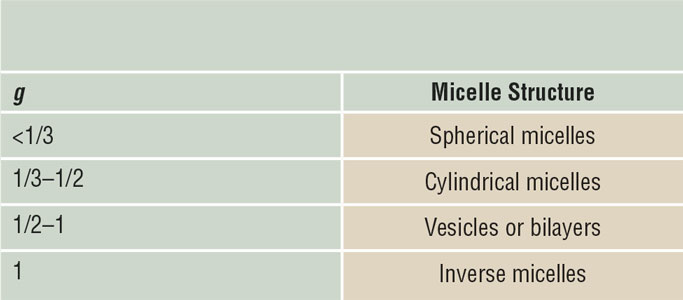
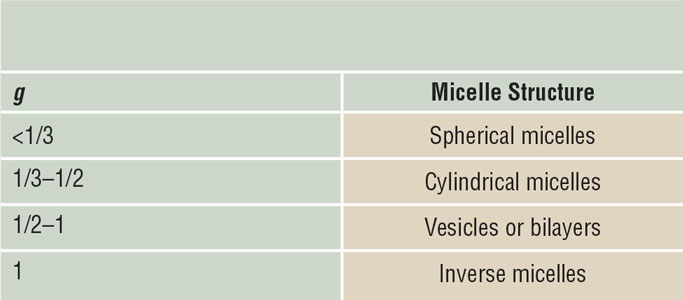
In principle, it is possible to predictably develop a specific micelle structure for confined synthesis of specific nanostructures through control of both the shape and concentration of surfactants. This can be guided by the surfactant critical packing factor  $g = {v \over {a_0 \bullet l}}$, where v is the total volume of the surfactant chains plus cosolvent organic molecules between the chains, a 0 is the effective head group area at the micelle surface, and l is the kinetic surfactant tail length or the curvature elastic energy.Reference Israelachvili43 Table II shows the micelle structures formed by some common amphiphiles and how these can be tuned by varying the critical packing factor. More importantly, this would increase reproducibility for the synthesis of specific nanostructures for desired properties, which is critical for correlating the synthesis–structure–property relations and to amplify the intrinsic advantages of individual porphyrins.
Expected micelle structure sequence as a function of the packing parameter, g. Reference Israelachvili43
Conclusions
We summarize the surfactant-assisted cooperative self-assembly method using surfactant “micelle-like” structures described in this article. Porphyrin nucleation and growth confined within these “micelle-like” structures driven by intermolecular interactions such as π–π stacking and axial coordination leads to the formation of well-defined 1D–3D optically and electrically active nanostructures. Through kinetic control, this method readily allows for fine tuning of the nanostructure and function on multiple length scales and multiple locations. These ordered nanostructures with controlled size, shape, molecular arrangement, and dimensions will provide a controllable model system to correlate synthesis–structure–property relations and to amplify the intrinsic advantages of individual porphyrins for application in light harvesting and energy storage. The method should extend to a wide range of porphyrin derivatives such as phthalocyanines and perylenes.
Acknowledgments
H.F. acknowledges partial support from the Center for Integrated Nanotechnologies, an Office of Science User Facility operated for the US Department of Energy (US DOE) Office of Science and Sandia’s Laboratory Directed Research & Development Program. W.W. acknowledges support from the National Natural Science Foundation of China (21422102 and 21403054). This article describes objective technical results and analysis. Any subjective views or opinions that might be expressed in the article do not necessarily represent the views of the US DOE or the United States Government. Sandia National Laboratories is a multi-mission laboratory managed and operated by National Technology and Engineering Solutions of Sandia, LLC, a wholly owned subsidiary of Honeywell International, Inc., for the US DOE’s National Nuclear Security Administration under Contract DE-NA0003525.

Wenbo Wei is an associate professor in the Key Laboratory for Special Functional Materials of the Ministry of Education at Henan University, China. He received his BS degree in applied chemistry from Wuhan University, China, in 2007, and his PhD degree in physical chemistry from the National Center for Nanoscience and Technology of China in 2013. His current research focuses on the self-assembly and applications of plasmonic materials and supermolecules. Wei can be reached by email at geminiow@gmail.com.

Jiajie Sun has been a scientist in the Department of Physics and Electronics at Henan University, China, since 2010. She received her BS degree in chemistry from Tianjin City University, China, in 2003, and her MS degree in the College of Life Science from Nankai University, China, in 2005. She joined the Institute of Life Science Research at Tsinghua University, China, in 2005. Sun later worked at Lovelace Respiratory Research Institute. Her research focuses on the self-assembly of porphyrins and its applications in biology. Sun can be reached by email at sunjiajie2006@hotmail.com.

Hongyou Fan is a distinguished member of the Technical Staff at Sandia National Laboratories and a national laboratory professor in the Department of Chemical and Biological Engineering at The University of New Mexico (UNM). He received his BS degree in chemistry from Jilin University, China, his MS degree in polymer chemistry and physics from the Chinese Academy of Sciences, China, and his PhD degree in chemical engineering from UNM. His research focuses on the fabrication and application of functional nanomaterials for nanoelectronics, nanophotonics, and energy storage. Fan can be reached by email at hfan@sandia.gov.